AI Deskilling: Why Fluency Isn't Dependency
Anthropic's study shows AI-assisted devs score 17% lower. But the real line between leverage and dependency isn't tool usage — it's cognitive engagement.
AI Deskilling: Why Fluency Isn't Dependency
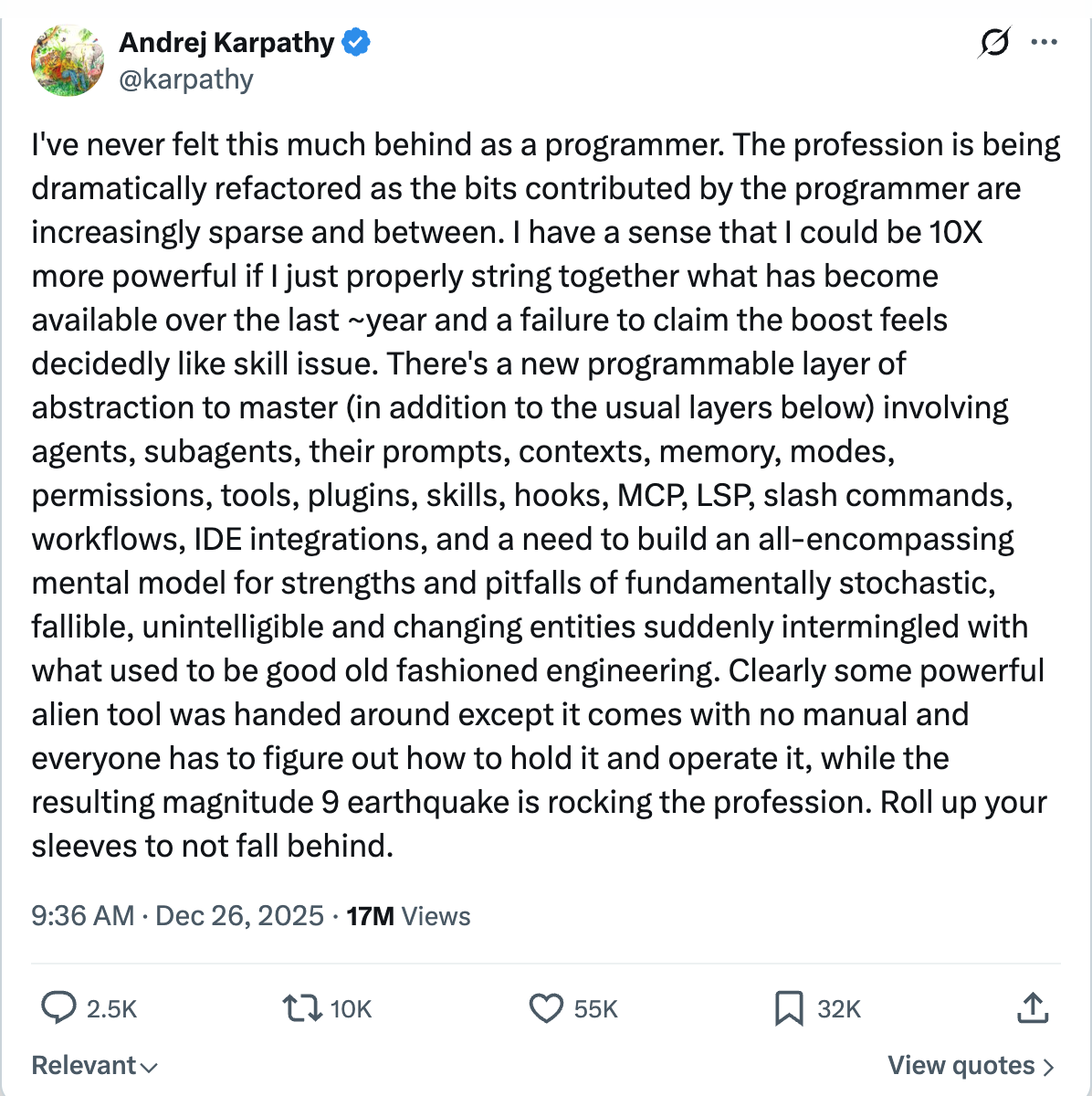
A 368-point Hacker News thread this week landed with a title that could have been a company-wide Slack message: "AI handles incidents, engineers lose touch with their systems." Meanwhile, Lenny Rachitsky's annual workforce survey — one of the largest of its kind — found that the tech workforce is splitting in two, with respondents confessing things like "I feel like I don't think hard enough anymore — I just follow Claude." And Andrej Karpathy, the person who literally built OpenAI's training infrastructure, admitted he's "slowly starting to atrophy my ability to write code manually."
The deskilling panic is everywhere. And it has data behind it now. But here's the thing the panic misses: fluency with AI tools isn't the same as dependency on them. The difference between a pilot who uses autopilot and one who can't land without it is not "how often they use autopilot" — it's whether they still understand the aerodynamics.
The Data Is Real — And Worse Than You Think
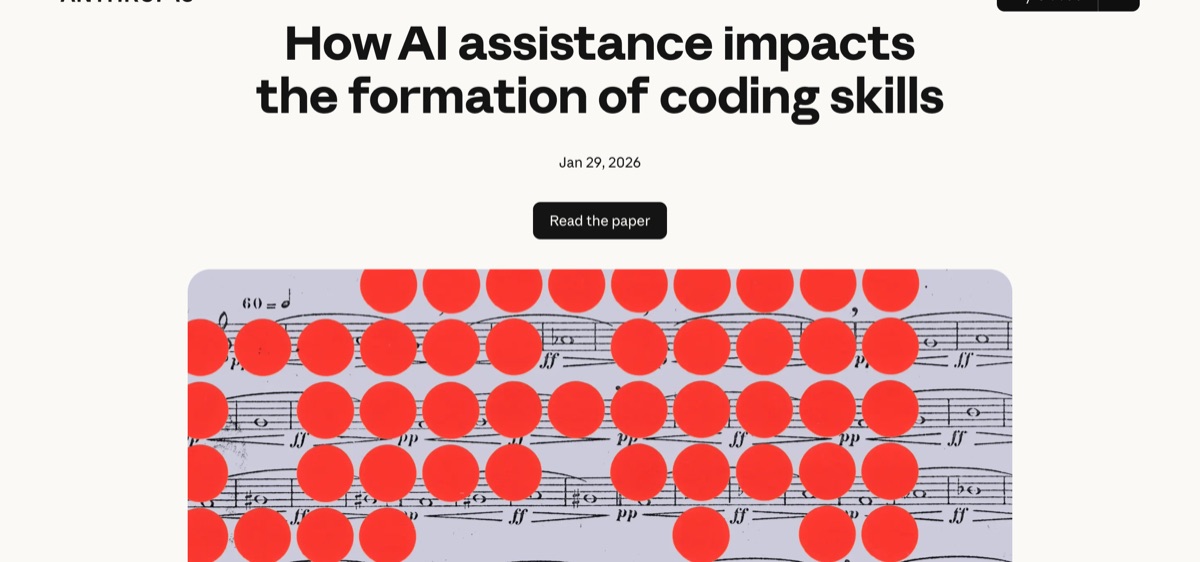
In January 2026, Anthropic published a study that should have been a fire alarm. Researchers Judy Hanwen Shen and Alex Tamkin recruited 52 software engineers, gave half of them an AI assistant, and asked everyone to learn Trio — a Python library for asynchronous programming that none of them knew.
The results were stark. The AI-assisted group averaged 50% on a post-task quiz. The hand-coding group averaged 67%. That's a 17% gap — roughly two letter grades — with a p-value of 0.01. The effect size (Cohen's d = 0.738) put it firmly in "large effect" territory.
But here's the finding that matters most: the biggest performance gap was on debugging questions. The AI group struggled specifically with recognizing when code was broken and diagnosing why. In other words, the skill most critical to production software — the ability to understand failure — was the one most damaged by AI reliance.
The Anthropic Study in Numbers: 52 engineers. 17% lower scores for the AI-assisted group. The largest gap was in debugging — the skill that matters most when systems fail at 3 AM and the AI doesn't have the context to help.
Read the full study on Anthropic →
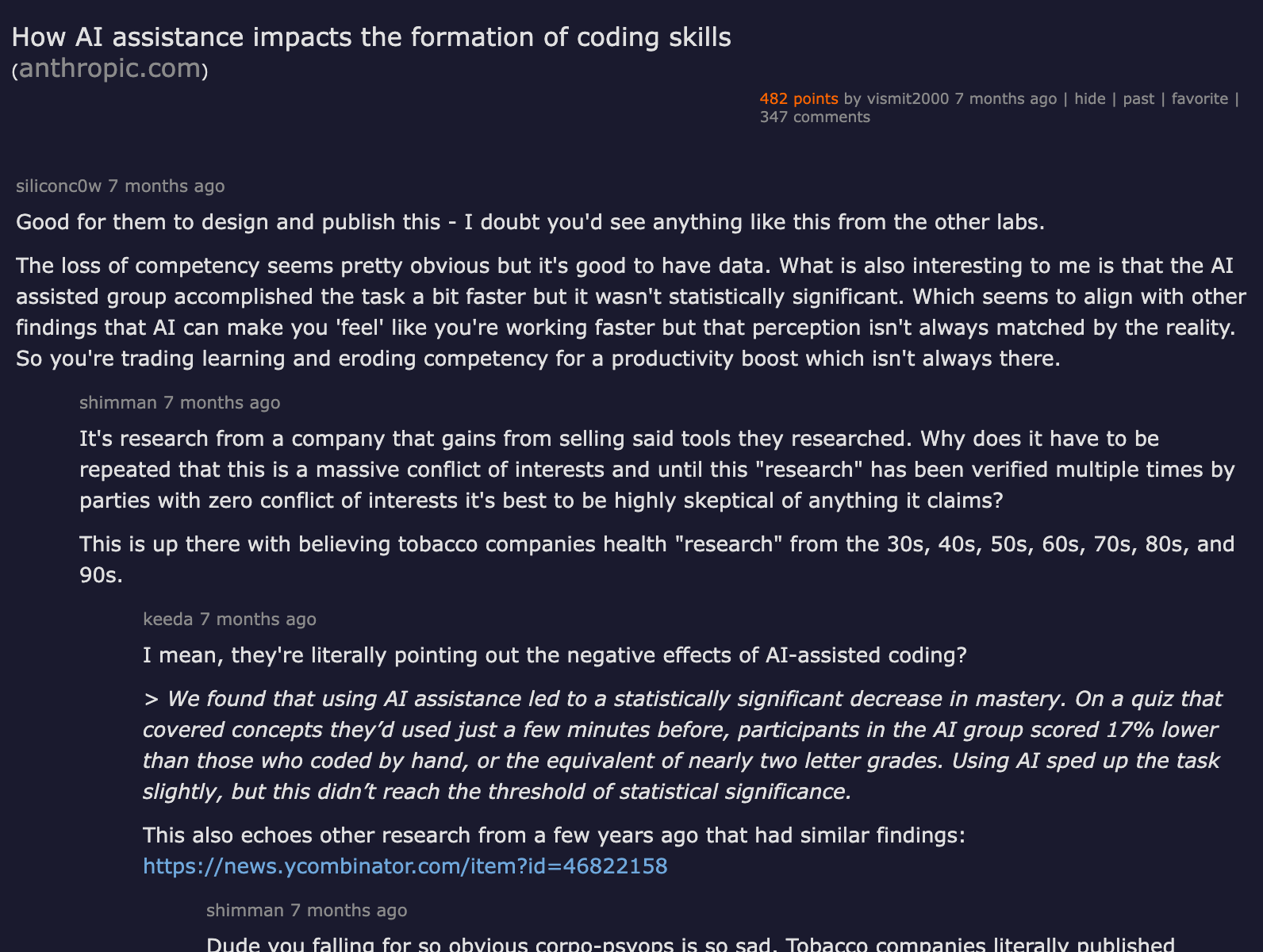
The Hacker News discussion of this study drew over 160 comments, with one developer summarizing the mood: "the loss of competency seems obvious but it's good to have data." Others debated whether the effect was temporary or structural — but few disputed that the pattern was real.
View discussion on Hacker News →
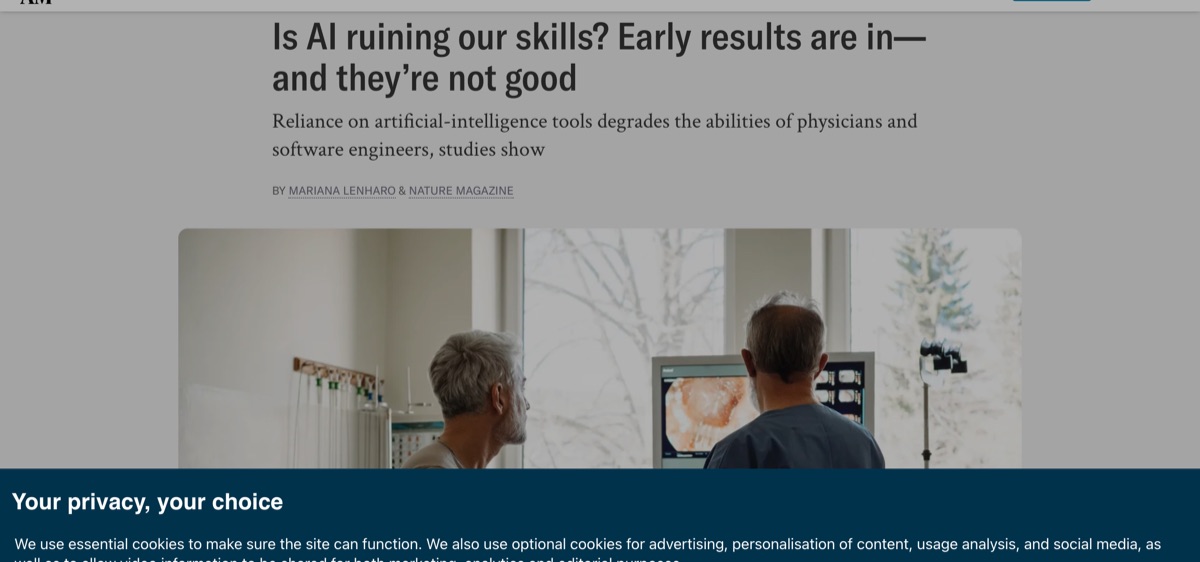
This wasn't a one-off. A Scientific American/Nature investigation in July 2026 compiled evidence across fields: a Polish endoscopy study found physicians' adenoma detection rates dropped from 28.4% to 22.4% after they'd been using an AI detection tool — their eyes had literally stopped looking as carefully. A survey found 70% of nurses and 77% of physicians worried about losing skills to AI over-reliance.
Read the full article on Scientific American →
The cognitive offloading mechanism is well understood: when you delegate a mental task to an external tool, your brain quietly stops doing that work itself. Calculators did it with arithmetic. GPS did it with navigation. But AI does something different — it doesn't just store or calculate. It reasons. And when you offload reasoning, you're offloading the part that was supposed to grow your brain.
What the Community Is Saying
The Hacker News thread on "engineers lose touch" drew 327 comments, and the signal-to-noise ratio was unusually high. One commenter described watching a senior colleague "regress from understanding infrastructure fundamentals to reflexively delegating all problem-solving to Claude, never pausing to think critically about outputs." Another put it bluntly: "30 minutes of patient, old school troubleshooting is the best way to understand a codebase... models are getting too egotistical... they'll keep shotgunning less likely fixes with undiminishing confidence."
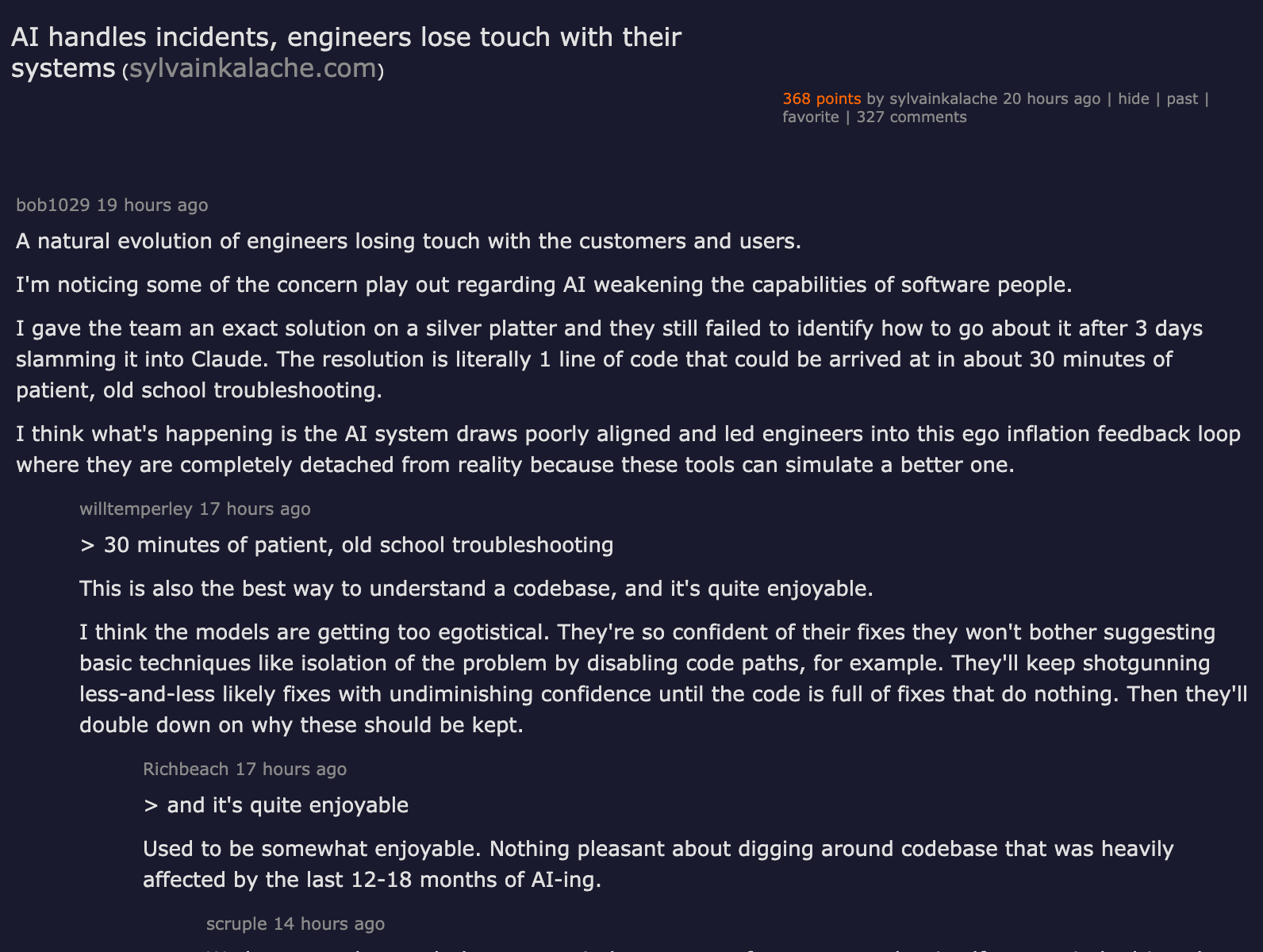
View the full discussion on Hacker News →
A parallel thread — "Coding expertise is going to collapse from AI reliance" — surfaced reports from enterprise companies where leadership had declared "if you're writing code manually, you're doing it wrong." This is the mandated-usage pattern: organizations pushing AI adoption without any corresponding investment in skill preservation.
Lenny Rachitsky's 2026 workforce survey quantified the emotional dimension. The workforce has split into four archetypes: the Energized (41%), the Conflicted (35%), the Disoriented (12%), and the Resentful (12%). And the finding that should alarm every engineering manager: AI identity stance predicts career optimism more strongly than role, seniority, or company size combined. The question "What has AI done to your sense of who you are?" is now the single best predictor of how a tech worker feels about their job.
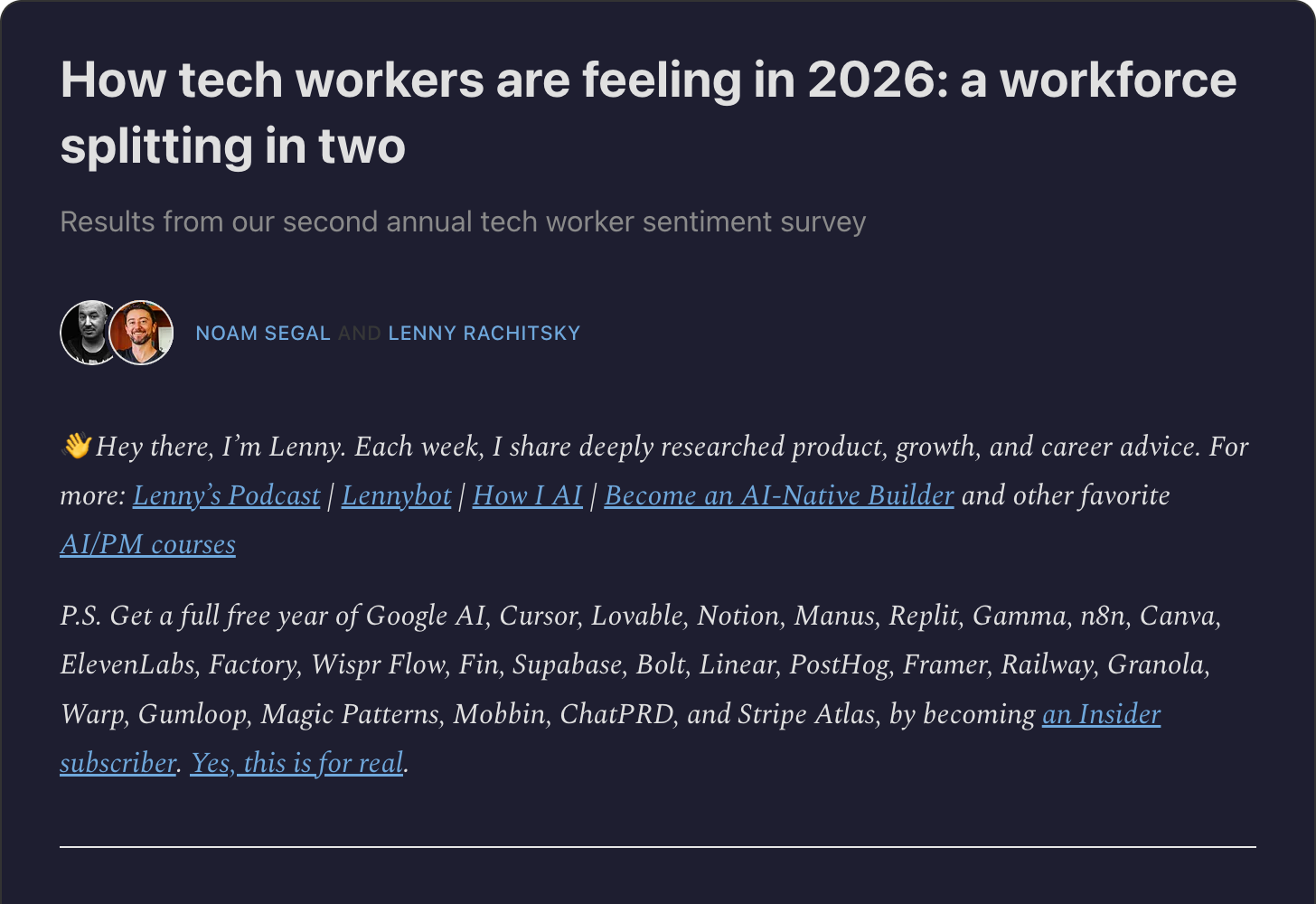
Read the full survey on Lenny's Newsletter →
Burnout jumped from 44.7% to 55.7% in a single year. And crucially, the top AI fear isn't job loss — only 22% worry about that. The real fear is being squeezed: expected to do more for the same pay, trapped in an unsustainable pace, watching the quality of their work decline while the velocity metrics go up.
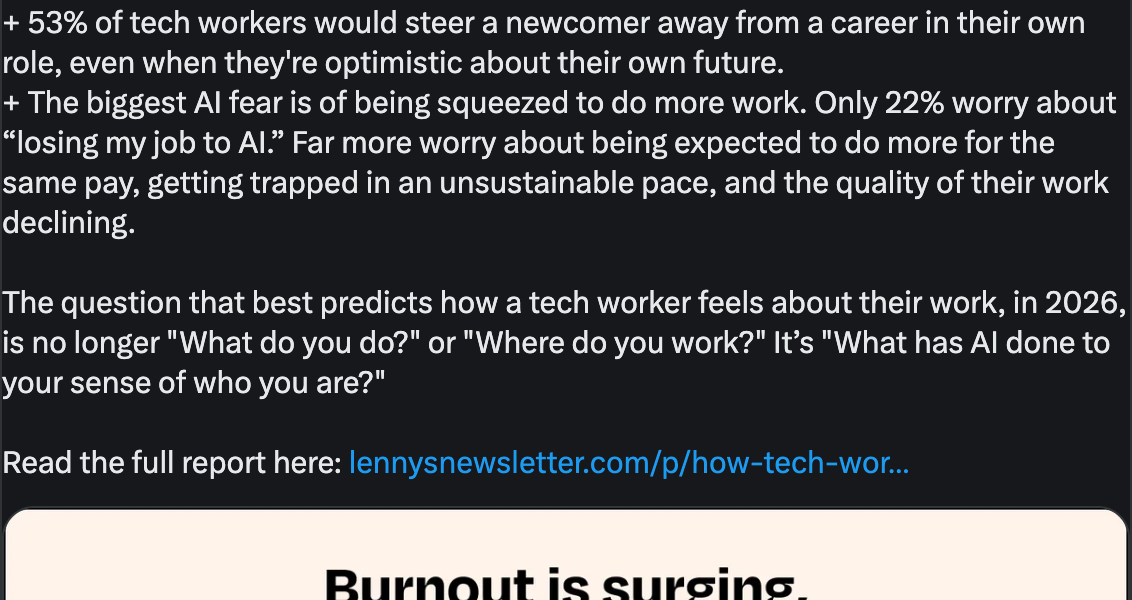
Cognitive Offloading vs. Cognitive Surrender
Here's where the panic gets it wrong. The deskilling narrative treats AI tool usage as a binary: you use it, you atrophy. But the Anthropic study itself contains the rebuttal.
Within the AI-assisted group, there was massive variance. The developers who scored well — some matching or exceeding the non-AI group — were the ones who asked conceptual questions and demanded explanations alongside the code. The low scorers were the ones who delegated wholesale or used the AI to debug for them without understanding the diagnosis.
This distinction has a name: cognitive offloading versus cognitive surrender.
Cognitive offloading is using a calculator so you don't waste 30 seconds on long division while solving a calculus problem. You still understand the math. You're freeing capacity for higher-order thinking.
Cognitive surrender is copying a StackOverflow answer you don't understand and deploying it. Except now the answers are so polished and complete that you can't even tell you don't understand them.
As Phil Clark wrote in "AI Fluent, Fundamentally Lost": "They build systems that look impressive and powerful but shatter under the pressure of real-world constraints." The illusion of competence is worse than obvious incompetence, because nobody catches it until production breaks.
The "Could I Have Written This?" Test
So what does healthy AI usage actually look like for a developer? Here's a framework.
Before accepting any AI-generated code, ask: could I have written this myself? Not "could I have written this faster" — that misses the point. The question is whether you understand every line, every design decision, every edge case well enough that you could have produced equivalent code without the tool.
If yes: you're offloading. The AI is a force multiplier for your existing understanding.
If no: you're surrendering. You're deploying code you don't understand into a system you're responsible for.
This is the line one Substack analysis crystallized perfectly: "Never let it write code you could not have written. That line is the difference between leverage and dependency."
The Fluency Framework — Five Rules That Keep AI From Eating Your Skills:
- The "Could I Have Written This?" test — before accepting AI output, verify you understand every line
- Friction budgets — schedule deliberate manual-coding sessions (2-3 hours/week) to maintain muscle memory
- Explain-first prompting — ask the AI to explain its approach BEFORE generating code
- Debug manually first — when something breaks, spend 15 minutes with the debugger before asking the AI
- Teach to verify — if you can't explain the AI's output to a junior developer, you don't understand it
The best developers in the Anthropic study weren't the ones who refused AI. They were the ones who used it as a dialogue partner — asking "why did you choose this approach?" and "what are the failure modes here?" before accepting the output. They treated the AI like a senior colleague whose code still needs review, not an oracle whose pronouncements are final.
The Real Problem Is Organizational, Not Individual
Contrarian Corner: The deskilling debate frames this as a personal discipline problem — "just be more intentional with your AI usage." But the structural forces pushing developers toward surrender are organizational, not individual. When leadership mandates "if you're writing code manually, you're doing it wrong" and measures performance by velocity, the incentive is to surrender, not to offload.
Consider what's happening at the enterprise level. Companies are measuring developer productivity by lines of code generated, PRs merged, tickets closed. AI makes all of those numbers go up. A developer who spends 30 minutes understanding a codebase before writing a fix looks slower on every metric than one who pastes the error into Claude and ships whatever comes back.
The HN thread on collapsing coding expertise surfaced this dynamic clearly: companies issuing top-down mandates to use AI everywhere, with no corresponding investment in understanding whether the AI output is correct. One commenter noted: "With AI, 'bad' engineers can now amplify their 'bad' engineering x10 across the organization."
This is the real deskilling vector. It's not that tools make people stupid. It's that organizations are incentivizing speed over understanding, and AI makes it possible to be fast without being competent.
Gartner predicts that critical-thinking atrophy will push half of global organizations to require "AI-free" skills assessments by the end of 2026. This is the corporate immune response: standardized tests to detect whether employees still possess baseline competencies, because the work product no longer reveals it.
The parallels to what Forbes' Bernard Marr describes as "the hidden cost of letting machines think for you" run deeper than most organizations want to admit. The cost isn't individual laziness — it's systemic blindness to the difference between output and understanding.
What This Means for You
If you're a developer, here's the actionable version:
1. Maintain your debugging instinct. The Anthropic study's clearest finding is that debugging is the first skill to atrophy. When something breaks, resist the urge to immediately ask the AI. Spend 15 minutes with a debugger, reading stack traces, forming hypotheses. This is the skill equivalent of going to the gym — painful, slow, and the only way to maintain the muscle.
2. Build "explain-first" into your workflow. Before asking the AI to generate code, ask it to explain the approach. Before accepting generated code, ask it to walk through the edge cases. You're converting a code-generation interaction into a learning interaction. The Anthropic study showed this pattern correlated with preserved skill formation.
3. Audit your AI usage pattern. Track for one week: how often do you accept AI output without modification? If it's above 80%, you're likely surrendering in places you shouldn't be. The developers who maintain skills modify, question, and reject AI suggestions at meaningful rates — 30-50% of the time.
4. Push back on velocity-only metrics. If your organization measures productivity by tickets closed or PRs merged, you have a management problem. These metrics can't distinguish between "shipped fast with understanding" and "shipped fast with time-bomb code." Advocate for quality signals: production incident rate, code review depth, post-deployment defect density.
5. If you're a junior developer, this matters 10x more. Seniors have existing mental models to validate AI output against. Juniors don't. If you're in your first 2-3 years, deliberately practice without AI for at least a portion of your learning time. The Anthropic study's sharpest finding was that juniors are the most vulnerable to skill formation disruption — and the most likely to be in environments that push AI usage from day one.
For a related perspective on how AI is reshaping engineering team structures, see our analysis of how a 5-person startup beats teams of 25 with AI agents. And for the broader cultural backdrop of these concerns, explore how the AI backlash is going mainstream.
The Autopilot Analogy Is Exact
Modern airline pilots use autopilot for the vast majority of flight time. Nobody calls them "deskilled." Why? Because the training pipeline explicitly preserves manual flying skills. Pilots are required to hand-fly regularly. They practice emergency procedures in simulators. The industry recognized that autopilot efficiency and manual skill preservation aren't contradictory — they're complementary.
Software engineering has no equivalent. There's no "manual flying requirement." There's no regulatory body ensuring developers can still debug without AI. The closest analogue is the emerging practice of "AI-free" technical interviews — and those are being adopted for exactly this reason.
The engineers who will thrive aren't the ones who reject AI. They're the ones who use it the way pilots use autopilot: constantly, confidently, and with the deep understanding required to take over when the automated system fails. Because it will fail. At 3 AM. On the system only you understand. And in that moment, the only thing that matters is whether you've been offloading or surrendering.
The line between fluency and dependency isn't how much you use the tool. It's whether you still understand what the tool is doing — and why.
ComputeLeap Team
The ComputeLeap editorial team covers AI tools, agents, and products — helping readers discover and use artificial intelligence to work smarter.
Join the discussion
Have thoughts on this article? Discuss it on your favorite platform:
Related articles
Vertical Models Just Stole the Inference Stack
Timestral, CERN Flare, and Kronos prove domain-specific models restructure deployment, not just benchmarks.
DeepSeek Just Repriced the Search Stack
V4.1 Flash 1017 improved every benchmark. The Search API undercuts Perplexity 7-to-1. Polymarket hasn't noticed.
Meta Builds the Models. Apple Sells the Rig.
Muse Spark Open runs on two Mac Studios via MLX. The open-weight frontier just found its distribution partner.
The ComputeLeap Weekly
Get a weekly digest of the best AI infra writing — Claude Code, agent frameworks, deployment patterns. No fluff.
WEEKLY. UNSUBSCRIBE ANYTIME.