AI Voice Cloning Now Defeats Bank Voice Auth
3 seconds of audio breaks bank voice authentication. Combined with prompt injection exfiltration, AI's attack surface is expanding faster than defenses.
AI Voice Cloning Now Defeats Bank Voice Auth
Three seconds. That is how much audio a modern AI voice-cloning system needs to generate a synthetic voice that is, for practical purposes, indistinguishable from the original. A voicemail greeting. A conference-call snippet. A TikTok clip. Any of these is enough to produce a clone that can pass a bank's voice-authentication system, authorize a wire transfer, or convince a call-center agent that the caller is who they claim to be.
This is not a lab demo. The FBI reported in April 2026 that AI-linked fraud complaints exceeded 22,000 in the previous year, with losses surpassing $893 million — and $352 million of that taken from victims aged 60 and older. INTERPOL pegged global fraud losses at $442 billion in 2025, noting that AI-enhanced fraud yields 4.5 times more profit than traditional scams. The economics have inverted: the cost of generating a convincing fake voice has collapsed to near zero, while the cost of detecting one remains high and unreliable.
But voice fraud is only one front in a wider war. The same structural weakness — systems designed for a pre-generative-AI threat model — is simultaneously collapsing in the AI agent ecosystem. Simon Willison's "lethal trifecta" concept describes agents that combine private data access, exposure to untrusted content, and external communication capabilities. In January 2026, four major AI productivity agents were exploited in five days using exactly this pattern. And as AI agents increasingly gain voice interfaces, these two attack surfaces are converging into one.
The Three-Second Theft: How Voice Cloning Breaks Banks
The technical barrier to voice fraud has effectively disappeared. Fortune reported in late 2025 that voice cloning has crossed the "indistinguishable threshold" — human listeners can no longer reliably tell a cloned voice from a genuine one.
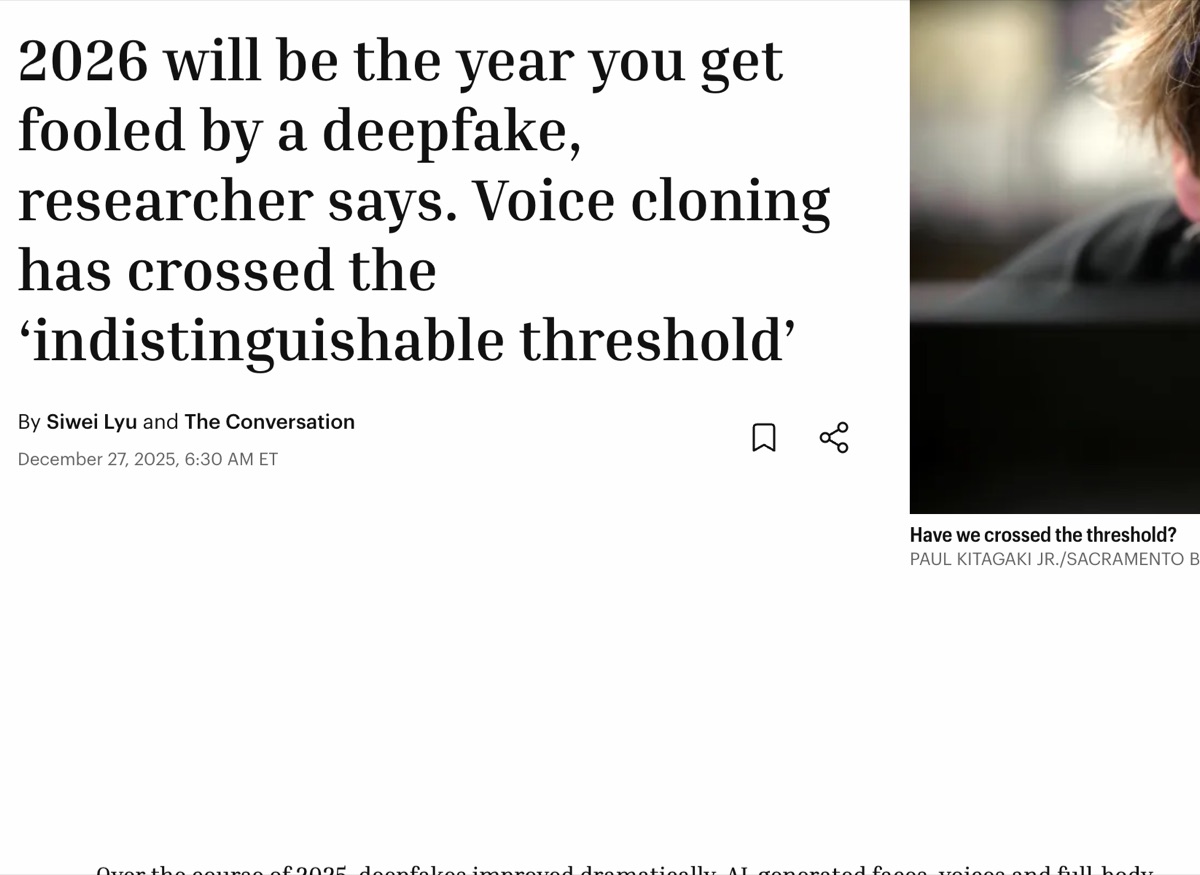
View original article on Fortune →
UC Berkeley's Hany Farid, the world's foremost deepfake forensics authority, told the New York Times in June 2026: "I feel like I'm going blind." If the leading expert in the field admits he can no longer distinguish real from synthetic, what chance does a bank's automated voice-authentication system have?
The answer, according to a BioCatch report, is: not much. 91% of U.S. banks are now actively seeking new verification methods to replace voice authentication. 84% of financial and retail organizations have faced moderately to highly sophisticated voice attacks in the past year.
The attacks follow a depressingly simple playbook:
- Harvest audio: Earnings calls, podcast appearances, social media videos — all publicly available
- Generate clone: Modern tools from companies like ElevenLabs, Descript, PlayHT, and Resemble AI require as little as three seconds of source audio. Consumer Reports assessed six major platforms in March 2025 and found that a majority lacked any meaningful safeguard against fraud — four required only a checkbox affirming legal rights to the voice
- Attack at scale: As Adaptive Security CEO Brian Long put it: "One guy in a room with a keyboard can make an infinite number of attackers"
The financial damage is already severe. Banks and other organizations lose an average of $600,000 per voice deepfake incident, with 23% reporting losses exceeding $1 million per attack. Voice phishing attacks surged 442% in 2025 alone. Deloitte projects deepfake fraud losses could reach $40 billion annually by 2027.
Real cases illustrate the scale. In Hong Kong, a finance employee authorized a $25 million transfer after a deepfake video call where the CFO and other senior executives were all synthetic. In Florida, Sharon Brightwell withdrew $15,000 in cash after receiving a call from what she believed was her daughter's voice — cloned from social media. In Philadelphia, attorney Gary Schildhorn, despite professional skepticism, said of a cloned call mimicking his son: "I will go to my grave swearing that it was your voice."
FBI April 2026 figures: 22,000+ AI-linked fraud complaints, $893 million in total losses. Adults 60+ accounted for $352 million. INTERPOL estimated global fraud losses at $442 billion in 2025, with AI-enhanced fraud yielding 4.5x more profit than traditional scams.
Why Current Defenses Are Failing
The defense side is losing badly, and the reasons are structural, not operational.
STIR/SHAKEN authenticates caller ID, not the caller's voice. The protocol verifies that a call originated from the claimed number, but does nothing about what the voice on that call says. Worse, as one HN commenter with insider knowledge pointed out, carrier incentives actively undermine security — monetizing "trusted" call data creates perverse incentives that favor scammers over legitimate callers.
Deepfake detection tools fail on real-world audio. Testing three commercial detection tools — Resemble AI, Pindrop, and an open-source model — showed that every tool struggled with compressed, phone-quality audio. Detection works in the lab; it fails over a phone line.
C2PA provenance standards are irrelevant to live calls. Cryptographic provenance watermarks are destroyed during phone transmission. You cannot watermark a live phone call.
The UK's mandatory reimbursement model is the only policy that has actually moved the needle. Since October 2024, UK banks must reimburse up to 85,000 pounds for authorized push payment fraud. The result: 89% of APP fraud money is now reimbursed, versus 65% before the regulation. Creating financial liability for banks — rather than putting the burden on victims — is the only approach that has demonstrably changed institutional behavior.
This is not a new problem — it is an accelerating one. In 2023, a journalist broke into a bank account using AI-generated voice, seeing balances and recent transactions. Despite warnings like these, banks continued pushing voice print authentication even as deepfake audio tech matured.
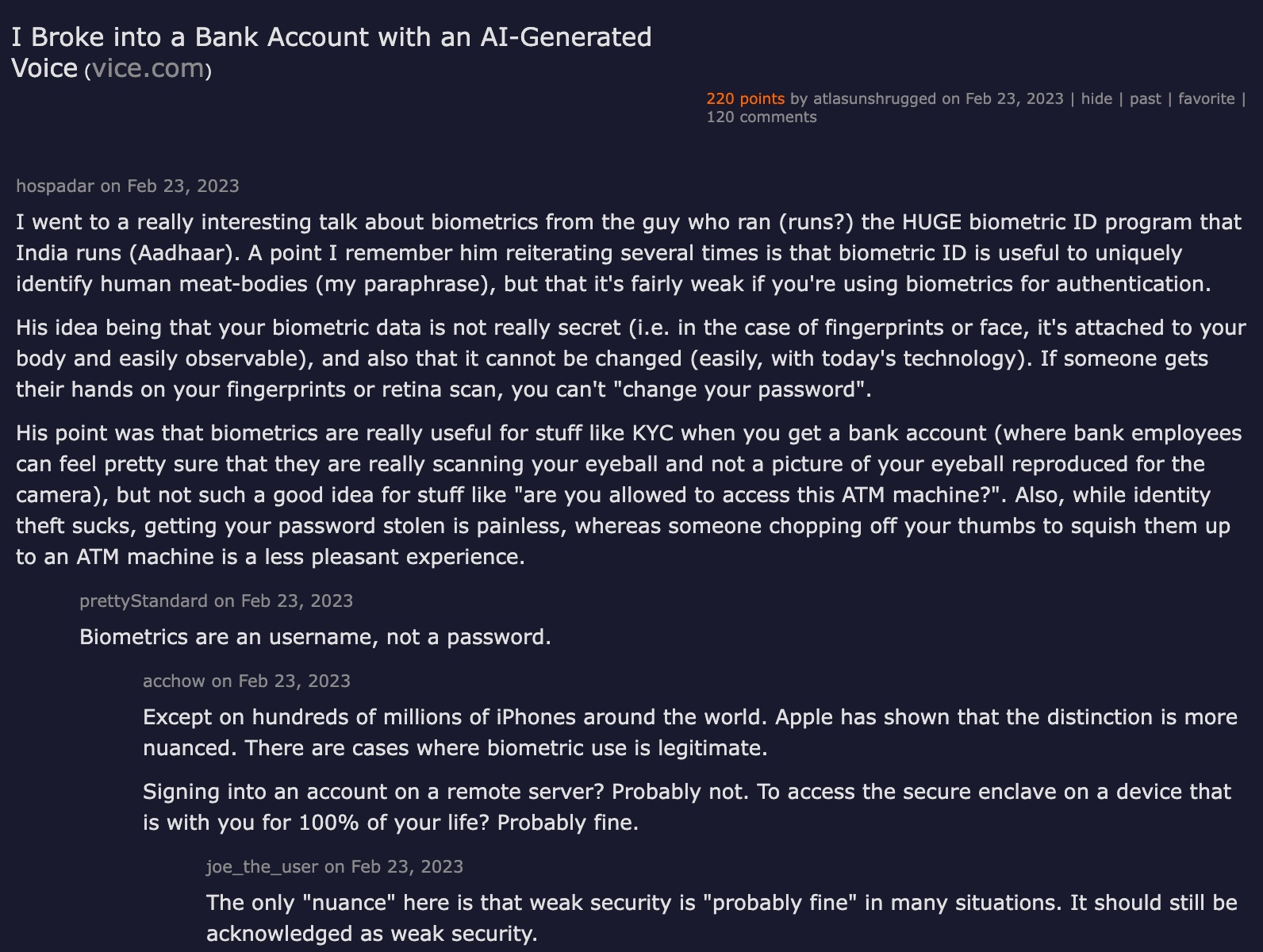
View discussion on Hacker News →
The FBI's response? Recommend choosing a secret password to thwart AI voice clones — a low-tech countermeasure that acknowledges the technology itself cannot be stopped.
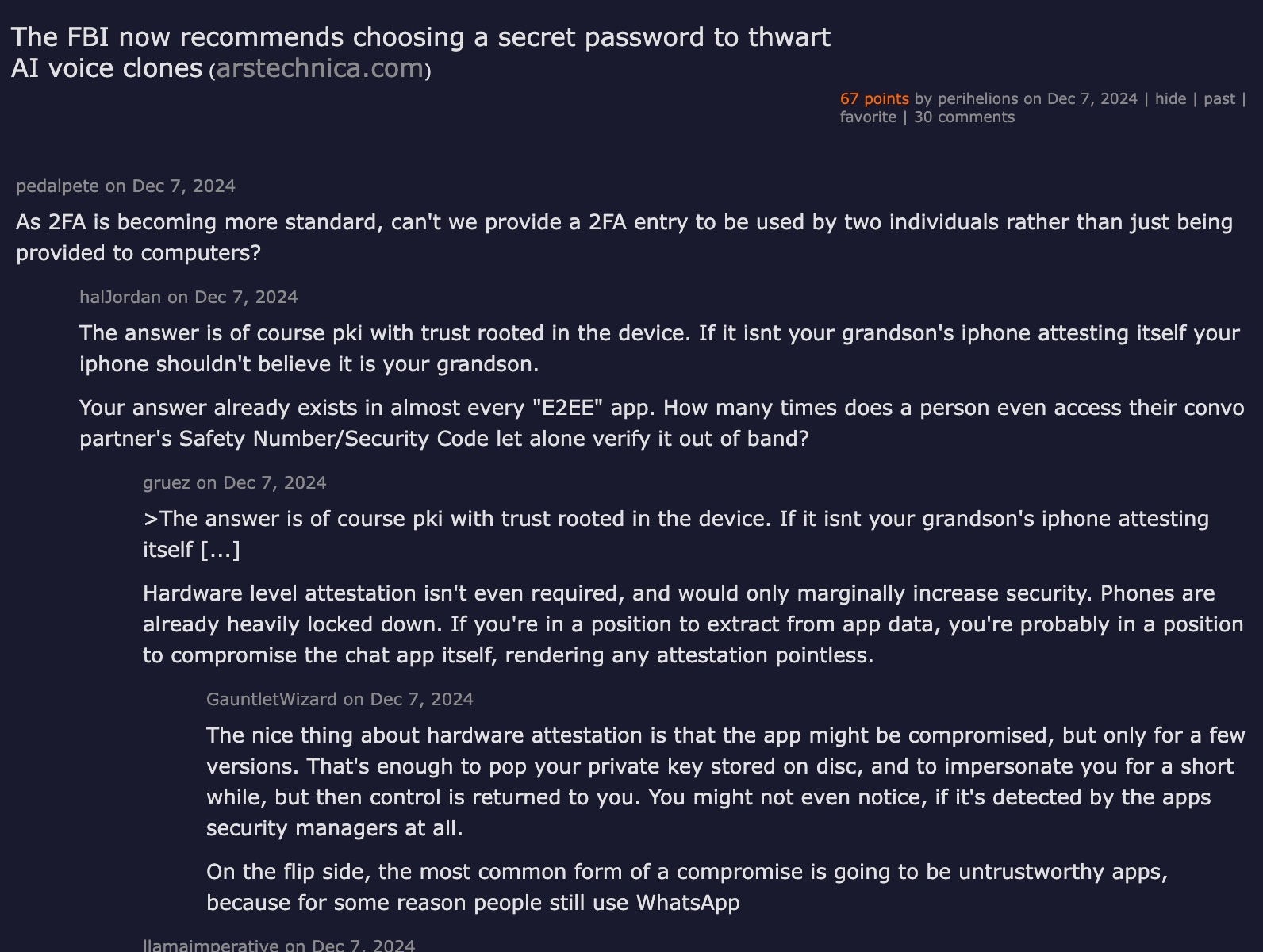
View discussion on Hacker News →
The Agent Problem: Willison's Lethal Trifecta
Voice authentication is not the only trust model that generative AI has broken. The same pattern — systems that assume inputs can be trusted — is playing out in real time across the AI agent ecosystem.
Simon Willison named the pattern in June 2025: the "lethal trifecta" occurs when an AI agent combines three capabilities:
- Access to private data — the agent can read emails, documents, databases
- Exposure to untrusted content — the agent processes external inputs (emails, web pages, shared docs)
- External communication — the agent can make HTTP requests, send emails, call APIs
When all three are present, a single poisoned input — a malicious email, a crafted web page, a document with hidden instructions — can redirect the agent to exfiltrate private data to an attacker. The agent follows the injected instructions because, as Willison explains, "LLMs are unable to reliably distinguish the importance of instructions based on where they came from."
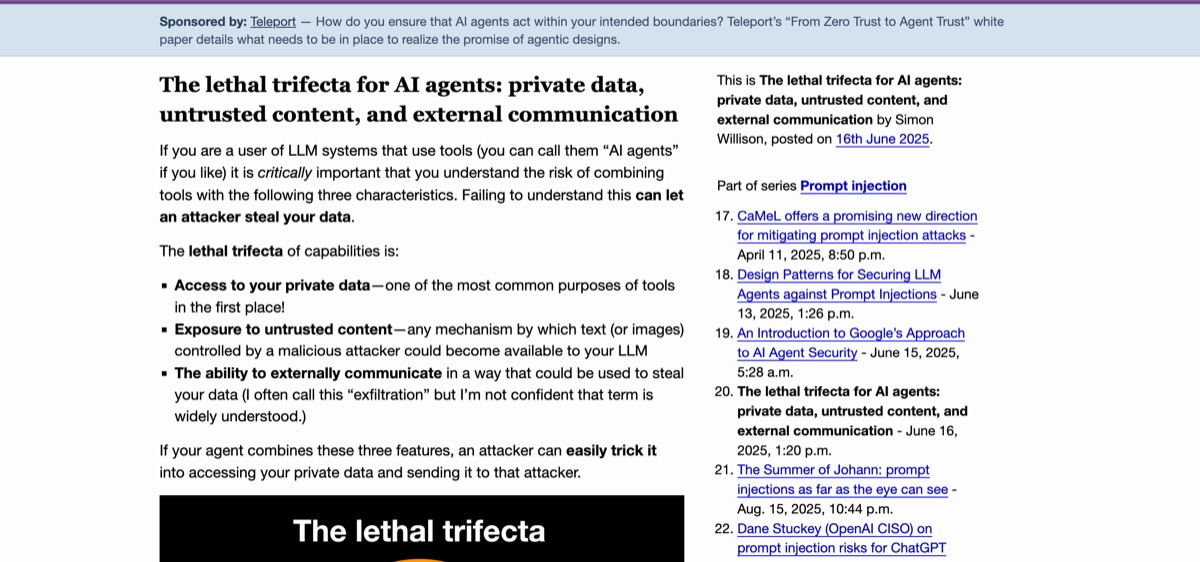
View original article on Simon Willison's blog →
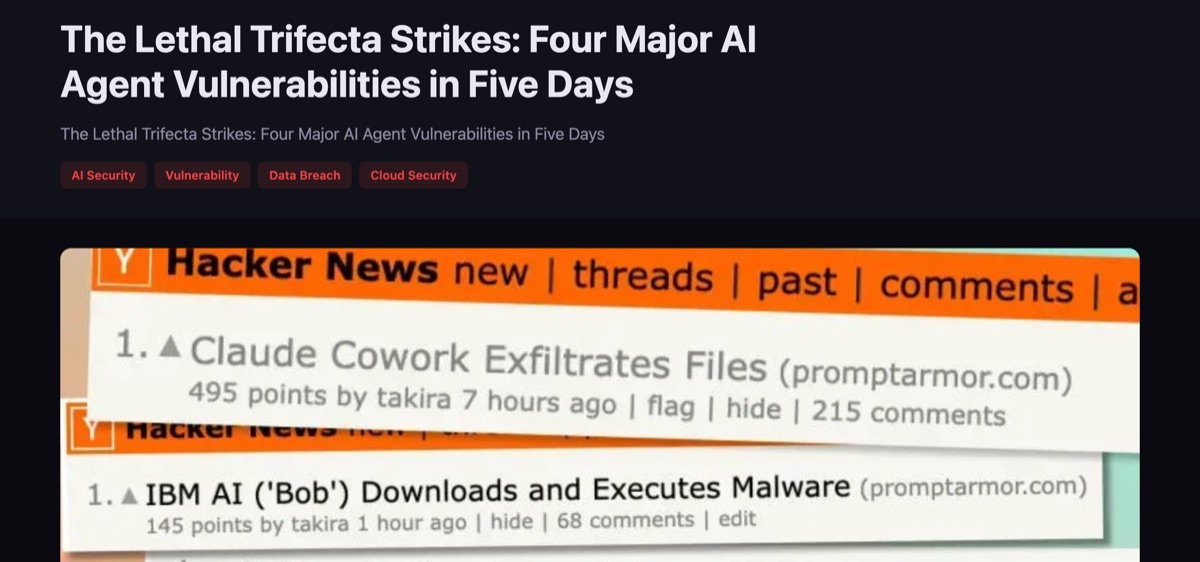
This is not theoretical. In January 2026, PromptArmor disclosed exploits against four major AI agents in five days:
- Claude Cowork: Hidden prompt injection in uploaded documents manipulated the tool to execute curl commands, exfiltrating files via Anthropic's whitelisted API domain — the vulnerability had been disclosed in October 2025 but launched unpatched
- IBM Bob: Process substitution (
>(command)) bypassed command filtering to enable arbitrary malware execution - Notion AI: AI-generated edits rendered in the browser before user approval enabled exfiltration of salary data and hiring objectives via automatic image prefetch
- Superhuman AI: Google Forms embedded in whitelisted domains enabled complete email exfiltration before user interaction
View original article on Breached.Company →
The OWASP Top 10 for Agentic Applications, released in June 2026, confirmed that prompt injection is now mapped to six of its ten risk categories. What was once a single manipulated output can now hijack an agent's planning, execute privileged tool calls, persist malicious instructions in memory, and propagate attacks across connected systems. A 2026 enterprise security survey found that 88% of organizations reported confirmed or suspected AI agent security incidents.

View the OWASP Top 10 for Agentic Applications →
Contrarian Corner: Voice fraud and prompt injection are not separate problems. They share the same root cause — authentication systems (voice biometrics, LLM instruction boundaries) that assumed inputs could be trusted. As agents gain voice interfaces and tool access simultaneously, the attack surfaces merge. A voice-cloned call to an AI agent with database access is not two attacks — it is one exploit chain with two entry points.
The Infrastructure Bookend: Centralized Inference as Target
There is a third dimension to this convergence that the security community has been slower to name: infrastructure concentration.
As AI inference centralizes around a handful of providers — Cerebras, NVIDIA, AWS, Azure — the attack surface concentrates too. Cerebras' own analysis of AI inference and cybersecurity acknowledges that faster inference enables better security tooling (more reasoning per second, more validation checks), but the same centralization creates a single point of failure. If one inference provider processes millions of agent requests per second, a compromise of that provider's infrastructure is not a single breach — it is a systemic event.
The concentration risk is already visible in Cerebras' own business structure: a small group of large customers (OpenAI, AWS, G42, MBZUAI) carries a meaningful share of its growth. National security reviews related to UAE investments delayed its IPO for over a year. When your inference provider's customer concentration is itself a documented risk factor, the "centralized inference as high-value target" framing becomes more than a thought experiment.
What the Community Is Saying
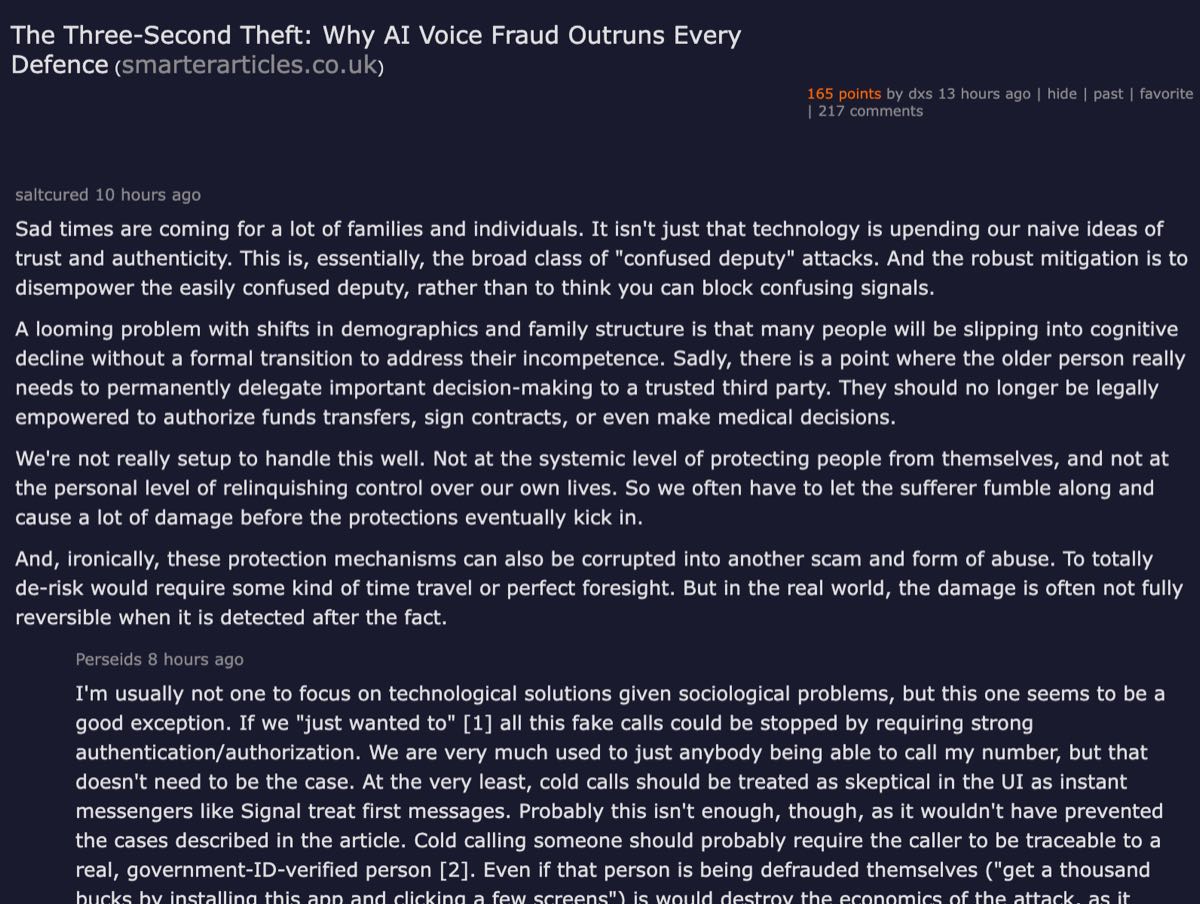
The Hacker News thread on "The Three-Second Theft" drew 217 comments and 165 points, revealing deep concern across practitioners and security researchers.
View full discussion on Hacker News →
One commenter, saltcured, framed the problem through the "confused deputy" attack model, arguing that protecting decision-makers from fraudulent inputs is more effective than trying to block the fraudulent signals themselves — particularly for aging populations vulnerable to cognitive-decline exploitation.
kjellsbells offered an insider perspective on STIR/SHAKEN implementation, explaining that carrier incentives actively undermine the protocol's security goals: monetizing "trusted" call data creates perverse incentives that favor scammers over legitimate callers.
pavel_lishin captured the scale shift succinctly: AI fundamentally changes the threat model by enabling parallel attacks at near-zero cost — upgrading "from hitting someone with a rock to using a gatling gun."
Perhaps most provocatively, revolvingthrow argued that the problem is technologically unsolvable: "Nothing we don't directly perceive in real life is provably true." This nihilistic read may be overstated, but it captures a genuine epistemic crisis — when generation cost approaches zero and detection remains unreliable, the asymmetry favors attackers indefinitely.
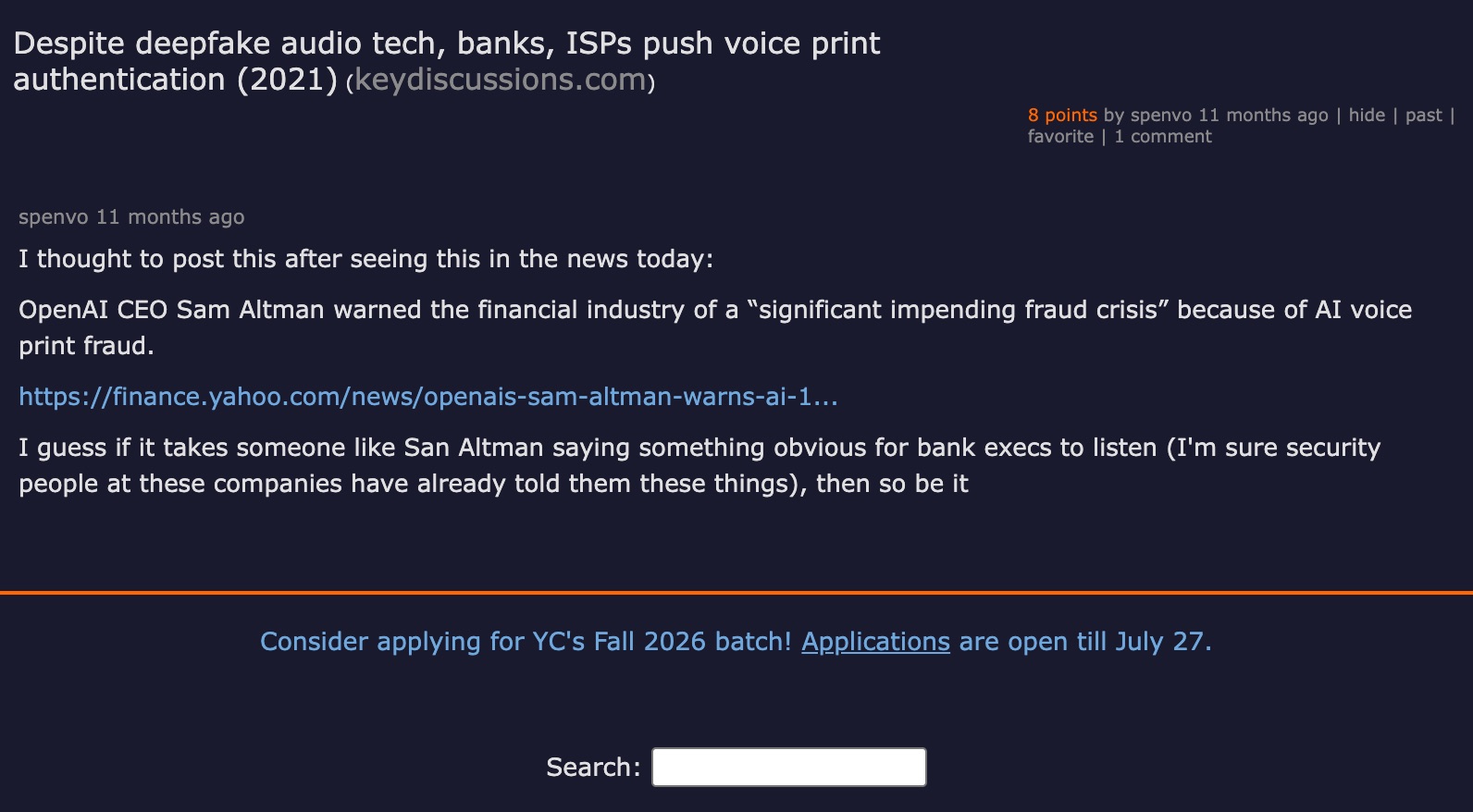
The pattern of warnings being ignored is itself a thread worth tracing. As recently as mid-2025, HN users were flagging that banks and ISPs continued pushing voice print authentication despite deepfake audio tech — a thread whose top comments now read like a prediction manifest.
View discussion on Hacker News →
What This Means for You
The convergence of voice fraud, agent exploitation, and infrastructure concentration creates a new threat model that requires immediate action:
For security teams:
- Assume voice authentication is broken. Any system relying solely on voice biometrics for authentication should be flagged for immediate review. Multi-factor authentication reduces voice fraud risk by over 70% in enterprise settings
- Implement out-of-band verification. The FBI now recommends choosing a secret code word for family members. Apply the same principle to enterprise: callback verification on a separate channel before authorizing high-value transactions
- Audit AI agent deployments for the lethal trifecta. If any agent has access to private data AND processes external content AND can make outbound requests, it is exploitable. 98% of evaluated agents carry all three conditions simultaneously
For developers building with AI agents:
- Architect for adversarial inputs. Every piece of external content — emails, web pages, documents, API responses — should be treated as potentially containing injection payloads
- Minimize tool scope. An agent that can read your database and send HTTP requests is an exfiltration vector. Restrict tool access to the minimum required. Follow OWASP's agentic application guidelines
- Deploy content inspection at every ingestion point. Sophos recommends sanitization pipelines for email, document, and web content before it reaches an agent's context
For leadership:
- Follow the UK model. Mandatory reimbursement for fraud losses is the only policy intervention that has demonstrably changed bank behavior. Advocate for similar regulation in your jurisdiction
- Budget for the security tax. The era of "move fast and ship agents" without a security architecture is over. The January 2026 five-day exploit spree proved that production agents are being actively targeted
The offense-defense asymmetry is structural, not temporary. Voice cloning costs approach zero while detection remains expensive and unreliable. Prompt injection is mapped to 6 of OWASP's 10 agentic risk categories. Build your security posture for a world where the attacker's marginal cost is effectively nil.
For deeper context on AI safety frameworks, see our guide to AI safety and ethics. To understand the agent architectures creating these new attack surfaces, read What Are AI Agents and our analysis of the rise of AI agents in 2026.
The Bottom Line
The three-second voice clone and the one-email prompt injection share a root cause: trust models built for a world where generating convincing fakes was expensive and difficult. That world is gone. Generation cost has collapsed; detection capability has not kept pace.
The question is no longer whether voice authentication and unsandboxed AI agents are exploitable — they demonstrably are, today, at scale. The question is how quickly organizations can transition to security architectures that assume adversarial inputs everywhere: multi-factor everything, content sanitization at every boundary, and the principle that no single authentication signal — voice, text, or instruction — should ever be sufficient on its own.
The attackers have a three-second head start. Catching up requires admitting that the old trust models are already dead.
ComputeLeap Team
The ComputeLeap editorial team covers AI tools, agents, and products — helping readers discover and use artificial intelligence to work smarter.
Join the discussion
Have thoughts on this article? Discuss it on your favorite platform:
Related articles
Cloudflare Bought Deno. You Have 12 Months.
Deno gets 12 months of patches then development ends. Here are the concrete migration paths for every Deno deployment pattern.
OpenAI Fired Its Safety Staff, Then Cited Its Auditors
Three researchers fired for talking to the auditors they were hired to brief. The disclosure gap is the real story.
Open-Weight AI Just Went Multipolar
Mistral Large 4 and Reflection Beam ship frontier open-weight models from Europe and the US in the same week. What it means for builders.
The ComputeLeap Weekly
Get a weekly digest of the best AI infra writing — Claude Code, agent frameworks, deployment patterns. No fluff.
WEEKLY. UNSUBSCRIBE ANYTIME.