Apple Paying Google $1B/Year to Run Siri on Gemini
Apple outsourced Siri's brain to Google Gemini in a $1B/year deal. Here's the architecture, the antitrust risk, and what it means.
On January 12, 2026, Apple made the most consequential admission in consumer AI history: it chose Google's Gemini to power the next generation of Siri in a multi-year deal estimated at roughly $1 billion per year. The company that designed its own silicon to escape Intel's roadmap just handed its most personal product — the voice assistant that lives on 2 billion active devices — to its biggest rival.
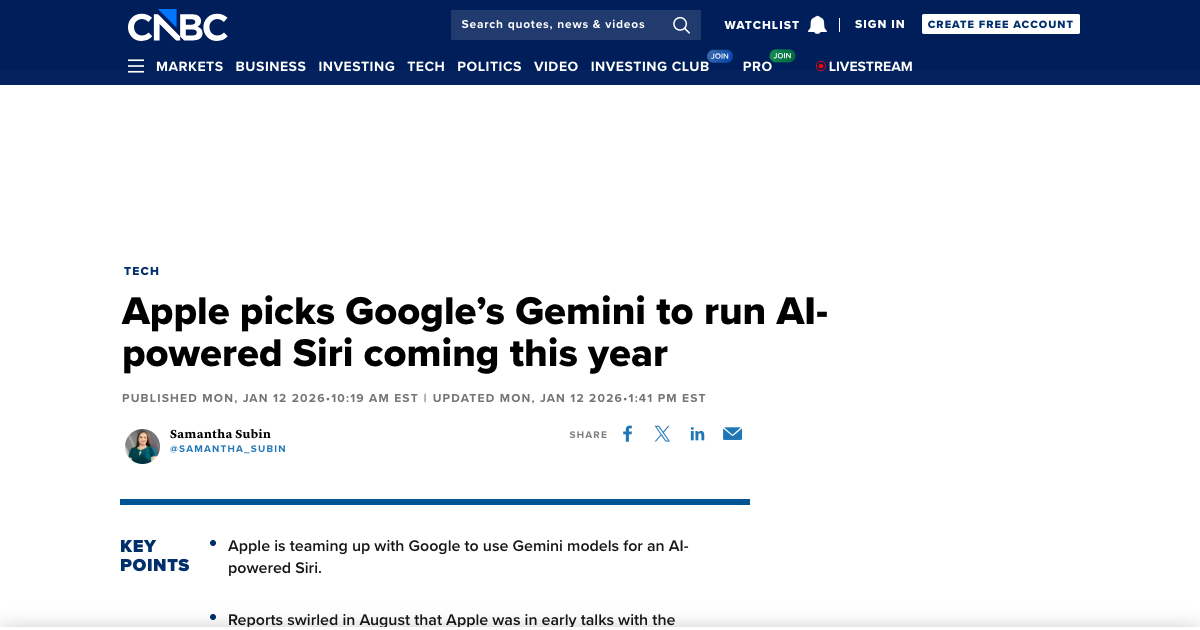
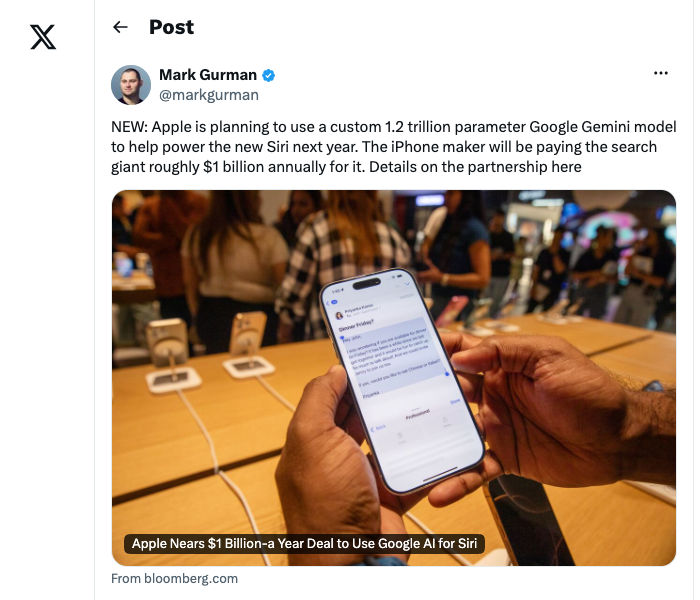
This is not a partnership in the conventional sense. It is a structural confession. Apple spent four years trying to build a frontier-class foundation model in-house, and it failed. The 150-billion-parameter cloud model Apple had running on its Private Cloud Compute infrastructure was not competitive. Google's custom 1.2-trillion-parameter Gemini model — eight times larger — was the only option that could deliver the assistant experience Apple had been promising since WWDC 2024.
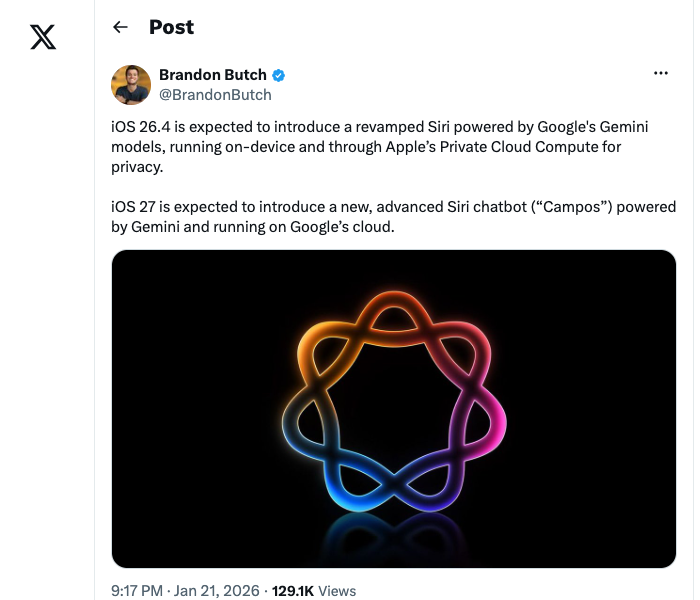
At WWDC 2026 on June 8, Apple made it official. Siri was rebranded as "Siri AI", a ground-up rebuild running on Gemini technology and Nvidia's latest Blackwell GPUs. Tim Cook's farewell keynote framed it as the dawn of Apple's next era. The subtext was harder to spin: the most valuable company on Earth outsourced the intelligence layer of its flagship product.
The Deal: What $1 Billion Buys
The partnership grants Apple access to a custom 1.2-trillion-parameter Gemini model built specifically for Siri and Apple Intelligence. According to TechCrunch's reporting, Apple selected Google after evaluating competing proposals from OpenAI and Anthropic, concluding "that Google's technology provides the most capable foundation for Apple Foundation Models."
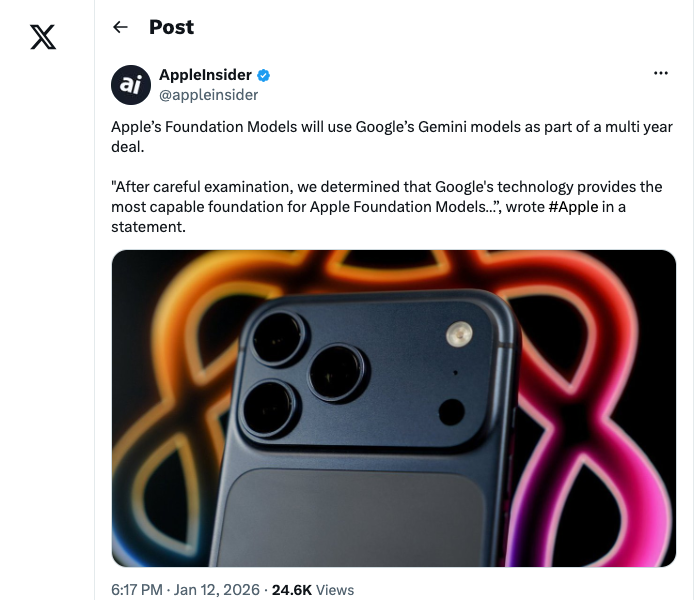
The financial terms tell their own story. Bloomberg's Mark Gurman estimated the deal at $1 billion annually, but Gene Munster at Deepwater Asset Management pegged the total value at $5 billion, arguing that maintaining two large models "wouldn't make a ton of sense for Apple." The deal is structured as a non-exclusive licensing agreement — Apple technically retains the right to integrate other providers — but as anyone following the Google Search default litigation knows, "non-exclusive" and "meaningfully contested" are very different things.
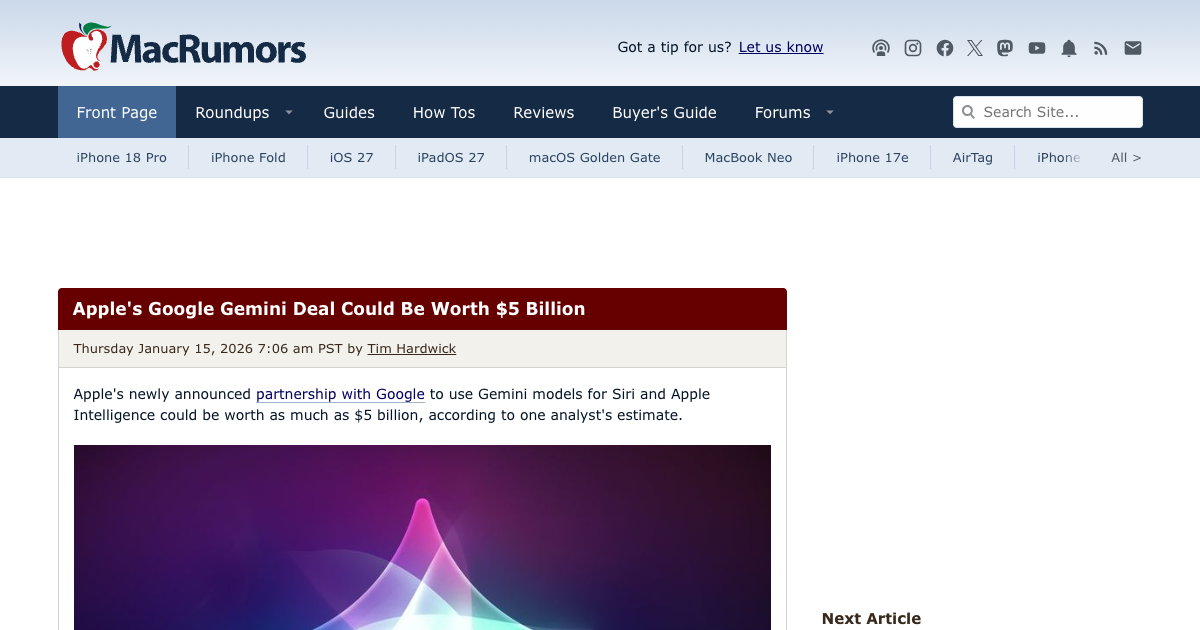
For context, Apple's existing Google Search default deal is worth approximately $20 billion annually to Apple. The Gemini arrangement may follow the same trajectory: a modest opening bid that balloons as the integration becomes load-bearing.
The deal gives Apple a custom 1.2T-parameter Gemini model — 8x larger than Apple's own 150B cloud model. Gene Munster estimates total value at $5B. Bloomberg puts the annual fee at ~$1B.
The Architecture: Three Layers of Siri
The rebuilt Siri operates on a three-layer architecture that reflects Apple's attempt to preserve its privacy guarantees while outsourcing the heaviest computation:
Layer 1 — On-Device. Simple tasks stay local, running on Apple's own compact models optimized for the Neural Engine in A-series and M-series chips. "Set a timer," "open Messages," and basic queries never leave the phone.
Layer 2 — Private Cloud Compute (PCC). Moderately complex requests route to Apple's own servers, where Apple controls the hardware, the software, and the encryption. This layer handles multi-step reasoning that exceeds on-device capacity but doesn't require Google's model.
Layer 3 — Google Cloud with Nvidia Blackwell B200. The hardest queries — the ones that require 1.2 trillion parameters of reasoning — route to Nvidia Blackwell B200 GPUs on Google Cloud. This is where the deal lives, and it is also where the privacy engineering gets creative.
Apple's Private Cloud Compute hardware could not run the 1.2T Gemini model at practical latency for the query volumes Siri requires. The solution: route those queries through Google's data centers while wrapping them in Nvidia's hardware-based confidential computing. Queries are anonymized, stripped of Apple ID linkage, and tokenized before reaching Google's infrastructure. Even Google's cloud operator cannot read the data in plaintext during processing.
An ACM conference paper presented in June 2026 independently validated Apple's three core PCC privacy claims. Apple's contract with Google also prevents Google from using Siri queries to train future Gemini models.
Apple's three-layer design means your "Hey Siri, set a timer" never leaves your phone. Only the hardest queries — the ones that need 1.2 trillion parameters — touch Google infrastructure, wrapped in hardware-level encryption.
Winners and Losers
Google: The Biggest Win Since Android
For Google, this deal is a strategic masterwork. After years of watching ChatGPT dominate the AI narrative, Gemini just became the default intelligence layer for the world's most valuable device ecosystem. Bank of America analysts noted the deal reinforces "Gemini's position as a leading LLM for mobile devices."
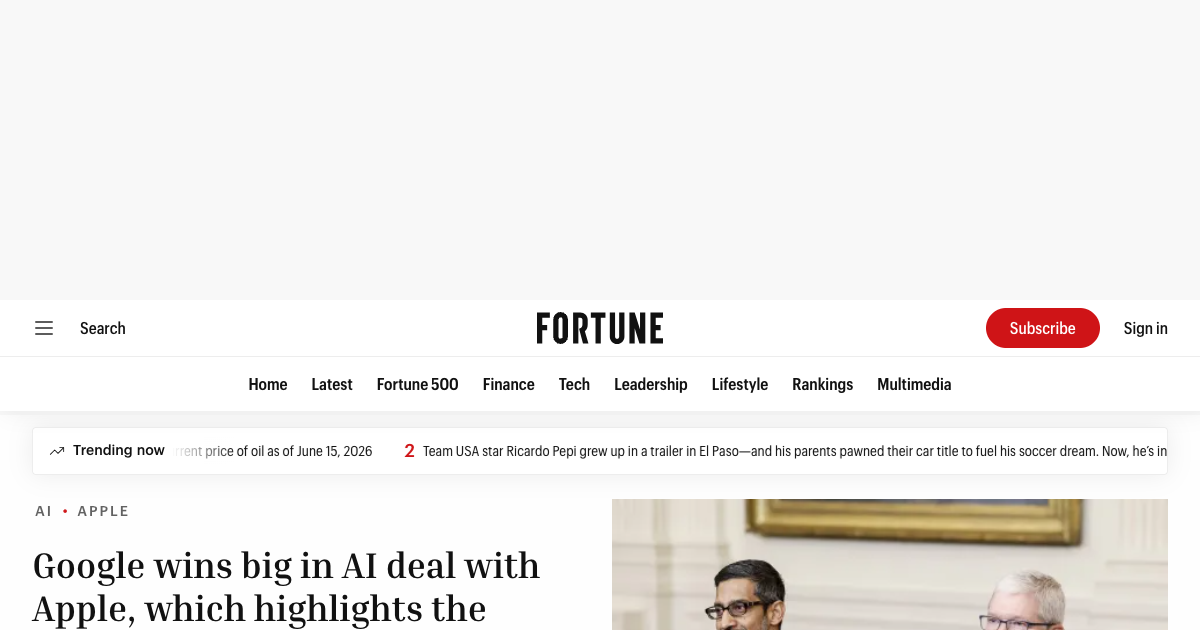
The market agreed. News of the deal helped push Alphabet's market valuation above $4 trillion. Every Siri query that routes through Gemini is a query that does not go through ChatGPT — and every user who learns to rely on Gemini-powered Siri is a user who may choose Google's services elsewhere.
During Google's Q4 2025 earnings call, executives confirmed the partnership and projected that the context-aware Siri would debut later in 2026. For a company that spent 2024 playing defense against OpenAI's consumer momentum, this was the validation it needed.
OpenAI: The Distribution Deal That Got Away
The implications for OpenAI are severe. As Fortune bluntly stated, "OpenAI lost the most important distribution deal in AI." Apple's 2+ billion active devices represent the ultimate platform for scaling AI to mainstream users, and OpenAI no longer owns that pipeline.
ChatGPT is not gone from Apple's ecosystem — it remains available for "complicated, opt-in queries" — but it has been demoted from the default intelligence layer to an optional second opinion. This is the difference between being the engine and being the spare tire.
The timing compounds the damage. OpenAI's consumer growth rate had reportedly slowed, and the company's upcoming AI device (designed by Jony Ive) now faces a market where the dominant mobile platform's assistant is powered by its biggest competitor.
Apple: The Pragmatist's Play
The conventional reading is that Apple lost. Analyst Daniel Newman called 2026 a "make-or-break year" for Apple's AI strategy, and outsourcing to Google certainly looks like a concession.
But there is a contrarian case worth taking seriously: Apple does not need to own the model. It needs to own the context layer — the intimate, permissioned dataset generated by 2 billion active devices. No AI lab possesses this. Apple treats Gemini's reasoning as a licensed commodity. The integration, the on-device data, the privacy architecture — that is the moat.
The parallel to the Google Search deal is instructive. Apple has been "outsourcing" its browser's default search engine to Google for two decades, earning $20 billion a year for it. That deal did not make Apple weaker. It made Apple the tollbooth operator on the most valuable default in tech.
The Google Search deal started small and grew to $20B/year. If the Gemini-Siri partnership follows the same trajectory, Apple may have just negotiated the most valuable AI distribution deal in history — as the buyer.
The Antitrust Shadow
The legal community noticed immediately. Vanderbilt antitrust professor Rebecca Haw Allensworth argued that the deal "essentially creates a second exclusive pipeline" raising the same structural concerns as the Google Search default arrangement.
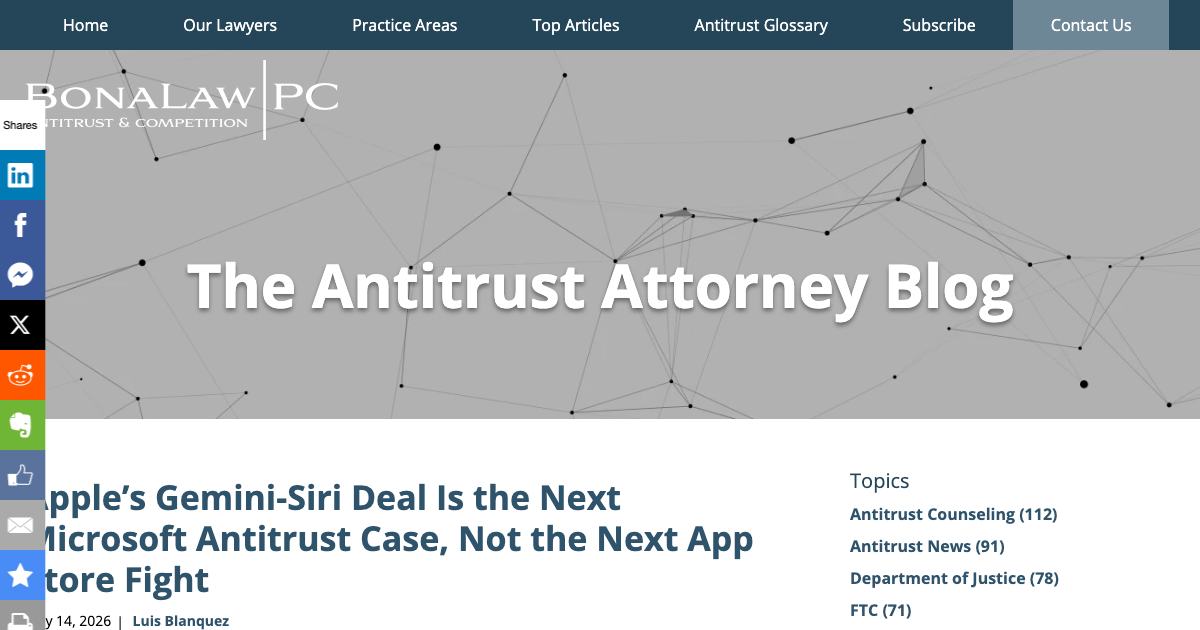
The comparison is not academic. A federal judge ruled in 2024 that Google's search distribution agreements with Apple were anticompetitive — that "defaults matter more than formal exclusivity" and that "once entrenched, defaults are remarkably sticky."
The Gemini-Siri deal raises an identical structural question. Apple claims the arrangement is "expressly not exclusive," pointing to iOS 27's Extensions framework that theoretically allows alternative AI providers. But the antitrust analysis is damning: "Apple does not compete with Gemini. Apple neutralizes it by absorbing it." Gemini gets system-level integration while rivals face sandboxed, higher-friction access.
The affected parties extend beyond Google and Apple. AI startups, vertical AI companies, app developers, and content platforms all face growing foreclosure risks as Siri becomes the dominant intermediary between users and digital services.
No enforcement action has been filed yet. But the legal scholars writing about this deal are not using tentative language. They are drawing direct lines to Microsoft's browser monopolization case — and to the Google Search ruling that already found this exact structure anticompetitive.
What Siri AI Actually Does
The rebuilt assistant, confirmed at WWDC 2026, ships with three headline capabilities:
Cross-App Operation. Siri AI can chain actions across multiple apps in a single request. "Book a restaurant for Friday night, add it to my calendar, and text the group chat the details" is one prompt, not three.
On-Screen Awareness. Point Siri at what is on your screen and ask about it. It understands the context of the current app state — a departure from old Siri, which treated each query as context-free.
Personal Context Understanding. Siri AI draws on your on-device data — messages, emails, browsing history, app usage patterns — to personalize responses without sending that data to the cloud.
Apple also announced that SiriKit is being deprecated in favor of App Intents, signaling that every third-party developer needs to rebuild their Siri integration for the Gemini-powered architecture. The migration clock is ticking.
With iOS 26.4 expected to deliver these features to 1.5 billion daily users, this is one of the largest-scale AI deployments in history — running on a model Apple does not own, hosted on hardware Apple does not control.
The Bigger Picture
Apple's Gemini deal is not an isolated decision. It is the latest data point in a pattern that is reshaping the AI industry:
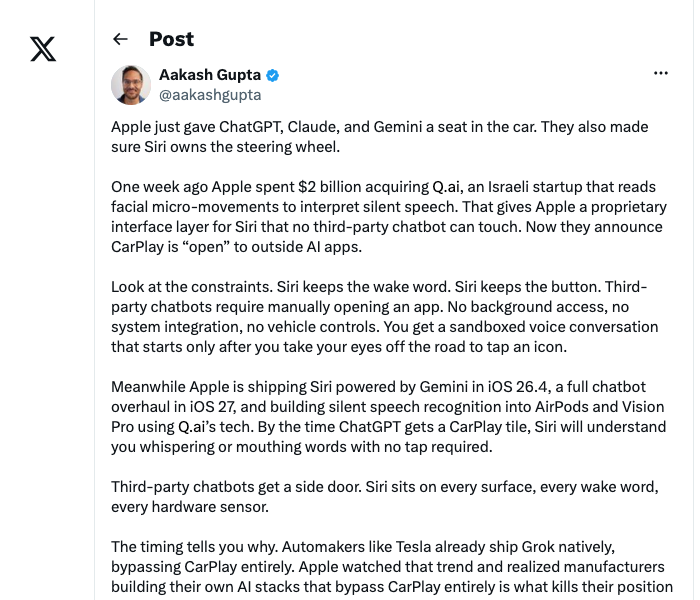
The model layer is commoditizing. When a $3 trillion company concludes it is cheaper to license a frontier model than build one, the economic signal is clear. Foundation models are becoming infrastructure — like cloud compute, like databases, like CDNs. The value is migrating to the integration layer above them.
Distribution is the new moat. OpenAI has the best consumer product in AI. It did not matter. Apple chose the model that came with the best infrastructure deal. In AI, as in every prior technology wave, whoever owns the distribution channel owns the margin.
Privacy is an architecture problem, not a marketing one. Apple's three-layer approach — with hardware-encrypted confidential computing on the hardest queries — is genuinely novel. It proves you can outsource intelligence without outsourcing trust, but only if you are willing to invest in the plumbing.
For developers, operators, and anyone building on top of AI models: this deal is a blueprint. The company that controls the interface, owns the user relationship, and manages the data layer will capture the value — regardless of whose model generates the tokens.
If you are comparing the three major AI assistants powering consumer devices today, our Claude vs ChatGPT vs Gemini comparison breaks down the capabilities head to head. And if you are curious about Apple's on-device AI ambitions — the Layer 1 that stays on your phone — our deep dive on the iPhone 17 Pro's 400B on-device LLM covers what Apple is building for the queries that never need Google at all.
The frontier lab that outsourced its brain may have made the smartest move in the AI race — not by building the best model, but by building the best tollbooth.
ComputeLeap Team
The ComputeLeap editorial team covers AI tools, agents, and products — helping readers discover and use artificial intelligence to work smarter.
Join the discussion
Have thoughts on this article? Discuss it on your favorite platform:
Related articles
The ASI Control Problem: Why Both Obvious Fixes Fail
Tiered pacing and trusted-AI bootstrapping are named alignment programs with documented failure modes. What would have to be true to control ASI.
Amodei Says Slow Down. The Junior Researcher Was Right
Three frontier CEOs called for a slowdown days after a junior researcher resigned. Why the 'just a junior' dismissal gets AI risk backwards.
Anthropic's Doom Warning Is Really a Tooling Gap
A researcher quit Anthropic warning AI could kill us all. The auditable part: recursive self-improvement research is public and compounding. Oversight isn't.
The ComputeLeap Weekly
Get a weekly digest of the best AI infra writing — Claude Code, agent frameworks, deployment patterns. No fluff.
WEEKLY. UNSUBSCRIBE ANYTIME.