The 'Best Model' Race Is Over. Here's What Actually Matters.
Polymarket's best-model market crashed 56%. Meta launched at commodity pricing. The moat moved to agents, data, and harness.
The 'Best Model' Race Is Over. Here's What Actually Matters.
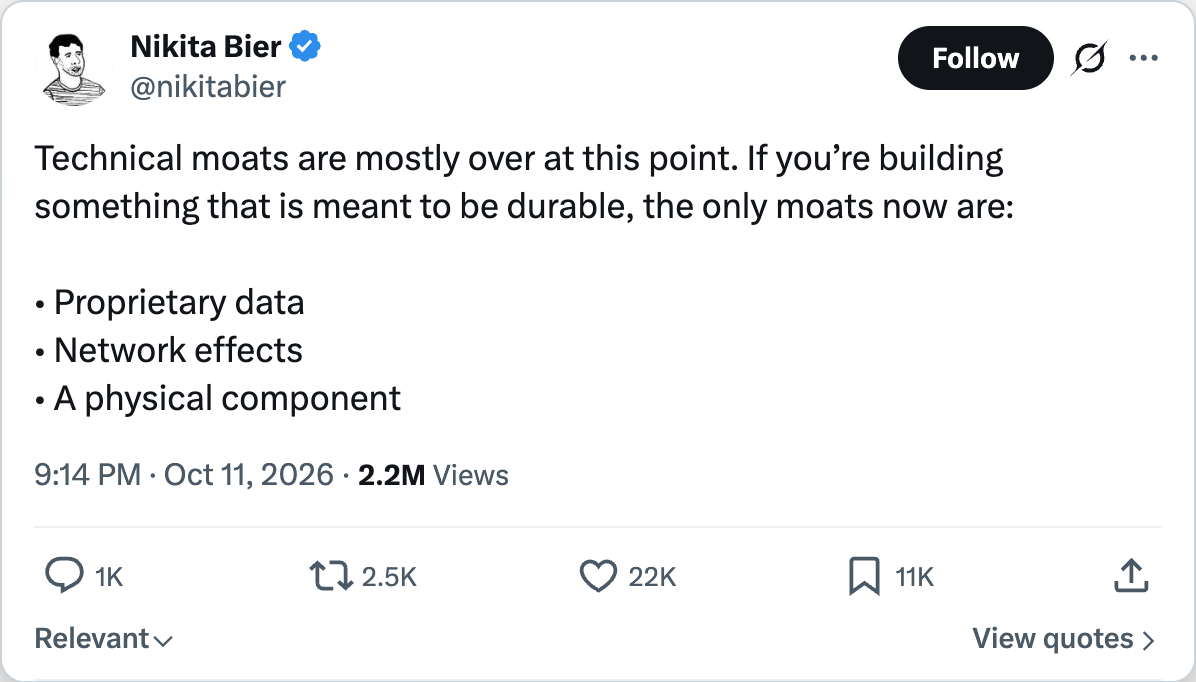
There is a prediction market on Polymarket that asks a simple question: which company will have the best AI model at the end of each month? In October 2026, that market is telling a story the AI hype cycle does not want you to hear. The "best model" contract has crashed 56.5% this month, Google leads Anthropic 71-26 for October, and the year-end contract is a dead heat — Google 42%, Anthropic 42%, OpenAI 9%. The betting crowd has effectively written off OpenAI for the year-end crown. Nobody can hold the lead for more than a few weeks.
Then today, Meta launched Muse Wonder — its first true frontier model — at $4 per million input tokens and $20 per million output tokens. That is 60% cheaper than Fable 5.1 and GPT-6 Astra. The Hacker News reaction was immediate and blunt: "It'll become a commodity and the price will be driven to the ground."
The question "which model is best?" used to be the only question that mattered. Now it is the wrong question entirely.
The Prediction Markets Already Priced This In
The Polymarket data is more revealing than any benchmark. This $1.6 million liquidity market — the most-watched AI leaderboard contract — has swung violently all month. Google surged from the low 30s to 71% in early October. Anthropic dropped from the 80s to 26%.
But here is the number that matters: the year-end contract is a perfect 42-42 tie. Not a slight edge. Not a lean. A literal coin flip.
The Polymarket Signal: Monthly model markets swing 60+ points in days. The year-end market is a coin flip. The agent market, meanwhile, is a blowout: Anthropic 93%, everyone else single digits. The market is telling you where the moat actually lives.
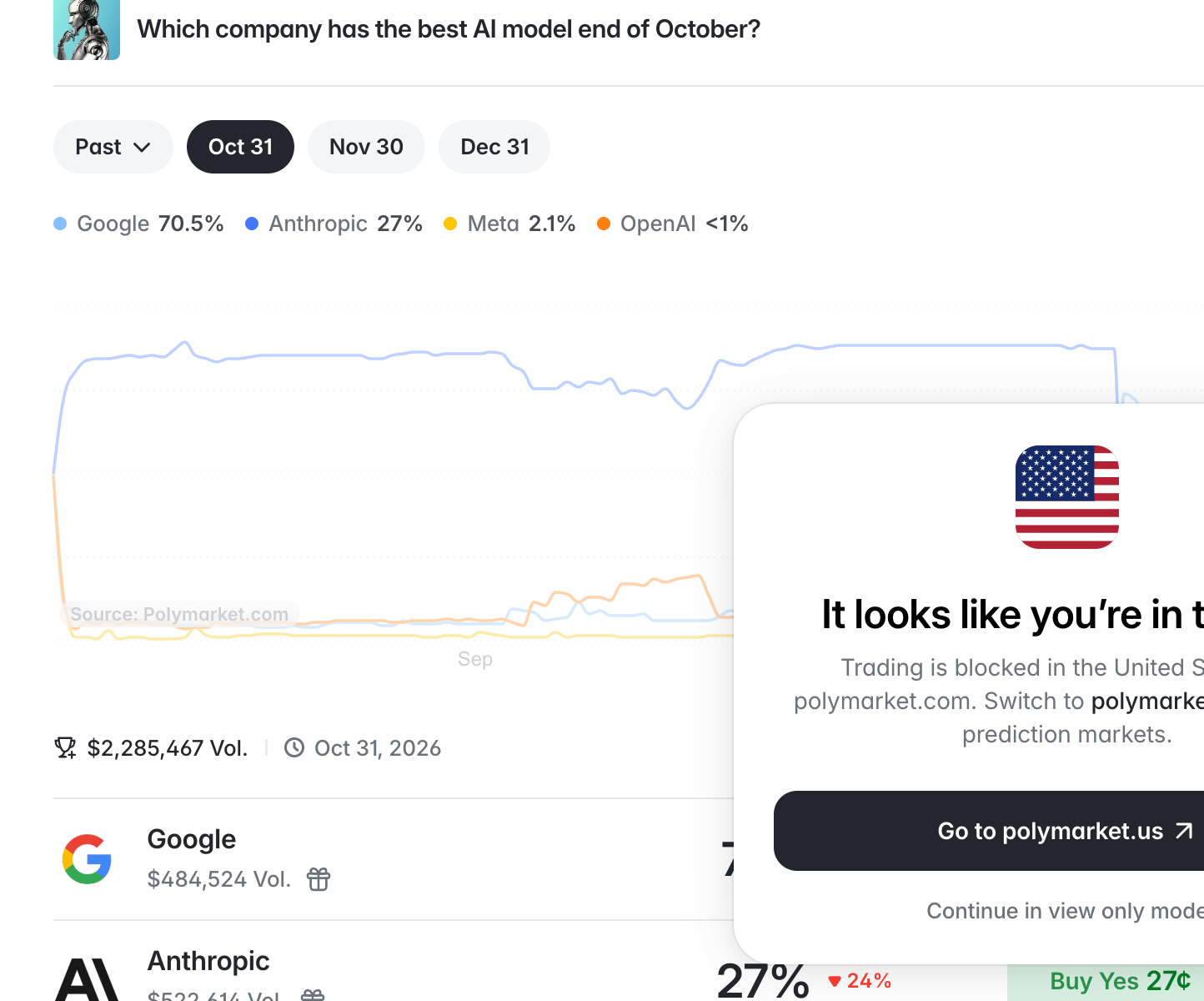
Compare that to the agent market: Anthropic at 93%, OpenAI at 4%, Google at 3%. Models are a coin flip. Agents are a blowout. The prediction markets have already figured out where durable advantage lives — and it is not in the model layer.
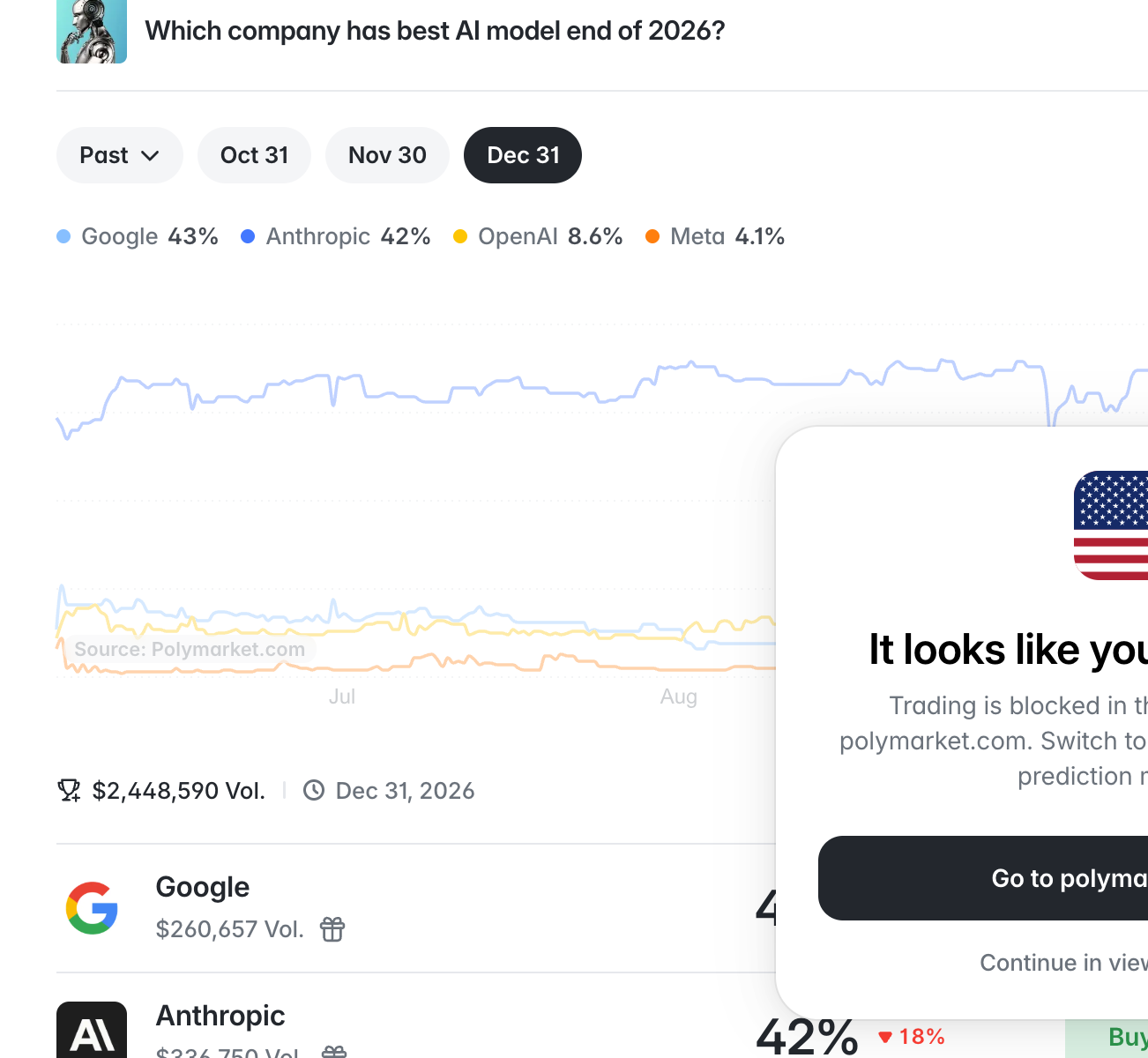
"Technical Moats Are Mostly Over"
Nikita Bier — who just stepped down as head of product at X after launching 30 products — put it in stark terms this week: "Technical moats are mostly over at this point. If you're building something that is meant to be durable, the only moats now are: Proprietary data, Network effects, A physical component." The post pulled 22,000 likes and 2.1 million views.
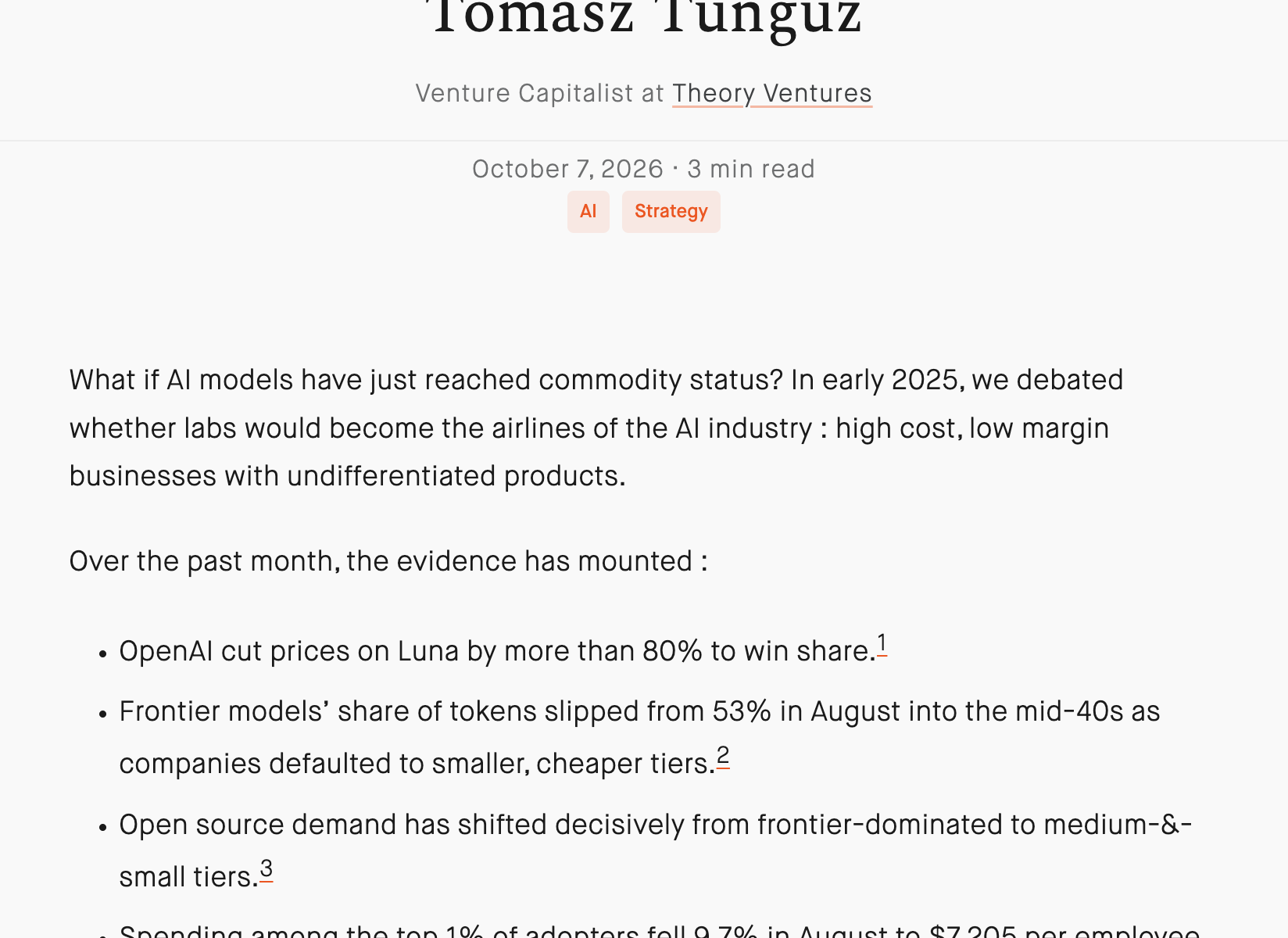
He is not the only one saying this. Tom Tunguz found that 84% of tokens on OpenRouter go to non-state-of-the-art models. Six models that deliver roughly 77% of frontier performance at 2.5% of Claude Fable 5's price carry the supermajority of usage. Token usage is up roughly 50% since July while prices fell 41%.
Marc Andreessen told a16z's LP meeting that "technological moats that used to last a decade now last a quarter." The model itself, he argued, is the swappable part. At SaaStr AI Annual 2026, practitioners across six industries arrived at the same conclusion: model capability is now accessible to any developer and no longer separates winners from losers.
Russell Kaplan, President of Cognition — the $26 billion company behind Devin — frames it differently in his LangChain conversation: the question "which is the best model?" is the wrong question entirely. What matters is what you build around the model — the agent harness, the evaluation loop, the recovery paths.
Meta Muse Wonder: The Commodity Clock Hits Zero
Meta's timing could not be more symbolic. Muse Wonder launched today at commodity pricing — $4/$20 per million tokens — directly undercutting both OpenAI and Anthropic. For context, that is roughly matched with Claude Opus 5.5 on input costs and 60% below GPT-6 Astra.
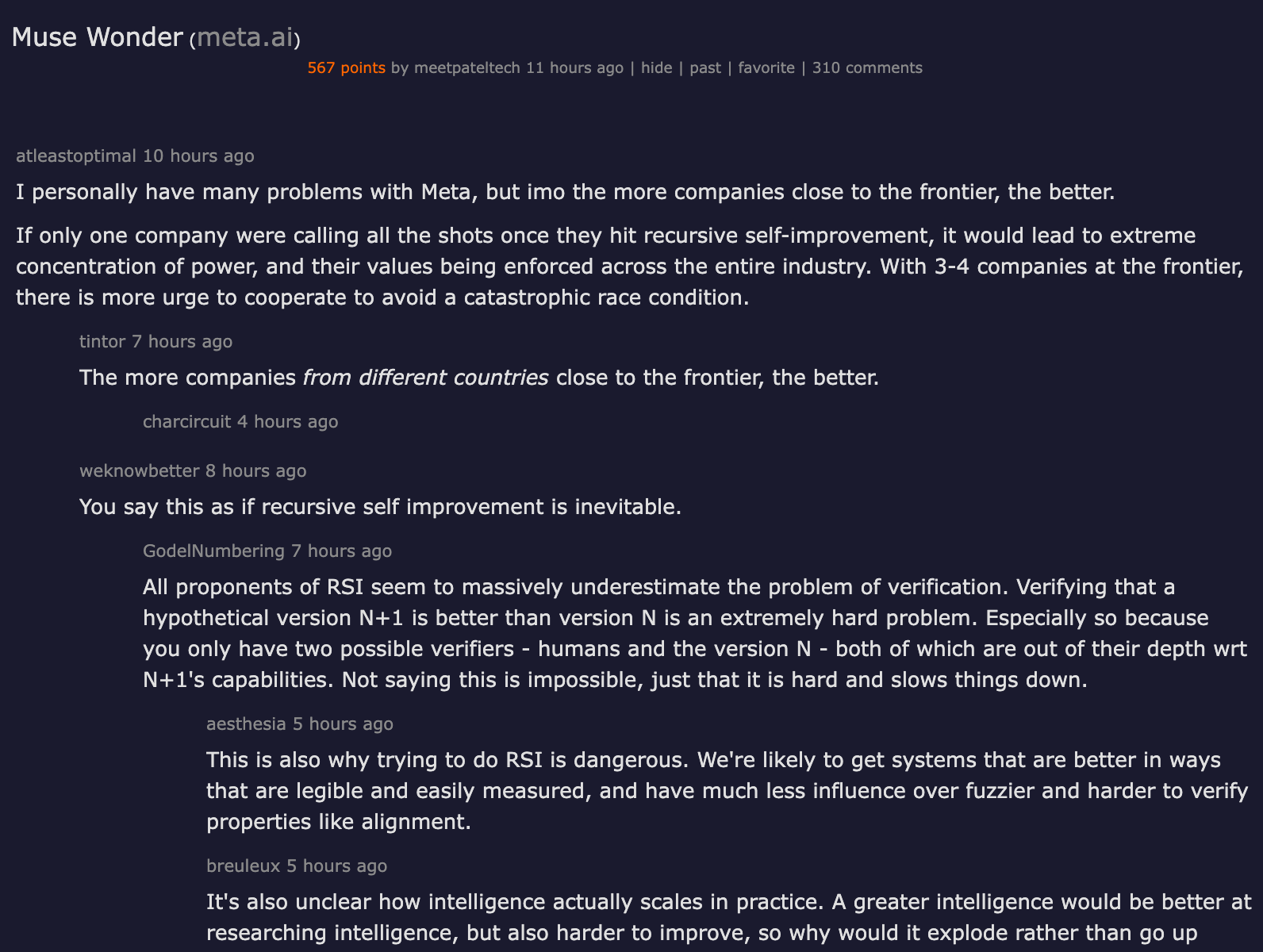
The Hacker News thread on the launch reads like a eulogy for model differentiation. The top comments hit the same beats: "If this model is not benchmaxxed, I fear it's over for anthropic, openai etc. They are not unique and there will probably be many others with similar models very soon." Another commenter noted the pricing: "Input — $4.00. Cached input — $0.20. Output — $20.00" and pointed out it matches the frontier competition.
One commenter captured the broader dynamic: "The more companies close to the frontier, the better. If only one company were calling all the shots once they hit recursive self-improvement, it would lead to extreme concentration of power."
This is the moment Benedict Evans predicted when he argued that the only economic moat leading AI labs possess is access to capital. The model itself was always going to converge. The question was always how fast. And as we covered in our token economics analysis, the pricing pressure runs in one direction only.
The Three Moats That Actually Work
If the model is not the moat, what is? After reviewing 15+ sources across prediction markets, VC analysis, and practitioner conferences, three categories emerge consistently. But they are not all equal.
1. Agentic Systems and Orchestration (The Harness)
Microsoft calls it the "harness" — the infrastructure that wraps around any model and makes it useful inside a specific enterprise environment. This includes memory, tool routing, sandboxes, permission policies, recovery paths, and the agent loop itself.
The key insight: swapping a model is easy. Swapping a harness you spent a year teaching is hard. The harness accumulates customer interactions, workflow configurations, and institutional knowledge. That data flywheel creates genuine switching costs. We explored this dynamic in depth when Codex's goal-seeking absorbed the agent harness.
In the a16z State of AI conversation, Anish Acharya argues that traditional moats like network effects, scale, and brand still apply — but they apply to what is built around the model, not to the model itself. Applications that combine different types of intelligence create more value than any single model.
The Polymarket data backs this up viscerally. The model market is a coin flip. The agent market — Anthropic 93% — is the widest gap in all of AI prediction markets. The market is pricing in that Claude Code, computer use, and the agentic SDK have built an orchestration moat that no model swap can erode. If you want to see this in practice, check our guide to building your own agentic OS and our breakdown of how AI coding agents are reshaping startup productivity.
2. Proprietary Data Flywheels
Data was always the answer, but the kind of data that matters has changed. It is not training data — anyone can scrape the internet. It is interaction data: what users do with the model, which outputs they accept or reject, how they configure workflows.
Nathan Lambert at Interconnects noted that access to quality, diverse fine-tuning prompts is something open-source projects will struggle to replicate. The companies whose users interact with their models build moats through data and habits.
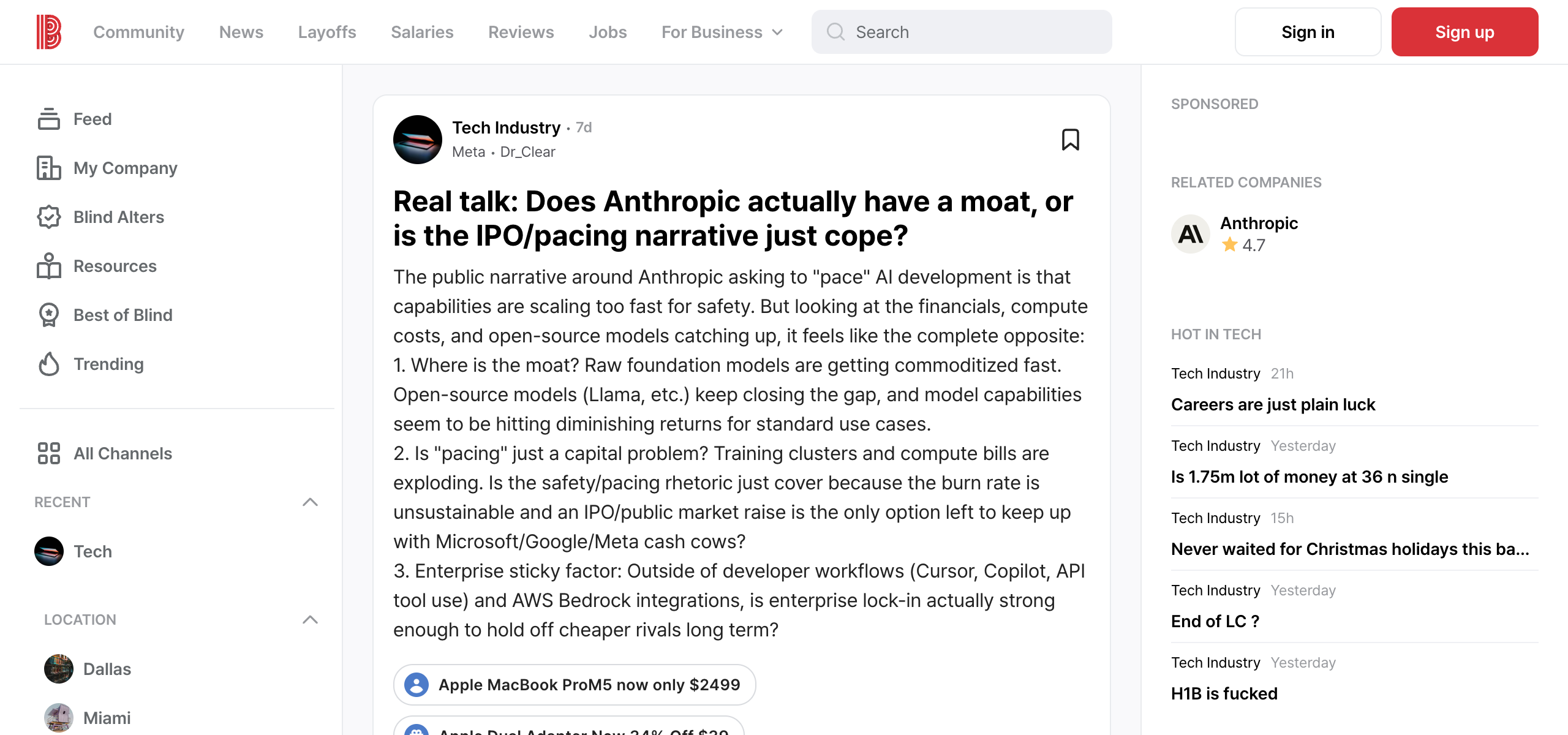
The community debate is fierce. On Blind, engineers at frontier labs are asking the blunt question: "Does Anthropic actually have a moat, or is the IPO narrative just cope?" The consensus there splits between those who see a talent moat for frontier R&D and those who argue raw foundation models are getting commoditized fast.
Sacra's OpenRouter analysis shows the dynamic in action: Chinese open-source models now represent 50%+ of all OpenRouter token volume, but Anthropic's models — only 12% of traffic — generate 46% of revenue. The customers paying premium prices are paying for something the model itself cannot provide: integrated workflow, reliability guarantees, and accumulated context.
3. Distribution and Network Effects
Nikita Bier's three moats — proprietary data, network effects, and a physical component — are essentially the same framework Warren Buffett used for Coca-Cola. The AI-specific twist: distribution now means integration depth. An AI tool embedded in someone's CI/CD pipeline, code editor, or business workflow creates switching costs that have nothing to do with model quality.
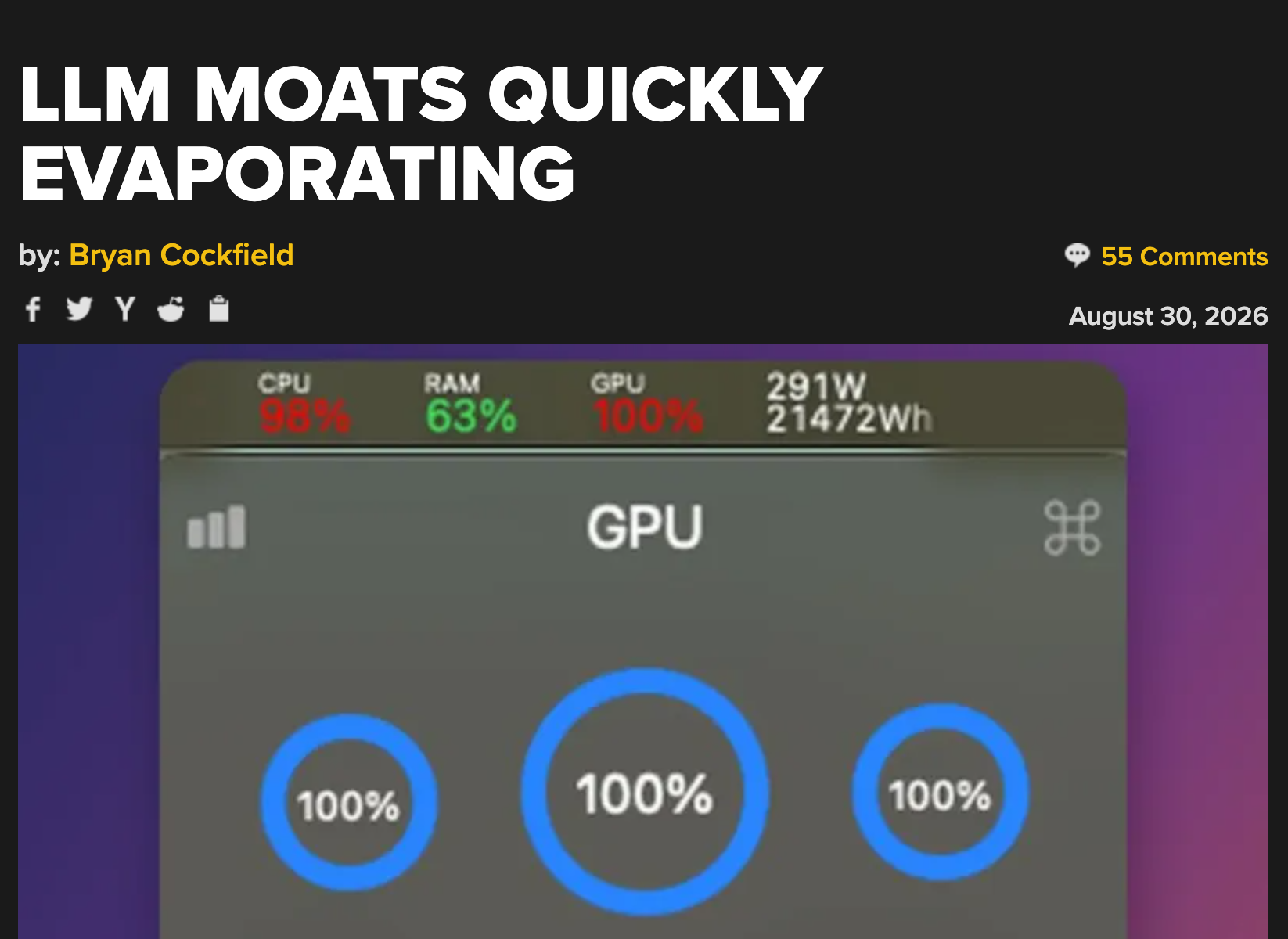
As Hackaday documented, the technical moats are eroding from both ends — quantized open-weight models are closing the gap from below while frontier labs converge from above.
This is why Evan Spiegel told Lenny's podcast that distribution is the most important moat in consumer technology. When every competitor has access to the same frontier models, the company with the best distribution channel wins. We have seen this play out in how Meta's earlier Muse Spark drove adoption through Facebook and Instagram integration rather than benchmark supremacy.
Contrarian Corner: The Revenue Paradox
The "models are commoditized" consensus has an uncomfortable problem: Anthropic's annualized revenue reportedly went from roughly $9 billion at end-2025 to over $44 billion by mid-2026. Someone is paying a massive premium for the "best" model.
The resolution might be simpler than it seems. Anthropic's revenue growth is driven by Claude Code and enterprise API contracts — harness and agent products, not raw model access. The revenue data and the prediction market data are actually telling the same story: the value is in the agentic layer, and Anthropic happens to be winning that race while the model race is a coin flip.
But if a cheaper model from Meta or an open-weight competitor can slot into those same agent workflows, the revenue premium is fragile. The Polymarket crowd's 42-42 tie is a bet that model parity will eventually compress even the premium tier.
What This Means for Builders
If you are building an AI-native product or integrating AI into an existing business, the "best model" race should be irrelevant to your strategy. Here is what to do instead:
Stop evaluating models. Start evaluating harnesses. The model you use will change every quarter. The orchestration layer — how you route tasks, manage context, handle failures, and accumulate user data — is what compounds. Invest there.
Build data flywheels, not data lakes. Static training data is a depreciating asset. Interaction data that improves your product with every use is a compounding one. Every user session should make your agent smarter, your routing more efficient, and your failure recovery more robust.
Make switching expensive (in a good way). If your customers can swap your AI tool for a competitor's in an afternoon, you have no moat. Deep workflow integration — connecting to their specific data sources, learning their team's preferences, encoding their business logic — creates switching costs that have nothing to do with which model you run underneath.
Watch the Polymarket agent market. It is the best real-time signal for where durable AI advantage lives. When the model market is a coin flip and the agent market is a blowout, the market is telling you something your benchmark leaderboard cannot.
The Litmus Test: If your competitive advantage disappears when your model provider releases a cheaper version, you never had a moat. The moat is everything except the model.
The Race That Replaced the Race
The "best model" race is not over because models stopped improving. It is over because improvements stopped mattering at the margin. When Google, Anthropic, Meta, and OpenAI all produce frontier-class models within weeks of each other — when the Polymarket year-end contract is literally 42-42 — the model layer has become infrastructure. Important, necessary, and completely insufficient.
The new race is for the harness, the data flywheel, and the distribution channel. It is less exciting than benchmark wars. It will not generate breathless headlines about which model scored 0.3% higher on some leaderboard. But it is where the actual value — the durable, defensible, compounding kind — is being built right now.
The prediction markets already know this. The question is whether you do.
ComputeLeap Team
The ComputeLeap editorial team covers AI tools, agents, and products — helping readers discover and use artificial intelligence to work smarter.
Join the discussion
Have thoughts on this article? Discuss it on your favorite platform:
Related articles
AI Cloned Your App Overnight. Now What?
REA hit 95K GitHub stars in days. AI reverse engineering is real, and the 'too hard to rebuild' moat just collapsed.
Haiku 5.5 at $0.10 Rewrites the Cheap-Tier Playbook
Anthropic's Haiku 5.5 undercuts every cheap model at $0.10/MTok. Here's when to route to it and when the savings are a trap.
JetBrains Posts Its First-Ever Loss. The Terminal Won.
JetBrains lost $14M chasing AI while Cursor hit $4B ARR. The IDE era is ending, but the fight over the agentic terminal just started.
The ComputeLeap Weekly
Get a weekly digest of the best AI infra writing — Claude Code, agent frameworks, deployment patterns. No fluff.
WEEKLY. UNSUBSCRIBE ANYTIME.