Cloudflare Bought Deno. You Have 12 Months.
Deno gets 12 months of patches then development ends. Here are the concrete migration paths for every Deno deployment pattern.
Cloudflare Bought Deno. You Have 12 Months.

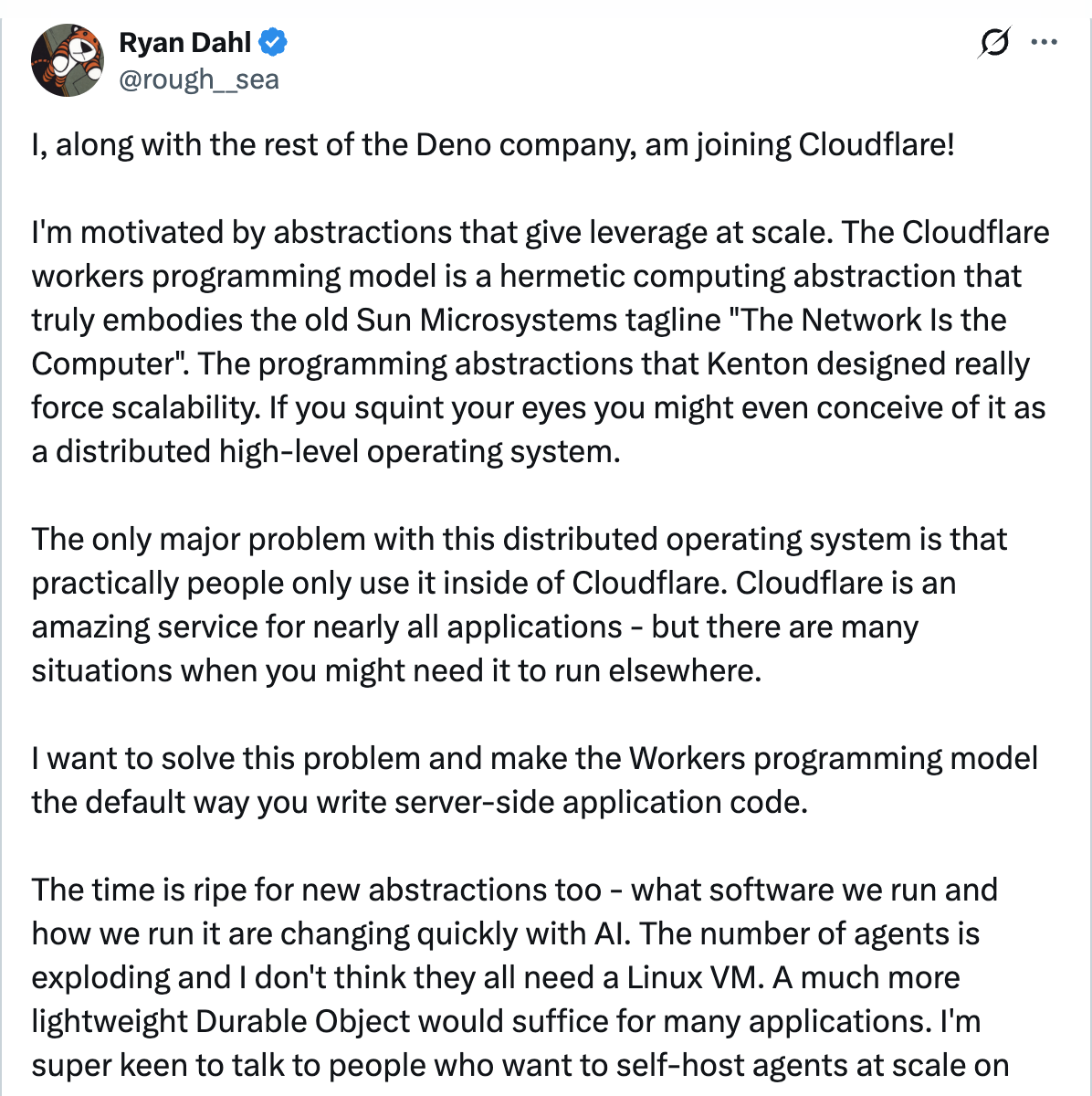
Cloudflare announced on October 9, 2026, that it is acquiring Deno -- the entire team, the technology, and the open-source runtime that Ryan Dahl built as his second attempt to fix JavaScript on the server. The announcement on Deno's blog is short and direct: the Deno runtime gets twelve months of bug fixes and security patches. After that, Cloudflare ends development. Deno Deploy, the hosted service, shuts down in six months. The Deno runtime stays open source, and Cloudflare "welcomes others who want to continue its development."
That is corporate-speak for: nobody at Cloudflare is going to work on the Deno runtime after October 2027.
The Hacker News thread hit 1,315 points and 677 comments within 24 hours -- the top story on October 9. The developer reaction is a mix of mourning and pragmatism. If you built production systems on Deno, the mourning phase needs to be short. The clock is already running.
What Cloudflare Actually Bought
Cloudflare did not acquire Deno for the runtime. It acquired Deno for celld.
celld is a Rust binary that Ryan Dahl and Bert Belder quietly released in August 2026 under the Apache 2.0 license. It runs Cloudflare Workers applications -- including Durable Objects -- on your own servers. Each Durable Object gets its own SQLite database, replicated to an S3-compatible bucket you control. There is no separate control plane, no consensus service, no membership system. Just the binary, your VMs, and a bucket.
That is the asset Cloudflare wanted. Dahl himself acknowledged this in his Hacker News comment: he no longer thinks the Deno runtime is "where I can do the most important work." He described Deno as "well engineered" but "not solving big problems," stuck chasing npm compatibility instead of building something genuinely new. celld, he said, works well and depends only on object storage for coordination and persistence.
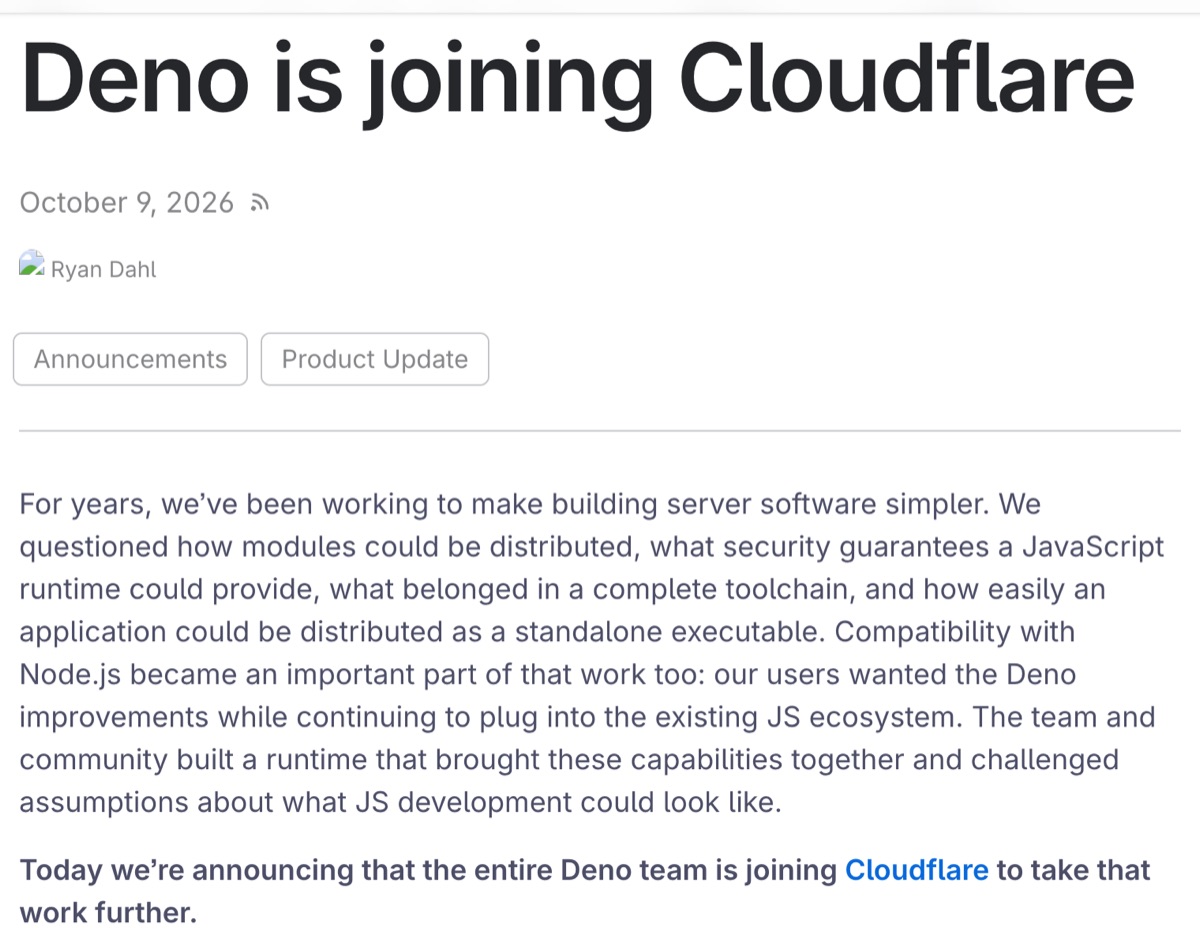
Read the original announcement on Deno's blog →
Cloudflare's open-source Workers runtime, workerd, has supported Durable Objects only as a single instance -- a limitation that blocked multi-machine production clusters. The plan is to merge celld's distributed architecture into workerd, led by Dahl and Belder. Kenton Varda, the architect of Cloudflare Workers, confirmed this is not a typical acquisition -- it is a technical bet on self-hosting.
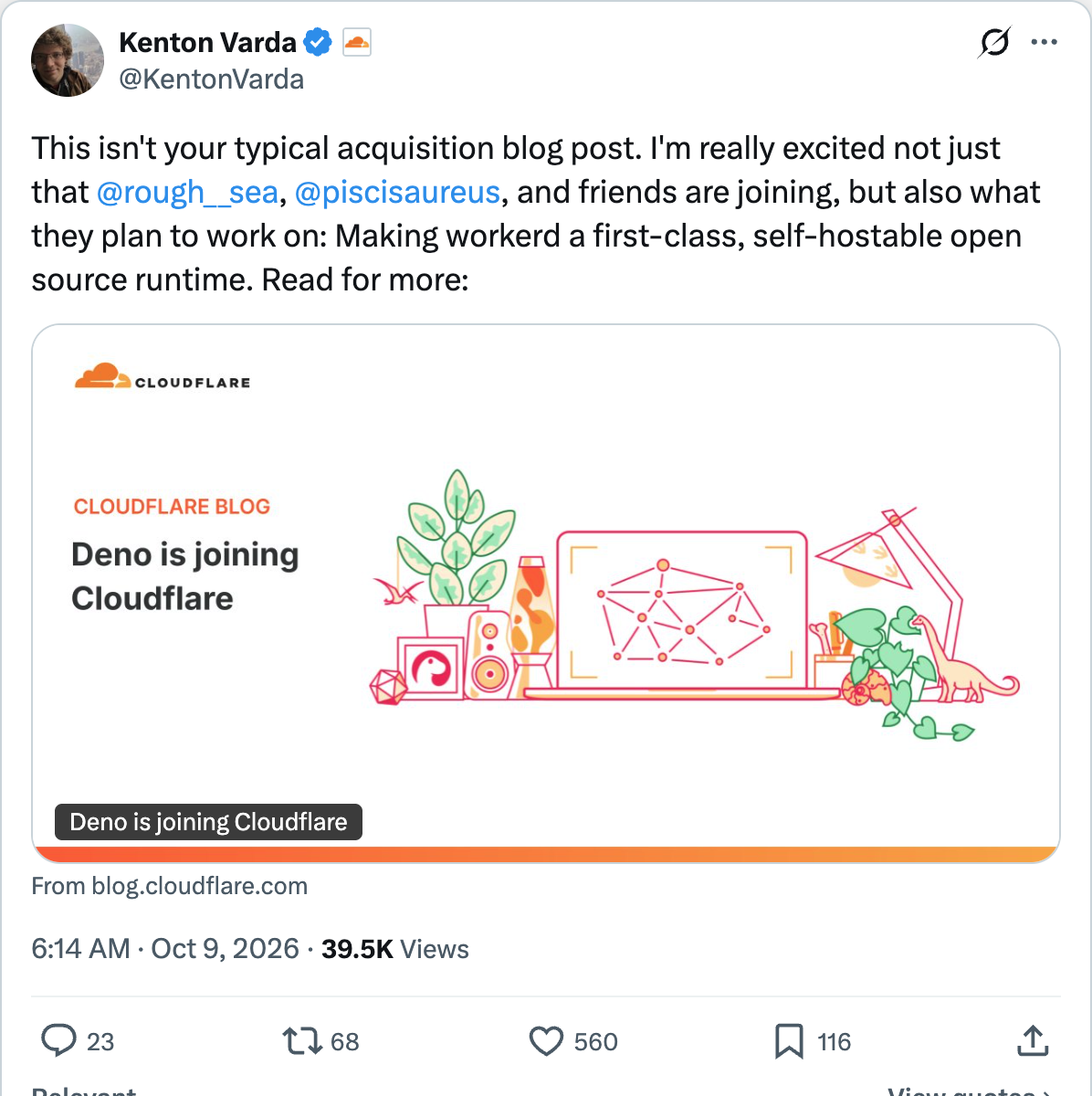
The stated goal: make self-hosted Workers a first-class production deployment target for enterprises that cannot move customer data off-premises.
celld was released in August 2026 at version 0.1.0 and is already at v0.4.1. It reads a standard wrangler.json, runs V8 isolates, and uses an S3-compatible bucket as its only coordination layer. Each Durable Object gets its own SQLite database. The architecture has no control plane, no consensus protocol, and no membership service.
The Timeline That Matters
Here is what the announcements commit to:
| Asset | Status | Deadline |
|---|---|---|
| Deno runtime | Monthly security and bug-fix releases | ~October 2027 (12 months) |
| Deno Deploy | Shutdown; paying customers migrated to Workers | ~April 2027 (6 months) |
| JSR (jsr.io) | Continues operating, infrastructure moves to Cloudflare | Ongoing |
| rusty_v8 | Being integrated into workerd | No public deadline |
| Fresh framework | Not mentioned in either announcement | Future unclear |
| Deno Subhosting | Not mentioned in either announcement | Future unclear |
If a Deno asset was not named in either announcement, assume it has low engineering priority inside Cloudflare. Plan accordingly.
The Deno Deploy migration is particularly urgent. Deno had already been migrating users from "Deploy Classic" (dash.deno.com) to a new platform, with a shutdown date of July 20, 2026, for the classic version. The official migration guide covers account creation, environment variable migration, custom domain transfers, and code changes. Some features do not carry over: Deno queues are unsupported on the new platform, KV data is not migrated automatically, and the region count dropped from six to two (US and EU).
Now that Deno Deploy itself is shutting down, the destination shifts from "new Deno Deploy" to Cloudflare Workers. Cloudflare says it will offer migration support for paying customers.
Cloudflare's JavaScript Infrastructure Play
This is not a one-off acquisition. Cloudflare has been systematically assembling the JavaScript infrastructure stack:
- January 2026: Acquired Astro Technology Company -- the team behind the Astro web framework and Flue, an agent harness framework that runs as Durable Objects on Workers.
- June 2026: Acquired VoidZero -- steward of Vite (129M weekly npm downloads), Vitest, Rolldown, and the Oxc toolchain. Evan You's team joined Cloudflare's ETI organization.
- October 2026: Acquired Deno -- celld for self-hosted Workers, the Deno team's runtime expertise, and JSR.
Together, these cover the full build-deploy pipeline: Astro for the framework layer, Vite and Rolldown for bundling, and celld/workerd for running code anywhere -- Cloudflare's edge network or your own infrastructure.
As SoftwareSeni's analysis puts it: "Open-source developer tools achieve massive adoption but generate no revenue, while platform companies need to control the supply chain that feeds developers into their deployment platforms."
Cloudflare is not the only company doing this. The broader pattern of platform companies absorbing developer tools is accelerating:
- December 2025: Bun's team joined Anthropic.
- March 2026: Astral (uv, Ruff -- Python tooling) agreed to join OpenAI's Codex group.
- September 2026: Shopify acquired Tailwind Labs.
The business model problem is structural. Developer tools get adopted because they are free and excellent. But "free and excellent" does not generate the revenue needed to sustain a venture-backed company with a $26M raise and a team to pay. Sequoia led Deno's Series A in 2022. Four years later, the exit is an acqui-hire into Cloudflare.
What the Community Is Saying
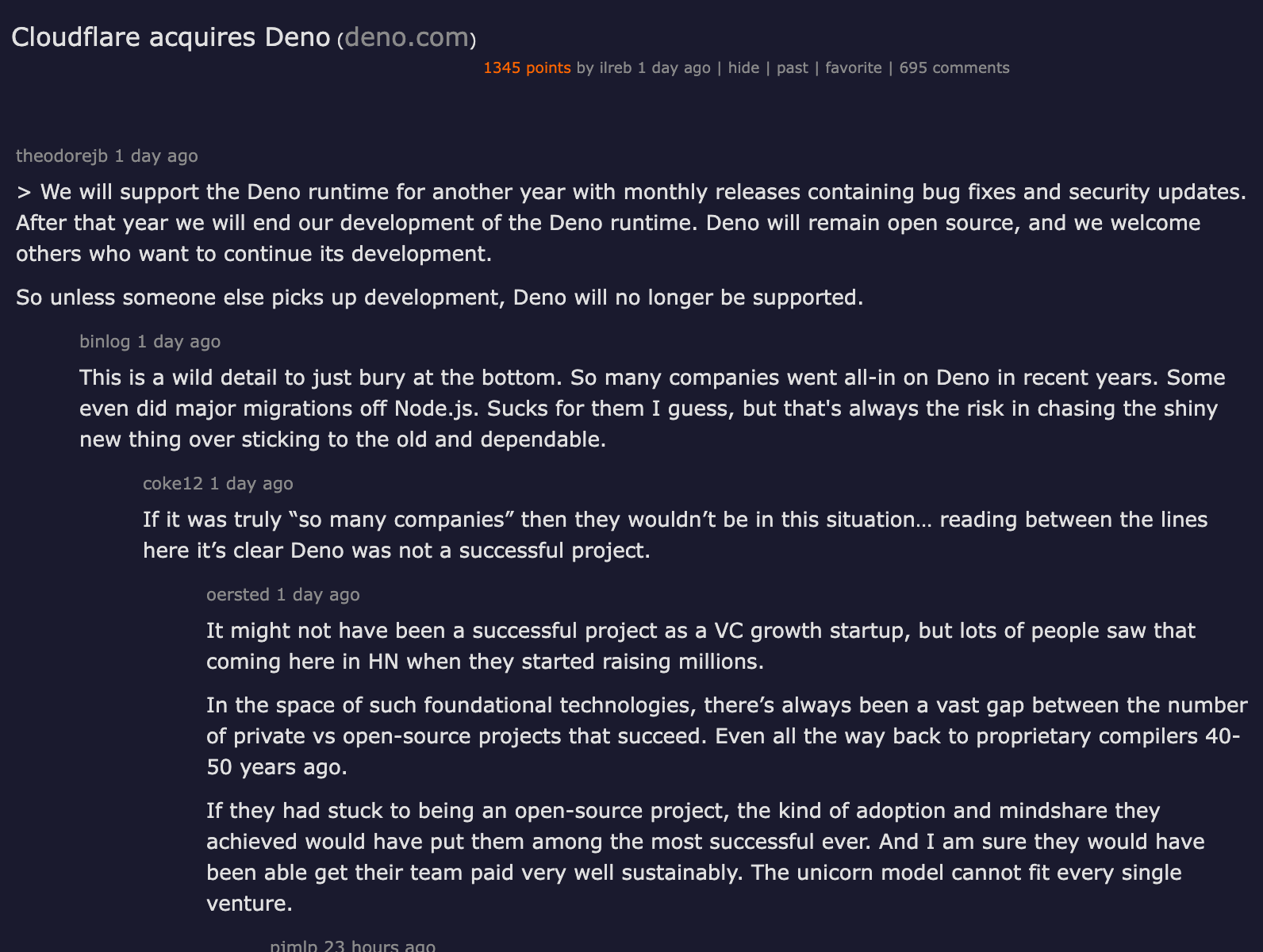
View the full discussion on Hacker News →
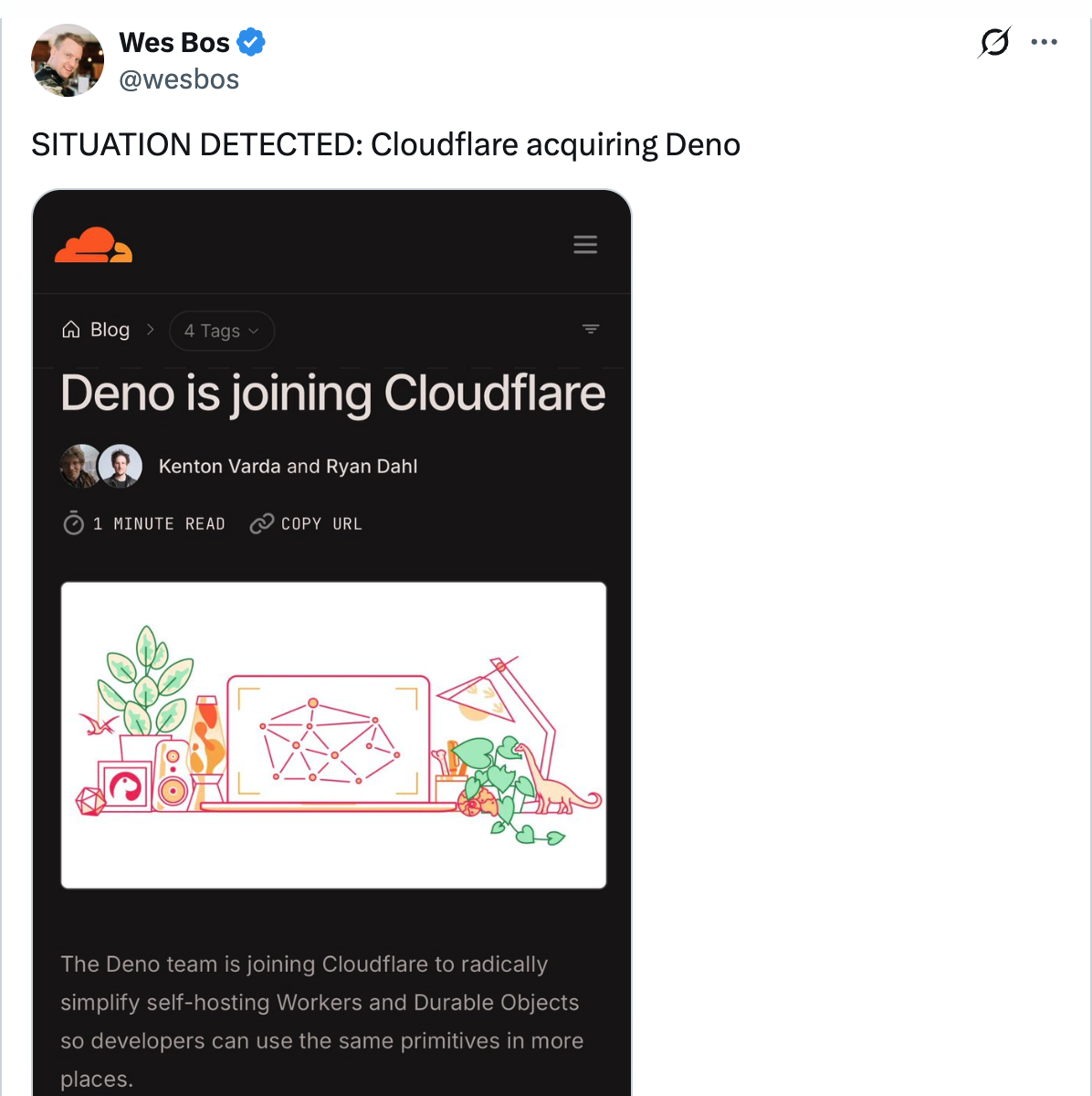
The Hacker News thread is one of the more emotionally charged discussions in recent memory. Several themes emerge:
Mourning the vision. The top-voted comments express genuine grief. One developer wrote: "I'm so bummed about this. Deno is by far my favourite JS runtime. I could sense this coming for a while now, but I was hopeful." Another: "I loved early Deno and am sad to see it die. I invested heavily in the Deno ecosystem because of Ry's initial vision for it. But I stopped because I saw this coming the moment they changed course and started putting npm compatibility as a priority."
The npm compatibility trap. Multiple commenters point to the pivot toward Node.js compatibility as the moment Deno lost its identity. Once Deno could run npm packages, its surface area expanded from "beautifully simple" to indistinguishable from Node. The original thesis -- a secure, web-standards-first runtime that was explicitly not Node-compatible -- gave way to the reality that developers will not abandon their dependency trees.
The fork question. Deno stays open source under MIT and Apache 2.0. But the loss of a funded, full-time team makes a community fork a very different proposition from a company-backed runtime. The Deno runtime is a substantial codebase with its own V8 integration layer, permissions system, and toolchain. Maintaining that without corporate backing is possible (Node.js itself is a foundation project) but requires serious institutional commitment.
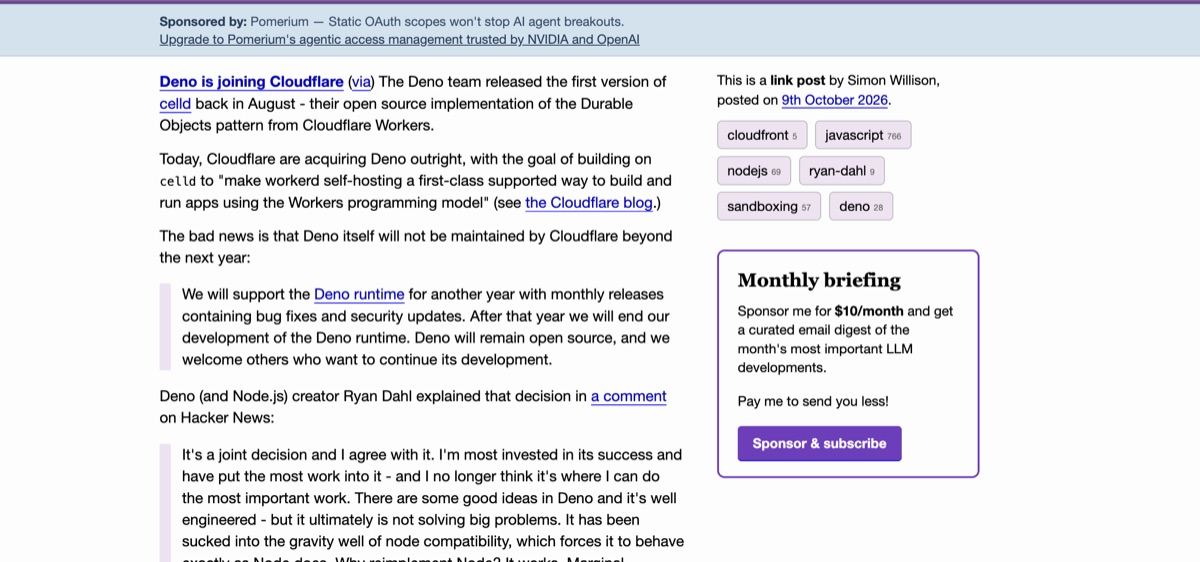
Read Simon Willison's analysis →
Simon Willison noted that Deno's permissions system -- the ability to specify exactly which files, folders, and network hosts a script can access -- is his favorite feature. He pointed out that Node.js added a similar permissions model in v20 (April 2023), marked stable in v22.13.0 (January 2025), but with a key limitation: Node's model cannot allow-list specific network hosts. Networking is either fully on or fully off.
Your Migration Playbook
Here is a concrete timeline and decision tree for every common Deno deployment pattern.
Phase 1: Inventory (by December 1, 2026)
Audit your codebase for Deno-specific surface area:
- Deno namespace APIs (
Deno.serve(),Deno.readTextFile(),Deno.env, etc.) - Import maps and URL imports (still the default in Deno; Node uses
package.json) - Permissions flags (
--allow-net,--allow-read, etc.) - Deno-specific std library (
deno.land/stdorjsr:@std/*) - Fresh framework components (if applicable)
- Deno Deploy infrastructure (KV, cron jobs, custom domains)
Phase 2: Deno Deploy Migration (by February 1, 2027)
If you are on Deno Deploy, you have two options:
Option A: Cloudflare Workers (path of least resistance)
Cloudflare is offering migration support for paying customers. Workers uses the same V8 isolate model, and celld's API compatibility with Workers means the programming model is converging. Key differences to account for:
- Workers uses
wrangler.jsonconfiguration, notdeno.json - Durable Objects replace Deno KV for state management
- Workers has a 128MB memory limit per isolate
- Cold starts are sub-1ms on Workers vs ~50ms on Deno Deploy
Option B: Another edge platform
- Vercel Edge Functions -- strong Next.js integration, but less flexibility for non-Next workloads
- AWS Lambda@Edge -- more operational overhead, but no vendor lock-in at the runtime level
- Railway or Fly.io -- if you want to run your own containers and avoid edge-specific constraints
Phase 3: Runtime Migration (by June 1, 2027)
For production APIs and services running on deno run:
Option A: Node.js 24+
Node.js has absorbed most of Deno's original innovations:
- Native TypeScript execution (Node 22+)
- ES Modules as default
- Built-in SQLite (Node 22.5+)
- Permissions model (stable in Node 22.13+)
- Built-in test runner
.envfile support
The migration path is well-documented. Replace Deno.* APIs with their Node equivalents, switch from URL imports to package.json + npm, and update your CI configuration.
Option B: Bun
Bun is now part of Anthropic and focused on AI workloads, but it remains a fast, Node-compatible runtime. If your workload is performance-sensitive and you are comfortable with Bun's smaller ecosystem, it is a viable target.
Option C: Wait for merged workerd
If you are building on Durable Objects patterns (stateful, distributed, WebSocket-heavy), waiting for the celld and workerd merger may be the right call. This is the riskiest option -- the merger has no public deadline and may take 12-18 months to reach production readiness.
Phase 4: Local Scripts (Low Priority)
Deno scripts used for local tooling, CI scripts, and developer utilities are low risk. Pin your Deno version in your Dockerfile or CI config and keep running them. They will continue to work long after Cloudflare stops shipping patches -- the runtime does not phone home or require a license server.
Ryan Dahl built Deno because he had regrets about Node.js. His famous "10 Things I Regret About Node.js" talk at JSConf EU laid out everything he would do differently. Now, nearly a decade later, Node.js has adopted most of those ideas -- and Deno's creator has moved on to a different problem entirely.
The Contrarian Take: This Might Be the Best Outcome
Contrarian Corner: Before you light a candle for Deno, consider the alternative timeline.
The standard narrative is that Cloudflare killed Deno. But what was the alternative? Deno had raised $26 million and struggled to monetize. Deno Deploy never achieved the adoption that would sustain the company. The runtime was increasingly indistinguishable from Node.js as it added npm compatibility.
The realistic counterfactual is not "Deno thrives independently." It is "Deno slowly runs out of runway, reduces the team, ships fewer updates, and fades into irrelevance while developers gradually migrate anyway." We have seen this movie before -- it is how most developer-tool startups end when they cannot find a business model.
Under Cloudflare, the celld technology gets a real shot at becoming a standard. Durable Objects as a portable, self-hostable backend primitive could be genuinely transformative for AI agent infrastructure -- stateful, persistent, with embedded SQLite and WebSocket support. That is a bigger idea than "a better Node.js."
The risk is that Cloudflare's self-hosting story never materializes and celld becomes another internal tool that slowly rots. That is a real risk. But at least the code is Apache 2.0. The community can fork it if Cloudflare drops the ball.
What This Means for You
If you are evaluating JavaScript runtimes today: Node.js is the safe default. It has absorbed Deno's best ideas, has the largest ecosystem, and is not dependent on a single company's acquisition strategy. Bun is the performance play. Workers + workerd is the edge/serverless play.
If you are a Cloudflare customer: This is bullish. Self-hosted Workers would let you run the same code on Cloudflare's edge and on your own infrastructure, with Durable Objects for stateful workloads. The AI agent use case is compelling -- imagine running agent harnesses on-premises for regulated industries while using Cloudflare's edge for the public-facing API.
If you are building developer tools: The business model question just got louder. Deno raised $26 million from Sequoia and still could not make it work as a standalone business. If you are building open-source developer infrastructure, your exit is likely an acquisition by a platform company, not an IPO. Price your expectations accordingly.
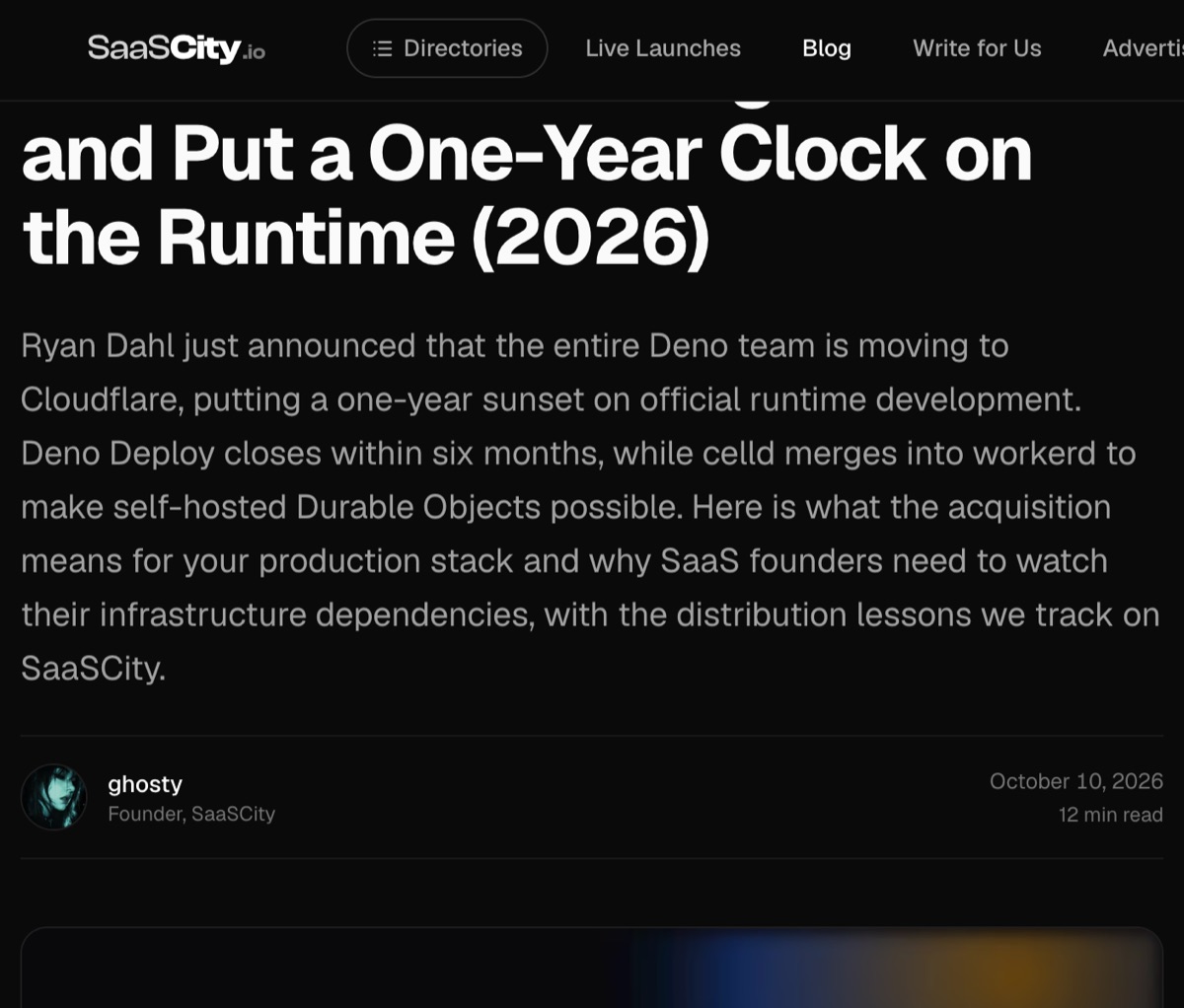
Read the full analysis on SaaS City →
The market agreed: Cloudflare shares rose 5.6% on the announcement, closing at $360.93. Wall Street sees this as Cloudflare strengthening its position in the serverless infrastructure market. Deno's investors got an exit. Cloudflare got the team and the technology. The developers who built on Deno got a migration project.
That is how consolidation works. The question is not whether it is fair. The question is what you do about it in the next 12 months.
ComputeLeap Team
The ComputeLeap editorial team covers AI tools, agents, and products — helping readers discover and use artificial intelligence to work smarter.
Join the discussion
Have thoughts on this article? Discuss it on your favorite platform:
Related articles
OpenAI Fired Its Safety Staff, Then Cited Its Auditors
Three researchers fired for talking to the auditors they were hired to brief. The disclosure gap is the real story.
Open-Weight AI Just Went Multipolar
Mistral Large 4 and Reflection Beam ship frontier open-weight models from Europe and the US in the same week. What it means for builders.
OpenAI's Culture Problem Just Went Mainstream
Robinson's Atlantic essay, Altman's deflection, and Polymarket at 1% converge into one story about OpenAI's unraveling.
The ComputeLeap Weekly
Get a weekly digest of the best AI infra writing — Claude Code, agent frameworks, deployment patterns. No fluff.
WEEKLY. UNSUBSCRIBE ANYTIME.