Compute Is Now a Tradable Commodity
CME and ICE are listing GPU futures. Amazon says $220B isn't enough. Here's what compute-as-commodity means for builders.
ComputeLeap Team
Compute Is Now a Tradable Commodity
On July 30, Andy Jassy told investors that Amazon's $220 billion AI infrastructure buildout — the largest capital expenditure program in corporate history — is still not enough. "We will still not have enough capacity to meet all the demand we have in 2026," Jassy said on the Q2 earnings call. He expects the same will be true in 2027. The contracted demand for 2028, he added, is "striking."
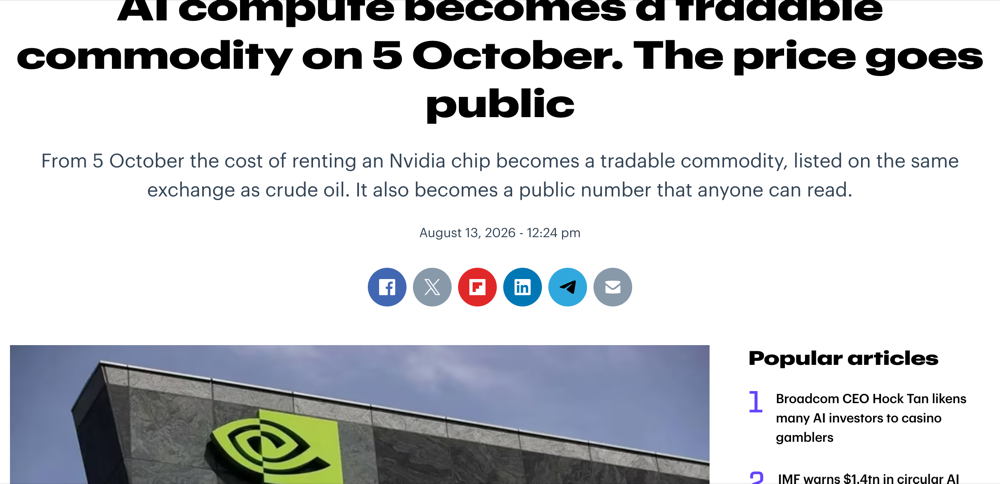
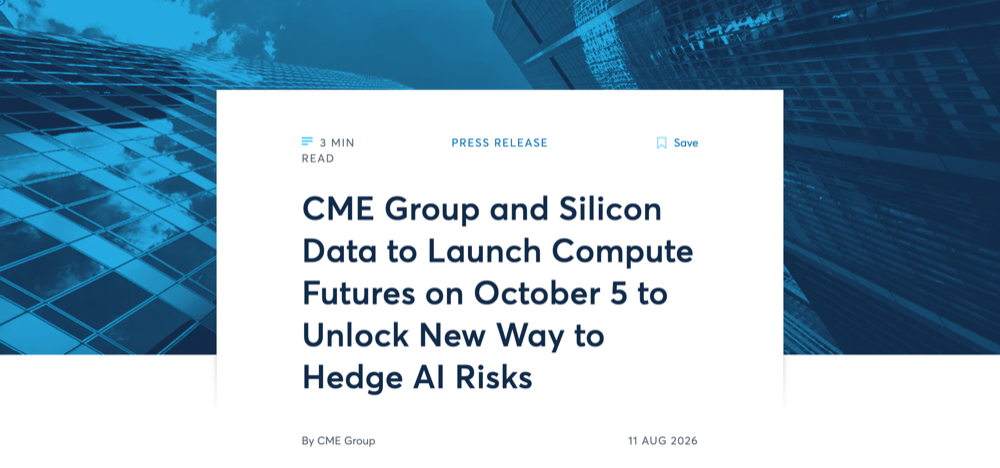
Meanwhile, Wall Street is building the infrastructure to trade the thing Amazon can't build fast enough. CME Group — the exchange that trades oil, corn, and Treasury futures — announced in August that it would list compute futures on October 5, 2026. The contracts are cash-settled against Silicon Data's daily GPU rental-rate benchmarks: one for Nvidia's H100, one for the B200. Each covers 730 GPU-hours — one month of capacity.
The message is unmistakable: compute is detaching from any single cloud provider and becoming a traded asset class, complete with spot indices, forward curves, and derivatives contracts. What that means for builders, operators, and investors is the subject of this article.

The Demand Signal: $220B and Still Short
Amazon's capex raise from $200B to $220B wasn't driven by new construction. It was driven by higher memory costs — the DRAM and HBM chips that sit alongside every GPU. AWS posted $42.2 billion in Q2 revenue, up 37% year-over-year, its fastest growth in 18 quarters. But trailing free cash flow went negative by $7.6 billion.
Amazon is not alone. Combined 2026 hyperscaler AI infrastructure spending is estimated at nearly $700 billion, roughly double the 2025 level. The gap between what's being spent and what's needed is what makes compute look, to Wall Street, like a commodity market waiting to happen.
When demand persistently outstrips supply, and the price of the underlying asset is volatile and opaque, financial markets step in. That's how oil went from a thing Standard Oil controlled to a thing the NYMEX traded. It's how electricity went from a utility monopoly product to a deregulated market with spot prices, day-ahead auctions, and capacity contracts. Compute is following the same path — except faster, and with more actors fighting over the exchange infrastructure.
View original article on The Next Web →
The Players: Who's Building the Exchange Layer
The compute-as-commodity market is being built simultaneously by at least five separate efforts. Here's the landscape:
CME Group + Silicon Data — The heaviest punch. CME, which clears $1 quadrillion in notional derivatives annually, partnered with Silicon Data to list the first regulated compute futures on the NYMEX. Silicon Data's CEO, Carmen Li, also runs Compute Exchange, a spot marketplace for GPU procurement. The index tracks hourly rental rates across providers and configurations — an attempt to impose price transparency on a market that currently has none.
ICE + Ornn — Intercontinental Exchange, which owns the NYSE, plans its own suite of cash-settled GPU futures tied to the Ornn Compute Price Index (OCPI). Ornn, backed by a $33M seed round from a16z crypto, built its index exclusively from live spot transactions — not surveys or quotes — and distributes it on Bloomberg Terminal. The OCPI covers H100, H200, B200, and RTX 5090 hardware.
Kalshi — The prediction market turned commodity exchange launched compute forward curves on July 14 for B200, H200, and A100 chips. Its forward data already shows a price structure: B200 falling from $5.83/hr to $5.30/hr over six months, H200 from $4.61 to $4.27, while H100 ticks up from $2.62 to $2.77. That's backwardation on the new chips and mild contango on the older ones — a term structure that traders in any commodity market would recognize instantly.
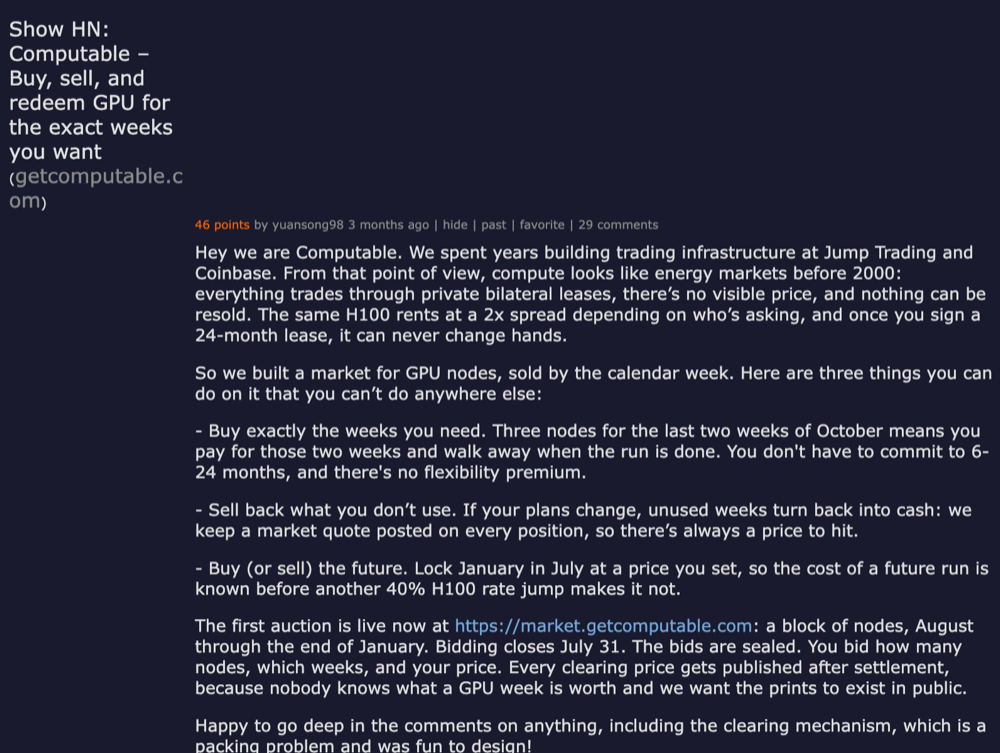
Computable — A YC-backed marketplace for physical GPU capacity. Buyers purchase, sell, and resell weekly H100 node allocations via sealed auctions. The founders built trading infrastructure at Jump Trading and Coinbase. The Show HN launch drew immediate interest from developers looking for alternatives to cloud lock-in.
View discussion on Hacker News →
SF Compute — Sells GPU clusters on contracts that customers can sublease. Its far-horizon play: cash-settled futures that let data centers lock in prices for compute they'll deliver next winter.
View original press release on CME Group →
What the Spot Market Actually Looks Like
If you tried to buy compute today, you'd encounter a market that looks like oil trading in the 1970s — before OPEC, before NYMEX, before Brent. Prices vary wildly by provider, contract length, GPU configuration, and whether you're willing to accept preemption risk.
The current snapshot, compiled from Silicon Data and Ornn benchmarks:
| GPU | Spot Rate ($/hr) | Forward (6mo) | Spread |
|---|---|---|---|
| B200 | ~$5.62 | ~$5.30 | -5.7% (backwardation) |
| H100 | ~$2.72 | ~$2.77 | +1.8% (contango) |
| A100 | ~$1.65 | n/a | — |
But these numbers hide enormous variance. One analysis found an eightfold gap between the cheapest marketplace spot listing ($0.94/hr for H100) and the lower bound of Silicon Data's hyperscaler on-demand benchmark ($7.40/hr). That isn't a rounding error — it's a market where price discovery hasn't happened yet.
The SemiAnalysis data tells the volatility story more starkly: H100 one-year rental pricing rose 40% in five months, from $1.70/hr in October 2025 to $2.35/hr by March 2026. Blackwell spot rental surged 48% between February and April 2026. For any AI startup budgeting compute costs, that kind of swing is existential.
The Regulatory Standoff
Here's where the story gets interesting. The October 5 launch didn't happen.
On September 21, the CFTC's Division of Market Oversight extended its review of the NYMEX filings by 45 days — pushing the decision date to November 9, 2026. The letter cited the need to analyze "novel or complex issues." In August, the CFTC had issued a broad call for public comment on compute derivatives.
As of October 23, 2026, the CFTC has extended its review of CME's compute futures contracts to November 9. The October 5 launch date has passed without trading beginning.
CME CEO Terry Duffy isn't happy. He's accused the CFTC of applying "double standards" — blocking regulated futures while prediction markets like Kalshi trade similar instruments under lighter oversight.
The CFTC's caution isn't entirely unreasonable. The compute market is fragmented and opaque. There's no single definition of what constitutes an "H100 hour" — Silicon Data itself acknowledges that Nvidia's H100 alone has more than 50 configurations, with prices varying by specs, memory, bandwidth, utilization, and data center location. That makes manipulation easier and detection harder than in mature commodity markets.
The Packaging Bottleneck Nobody's Pricing
Here's the non-obvious angle that the futures market is ignoring: the binding constraint on GPU supply isn't FLOPs, and it isn't fab capacity. It's advanced packaging geometry.
Every modern AI accelerator — H100, B200, MI300X — requires a technology called CoWoS (Chip-on-Wafer-on-Substrate). It places the GPU logic die and HBM memory stacks side-by-side on a silicon interposer inside a single package. Conventional PCB substrates can't achieve the connection density AI workloads require.
TSMC handles approximately 95% of advanced packaging globally. Their CoWoS capacity was roughly 30% short of demand as of mid-2026, with production at ~75,000 wafers per month rising to an estimated 135,000 by 2027. Nvidia's chips alone consume 40-50% of that capacity.
This is why Jassy's "still not enough capacity" framing matters more than the dollar figure. You can announce $220 billion in capex. You can list futures contracts on the CME. You can build a Bloomberg-distributed price index. But if TSMC's packaging lines can't physically assemble enough GPUs, the underlying commodity stays scarce regardless of how much financial infrastructure you layer on top.
The oil market analogy breaks down precisely here. When oil prices spike, producers can drill more wells. When compute prices spike, the bottleneck is a single company's advanced packaging capacity in Hsinchu, Taiwan, and the lead time on expanding it is measured in years, not months.
And that's before geopolitics enters the picture. Ukrainian drone strikes are now targeting Russian data centers, destroying compute infrastructure as a strategic military objective. When GPU clusters become military targets, the scarcity dynamics get a kinetic dimension that no futures contract can hedge.

What the Community Is Saying
The financial infrastructure is racing ahead, but the people actually building with compute are watching with a mix of interest and skepticism.
View original discussion on Reddit →
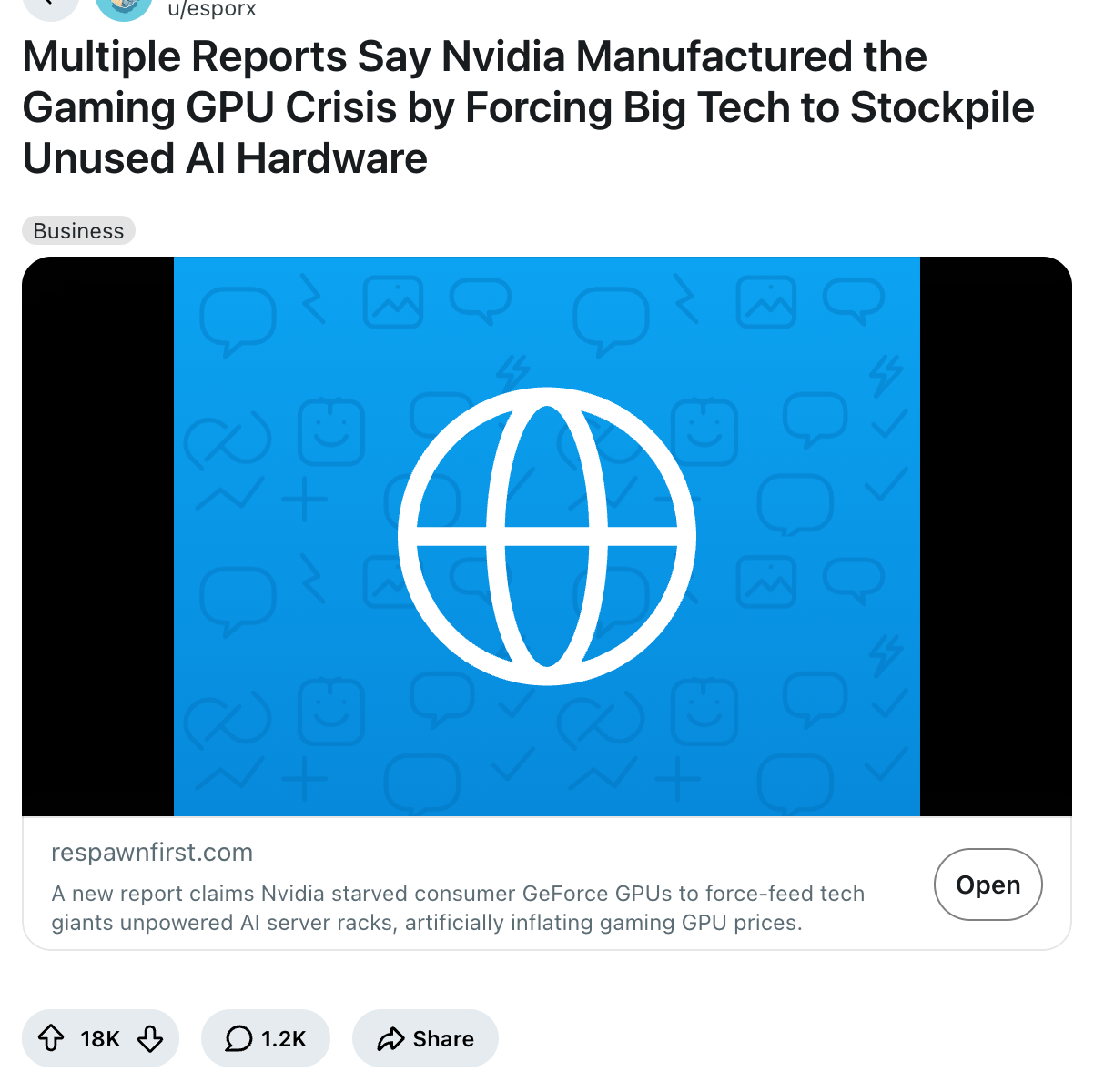
On Reddit, a thread with over 10,000 points alleges that Nvidia manufactured the gaming GPU crisis by pressuring hyperscalers to stockpile hardware they don't fully utilize. If true, the "compute shortage" narrative driving futures market demand is at least partly a supply-chain design choice — which would make price indices based on scarcity dynamics unreliable.
View original post on Substack →
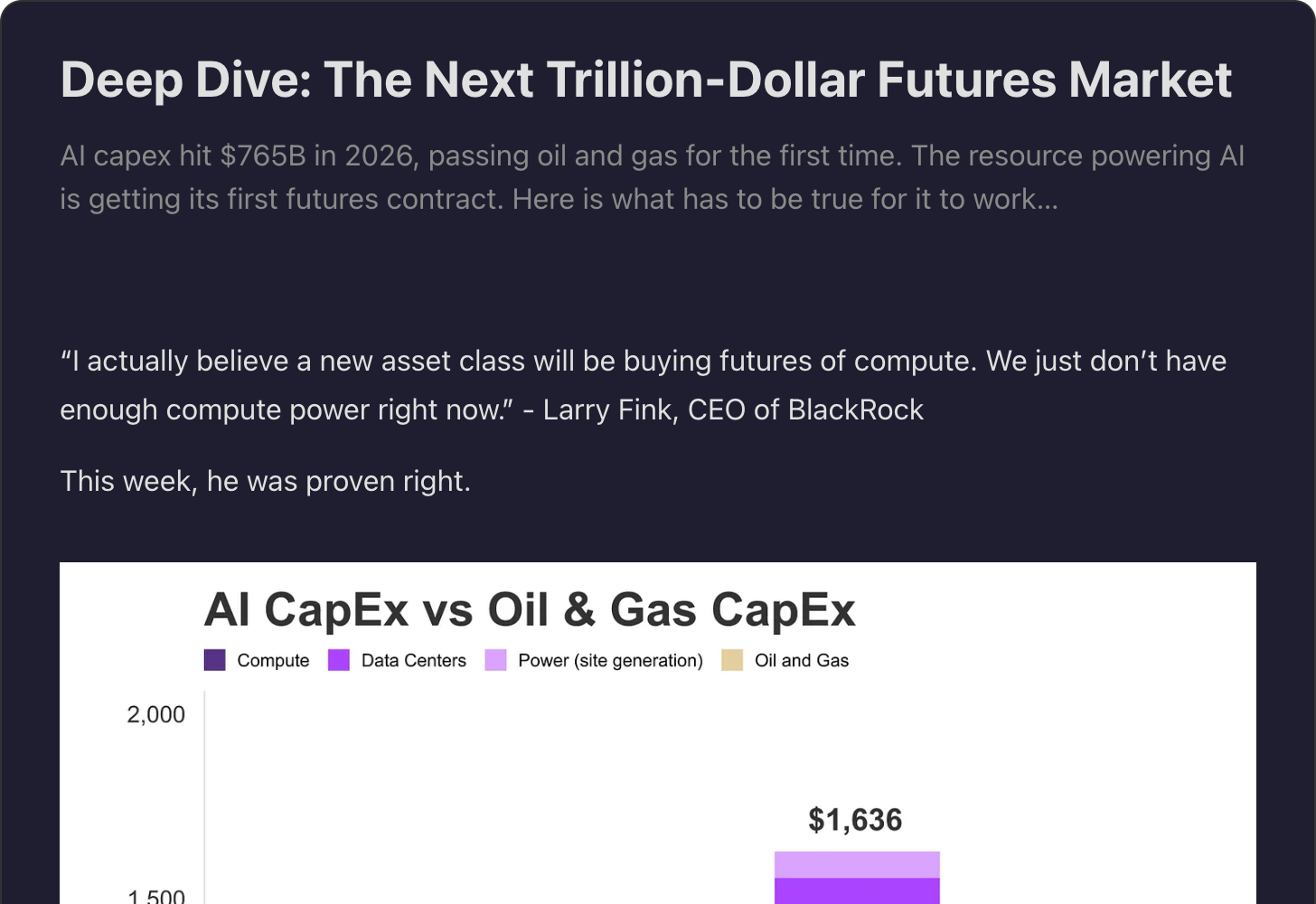
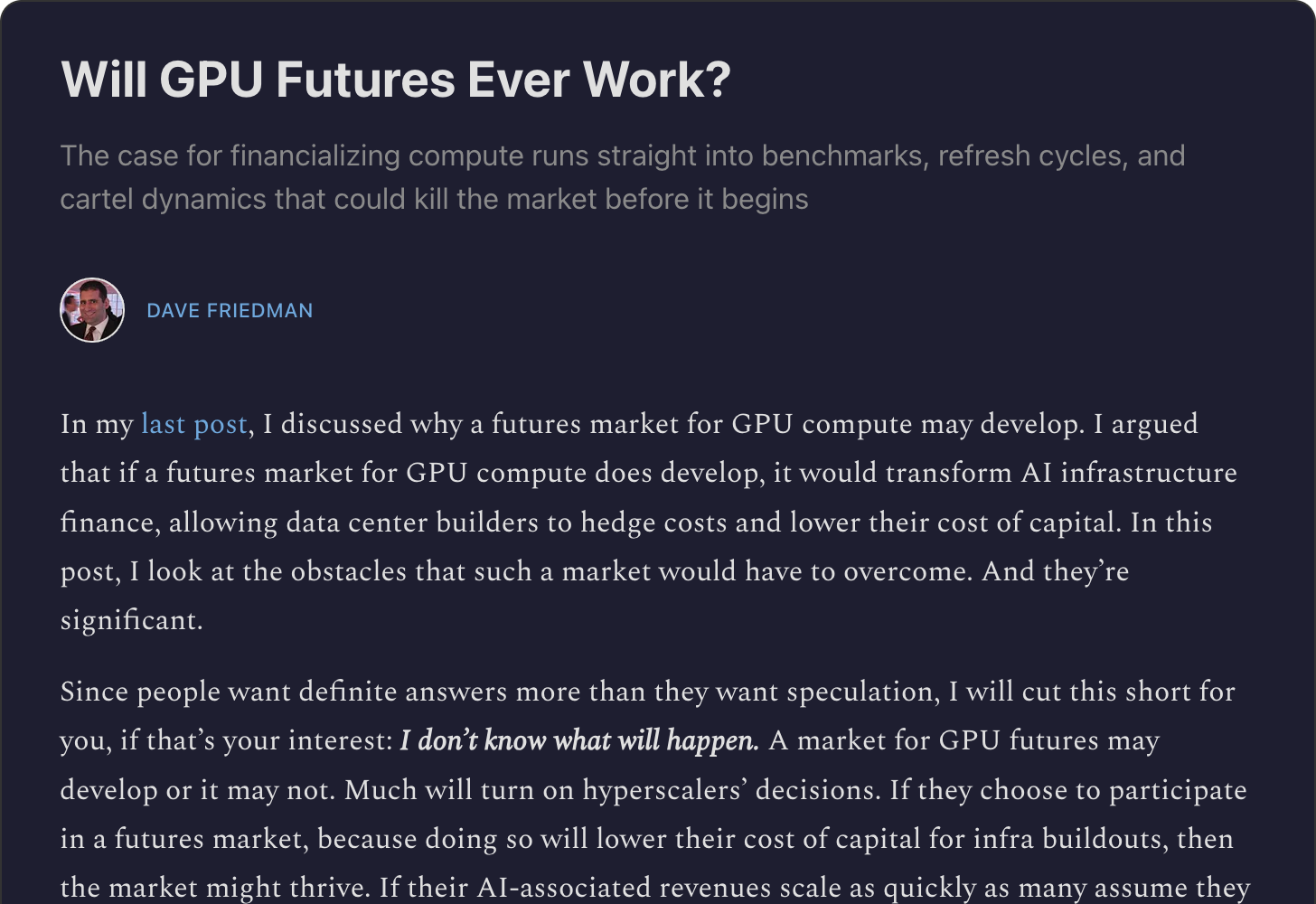
Chamath Palihapitiya's newsletter on compute financialization raises the standardization problem head-on: "H100 performance differed by as much as 34.5% in one test." Dave Friedman, in his GPU market series, asks bluntly whether GPU futures will ever work given how opaque and bundled pricing remains.
View original post on Substack →
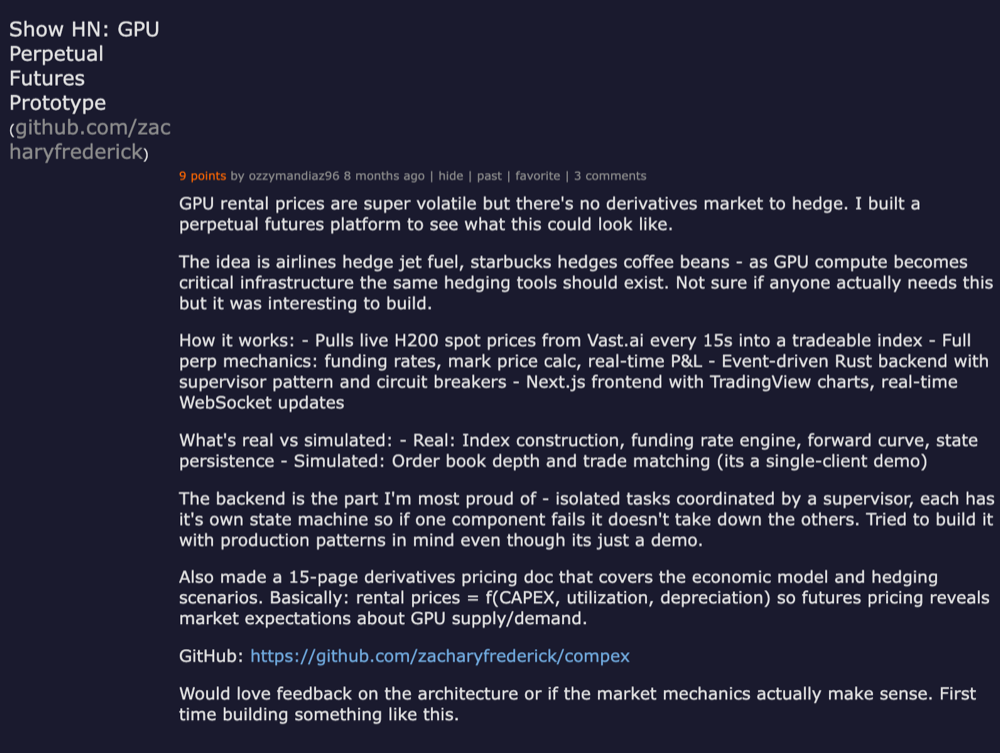
On Hacker News, a GPU Perpetual Futures Prototype Show HN post drew discussion about whether futures can work at all for an asset this heterogeneous.
View discussion on Hacker News →
The FIA's explainer attempts to address this by noting that the contracts settle against indices — not physical delivery — so the standardization problem becomes the index provider's problem, not the trader's. But that just moves the question: how trustworthy is an index when price trackers disagree by 8x?
Contrarian Corner: GPU futures might be a solution in search of a problem. Cash-settled contracts that deliver zero GPU-hours could create a speculative layer that benefits exchanges and index providers more than actual AI builders. The CFTC's hesitation isn't bureaucratic drag — it's legitimate concern about market manipulation in a fragmented, opaque market.
What This Means for You
If you're an operator, startup founder, or infrastructure engineer, here's the practical takeaway:
1. Price transparency is coming — use it. Even if CME's launch slips further, Kalshi's forward curves and Ornn's OCPI are already public. You can see the market's implied rental rates for the next six months. If you're negotiating a cloud contract, you now have a benchmark that isn't just "whatever AWS charges."
2. Diversify providers now. The cloud-to-commodity shift means your negotiating leverage increases as price transparency improves. Locked-in cloud contracts made sense when switching costs were high and pricing was opaque. That era is ending. If you can tolerate operational complexity, marketplace and spot compute (Computable, Vast.ai, Lambda) runs 60-70% cheaper than on-demand hyperscaler rates.
3. Watch the term structure. Backwardation on B200 and contango on H100 tells you the market expects new-generation supply to loosen while older chips get scarcer (as providers retire them). If your workloads can run on H100, lock in pricing sooner rather than later.
Watch Kalshi's compute forward curves as a free leading indicator for GPU rental-rate direction. Backwardation on B200/H200 suggests the market expects new-generation supply to loosen; contango on H100 suggests older chips will get scarcer.
4. The packaging bottleneck sets the timeline. Ignore capex announcements — they tell you about dollars committed, not GPUs deliverable. Track TSMC's CoWoS capacity numbers instead. When packaging catches up with demand, compute prices will fall structurally, not cyclically. Current estimates suggest that's a 2027-2028 story at the earliest.
5. Treat compute cost as a financial risk, not just an engineering cost. If 48% spot-price swings can happen in two months, compute belongs in your financial risk model alongside currency exposure and input costs. Whether you hedge via futures (when they launch) or via contract structure (prepaid reservations, spot-instance portfolios), treating compute as "just an AWS bill" is increasingly naive.
For more on the capex math driving this shift, see our analysis of whether the AI scaling law is breaking. For the unit economics of AI compute, see why AI still costs more than the human it replaces. And for the memory cost dynamics behind Amazon's $20B raise, see the AI memory squeeze.
The Larger Picture
Five years from now, we'll look back at 2026 the way energy traders look at the early 1980s — the moment a controlled, opaque market cracked open into a traded one. The players are different (CME instead of NYMEX's humble origins, Ornn instead of Reuters' telex-era price reporting), but the dynamics are identical: persistent scarcity, volatile pricing, and a user base that needs hedging tools.
The outcome is not guaranteed. Oil futures took decades to reach deep liquidity. Power markets are still regionally fragmented. Compute has additional problems — performance heterogeneity, rapid hardware obsolescence, the impossibility of physical delivery — that could keep futures markets thin and speculative.
But the direction is clear. When Amazon spends $220 billion and says it's not enough, when two of the world's largest exchanges race to list the same asset, when prediction markets are already pricing forward curves — the question isn't whether compute becomes a traded commodity. It's what grade, on which exchange, and at what cost.
Sources: CME Group, Data Center Knowledge, Kalshi, AIWeekly, Risk.net, FIA, Axios, Semafor, The Next Web, fourweekmba, Reddit r/technology, Chamath, Dave Friedman
ComputeLeap Team
The ComputeLeap editorial team covers AI tools, agents, and products — helping readers discover and use artificial intelligence to work smarter.
Join the discussion
Have thoughts on this article? Discuss it on your favorite platform:
Related articles
The $80B Loss That Might Be Genius
Anthropic lost $80.7B on paper while DeepSeek prints 82% API margins. Why both strategies could win the AI economics war.
Wall Street Wrote the AI Boom's Checks. Now It Wants Out.
JPMorgan, Morgan Stanley, and MUFG are scrambling to offload billions in AI data-center debt. What their exit means for the buildout.
Anthropic's $2T IPO Has a $518B Problem
The prospectus locks in $518B of compute but admits enterprises can walk. Here's what that asymmetry means.
The ComputeLeap Weekly
Get a weekly digest of the best AI infra writing — Claude Code, agent frameworks, deployment patterns. No fluff.
WEEKLY. UNSUBSCRIBE ANYTIME.