The De-Flock Revolt: What Happens When Trust Gets Cashed Out
Flock Safety's 120K cameras face a bipartisan backlash after a cop stalked his wife 717 times and activists mapped every lens.
The De-Flock Revolt: What Happens When Trust Gets Cashed Out
A Florida cop named Christopher Goodson queried Flock Safety's license plate database 717 times to track his estranged wife's car. He logged fake case numbers -- assault, drugs, motor vehicle offenses -- to justify every search. His wife was never under investigation. Meanwhile, a viral campaign called "De-Flock America" is urging citizens to disable, cover, or destroy Flock Safety's AI-powered cameras on Halloween night, and the movement has jumped from Reddit fringe to mainstream news in under two weeks.
This is not an isolated privacy scare. It is a pattern: companies earn trust through genuine utility, then quietly cash it out. Flock Safety's 120,000 automated license plate readers (ALPRs) across 49 states have genuinely helped solve crimes -- kidnappings, car thefts, hit-and-runs. But the same infrastructure that finds stolen cars also lets a stalker track his wife's movements across an entire city, lets ICE run immigration sweeps through plate data, and generates 20 billion vehicle scans per month with no federal warrant requirement and, until two weeks ago, no meaningful access controls.
The Scandal That Broke the Dam
View original discussion on Reddit
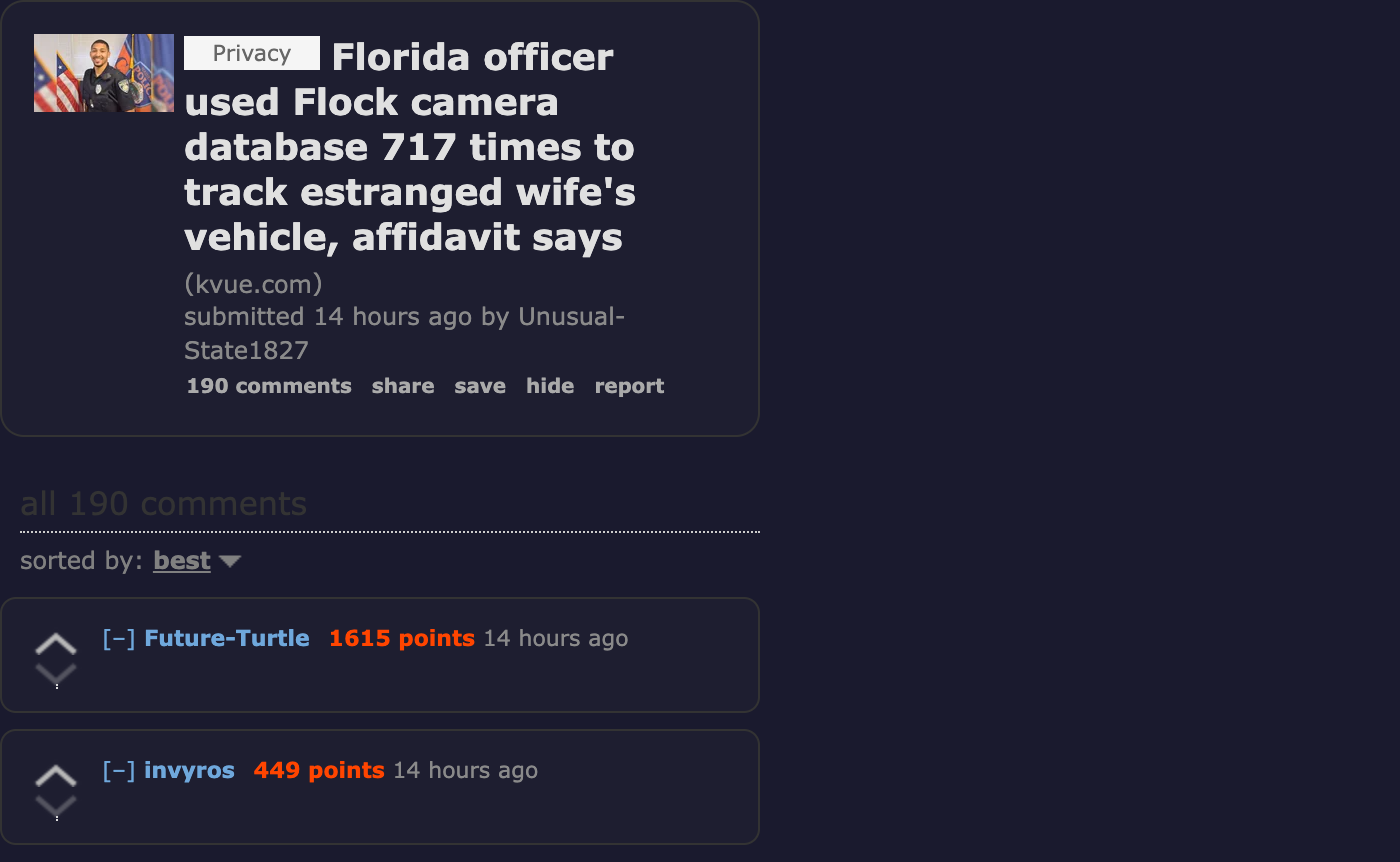
Haines City Police Officer Christopher Goodson, 31, was arrested on August 11 after investigators found he had searched for his estranged wife's vehicle 717 times in the Flock Safety database between September 2024 and June 2026. The numbers are staggering: 280 entries in September 2025 alone, 104 in November. He was charged with offenses against users of computers and official misconduct.
But Goodson is not an aberration. He is a data point in a pattern. A Georgia police chief was found dead by suicide after being arrested for using Flock to stalk multiple people. A Monroe County sheriff's deputy was arrested for allegedly stalking a woman he met on a TV production set. A former Kansas police supervisor lost his certification for using police cameras to spy on his estranged wife.
The common thread is access without accountability. Flock's system gave 140,000 officers across thousands of agencies the ability to search anyone's movements. Until August 2026, the only guardrail was a text field where officers typed a case number. Any case number. There was no verification that the case existed, that the officer was assigned to it, or that the search was relevant to an investigation.
The Contrarian Corner: Flock's defenders have a real point. The company claims its cameras have helped resolve over 1 million crimes. The De-Flock movement's Halloween vandalism call risks destroying infrastructure that genuinely helps find kidnapped children and recover stolen vehicles. Flock's own audit tools caught Officer Goodson -- they flagged his anomalous search patterns and referred the case to investigators. The question is not whether the cameras work. It is whether the abuse cases are systemic failures or fixable exceptions in a beneficial system.
The De-Flock Movement Goes Mainstream
View original discussion on Reddit
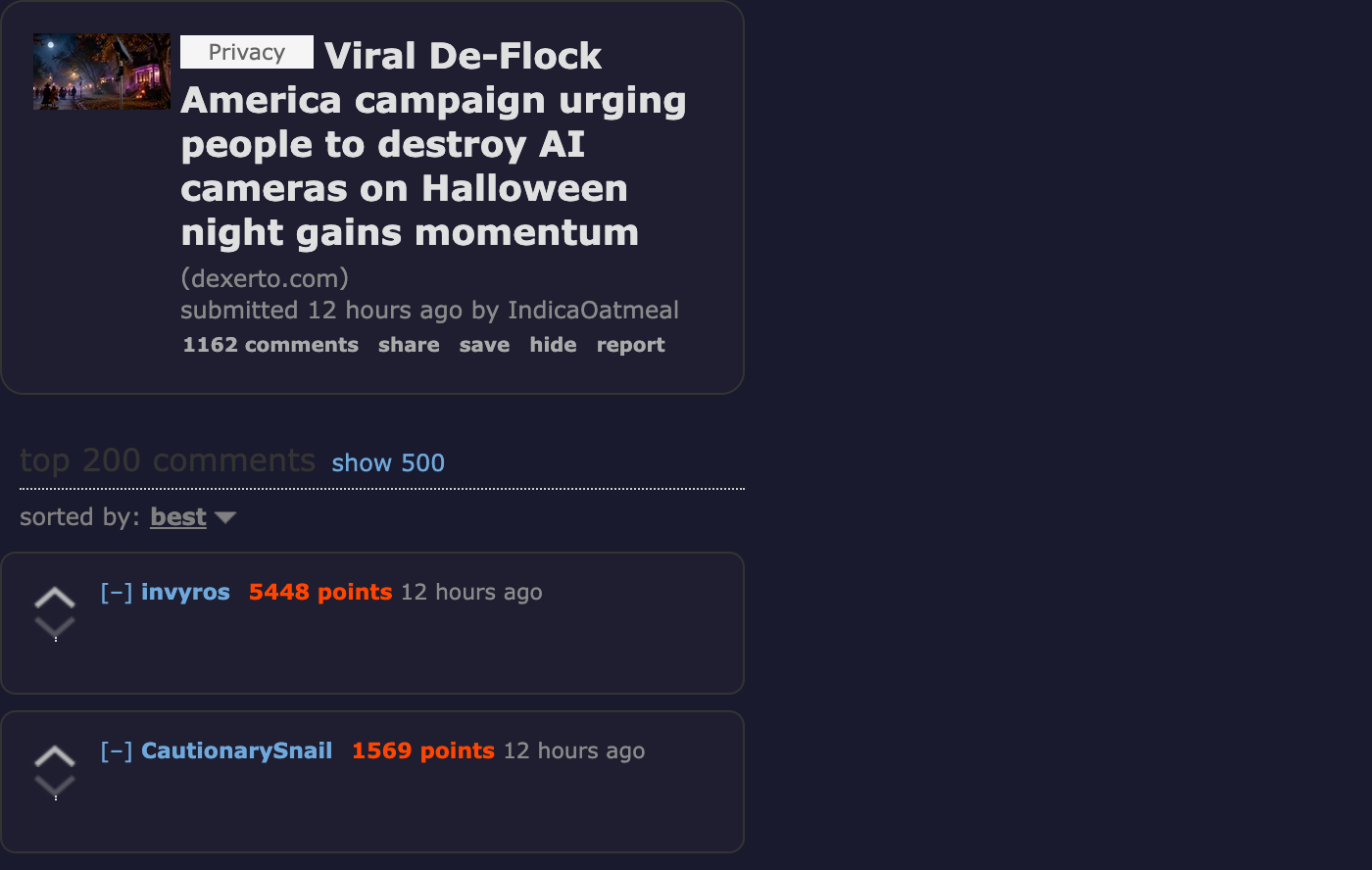
The "De-Flock America" campaign first gained traction on Reddit's r/technology, where a post about the viral Halloween campaign pulled over 9,000 upvotes. The pitch: Halloween night provides crowds and costumes as cover to disable Flock cameras. The movement is uncoordinated -- no central organizer, no clear chain of command -- which makes it both harder to stop and harder to predict.
But the destruction of cameras is just the visible tip. The deeper resistance is informational. Will Freeman's DeFlock.me project crowdsources the locations of Flock cameras nationwide, turning the surveillance apparatus transparent. When Flock sent a cease-and-desist letter claiming trademark dilution, the EFF responded by defending the project as protected First Amendment speech. A real estate listing recently made Hacker News when a buyer cancelled a home showing after DeFlock showed two cameras operated by the HOA.
At least 100 cities have now rejected ALPRs, most of them Flock cameras. Chandler, Santa Cruz, Mountain View, and El Cerrito have all ended contracts. Denver held a town hall where hundreds of residents objected. Americans are physically dismantling and destroying cameras across the country.
The Unusual Coalition
What makes the Flock backlash different from typical privacy debates is who is angry. This is not a left-versus-right issue. Privacy advocates and conservative media are on the same side. RedState ran a piece titled "Get Flock'ed: Americans Revolt Against Creepy Camera Network -- and the CEO Blinks." Congresswoman Luna, a Republican from Florida, drafted a bill to ban Flock cameras nationwide.
President Trump weighed in on August 17, saying the issue "is being studied right now" and acknowledging "you have pros and cons." For a president who typically projects certainty, the hedge is telling: the surveillance issue cuts across his base.
The coalition works because the threat is bipartisan. Left-leaning critics point to ICE using Flock data for immigration enforcement -- at least 4,000 immigration-related searches between Trump's inauguration and May 2025. Right-leaning critics see government overreach and the erosion of Fourth Amendment protections. Both see a private company with more surveillance power than most federal agencies and zero democratic accountability.
How Flock Cameras Actually Work
For anyone searching "what do Flock cameras record" -- here is what the system captures and stores.
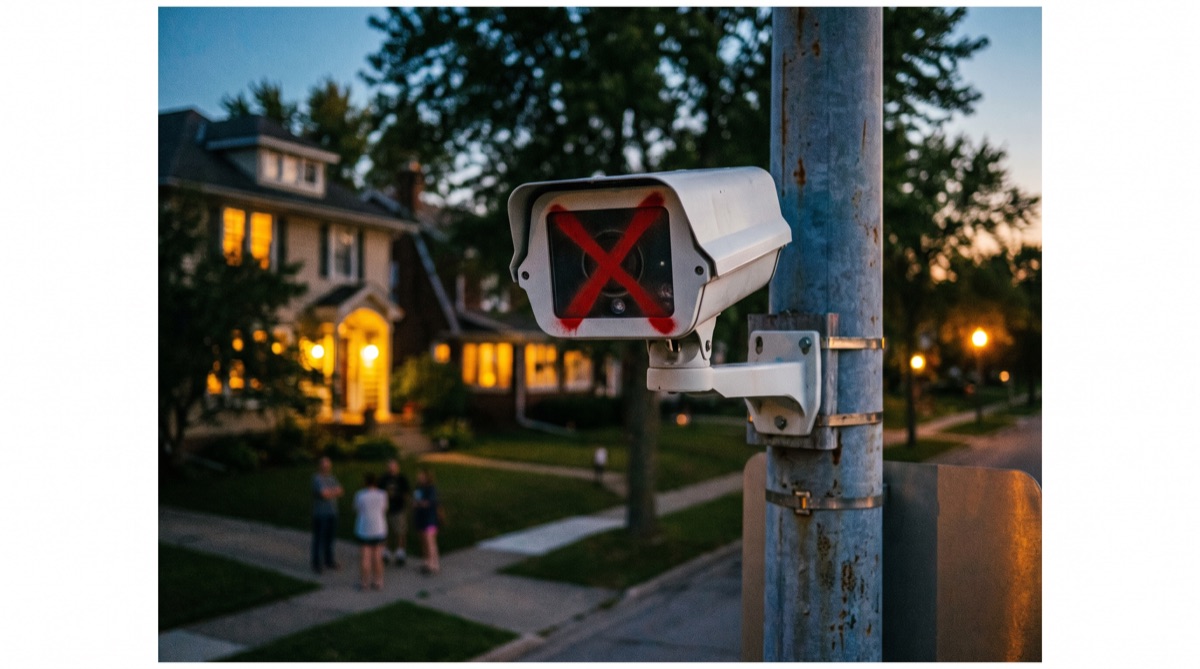
Flock Safety's ALPRs are solar-powered cameras mounted on poles, typically at intersections, neighborhood entrances, and commercial parking lots. Every time a vehicle passes, the camera photographs the license plate and uses OCR to convert it to searchable text. But it captures far more than the plate:
- License plate number (converted to text via OCR)
- Vehicle make, model, color, and body type
- Distinguishing characteristics -- bumper stickers, roof racks, damage, aftermarket modifications
- Timestamp and GPS location
- Direction of travel
All of this feeds into a centralized database shared across thousands of law enforcement agencies. Officers can search by plate number, partial plate, vehicle description, time window, or location. The system sends real-time alerts when a vehicle on a hot list passes a camera. A search for "green sedan with American flag bumper sticker" or "pickup truck with paint scratches" will return results.
What Flock says it does not do: The company states its cameras do not use facial recognition, do not record audio, do not track phones, and do not determine immigration status. But Meta's Ray-Ban patent filing (see below) shows where the industry is heading -- and Flock's own abandoned "distress detection" audio program, which the EFF forced them to kill in July 2026, shows the temptation to expand scope is constant.
Can you opt out? Functionally, no. Flock has no consumer opt-out mechanism. A handful of cities (like Los Altos Hills) allow residents to exclude their plates, but only if they prove residency at a local address. For everyone else, the cameras log you whether you consent or not. There is no federal regulation, no warrant requirement, and no nationwide data protection standard for ALPR data.
Flock Blinks -- But the Reforms Have a Hole
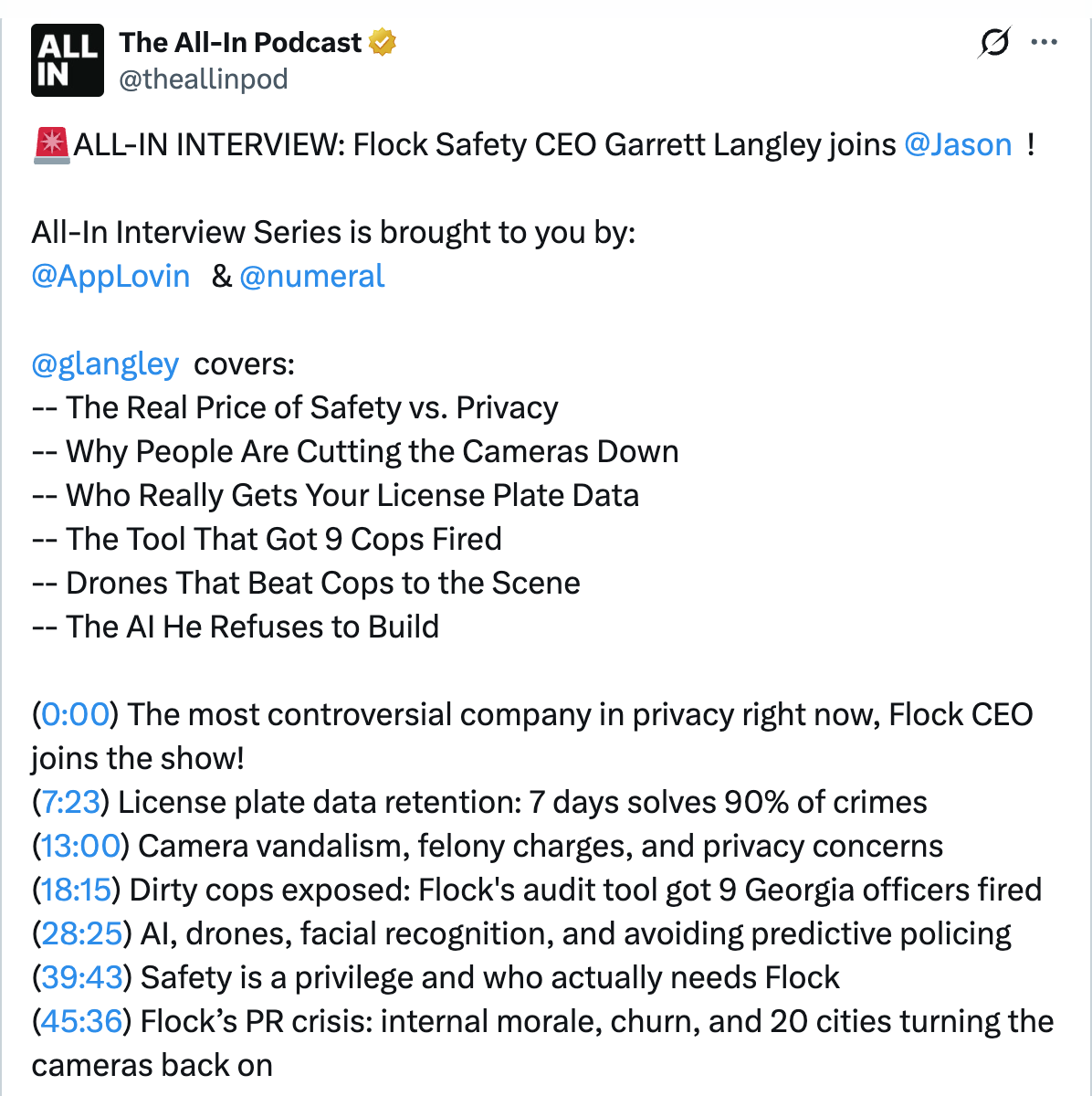
Facing unprecedented backlash, Flock CEO Garrett Langley appeared on the All-In Podcast on August 17 and announced platform changes: data retention slashed from 30 days to 7, mandatory case codes for every search, and expanded audit tools.
But the ACLU immediately identified the gap: officers can still type any case number they want. There is no verification that the case exists or that the officer is assigned to it. The structural warrant gap remains because any of 140,000 officers can still enter a fabricated case number. Officer Goodson typed fake assault and drug case numbers 717 times. A text field is not a safeguard.
The 7-day retention window is also less of a concession than it appears. Langley told All-In that "7 days solves 90% of crimes," framing it as sufficient. But as the ACLU's deeper analysis notes, the real concern is not retention duration -- it is the warrantless retrospective search itself. The Fourth Amendment question is whether the government should be able to query a database of everyone's movements at all, not how long the data persists.
The Bigger Picture: Consumer Trust as a Depletable Resource
The Flock story does not exist in isolation. The same week, two other stories hit the surveillance nerve -- and they share the same DNA.
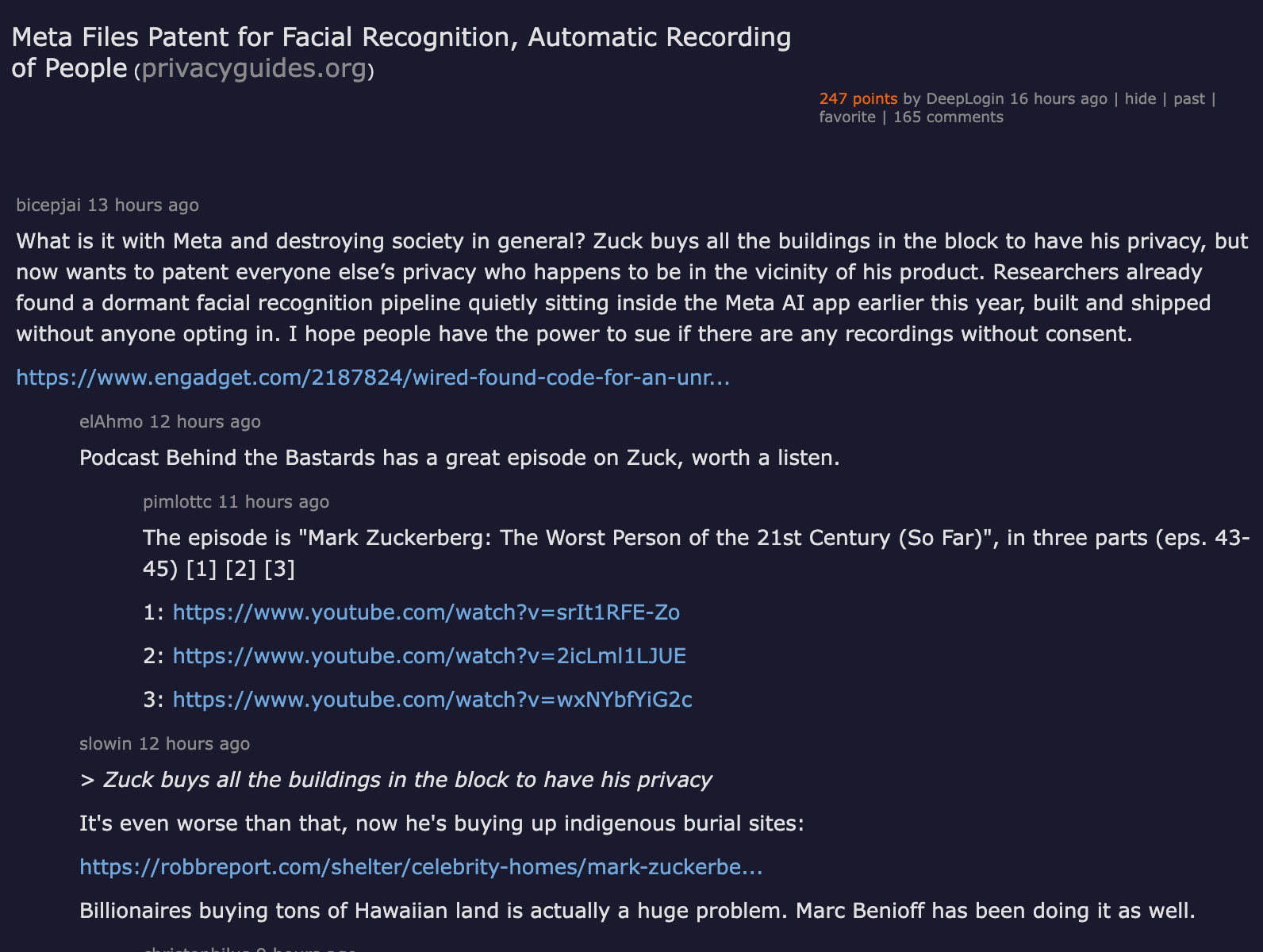
Meta's Ray-Ban facial recognition patent. Published August 13, US 2026/0238876 A1 describes a "Smart Cameras" system that identifies people by face, analyzes their expressions, tracks their gaze, and automatically records "interesting" events without the wearer commanding it. The patent is a continuation of a 2022 filing and is far from a shipping product -- but it reveals where Meta's product thinking is heading.
View discussion on Hacker News
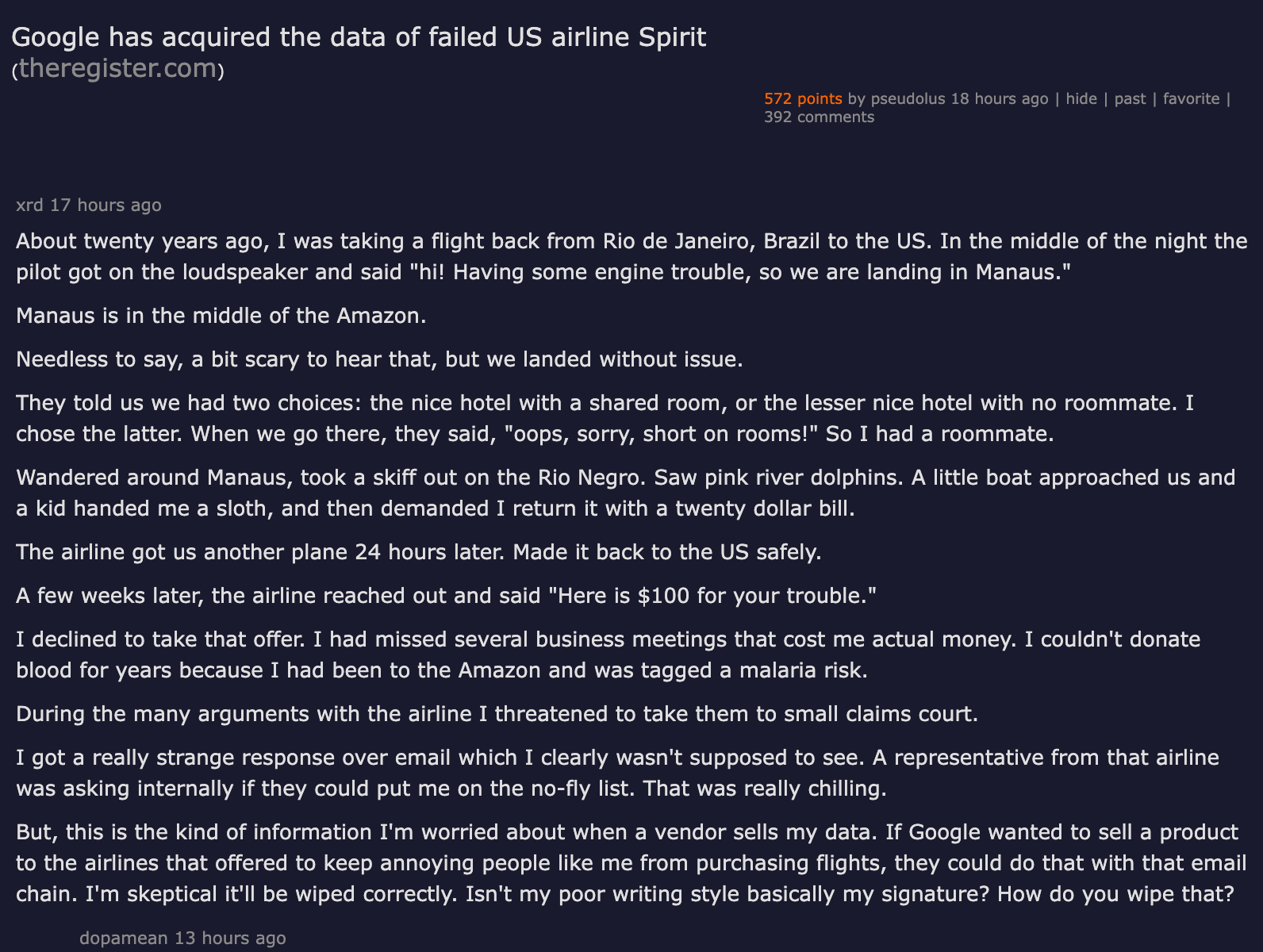
Google buying Spirit Airlines' data for AI training. Google won a bankruptcy auction for $10 million, acquiring 100 million emails, 500 million Microsoft Teams chats, and 7.5 billion passenger transaction records from the bankrupt airline. Google says personal data will be scrubbed before receipt -- but when you have 7.5 billion transaction records to cross-reference, "deidentified" is a legal fiction, not a technical guarantee.
View discussion on Hacker News
The connective tissue across all three -- Flock, Meta, Google -- is the same: consumer trust, originally earned through utility (Flock solves crime, Ray-Bans are cool glasses, Spirit sold cheap flights), is being cashed out by the platforms that earned it. The relationship began as transactional and silently shifted to extractive. The Amazon Ring-Flock partnership collapse tells you consumers have started to notice: Ring's Super Bowl ad -- a lost dog found via networked cameras -- triggered a boycott so fierce that Amazon killed the integration within days.
For a deeper look at how the AI backlash is reshaping consumer behavior, see our analysis of DuckDuckGo's No-AI search surge and Microsoft's AI cost crisis.
What the Community Is Saying
The Flock backlash has generated some of the most engaged discussions on Reddit and Hacker News this year. The r/technology De-Flock post pulled over 9,000 upvotes with extensive debate about whether destroying cameras is justified civil disobedience or counterproductive vandalism. The Florida stalking case hit 3,000 upvotes with commenters noting the pattern of law enforcement misuse across multiple states.
On Hacker News, the Flock camera tracking thread and the dashcam surveillance expansion story together paint a picture of a company pushing into every possible data source -- ALPR cameras, Ring doorbells, now rideshare dashcams. A separate thread about a home buyer cancelling a showing after DeFlock revealed HOA cameras shows how the surveillance premium is starting to affect property values.
What This Means for Builders: If you are building any product that collects location, biometric, or behavioral data, Flock's trajectory is your cautionary tale. Access controls, audit trails, data retention limits, and warrant requirements need to be designed from day one -- not bolted on after a cop stalks his wife 717 times and the ACLU writes a press release. The cost of retrofitting trust is always higher than the cost of building it in. For a deeper dive on building ethical AI systems, see our AI Safety and Ethics Guide.
Where This Goes Next
Three predictions:
1. Federal legislation is coming, but it will be weak. The bipartisan anger creates political cover for action, but the law enforcement lobby is powerful and Flock has spent heavily on lobbying. Expect a framework that mandates retention limits and audit logs but stops short of requiring warrants. The Fourth Circuit case where the ACLU filed an amicus brief could be the real game-changer -- if the court rules that ALPR data collection constitutes a search under the Fourth Amendment, it rewrites the rules for the entire industry.
2. The De-Flock movement will fragment. The Halloween vandalism call makes for viral content but terrible strategy. Destroying cameras is a felony in most states, and it gives Flock a sympathetic narrative. The effective resistance is civic: showing up at town halls, filing public records requests, mapping camera locations, and voting out city councils that approve contracts without community input. The ACLU's "Get the Flock Out" campaign is building the institutional version of what the Reddit movement started.
3. The trust-cashing pattern will accelerate. Meta's patent and Google's Spirit data buy are not anomalies. Every major tech company is sitting on consumer data originally collected under one social contract (photos for memories, flights for travel) and repurposing it under another (AI training, behavioral modeling, surveillance infrastructure). The companies that survive this reckoning will be the ones that ask permission before they pivot. The ones that don't will face their own De-Flock moment.
The surveillance debate is not about whether cameras work. It is about who controls them, who audits the controllers, and whether "we might solve a crime" justifies recording every car in America. Right now, the answer to all three questions is uncomfortable: nobody, nobody, and we never asked you.
ComputeLeap Team
The ComputeLeap editorial team covers AI tools, agents, and products — helping readers discover and use artificial intelligence to work smarter.
Join the discussion
Have thoughts on this article? Discuss it on your favorite platform:
Related articles
Open Weights Just Closed the Gap
Cloudflare's Clef beats the incumbent, FLUX 3 Image ships, and PewDiePie gets banned for distilling. Open weights are frontier.
Humanoids Are a Backward-Compatibility Layer
Palmer Luckey's strongest robotics argument, ARK's beaten forecasts, and China's embodiment race reframe humanoids as the API for the physical world.
Sonnet 5.5 Just Ate Opus. Anthropic Did It on Purpose.
Sonnet 5.5 scores 70.6% on Terminal-Bench — beating Opus 5.5's 66.4% — at half the price. Here's why Anthropic is cannibalizing its own premium tier.
The ComputeLeap Weekly
Get a weekly digest of the best AI infra writing — Claude Code, agent frameworks, deployment patterns. No fluff.
WEEKLY. UNSUBSCRIBE ANYTIME.