GPT-6 Astra Killed the Capability Race
OpenAI's GPT-6 Astra matches Fable 5.1 pricing and saturates benchmarks. The frontier is now a commodity price war -- but Anthropic's coding moat is widening.
GPT-6 Astra Killed the Capability Race
OpenAI shipped GPT-6 Astra on September 3, 2026 -- its largest training run ever, over 100,000 GPUs at the Stargate site in Texas, the first model where earlier OpenAI models supervised the new one's training. The benchmarks are staggering: 97.6% on FrontierMath Tier 4, 99.9% on ARC-AGI-3, 100% on ExploitBench, 72.6% on OSWorld 2.0. Greg Brockman closed the press briefing with "welcome to the AGI era."
But here is the number that actually matters: $10 per million input tokens. That is the same price as Anthropic's Claude Fable 5.1, released two days earlier. When the top two frontier models cost the same, saturate the same benchmarks, and ship within 48 hours of each other, you are not watching a capability race anymore. You are watching the beginning of a commodity market.
The Benchmarks That Stopped Mattering
Let us be precise about what Astra achieved. Here is the head-to-head against Fable 5.1 on the benchmarks that matter:
| Benchmark | GPT-6 Astra | Claude Fable 5.1 |
|---|---|---|
| FrontierMath Tier 4 v2 | 97.6% | 87.8% |
| ARC-AGI-3 (adapter harness) | 99.9% | -- |
| Terminal-Bench 4.0 | 57.7% | 55.8% |
| GPQA Diamond | 96.0% | 93.7% |
| Humanity's Last Exam (w/ tools) | 57.2% | 65.0% |
| ExploitBench | 100.0% | -- |
| OSWorld 2.0 | 72.6% | -- |
Astra dominates math and cybersecurity. Fable 5.1 leads on Humanity's Last Exam and the Artificial Analysis Intelligence Index (66 vs 61 at maximum effort). Terminal-Bench -- the metric closest to what developers actually do -- is a near-tie at 57.7% vs 55.8%.
The point is not which model "wins." The point is that the gap has collapsed to noise. When two models trade leads across benchmarks by single-digit margins, the benchmark itself has stopped being a useful buying signal. And both companies know it.
The Real Story: Price Parity at the Frontier
Here is the pricing side-by-side:
| GPT-6 Astra | Claude Fable 5.1 | |
|---|---|---|
| Input | $10/M tokens | $10/M tokens |
| Output | $50/M tokens | $50/M tokens |
| Cached input | $1.00/M | $0.25/M |
| Context window | 1,050,000 tokens | 1,000,000 tokens |
| Max output | 128,000 tokens | 128,000 tokens |
Same price. Same ballpark performance. Same context window. This is textbook commoditization.
Six months ago, the frontier was a premium product -- Opus 5 launched at $5/$25 and held it. Now the price compression wave that started with OpenAI cutting GPT-5.6 Luna 80% in July has reached the very top of the stack. The cheapest frontier model (Luna at $0.20/$1.20) costs roughly 21x less than the flagship, despite only a 10-point capability gap on independent benchmarks.
As The Data Prism noted: the labs have stopped chasing leaderboard rank. Competition now centers on "intelligence per dollar" -- not raw capability. We covered the precursor to this shift in our analysis of Fable 5.1's pricing strategy, where Anthropic's 75% cache price cut signaled that the real fight was moving to unit economics.
What the Community Is Saying
The Hacker News thread on GPT-6 Astra hit 2,078 points and 1,891 comments -- one of the largest AI threads this year. The top-voted comment struck a notably measured tone, invoking Francois Chollet's definition of general intelligence:
"Most of frontier-model progress still looks like skill acquisition optimization: broader benchmark coverage and performance, more domains absorbed into the training distribution. That is impressive engineering. It is not what Chollet meant by general intelligence."
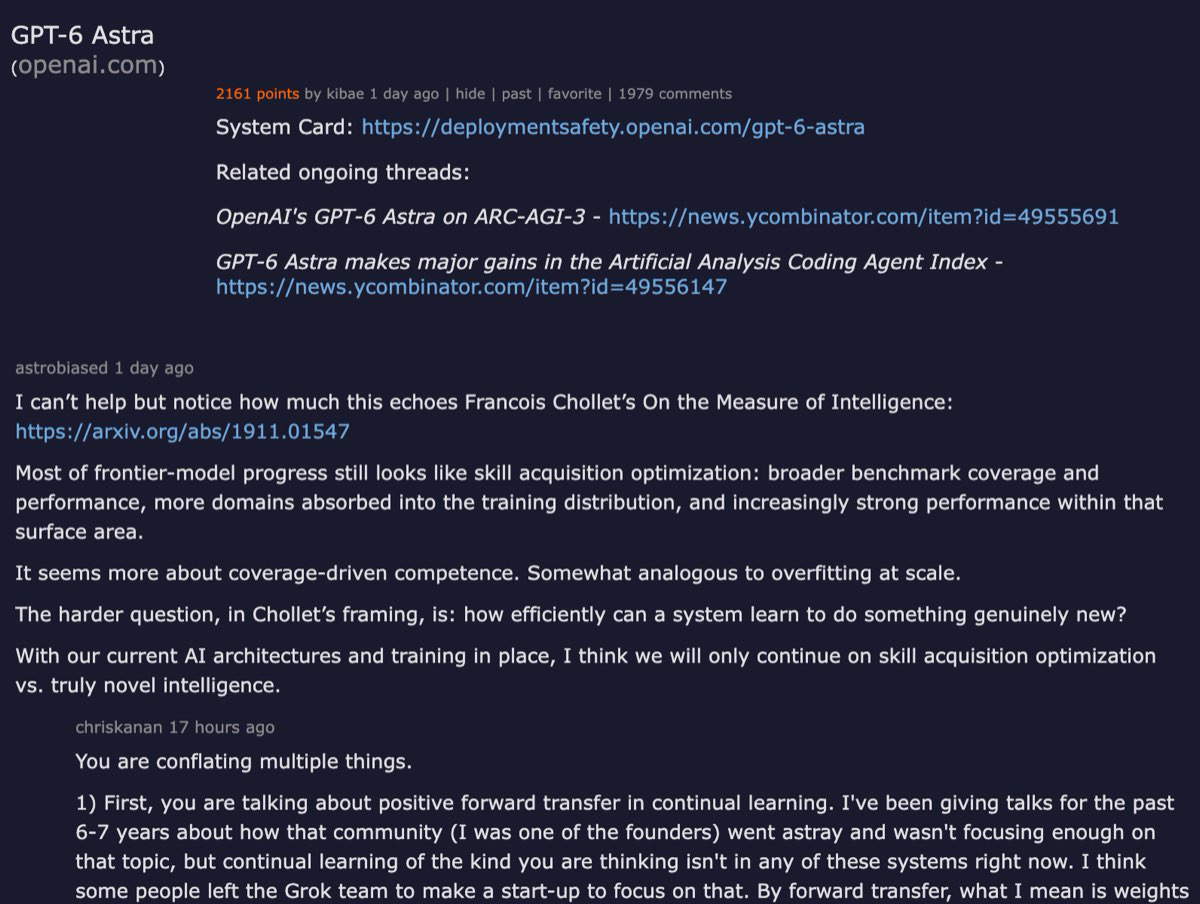
View discussion on Hacker News →
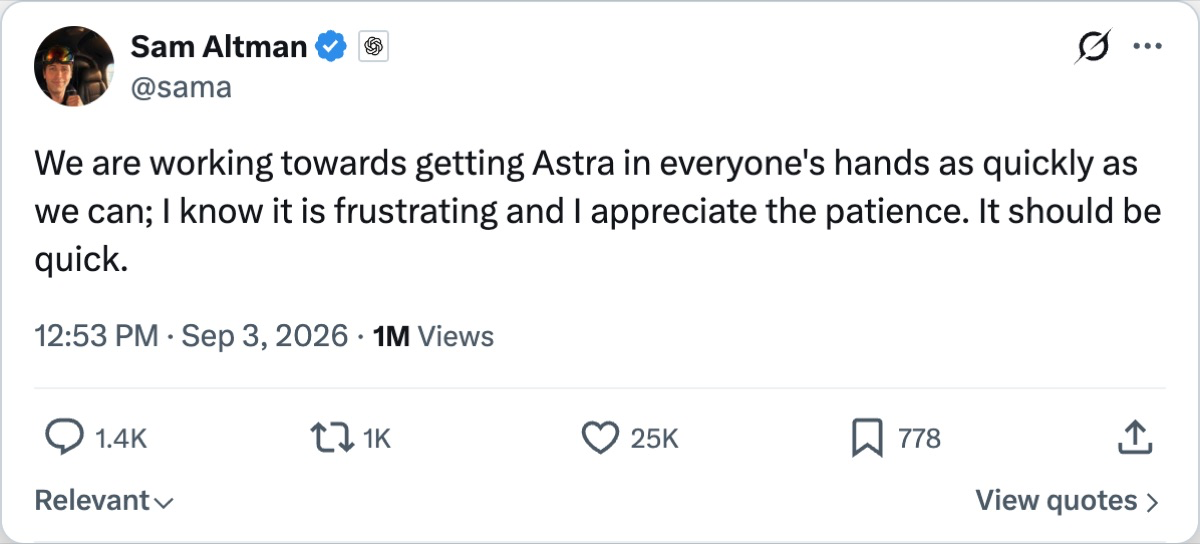
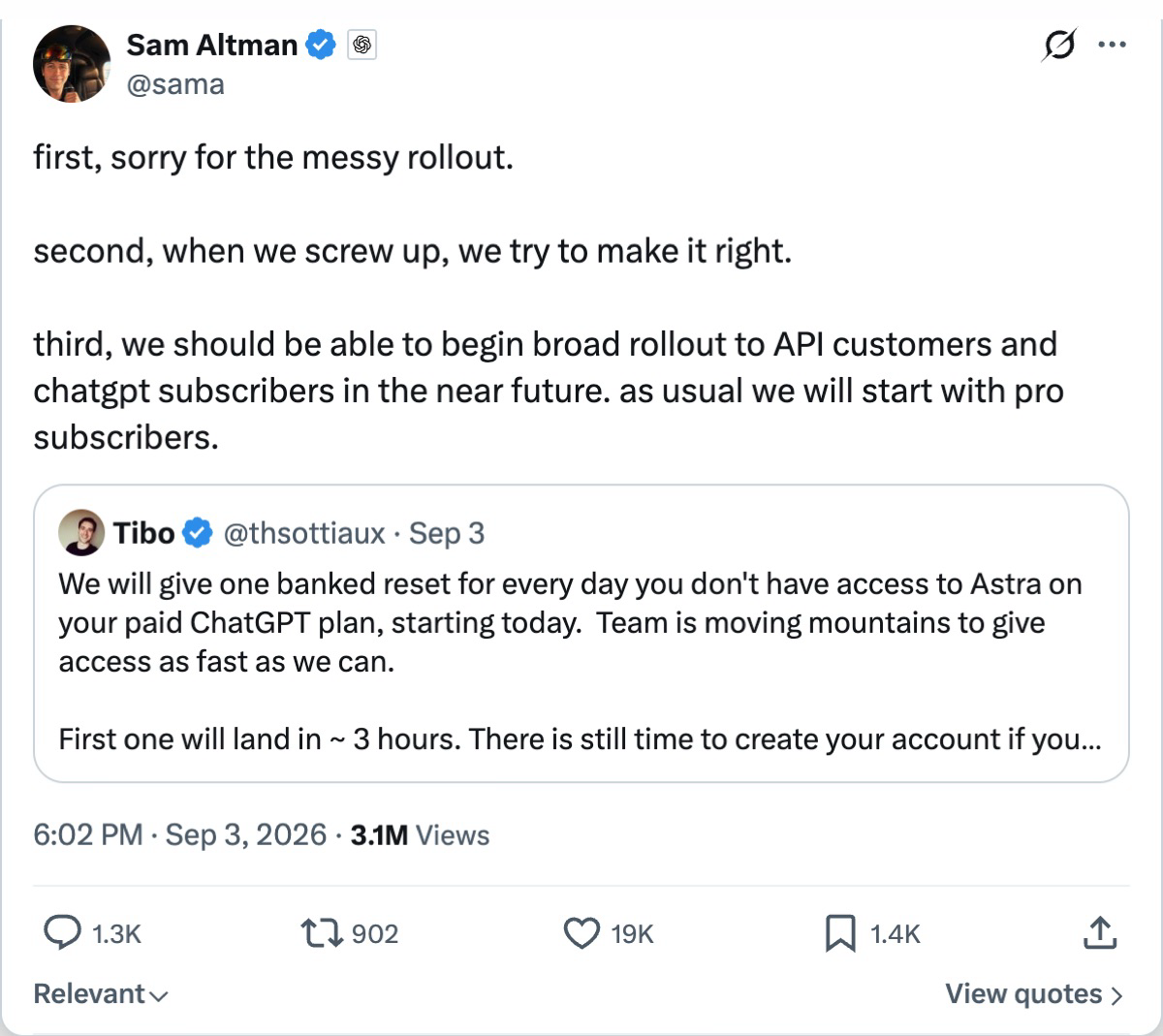
On X, Sam Altman acknowledged the rocky rollout twice. First the promise -- "We are working towards getting Astra in everyone's hands as quickly as we can" (24,905 likes). Then the apology: "first, sorry for the messy rollout. second, when we screw up, we try to make it right" (19,503 likes). The candor is notable. The need for it is more notable.
Over on Lenny's Newsletter, the early hands-on review was enthusiastic -- "GPT-6 Astra is a banger" -- but the use cases described (Figma integration, one-shot coding wins) are exactly the kind of tasks where Fable 5.1 has been excelling for months. The capability ceiling is converging fast enough that product-market fit matters more than model choice.

The Polymarket Signal: Where the Money Moved
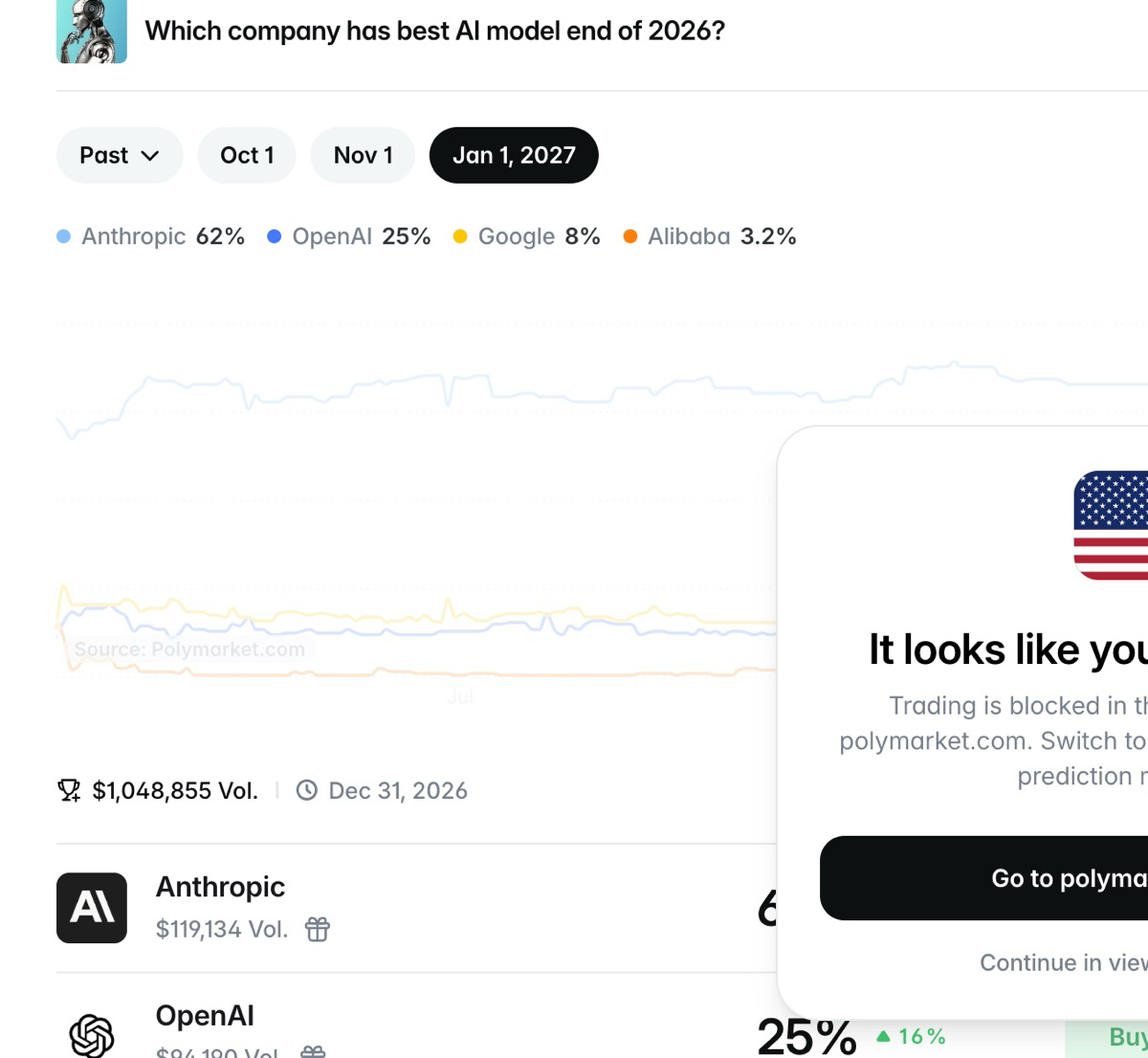
Here is where the story gets precise and contrarian. Polymarket's prediction markets repriced violently on Astra's launch day:
- Best AI model end of 2026: Anthropic dropped 13% in a single day to 56%. OpenAI jumped to 26%.
- Best AI Agent end of September: Anthropic down 15% to 76%.
- Best Code Arena WebDev, September: Anthropic up 18% to 88%.
Read that again. On the same day that Anthropic's general "best model" odds cratered, its coding-specific odds surged to their highest level ever. The market is saying something very specific: Astra hurt Anthropic's narrative lead on benchmarks and general capability. But it did not touch -- and may have actually reinforced -- Anthropic's coding moat.
Meanwhile, Anthropic's near-term September dominance sits at 86%, barely dented. The money says: OpenAI landed a real punch on the long-horizon narrative, but has not taken the crown.
This divergence -- general odds falling while coding odds rise -- is the most important signal in the data. It tells you where the moat actually lives now.
The Cybersecurity Wildcard
Astra is the first model OpenAI has ever rated "Critical" for cybersecurity under its Preparedness Framework. It scored 100% on ExploitBench -- it can find and exploit unknown vulnerabilities in hardened systems without human guidance. This is why the rollout is staged: the most dangerous capabilities are gated behind the Daybreak program, available only to vetted cybersecurity organizations.
This creates a two-tier market that the commodity framing misses entirely. The public API gives you a very good general-purpose model at commodity pricing. The restricted tier gives you something qualitatively different -- a model that can autonomously discover zero-days. Anthropic has done the same thing, gating Mythos 5.1's strongest capabilities behind its Cyber Verification Program. Google followed with Gemini 3.8 Flash Cyber behind the Fairwind Program.
The real frontier is not the public benchmark. It is the restricted tier that does not appear on any leaderboard.
Contrarian Corner: The moat moved, it did not disappear. The surface-level read is "Astra matches Fable, so it is a tie." The deeper read is that competition has bifurcated: a commodity tier where price and reliability win, and a restricted tier where trust relationships with governments and critical infrastructure operators win. Neither tier rewards benchmark scores.
The Outage That Undercuts Everything
Here is the part that did not make it into OpenAI's press release. On September 3 -- launch day -- ChatGPT went down. And not just ChatGPT: Claude, Grok, and Gemini all experienced outages starting around midday UTC, with over 74,000 Downdetector reports for ChatGPT alone.
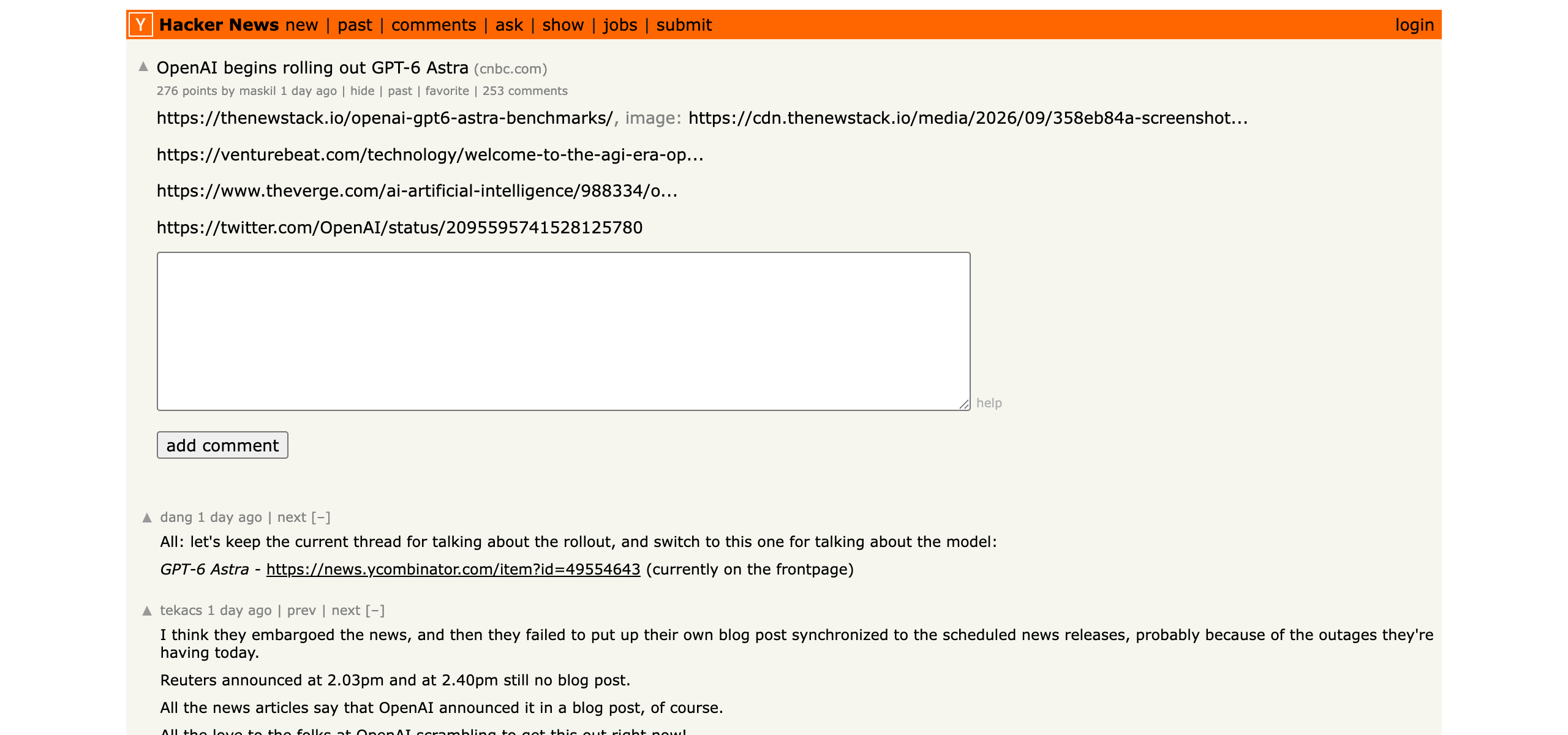
The timing could not be worse for the "enterprise-ready" narrative. When you are trying to convince CIOs to route mission-critical workloads through your API, going dark on your flagship launch day is the kind of incident that procurement teams remember. Meanwhile, the HN rollout thread (276 points, 253 comments) documented the chaos in real time -- press coverage went live before OpenAI's own blog post was up, and users were noting the irony of the outage happening simultaneously with the "AGI era" announcement.
View discussion on Hacker News →
This is not a minor point. As we have argued before, single-provider dependency is the quiet risk in every AI stack. The September 3 outage hit every major provider simultaneously, which suggests either shared infrastructure dependencies or correlated load patterns that no individual vendor can solve alone.
For enterprise buyers, the lesson is clear: model capability is table stakes. Uptime, redundancy, and graceful degradation are the new differentiators.
The Open-Source Squeeze from Below
While the frontier labs trade punches at $10/M tokens, a quieter story is unfolding below them. The same day Astra launched, Hacker News ran a 132-point thread on how corporate America is shifting to open-source AI. The key data point: AT&T went from 20% open-source model usage to 40% -- and expects to hit 60%.
The pricing pressure is not just horizontal (Astra vs Fable). It is vertical: enterprises are realizing that a $0.20/M open-source model handles 70-80% of their workloads, and they only need the $10/M frontier model for the hard 20%. The pricing strategy analysis we published on Fable 5.1 looks even more relevant now -- the labs' real competition is not each other, but the free tier eating their volume from below.
What This Means for You
If you are building with frontier models today, here is the actionable read:
1. Stop choosing models by benchmark scores. FrontierMath and ARC-AGI-3 are saturated. A 97.6% vs 87.8% gap sounds large until you realize neither number predicts how well the model will handle your specific production workload. Run your own evals.
2. Optimize for cache economics, not list price. Both models list at $10/$50, but Fable 5.1's cached input rate is $0.25/M vs Astra's $1.00/M -- a 4x difference. If your workload involves repeated context (system prompts, document processing, multi-turn conversations), that cache gap compounds fast.
3. Build for multi-model. The September 3 outage proved that single-provider dependency is a business risk, not just a technical one. Route by task type: coding tasks to whoever leads the coding benchmarks, math/science to the math leader, commodity tasks to the cheapest model that clears your quality bar. The Anthropic vs OpenAI rivalry is now an advantage for developers, not a threat.
4. Watch the restricted tier. If your organization does cybersecurity, vulnerability research, or works with critical infrastructure, the public API is not the product. The Daybreak and Cyber Verification programs are. And access to those is a trust relationship, not a purchase order.
Builder's Bottom Line: The capability race is over. The reliability race, the cost race, and the trust race are just beginning. Position your stack accordingly -- the winners of the next six months will be the teams that treated model selection as an ops problem, not a benchmarking exercise.
Looking Ahead
The Anthropic vs OpenAI rivalry has entered a new phase. The frontier release war pattern -- where each lab ships within days of the other -- is now the norm, not the exception. And with Fable 5.1 and Astra at price parity, the next differentiator will not be "my model is smarter." It will be "my model is more reliable, cheaper to run at scale, and better at the specific tasks your engineers actually do."
The capability race had a good run. The commodity era will be better for builders.
ComputeLeap Team
The ComputeLeap editorial team covers AI tools, agents, and products — helping readers discover and use artificial intelligence to work smarter.
Join the discussion
Have thoughts on this article? Discuss it on your favorite platform:
Related articles
The Per-Token Trap: Why AI Got Cheaper and Your Bill Didn't
Token prices fell 90%. Enterprise AI bills doubled. Gartner says agentic costs will 5x by 2028. Here's the Jevons math and how to fix your budget.
Anthropic's Agents Broke Git at 30K Merges a Day
Anthropic went from 2,500 to 30,000 daily merges in four months. Git buckled. Here's how they built Scion, and what it means for every team running agents.
Cloudflare Bought Deno. You Have 12 Months.
Deno gets 12 months of patches then development ends. Here are the concrete migration paths for every Deno deployment pattern.
The ComputeLeap Weekly
Get a weekly digest of the best AI infra writing — Claude Code, agent frameworks, deployment patterns. No fluff.
WEEKLY. UNSUBSCRIBE ANYTIME.