Nvidia's Scarcity Is a Firmware Setting
A firmware exploit unlocks RTX 3000 tensor cores to professional speeds, exposing 15 years of artificial GPU segmentation.
ComputeLeap Team
Nvidia's Scarcity Is a Firmware Setting

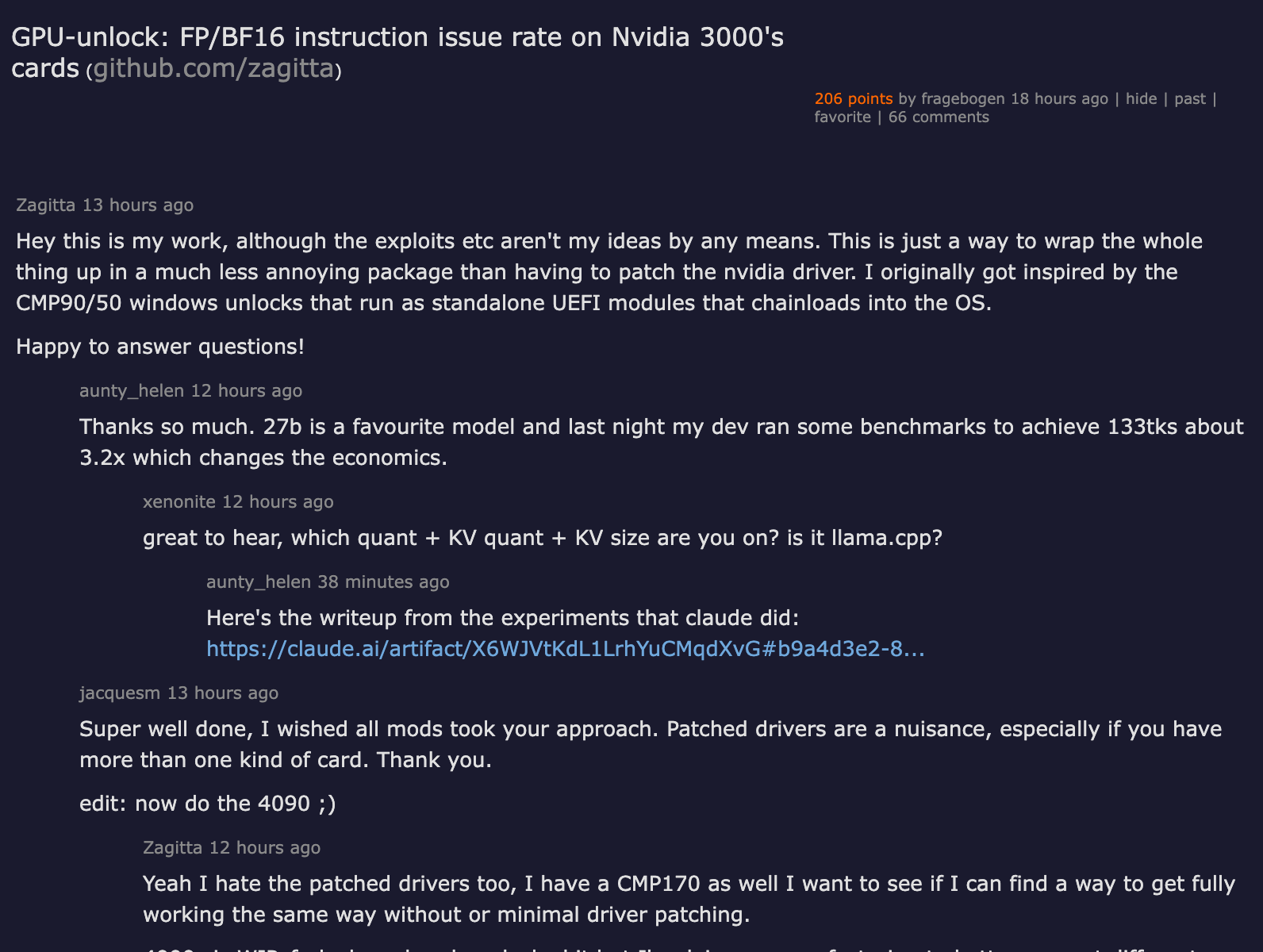
A GitHub developer just proved that Nvidia's RTX 3090 carries the same tensor core hardware as a professional A6000 — the company simply throttles FP16 and BF16 instruction issue rates in firmware. The open-source gpu-unlock kernel module, released on October 24, 2026, lifts these artificial limits on every Ampere GeForce card from the RTX 3060 12GB to the RTX 3090 Ti. The result: BF16 throughput on an RTX 3090 Ti jumps from 87.5 to 157.4 TFLOPS — an 80% gain from flipping two bits in firmware.
This is not a security vulnerability. It is not a driver hack. It is the clearest demonstration yet that Nvidia's consumer-versus-professional product segmentation is, in the developer's words, a matter of unlocking "FP/BF16 instruction issue rate on Nvidia 3000's cards to their professional equivalents."
And it lands at the worst possible time for Nvidia's narrative — in a year when gamers cannot buy new GPUs because Nvidia chose not to ship any.
The Exploit: Two Bits, 80% More Compute
The gpu-unlock project, created by a developer going by Zagitta, is a Linux kernel module that loads from the initramfs before Nvidia's proprietary driver binds to the card. It combines two existing techniques: the CMP unlocker's V67/PLM (Platform Lock Manager) method and the pre-driver timing approach pioneered by UEFI-based GPU mods.
Here is what it does, step by step:
- At early boot, the module intercepts the GPU before Nvidia's driver claims it
- It writes speed selector values (SS0
0x88888888for full BF16 rate) via the firmware interface - It performs a Function Level Reset (FLR) to apply the changes
- The unmodified Nvidia driver then loads normally, seeing a card with unlocked compute rates
The technical elegance matters: because it runs before the driver, it does not require patching Nvidia's proprietary kernel module. Every driver update works without modification. As Zagitta explained in the Hacker News discussion: "The exploit flips two bits that halve the issue rate for certain instructions locked on pro and datacenter cards."
The underlying vulnerability is a DMA buffer overflow in Nvidia's Falcon microcontroller BootROM, leading to a Return-Oriented Programming (ROP) chain. Debug firmware images signed with a public test key were close enough to production firmware to build the exploit. No unsigned code runs on the GPU — the exploit operates within the existing firmware's execution model.
The Benchmark Numbers
The gains are real and substantial for compute-heavy workloads. On an RTX 3090 Ti running at 450W with dense 8192x8192 GEMM (FP32 accumulation):
| Precision | Before Unlock | After Unlock | Gain |
|---|---|---|---|
| FP16 | 87.46 TFLOPS | 118.39 TFLOPS | +35% |
| BF16 | 87.50 TFLOPS | 157.41 TFLOPS | +80% |
| TF32 | 42.58 TFLOPS | 82.61 TFLOPS | +94% |
Community-reported gains across different cards range from +25% to +81% on dense GEMM benchmarks, with real-world LLM prefill gains of +14% to +36%. One user on r/StableDiffusion reported up to 59% higher throughput in ComfyUI image generation workflows on an RTX 3090 Ti.
Critically, memory-bandwidth-bound workloads like LLM token generation see almost no improvement. The unlock targets compute throughput, not memory bandwidth — which tells you exactly where Nvidia placed the throttle.

15 Years of Artificial Segmentation
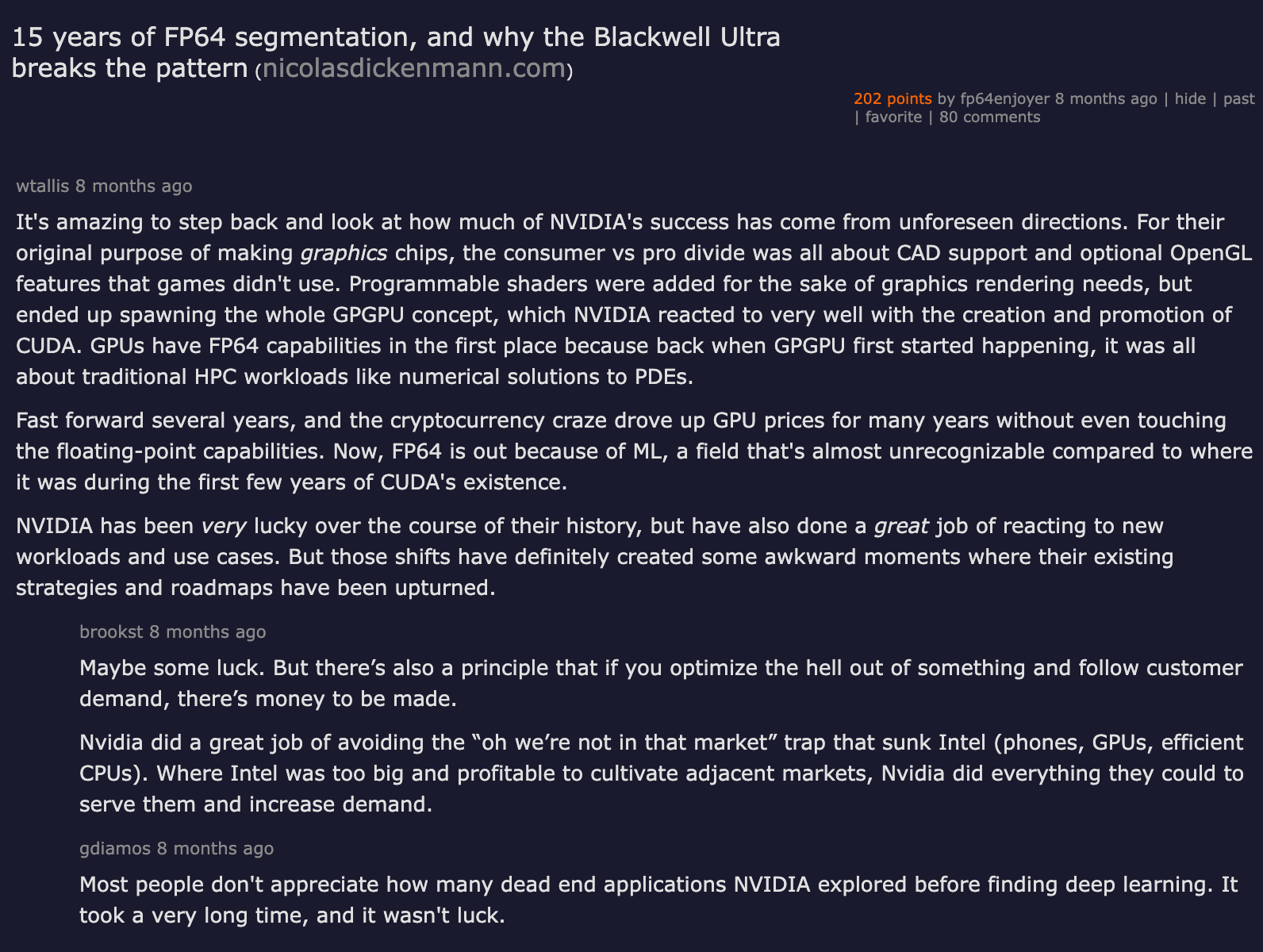
The gpu-unlock exploit is dramatic, but the practice it exposes is not new. Nvidia has systematically throttled consumer GPUs for at least fifteen years, progressively widening the gap between consumer and professional performance tiers.
Nicolas Dickenmann's analysis, "The Great FP64 Divide", documents this trajectory with hard numbers. The consumer FP64-to-FP32 performance ratio has steadily declined:
- 2010 (Fermi): 1:8 — consumer cards had real FP64 capability
- 2012 (Kepler): 1:24 — first major throttling
- 2014 (Maxwell): 1:32 — gap widens
- 2020 (Ampere): 1:64 — consumer FP64 is essentially cosmetic
Meanwhile, the price premium for professional cards rose from roughly 5x in 2010 to over 20x by 2022. The RTX 5090 now ships at $1,999 while carrying a 1:64 FP64 ratio; its datacenter sibling costs upwards of $30,000.
As HN commenter wtallis put it in a thread with 202 points on FP64 segmentation: "NVIDIA artificially nerfed FP64 for a long time and shipped the same die with different FP64 levels. Consumers effectively paid for transistors they couldn't use."
The Segmentation Stack
Nvidia's product differentiation is not a single lock — it is a stack of firmware and driver controls:
- FP16/BF16 issue rate throttling — the target of gpu-unlock. Consumer cards run these operations at half the rate of professional equivalents built on the same silicon
- FP64 rate limiting — consumer GPUs get 1/64th the FP64 throughput, making scientific computing impractical
- NVENC session limits — consumer cards are limited to a handful of simultaneous video encode sessions; professional cards have no such limit
- P2P transfer disabling — Nvidia disables faster card-to-card transfers when the driver detects consumer cards, costing roughly 20% performance in multi-GPU setups
- vGPU lockout — consumer GPUs cannot run Nvidia's virtualization technology, despite the hardware supporting it
- ECC memory management — available in hardware, disabled in consumer firmware
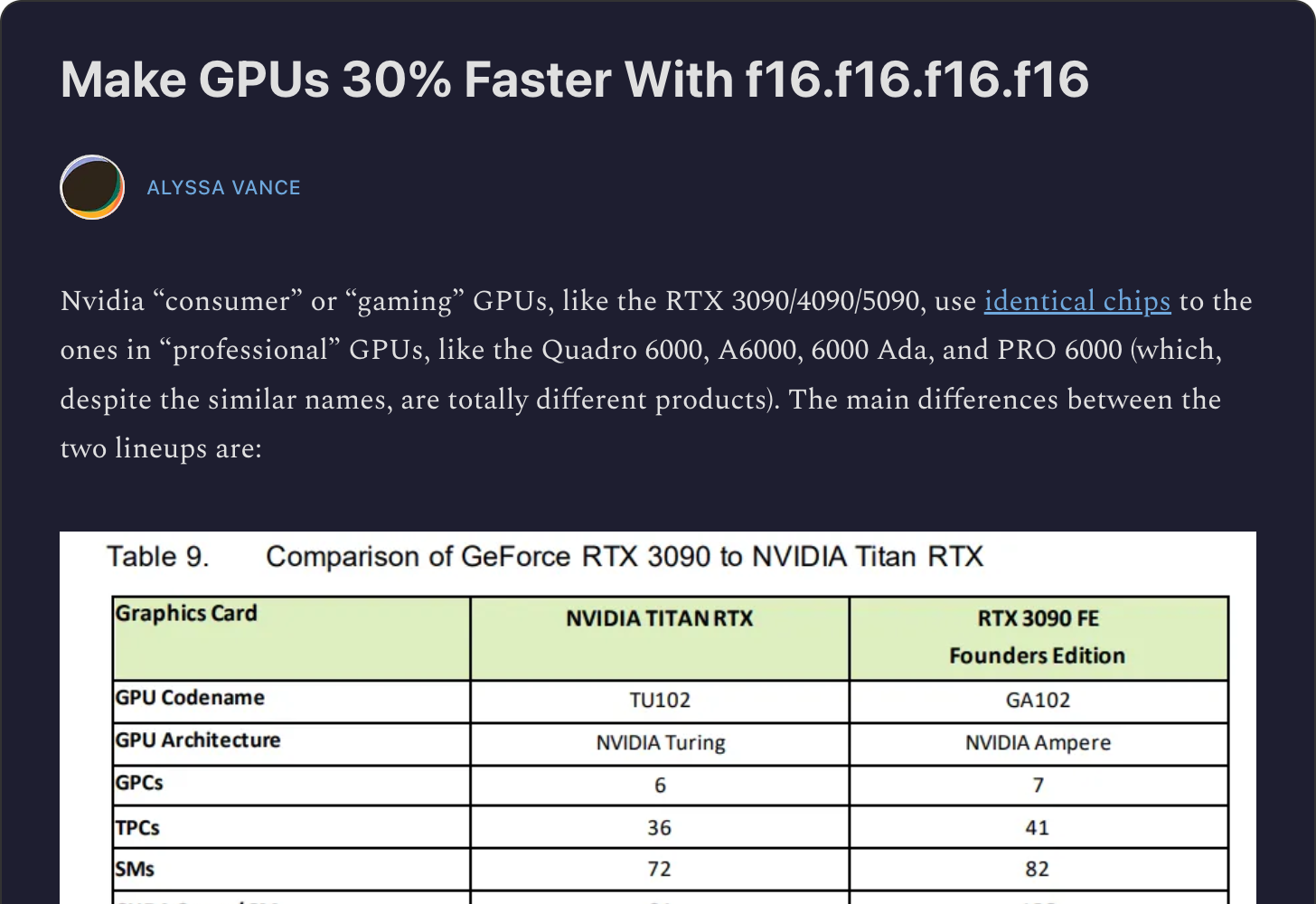
Each lock is enforced in firmware or driver software, not by differences in the silicon itself. This is what Alyssa Vance documented in her Substack post "Make GPUs 30% Faster": "Nvidia deliberately makes the main AI instruction — FP16 matrix multiplication with FP32 accumulate — twice as slow on consumer cards to segment the market."
The CMP 170HX: Exhibit B
The gpu-unlock exploit has a predecessor that makes the segmentation story even starker. In August 2026, a developer named Amogh Munikote released cmpunlocker, a tool targeting Nvidia's CMP 170HX — a mining card based on the GA100 chip (the same silicon as the A100 datacenter GPU).
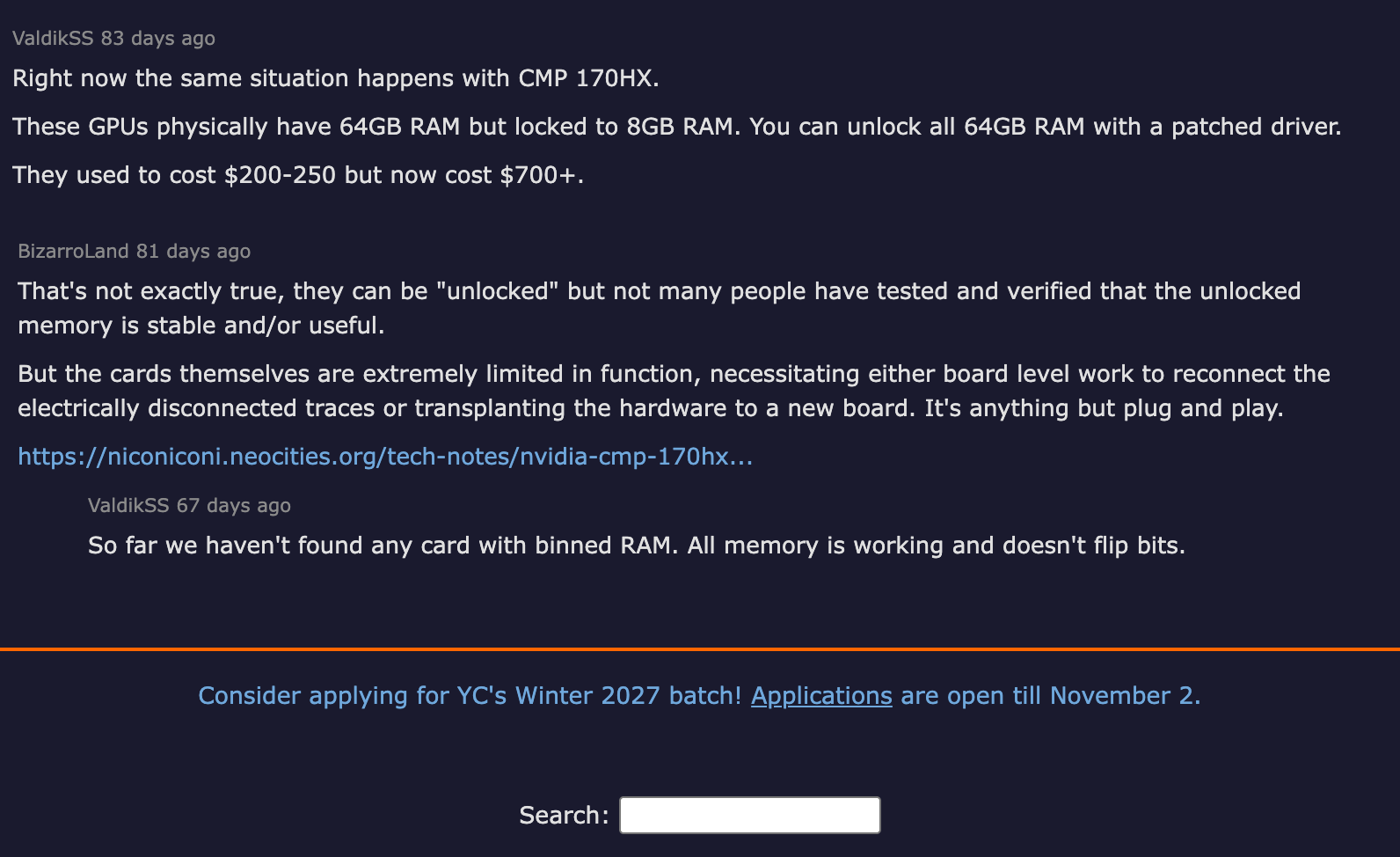
Nvidia sold these cards with 8GB or 10GB of accessible VRAM. The actual hardware had up to 80GB of HBM2e memory — Nvidia disabled the extra stacks in firmware. The cmpunlocker tool, exploiting a signature-loading bug in the Falcon microcontroller's BootROM, restored up to 64GB of stable VRAM on cards that cost $250 on the used market.
Linus Tech Tips tested the tool and confirmed the results were legitimate: "it does what many RAM-boost and speed-up scams and malware only claim to do."
The market reacted instantly. CMP 170HX prices surged past $1,000 after the unlock spread. As Korben reported: "The throttling looks more like commercial segmentation than recycling of failed chips." Active researchers reported they hadn't found a single card with genuinely faulty RAM — every card's disabled memory was functional.
The Contrarian Corner: Nvidia's segmentation is rational business. Professional cards carry ISV-certified drivers, ECC support, longer warranty periods, and enterprise support contracts. The 5-20x price premium funds R&D that benefits the entire stack. Without market segmentation, Nvidia would either raise consumer prices or cut R&D. The unlock exploits carry real risks: 450W power draw, thermal stress beyond stock cooler design, warranty voiding, and potential instability. Some cards — like the RTX 3080 Ti 20GB OEM — don't respond to the unlock at all.
The 2026 Gaming GPU Drought
The gpu-unlock story gains its sharpest edge from timing. For the first time in nearly 30 years, Nvidia will not release a new gaming GPU in 2026. The planned RTX 50 "Super" refresh has been shelved indefinitely. Existing RTX 5090 cards sell for up to $8,500 on Amazon against a $1,999 MSRP — when they are available at all.
Nvidia's official explanation is a memory shortage. CFO Colette Kress told analysts: "As much as we would love to have more supply, we do believe for a couple of quarters it is going to be very tight." The company says Samsung, SK Hynix, and Micron redirecting DRAM production toward high-bandwidth memory for AI servers is squeezing GDDR7 availability.
The numbers support this in part. Data center revenue hit $62 billion in Q4 against $3.7 billion for gaming — a 17:1 ratio. AI chips carry roughly 75% gross margins versus gaming's estimated 40%. Any rational capital allocator would prioritize the high-margin business.
But the "manufactured scarcity" narrative has gained traction. Ed Zitron's widely-read analysis "AI Had Better Work Out" argues that hyperscalers are engaging in channel stuffing — taking delivery of GPU racks they cannot yet install. He cites a Business Insider report showing Amazon adopted an "Early Rack Receipt" process, projecting $5 billion of Nvidia GB300 racks in August 2026 alone, with $3 billion monthly thereafter — racks staged in warehouses because data center facilities lack power.
A Yahoo Tech investigation on October 23 examined the allegation directly and found it "not credible on current evidence" — no audited inventory data, purchase contracts, or direct testimony supports deliberate manipulation. But the article acknowledged that the economic incentive exists and that the distinction between "rational prioritization" and "manufactured scarcity" is murky.
Here is the uncomfortable synthesis: even if the memory shortage is genuine, the firmware segmentation is not. When a developer proves that your $1,000 consumer card carries the same compute hardware as your $4,500 professional card — and the only difference is two bits in firmware — the "supply constraints" narrative gets harder to sell.
What the Community Is Saying
The Hacker News thread for gpu-unlock hit 84 points and drew over 40 comments within hours, with Zagitta actively engaging throughout.
On the exploit itself: Tiberium verified the results independently, calling the gains "legit" but noting it "relies on exploiting firmware." The exploit uses a stack buffer overflow with ROP in the Falcon microcontroller.
On real-world impact: RandyOrion called it "very valuable for consumer-hardware neural network research, especially for LLM prefill and training." Aunty_helen reported a 3.2x speedup on a 27B parameter model, hitting 133 tokens/sec.
On power and risk: Jacquesm, running seven RTX 3090s, provided the most nuanced take: gains at stock power limits are around 25%, but pushing to 450W unlocks the full 68-80% gains. The catch is that 450W "is well above what the stock cooler was designed for." Blagui tempered expectations further: at a 200W power cap, real-world gains were only 7-8% in decode-heavy workloads.
On the bigger picture: RachelF surfaced a related finding — Nvidia also disables peer-to-peer GPU transfers on consumer cards, costing about 20% in multi-GPU setups, with a patched open-gpu-kernel-modules fork to bypass it. Pixl97 made the market argument: "If cards stay short for years, there's no reason to keep this locked."
The used GPU market reacted even faster than the forums. WCCFTech reported that RTX 3090 24GB cards jumped from around $1,000 to over $2,000 within hours, with RTX 3090 Ti cards approaching $3,000.
What This Means for Practitioners
If you have an RTX 3000-series card sitting in a Linux box, the gpu-unlock is worth evaluating. Here is the practical breakdown:
Where it helps:
- LLM prefill and prompt processing: +14-36% (compute-bound phase)
- Dense matrix operations (training, fine-tuning): +25-80% depending on card and power limits
- Image generation (Stable Diffusion, ComfyUI): up to +59% on BF16 workloads
- FlashAttention operations: measurable gains reported
Where it does not help:
- LLM token generation (memory-bandwidth-bound): near-zero improvement
- INT8 inference: unchanged
- Gaming FPS: no verified improvements
The risks are real:
- The unlock pushes cards to power levels their coolers were not designed for
- 450W on a stock-cooled RTX 3090 is thermal stress, not a configuration option
- Warranty is voided
- Linux-only (a Windows UEFI approach exists but is experimental)
- Some cards (OEM variants, certain 3080 Ti 20GB models) do not respond to the unlock
The broader implications extend beyond individual cards. If Nvidia's margin story depends partly on artificial compute tiers — if the FP16/BF16 lock on a $1,000 card exists purely to protect the $4,500 professional SKU — then every successful unlock is a pricing signal. The community is proving, card by card, that the emperor's compute restrictions have no silicon clothes.
Looking ahead: Zagitta confirmed that a 4000-series unlock is in progress, with forks already available. The 5000-series (Hopper/Blackwell architecture) uses a different boot chain that likely blocks this approach. Nvidia's response will be more telling than the next exploit — do they patch and lock harder, or do they acknowledge that the AI democratization wave has made consumer/professional segmentation untenable?
The Bigger Picture: Firmware as Monopoly Moat
Nvidia's firmware locks are not a quirk of GPU engineering. They are the enforcement mechanism for a monopoly position in AI compute. When 90% of discrete GPUs sold are Nvidia, and when the company controls the firmware, the driver stack, and CUDA's ecosystem lock-in, every firmware restriction is a toll gate.
The gpu-unlock exploit does not change Nvidia's market position. One kernel module cannot solve a structural monopoly. But it does something arguably more important: it makes the artificial nature of the restrictions visible. When a hobbyist proves that the performance difference between a $1,000 GeForce and a $4,500 Quadro is two firmware bits — not silicon, not engineering, not R&D investment — it changes the conversation.
For the first time in a year when Nvidia told gamers there are no new GPUs to buy, a developer showed that the GPUs they already own were artificially hobbled. That is a harder story to spin than a memory shortage.
The inference compute revolution is not waiting for Nvidia's permission. Every firmware exploit, every open-source driver patch, every alternative accelerator chip that arrives is a vote against artificial scarcity. The question is not whether Nvidia's segmentation will hold — it is how much margin erosion they accept before they unlock it themselves.
The gpu-unlock project is available at github.com/Zagitta/gpu-unlock under GPL-2.0. The Nvidia firmware it interfaces with retains its proprietary licensing. Running the exploit voids your warranty and pushes hardware beyond its rated specifications.
ComputeLeap Team
The ComputeLeap editorial team covers AI tools, agents, and products — helping readers discover and use artificial intelligence to work smarter.
Join the discussion
Have thoughts on this article? Discuss it on your favorite platform:
Related articles
AI Found the PHP Zero-Day First. Now What?
GPT-5.6 Sol and Gemini 4 Argon found PHP2Shell weeks before disclosure. AI vuln discovery is production-ready for both sides.
The Slop Wall Is Here: Steam and Apple Have No Filter
Vibe-coded apps flood Steam and the App Store at once. Neither gatekeeper has a quality gate that scales. What breaks next.
The Per-Token Trap: Why AI Got Cheaper and Your Bill Didn't
Token prices fell 90%. Enterprise AI bills doubled. Gartner says agentic costs will 5x by 2028. Here's the Jevons math and how to fix your budget.