Nvidia's Money Story Outlasts the Spy Story
The spy narrative is collapsing, but the $1B insider sale and $7.5B China chip route remain. The real Nvidia scandal is governance.
ComputeLeap Team
Nvidia's Money Story Outlasts the Spy Story

The espionage headline is fading. The governance problem is not.
A week after Jensen Huang's departure from Nvidia, the spy narrative that dominated the news cycle is running into a wall. The Attorney General says "no conclusions reached." The CIA says it is "not yet convinced." The Director of National Intelligence calls the spy claim "not entirely accurate and over-torqued." Even the incoming House Intelligence Committee chair, after a classified briefing, could only say: "Today, at least, I don't know."
David Sacks, co-chair of the President's Council of Advisors on Science and Technology, put it bluntly: "The spy narrative is collapsing already."
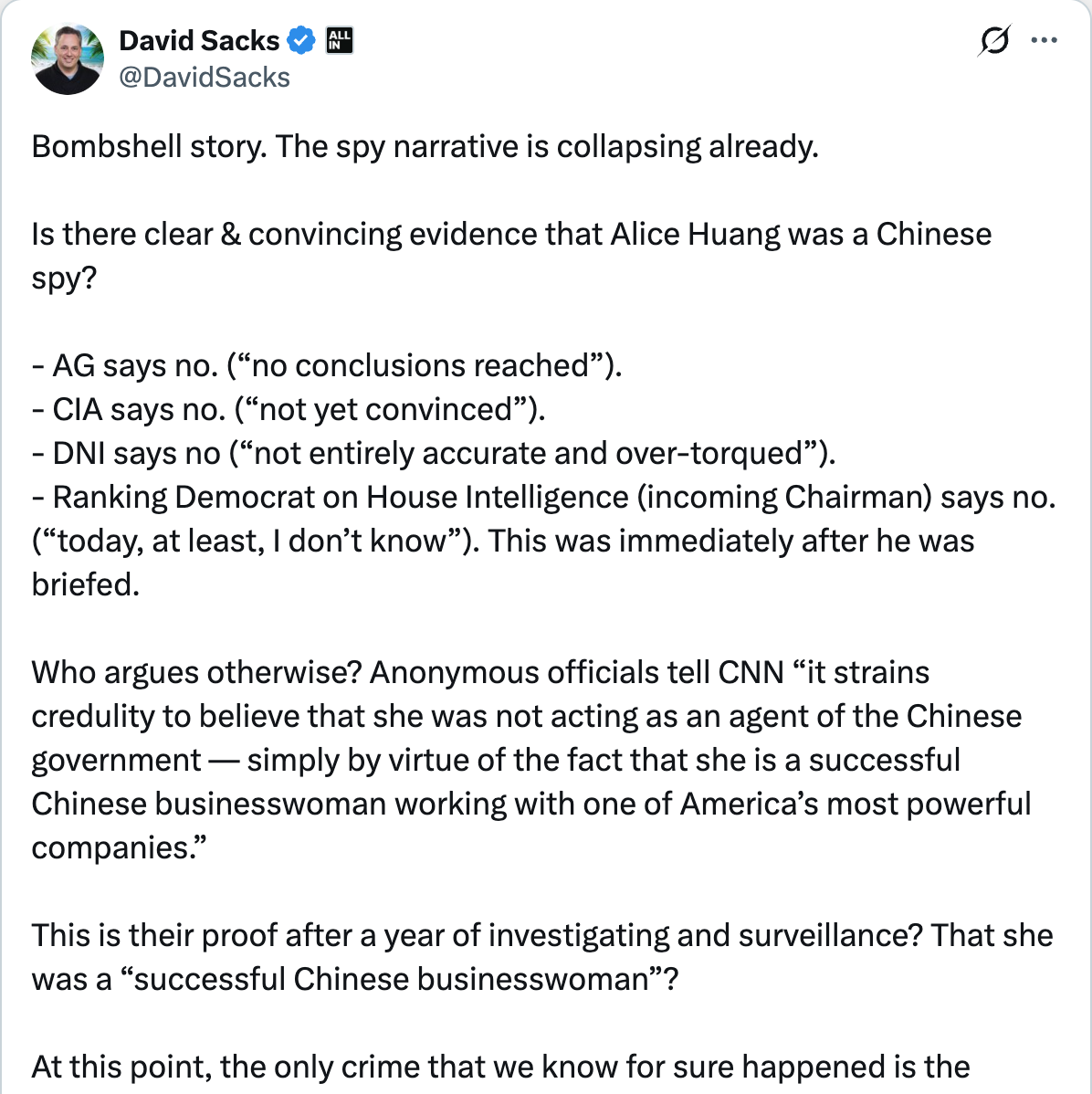
But here is what is not collapsing: a board director who sold nearly $1 billion in stock with no pre-set trading plan. A $7.5 billion pipeline of chips routed through Singapore shell companies to China. A circular financing model that has drawn comparisons to vendor lending schemes. And a succession vacuum in which the only named backup is a CFO who has never run a product organization.
When the spy headline burns out — and the intelligence community's own hedging suggests it will — the market will still have to price the governance story underneath. That story is harder to dismiss, and it has numbers attached.
The Intelligence Community's Walk-Back
The original bombshell, first reported by the New York Times on October 29, alleged that Jensen Huang had been the target of a Chinese espionage plot through his relationship with Alice Huang (no relation), CEO of Singapore-based cloud firm Megaspeed. The Financial Times cited a classified U.S. intelligence memo suggesting she had been recruited by China's Ministry of State Security.
The allegation landed like a depth charge. Nvidia's stock dropped over 4% on the first trading day, erasing roughly $200 billion in market cap. The board opened an independent investigation. Huang emailed staff admitting to marital infidelity and pledging cooperation. The Hacker News discussion alone drew 490 points and 403 comments.
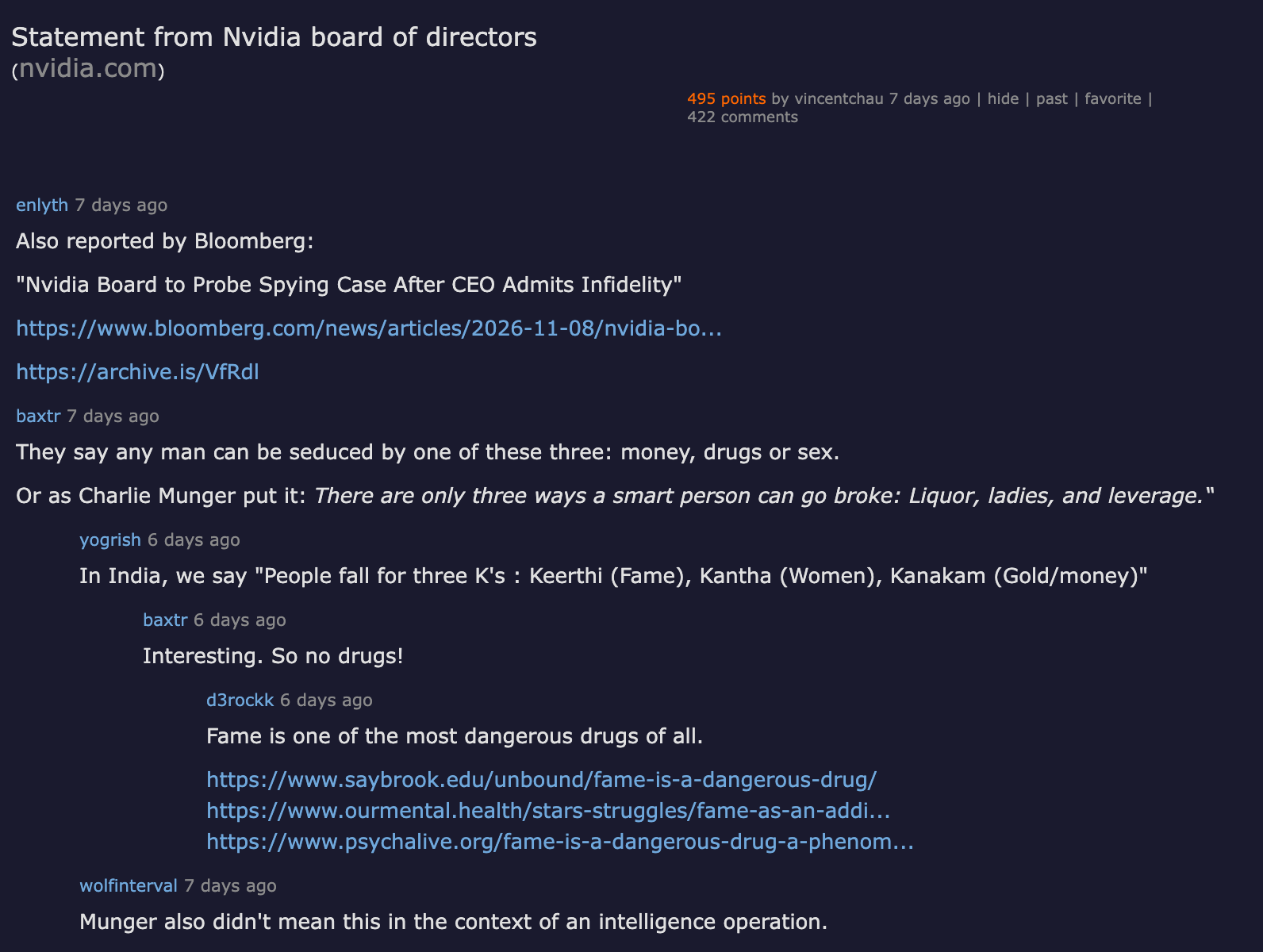
View discussion on Hacker News →
But then the walk-back began. CNN reported that the AG had reached no conclusions, the CIA was not yet convinced of the espionage claim, and the DNI described the initial reporting as over-torqued. China's foreign ministry called the allegations "groundless smears." President Trump defended Huang publicly.
Sacks argued that the only established crime so far is the leak of the classified memo itself — and called for a leak investigation rather than a spy hunt.
View original report on Benzinga →
None of this exonerates anyone. Singapore confiscated Alice Huang's passport from June 2025 to February 2026 over "potential false declarations in relation to Mega Speed." The DOJ is still investigating Megaspeed's chip distribution. "No conclusions reached" is bureaucratic hedging, not absolution. But it means the market is pricing in a spy-thriller premium on a story where the intelligence community itself cannot agree on the plot.
The Money Trail That Does Not Depend on Espionage
Strip the espionage question away entirely. What remains is a financial story with three independent threads, each carrying its own governance risk.
Thread 1: Mark Stevens' $947 Million Exit
Mark Stevens, a long-serving Nvidia board director and billionaire venture capitalist, sold approximately 4.2 million shares in Q3 2026 for roughly $947 million — the largest insider sale by any U.S. corporate director that quarter. The sales ran in three batches: $411 million across August 31 to September 2, $236 million on September 3-4, and $300 million on September 18.
The critical detail: no Rule 10b5-1 trading plan was flagged in the SEC filings for the initial batches. Pre-set trading plans are the standard mechanism insiders use to demonstrate that large sales are routine and not based on material non-public information. Stevens may hold a grandfathered pre-2023 arrangement that does not require the same disclosure — but in the current environment, the optics are brutal.
View original report on Yahoo Finance →
He also filed a Form 144 signaling a possible further sale of up to 5 million additional shares. Including earlier June sales, his total dispositions since the start of summer approach $1.35 billion.
The question governance analysts are asking: what did Stevens know, and when? The spy story broke publicly on October 29. Stevens' largest batch was September 2. The board says it had no advance knowledge. The market has to decide whether it believes that.
Timeline of Key Events
- Aug 31 – Sep 18: Mark Stevens sells ~$947M in Nvidia shares across three batches, no 10b5-1 plan flagged
- Oct 29: New York Times breaks the spy-plot story citing classified intelligence memo
- Nov 8: Nvidia board opens independent investigation; Huang emails staff admitting affair
- Nov 9-10: Stock drops ~10% over two sessions, erasing ~$200B+ in market cap
- Nov 13: David Sacks declares spy narrative "collapsing" citing AG/CIA/DNI pushback
- Nov 15 (today): Earnings in 2 days; congressional briefing in 3 days
Thread 2: $7.5 Billion in Chips Through Singapore
The Information reported that Alice Huang and her relatives built a network of companies in China and Singapore that facilitated the shipment of at least $7.5 billion in Nvidia chips to Chinese firms — including models covered by U.S. export controls. The network allegedly moved around 240,000 H100, H200, and A100 GPUs into China through Megaspeed and related entities.
CNBC's investigation into Megaspeed's footprint revealed a company whose balance sheet grew from $33 million to approximately $3 billion during 2024. Megaspeed denies any illegal chip transfers, stating it operates "fully within the bounds of all applicable export control regulations."
Ed Zitron's detailed investigation draws on Culper Research and Bloomberg reporting to allege that Megaspeed's Singapore subsidiary, SpeedMatrix, purchased $4.8 billion in GPUs while missing circuit boards turned up at a Chinese firm (Shanghai Shuoyao) with a near-copy of Megaspeed's website and a Tencent-tenanted data center.
This thread does not require the espionage allegation to be true. Even if Alice Huang never worked for Chinese intelligence, the question of whether Nvidia chips reached China through export-control-violating intermediaries stands on its own — and the DOJ investigation is ongoing.
Singapore's position adds a wrinkle. The city-state has said it does not enforce unilateral export controls imposed by other countries, creating a regulatory gap that Washington may now pressure it to close. This is the same type of export-control escalation we analyzed in our coverage of how the U.S. government pulled Fable 5 — the precedent that every frontier tech company now fears.
Thread 3: Circular Financing — Nvidia's Self-Reinforcing Revenue Loop
The third thread predates the scandal but converges with it. Nvidia has faced persistent questions about circular financing — arrangements where the company invests in or lends to entities that are simultaneously its largest customers.
The scale is staggering. Bloomberg has documented a financing web of more than $750 billion in which Nvidia invests in chip buyers who borrow to buy more chips. Jensen Huang rejected the label, calling the suggestion "ridiculous" and noting Nvidia's strategic investments total only $4.7 billion year-to-date against massive revenues.
But the critics have names and numbers. Michael Burry has compared Nvidia not to Enron but to Cisco during the dot-com bubble — arguing that hyperscalers are extending GPU useful-life assumptions from 2-3 years to 5-6 years to flatter earnings. The Financial Times calls it old-fashioned vendor financing with a new label. A Hacker News thread titled "Inside the Circular Financing of the GPU Boom" drew 370 points and 182 comments, with practitioners debating whether the revenue is real or manufactured.
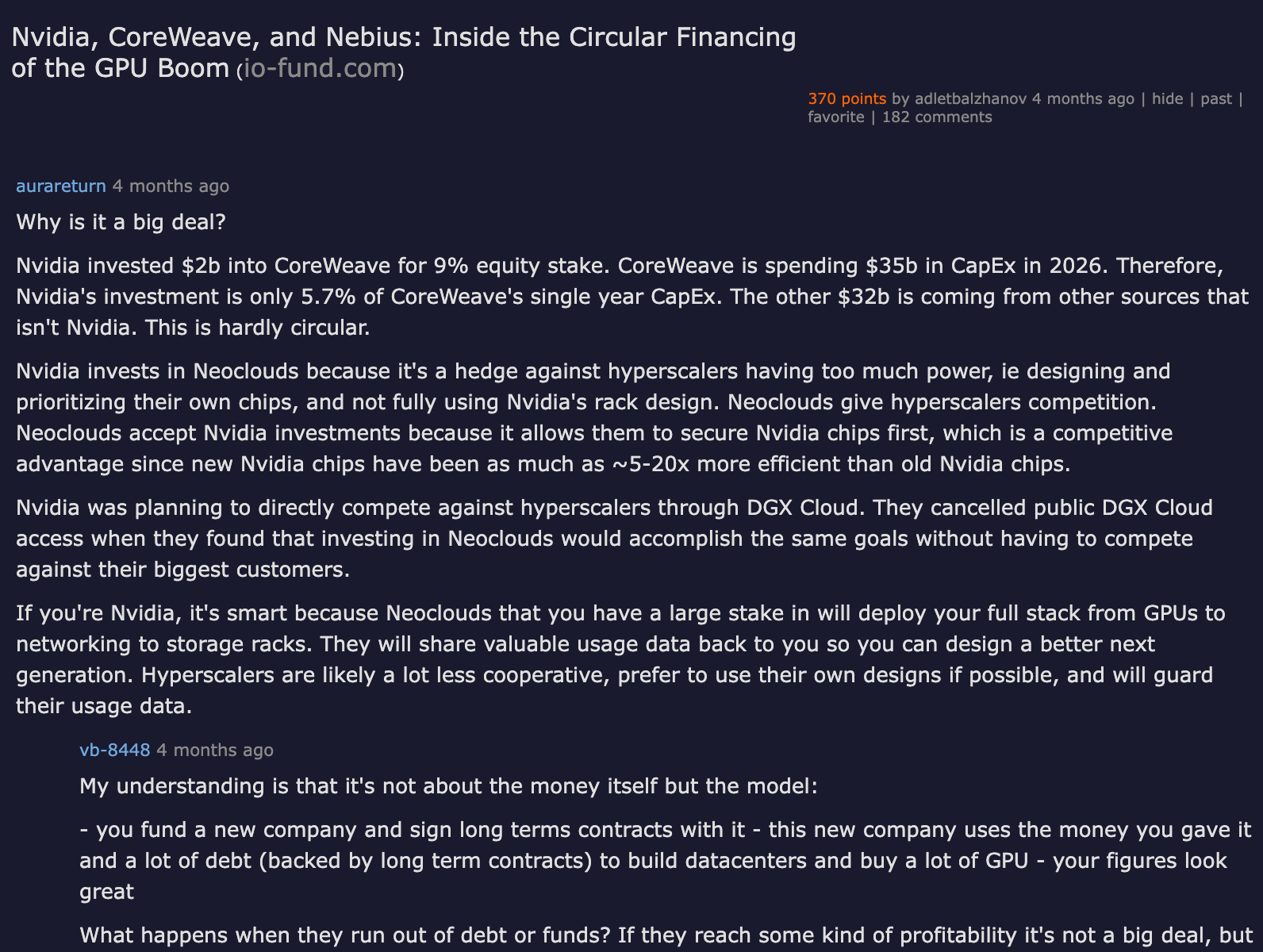
View discussion on Hacker News →
One data point cuts through the debate: the cost of insuring Nvidia's debt against default has tripled in 2026.
As we wrote in Nvidia Is the Central Bank of AI, the company has positioned itself as the backstop of GPU debt. That was a feature when the stock was climbing. It becomes a governance vulnerability when the CEO who built the system is suddenly gone.
The Succession Vacuum
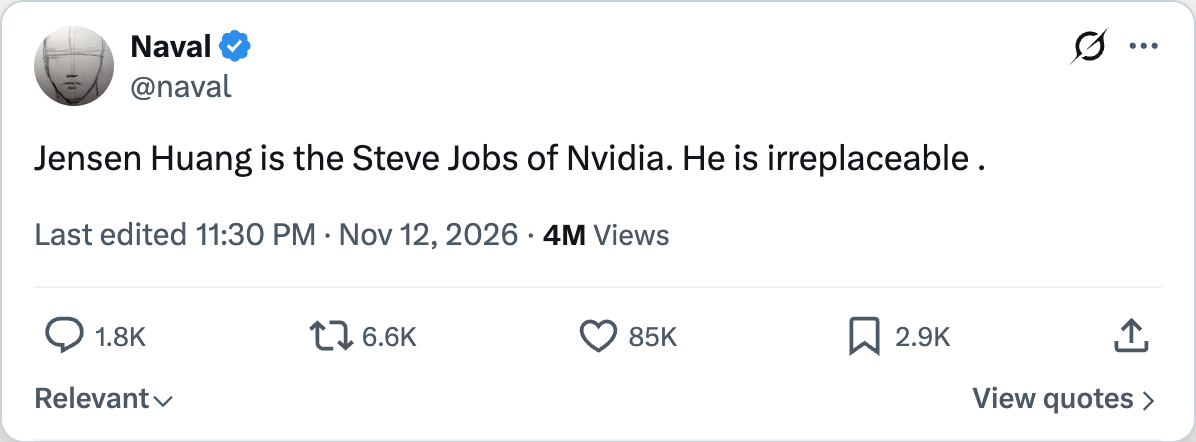
Naval Ravikant's post captured the bull case in five words: "Jensen Huang is the Steve Jobs of Nvidia. He is irreplaceable." 85,000 likes and 4 million views suggest the market agrees — which is precisely the governance problem.
Huang co-founded Nvidia in 1993 and ran it for over three decades. There is no named successor. The most commonly cited backup is CFO Colette Kress, who has been EVP and CFO since 2013 and is deeply respected on Wall Street — but she has never run a product organization or led a hardware engineering team.
A structural detail matters: Huang holds no super-voting stock. Unlike Zuckerberg at Meta or the Google founders, he can actually be removed by a standard board vote. The board expressed confidence in him and said he pledged full cooperation with the investigation. But analysts have noted that this framing — support conditional on cooperation — is the same language boards use before they pull that support.
Bernstein kept its Outperform rating and $400 target. The average 12-month analyst target from 62 analysts sits at approximately $327, well above the current price near $169. Wall Street's consensus is that this is a buying opportunity. But Wall Street's consensus also assumes the governance overhang resolves cleanly — an assumption that depends on earnings (November 17) and the congressional briefing (November 18) going well.
Contrarian Corner: Why the Bears Might Be Wrong
The governance bears could be overstating the risk. If Nvidia's Q3 earnings blow past expectations on November 17 — and the data center business shows genuine demand rather than circular financing — the stock discount becomes a buying opportunity. The circular-financing critique loses force if hyperscaler capex is genuinely demand-driven rather than subsidized. And the spy narrative's collapse could actually be bullish: it removes the national-security overhang that was the biggest tail risk. Naval's "irreplaceable" framing cuts both ways — if Huang stays, the key-man premium returns instead of the key-man discount.
What the Market Has to Price Now
The spy story was dramatic but may prove to be a distraction. The financial engineering underneath it is mundane, documentable, and — crucially — does not require any espionage allegation to be true.
Here is what the market is actually pricing:
-
Insider selling without pre-set plans. A board director liquidated nearly $1 billion in stock in a window that, in hindsight, looks suspicious. The board says it had no advance knowledge of the scandal. The SEC filings are silent on trading-plan coverage.
-
Export-control exposure. Whether or not Alice Huang is a spy, $7.5 billion in chips allegedly reached China through a network the DOJ is investigating. If those shipments violated export controls, Nvidia faces potential fines, license restrictions, and reputational damage in Washington at the worst possible time — right as the government debates tighter chip curbs.
-
Circular financing risk. The company that became the central bank of AI is now being asked whether it is also lending to its own customers. Credit-default swap spreads have tripled. That is the bond market's opinion, and the bond market tends to be right.
-
Succession risk. The most important AI company in the world has no named CEO successor. In any other context, this alone would be a governance red flag.
What This Means for You
- If you build on Nvidia hardware: Supply-chain concentration risk just became visible. The governance overhang means potential disruption to partnerships, export licenses, and product roadmaps. Diversify your compute strategy. As we explored in Compute Is Now a Tradable Commodity, GPU futures markets exist precisely for this risk.
- If you trade NVDA: The spy-narrative discount is probably temporary. The governance discount — key-man risk, insider selling patterns, no succession plan — may persist through Q1 2027. Watch the November 17 earnings for revenue geography reclassification and the November 18 congressional briefing for new disclosures.
- If you run a startup on GPU cloud: Your provider's balance sheet matters. The circular-financing debate signals that some GPU cloud providers are more leveraged than they appear. Ask your cloud vendor who backs their GPU financing.
The Week Ahead
November 17: Nvidia reports Q3 fiscal 2027 earnings. Any change to revenue geography reporting — particularly the distinction between billing location and ship-to location — will be scrutinized for China exposure.
November 18: Three House committee chairs have requested a closed-door briefing from Huang. Whether he attends, and what emerges, may determine whether the governance story escalates or de-escalates.
The spy story made for a good headline. The money story makes for a better investment thesis. When the intelligence community's hedging finishes draining the espionage narrative of its drama, what remains is a $2.7 trillion company with a governance gap where its founder used to stand, a board director's unexplained billion-dollar exit, and a supply chain that may have circumvented the law.
That is not a spy thriller. It is a corporate-governance case study — and the market is only beginning to price it.
ComputeLeap Team
The ComputeLeap editorial team covers AI tools, agents, and products — helping readers discover and use artificial intelligence to work smarter.
Join the discussion
Have thoughts on this article? Discuss it on your favorite platform:
Related articles
AI Compute Just Hit a Political Ceiling
41% of planned US data center capacity sits in states with anti-buildout governors. The constraint nobody modeled.
The Selloff and the S-Curve
Markets wiped $2.5 trillion off AI stocks the same week a METR audit showed capability progress doubling. One side is wrong.
The AI Economy Is Paying Itself
Chamath, Ramp, and Polymarket converge: most AI revenue is VC-funded companies buying from each other. What the data shows.