OpenAI Just Acquired Astral: What It Means for uv, Ruff, and Every Python Developer
OpenAI is acquiring Astral, the company behind uv and Ruff — the fastest-growing Python toolchain. Here's what this means for the open source ecosystem, why OpenAI wants Python infrastructure, and what you should do now.
OpenAI is buying Astral.
If that sentence doesn't immediately make you feel something, here's the context: Astral built uv and Ruff — the two tools that, in under three years, went from zero to hundreds of millions of monthly downloads and fundamentally changed what it feels like to work with Python. uv is the package manager that made pip feel prehistoric. Ruff is the linter that replaced Flake8, isort, and Black — combined — and ran 10-100x faster.
And now they belong to OpenAI.
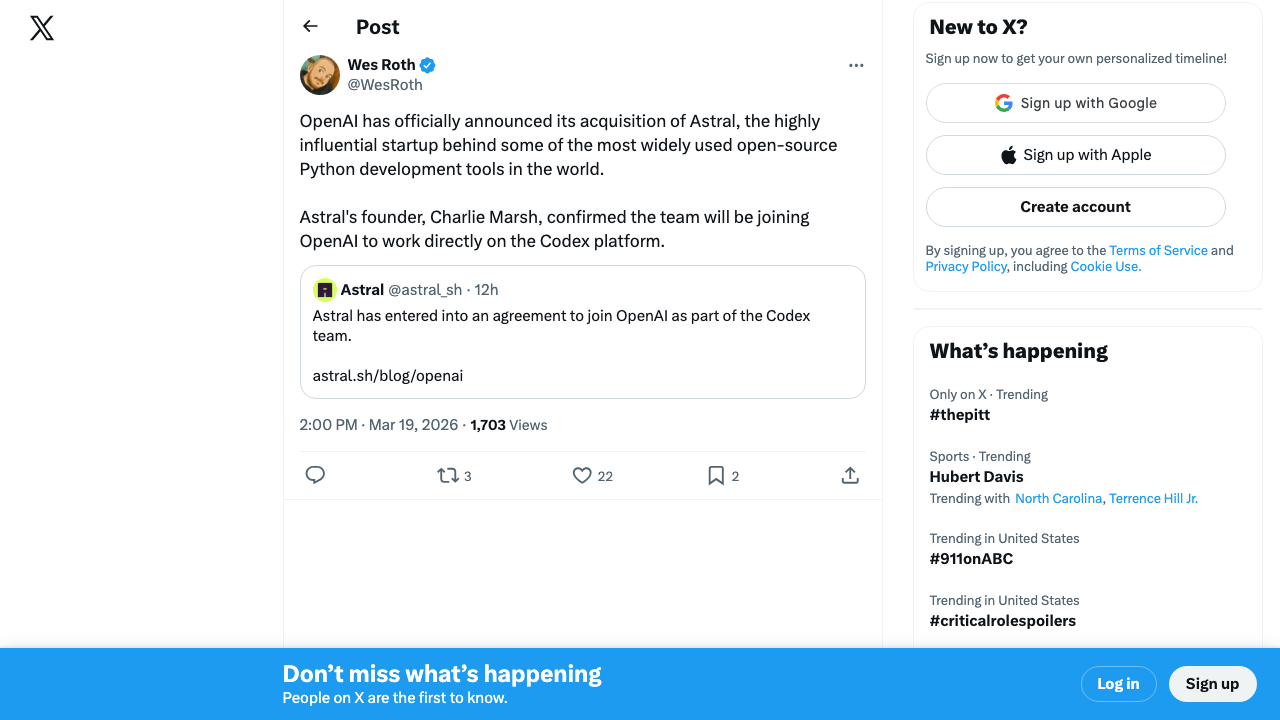
Charlie Marsh, Astral's founder, announced the deal this morning. The team joins OpenAI's Codex group. OpenAI's own announcement frames it as "accelerating Codex growth to power the next generation of Python developer tools." Both sides promise that uv, Ruff, and ty will remain open source.
The announcement rippled across the developer community immediately:
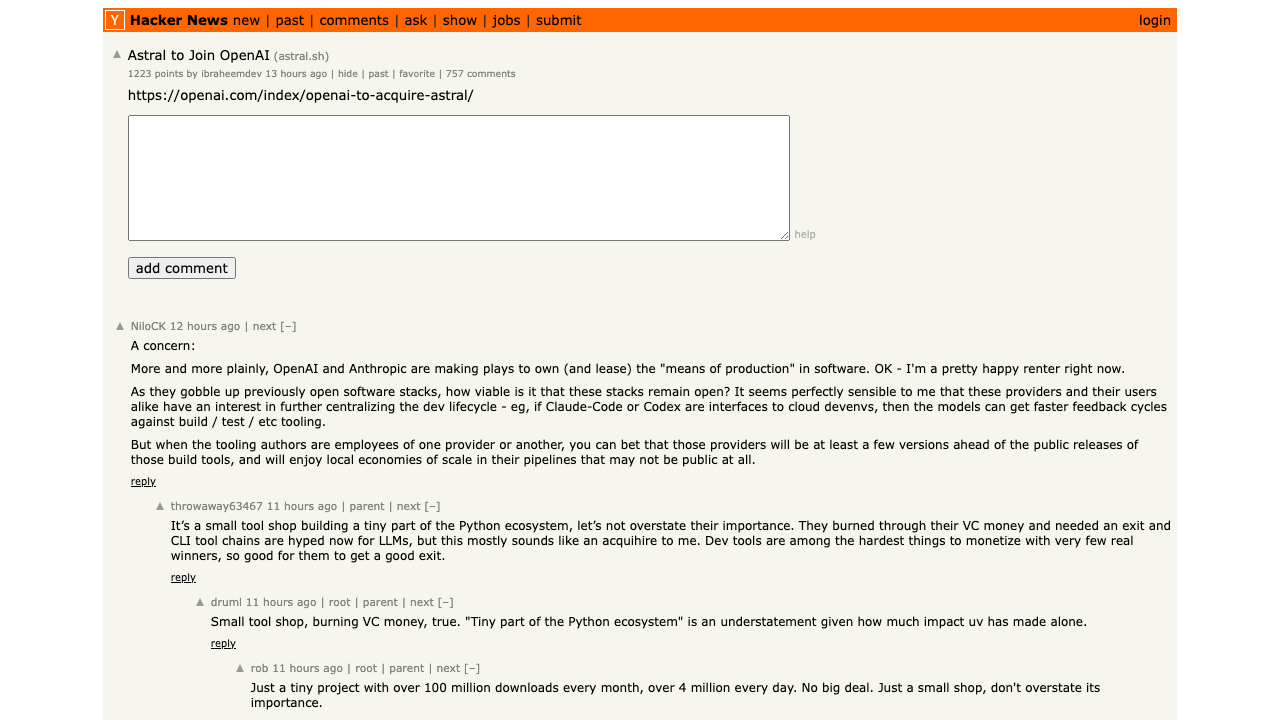
The Hacker News thread hit 757 points and 475 comments in hours. The mood: overwhelmingly anxious.
This article breaks down what happened, why OpenAI wants Python infrastructure, how the community is reacting, and — most importantly — what you should actually do about it.
What Happened
Astral entered into an agreement for OpenAI to acquire the company. The deal is subject to regulatory approval and customary closing conditions. After closing, the Astral team joins the Codex team at OpenAI.
Here's what we know:
- uv, Ruff, and ty remain open source — both Astral and OpenAI committed to this
- Astral joins the Codex team — not a separate division, they're embedded in OpenAI's AI coding agent product
- OpenAI will "explore ways [Astral's tools] can work more seamlessly with Codex" — this is the key sentence
- Codex has 2M+ weekly active users and saw 3x user growth since January 2026
- The deal has not closed yet — regulatory approval pending
Charlie Marsh's blog post reads like a founder who genuinely believes this is the right move for the mission. He credits the team, thanks his investors (Casey Aylward at Accel, Jennifer Li at a16z), and frames AI as "the highest-leverage thing we can do." OpenAI's announcement emphasizes that they want to "move beyond AI that simply generates code" toward systems that "participate in the entire development workflow."
Why OpenAI Wants Python Infrastructure
This is not a charity acquisition. OpenAI wants uv and Ruff because AI coding agents need fast, reliable Python tooling — and controlling the toolchain means controlling the developer experience.
Here's the strategic logic:
1. Codex Needs Better Tools
Codex — OpenAI's cloud-based coding agent — doesn't just write code. It needs to install dependencies, run linters, execute tests, and manage environments. Every Codex session that spins up a Python project uses pip (or uv), runs formatting and linting, and resolves dependencies.
uv is 10-100x faster than pip. That speed difference isn't a nice-to-have when you're running millions of agent sessions. It's a cost and latency multiplier that hits OpenAI's infrastructure bill directly.
2. The Developer Experience Moat
OpenAI, Anthropic, and Google are all building AI coding agents — Codex, Claude Code, and Gemini Code Assist. The models are converging in capability. The differentiator is increasingly the tooling layer — how well the agent sets up environments, resolves dependencies, formats code, catches errors.
By owning the best Python toolchain, OpenAI ensures Codex has first-party access to the tools developers already trust. It's the same play as Apple buying Beats or Google buying Android — own the layer that touches the user.
3. Roadmap Control = Product Control
Here's the part that makes the open source community nervous: when OpenAI owns Astral, OpenAI controls the uv and Ruff roadmap. The tools may stay open source, but the priorities shift.
Features that benefit Codex — like faster cold-start environment resolution, tighter integration with OpenAI's sandbox runtime, or optimized CI/CD for agent workflows — will naturally rise to the top of the backlog. Features the broader Python community wants but that don't serve OpenAI's product? They go to the back of the line.
This is how open source capture works. You don't close the source code. You shift who the roadmap serves.
Sam Altman said it at Stanford last week: programming agents are "the next ChatGPT-scale explosion." If that's your belief, acquiring the team that builds the fastest Python toolchain is not optional — it's table stakes.
Community Reaction: 475 Comments of Anxiety
The Hacker News thread is one of the most engaged discussions of the year. Here are the themes:
The Open Source Capture Concern
The top-voted comments orbit a single fear: what happens when corporate priorities override community needs?
One commenter captured it precisely:
Another pointed out the structural issue:
"It's a small tool shop building a tiny part of the Python ecosystem. They burned through their VC money and needed an exit."
An Astral employee pushed back: "As a point of information: Astral did not, in fact, burn through its VC money." But the structural point stands — VC-funded open source companies have a limited set of exits, and acquisition by a larger tech company is the most common one.
The "Fork It" Debate
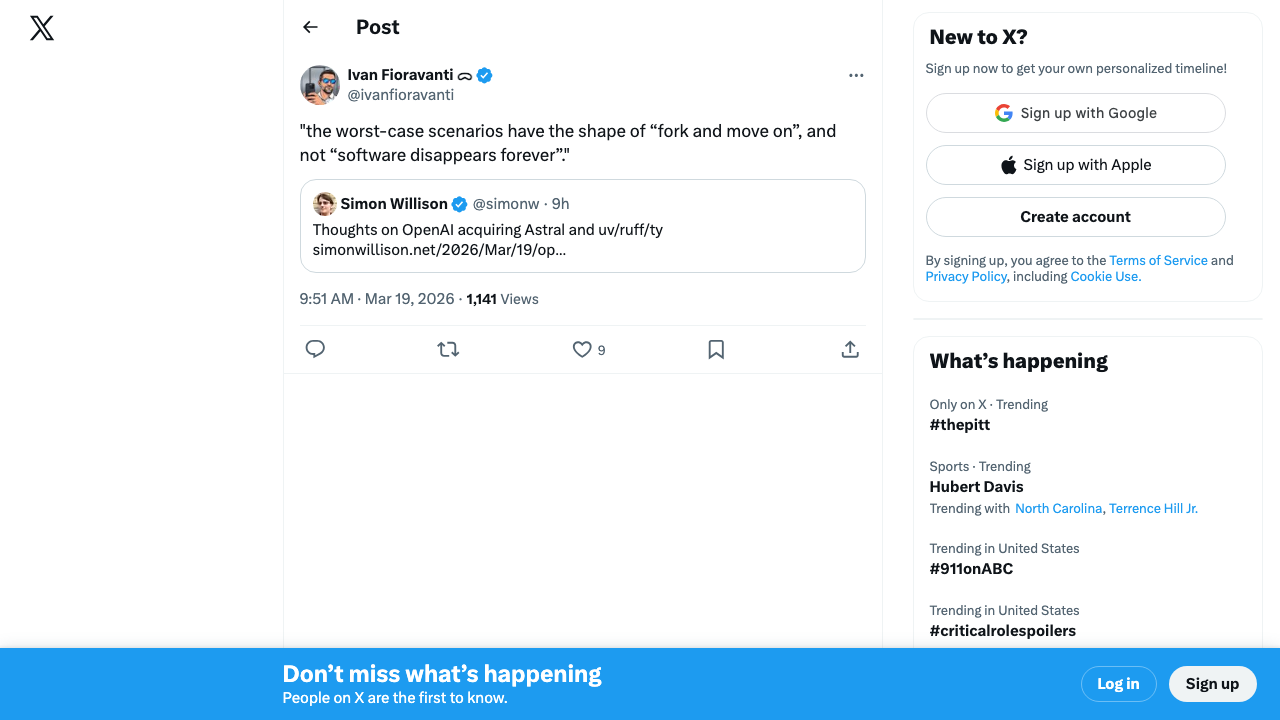
Multiple commenters noted that uv and Ruff are MIT-licensed, meaning anyone can fork them. The pragmatic response: forks require maintainers, and "angry forks usually don't last — angst doesn't prevent maintenance burnout."
This is the real risk. Forking is legally easy and practically hard. The Astral team's expertise — the people who actually wrote uv in Rust, who understand Python packaging internals at a deep level — now works for OpenAI. A community fork would start with the code but without the institutional knowledge.
The "It's Just an Acquihire" Take
Some commenters downplayed the significance: Astral is a small team, the Python ecosystem has alternatives, and if OpenAI screws up uv, people will just go back to pip.
The counter-argument is stronger: anyone who has used uv doesn't want to go back to pip. As one commenter put it: "I would stare longingly into the void, wondering if I can ever work another Python project after having experienced uv."
What This Means for You as a Python Developer
Let's move from analysis to action. Here's what actually changes:
Short Term (Next 6 Months): Nothing Breaks
The deal hasn't closed yet. Even after it closes, OpenAI has strong incentives to keep uv and Ruff working exactly as they do now. Breaking the tools that millions of developers depend on would be a PR disaster and would undermine the very ecosystem value OpenAI is acquiring.
What to do: Keep using uv and Ruff. Don't panic-migrate. Monitor the GitHub repos for changes in maintainer activity, response times, and roadmap direction.
Medium Term (6-18 Months): Watch the Roadmap
This is when the real test begins. After the integration honeymoon, watch for:
- Priority shifts — Do new features disproportionately serve Codex workflows?
- Integration lock-in — Does uv start offering "premium" features when used with Codex that aren't available standalone?
- Community engagement — Are external PRs still reviewed and merged? Are RFCs still accepted from the community?
- Contributor covenant — Does the CLA (Contributor License Agreement) change?
Long Term (18+ Months): Have a Plan B
If OpenAI does shift priorities, you want alternatives evaluated and ready. You don't need to switch now, but you should know your options:
Package Management Alternatives:
| Tool | Speed | Maturity | Notes |
|---|---|---|---|
| uv (current) | ⚡⚡⚡⚡⚡ | Production | The best option, for now |
| pip + pip-tools | ⚡⚡ | Battle-tested | Slow but reliable. The "boring technology" choice |
| Poetry | ⚡⚡⚡ | Stable | Good dependency resolution, slower than uv |
| PDM | ⚡⚡⚡ | Growing | PEP 582 support, active development |
| Hatch | ⚡⚡⚡ | Growing | From the PyPA maintainer, standards-focused |
Linting Alternatives:
| Tool | Speed | Scope | Notes |
|---|---|---|---|
| Ruff (current) | ⚡⚡⚡⚡⚡ | Lint + Format | Unmatched speed, comprehensive rules |
| Flake8 + plugins | ⚡⚡ | Lint only | Extensible, well-understood |
| Pylint | ⚡ | Deep analysis | Slowest, most thorough |
| Black | ⚡⚡⚡ | Format only | The original opinionated formatter |
| mypy / pyright | ⚡⚡ | Type check | Different category, complementary |
The Bigger Picture: The Great Absorption
This acquisition doesn't exist in isolation. It's part of a pattern that the HN community identified as the theme of the day: The Great Absorption.
AI companies are accumulating infrastructure, tooling, and talent at an accelerating rate:
- OpenAI acquires Astral → Python toolchain
- OpenAI acquires Windsurf → AI coding IDE
- Google acquires Character.AI → conversational AI talent
- Amazon invests $4B+ in Anthropic → model capabilities
- Microsoft owns 49% of OpenAI → the whole stack
Each acquisition follows the same playbook: identify open source or independent tooling that developers love, acquire the team, promise continued open source support, then gradually integrate the tools into your proprietary ecosystem.
The counter-narrative is worth considering: open-source alternatives are also shipping fast. LangChain and Nvidia recently launched a fully open coding agent stack — Deep Agents + OpenShell + Nemotron 3 Super — that competes directly with Codex and Claude Code. The question is whether open alternatives can match the velocity of well-funded corporate development.
The Real Question Nobody Is Asking
Everyone is debating whether uv stays open source. That's the wrong question.
The right question is: what happens to the next Astral?
The VC-to-acquisition pipeline creates a perverse incentive. Build beloved open source tools → get funded → get acquired by a mega-corp → tools get integrated into a proprietary ecosystem. Every cycle makes it harder for the next independent developer tooling company to get funded on its own terms, because investors now expect the acquisition exit.
The result: fewer independent tools, more corporate-owned infrastructure, and a developer ecosystem where the "free" tools are subsidized by companies whose primary business is selling AI services.
This isn't unique to OpenAI. It's a structural feature of how VC-funded open source intersects with the AI industry's need for infrastructure. And it's accelerating.
What to Do Right Now
Here's the practical playbook:
1. Don't panic-migrate. uv and Ruff still work. They're still MIT-licensed. Switching tools because of an acquisition announcement is premature optimization of your workflow.
2. Pin your dependencies. If you're worried about future uv changes, pin to specific versions in your CI/CD pipeline. uv==0.6.x today will work the same way tomorrow regardless of who owns the company.
3. Audit your toolchain concentration. How many of your critical development tools are owned by one AI company? If the answer is "most of them," that's a risk worth diversifying. Consider using AI coding assistants from multiple providers rather than going all-in on one ecosystem.
4. Watch the GitHub repos. Star and watch astral-sh/uv and astral-sh/ruff. If the contribution patterns change, you'll see it there first.
5. Evaluate alternatives casually. You don't need to switch, but you should know what else exists. Spend an afternoon trying Poetry or PDM on a side project. Set up Flake8 on one repo. Having a tested Plan B is different from executing on it.
6. Contribute upstream. If you care about uv/Ruff staying community-oriented, participate. File issues, submit PRs, join discussions. Projects with strong community involvement are harder to quietly redirect.
Timeline Predictions
Here's our read on how this plays out:
| Timeline | Prediction | Confidence |
|---|---|---|
| Q2 2026 | Deal closes, nothing changes for end users | 90% |
| Q3-Q4 2026 | Codex gets "native uv integration" — faster, tighter workflows | 85% |
| 2027 | uv features increasingly optimized for agent/CI workflows vs. human developer workflows | 70% |
| 2027-2028 | Community fork attempt if roadmap diverges significantly | 50% |
| 2028+ | uv either thrives under OpenAI or fragments like other corporate open source | Uncertain |
The most likely outcome is the middle path: uv and Ruff continue to work well for everyone, but the direction increasingly serves OpenAI's product vision. The tools don't break — they just stop evolving for your use case and start evolving for Codex's use case.
That's not malicious. It's just business.
This story is developing. We'll update this article as the deal progresses through regulatory review and we see the first signs of integration. Follow ComputeLeap for updates.
For more on the AI coding tools landscape, see our comparison of the best AI coding assistants in 2026 and our guide to building your first AI-powered application.
About ComputeLeap Team
The ComputeLeap editorial team covers AI tools, agents, and products — helping readers discover and use artificial intelligence to work smarter.
💬 Join the Discussion
Have thoughts on this article? Discuss it on your favorite platform:
Related Articles
Google's $40B Anthropic Bet: What It Means for Developers
Google's $40B Anthropic investment loops back as Google Cloud spend. Here's what it means for developers building on Claude.
Meta's Real Story Isn't the Layoffs. It's the Surveillance.
Meta cut 10%, Microsoft bought out 7%, Block gutted 40%. But the bigger story is Meta watching its own staff with AI to replace them.
Anthropic's $100B Clock: Dominance Has a 6-Month Fuse
Anthropic dominates 7 of 8 intelligence sources — but Codex hit 4M users and Sergey Brin now runs Google's catch-up team. Polymarket sees the clock.
The ComputeLeap Weekly
Get a weekly digest of the best AI infra writing — Claude Code, agent frameworks, deployment patterns. No fluff.
Weekly. Unsubscribe anytime.