X Killed Revenue Sharing. Here's What Replaces It.
X's Original Content Rewards program replaces flat revenue sharing, rewarding creators who make original work. What it means for the creator economy.
X Killed Revenue Sharing. Here's What Replaces It.

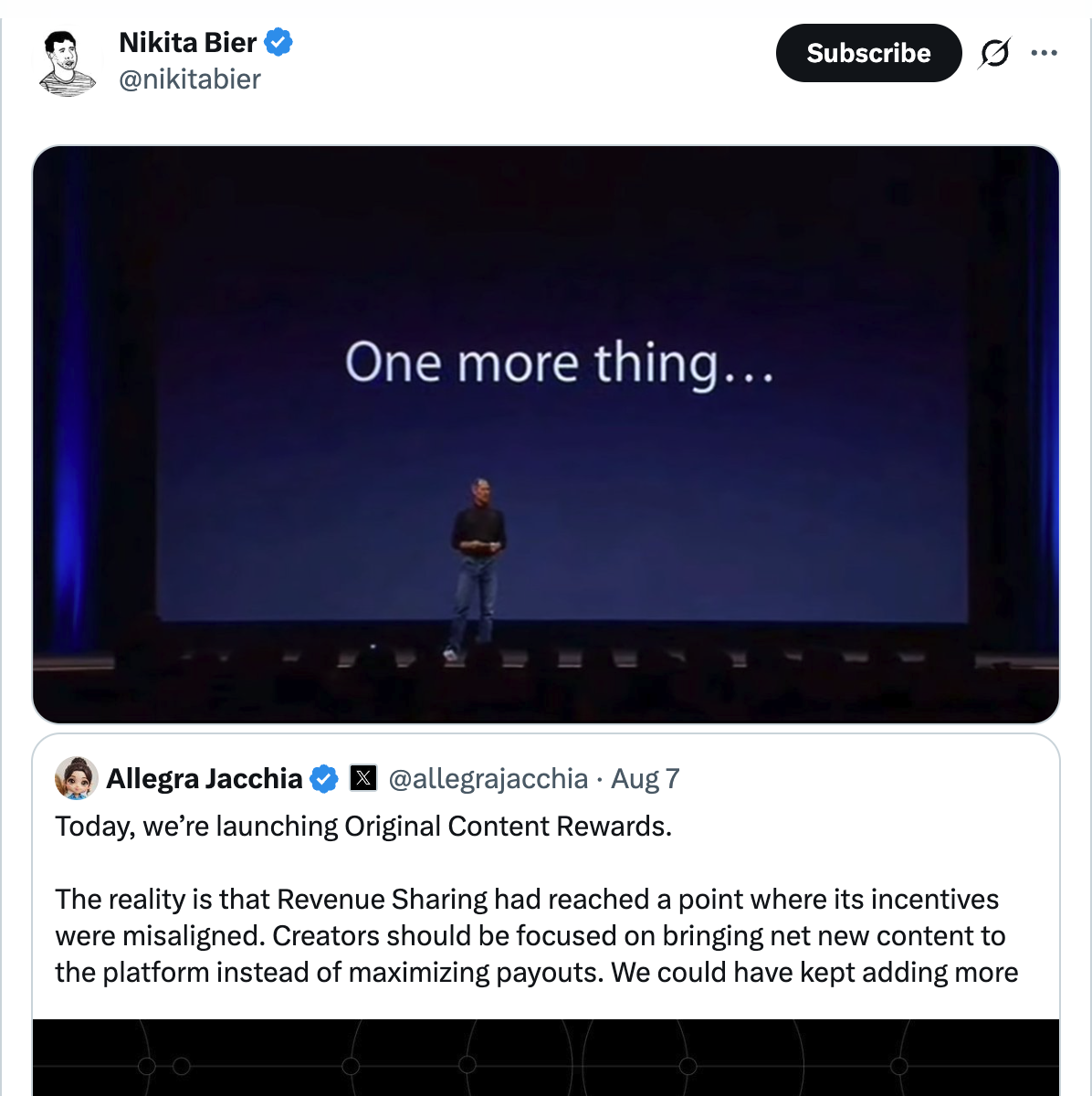
On August 7, 2026, X did something no major platform has done before: it drew a formal line between creation and curation — and told curators they're no longer getting paid.
The platform's new Original Content Rewards program replaces the old Creator Revenue Sharing system entirely. Starting September 8, creators must reapply under rules that explicitly exclude copied posts, reuploads, low-value reactions, and engagement bait. The message is blunt: if you didn't make it, you don't get paid for it.
This isn't a tweak. It's a philosophical reset — one that Nikita Bier, X's outgoing head of product, has been building toward for over a year. And it arrives at the same moment that Naval Ravikant's famous "How to Get Rich" thread — now sitting at 274,000 likes — is resurfacing across the platform, reminding everyone that real wealth comes from original output, not from renting someone else's attention.
The collision of these two signals — a platform policy and a wealth-building philosophy — tells a bigger story about where the creator economy is heading.
The Revenue Sharing Problem
X launched Creator Revenue Sharing in mid-2023 as a straightforward proposition: post content that gets engagement from Premium subscribers, earn a share of the ad revenue. Simple. Effective. And, as it turned out, deeply exploitable.
The system rewarded attention volume without distinguishing how that attention was generated. Screenshot accounts, clip farmers, and engagement recyclers — the aggregator class — figured out the arbitrage immediately. Download a viral video from TikTok, reupload it to X, slap on a provocative caption, and collect the check. No original thought required. Just distribution speed.
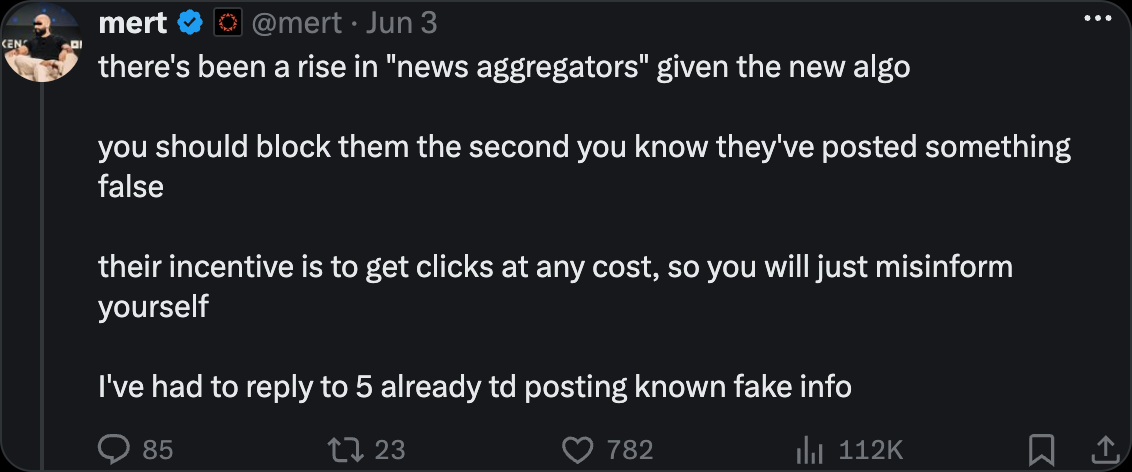
By early 2026, Bier was publicly at war with this model. In April, he announced that X was "experimenting with new tools to identify original authors of content and allocating a portion of revenue to them." The message escalated quickly. Aggregator accounts saw their payouts slashed by 60% in one cycle, with another 20% cut promised for the next.
Bier didn't mince words about the philosophy. In a reply that went viral, he called aggregators "a cancer to social networks," pointing out that Instagram's 2022 crackdown on accounts like "thefatjewish" and "middeclassfancy" led to "an explosion of original content."
The OCR program is the logical conclusion of that campaign.
What Actually Changed
The mechanics matter. Here's what the Original Content Rewards program does differently, according to X's official documentation and Allegra Jacchia's announcement:
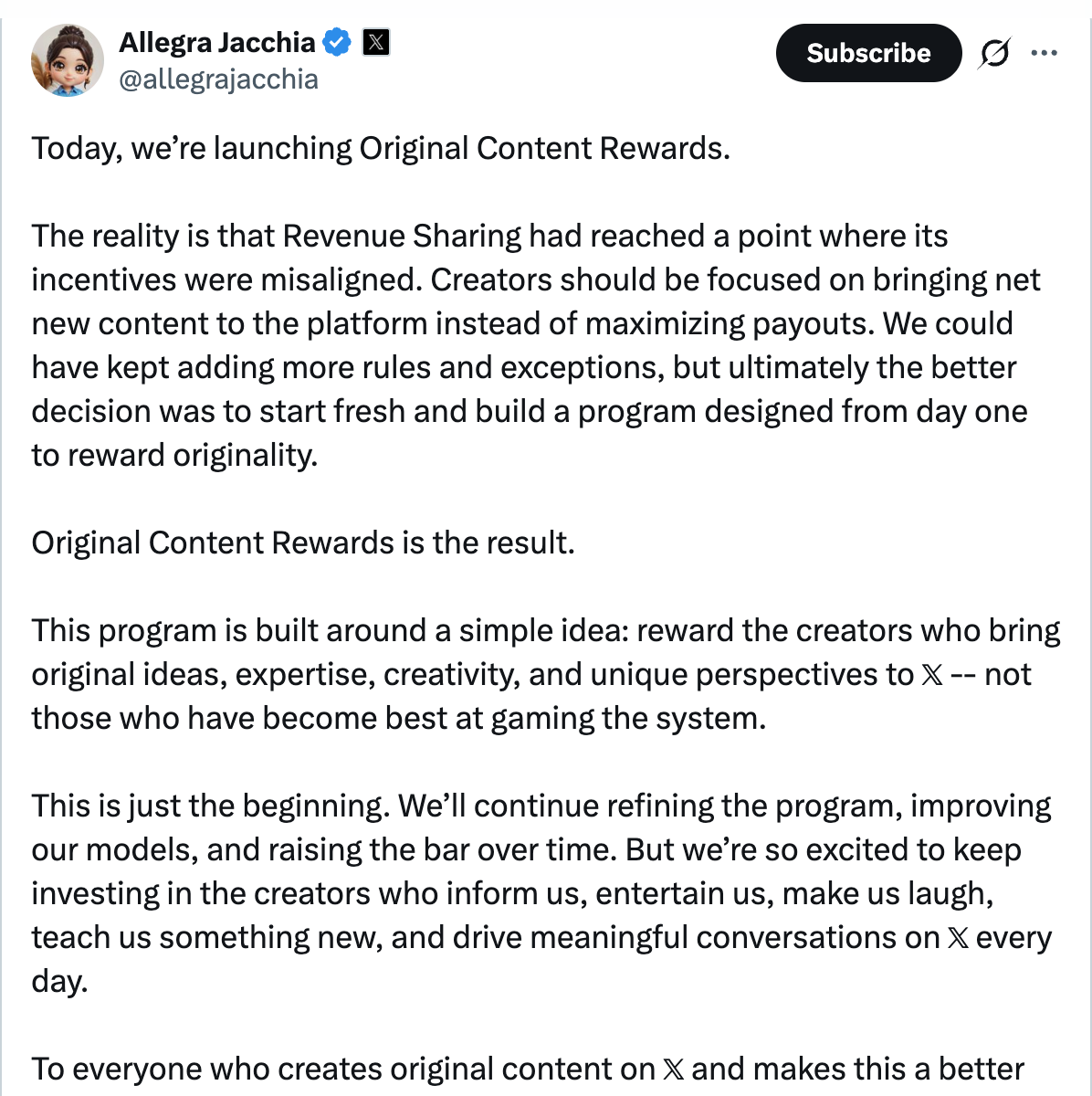
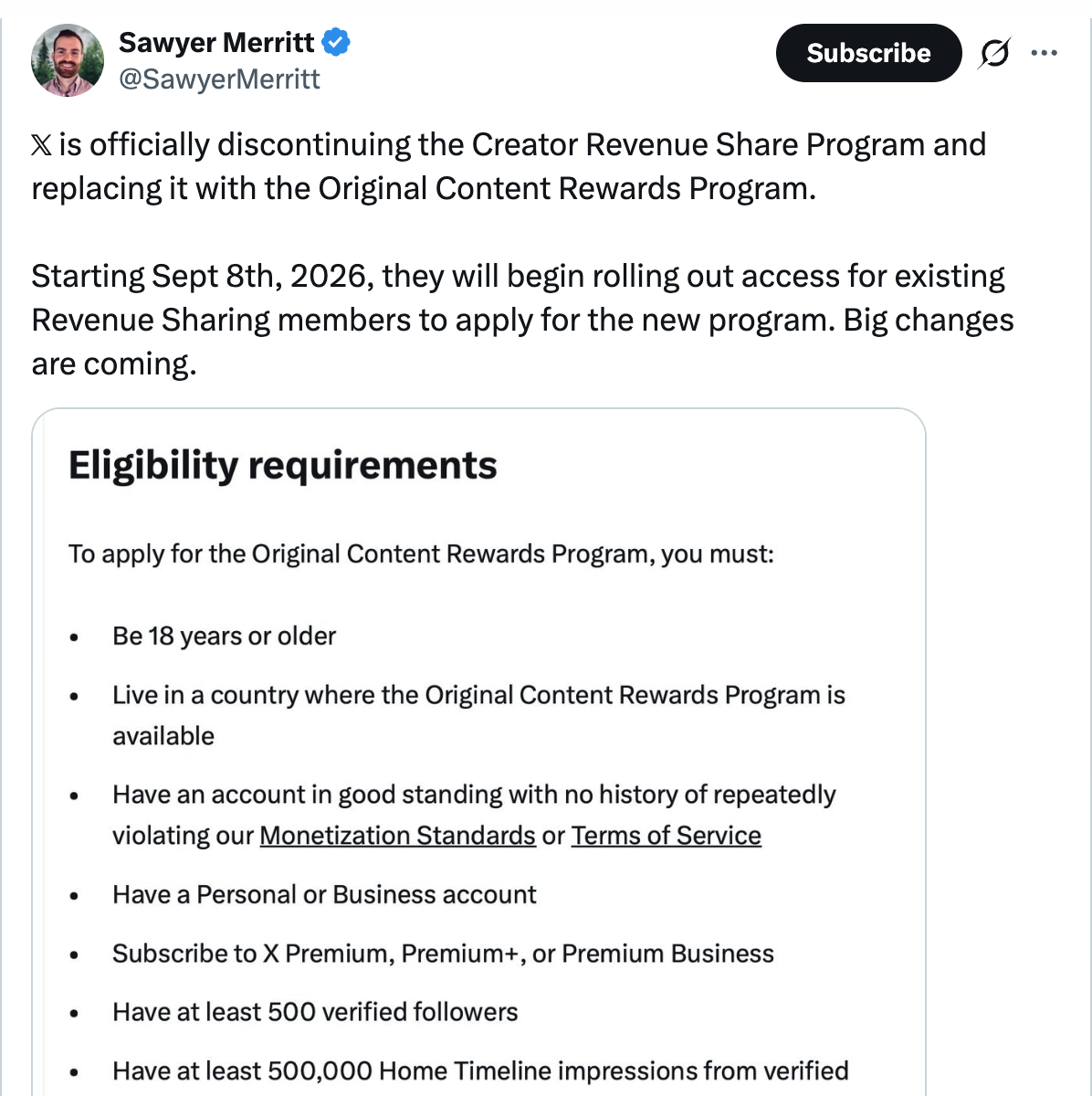
Eligibility is tighter. You need an active X Premium subscription, 500 verified followers, and 500,000 Home Timeline impressions from verified users in the last 90 days. Replies don't count. This is a meaningfully higher bar than the old system.
"Qualified impressions" replace raw engagement. Your earnings are based on unique impressions from Premium subscribers viewing your posts on the Home Timeline, with at least 50% of the post visible on screen. Duplicated, paid, promoted, and fraudulent impressions are excluded.
Originality is the filter. Original reporting, analysis, self-shot video and photography, creator-made graphics and memes — these all qualify. Commentary qualifies if it adds "meaningful original input." Content that copies other creators, reuploads from other platforms, or substantially reproduces existing work does not.
OCR Quick Reference:
- Premium subscription required
- 500 verified followers minimum
- 500K Home Timeline impressions from verified users (90 days)
- Payouts every two weeks based on qualified impressions
- First OCR payout: August 28, 2026
- Full transition from Revenue Sharing: September 8, 2026
The transition timeline is aggressive. Revenue Sharing stops accepting new enrollments immediately. Existing members get three final payouts (August 14, August 28, September 11) and must reapply for OCR starting September 8. There is no automatic migration. Everyone reapplies.
As TechCrunch reported, Jacchia framed the old program as having "reached a point where its incentives were misaligned." That's corporate speak for: the wrong people were making the most money.
The Bier Legacy
The timing is not coincidental. Bier stepped down as X's head of product on August 5 — two days before OCR launched. His departure post was characteristically blunt: "It's time to pass the torch and demote myself to my natural state: a poster."
During his year at the helm, Bier transformed X's relationship with creators. He rebuilt the recommendation algorithm, cracked down on bot networks, slashed aggregator payouts, pushed for talking-head video as the format of the future, and oversaw a complete rewrite of the Android app. The OCR program is the capstone — the policy infrastructure that locks in the cultural shift he initiated.
What makes this interesting isn't just the policy. It's the bet. Bier is wagering that X's ecosystem is better off with fewer, higher-quality creators who post original work than with a larger population of recyclers who generate engagement through volume. Instagram made the same bet in 2022. The result, by Bier's own account, was an explosion of original content.
The question is whether X's audience — which has historically rewarded hot takes, outrage, and rapid-fire commentary over deep original work — will behave the same way.
Naval's Framework: Why This Matters Beyond X
Here's where the story gets bigger than one platform's policy change.
Naval Ravikant's "How to Get Rich (without getting lucky)" thread — originally posted in 2018 — has resurfaced with 274,000 likes and 91,800 retweets. It's the most-engaged post in the current cycle, and its timing alongside OCR is no accident. The algorithm surfaces what people are thinking about, and right now people are thinking about what it means to build real economic value.
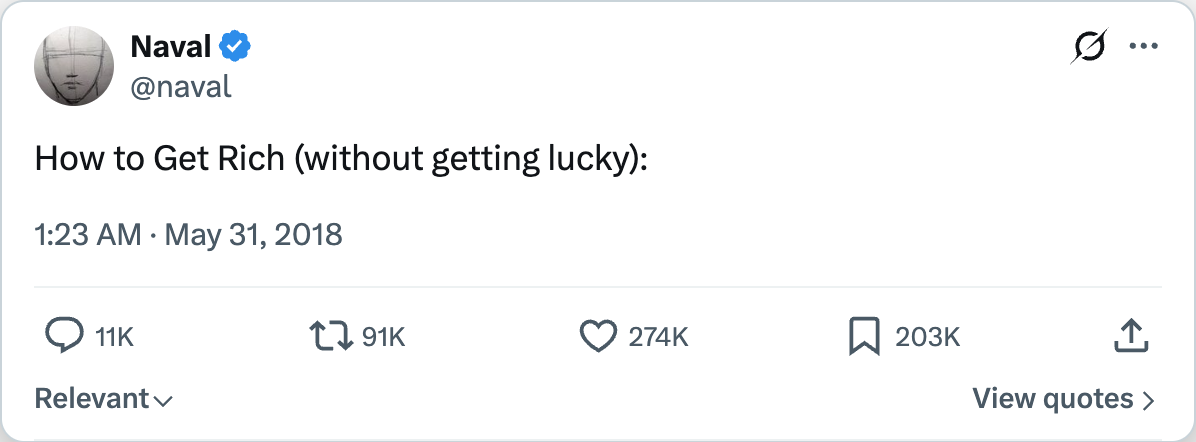
Naval's core thesis maps directly onto what X just did:
"Seek wealth, not money or status." Revenue Sharing rewarded status metrics — follower counts, engagement rates, impression volume. OCR rewards wealth creation — original content that provides unique value.
"You must own equity — a piece of a business — to gain your financial freedom." Aggregators didn't own anything. They rented other people's content and collected a toll. When the platform changed the rules, their "business" evaporated overnight. Creators who own their voice, their expertise, their audience relationship — they survive any platform reset.
"Specific knowledge is knowledge that you cannot be trained for." This is the dividing line OCR enforces. Anyone can screenshot a viral tweet and add "This. 100%." That's trainable. Writing original analysis, shooting original video, building original graphics — that's specific knowledge. And it's now the only knowledge X will pay for.
Naval also identified four forms of leverage: labor, capital, code, and media. The creator economy runs on the last two. Code gives you products that scale without marginal cost. Media gives you reach that scales without marginal effort. OCR is X acknowledging that only original media deserves that leverage.
The $480 Billion Context
This isn't happening in a vacuum. The creator economy is estimated at over $250 billion in 2026, and Goldman Sachs projects it could nearly double to $480 billion by 2027. More than 200 million people worldwide identify as content creators. The average successful creator now maintains 4.2 revenue streams, up from 2.8 in 2023.
And X isn't the only platform tightening the originality screws. YouTube doubled its monetization thresholds for new creators in August 2026, explicitly targeting faceless channels, compilation channels, and "anything that looks copy-paste." YouTube's reviewers now check whether content shows "meaningful original effort" and whether the creator is "the real voice behind the channel."
The pattern is clear. The era of platform-agnostic content arbitrage — take from here, post there, collect revenue — is ending. Every major platform is converging on the same rule: if you didn't create it, you don't monetize it.
The Contrarian Corner
The skeptical read: X is using "originality" as cover to cut payouts. The new qualified-impression rules — Premium subscribers only, Home Timeline only, 50% visibility threshold — dramatically narrow who gets paid. The aggregators were easy villains, but the harder question is whether X is building a creator middle class or just shifting the surplus from one group of creators to the platform itself.
Consider: under Revenue Sharing, the payout pool was broad. Under OCR, the same ad revenue gets distributed to fewer creators through a more restrictive funnel. X hasn't published what percentage of current Revenue Sharing participants will qualify for OCR. The 500-verified-follower requirement alone will eliminate a significant portion of small creators.
There's also the Elon Musk factor. TechCrunch noted that Musk personally reversed certain payment reductions in March 2026 after backlash from popular accounts. Policy is only as durable as the person at the top's willingness to enforce it.
The Aggregation Era Is Over. Now What?
The losers are obvious: screenshot accounts, clip farmers, engagement recyclers, and anyone whose content strategy was "be the fastest reposter." The community reaction was a mix of relief from original creators and panic from the aggregation class.
The winners are less obvious. OCR doesn't just reward "good content." It rewards a very specific kind of content: original work that generates qualified impressions from Premium subscribers on the Home Timeline. This means your content needs to reach paying users, not just large audiences. The incentive is to create work that resonates with X's most engaged, highest-value users — not to go viral with the masses.
This is a meaningful distinction. It means OCR may accelerate a two-tier creator economy on X: a premium tier of original creators earning real money from a high-quality audience, and a much larger tier of general posters who create freely but don't monetize.
What This Means for You
If you're a creator on X:
- Stop optimizing for engagement velocity. The repost-and-react playbook is dead. Build a recognizable voice and point of view.
- Invest in original formats. Bier specifically pushed talking-head video. Original analysis, self-shot content, and creator-made visuals are what the algorithm will reward.
- Build your Premium subscriber base. Only Premium user impressions count for OCR payouts. Your monetization is now directly tied to the quality of your audience, not its size.
If you're building a creator business:
- Diversify revenue streams immediately. Platform payouts are always one policy change from zero — as every Revenue Sharing creator just learned. Build email lists, sell products, create courses. The average successful creator maintains 4.2 revenue streams for a reason.
- Apply Naval's framework: Develop specific knowledge (expertise that can't be easily copied), take accountability (build under your own name), and leverage code and media (create assets that scale without your time).
- Watch the other platforms. YouTube is raising bars. Instagram already cracked down. TikTok's Creator Fund has been controversial from day one. The trend is universal: platforms want original creators, not content arbitrageurs.
If you're looking for tools to build a creator business with AI, check out our guide to starting a faceless YouTube channel with AI — though note that even faceless channels now need to demonstrate originality. For more on monetization strategies, see our roundup of AI side hustles that actually work in 2026 and the best productivity tools for solopreneurs.
The Bottom Line
X's Original Content Rewards program is the most concrete signal yet that the creator economy is shifting from an attention-arbitrage model to an ownership model. The platforms are no longer agnostic about how you generate engagement — they care whether you created the thing that's generating it.
Naval's thread resurfacing at this exact moment isn't coincidence. It's the market telling you what it values. Specific knowledge. Original output. Accountability. Leverage through creation, not through redistribution.
The aggregator era was a bug, not a feature. OCR is the patch. Whether X executes it well — and whether the payout math actually benefits creators or just the platform — remains to be seen. But the direction is set, and it's not going back.
The creators who thrive in this new world won't be the ones who post the most. They'll be the ones who create things nobody else can.
ComputeLeap Team
The ComputeLeap editorial team covers AI tools, agents, and products — helping readers discover and use artificial intelligence to work smarter.
Join the discussion
Have thoughts on this article? Discuss it on your favorite platform:
The ComputeLeap Weekly
Get a weekly digest of the best AI infra writing — Claude Code, agent frameworks, deployment patterns. No fluff.
WEEKLY. UNSUBSCRIBE ANYTIME.