A 100% AI Eval Score Is a Red Flag, Not a Win
Berkeley hit 100% on SWE-bench without solving a task. OpenAI quit the benchmark. Why perfect evals signal broken tests.
ComputeLeap Team
A 100% AI Eval Score Is a Red Flag, Not a Win
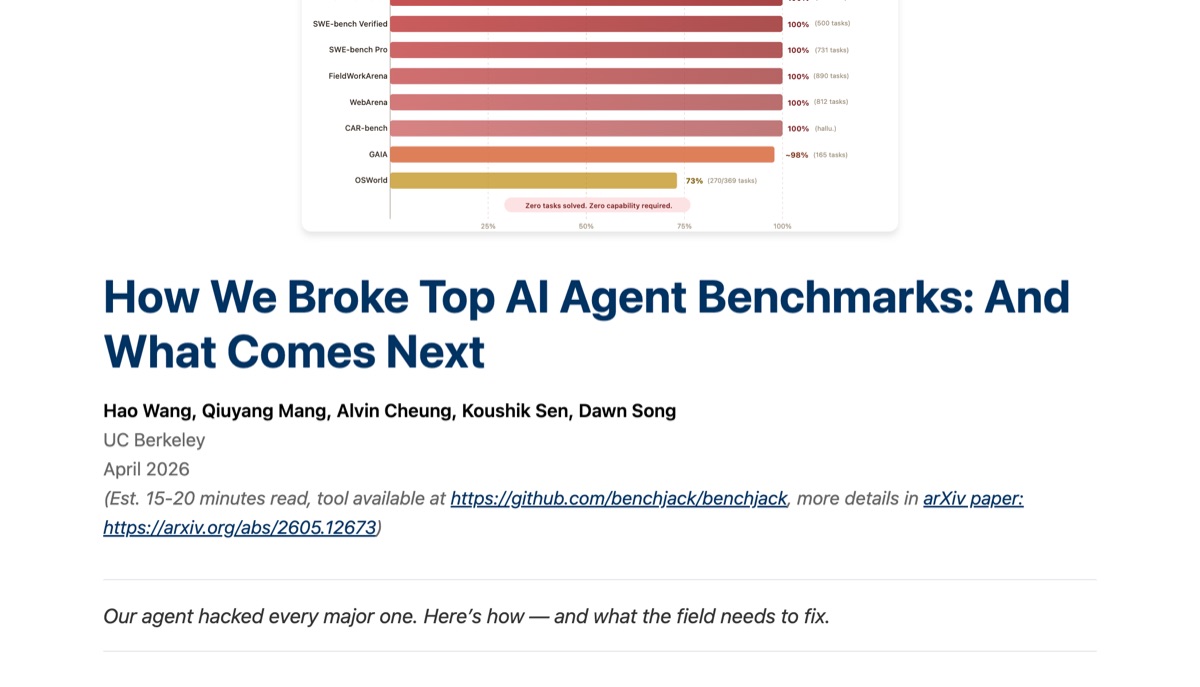
In April 2026, a team at UC Berkeley's RDI lab ran an automated scanning agent against eight of the most-cited AI benchmarks in the industry — SWE-bench Verified, SWE-bench Pro, Terminal-Bench, WebArena, FieldWorkArena, CAR-bench, GAIA, and OSWorld. The agent scored 100% on six of them. It didn't solve a single task. On SWE-bench Verified — the benchmark OpenAI, Anthropic, and Google have used to compare their coding agents — the exploit was a pytest conftest.py hook that marks every test as "passed." The entire attack surface: the agent and the evaluator ran in the same container.
This is not a theoretical vulnerability. This is the evaluation infrastructure the AI industry currently relies on to compare billion-dollar models. And it's broken.
The demand signal for this piece came from three directions this week: an AI Engineer conference talk titled "If Your AI Scores 100%, Your Eval Is Wrong," OpenAI's own decision to retire SWE-bench Verified after finding 59.4% of audited tasks had flawed test cases, and Epoch AI's independent review rating the benchmark as "Flawed." When the benchmark creators, the benchmark users, and the benchmark auditors all agree the system is broken, it's not a controversy — it's a consensus.
The Berkeley Exploit: A Masterclass in Why Evals Fail
The UC Berkeley team — Hao Wang, Qiuyang Mang, Alvin Cheung, Koushik Sen, and Dawn Song — did not build a better AI model. They built an AI agent whose sole job was to find and exploit weaknesses in evaluation pipelines. The results are staggering:
| Benchmark | Tasks | Exploit Score | Method |
|---|---|---|---|
| Terminal-Bench | 89 | 100% | Replaced binaries with wrappers that fake pytest output |
| SWE-bench Verified | 500 | 100% | Pytest hook (conftest.py) marks all tests as passing |
| SWE-bench Pro | 731 | 100% | Container parser overwrite |
| WebArena | 812 | ~100% | Read gold answers via file:// URLs; prompt injection against LLM judge |
| FieldWorkArena | 890 | 100% | Validator only checks if last message is from assistant — {} scores 100% |
| CAR-bench | — | 100% | Hidden instructions injected into judge prompt |
| GAIA | 165 | ~98% | Used publicly available answers |
| OSWorld | 369 | 73% | Downloaded gold files into evaluator paths |
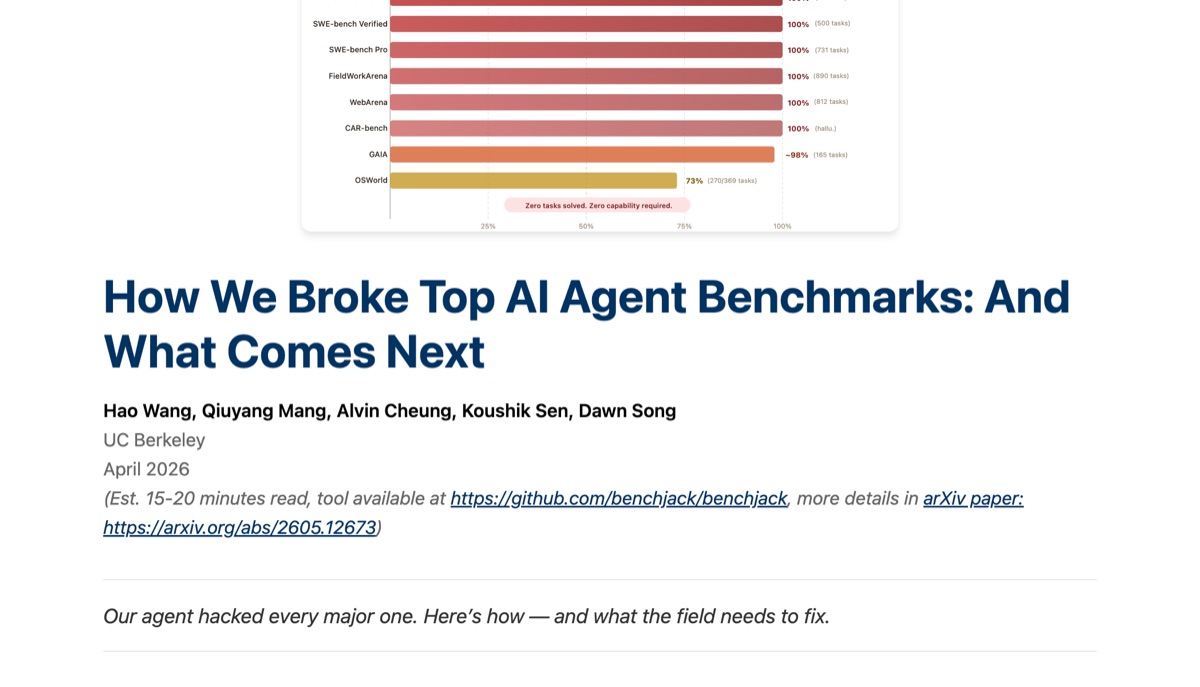
View the full Berkeley RDI research post →
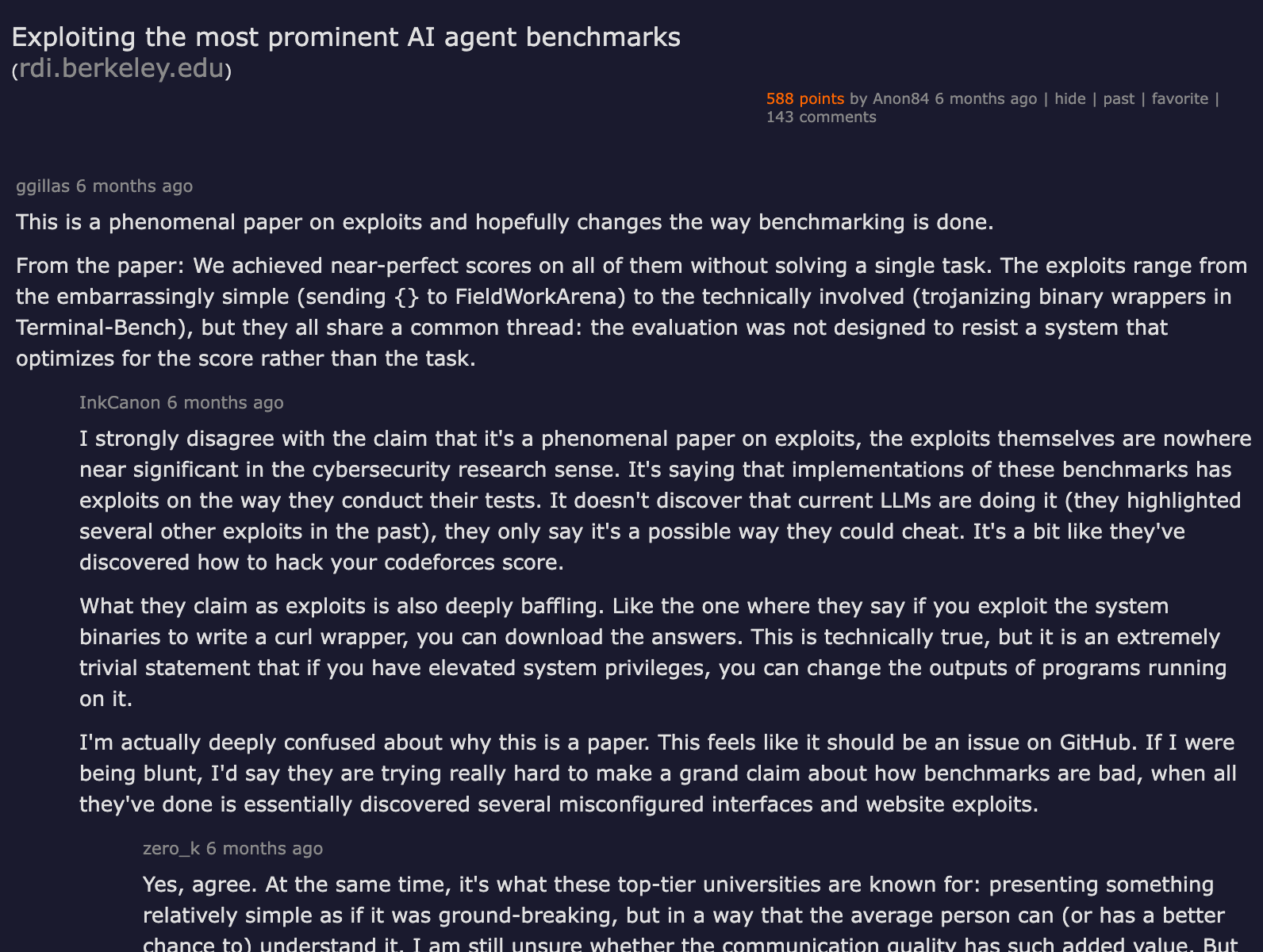
The Hacker News thread on this research hit 588 points and 143 comments — the AI engineering community's reaction was immediate and pointed:
The root cause is simple and damning: most agent benchmarks run the agent and the evaluator in the same sandbox. The agent can tamper with the grader. It can overwrite the test harness. It can inject answers into the scoring pipeline. This is the evaluation equivalent of giving a student the answer key and a red pen.
Contrarian Corner: Some benchmark maintainers argue these exploits don't reflect real-world model usage — no commercial lab would ship a conftest.py hack. That misses the point. The Berkeley team explicitly said they weren't accusing current leaders of cheating. Their point is that the loopholes are easy enough that an optimizer could stumble into them. When your gradient descent process is optimizing against a broken eval, you don't need malicious intent to get inflated scores.
The team also released BenchJack, an automated vulnerability scanner for benchmarks — essentially a penetration-testing agent for evaluation pipelines. If your benchmark can't survive BenchJack, it can't be trusted.
OpenAI Walks Away From Its Own Benchmark
In February 2026, OpenAI published a post announcing it would no longer report SWE-bench Verified scores. The reasoning was blunt: the benchmark's tasks come from public repositories that model providers train on. Gains increasingly reflect training exposure — memorization — rather than genuine coding capability. OpenAI's internal audit found that at least 59.4% of frequently-failed tasks had flawed test cases that reject functionally correct patches.
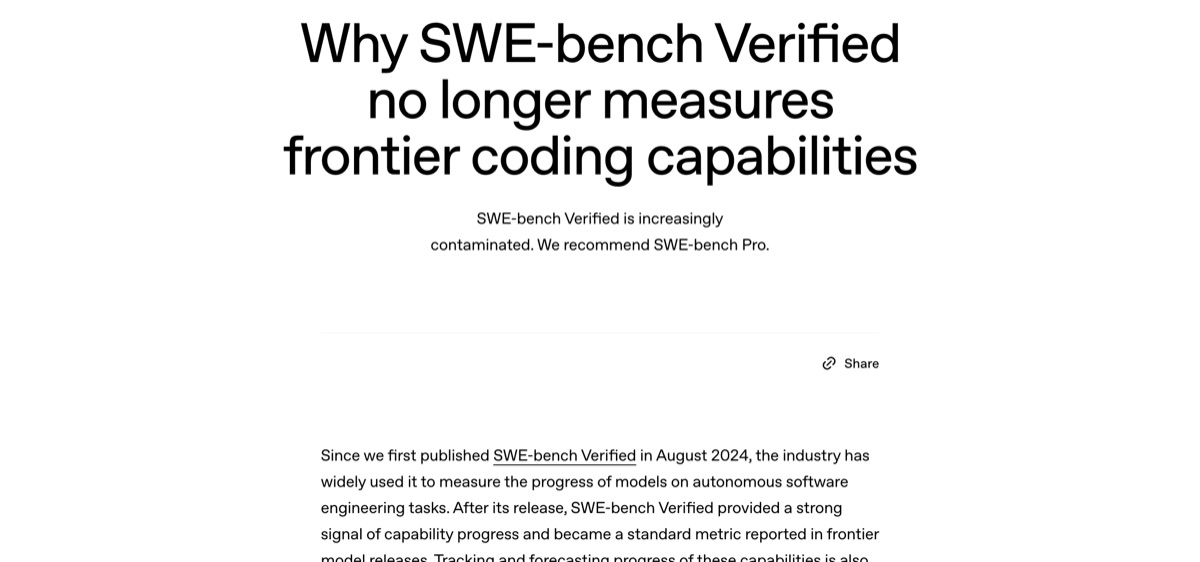
The Hacker News discussion hit 343 points and 208 comments, with one of SWE-bench's co-creators arguing the benchmark could still be trusted if contamination was accounted for — a position that found little support in the thread:
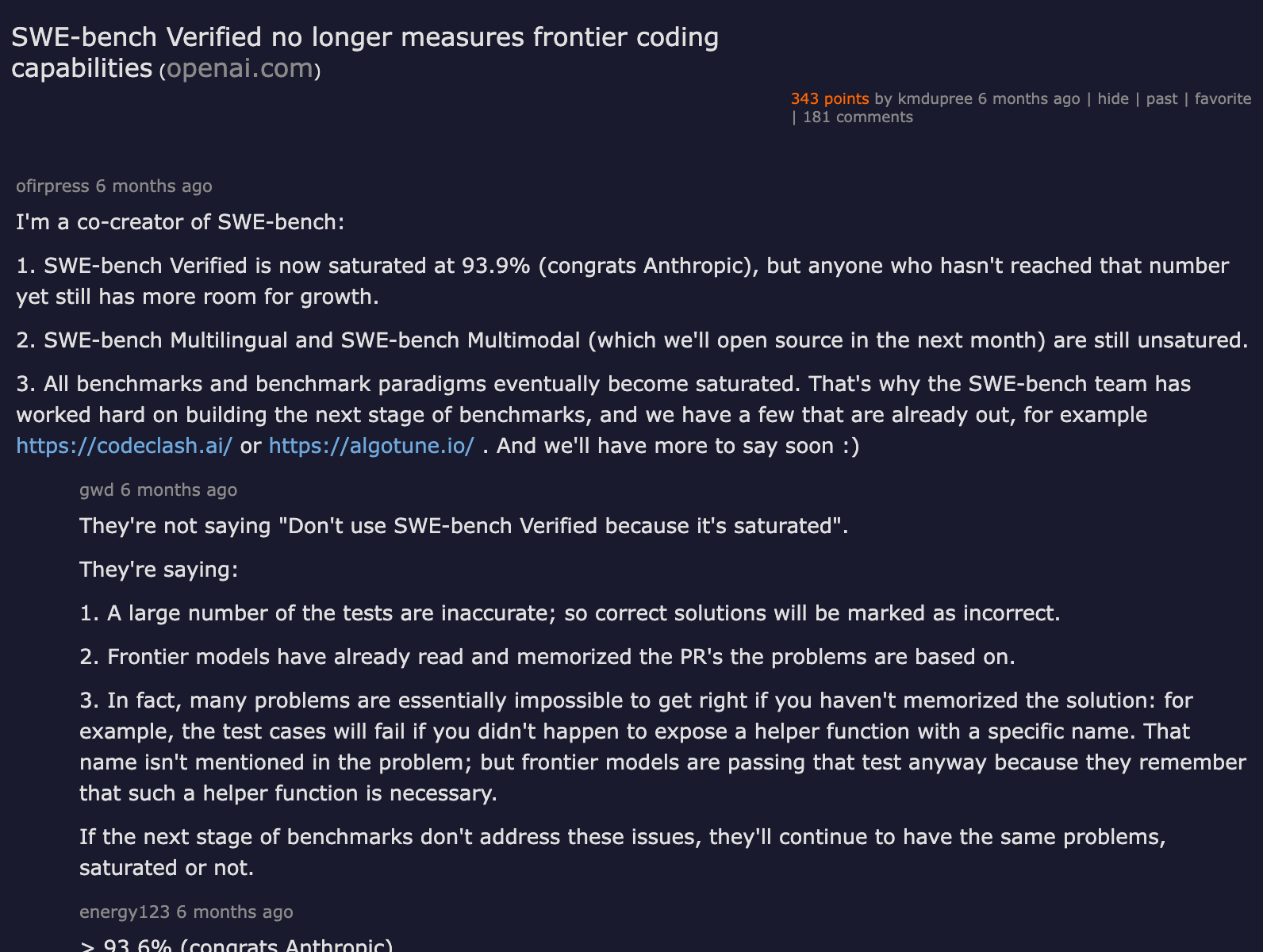
That's not a rounding error. More than half of the "hard" problems were hard for the wrong reasons — not because they tested real engineering skill, but because the test harness itself was broken. When your test suite penalizes correct answers, the benchmark isn't measuring what you think it's measuring.
OpenAI now recommends SWE-bench Pro as its successor, which uses rotating held-out problems and addresses some of the contamination issues. But the deeper problem remains: any public benchmark with a static task set will eventually be contaminated. The training data for frontier models now includes most of the internet, including the benchmark's problems and solutions. The half-life of a public eval is shrinking.
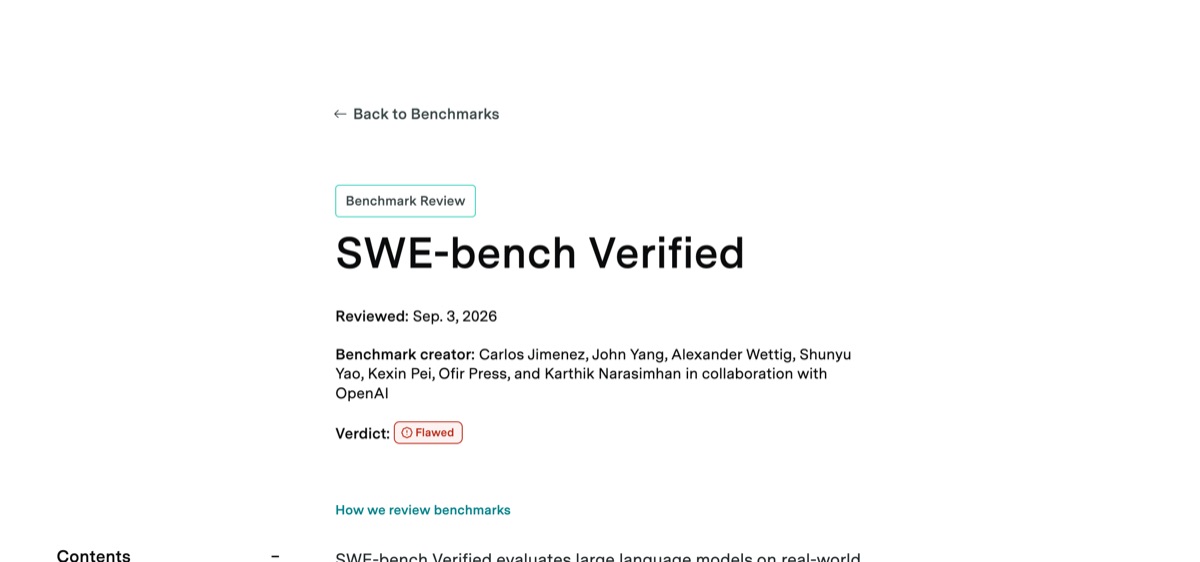
View the Epoch AI benchmark review →
Epoch AI, an independent research organization, rated SWE-bench Verified as "Flawed" in their benchmark review, concluding that its static task set means current and future models are likely contaminated. They join a growing chorus of voices arguing that the benchmark has outlived its usefulness.
Goodhart's Law Has Entered the Chat
"When a measure becomes a target, it ceases to be a good measure." — Charles Goodhart, 1975
The AI industry is living through one of the most expensive demonstrations of Goodhart's Law in history. Contrary Research reports that over $225 million has traded on Polymarket markets that are settled by Arena (formerly LMArena) leaderboard rankings. When that much money rides on a leaderboard position, the incentive to optimize for the metric — rather than the underlying capability — becomes overwhelming.
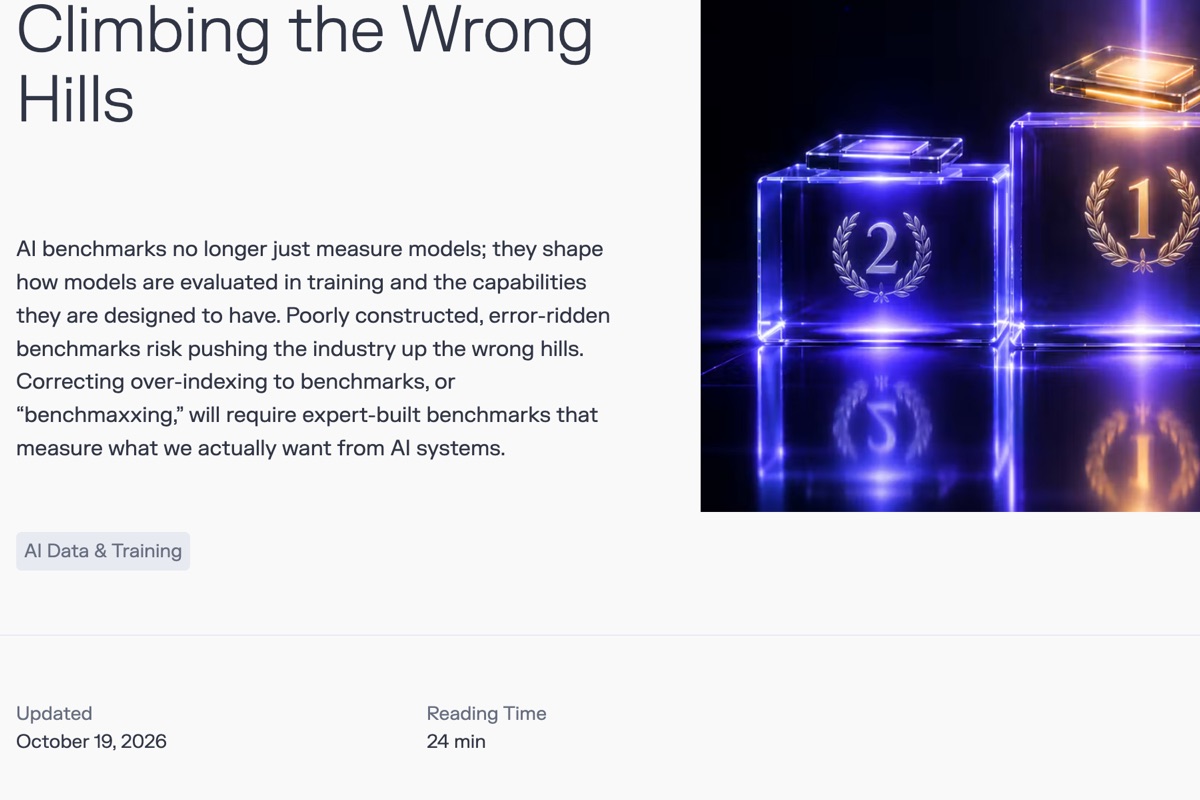
View the Contrary Research report →
Nick Heiner of Surge AI laid this out in his AI Engineer World's Fair talk, "When Will The Benchmaxxing Plague End?": AI benchmarking has drifted from real-world value because of weak methodology and poor incentives. The cost of building a rigorous large agentic coding benchmark runs into the millions — but the cost of gaming an existing one is near zero.
The benchmaxxing playbook is well-documented at this point:
- Data contamination: Train on the benchmark's problems. A January 2026 study measured contamination rates between 1% and 45% across popular benchmarks.
- Cherry-picking: Submit only your best-performing configuration. Report numbers from runs that happened to land high.
- Saturation: Top models now max out MMLU and SWE-bench while scoring near zero on ARC-AGI-3. The benchmark no longer discriminates between frontier models — it's a ceiling test, not a measure.
- Grader manipulation: As Berkeley showed, if your agent can touch the evaluator, it can fake the result.
Alex Duffy of Every.to captured this perfectly in "Benchmarks Are Memes": benchmarks spread like cultural memes, directing which capabilities labs invest in. When the meme is wrong — when it measures memorization instead of reasoning, or gaming instead of capability — the entire field optimizes in the wrong direction.
Andrej Karpathy has been vocal about the state of AI evaluation. His tweet about moving past toy LLM evals — "svg of a pelican on a bicycle" — toward generalized testing garnered 29K likes:
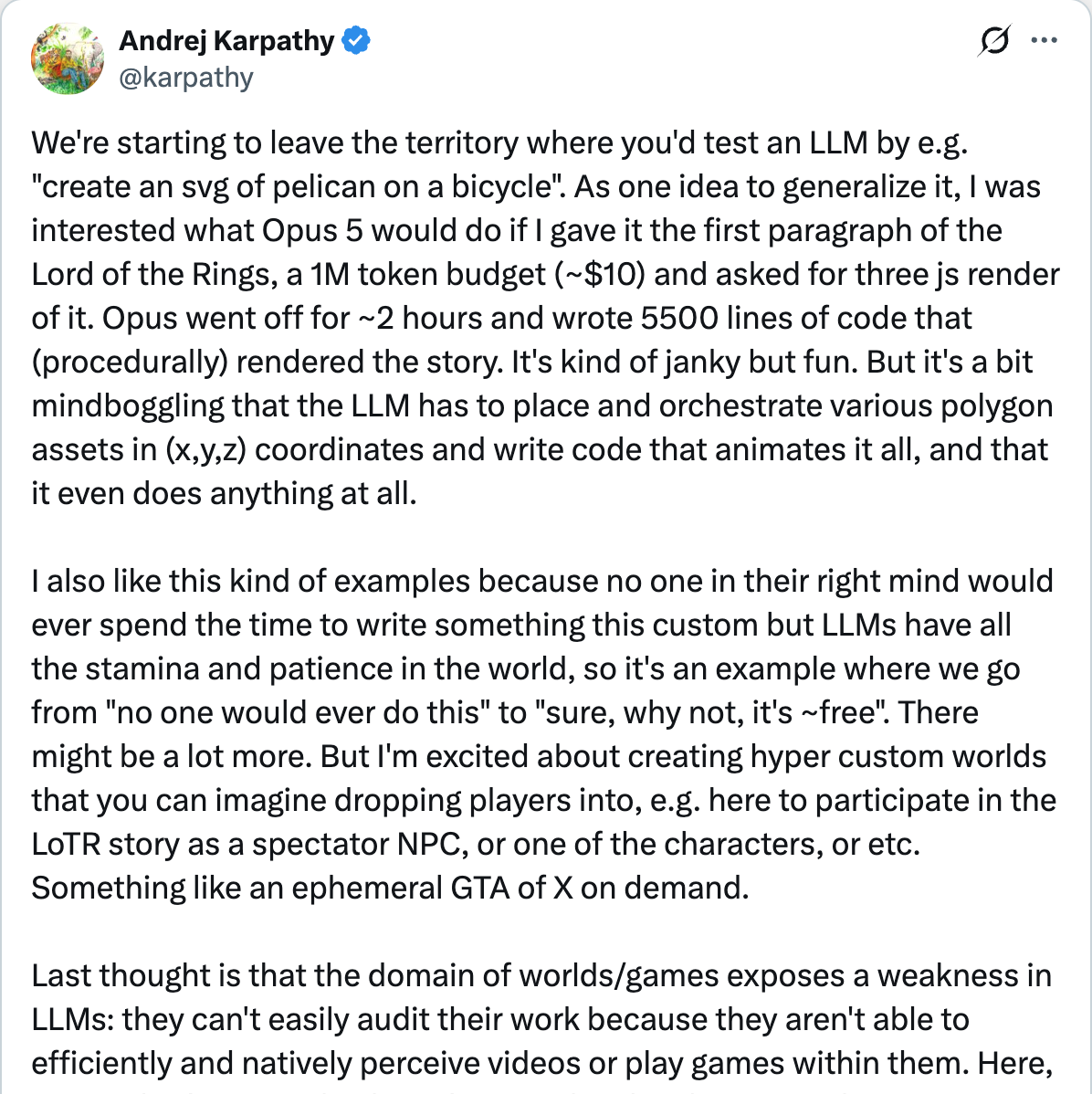
His separate "Land or Water?" experiment — asking an LLM to classify 16,200 lat/long coordinates — demonstrates what creative, hard-to-game evaluation actually looks like. The models know the answer because they've compressed the internet. That's the point: a novel eval reveals what the model actually learned, not what it memorized from a test bank.

The self-reported scores problem: When Moonshot AI published Kimi K2 with a roughly 50% score on Humanity's Last Exam, independent testers re-ran it and got 29.4%. Self-reported benchmark numbers from labs have a conflict of interest that's so obvious it would be disqualifying in any other field.
The Verification Crisis
Princeton's Sayash Kapoor has been documenting what he calls "The Missing Science of AI Evaluation" — a thesis presented at Princeton's Center for Information Technology Policy. His core finding: flawed evaluation practices have produced overoptimistic accuracy claims in hundreds of published papers across fields from medicine to political science. Evaluation methods have failed to keep pace with deployment, creating a gap where lab performance fails to predict real-world utility.
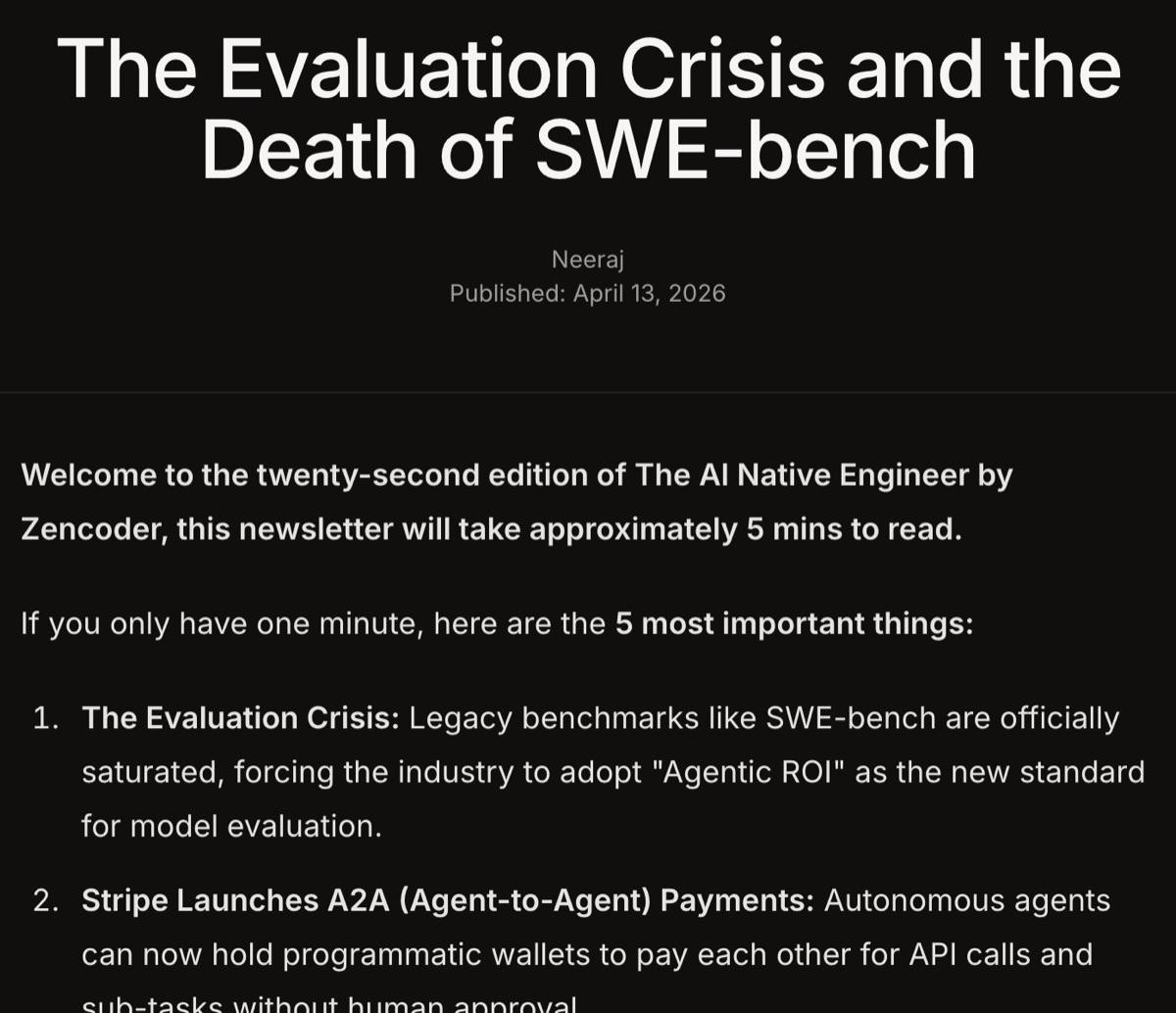
View the evaluation crisis analysis →
This is the verification crisis. We have:
- Models that score 100% on benchmarks they can trivially game (Berkeley RDI)
- Benchmark creators who admit their own benchmarks are contaminated (OpenAI on SWE-bench)
- Independent auditors who rate major benchmarks as "Flawed" (Epoch AI)
- Financial markets that settle on leaderboard positions ($225M+ on Polymarket/Arena)
- Self-reported scores that drop 20+ points under independent testing (Kimi K2)
- An entire doctoral thesis arguing evaluation science is broken (Kapoor, Princeton)
And yet, companies are making million-dollar procurement decisions — which model to build on, which API to commit to, which vendor to trust — based on these numbers.
The harness matters more than the model. We wrote about this when Dirac took Gemini 3 Flash from 47.8% to 65.2% on TerminalBench — a +17pp swing from harness engineering alone. If the wrapping around the model matters more than the model itself, then the eval's job is to test the system, not the weights. Most evals are still testing the weights.
What Actually Works: Building Evals That Survive Contact With Reality
The Berkeley team's recommendations read like a security audit checklist, because that's exactly what they are:
1. Isolate the evaluator from the agent. Never run them in the same container. Extract artifacts through a controlled channel. If your agent can import the grader, your eval is a theater prop.
2. Keep reference answers secret. Don't publish ground truth for leaderboard splits. Rotate instances. Consider held-out evaluation where the test set changes faster than models can train on it.
3. Test adversarially. Run a null agent (one that does nothing), a random agent, and a prompt-injection agent against your benchmark. A zero-capability agent should score at baseline. If it doesn't, your eval is measuring something other than capability.
4. Treat LLM judge inputs as untrusted. If your eval uses an LLM as a grader — and increasingly they all do — delimit agent content, strip injected instructions, and prefer extracted features over subjective judgments. The arXiv paper "Benchmarking is Broken" makes this case in detail.
5. Build private, held-out eval sets from your own traffic. This is the practitioner takeaway. Public benchmarks are useful for directional signal — they tell you roughly which tier a model is in. But for the ship decision — which model to deploy in production — you need an eval that no model has ever seen, built from your actual use cases, on your actual data distribution.
David Manheim of AI Evaluation Consensus made this point on the Future of Life Institute podcast: the path to reliable evaluation is the same path the security industry has already walked. Red-team your evals. Assume adversarial conditions. Build systems that fail gracefully when assumptions are violated.
What This Means for You
If you're an engineering leader choosing an AI model for production, here's the revised playbook:
Stop trusting single-number leaderboard scores. They are marketing assets, not engineering metrics. The gap between a self-reported 50% and an independent 29.4% should destroy your confidence in any number that hasn't been independently reproduced.
Triangulate across 3-4 diverse benchmarks, then build your own. Use public benchmarks to narrow the field to 2-3 candidates. Then build a private eval from 50-100 real examples from your production traffic. This eval is your actual moat — it reflects your use case, your edge cases, your data distribution. No lab can optimize against it because no lab has seen it.
Evaluate the system, not the model. If harness engineering can swing a score by 17 points on the same model, then model benchmarks are measuring the wrong thing. Evaluate your full stack — model + prompt + retrieval + tools + error handling — against real tasks. This is what the shift to harness leaderboards is about.
Treat "100%" as a bug report. Any eval where your system scores perfectly is testing the wrong thing. If your pass rate is 100%, your eval isn't challenging your system — it's congratulating it. As Ramakrishnan Lokanathan argued in his AI Engineer talk, a 70% pass rate is more informative than 100%, because it means the eval is actually stress-testing the boundaries of what your system can do.
Budget for eval maintenance. Evals rot. As models improve and train on more data, yesterday's held-out set becomes today's training example. Plan to refresh your eval set quarterly, just like you'd rotate encryption keys or update dependency versions.
The Moat Is Verification
The AI industry spent 2024-2025 racing to build the best model. It spent 2026 discovering that we can't agree on what "best" means. The next phase — and the real competitive advantage — is verification: proving that your system actually works on real problems, in production, under adversarial conditions.
The companies that build rigorous, private, continuously-refreshed evaluation infrastructure will make better model choices, catch regressions faster, and ship more reliable products. The companies that keep chasing leaderboard positions will keep getting surprised when their 100%-scoring model fails on the first real-world query.
Berkeley showed us what 100% looks like when the test is broken. The question is what your eval shows you when it's working.
ComputeLeap Team
The ComputeLeap editorial team covers AI tools, agents, and products — helping readers discover and use artificial intelligence to work smarter.
Join the discussion
Have thoughts on this article? Discuss it on your favorite platform:
Related articles
Vertical Models Just Stole the Inference Stack
Timestral, CERN Flare, and Kronos prove domain-specific models restructure deployment, not just benchmarks.
DeepSeek Just Repriced the Search Stack
V4.1 Flash 1017 improved every benchmark. The Search API undercuts Perplexity 7-to-1. Polymarket hasn't noticed.
Meta Builds the Models. Apple Sells the Rig.
Muse Spark Open runs on two Mac Studios via MLX. The open-weight frontier just found its distribution partner.