The RAM Oligopoly Is Back in Court
A federal judge denied Samsung, SK Hynix, and Micron's bid to dismiss a DRAM price-fixing suit. Here's what it means.
ComputeLeap Team
The RAM Oligopoly Is Back in Court

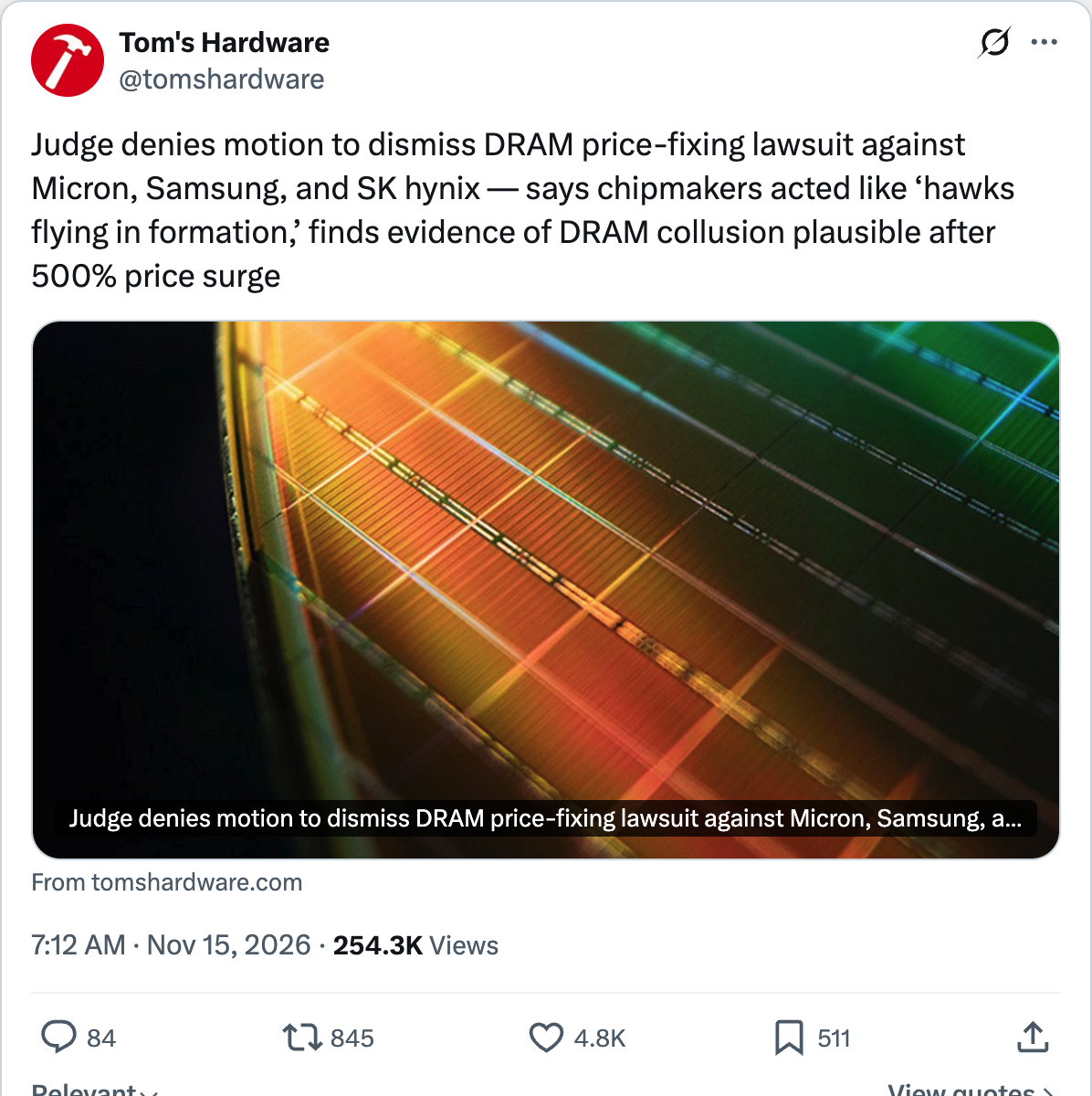
On November 14, 2026, U.S. District Judge Noel Wise denied Samsung, SK Hynix, and Micron's joint motion to dismiss a class-action lawsuit alleging they conspired to restrict DRAM supply and inflate memory prices. The ruling in Garciaguirre v. Samsung Electronics Co., Ltd. (Case No. 5:26-cv-06345-NW, N.D. Cal.) doesn't prove the three companies colluded — but it does something arguably more important: it forces them into discovery, where internal emails, planning documents, and production records will become evidence for the first time.
This matters because these three companies control over 91% of global DRAM revenue. That is not a competitive market with an antitrust problem. That is an oligopoly with a legal question hanging over it.
View discussion on Hacker News →
What the Court Actually Said
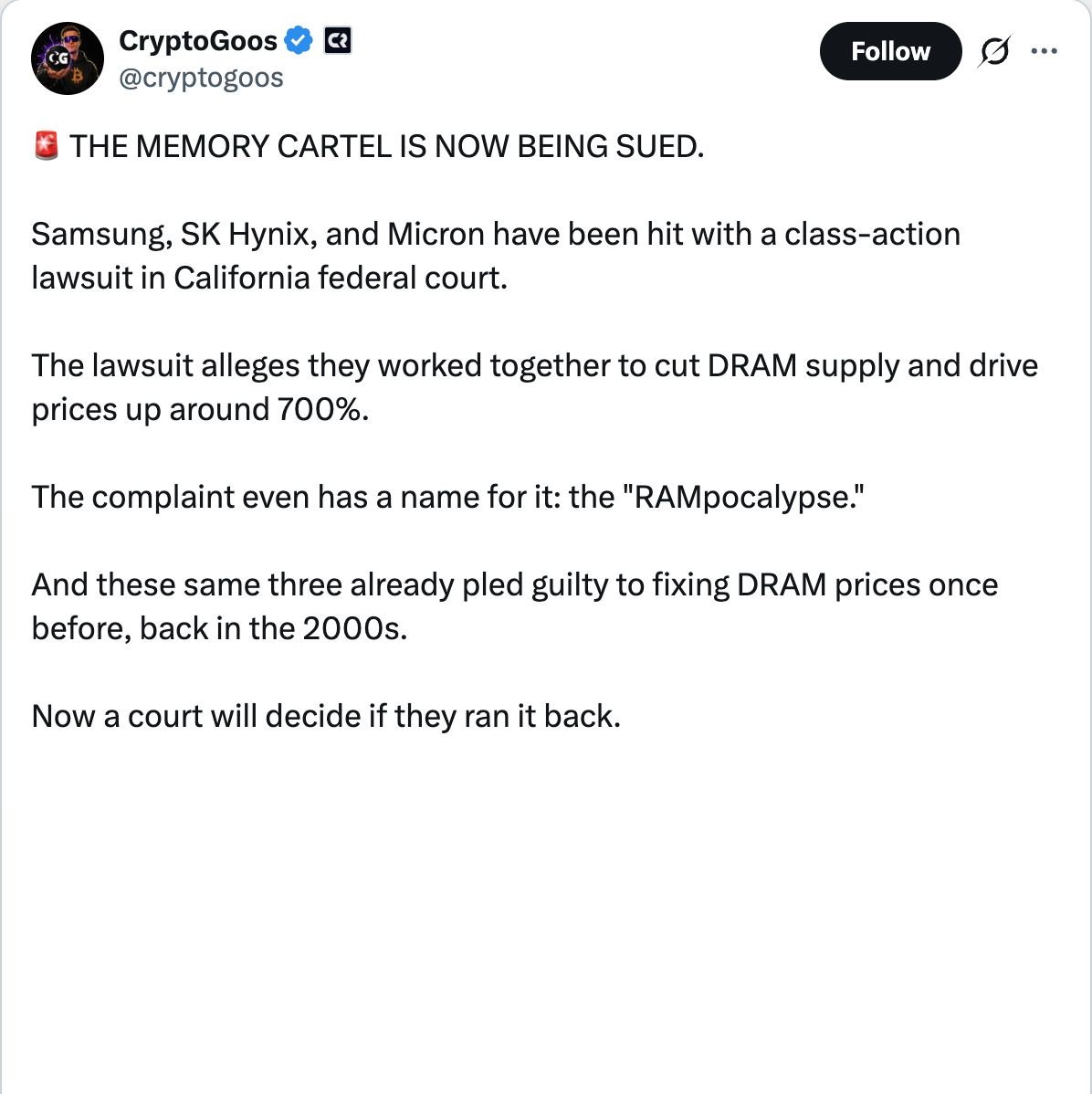
The seventeen plaintiffs — consumers and small businesses from five states — filed their complaint on June 25, 2026, alleging that the three chipmakers violated Section 1 of the Sherman Act by coordinating production cuts of conventional DRAM while shifting capacity to high-bandwidth memory (HBM) used in AI servers. The complaint claims conventional DRAM prices rose roughly 500% to 697% over a four-year period.
View original article on Tom's Hardware →
The defendants tried to kill the case at the pleading stage. Their central argument: this is just a rehash of DRAM II, the 2018 class action that the Ninth Circuit dismissed in 2022, ruling the trio's conduct was "more likely explained by lawful, unchoreographed free-market behavior" than by an illegal agreement.
Judge Wise disagreed. The court found the new case is not a repeat of DRAM II. Instead, the judge weighed a series of "plus factors" — circumstantial evidence that elevates parallel conduct from coincidence to plausible conspiracy:
- Coordinated production cuts on a tight timeline. SK Hynix began cutting conventional DRAM output on October 26, 2022. Micron followed about three weeks later. Samsung joined in April 2023. The court found these gaps "not such an unreasonably long delay that it defeats an allegation of parallel conduct on a motion to dismiss."
- Long-term HBM supply contracts paired with reported refusals of long-term conventional DRAM contracts.
- Micron's closure of its Crucial consumer brand in December 2025 — shutting down a retail channel that served exactly the market segment experiencing price spikes.
- Delayed or halted fab construction despite record prices. The court analogized this to refinery-capacity precedent: when prices are at all-time highs and you are not expanding capacity, that demands explanation.
- Near-identical customer-vetting practices adopted in January 2026, after the AI boom and HBM pivot were already underway.
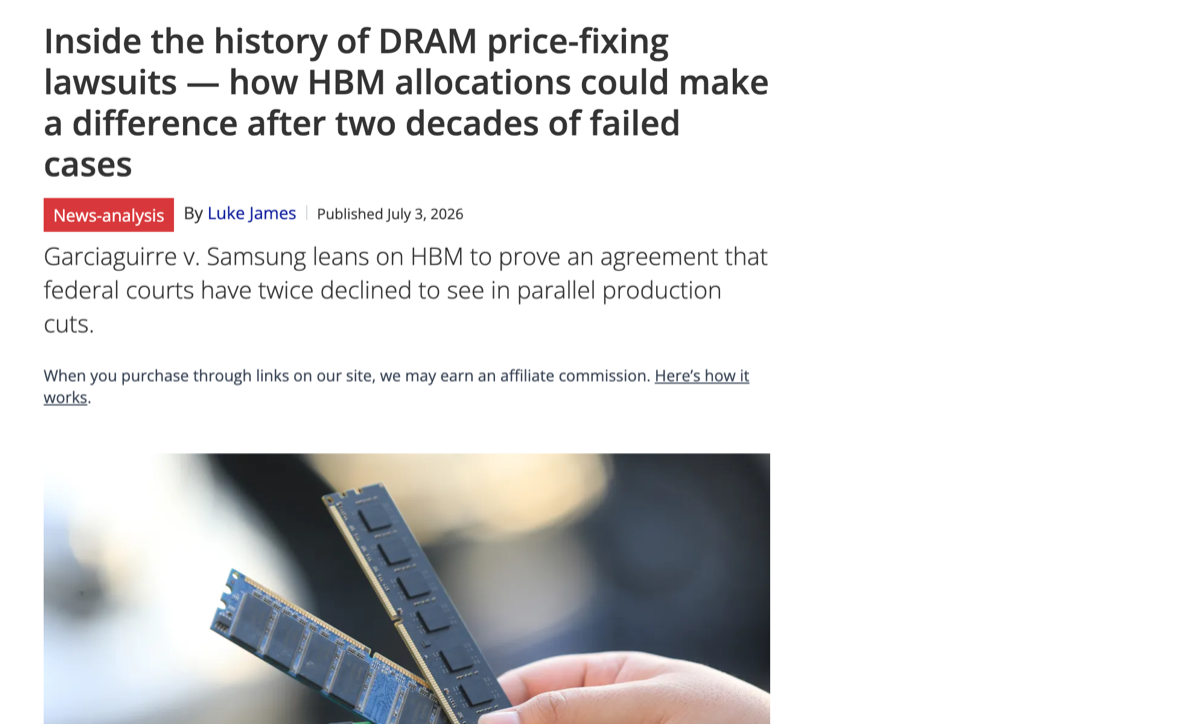
- The prior cartel history. Samsung paid a $300 million fine and SK Hynix paid $185 million for price-fixing DRAM from 1998 to 2002.
The court's most revealing language came in rejecting the defendants' framing of their behavior as independent hawks rationally watching each other. Judge Wise reframed it: these are not hawks watching each other — they are "hawks flying in formation." Formal responses are due December 7, 2026. The first case management conference is set for January 12, 2027.
A History That Keeps Rhyming
This is not the memory industry's first time in court, and that history is part of what kept the case alive.
From 1998 to 2002, Samsung, Hynix (now SK Hynix), Infineon, Elpida, and Micron ran a confirmed DRAM price-fixing cartel. The Department of Justice secured guilty pleas and fines totaling over $730 million. Samsung's $300 million penalty was one of the largest antitrust fines in DOJ history at the time. Micron escaped prosecution entirely by reporting the scheme to authorities and cooperating with the investigation — the textbook leniency play.
What happened to the executives who ran the cartel? As Gamers Nexus documented in their investigative series, many were promoted or retained. The institutional knowledge of how to coordinate supply in a concentrated market did not disappear with the guilty pleas.
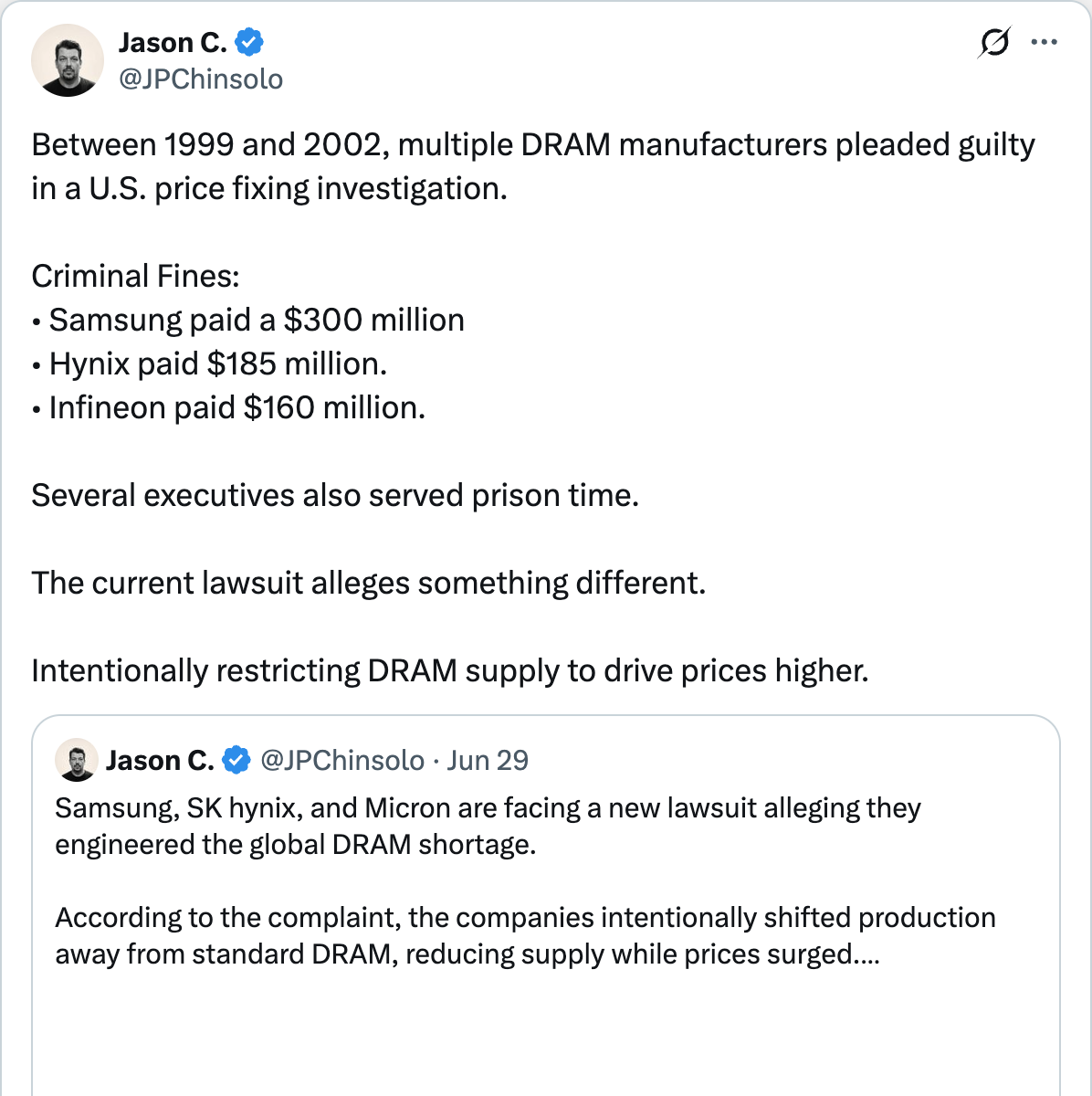
Then came the 2016-2018 period. China's State Administration for Market Regulation investigated the same three companies for DRAM pricing practices. In the U.S., Hagens Berman filed a class action in 2018 making similar allegations. That case was dismissed in 2020, and the Ninth Circuit upheld the dismissal in 2022, finding insufficient evidence of an actual agreement.
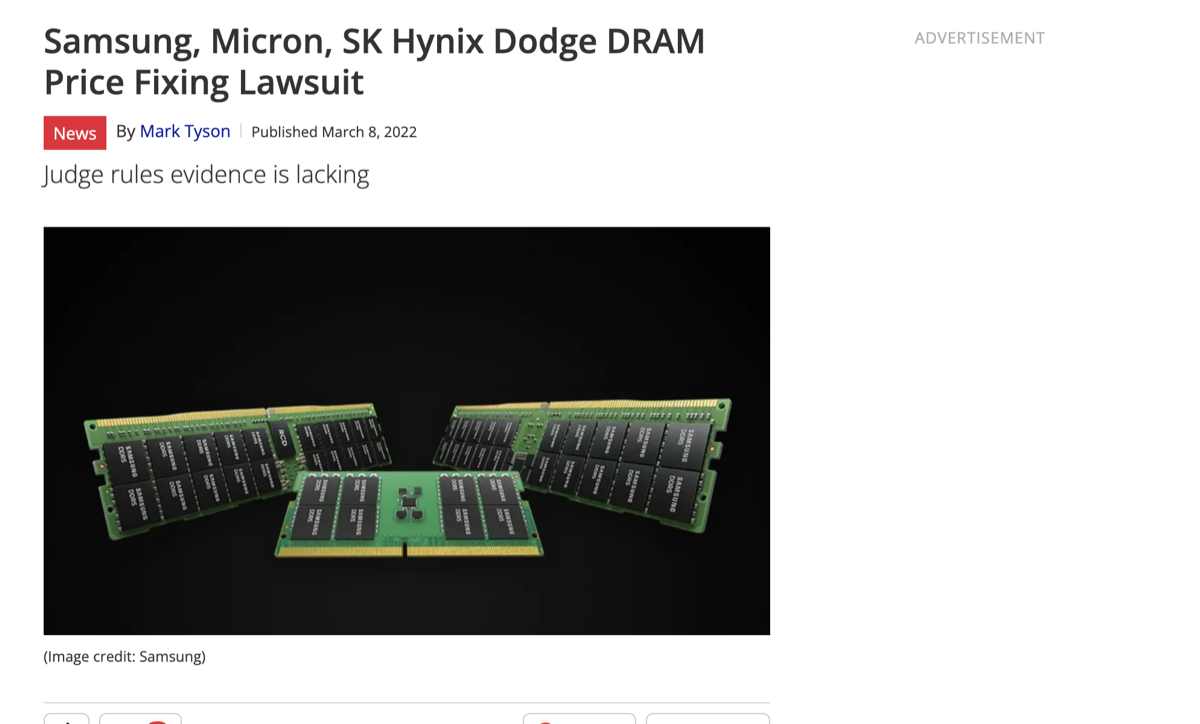
View original article on Tom's Hardware →
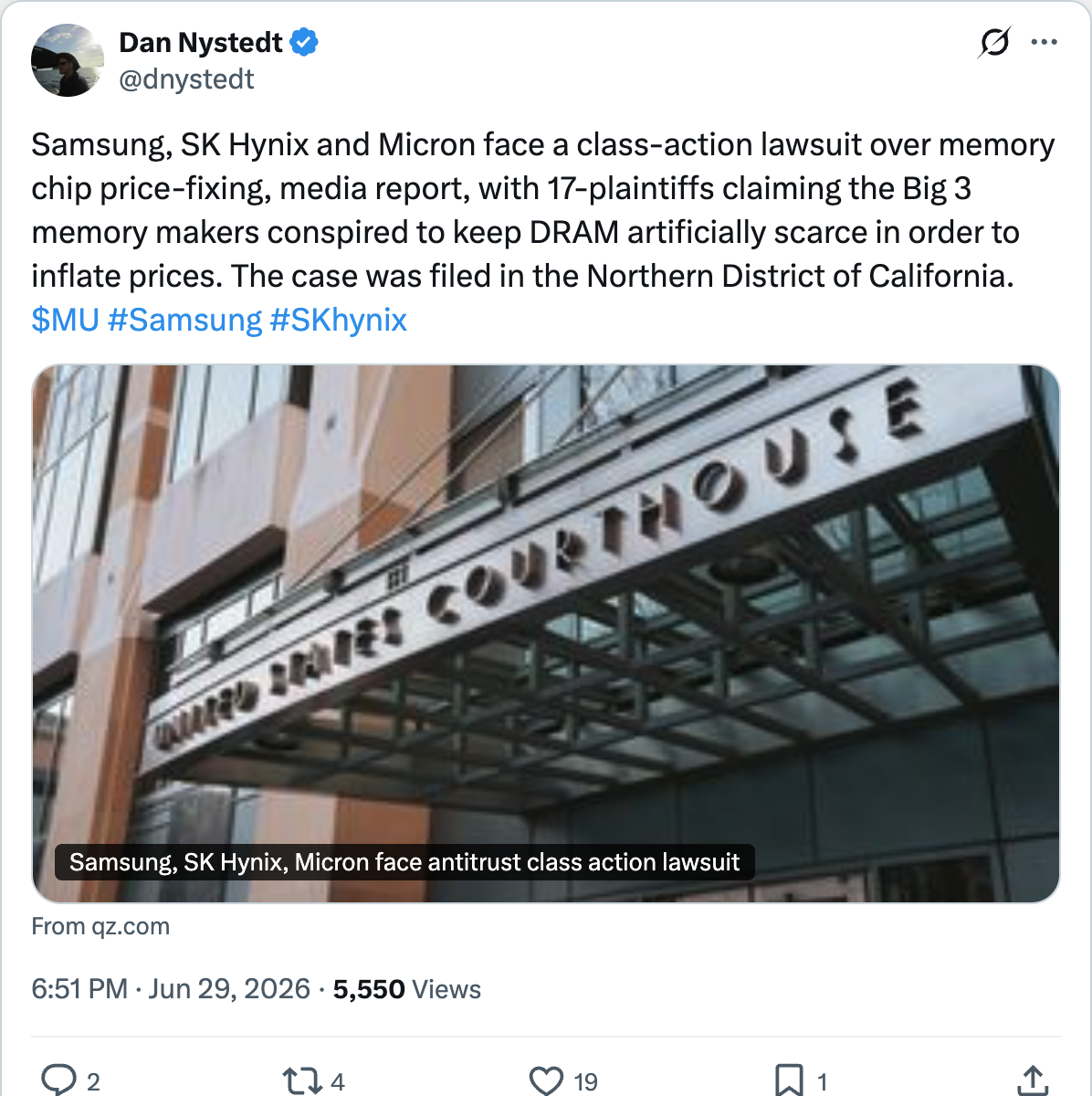
The pattern is clear: every time memory prices spike, lawsuits follow. The question is not whether this cycle repeats — it is whether this time the plaintiffs brought enough new evidence to survive where the 2018 case did not. Judge Wise's ruling says they did, at least at the pleading stage.
The Structural Problem: Why Three Companies Is Not a Market
Here is what the debate over collusion vs. legitimate business decisions misses: in a market where three companies control 91% of supply, the distinction barely matters.
As of Q3 2025, Samsung held approximately 38% of global DRAM revenue, SK Hynix held about 29%, and Micron held roughly 22%. Counterpoint data for Q1 2026 puts the combined share at 89%, with an HHI (Herfindahl-Hirschman Index) of 2,838 — well above the 2,500 threshold the DOJ considers "highly concentrated."
In a triopoly this tight, explicit coordination is almost unnecessary. Each company can observe the others' production decisions in real time through quarterly earnings, analyst briefings, and TrendForce's market data. When SK Hynix announces a production cut, Samsung and Micron know the supply equation changed. They can respond "independently" — and the result looks identical to coordination.
This is what economists call tacit collusion, and it is the defense's strongest card. As the Ninth Circuit wrote in dismissing DRAM II: parallel behavior in a concentrated market is "consistent with an antitrust conspiracy," but it is also "consistent with lawful competition."
The difference in the new case? The plus factors Judge Wise credited go beyond parallel pricing. Refusing long-term contracts, closing retail channels, halting fab construction during a price boom, and adopting identical customer-vetting policies — taken together, these suggest coordination that goes beyond simply watching the market.
The HBM Defense — and Its Limits
The defendants' most compelling argument is straightforward: HBM pays significantly more per chip than conventional DRAM. Shifting production toward HBM is rational profit maximization, not evidence of a conspiracy.
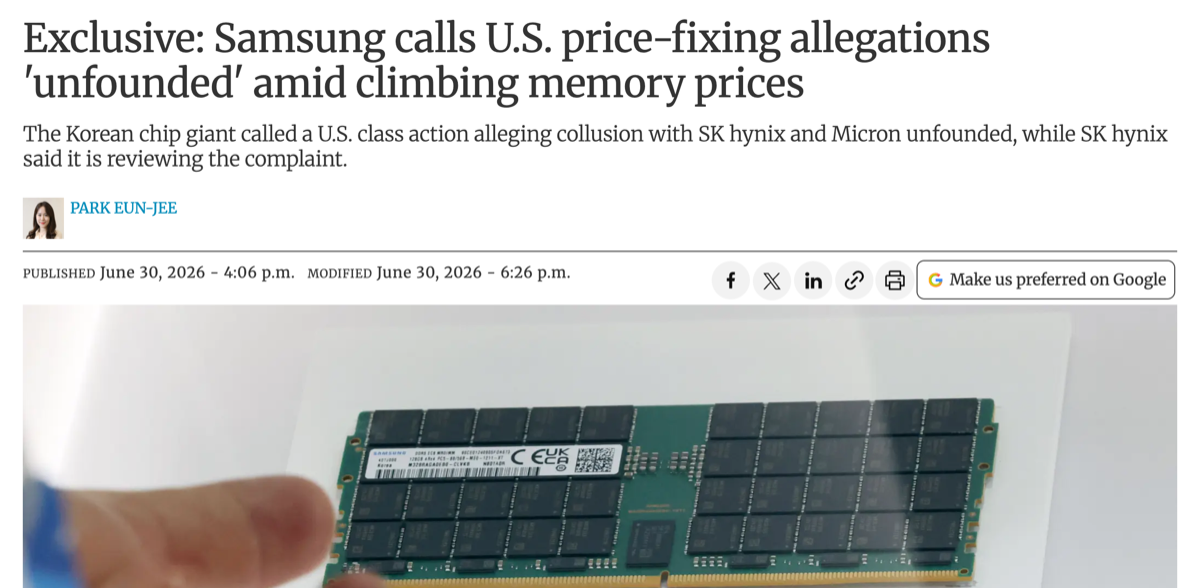
View original article on Korea JoongAng Daily →
Samsung told the Korea JoongAng Daily that the allegations are "unfounded" and that production decisions reflect "changing market conditions." The argument has economic weight: when AI hyperscalers like NVIDIA, Google, and Microsoft will pay premium prices for HBM3E, why would any rational chipmaker keep producing low-margin DDR4?
Contrarian Corner: The skeptics' strongest point: an oligopolist declining to start a price war is not evidence of a cartel — it is evidence of an oligopoly, which is legal. The 2022 Ninth Circuit already endorsed this view. If the plus factors do not hold up under discovery scrutiny, this case dies at summary judgment the same way its predecessor did. Proving collusion, as opposed to independent decisions in response to the same market conditions, remains extremely difficult.
But the HBM defense has a structural limit that Judge Wise spotted: if the pivot to HBM is purely market-driven, why are all three companies also refusing long-term conventional DRAM contracts? A legitimately market-driven firm would lock in revenue at high prices while it still can. Refusing to do so only makes sense if you are betting that prices will stay high — which only works if your competitors are making the same bet.
The court also noted that none of the three companies expanded conventional DRAM capacity despite the price spike — the equivalent of an oil company not drilling new wells when oil is at record highs. That is the kind of behavior that antitrust precedent treats as a red flag.
The Chinese Wildcard: CXMT
While the courtroom drama plays out, the most consequential threat to memory pricing is not a legal ruling — it is CXMT (ChangXin Memory Technologies), China's largest DRAM manufacturer.
CXMT's market share has roughly doubled in the past year, reaching an estimated 8% of global DRAM shipments. A Silicon Motion executive projected that CXMT could reach 15% in the coming years — enough to fundamentally reshape the pricing dynamics of the market.
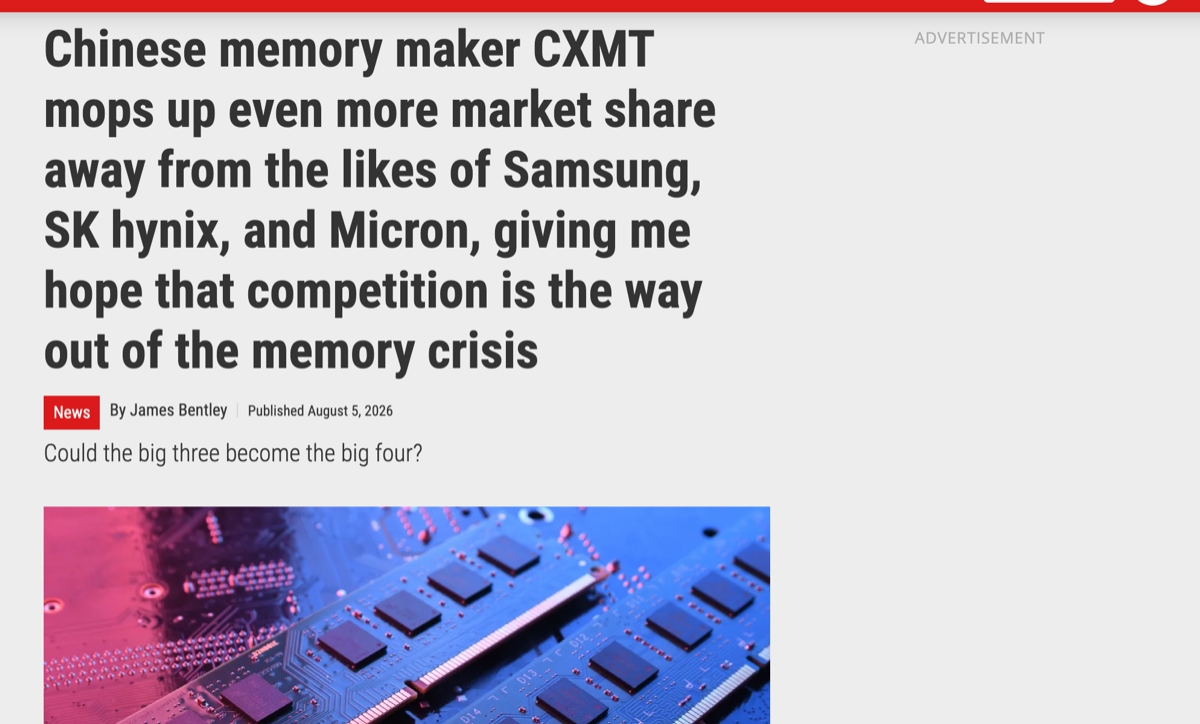
View original article on PC Gamer →
There is an irony here: the lawsuit may ultimately matter less than a Chinese fab in Hefei. Courts move in years. CXMT is shipping DDR5 today. If CXMT captures 15% of the market, the triopoly becomes a quadropoly — and the game theory that enables tacit collusion breaks down. As PC Gamer put it, competition may be "the way out of the memory crisis."
The constraint: CXMT's customers remain concentrated in China's domestic market. Geopolitical restrictions, including U.S. export controls on semiconductor equipment, limit how quickly CXMT can close the technology gap. The company is estimated to be about two process generations behind Samsung and SK Hynix — competitive for commodity DDR5, but not for cutting-edge HBM.
What the Community Is Saying
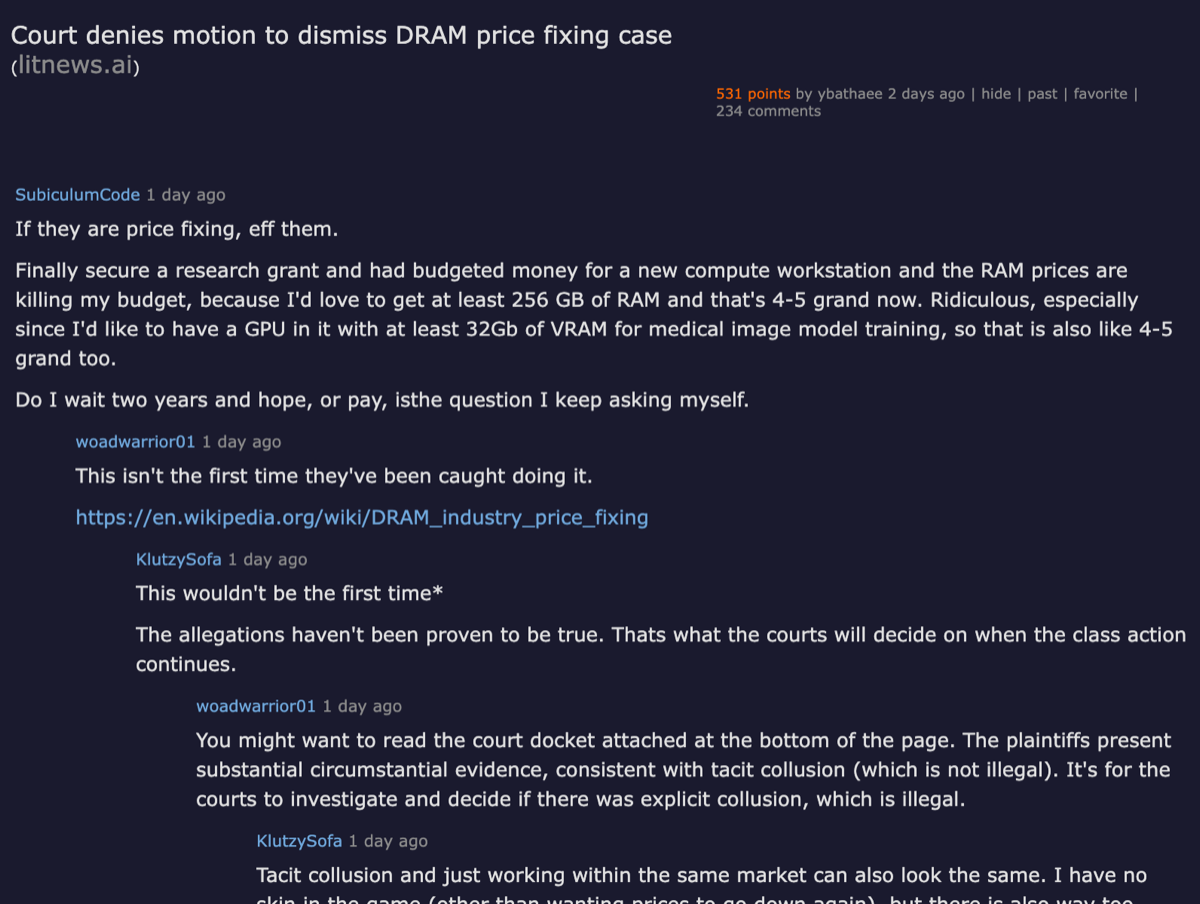
The Hacker News thread on the ruling hit 531 points and 234 comments, reflecting intense community interest. The discussion splits along predictable lines.
The "it's obviously collusion" camp points to the 1998-2002 cartel as proof of institutional willingness. The argument: a company that has been convicted of price-fixing before does not get the benefit of the doubt when prices spike again under suspiciously similar circumstances.
The "it's just an oligopoly" camp argues — correctly — that parallel behavior in a concentrated market is not evidence of an agreement. Three gas stations on the same corner will charge similar prices without ever talking to each other. The DRAM market, with 91% concentration, is structurally incapable of producing competitive pricing regardless of whether anyone picks up a phone.
The most interesting takes split the difference: the structural incentives make explicit coordination unnecessary, but the plus factors Judge Wise identified — especially the refusal of long-term contracts and the halt in capacity expansion — suggest the companies are doing more than simply following market signals.
We covered the demand side of this story when Apple raised prices in June. As we wrote in The AI Memory Squeeze Has Hit Your Wallet, data centers now consume roughly 70% of global memory chip production, leaving 30% for every consumer device on the planet. The supply-side behavior this lawsuit targets is the other half of the equation.
What Happens Next
The case now enters a critical phase. Answers are due December 7, 2026. The initial case management conference is set for January 12, 2027. After that, the plaintiffs get what they were really fighting for: discovery.
Discovery means subpoena power over internal communications. It means depositions of executives who made production allocation decisions. It means financial documents showing the actual margins on HBM vs. conventional DRAM. For the first time, the public will see whether the "independent market decisions" defense holds up against the companies' own internal records.
The defendants know what is at stake. Samsung, represented by O'Melveny & Myers, SK Hynix by Cleary Gottlieb, and Micron by Gibson Dunn — three of the most expensive law firms in the world — fought hard to avoid exactly this moment. They lost.
What This Means for Builders: Do not wait for this lawsuit to lower prices. Even if plaintiffs win at trial — which is years away — the remedy would likely be monetary damages, not a court order to increase production. The real price signals to watch are CXMT's quarterly market share numbers and the next round of fab construction announcements. If you are planning a local-AI inference build or a datacenter expansion, budget for current memory prices through at least mid-2028. The capacity cycle, not the courtroom, determines when relief arrives. For related infrastructure risk analysis, see our coverage of AI's Compute Political Ceiling.
Whether this case ultimately proves collusion or confirms that market structure alone explains the pricing behavior, the discovery phase will produce the most detailed public record of how the DRAM oligopoly actually operates since the DOJ investigation two decades ago. The memory market has three companies, $60+ billion in annual revenue, and a court order to open their books. Whatever comes next, the information asymmetry between the oligopoly and everyone who buys their products just got smaller.
ComputeLeap Team
The ComputeLeap editorial team covers AI tools, agents, and products — helping readers discover and use artificial intelligence to work smarter.
Join the discussion
Have thoughts on this article? Discuss it on your favorite platform:
Related articles
One Bad Day: The Cloud Concentration Tax
The MS365 outage hit 129K+ Downdetector reports in 20+ hours. It exposes the cloud concentration tax every organization pays but nobody budgets for.
The Week AI Became the Weapon
Anthropic's Claude rooted Linux in 53 minutes. North Korea looted Binance for $6.3B. Cursor shipped a backdoor. What Black October means for defenders.
OpenAI and Postman Quietly Reset Your Privacy
OpenAI re-enabled Codex training settings. Postman auto-installed AI hooks into dev tools. The pattern is bigger than both.