The $4,900 Humanoid Robot Changes Everything
A walking humanoid robot now costs less than a used Honda Civic. Here's what that means and what it doesn't.
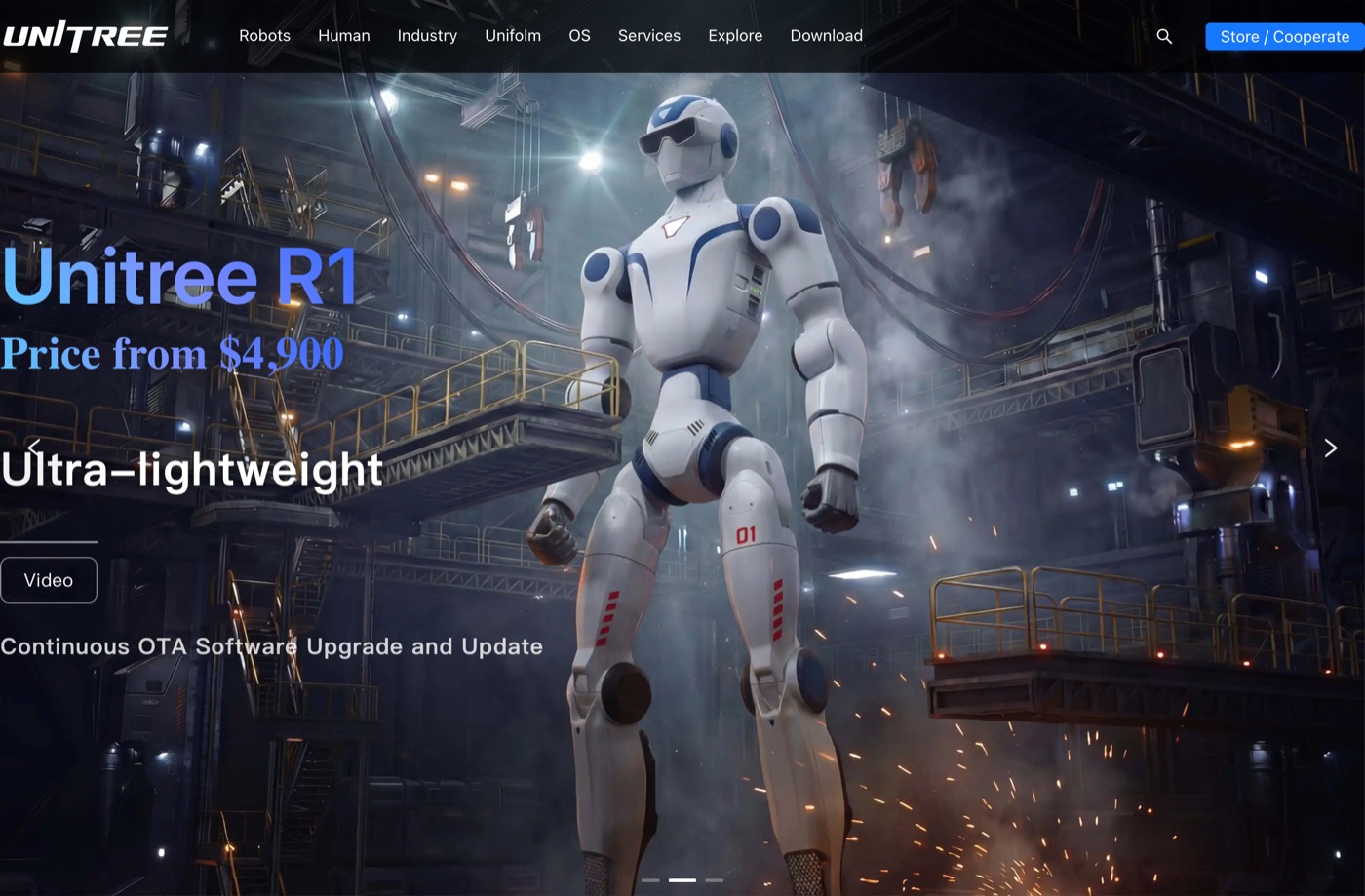
You can now buy a walking, flipping, kung-fu-kicking humanoid robot on AliExpress for $4,900 — less than a used Honda Civic, less than a semester of community college, less than what most people spend on a couch-and-TV combo. Unitree's R1 AIR shipped its first global batch in April, and it represents something the robotics industry has been promising and failing to deliver for decades: a humanoid robot that a normal person can actually afford.
But here's what the breathless headlines won't tell you: price is falling faster than capability. The gap between what this robot costs and what it can actually do is where the hype lives — and understanding that gap is the difference between seeing a revolution and seeing a very expensive toy.
The Number That Matters
The Unitree R1 AIR stands 4 feet tall, weighs 55 pounds, and packs 20 degrees of freedom into a bipedal frame that can run, do cartwheels, throw punches, and execute spin kicks. At CES 2026, Unitree's booth stopped traffic with R1s replicating Bruce Lee sequences, Michael Jackson dance moves, and Mike Tyson combinations.
The base R1 AIR ships with a monocular camera, 8-core CPU, and onboard AI for voice and image recognition. For $1,000 more, the standard R1 at $5,900 adds six more degrees of freedom (26 total), binocular depth perception, waist articulation, and head movement. Both come with hot-swappable batteries — about an hour of runtime per charge.
To put the price in context: Figure AI and Tesla each shipped roughly 150 humanoid units in 2025. Unitree shipped 5,500. That's not a typo — Unitree alone outshipped every Western humanoid manufacturer combined by a factor of 20x. The R1's $4,900 price point isn't an outlier. It's the leading edge of a Chinese manufacturing tidal wave.
The Raspberry Pi Parallel — and Its Limits
When the Raspberry Pi launched in 2012 at $35, it didn't replace laptops. It didn't become the computer most people use. What it did was remove the cost barrier between "I'm curious about computing" and "I can actually experiment." It created a generation of tinkerers, educators, and hobbyists who built projects that would never have existed if the entry price had stayed at $500+.
The R1 is doing the same thing for bipedal robotics. As Gartner analyst Bill Ray told Forbes: "You don't need a business case for a $4,900 robot — you can just buy it and see what it does."
"You don't need a business case for a $4,900 robot — you can just buy it and see what it does." — Bill Ray, Gartner
That quote captures both the promise and the asterisk. You can buy it is genuinely new. See what it does is the honest part — because right now, what it does is limited.
The R1 cannot fold laundry. It cannot load a dishwasher. It cannot pick up a glass of water without the EDU-grade articulated hands (custom pricing, not included). Its base model has no functional hands at all. Many of those jaw-dropping demo videos? Reviewers note they appear scripted or remote-controlled, with unclear levels of autonomy. The one-hour battery life means it needs a recharge before it finishes a movie.
Peter Diamandis predicts humanoid robots in homes by 2026 "in beta mode." That framing — beta mode — is more honest than most coverage. What the R1 delivers today is a bipedal platform you can program and experiment with, not a household helper. The Raspberry Pi of robotics, not the iPhone of robotics.
The Price War Nobody's Ready For
The R1 isn't happening in a vacuum. China now accounts for roughly 85% of global humanoid robot production, with over 140 manufacturers offering 330+ models. Morgan Stanley projects Chinese humanoid sales will double to approximately 28,000 units in 2026.
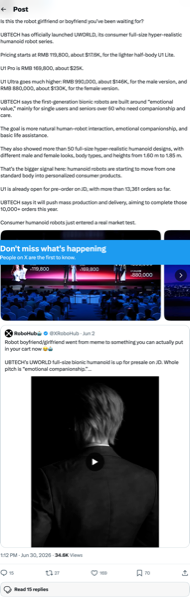
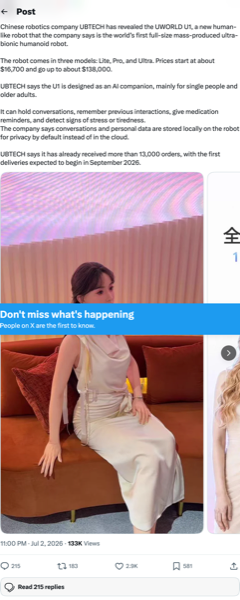
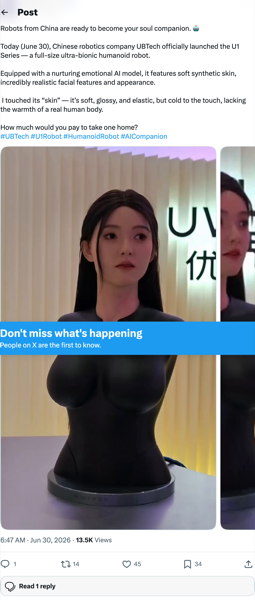
And the price compression is accelerating. This week alone, two things happened: UBTECH launched its UWORLD U1 companion robot series — full-size hyper-realistic humanoids starting at $16,700 for the Lite model, with 13,000+ pre-orders — and Digitimes reported that China's component price war has already cut dexterous hand costs in half, though precision parts are resisting further cuts.

Here's a quick snapshot of where pricing sits in mid-2026:
| Robot | Price | Maker | Status |
|---|---|---|---|
| Noetix Bumi | $1,400 | Noetix (China) | Shipping (compact, 94cm) |
| Unitree R1 AIR | $4,900 | Unitree (China) | Shipping globally |
| Unitree R1 | $5,900 | Unitree (China) | Shipping globally |
| Weave Isaac 1 | $7,999 | Weave Robotics | Fall 2026 pre-orders |
| Unitree G1 | $16,000 | Unitree (China) | Shipping |
| UBTECH U1 Lite | $16,700 | UBTECH (China) | Sept 2026 deliveries |
| 1X NEO | $20,000 | 1X (Norway) | Pre-orders |
| Tesla Optimus | $20-30K (target) | Tesla (US) | Consumer 2027-2029 |
| Figure 03 | Enterprise pricing | Figure AI (US) | BMW deployment |
Every single sub-$20K option is Chinese. That's not a coincidence — it's a supply chain reality. Morgan Stanley estimates that building a humanoid without Chinese parts would push actuator costs alone from $22,000 to $58,000, nearly tripling that single line item.
The Capability Gap Nobody Talks About
The investment thesis on humanoid robots is enormous. Jensen Huang called it a $40 trillion market. Goldman Sachs projects $38 billion by 2035. Morgan Stanley says $5 trillion by 2050. Diamandis says "millions, then billions" of humanoid robots are coming.
But here's what makes the current moment more nuanced than the forecasts suggest: most humanoid robots shipping today are, as Fortune's reporting put it, "performative rather than functional" — they struggle in unpredictable, messy environments. The real-world applications that justify mass deployment remain narrow: parcel sorting at postal centers, coffee preparation, warehouse logistics, security patrols. Useful, but not the household revolution the marketing implies.
Venture capitalist Chibo Tang captured the tension: "The use cases of these robots are still so limited... without that scale from the market, these companies are not able to really go into mass production."
China's own government has publicly warned about bubble risks in humanoid robotics, citing the "lagging state of commercialization and applications." When Beijing is cautioning about irrational exuberance in a sector it's funding through a five-year plan, that's worth noting.
It's a chicken-and-egg problem. Robots need real-world deployment to generate training data. But they need capability to justify deployment. And they need scale to bring costs down further. The $4,900 R1 cracks the price leg of that triangle — which is genuinely significant — but the capability and data legs are still catching up.
AI² Robotics founder Eric Guo pointed to the deeper bottleneck: accumulating quality training data from diverse real-world scenarios "could take years to massively scale up." The R1 can do a cartwheel because that motion can be precisely choreographed. Picking up a randomly placed mug from a cluttered kitchen counter — a task any three-year-old manages effortlessly — requires a fundamentally different kind of intelligence. It requires understanding physics, spatial relationships, material properties, and the ten thousand tiny variations that exist between "your kitchen counter" and "everyone else's kitchen counter."
This is the uncomfortable truth behind the spectacle: the hard problems in robotics were never about building cheaper hardware. They're about building software smart enough to handle the chaos of the real world. And while the hardware price curve is plummeting on a predictable manufacturing trajectory, the software capability curve remains stubbornly nonlinear.
What Actually Changes at $4,900
Strip away the hype, and the $4,900 price point changes three things that matter:
1. Education and research become accessible. Universities and high schools can now afford humanoid platforms for robotics courses. Previously, a single research-grade humanoid cost $100K+. Now a department can buy twenty R1s for the price of one old-generation platform. MIT's Media Lab, Stanford's robotics department, and dozens of Chinese universities are already building curriculum around sub-$10K humanoid platforms. The Weave Robotics Isaac 1 at $7,999 is chasing the same educational market with a home-oriented pitch for Fall 2026 deliveries. The open-source Berkeley Humanoid Lite project is pushing even lower for research-grade access.
2. The hobbyist ecosystem can finally emerge. The Raspberry Pi spawned an ecosystem of accessories, projects, tutorials, and communities that generated more innovation than the original hardware team could have imagined. A $4,900 humanoid platform could do the same for bipedal robotics. Unitree ships the R1 with an open SDK, and the developer community is already publishing walking-gait modifications, LLM-driven voice interaction demos, and custom manipulation experiments with aftermarket gripper attachments.
When price drops below the "ask permission" threshold — the number where an enthusiast can buy it without a business case or spousal negotiation — adoption dynamics change fundamentally. The Raspberry Pi hit that threshold at $35 for computing. Drones hit it around $500 with the DJI Phantom. The R1 is making the case that $4,900 is where humanoid robotics crosses it.
3. The West's price premium becomes unsustainable. When Chinese humanoids perform at 80% of Western capability for 20% of the price, the value proposition for most applications flips. Tesla's $20-30K Optimus target — which seemed aggressive when announced — now looks expensive relative to what Unitree is already shipping. Figure AI's enterprise-only model sidesteps the comparison, but its BMW factory success with 30,000+ X3 vehicles assembled shows the Western strategy: avoid the price war, win on capability.
We've tracked this acceleration before — three humanoid robots cracking records in a single week back in May wasn't a coincidence, it was a pattern. The $4,900 R1 is what that pattern looks like when it reaches the consumer price layer. And NVIDIA's robotics platform bet, which we covered in depth at GTC 2026, is the infrastructure play beneath it all — Jensen isn't calling it a $40 trillion market for fun.
The Honest Take
A $4,900 walking humanoid robot is genuinely remarkable. Five years ago, the cheapest bipedal humanoid cost $100,000+. Two years ago, Unitree's own G1 broke the floor at $16,000 and people called it a revolution. Today, $4,900. Tomorrow — given that the even cheaper Noetix Bumi ships at $1,400 for a compact 94cm educational model — the floor may not have a bottom yet.
The trajectory is real, and it's being driven by the same Chinese manufacturing engine that made smartphones, drones, and electric vehicles affordable. Unitree posted 1.7 billion yuan (~$250 million) in 2025 revenue with 278 million yuan in profit — this is a real business, not a subsidized science project. The company is profitable at these prices because Chinese supply chains have industrialized what was once artisanal fabrication.
But — and this is the asterisk that matters — affordability is not utility. The R1 is a platform, not a product. It's a development kit in humanoid form. The useful household robot — the one that folds laundry, cleans floors, fetches groceries — is still years and several capability breakthroughs away.
What we have right now is the Raspberry Pi moment: the instant where the price barrier drops low enough that thousands of tinkerers, researchers, educators, and entrepreneurs can finally get their hands on a humanoid platform and start building. The revolution isn't the $4,900 robot. The revolution is what those thousands of people build on top of it.
The real question isn't whether humanoid robots will become useful — they will. It's whether the path from "$4,900 acrobat" to "useful household helper" looks more like the smartphone trajectory (5-7 years from novelty to necessity) or the self-driving car trajectory (15+ years of "almost there"). The manufacturing curve says smartphone. The AI capability curve says something slower.
For now, the $4,900 R1 sits in a fascinating liminal space: too capable to dismiss, too limited to rely on, and too cheap to ignore. That's exactly where the most interesting technology lives — in the gap between what it costs and what it's worth.
And if history is any guide — from the Raspberry Pi to Arduino to the smartphone — the thing that eventually changes the world will be something nobody at Unitree, Tesla, or NVIDIA predicted. It usually is.
ComputeLeap Team
The ComputeLeap editorial team covers AI tools, agents, and products — helping readers discover and use artificial intelligence to work smarter.
Join the discussion
Have thoughts on this article? Discuss it on your favorite platform:
Related articles
Humanoids Are a Backward-Compatibility Layer
Palmer Luckey's strongest robotics argument, ARK's beaten forecasts, and China's embodiment race reframe humanoids as the API for the physical world.
Sonnet 5.5 Just Ate Opus. Anthropic Did It on Purpose.
Sonnet 5.5 scores 70.6% on Terminal-Bench — beating Opus 5.5's 66.4% — at half the price. Here's why Anthropic is cannibalizing its own premium tier.
The Emails That Could Sink Fair Use
Unsealed briefs reveal OpenAI and Microsoft executives privately called AI training 'the largest theft of labor in human history.'
The ComputeLeap Weekly
Get a weekly digest of the best AI infra writing — Claude Code, agent frameworks, deployment patterns. No fluff.
WEEKLY. UNSUBSCRIBE ANYTIME.