AMD Buys Taalas: The Chip That Bakes Weights Into Silicon
AMD acquired a startup that hardwires LLM weights into transistors. At 17,000 tokens/sec, the real question: was the GPU always just a phase?
AMD Buys Taalas: The Chip That Bakes Weights Into Silicon
On August 6, AMD announced a definitive agreement to acquire Taalas, a Toronto startup founded in 2023 by former Tenstorrent CEO Ljubisa Bajic. What Taalas does is genuinely strange: it takes a finished AI model -- say, Meta's Llama 3.1 8B -- and etches the model's weights directly into transistors on a TSMC 6nm die. No HBM. No data shuttling. No CUDA. The model is the chip. The HC1, Taalas's first product, runs Llama 3.1 8B at 16,960 tokens per second per user -- 48x faster than Nvidia's B200 and 8.5x faster than Cerebras's wafer-scale engine. It draws about 200 watts per card. A GPU inference rack draws 120 to 600 kilowatts.

Financial terms were not disclosed. The deal is expected to close in Q4 2026. But the real story is not the deal itself -- it is what Taalas's approach says about where inference hardware is heading, and why AMD paid for a 24-person team whose only shipped chip runs exactly one model.
How You Etch a Model Into a Chip
The conventional inference stack has an architectural bottleneck baked into its design. GPUs are general-purpose processors that store model weights in high-bandwidth memory (HBM) and shuttle them to compute units on every forward pass. As Karl Freund at Cambrian AI Research notes, modern accelerators spend roughly 90% of their energy on data movement rather than actual computation. The memory wall -- the gap between how fast transistors can compute and how fast memory can feed them -- defines the speed ceiling.
Taalas eliminates the wall by making it irrelevant. The HC1 uses mask-ROM to physically encode model weights into the chip's metal layers at fabrication time. There is no separation between storage and processing -- the weights are the compute, encoded at the transistor level. A single HC1 packs 53 billion transistors onto an 815 mm-squared die, storing all 8 billion parameters of Llama 3.1 8B in quantized form (aggressive 3-bit and 6-bit quantization) alongside a programmable SRAM block that serves as the KV-cache.
The result: inference at a speed that looks like a rendering glitch -- 16,960 tokens per second, with latency under 100 milliseconds per query.
But the speed is only half the story. The real innovation is the manufacturing process. Taalas claims that customizing an HC chip for a different model requires changing only two of the chip's 100+ metal layers, with a turnaround of approximately two months from receiving model weights to shipping deployable PCIe inference cards. As SiliconANGLE reported, Taalas built proprietary internal tools that make this tape-out cycle possible -- a structured-ASIC design flow through TSMC that is more factory than lab.
This distinction matters. AMD didn't buy a chip. It bought a chip factory method that could, in theory, turn any stable model into near-zero-marginal-cost inference silicon.
The 4K Decode Analogy -- and Why It's the Real Hook
The smartest take on this deal came from the Hacker News thread, which racked up 892 points and 669 comments within 24 hours.
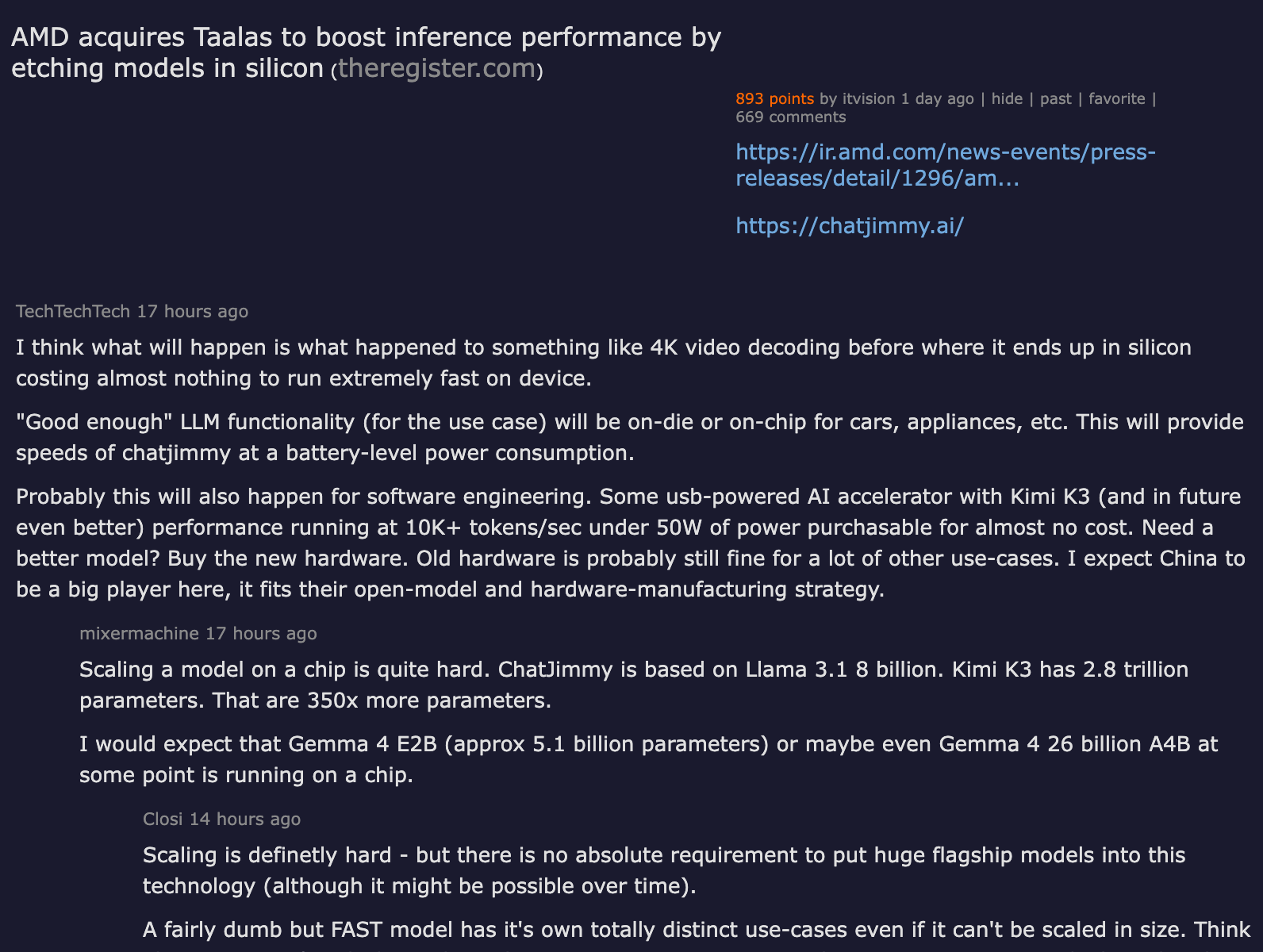
User TechTechTech drew the historical parallel that makes Taalas's approach click: "4K video decoding ends up in silicon costing almost nothing to run extremely fast on device." The analogy is precise. H.264 and H.265 video codecs went through the same arc: initially decoded on general-purpose CPUs (expensive, power-hungry), then on GPUs (faster, still flexible), then finally etched into fixed-function decoder blocks costing pennies to manufacture. Today every smartphone, smart TV, and security camera has a hardware video decoder that runs at near-zero power because the codec is settled -- nobody is shipping H.264 updates anymore.
The thesis: a "good enough" LLM -- Llama 8B for document classification, speech-to-text for voice assistants, a coding completion model for IDEs -- becomes a near-zero-cost chip feature once the model stabilizes. The GPU was always just the transitional architecture, the way CPUs were transitional for video decoding.
HN user cmrdporcupine extended this: smaller specialized models for document classification or speech-to-text, deployed across infrastructure at massive throughput, are the ideal first targets. User Closi noted that instant-response Alexa replacements don't need frontier capability -- they need speed and cost-efficiency, exactly what Taalas delivers.
As Nick Spisak observed when Taalas first emerged from stealth in February: "They hardwire AI models directly into silicon. No memory. No data shuttling. The model IS the chip."

The Competitive Landscape: Why Everyone Is Buying an Inference Startup
AMD's Taalas acquisition doesn't exist in isolation. The entire picks-and-shovels layer is consolidating:
| Acquirer | Target | Price | What They Got |
|---|---|---|---|
| Nvidia | Groq | ~$20B | LPU inference acceleration technology |
| AMD | Taalas | Undisclosed | Model-specific ASIC manufacturing method |
| SoftBank | Graphcore | Undisclosed | IPU architecture (absorbed into Arm) |
| Intel | SambaNova (partnership) | -- | Dataflow architecture integration |
| AMD | MK1, Mext, FastFlowLM | -- | Three AI acquisitions in 9 months before Taalas |
As Ben Pouladian observed on X: "The exit for these AI chip startups was never an IPO, it is getting absorbed by a larger chip company for the tech or the team. Just another cycle of the valley."

The pattern is clear: standalone inference startups cannot survive the distribution gap. Cerebras trades at a $50.9 billion market cap on under $200 million in quarterly revenue -- 300x revenue multiples that NextPlatform's analyst called "very risky." The math only works if you own the customer relationship. AMD and Nvidia do. Startups don't.
What AMD gets specifically is a way to disaggregate inference: use Instinct GPUs for prefill (the compute-intensive prompt-processing phase), then hand off to Taalas chips for decode (the token-generation phase where memory bandwidth is the bottleneck). As semiconductor analyst Austin Lyons noted: "Helios for prefill + Taalas for decode would be pinned to a particular model. That would be an interesting 'semi-custom' inference rack."

This mirrors what Nvidia itself did with the Groq acquisition: the NextPlatform analysis showed that GPU accelerators alone "can't drive more than 400 TPS/user at reasonable overall system throughput," even with future architectures. Adding specialized decode accelerators unlocks an "Ultra tier" at 1,000+ TPS/user. Taalas, at 17,000 TPS/user, doesn't just cross that threshold -- it obliterates it.
The Taalas Spectrum: Where It Fits Against Etched, Groq, and Cerebras
Not all inference accelerators are created equal. The market is fragmenting along a specificity spectrum:
GPUs (Nvidia H200/B200): Fully programmable. Run any model. Highest flexibility, lowest efficiency per inference dollar. The universal tool.
Wafer-scale (Cerebras): Programmable but architecture-specific. Massive on-chip SRAM eliminates HBM bottleneck. Runs any model that fits. About 2,000 tok/sec on Llama 8B.
Transformer ASICs (Etched Sohu): Hard-wired for the transformer architecture, not a specific model. Claims 500,000 tok/sec but no independent benchmarks yet. Can run any transformer model.
Model-specific ASICs (Taalas HC1): Hard-wired for a single model. Maximum performance (16,960 tok/sec), minimum flexibility. Each new model needs new silicon.
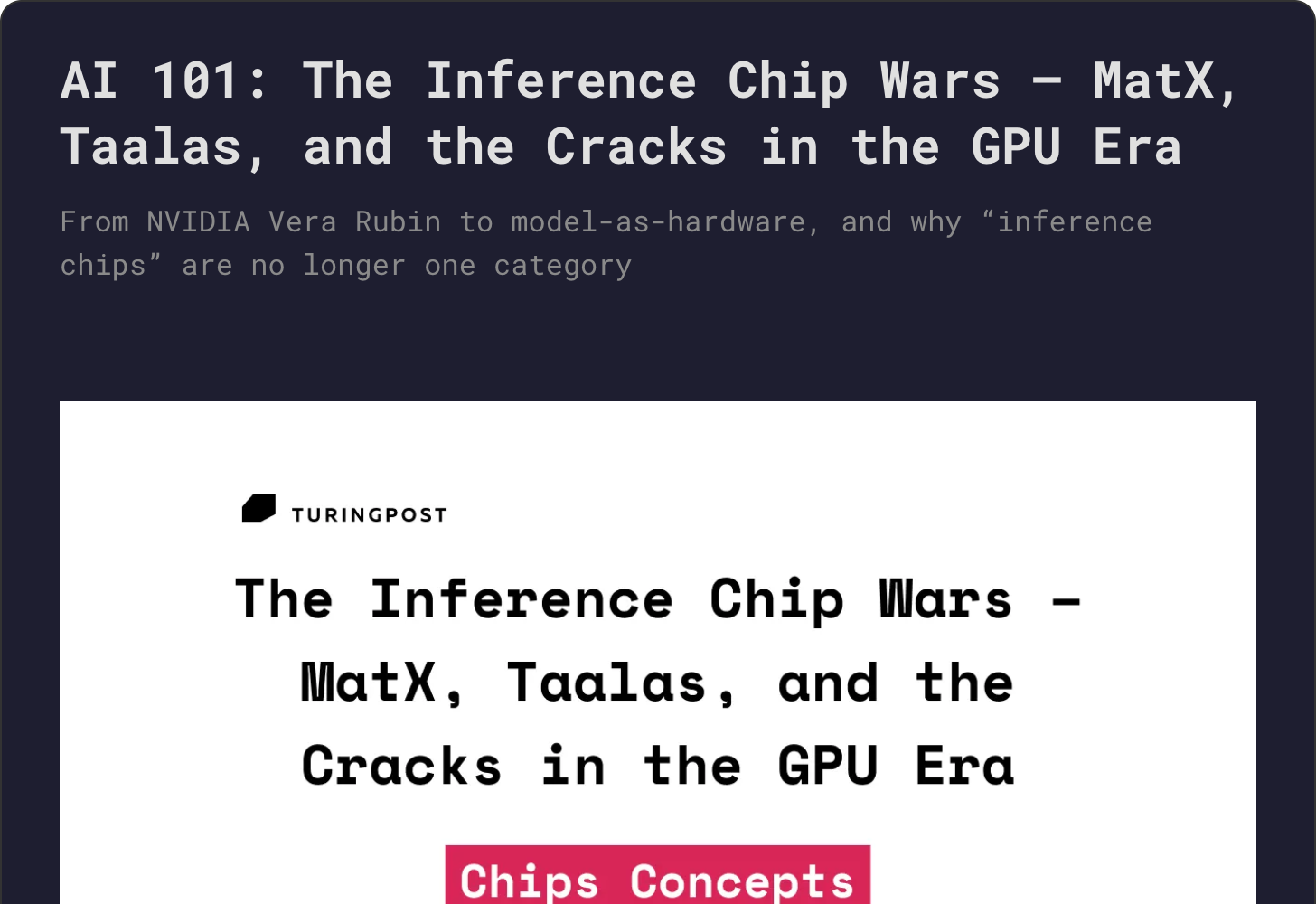
The tradeoff is stark: as you move right on the spectrum, performance improves by orders of magnitude, but flexibility drops to zero. Turing Post's analysis framed the key question: "How stable does a model need to be before it makes sense to etch it into silicon?"
The Open Question: Why Didn't OpenAI or Anthropic Buy Taalas?
Here is the question nobody in the 669-comment HN thread answered satisfactorily: why didn't a model lab buy Taalas?
OpenAI, Anthropic, and Google are the companies with the most to gain from near-zero inference costs. They operate the largest inference fleets. They know exactly which models are stable enough to etch into silicon. And they have the capital -- Anthropic raised $100 billion from Amazon, Google closed a $65 billion round for DeepMind infrastructure, OpenAI has a reported $157 billion valuation.
The answer reveals a structural split in the industry. Model labs change their models every 6 to 12 months. GPT-5 replaced GPT-4o. Claude 4 replaced Claude 3.5. The frontier is a treadmill. Etching a model into silicon only makes economic sense if the model stays deployed long enough to amortize the fabrication cost -- and frontier models don't.
But AMD and Nvidia don't care about which model is etched. They care about selling silicon. If customers want to etch Llama 8B today and Llama 9B in six months, that is two chip sales, not a problem. The two-month tape-out cycle that Taalas has engineered makes rapid model rotation economically viable for the chip manufacturer even if individual models have short lifespans.
This is why the acquisition went to a chipmaker rather than a model lab: Taalas's value accrues to the platform, not the model. AMD can offer Taalas-manufactured inference cards as a standard catalog item alongside Instinct GPUs, the same way Intel offers video decoder IP alongside general-purpose CPU cores.
The Contrarian Corner: What Could Go Wrong
The bears have real ammunition:
Model lifecycle mismatch. HN user paulryanrogers raised a fundamental problem: "answers will get outdated quickly whilst the silicon is fixed." Unlike H.264, which was standardized and frozen, AI models improve rapidly. A chip etched with today's Llama 8B will be outperformed by next year's Llama 9B 3B -- a smaller, better model on cheaper silicon.
Quantization quality loss. The HC1 uses aggressive 3-bit and 6-bit quantization to fit 8B parameters into 815 mm-squared. Kaitchup's technical analysis acknowledged this as a v1 tradeoff, with quality degradation noticeable in the 3-bit regime. If "baked" models deliver noticeably worse output than GPU-served full-precision inference, the cost advantage is moot.
Die size ceiling. HN user formerly_proven ran the math: an 8B model already hits reticle size (815 mm-squared) on TSMC N6, with ROM consuming half the area. Scaling to 70B or 400B models requires multi-chip packaging or wafer-scale approaches that negate the cost advantage.
Meta's big bet the other way. Meta signed a "multigenerational" deal with Nvidia and committed up to $100 billion over several years for custom MI450-based GPU infrastructure. If the world's largest open-source model producer is going all-in on GPUs, that is a significant signal against model-specific silicon at scale.
Operational complexity. Managing a fleet of single-model chips -- different SKUs for Llama 8B, Llama 20B, Mistral, Gemma -- adds infrastructure complexity that general-purpose GPUs simply don't have. As Karl Freund noted, "managing multiple hardware SKUs for different models strains data center infrastructure."
What This Means for You
The Taalas acquisition signals three things for practitioners building on AI infrastructure:
1. The inference cost floor is dropping faster than you think. At $0.0075 per million tokens, HC1-class silicon makes certain inference workloads effectively free. If you are building a product that calls a stable model millions of times per day -- a classifier, an embeddings engine, a code completion backend -- your cost structure is about to change by an order of magnitude. Start modeling what happens when inference costs approach zero for your specific use case.
2. "Inference speed" is no longer a moat. If you are a startup whose differentiation is serving models faster than Nvidia GPUs -- Groq, Cerebras, and now Taalas have all demonstrated 10-100x speedups over vanilla GPU inference. When AMD ships this as a catalog item in Helios racks, speed becomes a commodity. Your moat needs to be elsewhere: in fine-tuning, in the application layer, in data.
3. The bifurcation is real: frontier vs. floor. The GPU cloud bill is not going away for frontier work -- training, experimental models, multi-modal inference with rapidly evolving architectures. But for "good enough" inference at scale, the ASIC cost curve is heading toward the same endpoint as video decoding: near-zero marginal cost, baked into the hardware. The inference inflection we flagged in May is accelerating, and the memory cost squeeze that defines GPU economics is exactly the bottleneck Taalas sidesteps entirely.
The Road Ahead
Taalas's HC2 is due this summer, targeting 20 billion parameters per chip. The company has done simulations for DeepSeek R1 671B, which would require about 30 chips working synchronously. AMD plans to integrate the technology into its Helios rack-scale systems alongside Instinct GPUs and EPYC CPUs.
The real test is not whether the technology works -- it clearly does at demo scale. The real test is whether any model stabilizes long enough for an enterprise to commit to single-model silicon, or whether the two-month tape-out cycle is fast enough that it doesn't matter.
As one HN commenter put it: the question is not "will GPUs be replaced?" It is "what percentage of inference workload settles into the 'good enough' tier where ASICs dominate?" If that number is 20%, it reshapes the AI hardware cost curve. If it is 80%, the GPU becomes a niche training tool -- and Nvidia's $20 billion Groq buy starts to look like the smartest hedge in semiconductor history.
AMD just bet that the number is big enough to matter. The 4K decode analogy suggests they are right.
ComputeLeap Team
The ComputeLeap editorial team covers AI tools, agents, and products — helping readers discover and use artificial intelligence to work smarter.
Join the discussion
Have thoughts on this article? Discuss it on your favorite platform:
Related articles
The AI Liability Fight Nobody Wants
Bessent rejects liability shields, Naval demands full accountability, and OpenAI ships 6 misalignment reports as cover.
No Moat in Model Architecture: Jev Got 6 Clones in 48h
TypeSafe's Jev hit 36M views and spawned 6 open-source clones in 48 hours. The calibrated-decision primitive was commoditized before the waitlist cleared.
OpenAI Blitzed. The Money Didn't Move.
Polymarket odds for Anthropic rose during OpenAI's GPT-6 Astra launch week. The third time the market shrugged.
The ComputeLeap Weekly
Get a weekly digest of the best AI infra writing — Claude Code, agent frameworks, deployment patterns. No fluff.
WEEKLY. UNSUBSCRIBE ANYTIME.