AI's Payoff Problem Is Bigger Than You Think
Apollo says zero returns outside Big Tech. 200K creative jobs gone. Middle management next. The AI reckoning is here.
ComputeLeap Team
AI's Payoff Problem Is Bigger Than You Think
Four independent signals converged this week to deliver a message the AI industry doesn't want to hear: the money is flowing in, but the returns are not flowing out. Apollo's chief economist says the S&P 493 — every company outside the Magnificent Seven — is seeing zero margin improvement from AI spending. An Apricitas Economics analysis tallies 200,000 creative-class jobs lost over four years, with the sharpest Hacker News comment cutting deeper: AI isn't causing these losses yet — it's preventing the recovery. The Pragmatic Engineer's Will Larson says middle managers should retire or reskill. And npm co-founder Laurie Voss argues coding agents have made writing code nearly free, collapsing junior hiring.
Four different lenses. One conclusion. AI is a transfer machine — moving value from buyers to sellers and from the middle of organizations to the edges.
"You can see the computer age everywhere but in the productivity statistics." — Robert Solow, 1987. Nearly 40 years later, Apollo's Torsten Slok offers the update: "AI is everywhere except in the incoming macroeconomic data."
The Zero-Payoff Thesis
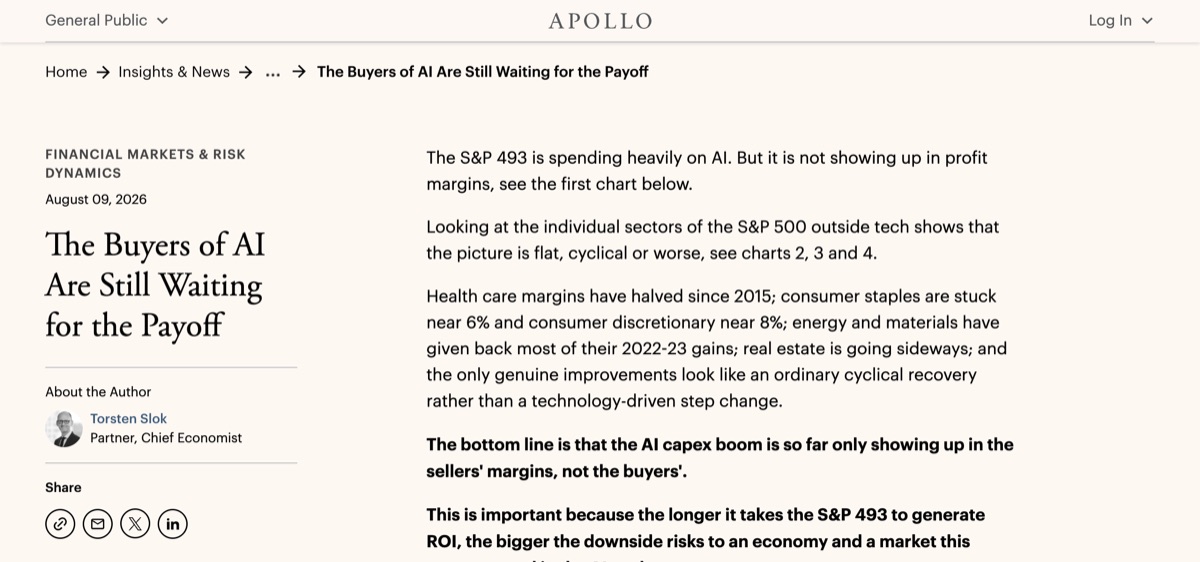
Torsten Slok, Apollo's chief economist, has been building this case since early 2026. In a February note, he observed that analyst earnings expectations for the S&P 493 remained "basically unchanged" while the Magnificent Seven saw theirs revised sharply upward. His conclusion: "The consensus does not expect AI to improve profitability for corporate America outside the tech sector."
By August, the data had gotten worse. In "The Buyers of AI Are Still Waiting for the Payoff", Slok walked through sector-by-sector margins and found a picture that was "flat, cyclical, or worse":
- Health care margins have roughly halved since 2015
- Consumer staples stuck near 6%
- Energy and materials gave back most of 2022-23 gains
- Industrials show no sign of margin growth
His bottom line: "The AI capex boom is so far only showing up in the sellers' margins, not the buyers'."
View original research note on Apollo →
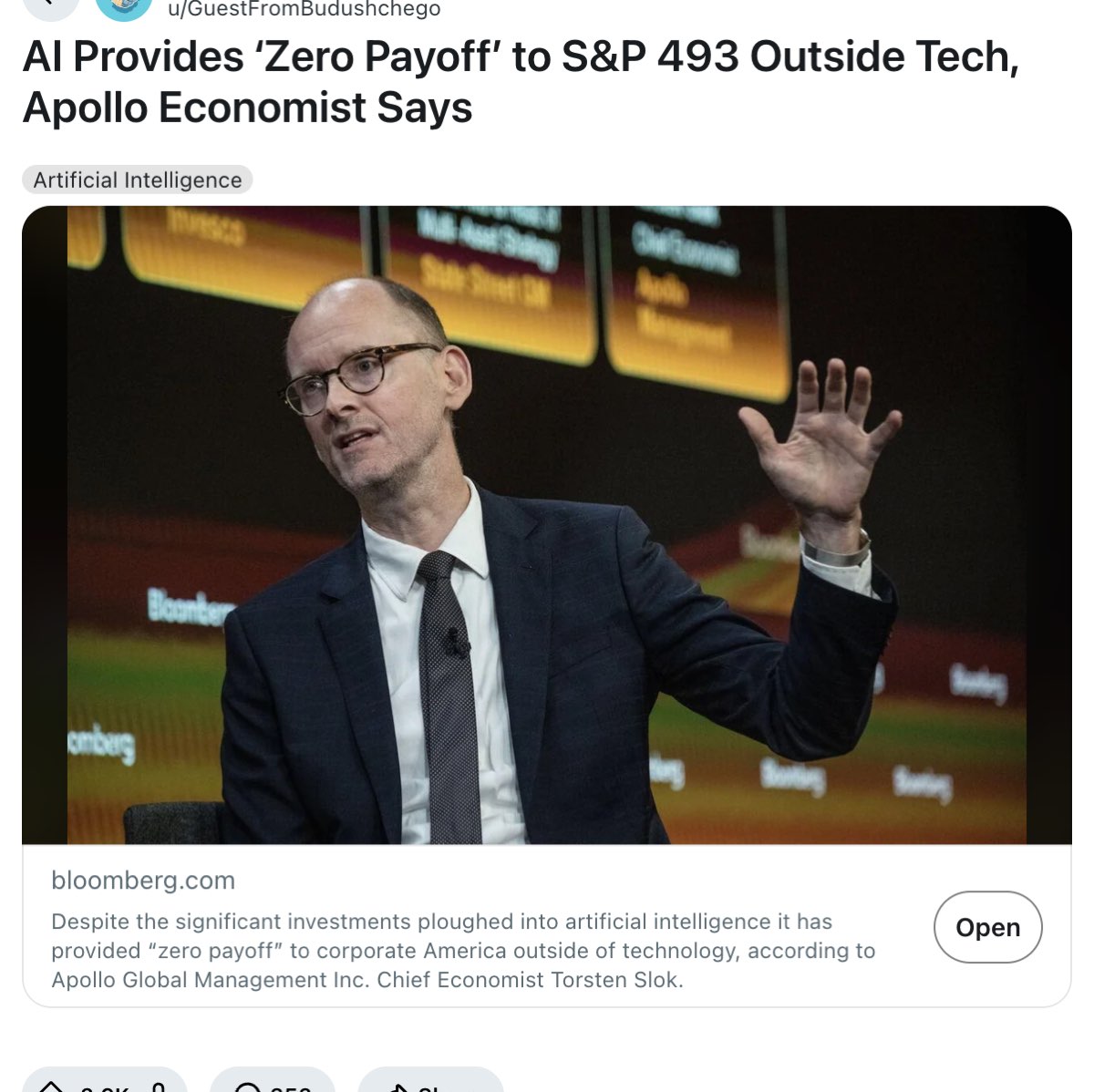
This framing hit Reddit's r/technology today with 1,276 upvotes and a 97.6% upvote ratio — one of the strongest consensus signals the subreddit has produced on an economic topic this year.
View original post on Reddit →
The data is reinforced by an NBER working paper surveying roughly 6,000 CEOs, CFOs, and executives across the US, UK, Germany, and Australia. The findings are sobering: nearly 90% of firms say AI has had no effect on employment or productivity over the past three years. Usage is thin — about 1.5 hours per week on average, with 25% of respondents not using AI at work at all.
The executives still expect gains ahead: a 1.4% productivity increase and a 0.8% output bump over three years. But that same optimism has been the answer for two years running, and the gap between expectation and measurement keeps widening.
200,000 Creative-Class Jobs and a Recovery That Won't Come
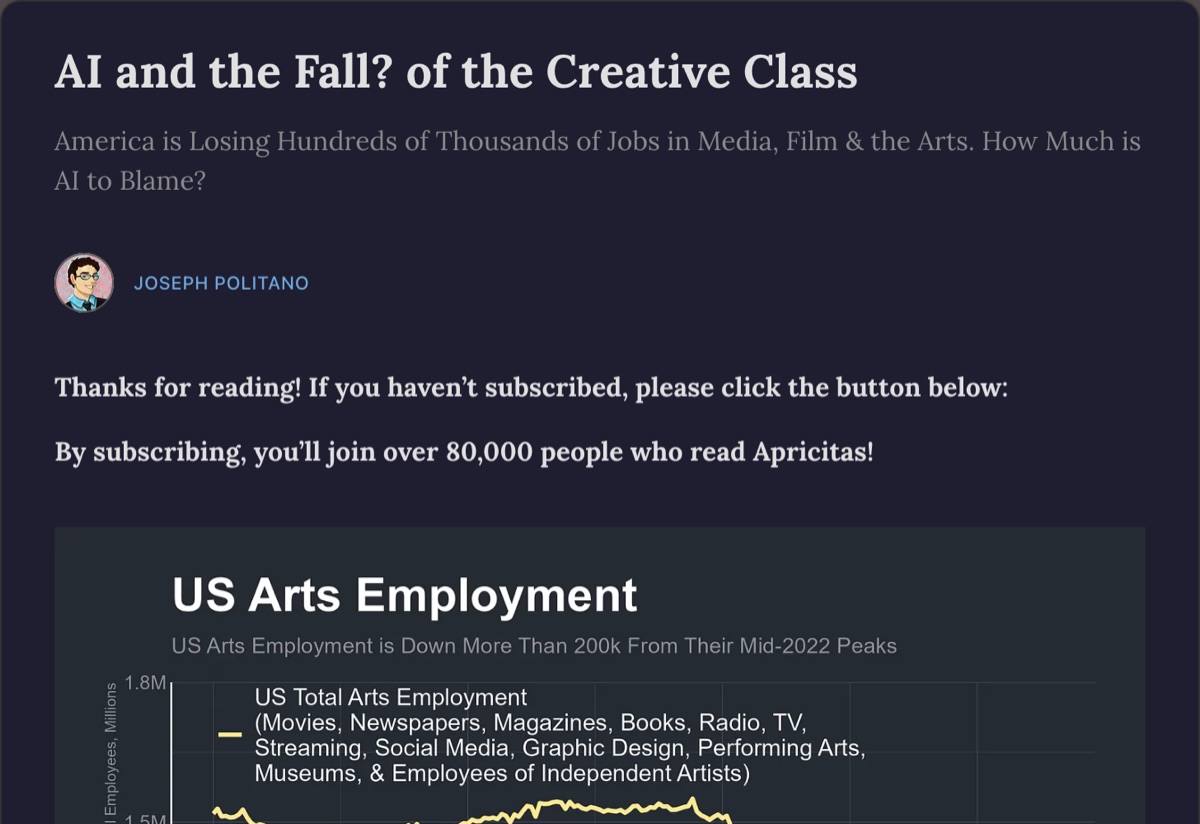
The macro picture gets a human face in Joseph Politano's Apricitas Economics analysis, which traces four years of creative-sector job losses that look like a recession — without the recession.
View original article on Apricitas →
The numbers are brutal:
- Movie and TV production lost more than 100,000 jobs — roughly a third of the sector, hitting employment levels not seen since 2008
- Written publishing shed over 70,000 positions
- Newspapers are down about 85% from their historical peak of 500,000
- Magazines have lost 66% of staff since the 1990s
Politano is careful with attribution. Hollywood consolidation, streaming cannibalization, and the post-COVID attention shift all play roles. Only 32% of arts and entertainment workers report using generative AI, well below the 62% cross-industry average. The signal isn't that AI killed these jobs — it's more insidious than that.
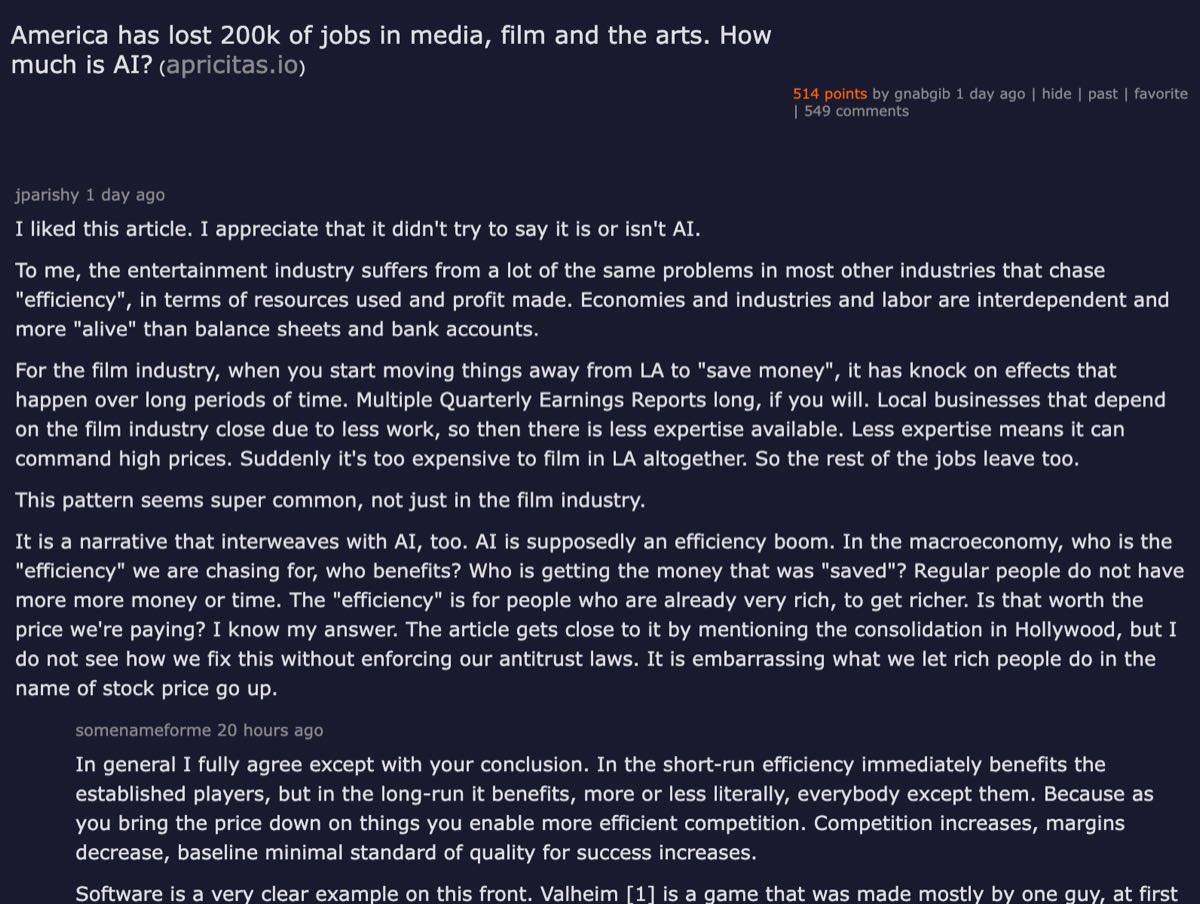
The Hacker News thread (466 points, 491 comments) surfaced the real insight: when hiring eventually resumes in these industries, the same headcount won't come back. AI doesn't need to cause the downturn to prevent the upturn. The work that disappears during a contraction gets absorbed by models before human headcount can recover.
View original discussion on Hacker News →
Richard Florida, who coined the term "creative class," pushed back in Fortune: "I'm not sure his numbers are right." But even Florida's optimism is telling — his argument is that AI will take the "grind-out jobs" rather than the truly creative ones, which concedes the central point. The middle of creative work — the competent production jobs that sustained hundreds of thousands of careers — is exactly what's vanishing.
The Hollowed-Out Middle: Management Edition
While creative-class losses are grabbing headlines, a quieter structural shift is happening inside tech companies. Will Larson — three-time CTO, author of Staff Engineer and An Elegant Puzzle — sat down with Gergely Orosz for a conversation that the Pragmatic Engineer titled with characteristic bluntness: "Middle managers: either retire or reskill."
Larson's argument is structural, not speculative. The AI-augmented individual contributor is now more productive than most middle managers whose primary function is coordination. If your job is scheduling meetings between people who could talk to each other, or aggregating status updates that a dashboard could surface, the clock is ticking.
Gartner's prediction from 2024 lands differently now: by 2026, 20% of organizations will use AI to eliminate more than half of their current middle management roles. We are in 2026. The window is here.
The Pragmatic Engineer's own Pulse #162 newsletter — titled "Even Fewer Middle Managers" — adds quantitative backing from engineering org surveys. The trend is consistent: companies are flattening hierarchies, eliminating coordination layers, and expecting senior ICs to self-manage with AI assistance.
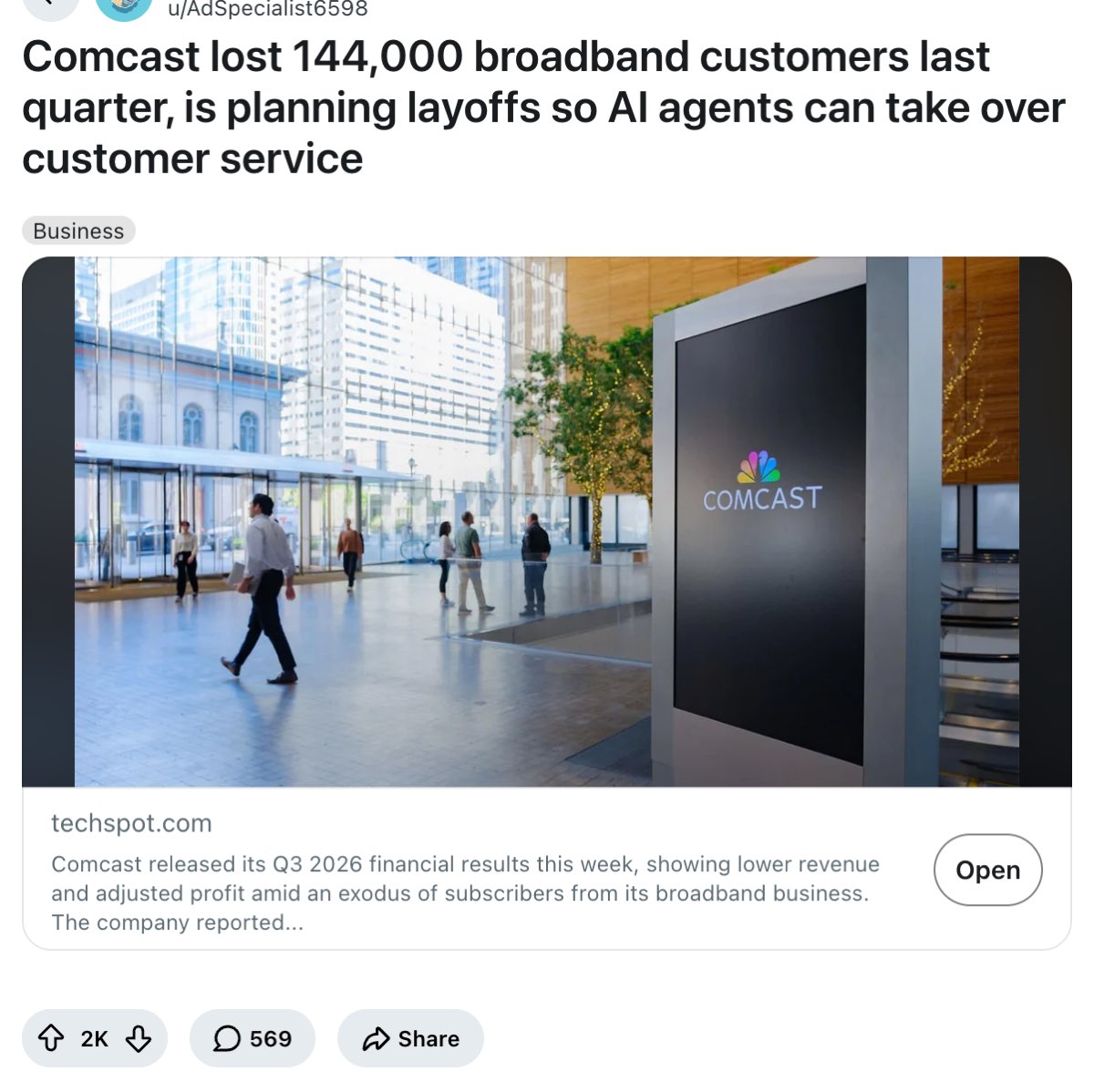
Comcast offers a real-world example of this pattern applied to customer service. The company lost 144,000 broadband subscribers last quarter and responded not by hiring more support staff but by planning layoffs to let AI agents handle customer interactions. The Reddit thread (1,255 points, 415 comments) tells you everything about public sentiment.
View original post on Reddit →
Junior Developers: The Vanishing Entry Point
The pattern repeats one layer down. Laurie Voss, npm co-founder and now at Arize AI, delivered the sharpest version of this argument at the AI Engineer conference: coding agents have made writing code nearly free, so the bottleneck has moved to review, operations, and security.
The implications cascade:
- Junior hiring collapses because the boilerplate work that trained new engineers is now automated
- The enduring role is the product engineer — someone who can define what "good" means, not just produce what was specified
- The entry path narrows from "learn to code" to "learn to judge code, systems, and products"
Entry-level software developer job postings have reportedly fallen as much as 67% between 2022 and 2026. Even if that number is directionally correct rather than precise, the signal is unmistakable. Microsoft's Mark Russinovich has argued that AI imposes "AI drag" on early-career developers who lack the systems knowledge to steer and verify agent output — you need experience to benefit from the tool that was supposed to replace experience.
The Infrastructure Side: Where the Money Goes
If the buyers aren't seeing returns, who is? Follow the capital.
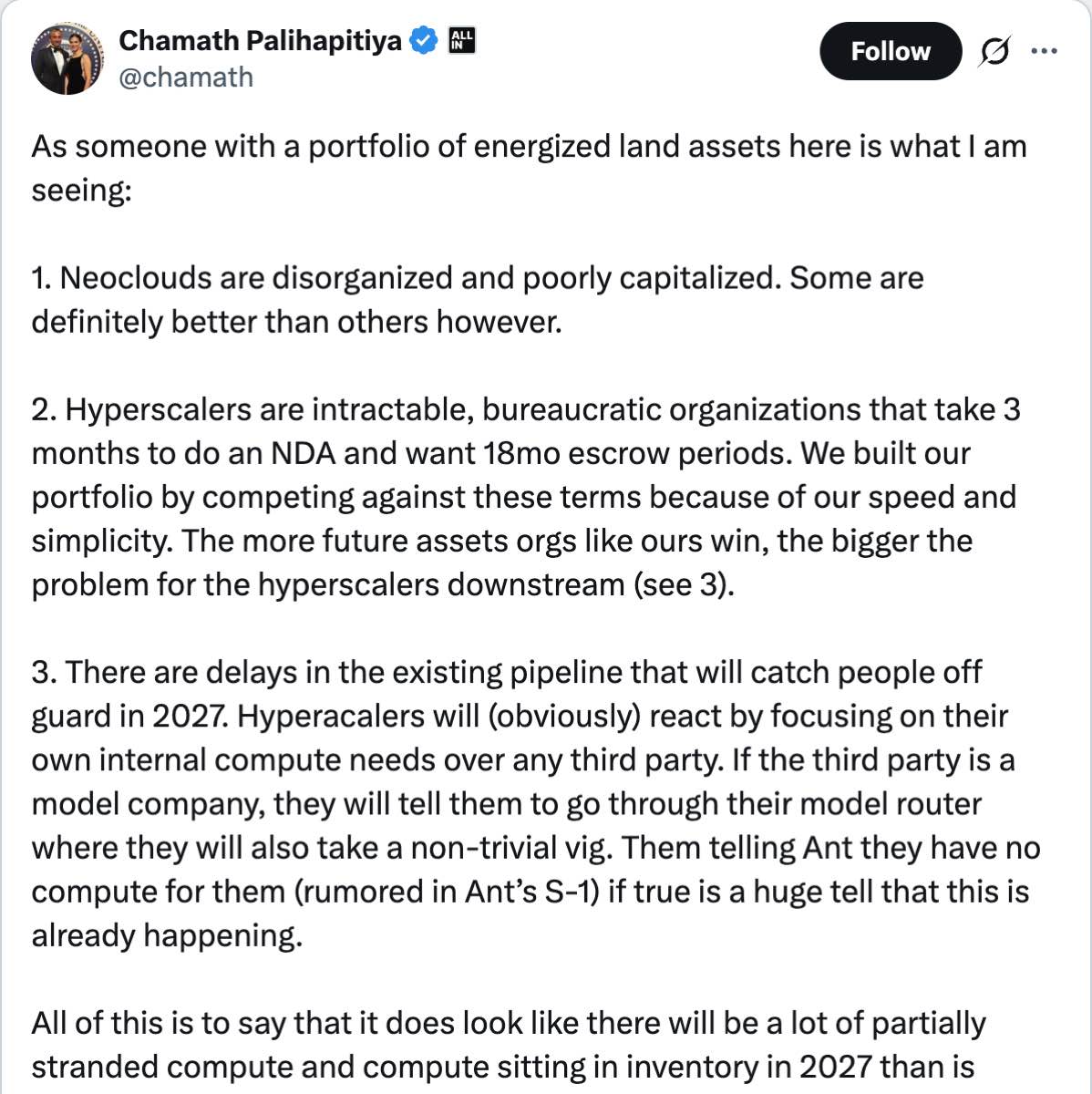
Chamath Palihapitiya's thread today paints the supply side: neoclouds are "disorganized and poorly capitalized," hyperscalers are "intractable bureaucratic organizations" that take months to approve anything, and the entire infrastructure buildout is creating a massive demand-supply mismatch. The money flows from enterprises to hyperscalers to NVIDIA — and at each step, the seller captures the margin.
Sequoia's David Cahn quantified this gap at roughly $600 billion: the revenue needed to justify current infrastructure spending minus what AI products actually generate. Even accounting for cost savings and efficiency gains that don't show up as revenue, the hole is enormous.
Apollo's own data shows that AI-related activity now accounts for approximately half of US economic growth in 2026, and roughly half of new corporate bond issuance is AI-related. The entire economy is leveraged to AI delivering returns — and the buyers' margins say it hasn't, yet.
Contrarian Corner: The Solow Rebuttal
Before declaring AI a bust, consider the historical pattern. Solow's computer paradox persisted from roughly 1973 to 1993 — two full decades — before productivity surged in the mid-1990s. The payoff came after businesses redesigned processes around the technology, not alongside early adoption. A Duke/Federal Reserve working paper found firms reporting 1.8% AI-driven productivity gains that didn't show up in macro data, suggesting real gains are happening at the firm level, invisible to aggregate statistics. The ISG research group argues we're in the "implementation dip" — gains materialize years later, after organizational redesign catches up to technical capability. The 90% of CEOs seeing "no impact" may simply be measuring too early.
The rebuttal to the rebuttal: the PC revolution didn't concentrate 50% of economic growth in a single bet. The downside risk if AI follows a 20-year payoff curve — with this much capital already committed — is qualitatively different from anything the Solow Paradox era faced.
The Hourglass Economy Takes Shape
Here is the pattern that connects all four signals:
At the top: Senior executives, principal engineers, and AI infrastructure sellers are doing well. NVIDIA's margins are at historic highs. Senior IC salaries keep climbing. The people who define strategy and architect systems are more valuable than ever.
At the bottom: Hourly, in-person, and physical-world jobs are relatively insulated. In-person entertainment is growing. Trades are booming. Healthcare workers remain in chronic shortage.
In the middle: Coordinators, middle managers, junior developers, creative production workers, and customer service reps — the roles that translate between strategy and execution — are being compressed from both sides. AI handles the routine translation. Seniors handle the judgment calls. The middle empties out.
This isn't a temporary dip. It's a structural reshaping. And unlike previous technology waves, it's happening simultaneously across corporate returns (the S&P 493), creative industries (200K jobs), management hierarchies (Gartner's 20% prediction), and technical hiring (junior dev collapse).
What This Means for You
If you're a middle manager: Larson's advice is worth taking seriously. Go back to line management. Reskill toward hands-on technical contribution. The coordination-heavy roles that don't directly produce or architect are the ones AI replaces first.
If you're a junior developer: The entry path hasn't closed — it's shifted. Product judgment, system design thinking, and the ability to evaluate AI-generated code matter more than raw coding speed. Seek roles that expose you to the full lifecycle, not just the code-writing step.
If you're an enterprise AI program leader: Stop measuring adoption rates and start measuring margin impact. The gap between "we deployed AI" and "AI improved our bottom line" is where billions in wasted spend hide. If you can't point to margin improvement after 18 months of deployment, the problem isn't the technology — it's the process design around it.
If you're an investor: The AI trade is the entire trade. Half of US economic growth and half of new corporate bonds are AI-linked. That concentration is either the beginning of a generational payoff or the setup for a correction that takes the whole market with it. There is no diversification if you hold the S&P 500 — you are already all-in on AI.
The Solow Paradox resolved itself once before. It could resolve again. But the 1990s productivity boom didn't arrive while 200,000 workers were watching their industries shrink, middle managers were being told to retire, and 90% of CEOs reported zero impact. If the payoff is coming, it's taking a route that looks nothing like the last time — and the people in the middle can't afford to wait 20 years to find out.
The convergence of market data, labor statistics, and organizational research tells one story this week: AI's value is real, but it's accruing to a narrow slice of the economy. For everyone else, the question isn't whether AI works — it's whether it works for them.
Related reading on ComputeLeap:
- AI Adoption Isn't Slowing. It's Repricing. — Our earlier analysis of the adoption-vs-value disconnect
- AI Backlash Is Here: No-AI Search Tripled, Costs Broke — The cost pressure side of this equation
- When Students Boo and VCs Cheer: AI's Cultural Split — The cultural divide that these economic numbers explain
ComputeLeap Team
The ComputeLeap editorial team covers AI tools, agents, and products — helping readers discover and use artificial intelligence to work smarter.
Join the discussion
Have thoughts on this article? Discuss it on your favorite platform:
Related articles
Nvidia's Scarcity Is a Firmware Setting
A firmware exploit unlocks RTX 3000 tensor cores to professional speeds, exposing 15 years of artificial GPU segmentation.
AI Found the PHP Zero-Day First. Now What?
GPT-5.6 Sol and Gemini 4 Argon found PHP2Shell weeks before disclosure. AI vuln discovery is production-ready for both sides.
The Slop Wall Is Here: Steam and Apple Have No Filter
Vibe-coded apps flood Steam and the App Store at once. Neither gatekeeper has a quality gate that scales. What breaks next.