AI's Water Bill: The Data Center Backlash Is Here
Meta contaminated a city's water. The DOE deleted conservation pages mid-heatwave. Communities are fighting back — and fusion is the long bet.
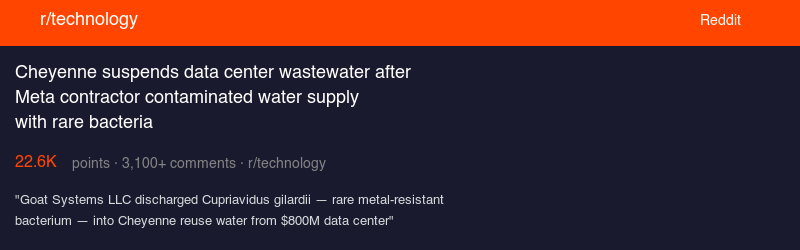
In February, city officials in Cheyenne, Wyoming discovered something in their reclaimed water system that shouldn't have been there: Cupriavidus gilardii, a rare metal-resistant bacterium traced to wastewater discharges from Meta's $800 million data center campus. The contamination shut down Cheyenne's reuse water system for months, and on July 2, the city publicly named Meta's construction entity — a shell company called Goat Systems LLC — as the source.
"It's a very, very unpleasant surprise," said City Councilman Pete Laybourn.
It shouldn't have been a surprise at all. Cheyenne is just the latest community learning what happens when AI's insatiable demand for compute meets the physical world: contaminated water, noise that residents describe as "living in hell," electricity bills that spike 267%, and — in the most surreal twist — a federal government that deleted its own energy conservation pages while a heatwave slammed the eastern seaboard.
The AI industry talks endlessly about parameters, benchmarks, and scaling laws. But the story converging across Reddit, Hacker News, X, and YouTube this week isn't about models. It's about watts, gallons, and the communities living next to the machines.
The water problem is worse than you think
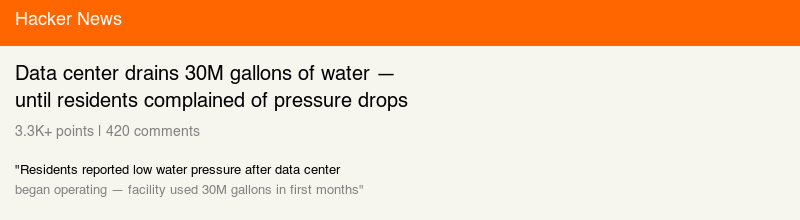
A Brookings Institution analysis puts the numbers in perspective: a typical data center consumes 300,000 gallons of water every day — equivalent to roughly 1,000 households. Large facilities gulp up to 5 million gallons daily, matching the needs of a town of 50,000. And water demand for data center cooling may rise by 870% as the current build-out continues.
The scale is hard to overstate. According to a Consumer Reports investigation, Phoenix-area data centers currently use 385 million gallons annually — a figure projected to explode to 3.7 billion gallons once planned facilities come online. About two-thirds of data centers built since 2022 sit in water-stressed regions.
And the reporting on this consumption understates reality. A 2026 study in AGU Advances documented significant transparency gaps in how tech companies report water usage, finding that actual consumption far exceeds what appears in corporate sustainability reports. Microsoft responded defensively that its latest facilities use 90% less water than its earliest ones — a claim that's technically true but obscures the fact that total consumption keeps climbing because they keep building more facilities.
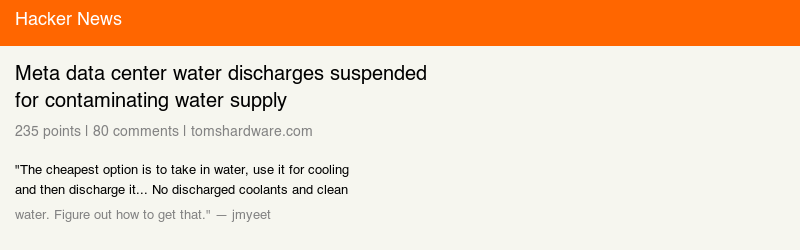
The Cheyenne incident crystallizes why the gap between corporate assurances and community reality keeps widening. Meta's "Project Cosmo" — the nearly 800,000-square-foot campus — wasn't draining drinking water. It was contaminating the reclaimed water system, the one used for parks and golf courses, with a bacterium that took months to clear. The city has now suspended all data center wastewater discharges.
Not just water: noise, bills, and backlash
Water is the most visceral story, but it's not the only one. In Dowagiac, Michigan, residents complain about constant noise from a Hyperscale data center facility. In Bristow, Virginia, a woman's expensive new windows can't block the sound from Google's "Mango Farm" complex. In New Jersey, neighbors are suing over an industrial hum that runs 24 hours a day.
Data centers operate 24/7, generating persistent background noise. Chronic exposure to environmental noise has been linked to sleep disturbance, hypertension, cardiovascular disease, and stress-related outcomes — but most local noise ordinances are written for noisy block parties, not industrial facilities.
Then there's the electricity bill. Consumer Reports found that areas with high concentrations of data centers saw electricity prices jump 267% over five years. Virginia resident John Steinbach watched his monthly bill spike from $100 to $281 in a single month. "It's just so far beyond any bill that I've ever had," he told the publication.
The scale of what's coming makes current complaints look quaint. There are 3,069 data centers operating in the U.S. today, with 1,489 more planned or under construction. Meta's proposed Hyperion project alone would require 5 gigawatts — three times New Orleans' entire power consumption. By 2028, data centers could consume 12% of all U.S. electricity, up from roughly 4% today.
Communities aren't taking it quietly. Between March and June 2025, opposition blocked or delayed $98 billion worth of data center projects. At least 25 were cancelled outright. Nearly three-quarters of Virginia voters — the state with the highest data center concentration in the country — blame the facilities for rising electricity costs.
The 6,000 deleted pages
Against this backdrop, the Department of Energy chose early July 2026 to delete approximately 6,000 web pages about energy conservation. The purge removed guidance on insulation, water conservation, the Solar Decathlon program, and — ironically — thermostat recommendations of 75–78°F during warm weather.
The timing was exquisite. New York City had just logged two consecutive days above 100°F. The deletions followed a political fight over NYC Mayor Zohran Mamdani's suggestion that residents set air conditioning to 78 degrees to reduce grid strain — the same advice that had appeared on the now-deleted DOE pages, and the same advice Texas Governor Greg Abbott has given during ERCOT emergencies.
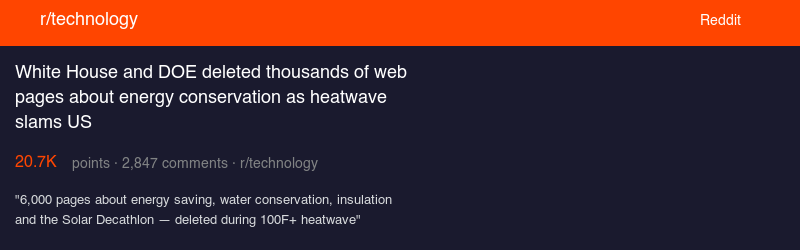
The Internet Archive preserved most of the deleted content. But the signal was clear: the federal government was withdrawing public service information during exactly the conditions that make it most needed — while simultaneously approving massive new loads on the grid from data centers that will need that same energy.
The supply response: nuclear, fusion, and the long bet
The demand side of this equation is alarming. The supply side is where it gets interesting — and where the skepticism should be highest.
Big Tech has started bypassing public utilities entirely, signing direct 20-year power purchase agreements with nuclear operators. Microsoft is spending $1.6 billion to restart Three Mile Island's Unit 1 reactor — an 835-megawatt facility expected online by 2027. Amazon, Google, and Meta have all signed or announced similar nuclear PPAs in 2025–2026.
Then there's fusion. On June 16, 2026, Helion Energy secured the world's first regulatory licenses for a commercial fusion power plant — a Radioactive Materials License and a Radioactive Air Emissions License from Washington state's Department of Health. CEO David Kirtley called it a historic first. Helion's Orion facility in Malaga, Washington has its assembly building complete and a generator building underway. The company has a power purchase agreement to supply Microsoft with 50 megawatts by 2028.
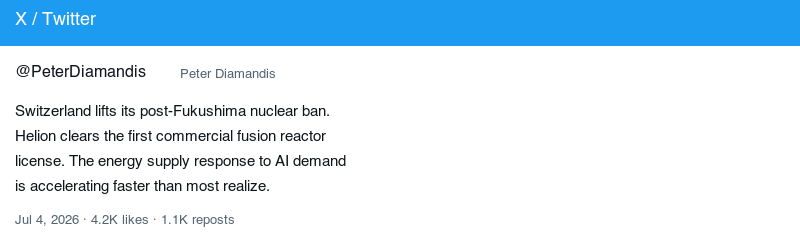
Internationally, the nuclear reversal is accelerating. On June 18, Switzerland's parliament voted to lift its post-Fukushima ban on new nuclear power plant construction — a stunning reversal of the 2017 referendum. The Greens have announced a counter-referendum, but the political momentum is clear.
The demand-side thesis is real: AI companies are the first entities in decades willing to sign 20-year power contracts, which is exactly the certainty nuclear and fusion projects need to attract capital. But demand-side willingness doesn't make supply-side physics move faster.
The reality check
Here's where the base rate matters.
Helion has a license. It doesn't have a running fusion plant. The licenses authorize construction activities and confirm safety protocols — they do not authorize power generation. Even the most optimistic fusion timelines place commercial electricity delivery well into the 2030s. The 2028 target for Microsoft's 50 MW is ambitious by any standard.
The nuclear restarts are more credible — Three Mile Island Unit 1 is a proven reactor with an existing grid connection — but they take years to complete and face their own regulatory and community hurdles. Nearly half of U.S. AI data centers planned for 2026 are already delayed, creating a 7-gigawatt gap that no amount of fusion optimism can fill in the near term.
Meanwhile, the communities bearing the costs aren't waiting for fusion to arrive. The Cheyenne contamination, the noise lawsuits, the electricity price revolts, the $98 billion in blocked projects — these are happening now. The bottleneck isn't chips or models anymore. It's watts and the communities living next to the watts.
The data-center-as-financing-vehicle story is compelling on a 20-year horizon. But the backlash is on a 20-month horizon. And history suggests that when communities, utilities, and regulators all push back simultaneously, the buildout slows — regardless of how much capital is behind it.
What this means for the AI industry
The AI industry has treated infrastructure as a solved problem — something money could always buy more of. The events converging this week suggest that assumption is breaking down.
The path forward isn't less AI infrastructure. It's infrastructure that earns its place in communities rather than extracting from them. Closed-loop cooling that reduces freshwater use by up to 70%. Air cooling systems that eliminate water dependence entirely. Noise mitigation that meets industrial standards, not residential block-party ordinances. Electricity procurement that doesn't externalize costs onto residential ratepayers.
The companies that figure this out won't just avoid lawsuits. They'll be the ones that actually get permits to build the next round of facilities — while their competitors fight community opposition that they could have prevented.
Fusion may eventually change the energy math. But it won't change the water math, the noise math, or the trust math. Those bills are coming due now.
For more on the economic pressures reshaping AI infrastructure, see our analysis of the capex math behind AI scaling and the growing AI backlash narrative.
ComputeLeap Team
The ComputeLeap editorial team covers AI tools, agents, and products — helping readers discover and use artificial intelligence to work smarter.
Join the discussion
Have thoughts on this article? Discuss it on your favorite platform:
Related articles
Open Weights Just Closed the Gap
Cloudflare's Clef beats the incumbent, FLUX 3 Image ships, and PewDiePie gets banned for distilling. Open weights are frontier.
Humanoids Are a Backward-Compatibility Layer
Palmer Luckey's strongest robotics argument, ARK's beaten forecasts, and China's embodiment race reframe humanoids as the API for the physical world.
Sonnet 5.5 Just Ate Opus. Anthropic Did It on Purpose.
Sonnet 5.5 scores 70.6% on Terminal-Bench — beating Opus 5.5's 66.4% — at half the price. Here's why Anthropic is cannibalizing its own premium tier.
The ComputeLeap Weekly
Get a weekly digest of the best AI infra writing — Claude Code, agent frameworks, deployment patterns. No fluff.
WEEKLY. UNSUBSCRIBE ANYTIME.