Anthropic's S-1 Hides the Real Story in Plain Sight
The S-1 shows 900% NRR and $16.3B revenue. It also shows Fortune 500 firms spend under $1 per $1,000 on AI. That gap is the whole story.
ComputeLeap Team
Anthropic's S-1 Hides the Real Story in Plain Sight
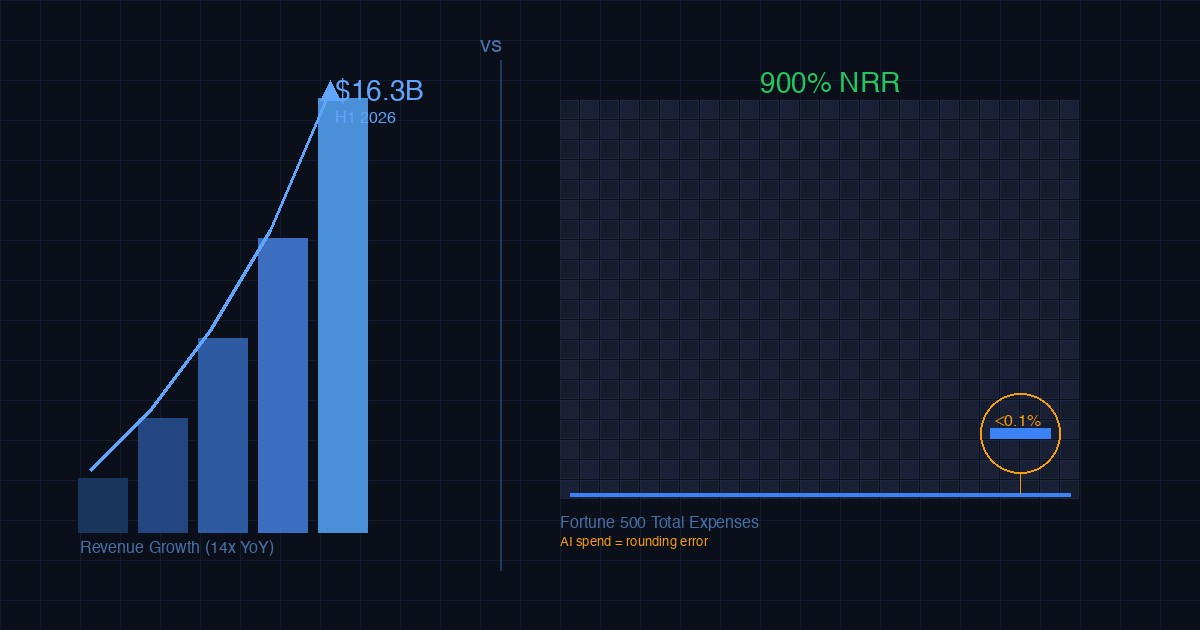
Anthropic filed its S-1 registration statement with the SEC on October 26, 2026. The headline numbers are staggering: $16.3 billion in first-half revenue (up from $1.16 billion a year earlier), 11,900 customers paying more than $100,000 annually, and net revenue retention of approximately 900 percent. Under the ticker ANT, Anthropic is on track for what could become the largest IPO in history.
But buried in the same filing is the number that actually matters: among its publicly traded Fortune 500 customers, average spending comes to less than one dollar for every thousand dollars of total expenses.
Read that again. The fastest-scaling enterprise software company ever recorded is still a rounding error in its own customers' budgets.
That single ratio — the gap between "biggest enterprise AI vendor in history" and "statistically invisible line item" — is the entire investment thesis for AI's next decade. Whether you read it as limitless upside or structural warning depends on assumptions the S-1 cannot settle. But the filing gives us, for the first time, the actual numbers to frame the question.
This analysis draws directly from Anthropic's public S-1 filing and its secondary coverage. For our earlier analysis of the $80.7B accounting loss, see The $80B Loss That Might Be Genius. For background on the confidential filing and Series H, see What a $965B IPO Filing Changes.
The Revenue Machine: What the Headlines Got Right
The top-line growth is not hyperbole. Anthropic's revenue trajectory has no precedent in enterprise software:
- H1 2026 revenue: $16.3 billion, with Q2 alone at $11.6 billion
- Year-over-year growth: approximately 1,300% from H1 2025's $1.16 billion
- Q3 2026 implied revenue: approximately $16.8 billion (from investor-meeting disclosures, not in the S-1)
- Annual run rate: exceeding $60 billion, up from roughly $4 billion in mid-2025
The customer expansion metrics are equally striking. The S-1 reports 11,900 customers above $100,000 in trailing twelve-month revenue as of September 30, 2026 — up from just 950 a year prior and 1,500 at the end of 2025. More than 1,900 of those customers exceed $1 million, and approximately 250 cross the $10 million threshold. The company counts all ten of the largest U.S. banks and nine of the ten largest pharmaceutical companies among its paying clients.
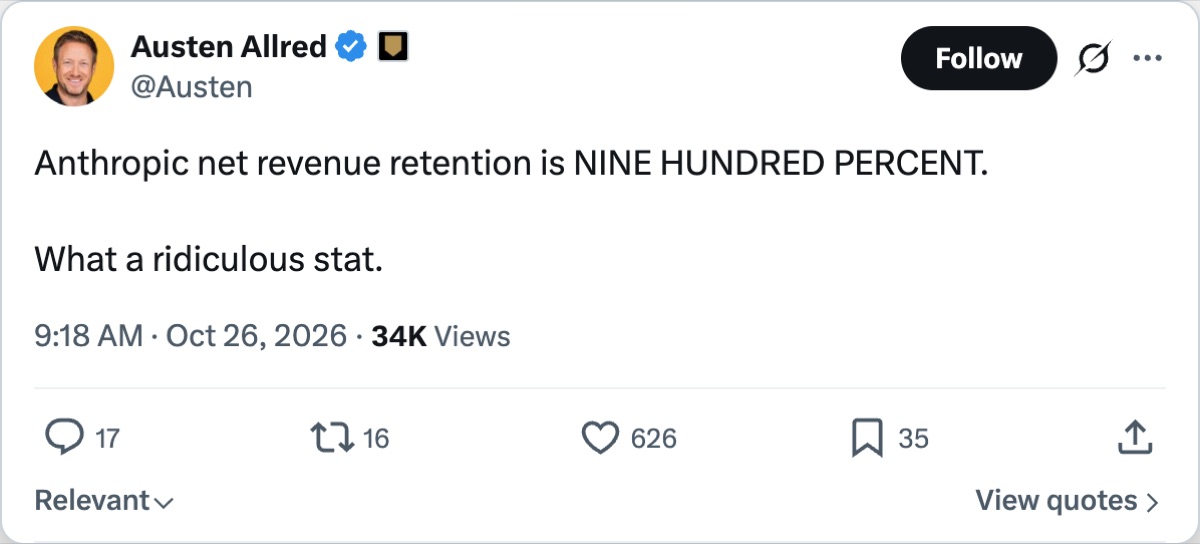
Net revenue retention of roughly 900 percent means existing customers are spending nine times what they spent a year ago. As Nate's Newsletter noted in its S-1 analysis, this is not just early customers expanding — spending is broadening: customers outside the top five supplied about 79 percent of September-quarter revenue, up from about 64 percent in the March quarter.
The Number the S-1 Buries
Now the other side.
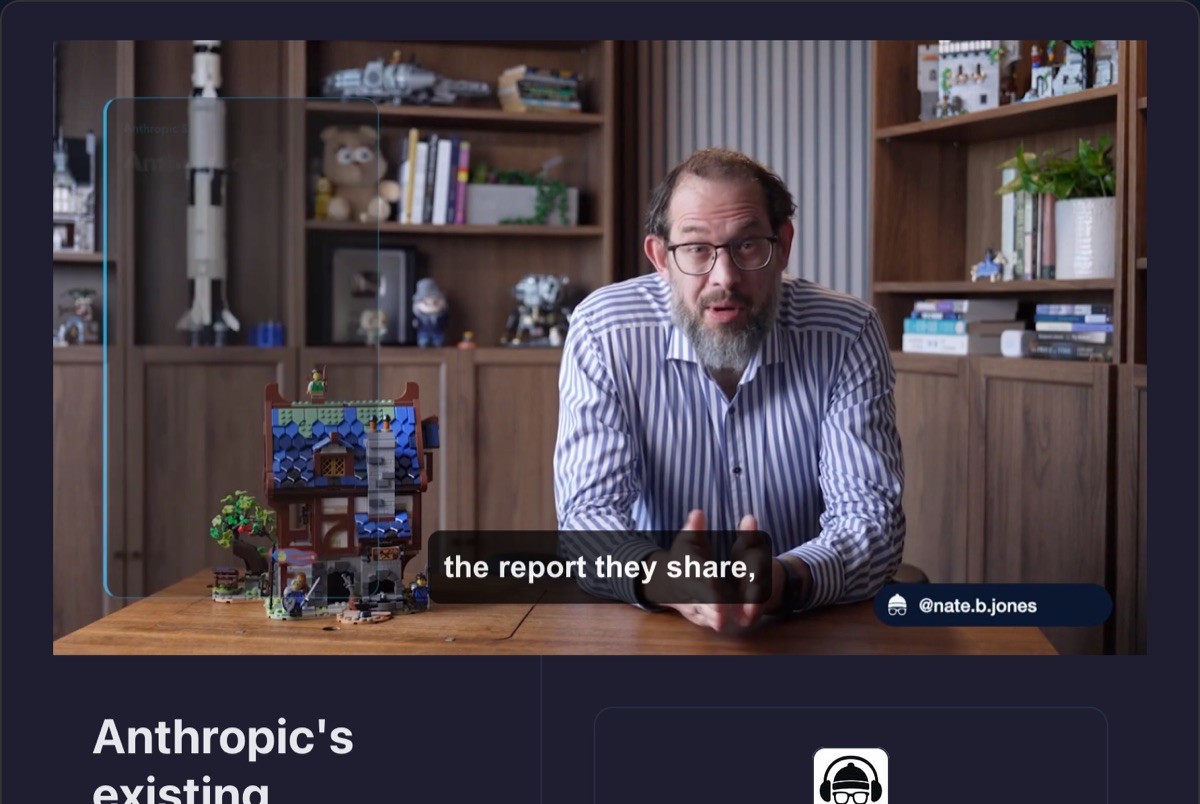
More than half of the Fortune 500 qualifies as an Anthropic customer at the $100,000 threshold. That sounds like dominant market position. But the S-1 also discloses — as MarketMusings spotted in its first-impressions analysis — that these same Fortune 500 customers spend less than 0.1 percent of their total quarterly expenses on Anthropic. Even the ten largest Fortune 500 customers spend less than 1 percent.
Let me put that in concrete terms. A Fortune 500 company with $50 billion in annual expenses spends under $50 million with Anthropic. A company with $10 billion in expenses spends under $10 million. These are not small companies running small pilots — they are the world's largest enterprises, spending over $100,000 annually, and AI is still effectively invisible on their income statements.
This creates an extraordinary paradox at the heart of the filing:
The Paradox: Anthropic is simultaneously the fastest-growing enterprise vendor in history AND a rounding error in enterprise budgets. The S-1 proves both of these things in the same document.
The bull case reads this as "Day 1" — the Amazon thesis applied to AI infrastructure. If enterprises are already growing at 900 percent NRR when AI is only 0.1 percent of their spend, imagine what happens when it becomes 1 percent. Or 5 percent. Anthropic would not be a $60 billion company — it would be a $600 billion one.
The bear case reads the same data point and asks a harder question: if the world's most sophisticated companies have been deploying AI for over two years and still spend almost nothing, maybe the constraint is not adoption speed but structural limits on what AI can replace.
Inside the Revenue Quality
The S-1 reveals details about revenue quality that most coverage has missed.
Revenue composition: Approximately 80 percent of H1 2026 revenue was consumption-based (API usage), with the remaining roughly 20 percent from subscriptions (Claude Pro, Max, Team plans). This matters because consumption revenue scales with actual usage, not seat count — when enterprises find productive work for AI, the bill rises automatically.
Product stickiness: Over half of customers spending $100,000 or more used both Claude Platform (the API) and at least one Anthropic application product by the September quarter, up from about 30 percent in late 2025. The filing also reveals that the top 5 percent of Claude Code enterprise users spend approximately 20 times the average enterprise user without Claude Code — a signal that coding workflows drive outsized expansion.
Seasonal sensitivity: Customer spending dropped approximately 20 percent in the two weeks ending January 2, 2026, compared to the two weeks ending December 19, 2025. Holiday code freezes and enterprise procurement cycles directly affect the revenue line. This is a business tightly coupled to actual workflow activity, not annual site licenses.
Model dependency: Over 80 percent of Q3 revenue came from model versions released in the prior six months. This is both a strength — it means customers adopt new capabilities rapidly — and a risk. If a model cycle disappoints or a competitor ships something better, the revenue could shift just as fast.
The Margin Story: Better Than Expected, But Fragile
The operating economics surprised skeptics. Fortune's Shawn Tully called the core business "thriving":
- Gross margin: 85 percent for H1 2026, up from approximately 39.5 percent for all of 2025
- Adjusted operating margin: 19 percent in Q2 2026, with $1.62 billion in adjusted operating income for H1
- Free cash flow: $3.93 billion in operating cash flow, $3.45 billion in free cash flow for H1 2026
- Compute efficiency: Revenue per compute dollar rose from $0.40 in Q1 2025 to $2.08 in Q2 2026
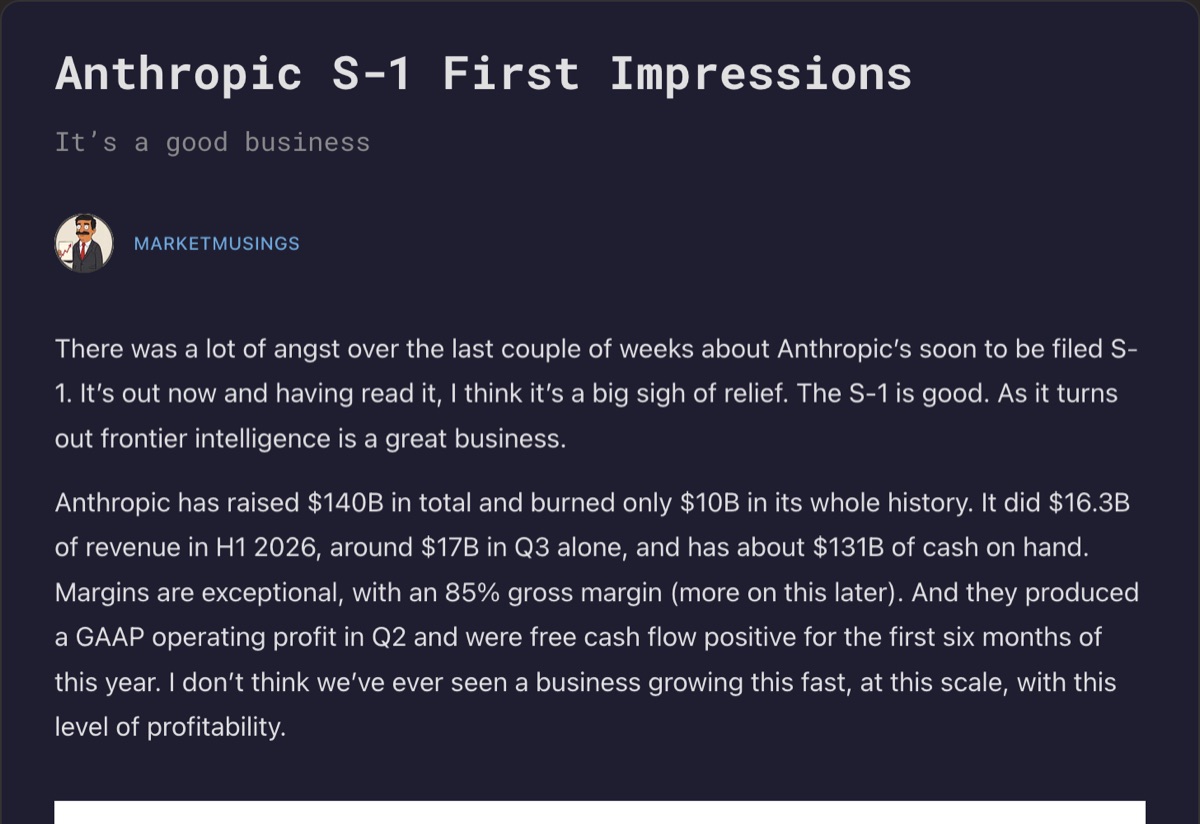
Revenue per employee tells a particularly striking story. MarketMusings calculated that Anthropic generates approximately $12 million in annualized revenue per employee, compared to Meta ($3 million), Google ($2 million), and Microsoft ($1.5 million). People costs have fallen from 40 percent of revenue to 19 percent, and compute from 160 percent to 55 percent.
But the filing itself warns these margins may compress. In the company's own words, "operating margin and Adjusted Operating Margin may compress" in future periods. Why? Because the compute commitments are locked in while revenue is not.
The $498 Billion Asterisk
This is where the filing gets uncomfortable.
Anthropic has signed approximately $657 billion in infrastructure agreements and equipment leases. Of that, $498 billion is noncancelable — Anthropic must pay whether or not it uses the capacity. The major commitments include:
| Partner | Commitment | Cancelable? |
|---|---|---|
| Broadcom TPU lease | $161B | No |
| SpaceX AI | ~$120B | Yes (90-day notice) |
| Google Cloud | $114.5B | No |
| Amazon Web Services | $110B | No |
| Microsoft | $44.9B | No |
| Nscale | $44.6B | Partial |
| Lambda | $41.3B | Partial |
| AMD | $20B+ | Conditional |
Most of these contracts run seven years or fewer, implying roughly $70 billion in annual obligations. The asymmetry is stark: Anthropic's compute commitments are locked; its customers' spending is not. As we analyzed in October, this is the structural risk at the heart of the AI capital cycle.
What the Community Is Saying
The S-1 landed like a Rorschach test across platforms. The Hacker News thread hit 1,044 points and 957 comments within 48 hours. The top-voted comment drew WeWork parallels: "They've made absolutely massive forward cash commitments, on a business that's increasingly commoditized, and with little hard evidence that they'll generate the revenue — let alone the cashflow — to pay for all these future liabilities."
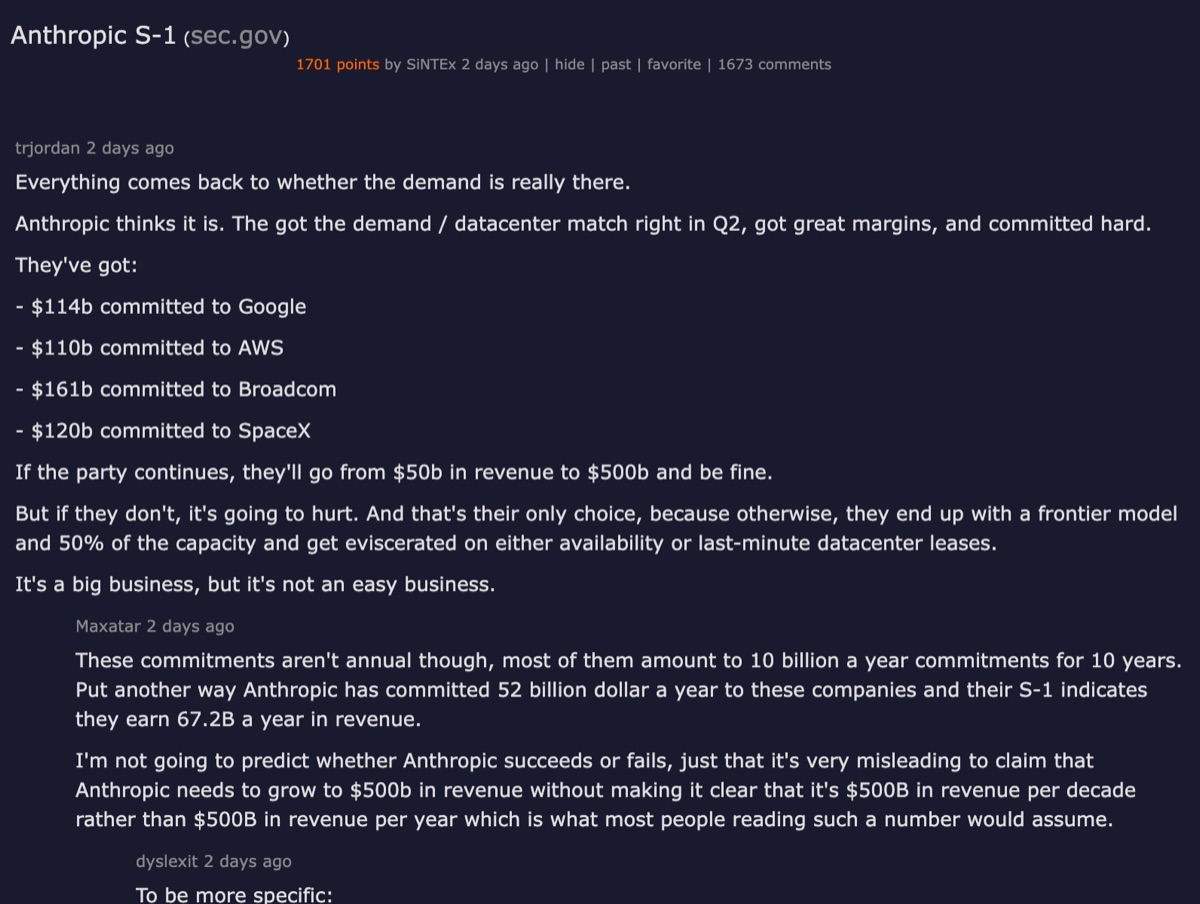
Another highly voted HN comment raised the philosophical question: "If the AI maximalism turns out correct — which is needed to justify the valuations — why would AI companies respect money and ownership?" The point is sharper than it sounds: if AI truly replaces most cognitive work, the economic assumptions underlying trillion-dollar valuations may not hold on either side.
On Reddit, the risk factors section became a meme. One r/technology thread with 5,600 upvotes focused on the seven potential AI nightmares in Anthropic's 93-page risk-factor section, including blackmail, sentience, and existential threats.
The earlier thread about the $80.7 billion loss pulled 25,000+ upvotes, with the community split between "dot-com crash 2.0" and "you don't understand non-cash accounting."
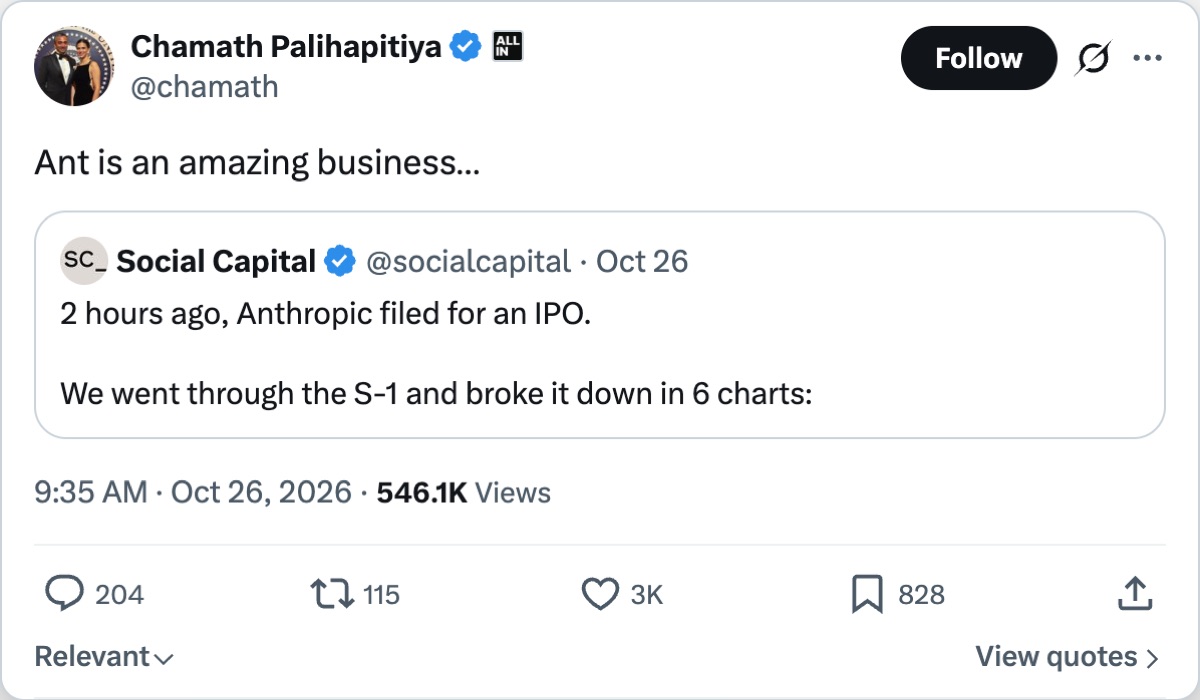
On X, the reactions split along predictable lines. Chamath Palihapitiya called it "an amazing business" — six words, 3,000 likes, from an investor with disclosed exposure. Brad Gerstner of Altimeter celebrated the milestone while confirming major participation in the IPO.
The more analytically useful X take came from Austen Allred, who highlighted two statistics: Anthropic now holds more cash and cash equivalents than Microsoft, Alphabet, Apple, Amazon, Meta, or Nvidia — and its 900 percent NRR is "a ridiculous stat." Both observations are correct and both miss the $1-per-$1,000 context.
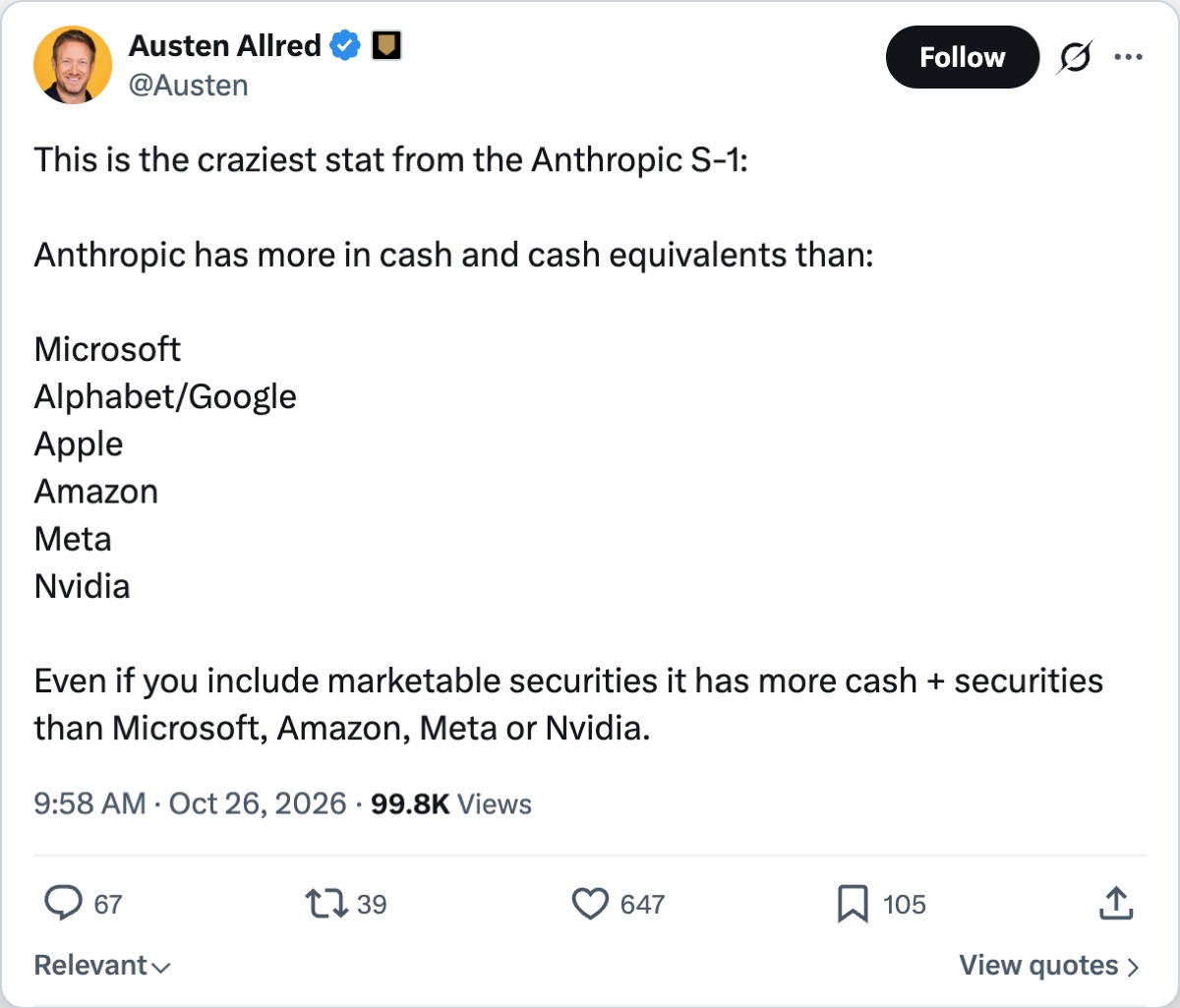
The cash position is real but misleading. Anthropic's $131.7 billion in cash and investments reflects recent fundraising, not accumulated profits. Critically, $498 billion of its commitments are noncancelable — the cash is already spoken for.
The Contrarian Corner: What If Low Spend Is the Ceiling, Not the Floor?
The consensus narrative treats the under-0.1-percent wallet share as pure upside. But consider the counter-argument.
Enterprises have had access to frontier AI models for over two years. They have dedicated AI teams, partnership agreements with multiple providers, and executive mandates to deploy. And yet the average Fortune 500 company — after all of that — spends less on Anthropic in a quarter than it spends on office supplies.
Several structural factors could explain why the ceiling is lower than bulls assume:
-
AI replaces costs it cannot bill for. If AI makes a $200K knowledge worker 30 percent more productive, the company saves $60K — but it does not spend $60K on AI. The productivity gain gets captured internally, not externally.
-
Switching costs are low. The S-1 acknowledges this: consumption-based pricing means customers can shift to a competitor (or open-source models) with minimal friction. Over 80 percent of revenue coming from models released in the prior six months cuts both ways — it means customers are model-agnostic, not vendor-locked.
-
The per-token price is falling. Anthropic's own compute efficiency gains — from $0.40 of revenue per compute dollar to $2.08 — reflect both demand growth and lower unit costs. But lower unit costs mean customers can do more work for less money. The revenue-per-customer ceiling may be structurally lower than in traditional enterprise software.
-
Competitive intensity is rising. Jeremy Kahn in Fortune's Eye on AI flagged that The Information reported OpenAI is winning share by undercutting on price, with its new GPT-6.1 Terra model up to 50 percent cheaper per token than the previous generation.
None of this means the bear case is right. But the S-1 does not settle the question. It proves that AI adoption is real, that revenue grows explosively in early cycles, and that enterprises like the product. It does not prove that $1 per $1,000 becomes $10 per $1,000 — or that the transition happens fast enough to justify $500 billion in locked-in infrastructure.
What This Means for Practitioners
For developers and teams building on Claude, the S-1 reveals the economic reality behind the product you use daily:
Pricing stability depends on enterprise expansion. If Fortune 500 firms stay at 0.1 percent of expenses, Anthropic's margins depend on continued growth of new customers and new use cases — not deeper penetration of existing ones. That makes pricing competitive and likely to stay favorable for builders in the near term.
Model cadence is existential for Anthropic. With 80 percent of revenue coming from recently released models, there is zero room for a miss. Expect aggressive model release schedules for the foreseeable future. For builders, this means frequent migration work but also frequent capability jumps.
Consumption-based pricing is the business model. If you are budgeting for AI infrastructure, plan for variable costs that track with actual usage, not flat licenses. The 20 percent holiday dip tells you that enterprise AI spend is directly tied to headcount activity — which matters for capacity planning.
The filing confirms Claude Code's outsized economics. Top Claude Code users spending 20x the average non-Code user validates the tool as a genuine revenue driver, not a loss leader. Expect continued heavy investment in agentic coding capabilities.
The Bottom Line
The Anthropic S-1 is a remarkable document — 335 pages that simultaneously make the strongest bull case ever assembled for an AI company and contain enough risk factors to make a derivatives trader nervous. The 900 percent NRR, 85 percent gross margins, and $16.3 billion in half-year revenue are real and extraordinary.
But the number that will determine whether ANT is a generational investment or a cautionary tale is neither the revenue nor the loss. It is that $1 per $1,000 — the gap between what enterprises pay for AI today and what they would need to pay for Anthropic to grow into its commitments.
The S-1 proves demand exists. It does not prove demand scales fast enough to fill a $500 billion hole. That question will be answered not by Wall Street's pricing of ANT shares, but by the enterprise procurement decisions of the next 24 months.
If you found this analysis useful, you might also want to read our earlier coverage: The $80B Loss That Might Be Genius breaks down the accounting behind the headline loss, Anthropic's $2T IPO Has a $518B Problem examines the compute commitment asymmetry, and Anthropic's $100B Clock tracks the competitive dominance timeline.
ComputeLeap Team
The ComputeLeap editorial team covers AI tools, agents, and products — helping readers discover and use artificial intelligence to work smarter.
Join the discussion
Have thoughts on this article? Discuss it on your favorite platform:
Related articles
Compute Is Now a Tradable Commodity
CME and ICE are listing GPU futures. Amazon says $220B isn't enough. Here's what compute-as-commodity means for builders.
The $80B Loss That Might Be Genius
Anthropic lost $80.7B on paper while DeepSeek prints 82% API margins. Why both strategies could win the AI economics war.
Wall Street Wrote the AI Boom's Checks. Now It Wants Out.
JPMorgan, Morgan Stanley, and MUFG are scrambling to offload billions in AI data-center debt. What their exit means for the buildout.