The Per-Token Trap: Why AI Got Cheaper and Your Bill Didn't
Token prices fell 90%. Enterprise AI bills doubled. Gartner says agentic costs will 5x by 2028. Here's the Jevons math and how to fix your budget.

The Per-Token Trap: Why AI Got Cheaper and Your Bill Didn't
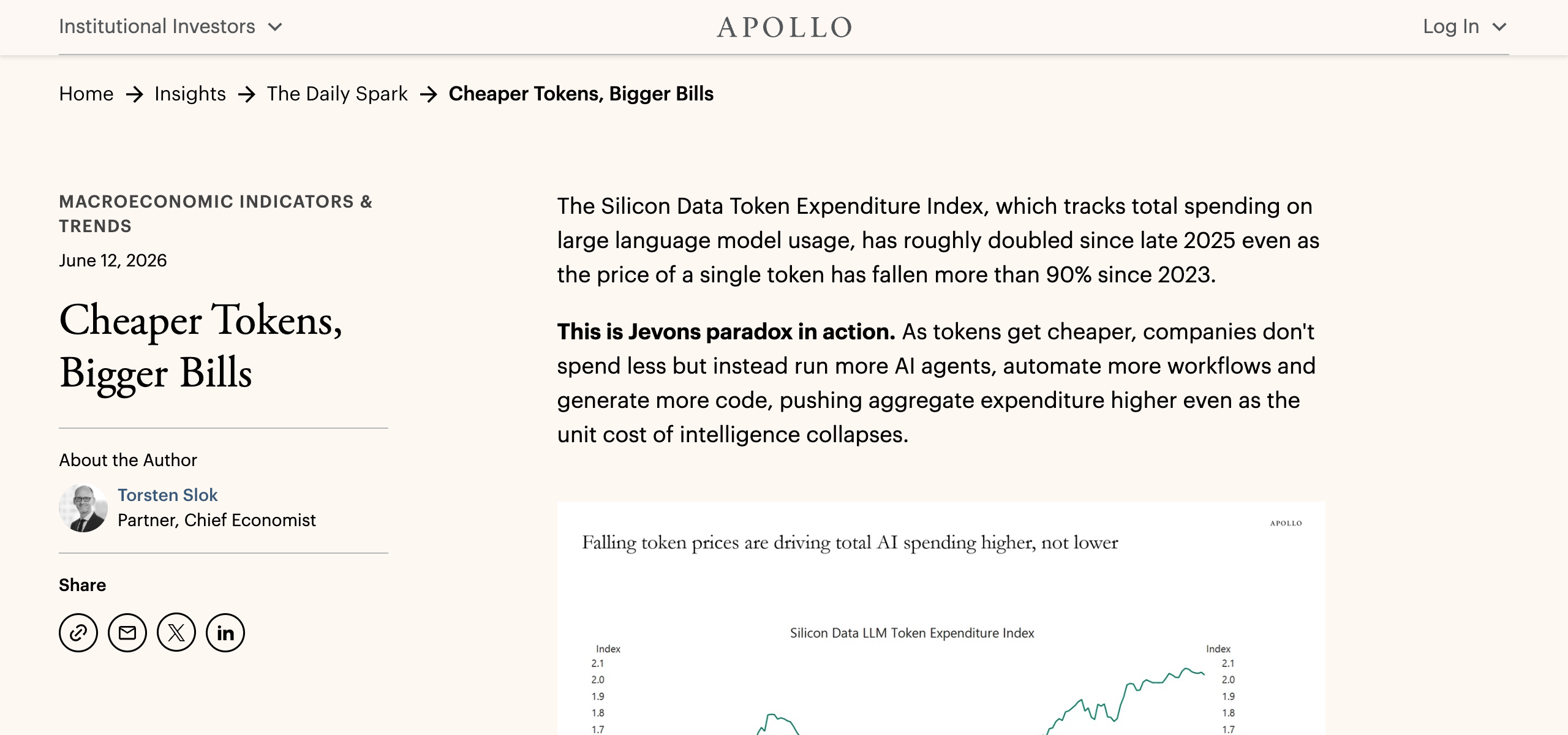
Here is the number that should be pinned to every CTO's whiteboard: the price of a single AI token has fallen more than 90% since 2023. In that same window, total enterprise spending on large language models has doubled, according to Apollo chief economist Torsten Slok's analysis of the Silicon Data Token Expenditure Index. Ramp's billing data tells an even starker story — businesses' monthly AI spend roughly quadrupled between February 2025 and February 2026.
This is not a paradox waiting to happen. It is a paradox that already arrived. And if your team is still tracking "cost per million tokens" as the primary budget metric, you are optimizing the wrong number.
View original analysis on Apollo →
The Jevons Paradox, Explained With Your Invoice
In 1865, economist William Stanley Jevons observed something counterintuitive about coal: as steam engines became more efficient and the effective cost of coal fell, Britain did not burn less coal. It burned dramatically more. The efficiency gains made coal-powered industry viable for use cases that were previously too expensive, and total consumption exploded.
Torsten Slok, in his June 12, 2026 Daily Spark, labeled what is happening in AI spending "Jevons paradox in action." The mechanism is identical. As tokens get cheaper, companies do not spend less — they run more AI agents, automate more workflows, generate more code, and attempt tasks that were previously cost-prohibitive.
The math is simple:
Cost per task = (tokens per task) x (cost per token)
Cost per token is falling. But tokens per task is rising much faster — and that is the variable nobody budgeted for.
Bain & Company's 2026 analysis found that token costs halved from December 2024 to December 2025. But tokens consumed grew 450% over the same period. Bain attributes this to three forces: companies upgrading to newer, more capable (and token-hungry) models; agents handling more complex multi-step tasks; and teams expanding AI usage once they trust it with larger jobs. Their summary is blunt: "The bill stays stubbornly high."
Bain's key finding: Token costs halved from Dec 2024 to Dec 2025. Tokens consumed grew 450% over the same period. The bill doesn't move — it shifts from "paying more per unit" to "paying for vastly more units."
What the Community Is Saying
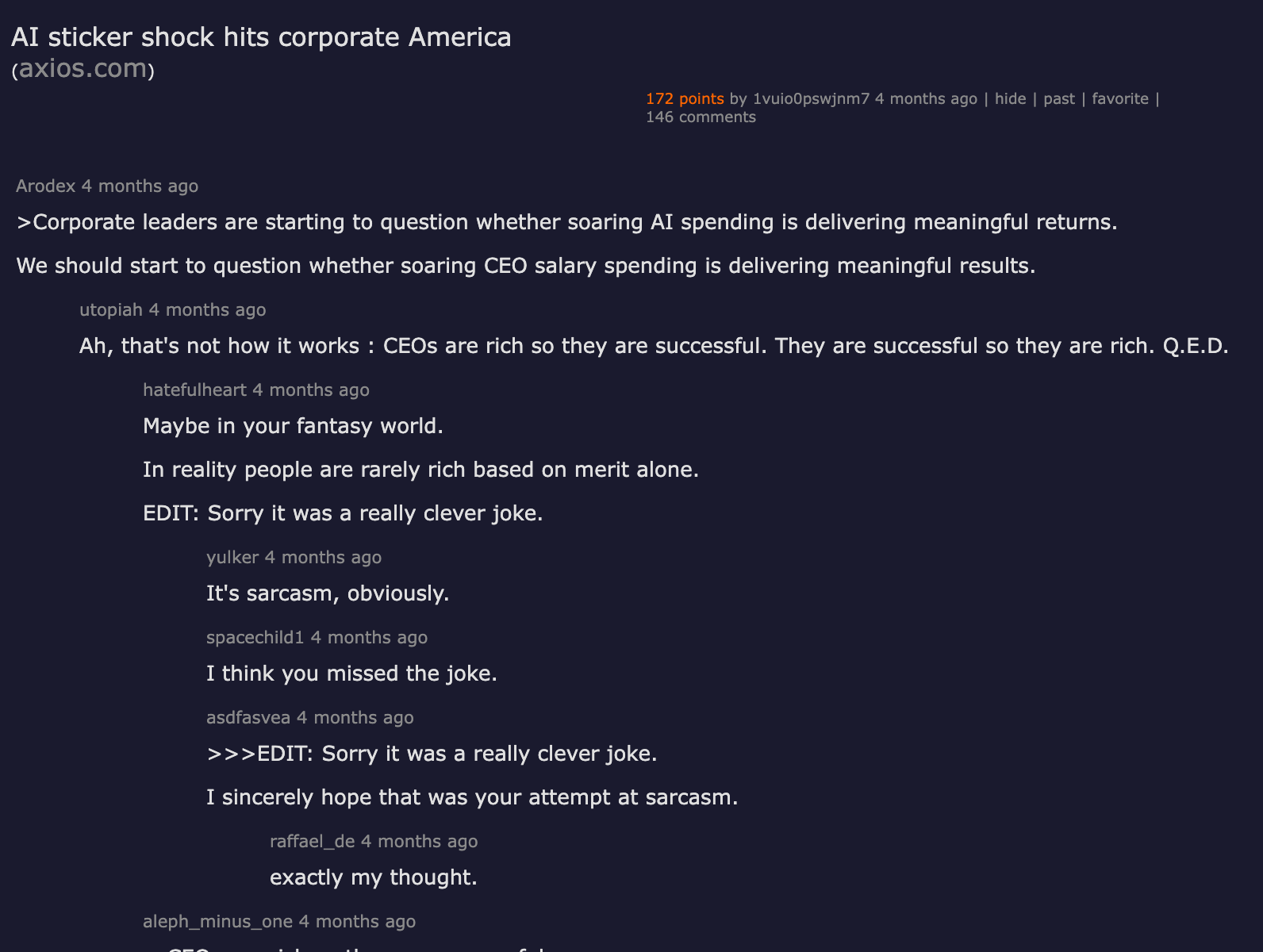
The per-token trap has been one of the most debated topics on Hacker News in 2026. When Fortune broke the Uber budget story, the HN thread drew hundreds of comments — many from engineers who had experienced the same cost shock firsthand.
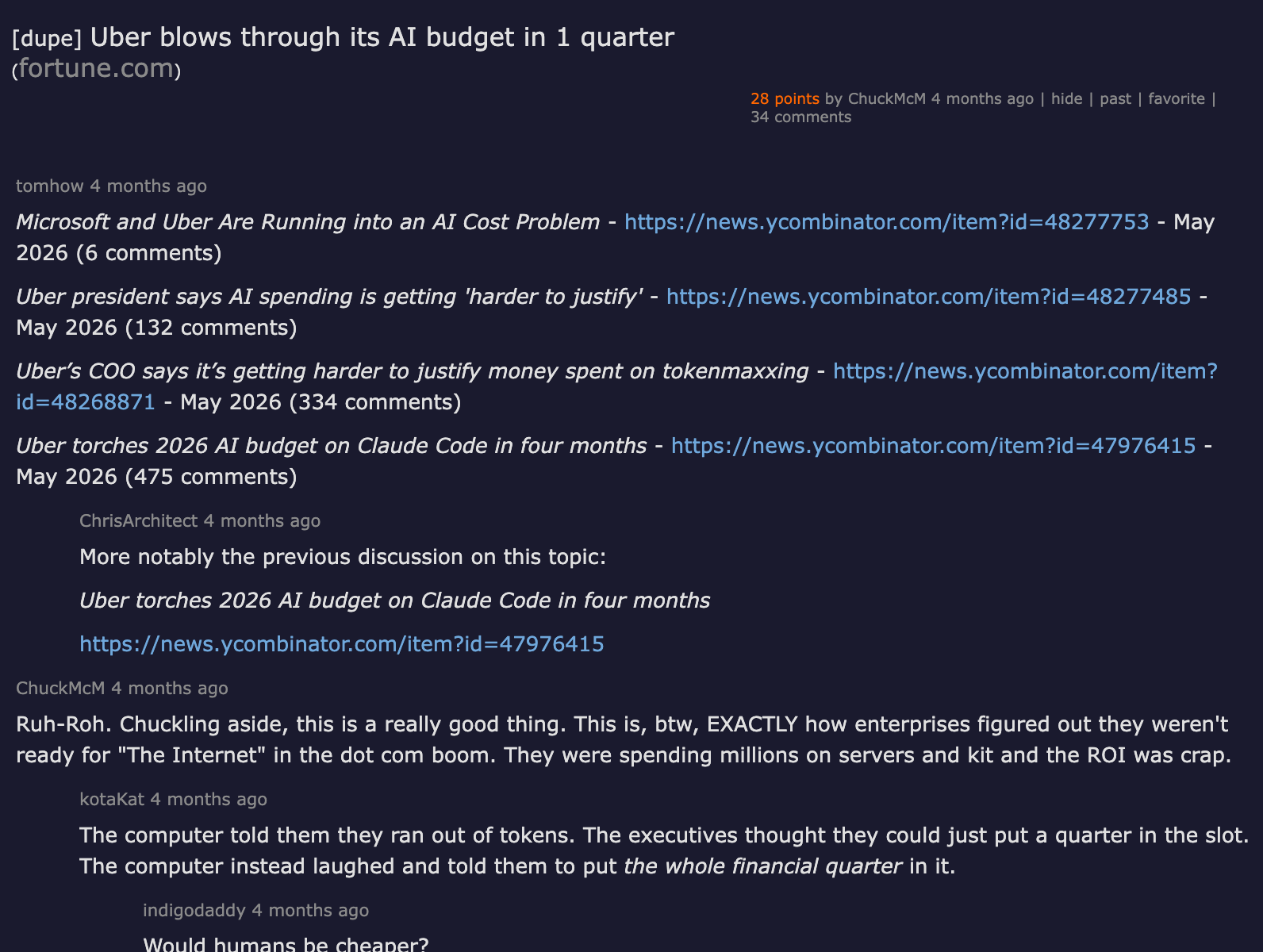
The recurring theme: engineers know per-token pricing is misleading, but their organizations keep tracking it as the primary metric. One commenter noted that "the cost is overwhelmingly dominated by the cost of input tokens (cached) in Claude Code sessions" — confirming that context re-reads, not model choice, drive the real expense.
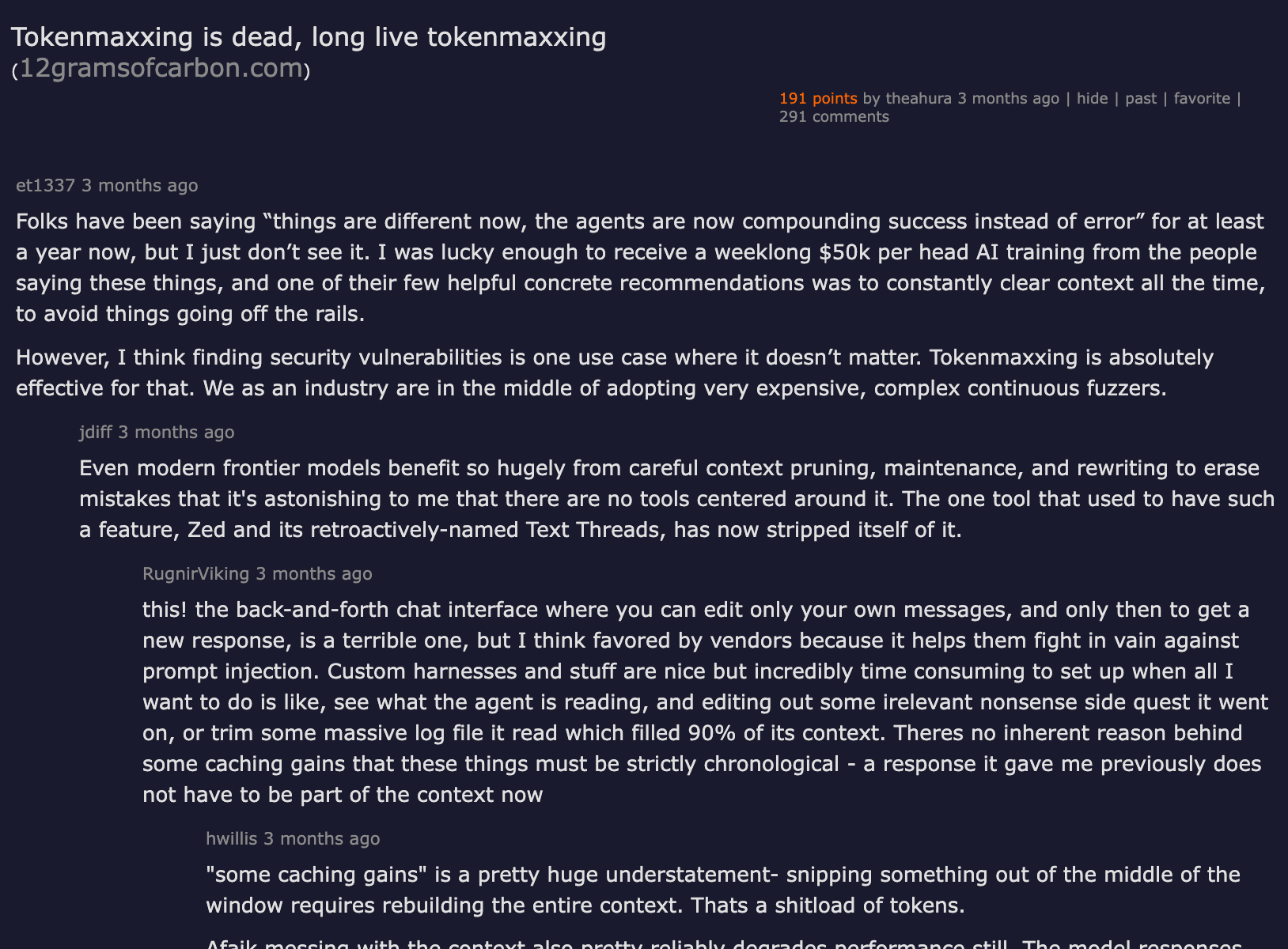
A later thread titled "Tokenmaxxing is dead, long live tokenmaxxing" captured the industry's pivot moment — companies pulling back from internal usage leaderboards and shifting to outcome-based measurement.
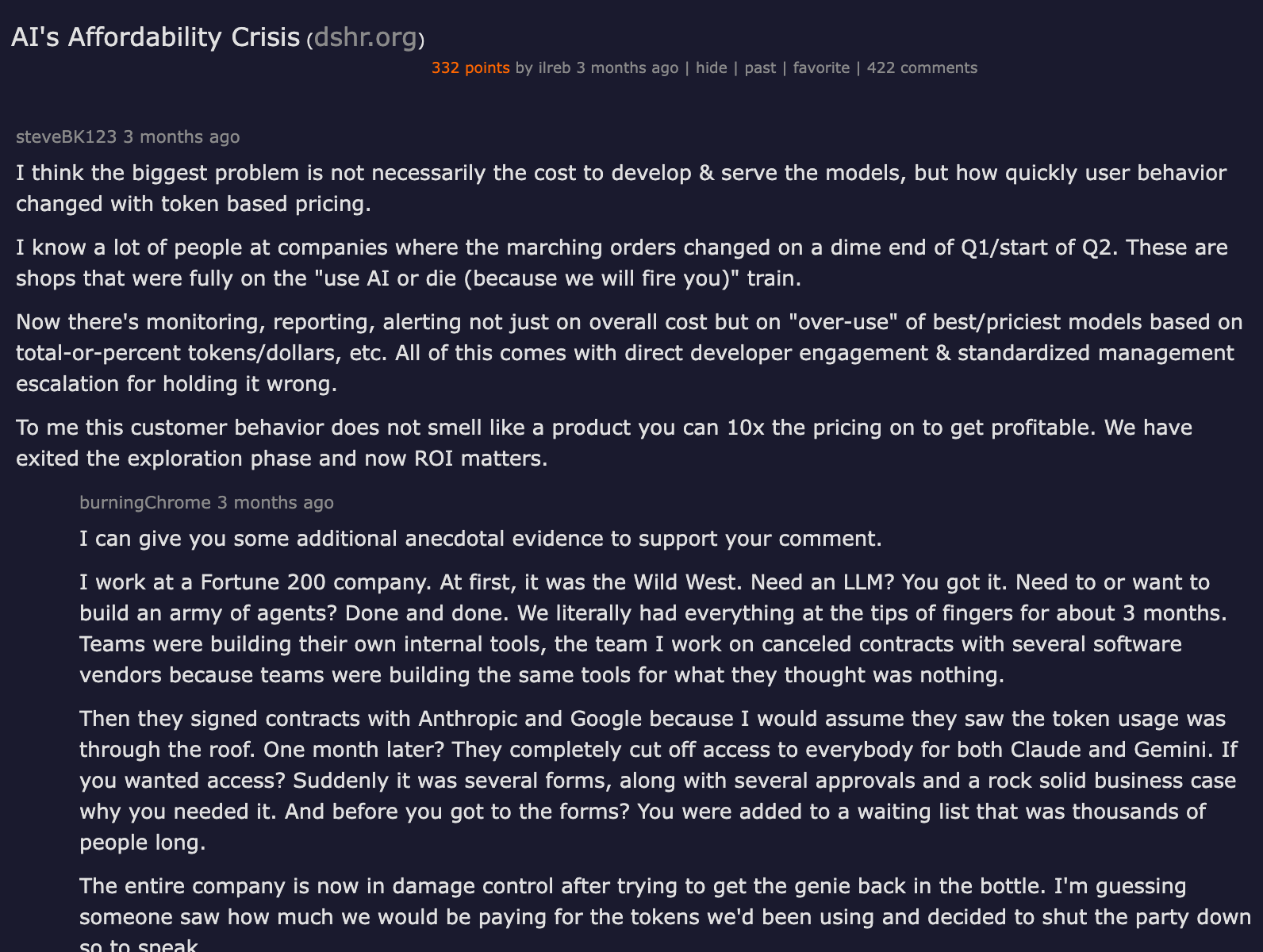
Meanwhile, the broader "AI sticker shock" and "AI affordability crisis" threads reveal a practitioner community that is increasingly skeptical of the "AI will be free" narrative and demanding better cost tooling.
Why Agents Broke the Budget
The shift from chatbot to agent is the single largest driver of the cost explosion. A chatbot query is a one-shot exchange: you send a prompt, you get a response, you pay for a few hundred tokens. An AI agent — the kind now embedded in coding tools, customer support pipelines, and enterprise automation — operates differently.
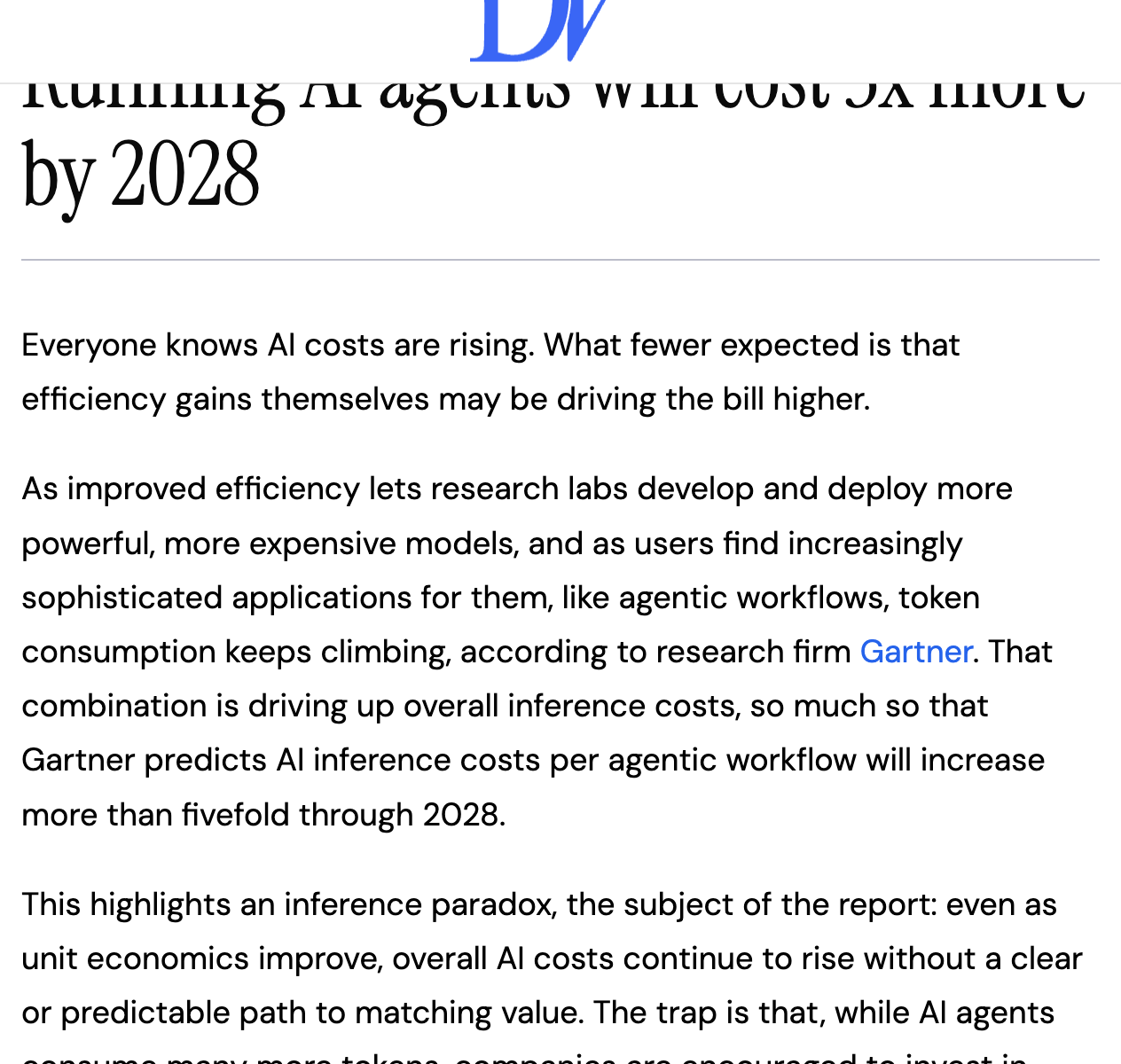
Gartner's August 2026 press release coined the term "Inference Paradox" to describe what happens when agents take over. Their prediction: inference costs per agentic workflow will increase more than fivefold through 2028, even as per-token prices continue their decline.
View original coverage on The Deep View →
Why? Because agents resend their full context at every step. Each tool call, each reasoning iteration, each self-correction loop multiplies the token count. The Substack analyst Koo Ping Shung breaks down the arithmetic: a simple AI query uses a few hundred tokens. Multi-step reasoning and agentic coding tasks use 5-30x more. For the most complex autonomous workflows — the kind companies like Uber deployed to thousands of engineers — consumption can hit 1,000x the baseline.

View original post on Substack →
Gartner's Inference Paradox: Token costs will fall by 95% by 2030. Agentic workflow costs will rise more than 5x by 2028. Both statements are true simultaneously — and that is precisely the trap.
At a $30 flat-fee seat, that math worked. At consumption-based pricing, a single user's agentic session can trigger hundreds of dollars in compute. And in 2026, every major AI provider has shifted toward consumption-based billing for their most capable models.
The Uber Cautionary Tale
No company illustrates the per-token trap more vividly than Uber.
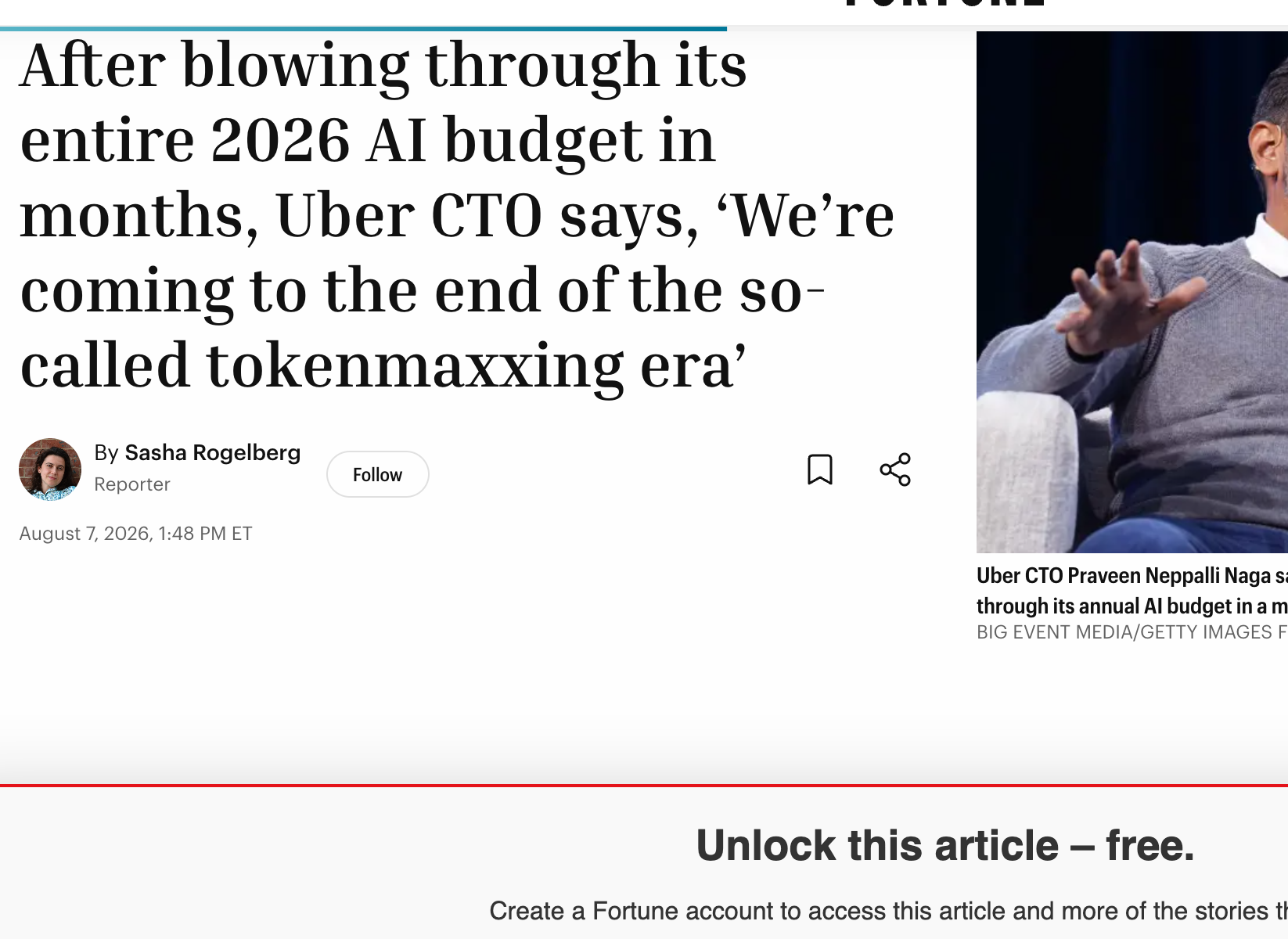
In early 2026, Uber rolled out Claude Code to thousands of engineers. They built internal leaderboards ranking employees by token consumption — a practice the industry now calls "tokenmaxxing." The result: Uber burned through its entire 2026 AI coding budget in the first four months of the year.
View original article on Fortune →
Uber's COO Andrew Macdonald admitted in May that the link between AI spending and shipped product features was "not there yet." And CTO Praveen Neppalli Naga eventually declared the tokenmaxxing era over, telling Fortune that "AI success will not be characterized by who spends the most tokens."
But Uber's recovery is instructive. Rather than slashing AI usage, Naga's team treated the spending problem as an engineering problem:
- Improved prompt caching — reducing redundant context re-reads
- Changed the default model — routing routine tasks to cheaper models
- Per-hour usage visibility — letting engineers see their own costs in real time
- Model efficiency testing — evaluating newer models for token economy, not just capability
The result: Uber quadrupled the number of employees using frontier AI tools while simultaneously cutting cost per token. That is the Jevons paradox working for you instead of against you — if you instrument it correctly.
The Ramp Data: 4x in 12 Months
Ramp, the corporate card and expense management company, sits on a uniquely valuable dataset: actual billing records from tens of thousands of businesses. Their April 2026 Leading Indicators report reveals the spending reality beneath the price-drop headlines:
- Paid AI adoption among businesses on Ramp crossed 50.4% in March 2026, up from 35% a year prior
- Monthly AI spend quadrupled between February 2025 and February 2026
- For the biggest spenders, AI costs jump 50% or more in about one of every four months
- Anthropic's business customers spending over $1M annually doubled to 1,000 since February 2026

View original report on Ramp →
Why Ramp's data matters: This is first-party billing data from actual corporate credit cards, not a survey or forecast. When 50%+ of businesses are paying for AI and their spend is quadrupling year-over-year, the per-token price decline is a rounding error on the actual invoice.
Early Ramp data also suggests businesses spending heavily on AI grew revenue faster than those that did not — though they note the correlation does not prove causation. This is the dangerous part of the trap: the spending feels productive, which makes it harder to question.
FinOps Is Already Scrambling
The FinOps Foundation's 2026 State of FinOps report found that 73% of organizations reported AI costs exceeding their original budget. More telling: FinOps teams managing AI spend jumped from 31% two years ago to 98% in 2026. AI cost management went from "emerging concern" to "existential priority" in 24 months.
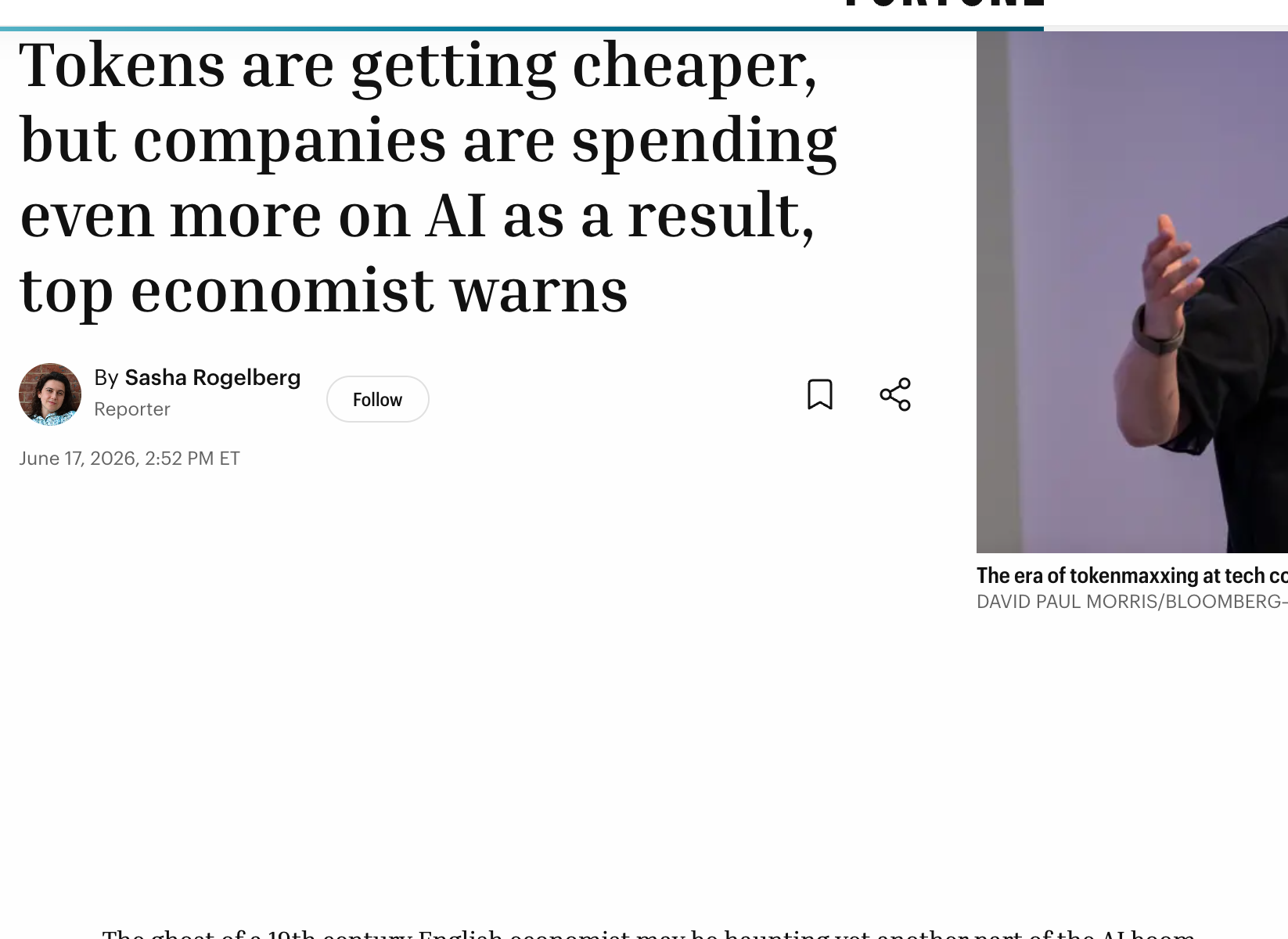
At FinOps X 2026 in San Diego, a recurring message dominated: AI is pushing FinOps beyond its cloud cost-management roots. Traditional cloud cost optimization assumes you can see and control provisioned resources. Token-based AI billing is fundamentally different — usage is probabilistic, model behavior is nondeterministic, and a single prompt can cost anywhere from $0.001 to $5 depending on the model, context length, and number of reasoning steps.
View original article on Fortune →
Forrester reported that the Linux Foundation launched a new Tokenomics Foundation specifically to address AI billing and spend management — a signal of how seriously the industry takes this problem. The FinOps Foundation's top recommendation: stop treating AI costs like cloud costs. Token-level cost tracking needs model-aware attribution, per-team budgets with alerts, and governance at the API key level, not just the account level.
Contrarian Corner: Is "AI Costs Are Exploding" Overhyped?
The cost-explosion narrative benefits a very specific group: FinOps vendors, AI cost management startups, and consultancies selling optimization services. For the median company, AI spending is still a small fraction of total IT spend. The companies making headlines — Uber, Meta, large tech firms with thousands of engineers — are outliers who gamified token usage with leaderboards and "tokenmaxxing" culture. That is a management failure, not a structural economic problem. The real question is whether the value created justifies the spend, and on that question, the data is murkier than the cost alarmists admit.
The Formula That Actually Matters
The industry is slowly converging on a fix, and it starts with changing the metric. Torsten Slok, Gartner, and Uber's post-mortem all point to the same shift:
Stop measuring cost per token. Start measuring cost per successful outcome.
Here is what that looks like in practice:
1. Model Routing (Not Model Loyalty)
Not every task needs a frontier model. A classification task that GPT-4.1 Nano handles at $0.10 per million tokens should not be routed to Claude Opus 5 at $15. Bain found that teams consistently upgrade to the newest, most expensive model the moment it ships — even when the cheaper model performs identically for their use case.
Build a routing layer. Send hard tasks to frontier models, routine tasks to efficient ones, and cached responses for anything you have seen before. Our guide to cutting Claude Code token costs 60-90% with rtk walks through this at the individual developer level.
2. Token Budgets Per Team
Give every team a monthly token budget with real-time visibility. When engineers can see that their last agentic session cost $47, their behavior changes — fast. Uber's turnaround started exactly here.
3. Caching and Context Management
Agents resend their full context at every turn. Prompt caching, summarization of prior context, and smart window management can cut token volume 30-60% without any loss in task quality. This is the single highest-ROI optimization an engineering team can make.
4. Measure Outcomes, Not Usage
Uber built leaderboards around token consumption and got exactly what they incentivized: maximum consumption. The fix was flipping the metric from "tokens used" to "tasks shipped per token spent." The companies that will thrive in the post-tokenmaxxing era are the ones that treat AI spend as an input to a productivity equation, not a scoreboard.
What This Means for You
If you are an engineering leader, a CTO, or a CFO watching your AI line items, here is the bottom line:
The per-token price will keep falling. Goldman Sachs projects token consumption growing 24x by 2030. Gartner expects per-token costs to drop 95% by the same date. But agentic workflows — the only kind of AI deployment that actually replaces manual work — will consume tokens at a rate that outstrips every price cut.
This is not a temporary mismatch. It is the new equilibrium. The AI industry has entered a Jevons cycle that mirrors electricity, telecommunications, and cloud computing before it: each unit gets cheaper, usage explodes, and total spend grows.
The winners will not be the companies that spend the least on AI. They will be the companies that spend the right amount — with per-team budgets, model routing, caching, and outcome-based metrics replacing the tokenmaxxing free-for-all.
As Uber's CTO put it: efficiency is an engineering problem, not a budget problem. Solve it like one.
The one-line takeaway: Track cost per successful outcome, not cost per million tokens. Every other optimization follows from getting that metric right.
Further reading on ComputeLeap:
- AI's $700B Subsidy Clock Is Ticking — the subsidy angle on the same Jevons paradox
- AI Still Costs More Than the Human It Replaces — MIT's finding that AI is cheaper in only 23% of enterprise roles
- The 6x AI Pricing Lie: Why "Cheap" Models Cost More — Stanford's study on cost-per-correct-answer vs cost-per-token
ComputeLeap Team
The ComputeLeap editorial team covers AI tools, agents, and products — helping readers discover and use artificial intelligence to work smarter.
Join the discussion
Have thoughts on this article? Discuss it on your favorite platform:
Related articles
Anthropic's Agents Broke Git at 30K Merges a Day
Anthropic went from 2,500 to 30,000 daily merges in four months. Git buckled. Here's how they built Scion, and what it means for every team running agents.
Cloudflare Bought Deno. You Have 12 Months.
Deno gets 12 months of patches then development ends. Here are the concrete migration paths for every Deno deployment pattern.
OpenAI Fired Its Safety Staff, Then Cited Its Auditors
Three researchers fired for talking to the auditors they were hired to brief. The disclosure gap is the real story.
The ComputeLeap Weekly
Get a weekly digest of the best AI infra writing — Claude Code, agent frameworks, deployment patterns. No fluff.
WEEKLY. UNSUBSCRIBE ANYTIME.