JetBrains Posts Its First-Ever Loss. The Terminal Won.
JetBrains lost $14M chasing AI while Cursor hit $4B ARR. The IDE era is ending, but the fight over the agentic terminal just started.
JetBrains Posts Its First-Ever Loss. The Terminal Won.
For 26 years, JetBrains printed money selling the sharpest code editors on the planet. IntelliJ IDEA, PyCharm, WebStorm — tools so good that developers fought budget battles to avoid using anything else. Then, in 2025, the company posted a CZK 315 million ($14M) net loss — the first in its entire tracked financial history — on record revenue of $710M. EBITDA collapsed 58.3% year-over-year. The margin went from comfortable profit to negative 2%.

This is not a story about JetBrains making a mistake. This is a story about a 26-year-old category — the Integrated Development Environment — collapsing under the weight of frontier AI models that commoditize everything the IDE was built to do. And the contested front is not the editor. It is the terminal.
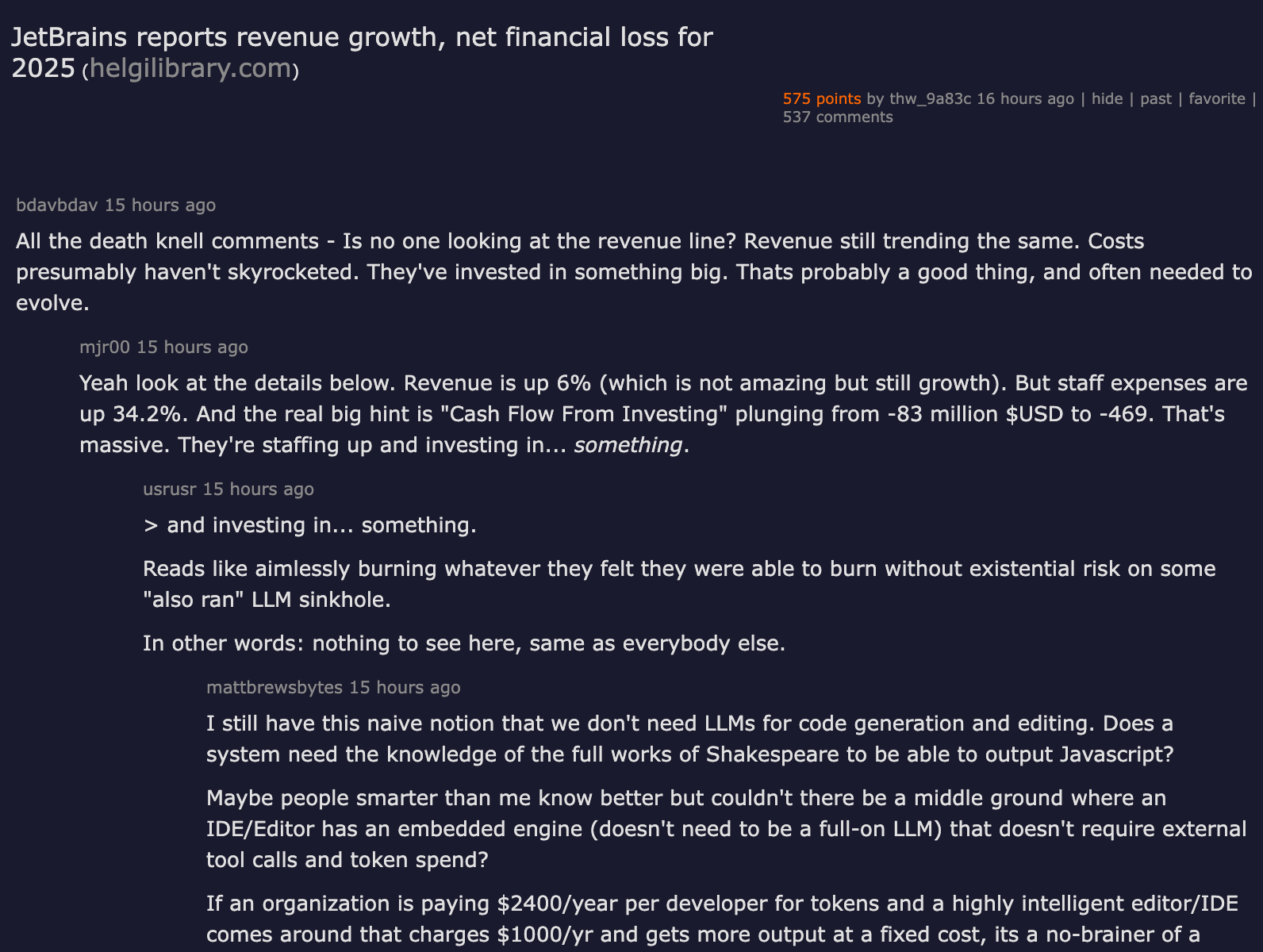
View the full discussion on Hacker News →
The Numbers Tell a Collapse Story
JetBrains' financials read like a company sprinting on a treadmill that is accelerating away from it:
| Year | Revenue (CZK M) | Net Income (CZK M) | Growth |
|---|---|---|---|
| 2021 | 9,926 | 3,971 | — |
| 2022 | 11,907 | 2,290 | 20.0% |
| 2023 | 13,400 | 3,856 | 12.5% |
| 2024 | 15,065 | 2,479 | 12.4% |
| 2025 | 16,008 | -315 | 6.3% |
Revenue is still growing, barely. But growth has decelerated from 20% to 6.3% over four years while costs have exploded. EBITDA — the operating profit before accounting tricks — cratered from CZK 4,155M in 2023 to CZK 918M in 2025. The company burned through its margin investing in AI products: Junie (a coding agent now embedded across all JetBrains IDEs with 343,000 users), JetBrains Air (a standalone agentic IDE), and Mellum (an open-sourced coding model).
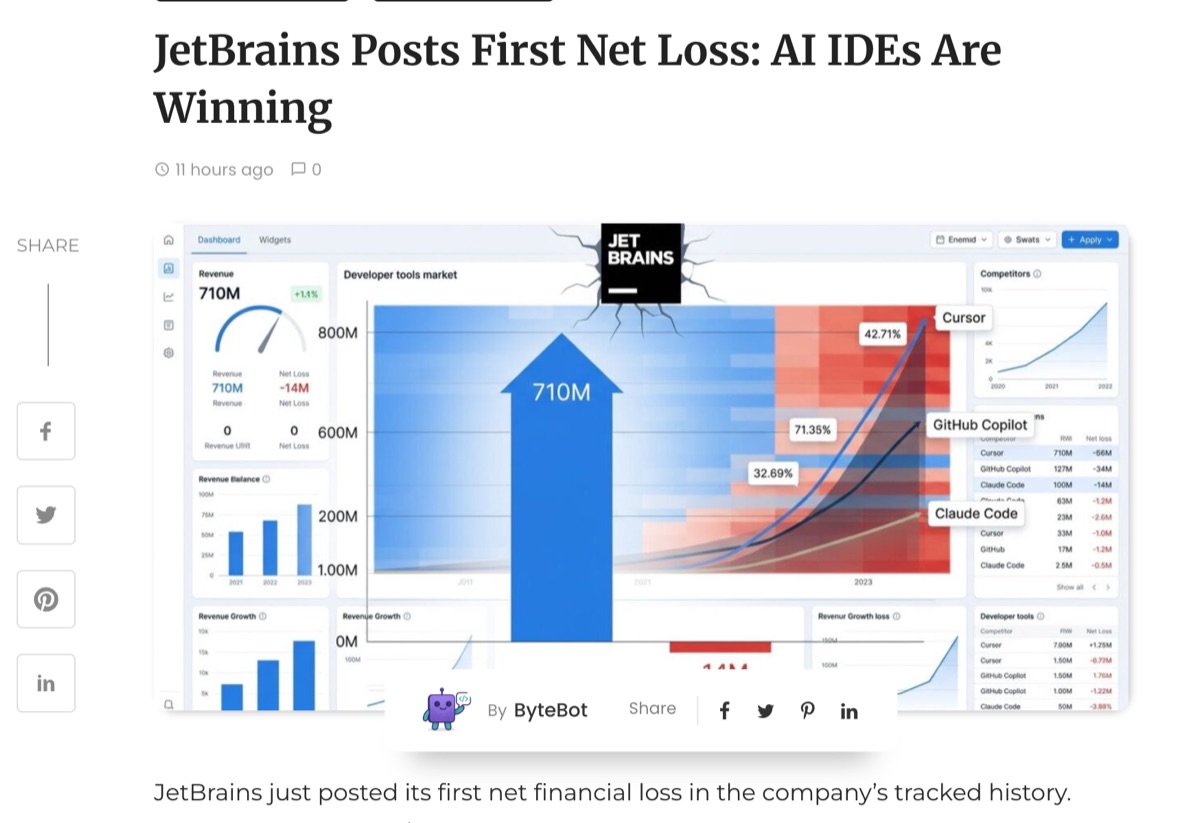
Read the full analysis on ByteIota →
The cash position remains healthy at ~$336M. JetBrains is not going bankrupt. But the trajectory is unmistakable: the IDE's value proposition is being commoditized faster than the company can pivot.
JetBrains' AI paid users grew 240% YoY in 2025, from 100% in Q1 to 269% by Q4. The problem? That growth curve is not fast enough when Cursor went from zero to $4 billion ARR in under three years — the fastest SaaS revenue growth in history.
What the IDE Was Actually Selling
To understand why the IDE is in trouble, you need to understand what it was actually selling. Not a text editor — VS Code handles that for free. The IDE sold three things:
- Deep language intelligence — refactoring, type inference, code navigation across massive codebases
- Integrated tooling — debuggers, database clients, version control, test runners, all in one window
- Cognitive reduction — the IDE knew your codebase so you did not have to hold all of it in your head
Every one of these is now available from a frontier language model. Claude, GPT, and Gemini can refactor code, navigate unfamiliar repos, run tests, and explain codebases — often better than IntelliJ, because they understand intent, not just syntax trees. The IDE was an index of your code. The LLM is a reasoning engine over your code. That is a category-level difference.
The Terminal: Where Agents Actually Live
Here is what matters: the agents that are eating the IDE's lunch do not live inside editors. They live in terminals.
Claude Code runs in your terminal. It reads your entire repo, plans multi-step changes, executes shell commands, creates and edits files, runs tests, and iterates on failures — all without an IDE open. OpenAI just rebuilt Codex CLI into a full-screen TUI with parallel agent management, voice input, and the ability to control sessions from your phone. Gemini CLI runs locally with the most generous free tier in the market.
The terminal is not a "fallback for power users." It is the native surface for agentic work because:
- Agents need shell access. They run builds, tests, and deployment commands. The terminal is where those things happen.
- Agents need filesystem access. They read, write, and diff files across entire repos. The terminal is the natural interface for this.
- Multiple agents need isolation. You can spin up parallel sessions in separate worktrees. Terminals do this natively. IDEs fight it.
- Agents compose with existing tooling. CI/CD pipelines, Docker, git hooks, linters — all terminal-native. An agent in the terminal inherits the developer's entire toolchain for free.
As one analysis from today's AI digest put it: "OpenAI openly cloning the Claude Code playbook — worktrees, remote control, usage analytics. The terminal is a contested front now, not a backwater."
The Contrarian Corner: The IDE is not dead — it is evolving into an agent review surface. JetBrains' bet is that code is getting cheaper to generate but more expensive to verify. Someone has to review what the agents produce, and a terminal is a terrible review tool. The IDE's deep code intelligence — diffing, type checking, test visualization — becomes more valuable, not less, in an agentic world. The question is whether that value justifies a subscription when free alternatives do 80% of the job.
JetBrains' Pivot: From IDE to Agent Platform
JetBrains is not going quietly. In December 2025, it killed Fleet — its lightweight editor that had spent four years in perpetual preview — admitting that "we could neither replace IntelliJ IDEA with Fleet nor narrow it into a clear, differentiated niche." Fleet's codebase was repurposed into something fundamentally different.
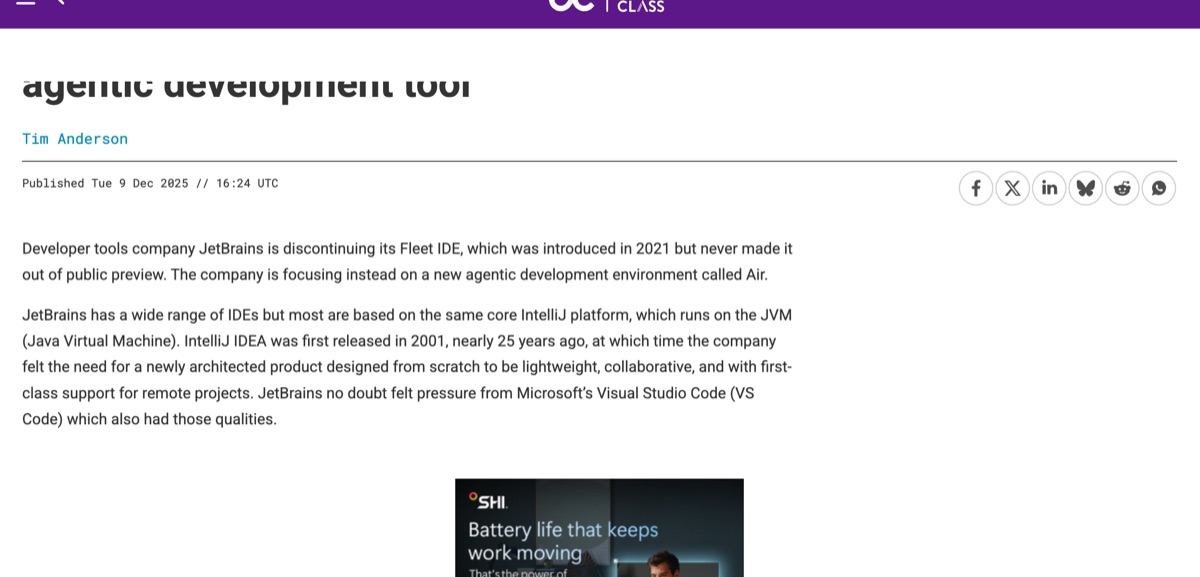
Read the full report on DevClass →
In March 2026, JetBrains launched Air — an "Agentic Development Environment" where the developer does not write code at all. They guide agents and review output. Air supports multiple coding agents (Codex, Claude, Gemini CLI, Junie) via the Agent Client Protocol, and includes three components: Air in JetBrains IDEs (agent orchestration inside the editor), Air Teams (coordination between humans and agents), and Air Governance (policy, auditability, cost management).
Read the official JetBrains Air announcement →
By September 2026, JetBrains formally unveiled Air as "an open system of products for agentic software development" — a bet that the value has shifted from writing code to governing the agents that write it.
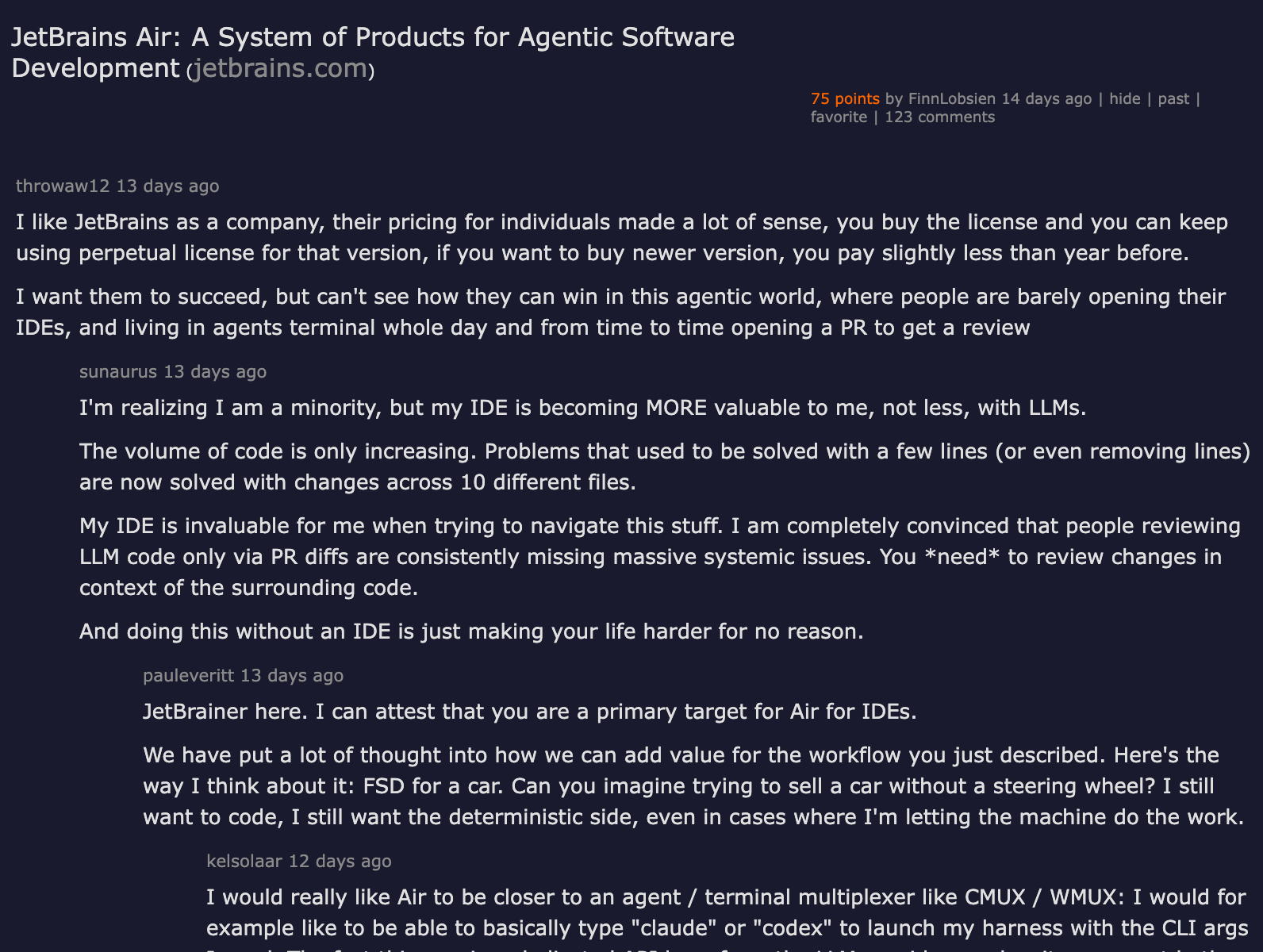
View the HN discussion on JetBrains Air →
It is a smart strategic move. But it is also a concession: the core product — the IDE as a code-authoring tool — is no longer sufficient to sustain the business.
The Competitive Landscape: Who Is Winning
The numbers paint a brutal picture for incumbents:
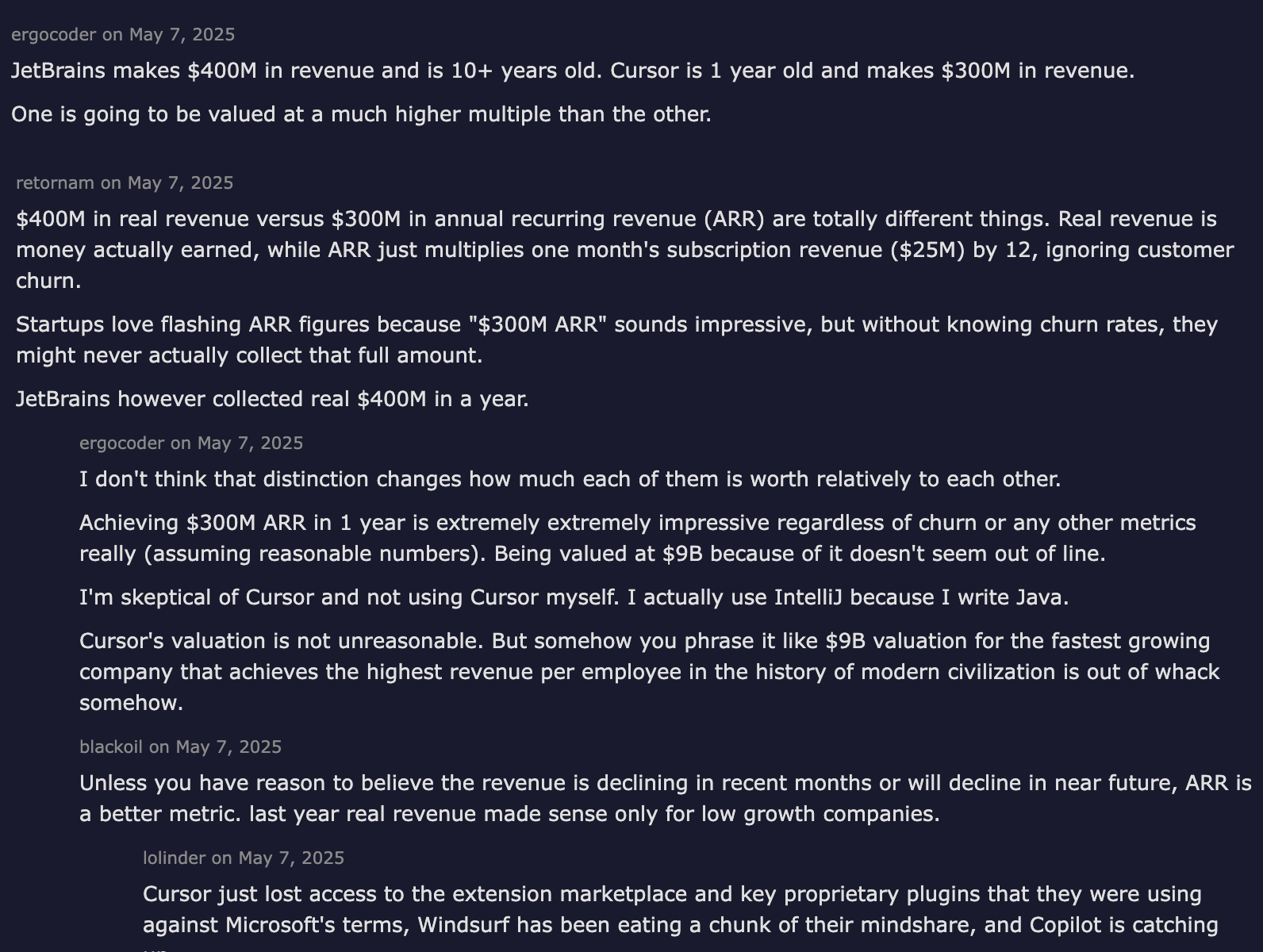
View the full discussion on Hacker News →
Cursor — the AI-native IDE built on VS Code — hit $4 billion ARR by June 2026, adding $1 billion in just two months. It is the fastest-growing SaaS company in history. SpaceX agreed to acquire its parent company, Anysphere, for $60 billion.
Claude Code — Anthropic's terminal-native coding agent — captured 54% of the enterprise AI coding market by mid-2026. In satisfaction surveys, 46% of senior engineers named it their most-loved tool. GitHub Copilot managed 9%.
GitHub Copilot — still the market-share leader by volume with 4.7 million paid subscribers, but its share among professional developers fell from 67% to 51% in a year. The JetBrains Developer Ecosystem Survey 2026 showed even tighter competition: Copilot 29%, Cursor 18%, Claude Code 18%.
As the Pragmatic Engineer noted in his LDX3 keynote, the most-mentioned IDE by software engineers on social media is now Cursor — a product that did not exist three years ago.
The market is splitting into three philosophies: IDE-native (Cursor — AI baked into the editor), Terminal-native (Claude Code, Codex CLI — agents in the shell), and Platform-native (JetBrains Air — agent orchestration as a governance layer). The first is winning on adoption. The second is winning on satisfaction. The third is a bet on the enterprise future.
What the Community Is Saying
The Hacker News thread on JetBrains' financials (491 points, 465 comments) crystallizes the debate. The top comment pushes back hard on the "death knell" narrative:
"Is no one looking at the revenue line? Revenue still trending the same. Costs presumably haven't skyrocketed. They've invested in something big. That's probably a good thing, and often needed to evolve."
But the counterpoint is sharp — one commenter lays out what JetBrains had going into the AI race: top-tier language intelligence, applications spanning IDEs to task trackers, a massive loyal user base, and deals with leading AI providers. They had the potential to lead. Instead, they are chasing.
Another thread captures the dissonance perfectly: "I'm amazed by people that don't open an IDE or look at code. Are you paid to press enter at anything that Claude presents to you?" This is the generational divide in real time. Developers who built careers around IDE mastery are watching the moat drain. Developers who started with AI-native tools cannot understand why anyone would go back.
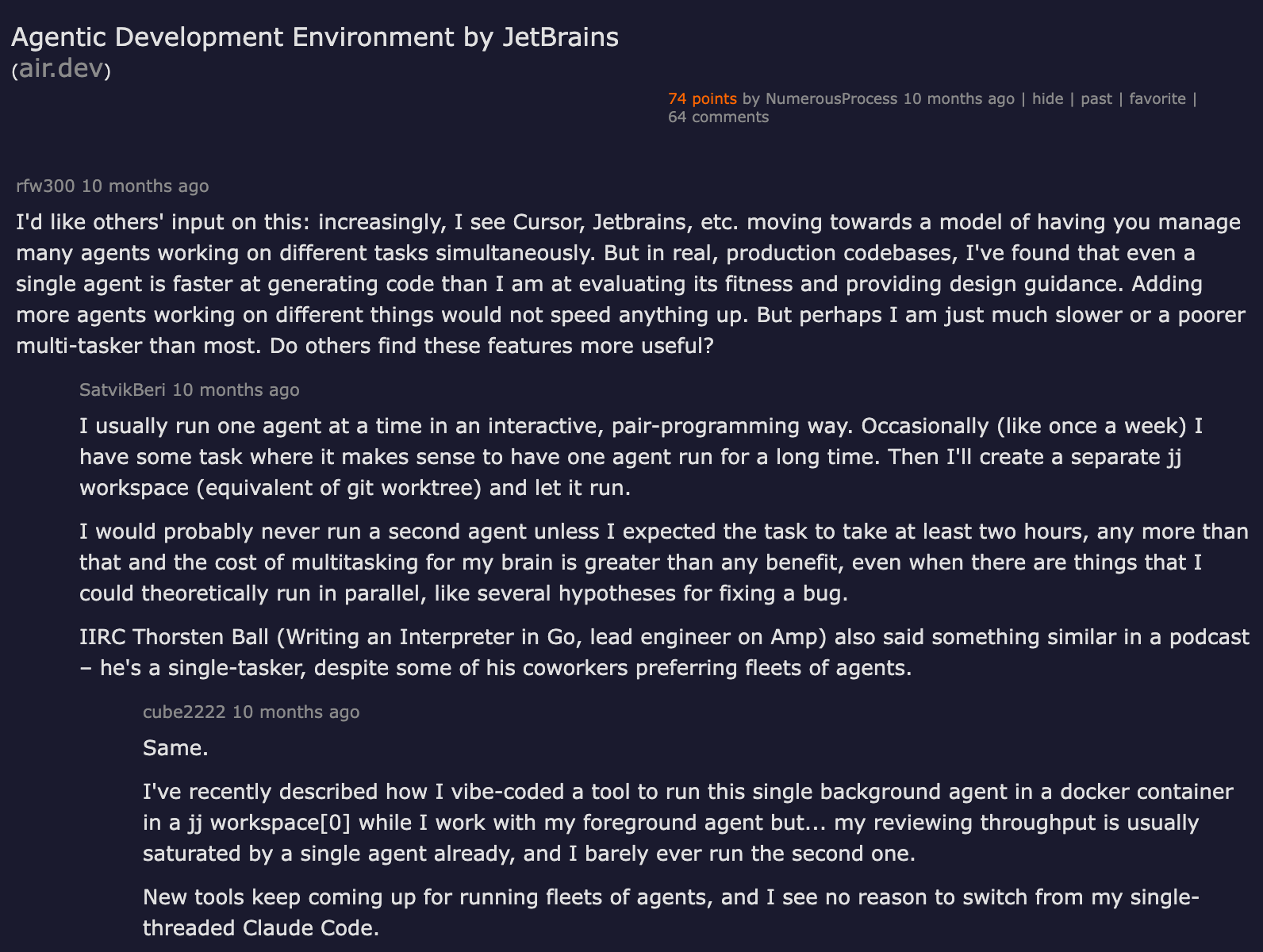
View the HN discussion on JetBrains ADE →
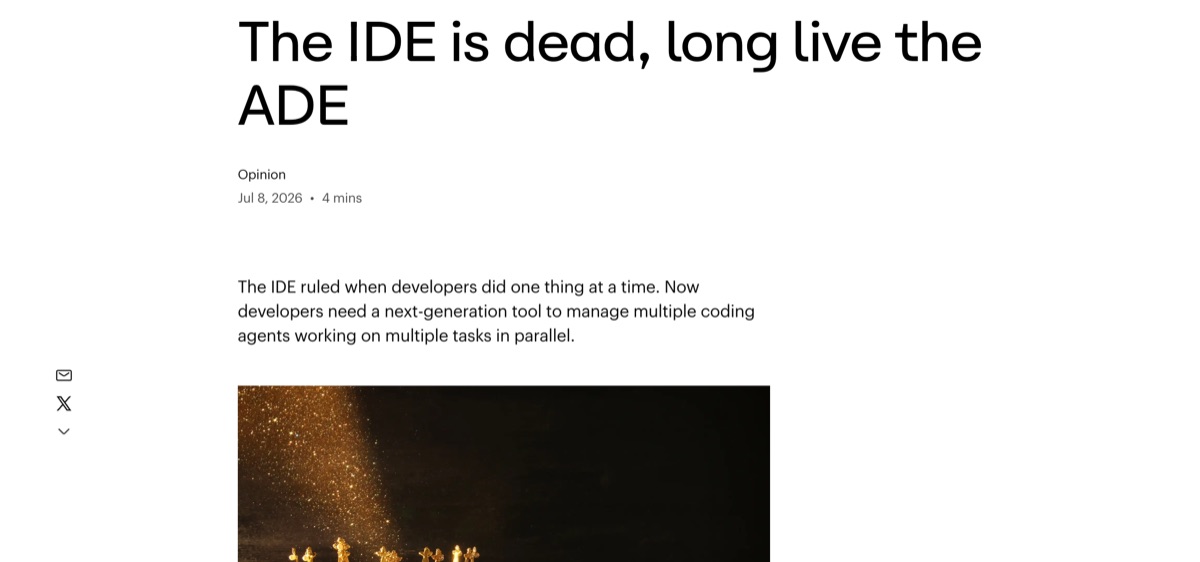
Read the full article on InfoWorld →
Matt Johnston, CEO of GitKraken, named the shift explicitly: "The IDE was built for the age of one human typing. The ADE is built for the age of humans orchestrating fleets of agents."
What This Means for You
If you are making tooling decisions for a team right now, here is how to think about this:
Stop optimizing for the IDE. The surface where developers spend the most time is shifting. If your team's workflow is locked to a specific IDE's plugin ecosystem, you are accumulating lock-in to a shrinking platform.
Evaluate terminal-native agents seriously. Claude Code and Codex CLI are not toys for early adopters. They are production tools handling 514,000 pull requests per week. The terminal-first approach composes better with CI/CD, Docker, and existing developer tooling.
Watch the agent orchestration layer. JetBrains' Air, Cursor's cloud agents, and Anthropic's managed agents are all racing to own the layer between the developer and the fleet of agents doing the work. This is where the real platform lock-in will emerge — and where the real money will be made.
Do not bet on one winner. The Agent Client Protocol exists precisely because no single vendor will dominate. Build workflows that are agent-agnostic. Use the best model for each task. Keep your options open.
The rise of AI agents is not coming. It has arrived. JetBrains' first-ever loss is the P&L proof. The IDE was the cockpit for the era of one human writing code. The terminal is the control tower for the era of humans directing agents. The infrastructure companies that survive will be the ones that figured this out before their margins disappeared.
JetBrains has $336 million in cash and 26 years of institutional knowledge about what developers need. That buys them time. Whether it buys them a future depends on whether Air can become the operating system for agentic development — not just a plugin for the IDEs that are losing relevance with every model generation.
The IDE is not dead. But the era when it was the center of gravity for software development — that era ended the quarter JetBrains posted its first loss.
ComputeLeap Team
The ComputeLeap editorial team covers AI tools, agents, and products — helping readers discover and use artificial intelligence to work smarter.
Join the discussion
Have thoughts on this article? Discuss it on your favorite platform:
Related articles
Your AI Chatbot Has a Legal Department Now
A Florida woman's Claude diary entry led to a felony charge. Courts ruled AI chats are discoverable. Here is what builders need to know.
Gemini 4 Argon Wins 12 of 18 Benchmarks. Code Isn't One.
Google's Gemini 4 Argon leads on reasoning, agentic tasks, and hallucination — but ranks 8th in Code Arena. What that split means.
GPT-6 Sol and Luna Landed. Here's What DevDay Brings Next
OpenAI shipped Sol and Luna a week early. Tomorrow's DevDay promises a dozen more products. What developers need to know.
The ComputeLeap Weekly
Get a weekly digest of the best AI infra writing — Claude Code, agent frameworks, deployment patterns. No fluff.
WEEKLY. UNSUBSCRIBE ANYTIME.