Your Next AI Workstation Is a Mac Studio
M5 Ultra ships with 512GB at 1.2 TB/s. Samsung is doubling HBM4 output. Here's why the local-inference math finally works.
Your Next AI Workstation Is a Mac Studio
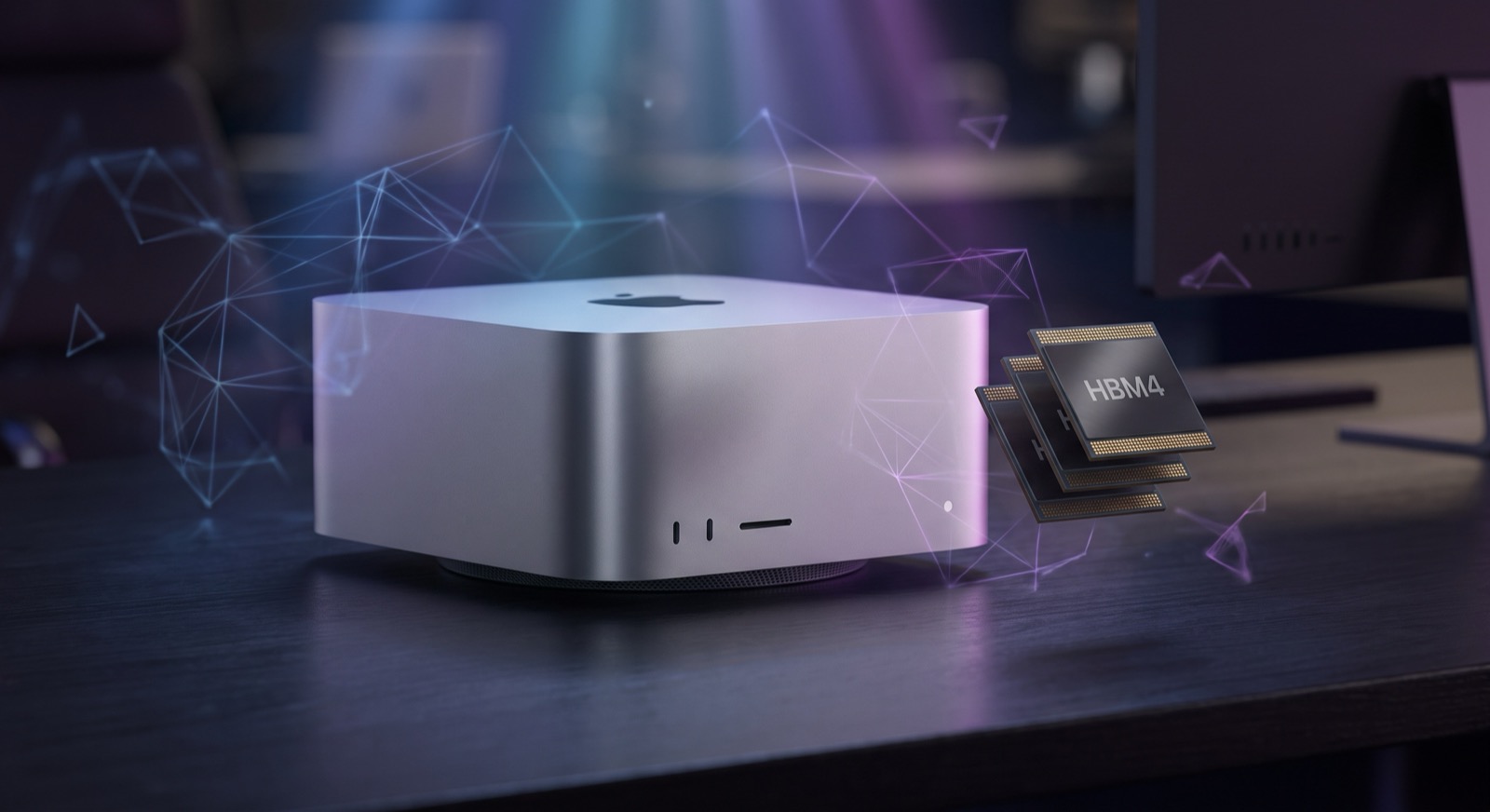
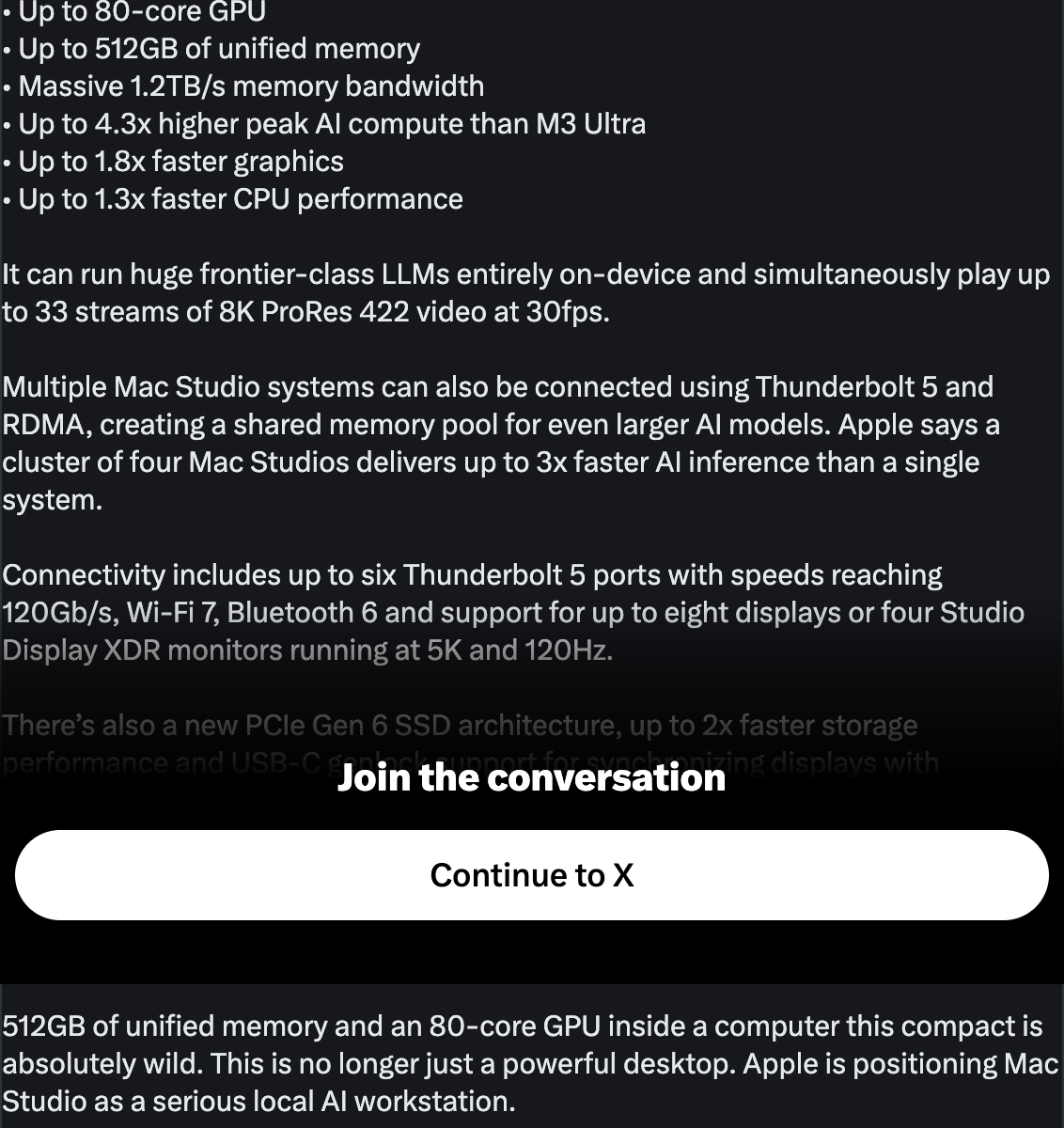
Samsung just announced it will more than double HBM4 and HBM4E production — from 20,000 wafers per month to 50,000 by 2027. On the same weekend, Apple's M5 Ultra Mac Studio started shipping to reviewers with 512GB of unified memory pushing 1.2 TB/s of bandwidth. These two stories aren't coincidence. They're the same story: the memory bottleneck that kept large-model local inference impractical is breaking open, and the first machine to capitalize on it is sitting on a desk, not in a rack.
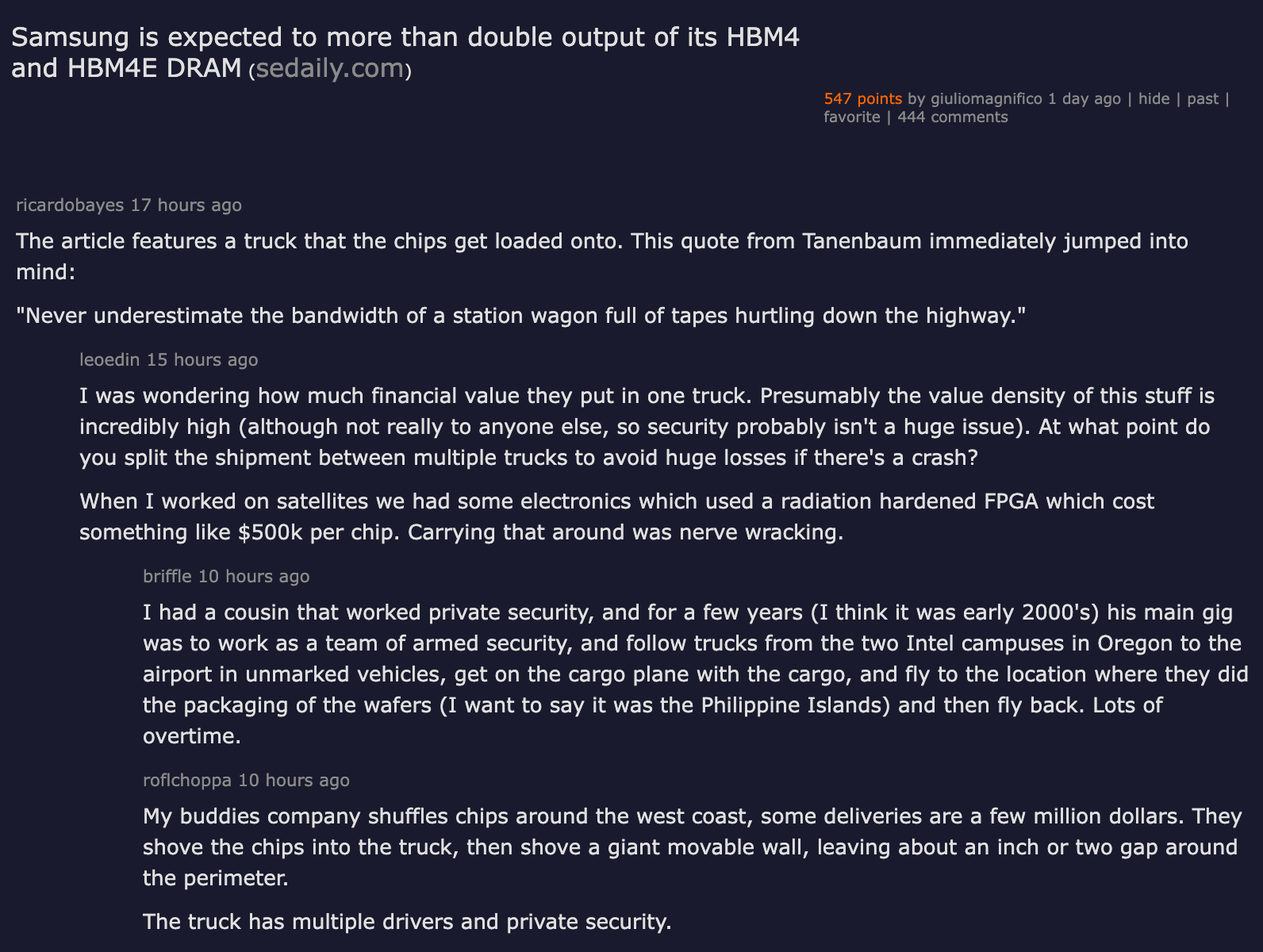
The Hacker News thread on Samsung's HBM4 expansion hit 547 points and 444 comments — numbers that would be unremarkable for a new model drop, but extraordinary for a memory supply-chain story. Developers are paying attention to DRAM economics because they've learned the hard way: your model is only as fast as the memory feeding it.
The Memory Wall Is the Real Bottleneck
Every LLM inference workload is memory-bandwidth-bound. A 70B parameter model at 4-bit quantization needs roughly 35GB of memory just to load the weights, and every token generated requires a full pass through those weights. The speed limit isn't your GPU's FLOPS — it's how fast you can shuttle data from memory to compute.
This is why the RTX 5090 vs M5 Ultra comparison that dominates tech Twitter is asking the wrong question. The RTX 5090 pushes ~1,792 GB/s of bandwidth through its 32GB of GDDR7 — faster per byte than the M5 Ultra's 1.2 TB/s. On an 8B model, the 5090 hits ~145 tokens/sec while the M5 Max manages ~75 tok/s. NVIDIA wins. Case closed.
Except a 70B model doesn't fit in 32GB. Neither does a 120B MoE. Neither does Llama 4 Maverick 400B. The RTX 5090 hits a hard VRAM wall, and the moment you start offloading to system RAM over PCIe, your effective bandwidth drops to ~64 GB/s. That 145 tok/s collapses to single digits.
The real comparison: NVIDIA wins tokens per second. Apple wins gigabytes per dollar. At 70B+ parameters, there is no NVIDIA consumer option — only multi-GPU server rigs that cost $15K+ and draw 900W.
What the M5 Ultra Actually Delivers
Tom's Hardware calls it a "local model citizen" that outpaces NVIDIA's DGX Spark on prompt processing, with throughput 2x the M4 Max and nearly 4x the DGX Spark. The review roundup at 9to5Mac confirms 20-30% improvement over M3 Ultra across CPU, GPU, and neural engine scores.
Here are the numbers that matter for local LLM inference, compiled from ModelFit and Contra Collective benchmarks:
| Model | Quant | M5 Ultra tok/s | Fits RTX 5090? |
|---|---|---|---|
| Qwen 2.5 14B | Q4 | 120-140 | Yes (~130 tok/s) |
| Llama 3.3 70B | Q4 | 42-52 | No (needs ~38GB) |
| 120B MoE | Q4 | ~43 | No |
| Llama 4 Maverick 400B | Q4 | ~12 | No |
| Llama 3.1 405B | Q4 | 8-12 | No |
The 512GB tier is the first consumer-purchasable machine that loads Llama 4 Maverick 400B entirely in memory at usable speed. That's a model class that previously required a server rack.
Samsung's HBM4 Boom: Why This Matters for Your Desk
Here's the connection most coverage is missing. Apple didn't wake up one morning and decide to offer 512GB of unified memory. The M5 Ultra's memory subsystem is economically possible because the global high-bandwidth memory supply chain has expanded dramatically.
Samsung's HBM4 delivers 3,300 GB/s bandwidth per stack — a 2.7x improvement over previous generations — by doubling the I/O pin count from 1,024 to 2,048. The company began mass production in February on its 6th-generation 10nm-class 1c node, with HBM4E samples shipping mid-2026.
Now Samsung is doubling that capacity again: overall HBM wafer input rising from roughly 180,000 to 250,000 wafers/month in 2027, a 40% increase. HBM4-family products could account for 80% of shipments by next year. Samsung's HBM sales are expected to more than triple in 2026 compared to 2025.
This supply expansion has a downstream effect that goes beyond datacenter GPUs. Apple uses LPDDR5X, not HBM, in its consumer silicon — but the memory market is interconnected. When Samsung, SK Hynix, and Micron all redirect capacity toward high-bandwidth memory, the supply-demand dynamics for all memory types shift. More HBM4 fabs mean more DRAM process expertise, better yields, and eventually lower per-bit costs across the board.
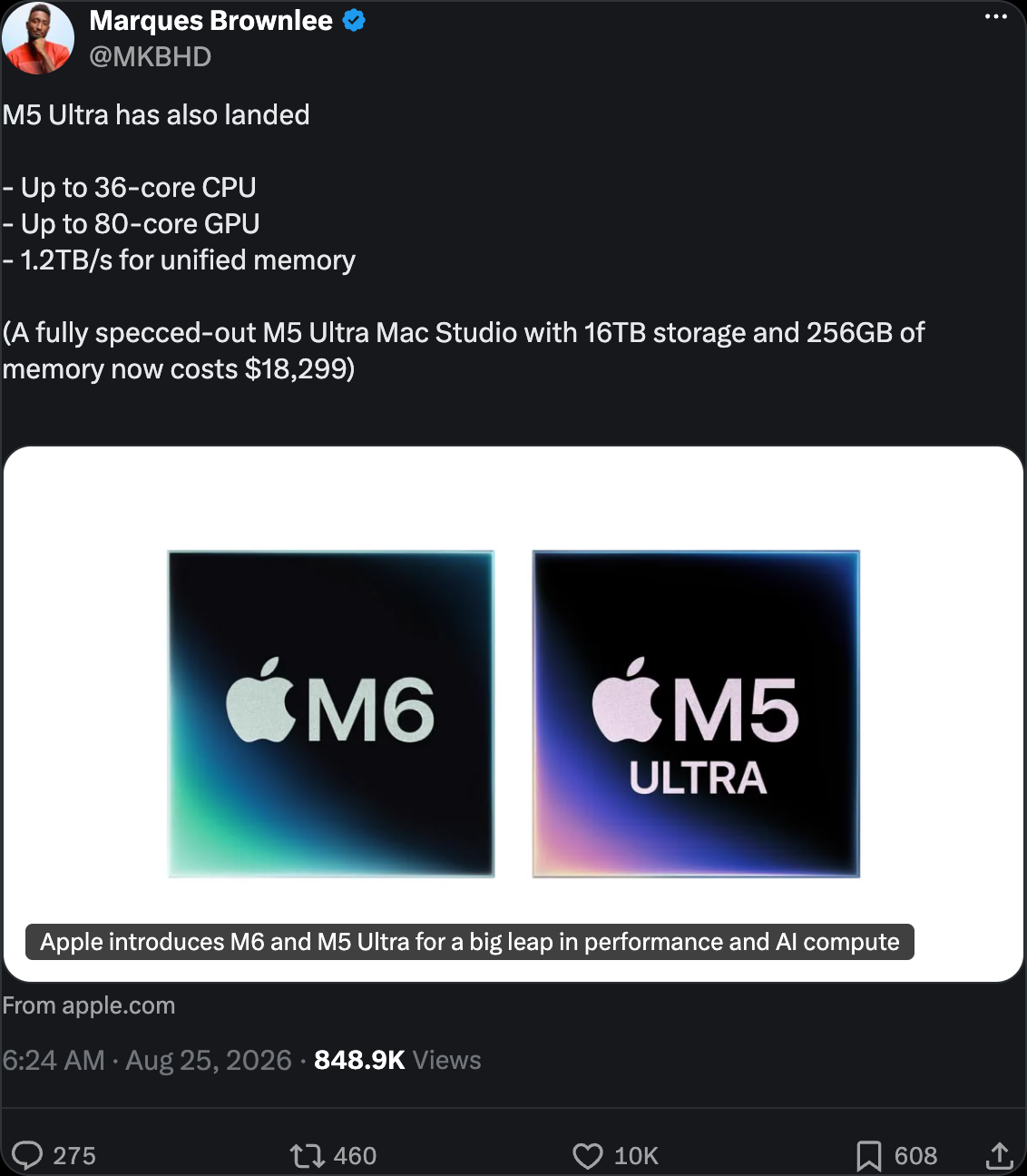
We've been covering this squeeze since May — when Epoch AI reported that HBM accounts for 63% of AI chip costs — and again in June when Apple hiked MacBook prices on rising DRAM costs. The M5 Ultra's 512GB configuration at $18,299 fully loaded isn't cheap, but it's a price that exists. Two years ago, this memory density at this bandwidth was a datacenter-only proposition.
The API Break-Even Math
The Dev.to analysis that went viral on launch day laid out the economics plainly:
- $200/month API spend → 34-month payback on an M5 Ultra
- $500/month → 14-month payback
- $1,000/month → under 7 months
These numbers assume you're running models in the 70B-400B range where cloud API pricing is $5-15 per million tokens. If you're a solo developer running Llama 3.3 70B for coding assistance 8 hours a day, or a startup running customer-facing inference, the M5 Ultra pays for itself within a year.
The comparison isn't M5 Ultra vs RTX 5090. It's M5 Ultra vs curl https://api.openai.com.
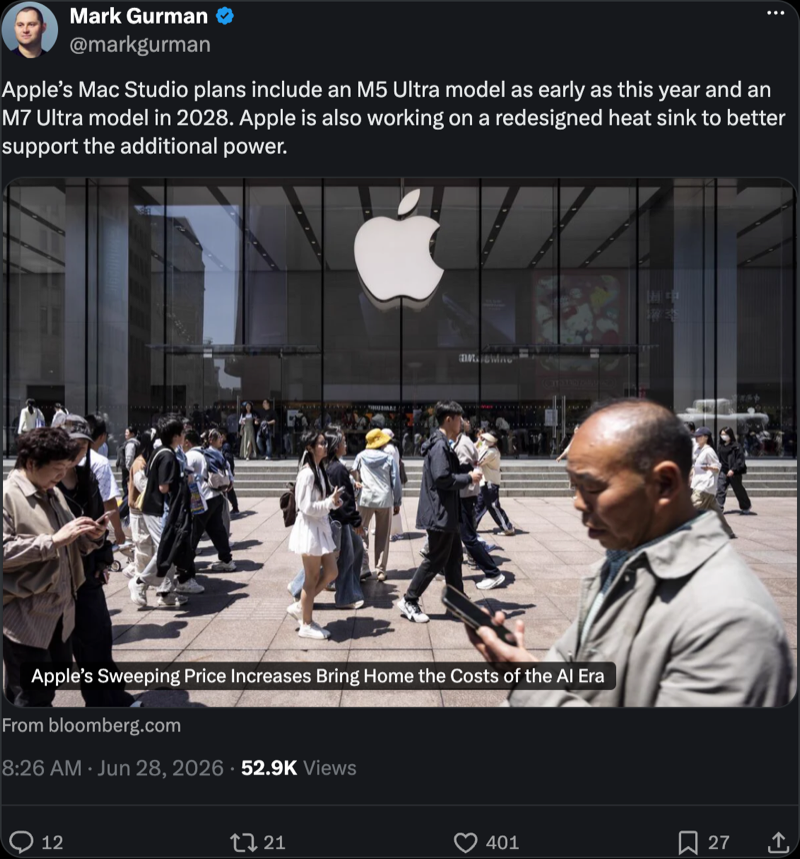
Contrarian Corner: Apple is riding Samsung's supply wave, not creating it. The M5 Ultra's 1.2 TB/s bandwidth is impressive, but Apple still uses LPDDR5X — not HBM. The real HBM4 beneficiaries are NVIDIA's next-gen datacenter GPUs and AMD's MI450. If Samsung's supply expansion lowers DRAM costs broadly, the next M-series chip could offer 512GB at a dramatically lower price point — making today's $18K config the early-adopter tax, not the new normal.
The Software Stack: MLX Has Arrived
Two years ago, buying a Mac for LLM inference meant fighting the CUDA ecosystem. That's changed. MLX, Apple's machine learning framework purpose-built for Metal GPU acceleration, now delivers the highest sustained generation throughput on Apple Silicon.
The practical stack in September 2026:
- Ollama + MLX backend: one-command model downloads, OpenAI-compatible API server
- MLX-LM: direct Python integration, LoRA fine-tuning support (still early but functional)
- llama.cpp Metal: the universal fallback, well-optimized for Apple Silicon
- LM Studio: GUI for non-terminal users, drag-and-drop GGUF loading
The gap that remains is training and fine-tuning — CUDA still dominates, and most research papers ship PyTorch reference implementations that assume NVIDIA. But for inference, which is what 95% of local-AI users actually do, Apple's software story is now credible.
MacStories' Federico Viticci called it "a dream machine for local AI agents" — and he's running multi-agent architectures on it with several models loaded simultaneously. We explored this use case ourselves when the M5 Ultra was first announced in August, running Qwen 125B on the 512GB configuration.
Which Configuration Should You Actually Buy?
Not everyone needs the $18K 512GB config. Here's the practical buying guide based on what models you want to run:
96GB M5 Ultra ($5,499): Loads Llama 3.3 70B Q4 comfortably. This is the sweet spot for most developers who want a single powerful local model for coding, writing, and analysis. You get 42-52 tok/s on 70B — faster than most cloud API first-token latencies under load.
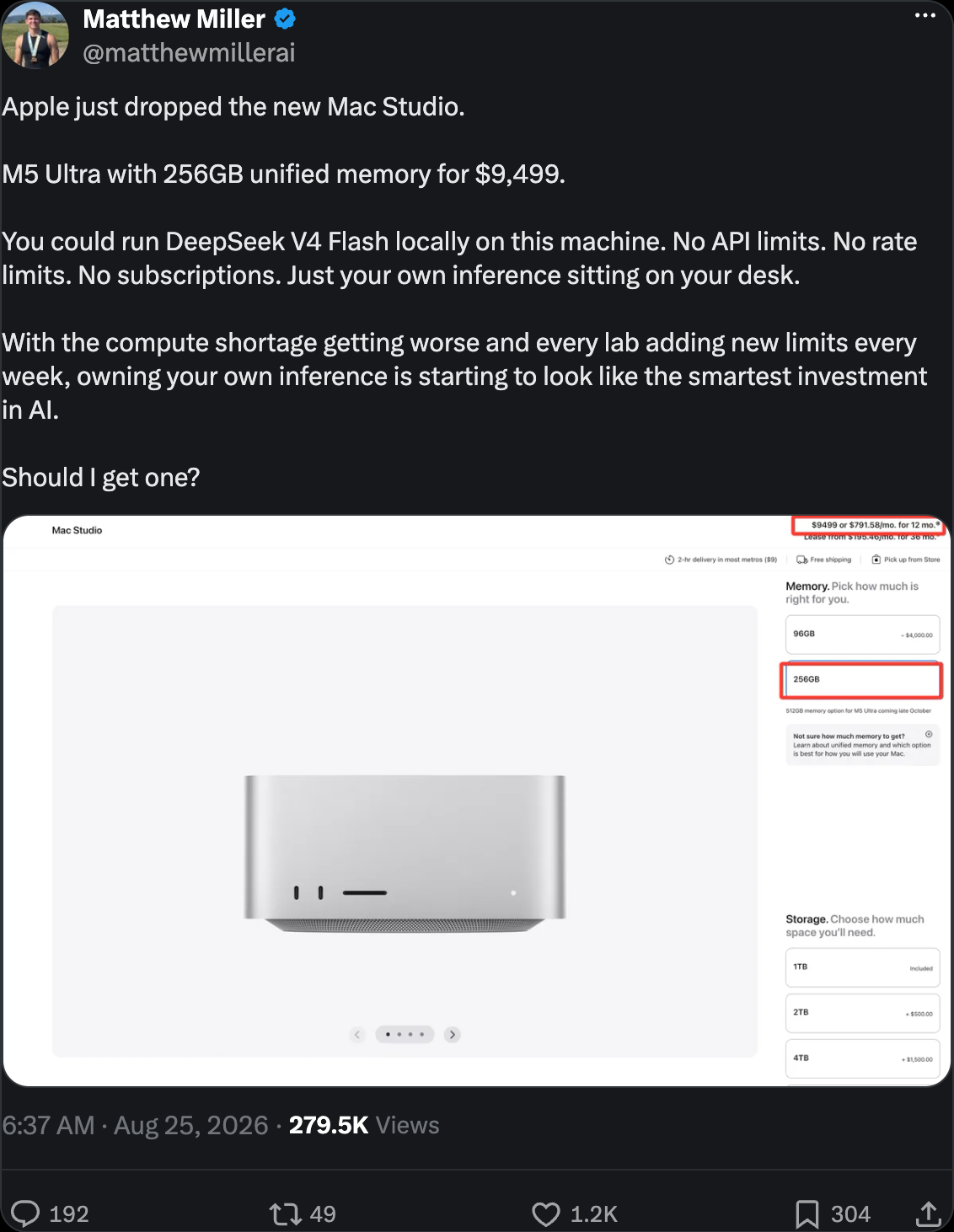
256GB M5 Ultra (~$9,499): Loads 120B MoE models and multiple 70B models simultaneously. If you're running agent architectures or need to A/B test models locally, this is the tier. Tom's Hardware notes it competes with 2x DGX Sparks at similar price but with 256GB of unified memory.
512GB M5 Ultra (~$18,299): Loads Llama 4 Maverick 400B and DeepSeek-class 670B+ (tight fit). This is for teams running production-grade local inference or researchers who need frontier-class models on-premise. Ships late October.
The M5 Max alternative ($2,499-$3,199): If your target models are 32B and under, the M5 Max with 128GB is half the price with excellent MLX performance. 70B models run at ~18 tok/s — usable but not fast.
Power efficiency matters more than you think. The M5 Ultra runs at 25-35W during inference. An RTX 5090 system draws ~450W — roughly 10x more. Over a year of 8-hour daily use, that's ~$300 in electricity savings alone at US average rates. The Mac Studio is silent; NVIDIA rigs are not.
What This Means for You
The convergence of Samsung's HBM4 supply expansion and Apple's M5 Ultra is a signal, not just a product launch. Memory bandwidth has been the binding constraint on local AI inference, and that constraint is loosening on both the supply side (Samsung doubling output, SK Hynix competing aggressively) and the product side (Apple shipping 512GB unified memory to consumers).
If you're currently spending $200+/month on cloud inference APIs, the M5 Ultra 96GB makes financial sense within 18-34 months. If you need models that don't fit in 32GB of VRAM — and increasingly, the best models don't — there's no NVIDIA consumer product that competes.
The question isn't whether local inference hardware is good enough. As of this week, it is. The question is whether you're running models large enough to justify the premium over cloud APIs.
For the subset of developers, researchers, and startups where the answer is yes, the Mac Studio M5 Ultra is the machine. And Samsung just told you the memory economics are only getting better from here.
ComputeLeap Team
The ComputeLeap editorial team covers AI tools, agents, and products — helping readers discover and use artificial intelligence to work smarter.
Join the discussion
Have thoughts on this article? Discuss it on your favorite platform:
Related articles
DeepSeek's Price War Has a Market-Share Problem
V4.1 Flash costs $0.15/M tokens and tops benchmarks, yet Polymarket shows OpenAI at 96% API share. The cheapest model rarely wins.
OpenAI Shipped Autonomy, Then Warned It Can't Control It
OpenAI's chief scientist warns alignment is unsolved 3 days after shipping GPT-6 Astra's delegated autonomy. What builders need to know.
AI Deskilling: Why Fluency Isn't Dependency
Anthropic's study shows AI-assisted devs score 17% lower. But the real line between leverage and dependency isn't tool usage — it's cognitive engagement.
The ComputeLeap Weekly
Get a weekly digest of the best AI infra writing — Claude Code, agent frameworks, deployment patterns. No fluff.
WEEKLY. UNSUBSCRIBE ANYTIME.