NVIDIA Shipped a Local AI Router. Nobody Noticed.
PAIR routes inference across your home network. DGX Spark and RTX Spark supply the hardware. This is NVIDIA hedging its cloud-GPU empire.
NVIDIA Shipped a Local AI Router. Nobody Noticed.
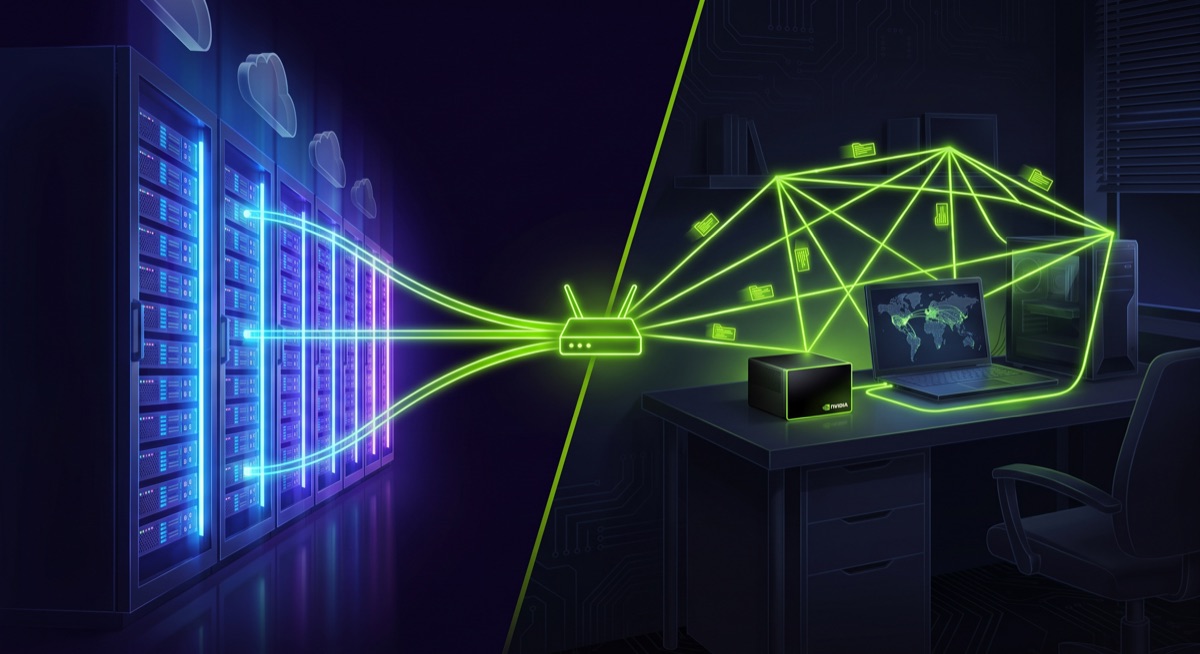
While the industry spent the first week of September dissecting GPT-6 Astra benchmarks and Anthropic's latest context-window flex, NVIDIA quietly shipped something that matters more for the long-term shape of AI infrastructure: an open-source router that turns every GPU in your house into a unified inference cluster. It is called PAIR — Personal AI Router, and it landed at IFA 2026 on September 3 alongside a hardware lineup — DGX Spark already shipping, RTX Spark PCs arriving in October — purpose-built to run agents locally.
This is not a side project. It is a corporate hedge.
NVIDIA posted $96.2 billion in quarterly revenue in Q2, with $89 billion from data center alone. But the company is simultaneously investing in a parallel thesis: that cloud-GPU revenue has a structural ceiling, and whoever owns the local-inference routing layer will control the economics of the next decade.
What PAIR Actually Does
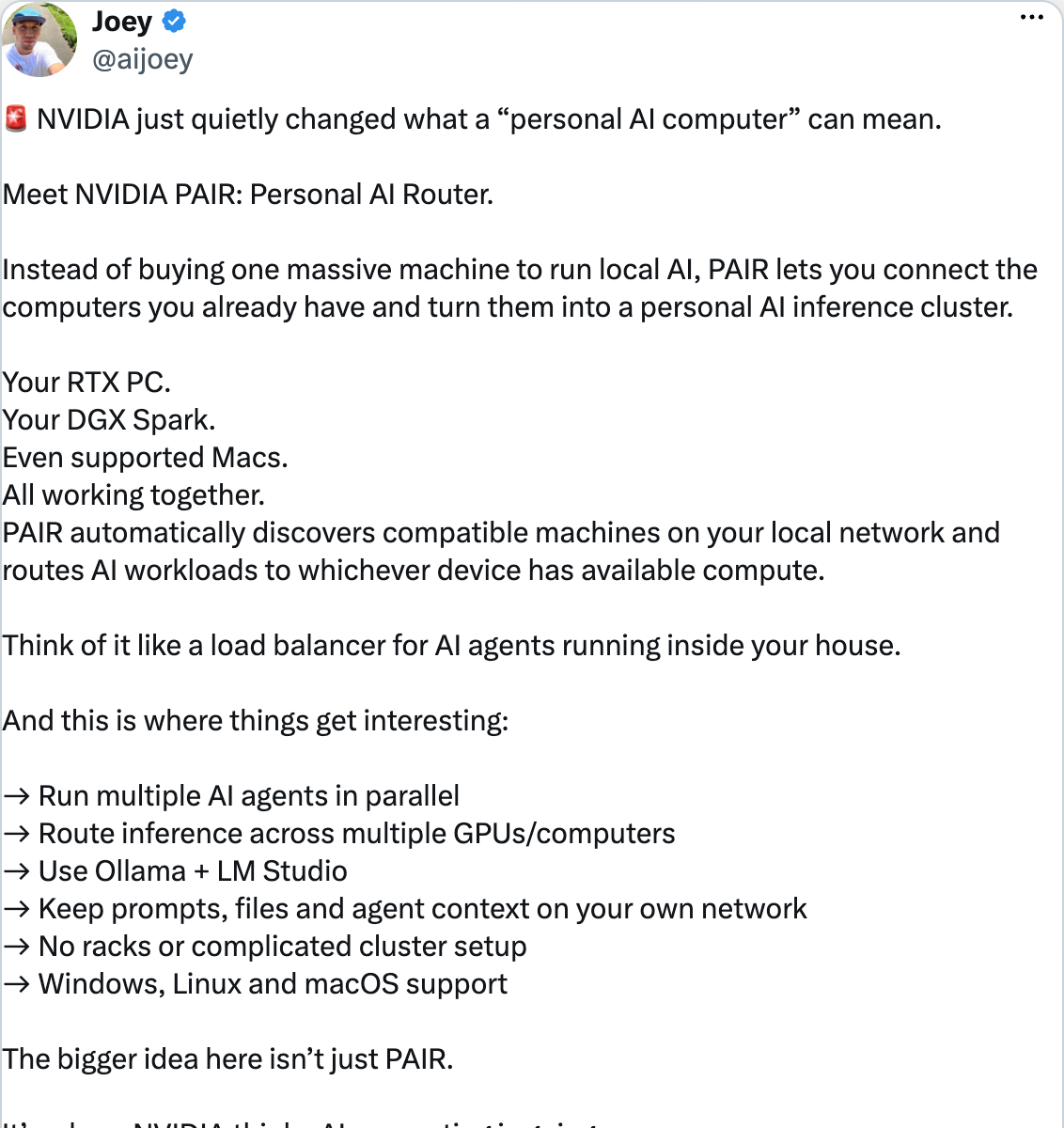
PAIR is a background service that sits between your AI applications and whatever hardware happens to be on your local network. When you send an inference request — through Ollama, LM Studio, or any OpenAI-compatible client — PAIR intercepts it, inspects the engine and model requirements, and routes it to whichever node has capacity.
The routing logic is straightforward: check which systems are online, which have the requested model loaded, and which GPUs are least loaded. Then send the entire request to one eligible node for end-to-end execution.
The hardware scope is notable. Beta supports GeForce RTX 20-series and newer, RTX PRO workstation GPUs, DGX Spark, and — crucially — Apple M4 silicon. Windows, macOS, Linux. Device discovery happens via mDNS with mTLS encryption for inter-node traffic. It is Apache 2.0 licensed and fully open source.
PAIR benchmark: In a five-subagent demo using Hermes Desktop and Ollama with Qwen 3.6 35B, a three-device PAIR cluster (RTX Spark + DGX Spark + RTX 5090) completed the workload in 8 minutes 48 seconds — versus 18 minutes on a single device. Not by pooling VRAM or sharding models, but by routing independent agent tasks to idle GPUs.
What PAIR explicitly does not do is equally telling: it does not merge GPUs, pool VRAM, shard models across machines, or split a single inference request between nodes. This is not distributed computing in the Kubernetes sense. It is a load balancer for embarrassingly parallel agent workloads — and that constraint is the strategic tell.
The Hardware Pincer: DGX Spark and RTX Spark
PAIR is the routing layer. But a router without hardware to route to is academic. NVIDIA has been shipping the hardware all year.
DGX Spark ($4,699) has been available since May — a desktop box delivering 1 PFLOP of FP4 compute and 128GB of unified memory. It runs inference on models up to 200 billion parameters and fine-tunes models up to 70B locally. The September DGX Spark OS update shipped a streamlined NemoClaw installer and faster inference on top agentic models including DeepSeek v4 Flash (284B MoE, 13B active).
RTX Spark arrives in October — a new class of Windows PCs from Lenovo and Acer. Same Grace CPU + Blackwell GPU architecture as DGX Spark but aimed at consumers and enthusiasts. 1 PFLOP, up to 128GB unified memory, 20-core Grace CPU. NVIDIA frames it as purpose-built for running AI agents locally: the IFA announcement highlights a new Windows Agent framework for background operation, plus simplified setup across Hermes Agent, OpenClaw, and Perplexity Portable Computer.
And the software layer got faster too: new llama.cpp optimizations deliver up to 1.9x throughput on RTX 5090, while vLLM improvements push 1.2-1.4x gains across RTX PRO and dual DGX Spark clusters.
The pincer is clear: DGX Spark for developers and prosumers now, RTX Spark for mainstream consumers in October, PAIR to stitch them together, and inference-framework optimizations to make the whole stack competitive with cloud APIs on latency and throughput. This is not a hobby project announced at a developer conference. This is a go-to-market strategy with SKUs, partners, and ship dates.
Cloud-GPU Revenue Has a Ceiling
Why would a company posting $96B quarters invest in a thesis that competes with its own data center business?
Because NVIDIA's leadership can read the same trend lines everyone else can.
Inference now dominates AI compute. It has grown from roughly a third of workloads in 2023 to half in 2025 to two-thirds in 2026. Training requires massive, bursty capital expenditure on GPU clusters — exactly NVIDIA's sweet spot. Inference is different: it is continuous, cost-sensitive, and increasingly distributed. And it is where the custom silicon competitors are gaining ground.
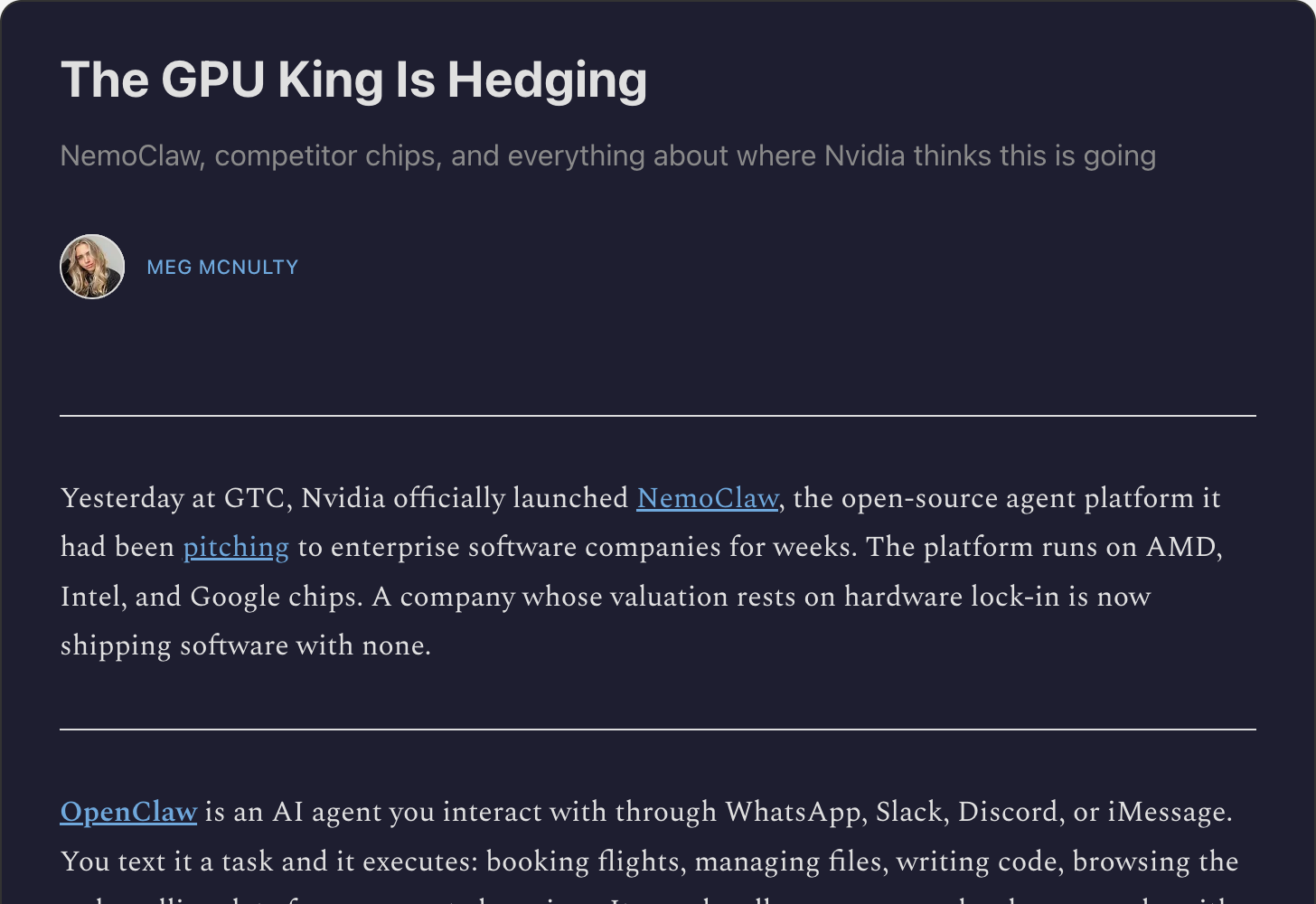
The margin compression thesis. Google prices its TPUs 30-40% below NVIDIA for inference. Amazon's Trainium chips target the same gap. OpenAI built its own Jalapeno chip at 1.9x the inference-per-watt of Blackwell. Microsoft's Maia is advancing. As Meg McNulty wrote in CipherTalk: "Nvidia can keep every customer and still watch margins fall." The threat is not losing market share — it is watching 70% margins compress toward 55% as inference commoditizes.
View original post on Substack →
Inference is splitting architecturally. VentureBeat's analysis of the $20B Groq acquisition argues the general-purpose GPU era is ending. Prefill (processing context) is compute-bound and suits GPUs. Decode (token generation) is memory-bandwidth-bound and suits Groq's SRAM architecture. NVIDIA bought Groq to offer "disaggregated inference" — splitting workloads between Rubin GPUs and Groq LPUs for 35x efficiency — rather than ceding the decode market entirely.
The local-inference push is the consumer-side version of the same hedge. If cloud margins compress from above (custom chips) and from below (local hardware good enough for most tasks), NVIDIA needs to own the routing layer at both ends.
The Routing-Layer Land-Grab
Here is the thesis that ties the announcements together: the routing layer is the new control point in AI infrastructure, and multiple players are racing to own it.
The Security Boulevard analysis of the 2026 inference stack identifies four optimization layers: compute efficiency, memory efficiency, serving efficiency, and inference economics. Value is migrating upward — from raw kernel speed to routing decisions about where and how to execute each request.
NVIDIA is not alone in seeing this:
- Apple routes between on-device inference and Private Cloud Compute based on task complexity — and the routing logic is invisible to the user
- Stripe acquired OpenRouter, which processes over 10 trillion tokens per day across 70+ providers. Stripe now controls the payment rail and the routing layer for inference.
- Qualcomm acquired Modular to abstract hardware routing across heterogeneous accelerators
- NVIDIA shipped PAIR for local routing and Dynamo for datacenter orchestration
As MindCast AI puts it: "Economic value is moving to the layer that governs routing decisions." Routing-share-of-inference-volume is becoming a dominant valuation metric.
PAIR fits this framework precisely. It is a routing layer for the consumer/prosumer segment — OpenAI-compatible API endpoint, Ollama-compatible proxy, mDNS discovery, the works. If every RTX and Spark owner uses PAIR to route local inference, NVIDIA owns the default routing layer for the fastest-growing segment of AI compute. Even if those users occasionally run Apple silicon nodes through PAIR, the router still carries NVIDIA's name.
This is the Hugging Face acquisition thesis extended: own the layer where developers make decisions. The registry is where you choose what to run. The router is where you choose where to run it.
What the Community Is Saying
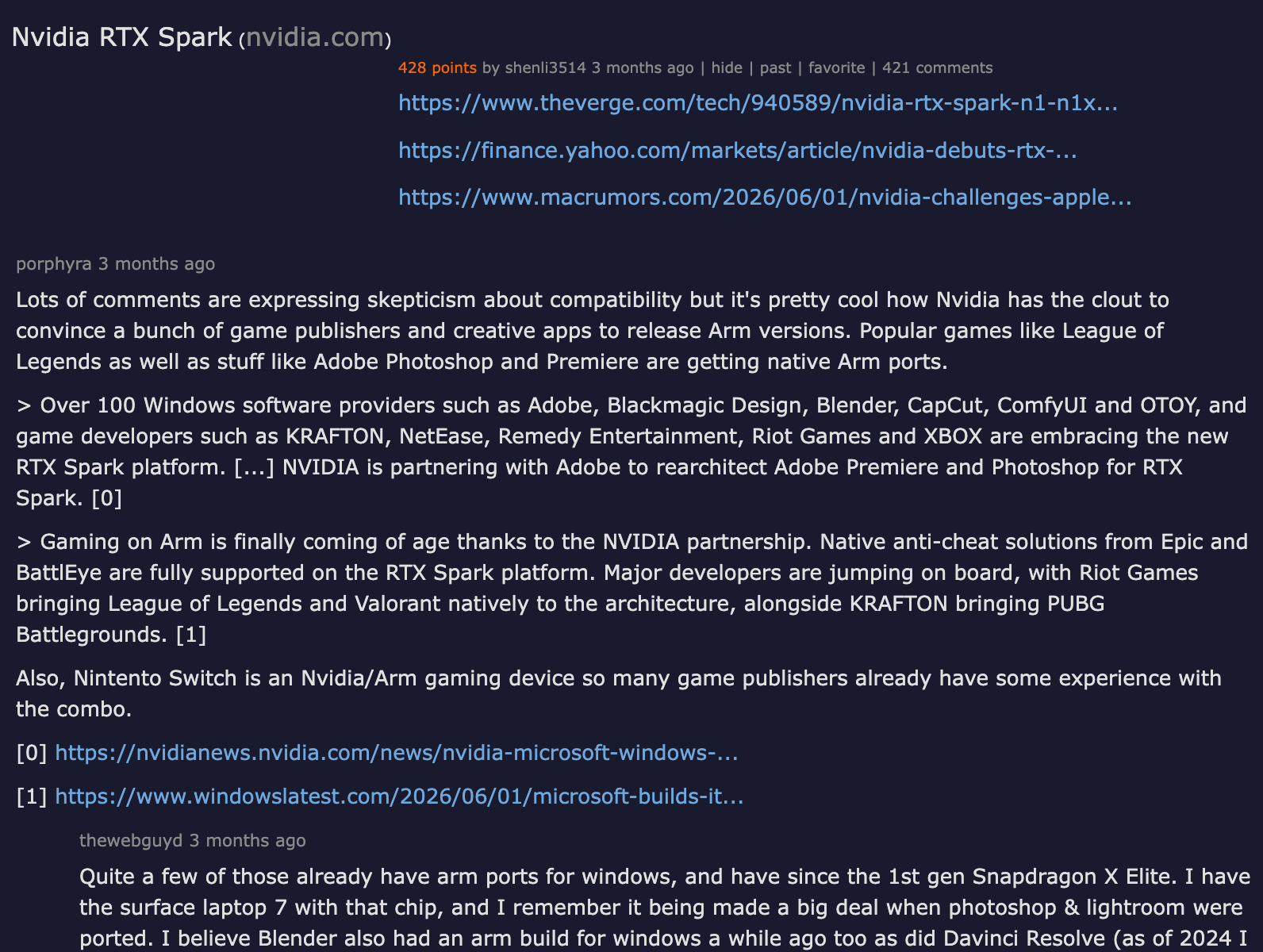
The HN thread on RTX Spark (428 points, 421 comments) reveals a community split between hardware skeptics and strategic bulls. The top concern: memory bandwidth. At 600GB/s, RTX Spark significantly lags the M3 Ultra's 819GB/s and Apple's MLX-optimized inference stack. Multiple commenters question whether NVIDIA's ARM-based Windows devices will avoid the Snapdragon laptop debacle.
But the strategic read is more interesting. As one commenter noted: "This move protects NVIDIA against Apple's MLX framework threat, ensuring consumer hardware pathways exist as local AI inference potentially shifts away from cloud services." The hardware may be imperfect. The positioning is calculated.
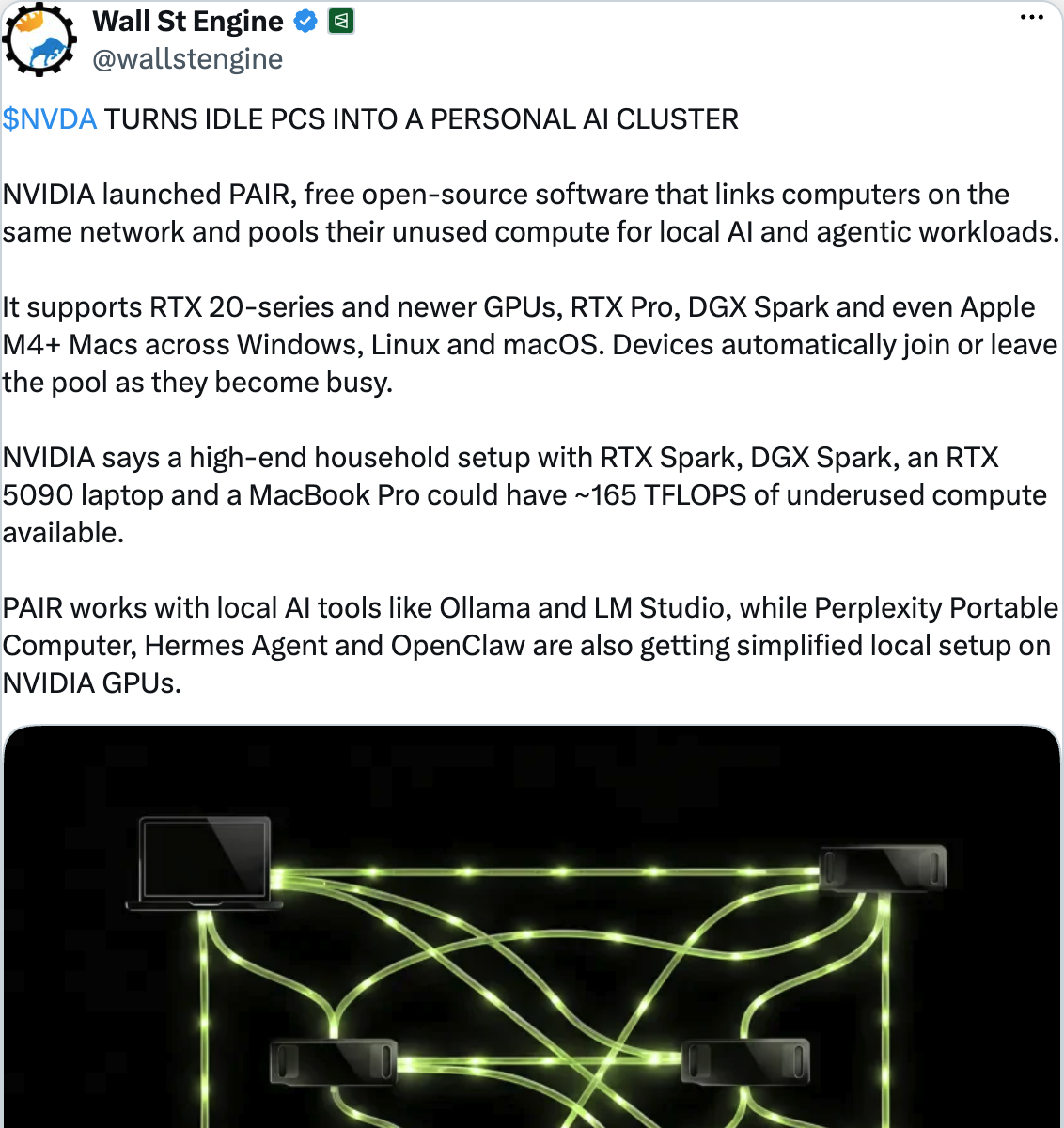
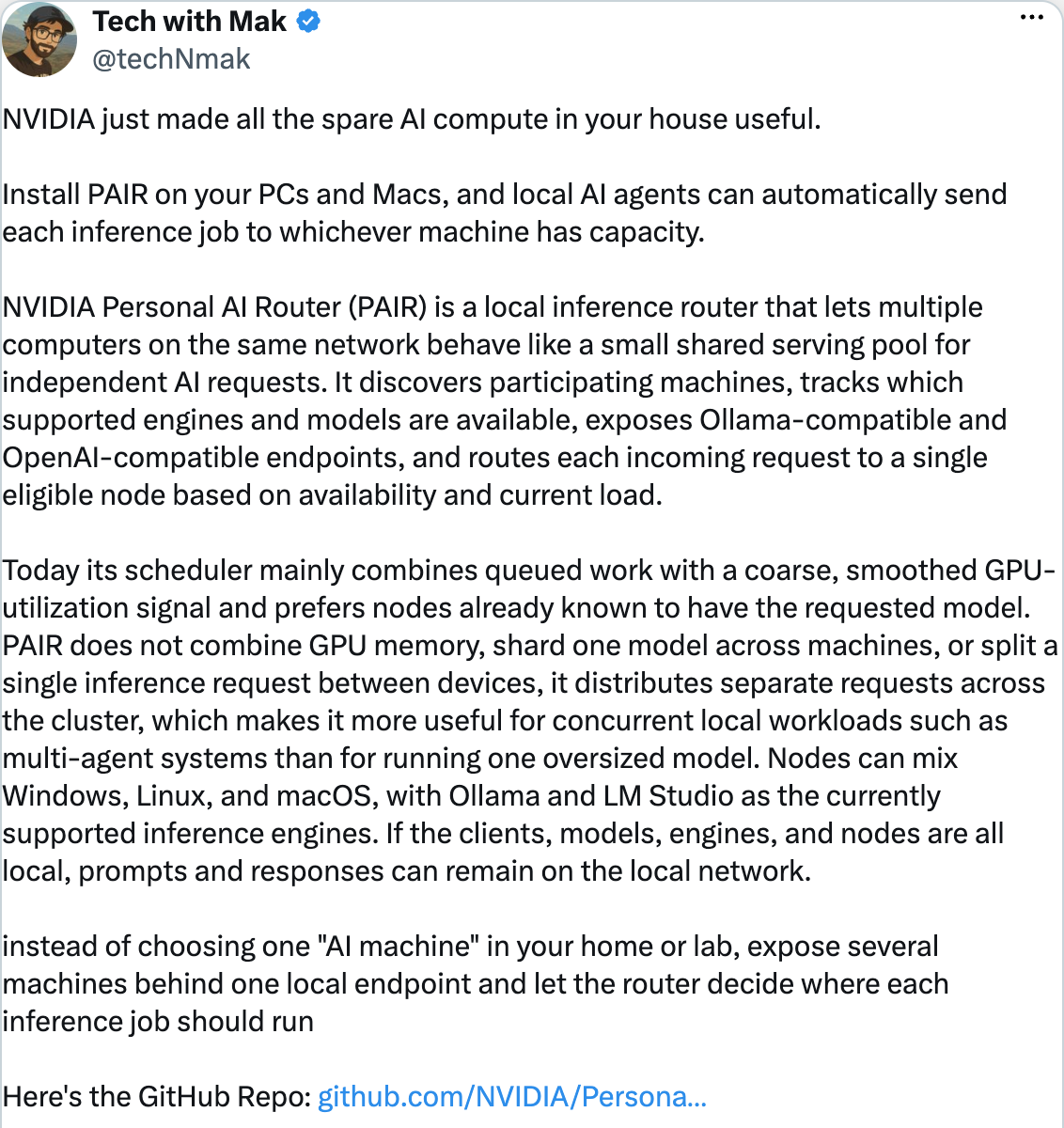
On X, the reaction split between consumer enthusiasm and structural analysis. Tech with Mak called out the practical angle: "NVIDIA just made all the spare AI compute in your house useful." Wall St Engine read it as ecosystem defense: free open-source software that deepens reliance on the RTX ecosystem.
XDA's hands-on review found PAIR "surprisingly more flexible than advertised" — they successfully connected machines across countries via Tailscale, loaded custom engine manifests for vLLM (not officially supported at launch), and even got it serving on AMD and Intel GPUs despite the NVIDIA branding. The rough edges are real (macOS code-signing failures, mDNS discovery issues across VPNs), but the architecture is more open than the marketing suggests.
Contrarian Corner: Is local inference a dead end?
The bear case writes itself: frontier models keep scaling beyond what any local hardware can run. GPT-6 Astra reportedly runs on clusters that dwarf anything PAIR can stitch together. Enterprise security, compliance, and SLA requirements favor cloud providers with SOC 2 certifications and guaranteed uptime.
And PAIR's own limitations validate this — no VRAM pooling, no model sharding means it handles only embarrassingly parallel workloads. You cannot run a single 400B model across three PAIR nodes.
Here is the counter: agents are embarrassingly parallel by design. A coding agent spawning five sub-agents for research, testing, documentation, code review, and deployment is exactly the workload PAIR optimizes for. The frontier is not one giant model doing one giant thing. It is swarms of capable-enough models doing many things concurrently. And for that use case, local routing beats cloud APIs on cost, latency, and privacy simultaneously.
The Nemotron Flywheel
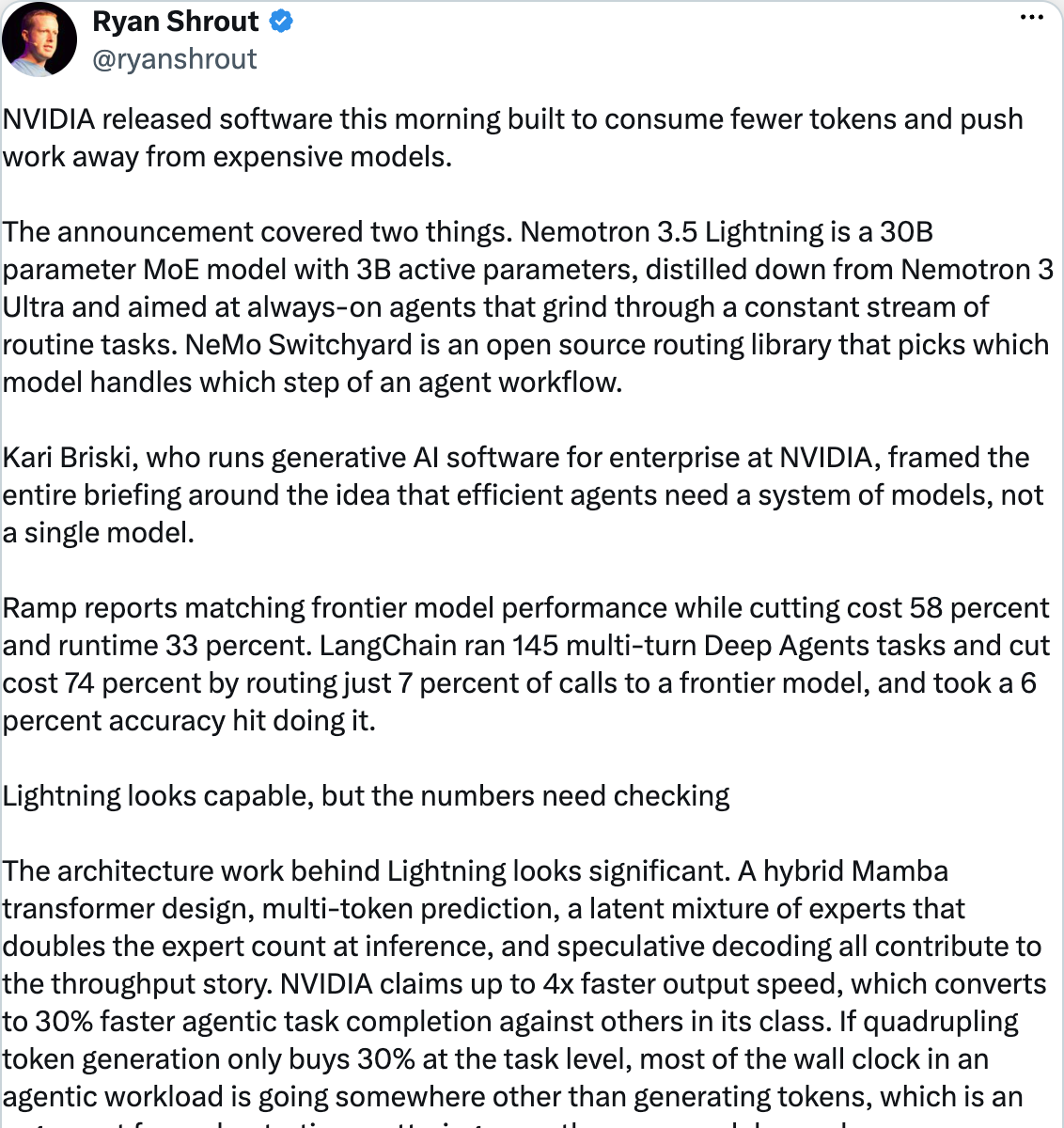
There is one more piece: NVIDIA's open model strategy. Nemotron 3.5 Lightning is a 30B-parameter MoE model with 3B active parameters, distilled from Nemotron 3 Ultra and sized to run on a single consumer GPU. NemoClaw wraps it with enterprise security controls — sandboxing, privacy routing, local inference — and deliberately runs on AMD, Intel, and Google hardware.
Why would NVIDIA release models that run on competitor chips? Because the model is the lure; the ecosystem is the trap. Every developer who adopts Nemotron pulls in TensorRT-LLM for optimized inference, NIM containers for deployment, and now PAIR for routing. The open model runs everywhere; the optimized stack runs best on NVIDIA. Ryan Shrout put it directly: "NVIDIA released software built to consume fewer tokens and push work away from expensive models." Fewer cloud tokens means more local inference. More local inference means more GPU sales.
What This Means for You
For agent developers: PAIR gives you a zero-cost way to test multi-agent architectures on local hardware today. If you have an RTX card and a Mac (or two RTX cards), you can run parallel agent workflows without touching a cloud API. The router is OpenAI-compatible — your existing agent framework likely works without modification.
For infrastructure decision-makers: Watch the routing layer, not the chip wars. NVIDIA, Apple, Stripe/OpenRouter, and Qualcomm/Modular are all converging on the same control point. The company that becomes the default router for inference — local, cloud, or hybrid — captures the margin that used to go to chip vendors. Our earlier analysis of Cursor's router as a cost control point is playing out at the hardware level now.
For investors: NVIDIA's $96B quarter is real, but the local-inference bet tells you what management thinks about the next five years. They see margins compressing as inference commoditizes and custom chips proliferate. The hedge is owning the software layer — routing, orchestration, model optimization — that generates demand for NVIDIA hardware regardless of where inference runs. The Groq acquisition, Hugging Face deal, and now PAIR are all moves in the same game.
The Bottom Line
NVIDIA is not pivoting away from data center GPUs — $89 billion in quarterly data center revenue makes that clear. But the company is building a parallel stack for a world where inference happens everywhere: in the cloud, at the edge, on your desk, distributed across your house.
PAIR is the clearest signal yet. It is free, open source, and designed to make every NVIDIA GPU (and Apple silicon, for now) part of a unified inference fabric. The bet is not on any single hardware form factor. The bet is on the routing layer — the software that decides where every inference request goes.
When we analyzed NVIDIA's GTC 2026, we argued the company was becoming an operating system company. PAIR completes that thesis. An OS does not care whether the compute is local or remote. It routes work to wherever capacity exists. That is exactly what NVIDIA is building — not just for data centers, but for living rooms.
The company posting $96 billion quarters is simultaneously hedging against a future where those quarters are not enough. That is either paranoia or the most expensive insurance policy in tech history. Given NVIDIA's track record, bet on the latter.
ComputeLeap Team
The ComputeLeap editorial team covers AI tools, agents, and products — helping readers discover and use artificial intelligence to work smarter.
Join the discussion
Have thoughts on this article? Discuss it on your favorite platform:
Related articles
The Slop Wall Is Here: Steam and Apple Have No Filter
Vibe-coded apps flood Steam and the App Store at once. Neither gatekeeper has a quality gate that scales. What breaks next.
The Per-Token Trap: Why AI Got Cheaper and Your Bill Didn't
Token prices fell 90%. Enterprise AI bills doubled. Gartner says agentic costs will 5x by 2028. Here's the Jevons math and how to fix your budget.
Anthropic's Agents Broke Git at 30K Merges a Day
Anthropic went from 2,500 to 30,000 daily merges in four months. Git buckled. Here's how they built Scion, and what it means for every team running agents.
The ComputeLeap Weekly
Get a weekly digest of the best AI infra writing — Claude Code, agent frameworks, deployment patterns. No fluff.
WEEKLY. UNSUBSCRIBE ANYTIME.