The Open-Weight Frontier Arrived in a Single Day
Inkling and Kimi K3 shipped within 24 hours. Prediction markets repriced China, not Anthropic.
The Open-Weight Frontier Arrived in a Single Day

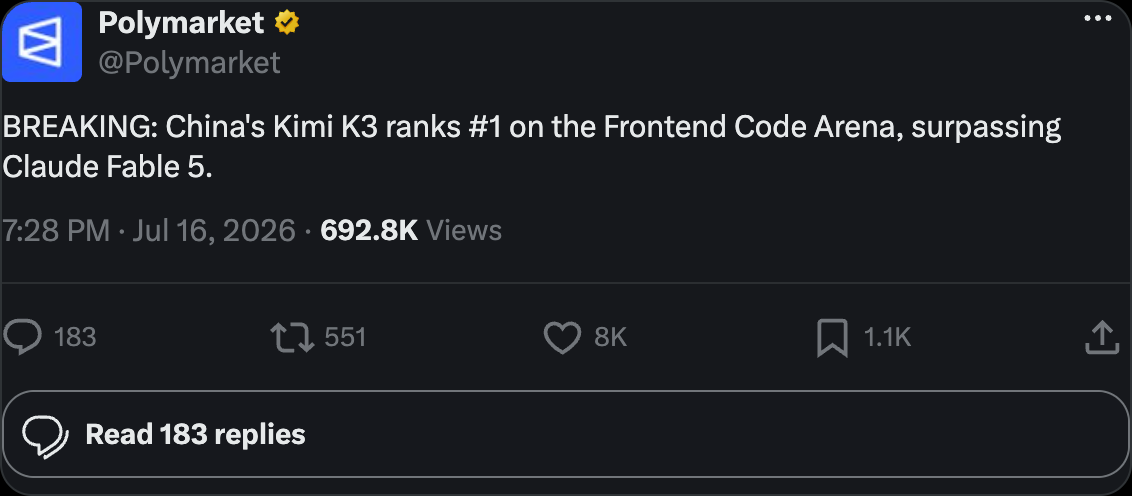
On July 15, Thinking Machines Lab — Mira Murati's startup, nine months old — dropped Inkling: 975 billion parameters, 41 billion active, natively multimodal, Apache 2.0. Sixteen hours later, Moonshot AI shipped Kimi K3: 2.8 trillion parameters, number one on the Frontend Code Arena above Claude Fable 5, with full open weights promised by July 27.
Two independent labs. Two continents. One day. This is not a coincidence — it is a capability floor rising permanently.
The reaction on X was immediate. Soumith Chintala, Thinking Machines co-founder, put it plainly:
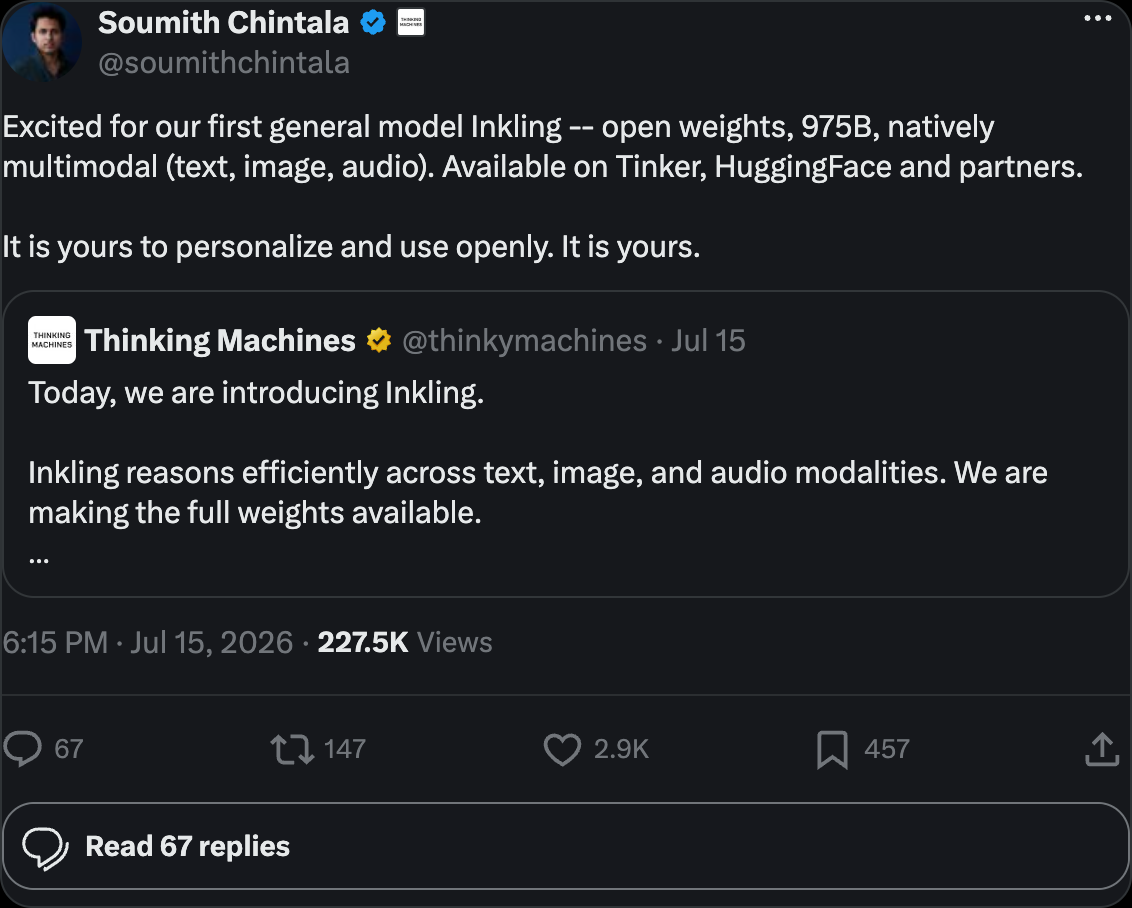
And the market verdict? Polymarket traders repriced the Chinese AI race — not the frontier labs' moat. More on that below.
Inkling: The Nine-Month Manifesto
Thinking Machines achieved market entry in approximately nine months, compared to OpenAI's five years and Anthropic's three. The company employs roughly 200 people and was founded by former OpenAI CTO Mira Murati. Five days before Inkling's release, the lab published a manifesto titled "Future Worth Building Is Human" — and Inkling is the technical bet behind that positioning.
The architecture: a 66-layer decoder-only transformer with a sparse Mixture-of-Experts backbone. Each token routes to 6 of 256 experts, plus 2 shared experts active on every token. Total parameters: 975 billion. Active per inference: 41 billion. It was pretrained on 45 trillion tokens across text, images, audio, and video, with a context window stretching to 1 million tokens.
Here is what makes it interesting: Thinking Machines explicitly says Inkling is "not the strongest overall model available today, open or closed." On HLE with tools, it scores 46.0% versus Claude Fable 5's 64.5%. On SWE-Bench Verified, 77.6% against Fable's 95.0%. The company is not selling benchmark dominance — it is selling the right to customize.
Inkling's SWE-Bench Verified score of 77.6% trails Fable 5 by 17 points — but for teams fine-tuning a base model via Tinker, the delta matters less than the license. Apache 2.0 means no usage restrictions, no model-as-a-service lock-in, and no phone call to legal before deployment.
The TechCrunch framing captured the business thesis: Microsoft CEO Satya Nadella warned that enterprises using proprietary models "effectively pay twice" — through subscription costs and by surrendering business knowledge. Inkling is the technical answer to that argument.
Bill Gurley connected it to a broader strategic shift:
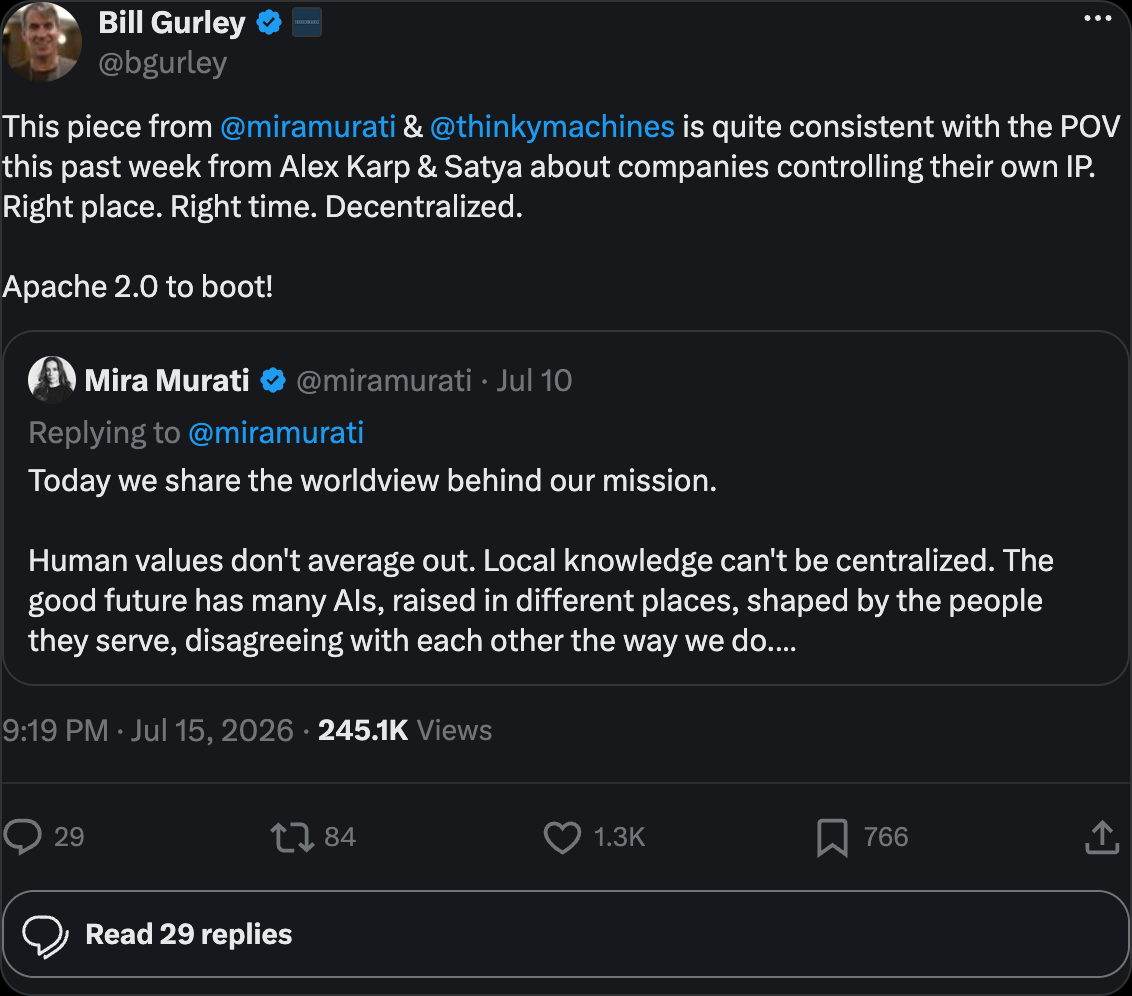
Kimi K3: The Largest Open-Weight Model Ever
If Inkling is the customization play, Kimi K3 is the raw-scale statement. Moonshot AI's new model packs 2.8 trillion parameters — roughly 75% larger than DeepSeek's V4 Pro — into a Mixture-of-Experts architecture with 896 total experts.
The technical innovations are specific and non-trivial. Kimi Delta Attention (KDA) is a hybrid linear attention mechanism designed for long-context coding workloads. Attention Residuals replace standard residual connections and selectively retrieve representations across depth. The model was trained with quantization-aware training using MXFP4 weights and MXFP8 activations — a bet on inference efficiency at scale.
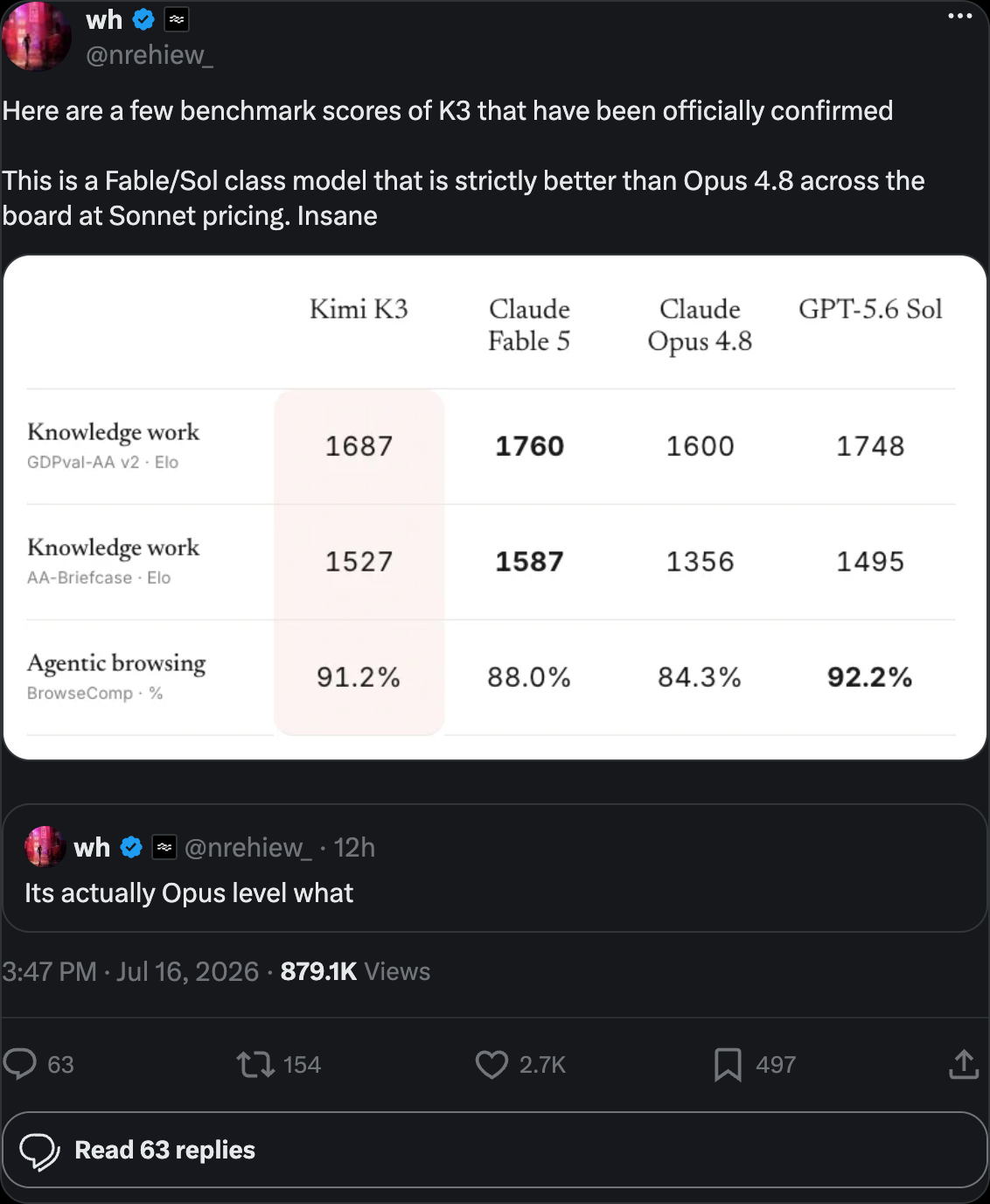
The benchmarks tell the market story. On Artificial Analysis, K3 scores 57 on the Intelligence Index — comparable to Opus 4.8 (56) and GPT-5.5, though still behind Fable 5 (60) and GPT-5.6 Sol (59). But on Arena.ai's Frontend Code Arena, K3 debuted at number one with a score of 1,679 — beating Fable 5's 1,631 and GPT-5.6 Sol's 1,618.
The pricing tells the strategy story. K3 charges $3 per million input tokens and $15 per million output tokens — matching Anthropic's Sonnet series. This is a significant departure from the Chinese AI pricing playbook, which historically leaned on subsidized rates to drive adoption. As The Decoder noted, K3 signals the end of super-cheap Chinese AI. When your model matches frontier benchmarks, you price like a frontier lab.
One of the sharpest assessments came from machine learning researcher @nrehiew_, whose post hit 614K views in hours:
The Prediction Markets Already Priced the Fallout
Here is where it gets interesting for anyone tracking the competitive landscape. Polymarket's "Best AI model (end of July)" market still has Anthropic at 97% — a near-lock backed by $2.3 million in liquidity. But that 97% is down 6.2 percentage points month-over-month. The bleed is slow, but it is real and directional.
The sharper move happened in the Chinese AI race. Polymarket's "Best Chinese AI company" market saw Alibaba collapse by 40 points in a single week — from dominant front-runner to a narrow 54% lead, with Moonshot surging to 42%. DeepSeek, which dominated the narrative six months ago, was written off at 1%.
We noted the Chinese AI market was "consolidating" yesterday when Alibaba sat at 85%. That read aged roughly 12 hours. The minus-40-point swing is one of the sharpest AI prediction-market moves we have tracked. Lesson reinforced: in a field releasing frontier models on 24-hour cycles, "consolidating" is a dangerous word.
The takeaway is not that Anthropic's position is collapsing — it clearly is not, not yet. The takeaway is where prediction markets chose to price the disruption. Traders looked at two open-weight releases and concluded the competitive threat runs within China's own ecosystem, not against the Western frontier. Moonshot eating Alibaba's lunch is the story the money tells.
But watch the 6.2% monthly slide on Anthropic's "best model" share. It is the difference between a leading indicator and a lagging one. Today it registers as noise. If open-weight releases keep arriving at this tempo, the Polymarket consensus has a shelf life.
The Training-Lineage Secret Is Out
Sriram Krishnan, a former senior policy advisor on AI at the White House, captured the structural shift:
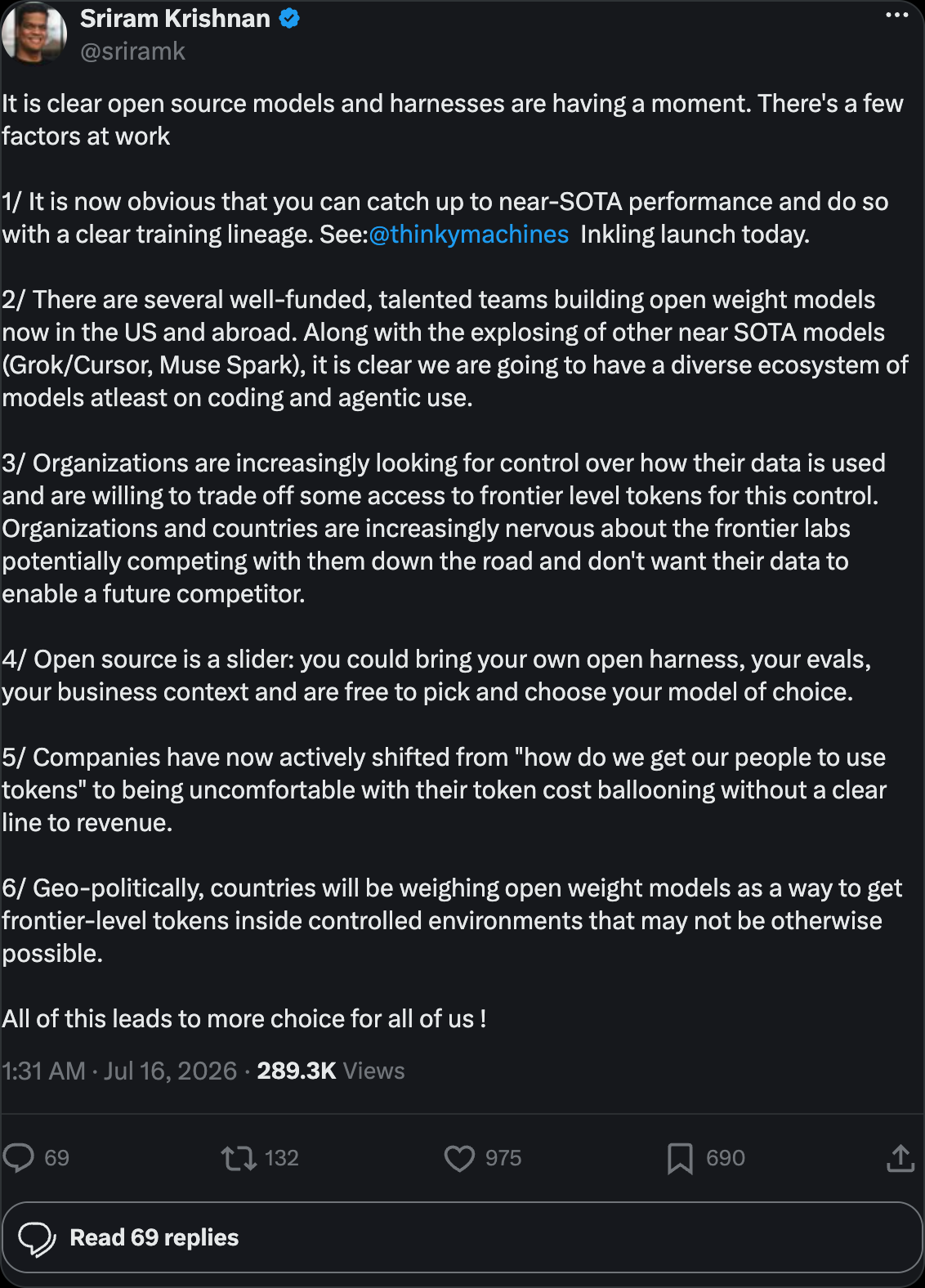
This is the quiet bombshell. When we covered GLM-5.2 vs Opus 4.8 three weeks ago, the question was whether a single open-weight model could match frontier benchmarks. GLM-5.2 proved it could — on coding, at least.
What Inkling and K3 prove is different. The training recipe is replicable by independent teams operating on different continents, with different architectures, on different timelines. One lab used Muon optimization and relative positional embeddings instead of RoPE. The other invented Kimi Delta Attention from scratch. Both arrived at frontier-competitive results in the same 24-hour window.
Jason Calacanis, drawing the broader pattern, noted: "Things accelerated more in the last 30 days from a dozen players than in the last year. Open source models are compounding. Frontier models are refining."
This connects directly to the thesis we traced in our frontier release war coverage: the gap between "best model" and "good enough model" compresses faster than anyone's pricing model accounts for.
Apache 2.0 as Geopolitics
Inkling's Apache 2.0 license is not just a developer-relations choice. Pablo Chavez's analysis on Substack documents that 86% of sovereign AI model projects worldwide release weights openly — and that Alibaba's Qwen has started appearing in sovereign AI deployments from the UAE to Thailand to Uganda.
The geopolitical logic is straightforward. The US government demonstrated it can force access to frontier models to be suspended internationally. Open weights, once downloaded, cannot be switched off. For any government or enterprise outside the US, the difference between a proprietary API and an Apache 2.0 checkpoint is the difference between a leased capability and a sovereign one.
Thinking Machines and Moonshot arrive at the same licensing conclusion from opposite sides. Murati's lab frames it as "resistance to censorship" and enterprise self-determination. Moonshot frames it as competitive differentiation against closed Chinese rivals (hence the Alibaba collapse on Polymarket). But the downstream effect is identical: more frontier-grade weights in circulation, harder for any single government or company to gate access.
The open-weight-as-sovereignty thesis connects to why we have been tracking the Chinese coding model surge. Every open release raises the floor. The question for closed labs is no longer "can anyone match us?" — it is "how long before matching us is table stakes?"
What the Community Is Saying
The Hacker News threads for both releases were among the most active AI discussions of the month.
The Inkling thread pulled 1,183 points and 281 comments. The top-voted comment framed it as "the first competitive non-Chinese open weights model since Llama 3" — a notable characterization given that Meta's Llama series had been the default American open-weight option for over a year. Multiple commenters debated whether Thinking Machines' Tinker fine-tuning platform represents a sustainable business model or whether open weights commoditize the value down to infrastructure.
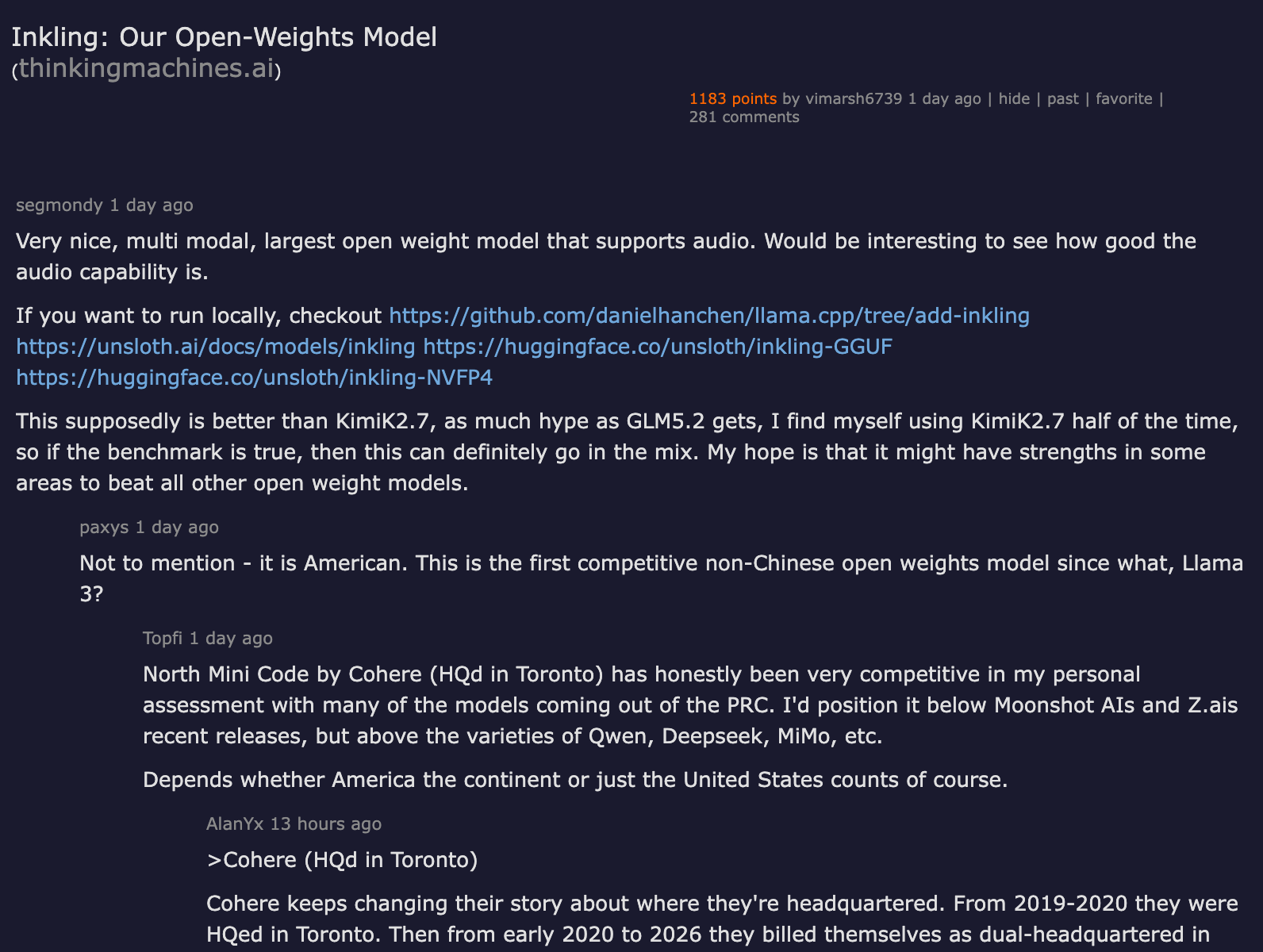
The K3 thread hit 1,246 points and 783 comments — the hotter discussion. Simon Willison ran his signature pelican-on-a-bicycle SVG test: 95 input tokens, 16,658 output tokens (13,241 of them reasoning), total cost 25 cents. His verdict on the benchmark itself: useful for vibes, but the real test is agentic tool calling and reliable long-context performance.
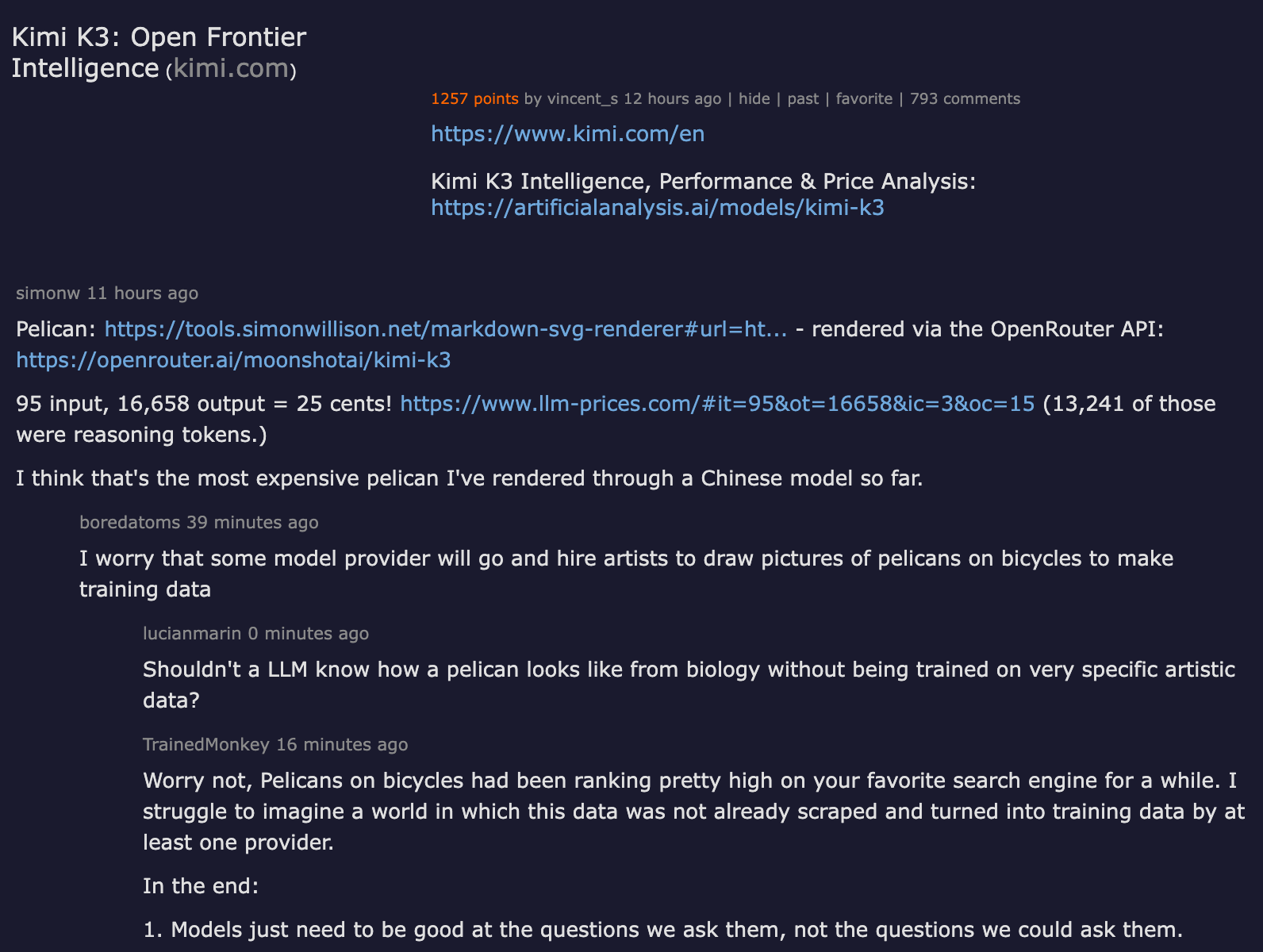
A pragmatic observation from the HN thread: K3's pricing at $3/$15 per million tokens matches Sonnet, but "reasoning efficiency matters directly for how expensive a model actually is in real use." If K3 burns 13,000 reasoning tokens on a pelican, cost-per-task may exceed what the headline rate suggests.
The Contrarian Case: Open Weights Commoditize the Wrong Layer
Here is the uncomfortable counter-argument that the celebration skips over.
K3 needs 64+ accelerators to self-host. Inkling candidly admits it is not the strongest model available. The training-lineage secret may be out, but the distribution-lineage secret is not. Anthropic embeds Claude into AWS Bedrock, GitHub Copilot, Slack, and a growing agentic toolchain. OpenAI sits inside Microsoft 365. The moat may have already moved from training to distribution — and open weights commoditize the wrong layer.
Omar Sarabi, who tracks these releases closely, flagged this directly: "We might have an open-weight Fable/Mythos 5-level model by EOY. But overdependence on one model is a poor strategy." The implication: the model layer is becoming interchangeable, which means value accrues to the layers above and below — infrastructure, tooling, and agentic frameworks.
For teams actually deploying models, the question is not "which model has the best benchmark" but "which model integrates into our existing stack with the least friction." On that axis, Claude Code, ChatGPT's Codex agent, and GitHub Copilot have distribution advantages that no open-weight release automatically erases.
What This Means for You
If you are a developer, engineering lead, or technical founder, here is the actionable read:
1. Your model migration plan needs a shorter shelf life. Two frontier-competitive open-weight models dropped in 24 hours. If your architecture is hard-wired to a single proprietary API, you are paying a growing tax on optionality. Build your inference layer to swap models — the providers who do this well (Together, Fireworks, OpenRouter) are becoming infrastructure, not commodities.
2. Benchmark marketing is officially unreliable. K3 is number one on Frontend Code Arena but eighth or ninth on broader benchmarks. Inkling is not the strongest model on any individual eval but may be the most customizable one. Choose models based on your use case, not the leaderboard. If you are building a coding agent, K3 deserves evaluation. If you need a fine-tunable multimodal base, Inkling is the new starting point.
3. Watch the Polymarket slide, not the Polymarket level. Anthropic at 97% looks like dominance. Anthropic at 97% and falling 6.2% per month looks like a trend. The absolute number says "safe." The derivative says "eroding." Act accordingly in your technology bets.
4. Apache 2.0 is a procurement argument now, not just a developer one. If your enterprise evaluates AI vendors through a lens that includes data sovereignty, IP control, and supply-chain risk — and after the scaling-law capex math, it should — open-weight models just crossed the capability threshold where the license matters more than the leaderboard.
The Question That Changed
A month ago, the open-weight conversation centered on "can they catch up?" After GLM-5.2, Meta Muse Spark, Inkling, and now K3, that question is settled. The new question — the one that keeps frontier-lab executives awake — is simpler and harder: what is a frontier lab selling in 12 months if the training recipe is public, the weights are Apache 2.0, and the inference providers commoditize access?
The answer, for now, is distribution, brand, and agentic tooling. But distribution advantages erode when the model layer becomes interchangeable. And July 15-16, 2026 is the day two independent labs proved it is becoming exactly that.
ComputeLeap Team
The ComputeLeap editorial team covers AI tools, agents, and products — helping readers discover and use artificial intelligence to work smarter.
Join the discussion
Have thoughts on this article? Discuss it on your favorite platform:
Related articles
Anthropic's Agents Broke Git at 30K Merges a Day
Anthropic went from 2,500 to 30,000 daily merges in four months. Git buckled. Here's how they built Scion, and what it means for every team running agents.
Cloudflare Bought Deno. You Have 12 Months.
Deno gets 12 months of patches then development ends. Here are the concrete migration paths for every Deno deployment pattern.
OpenAI Fired Its Safety Staff, Then Cited Its Auditors
Three researchers fired for talking to the auditors they were hired to brief. The disclosure gap is the real story.
The ComputeLeap Weekly
Get a weekly digest of the best AI infra writing — Claude Code, agent frameworks, deployment patterns. No fluff.
WEEKLY. UNSUBSCRIBE ANYTIME.