Your AI Vendor Just Became Your Rival
OpenAI cut Cursor off after SpaceX's acquisition. Four cutoffs in 14 months reveal API access is now a weapon, not a utility.
Your AI Vendor Just Became Your Rival
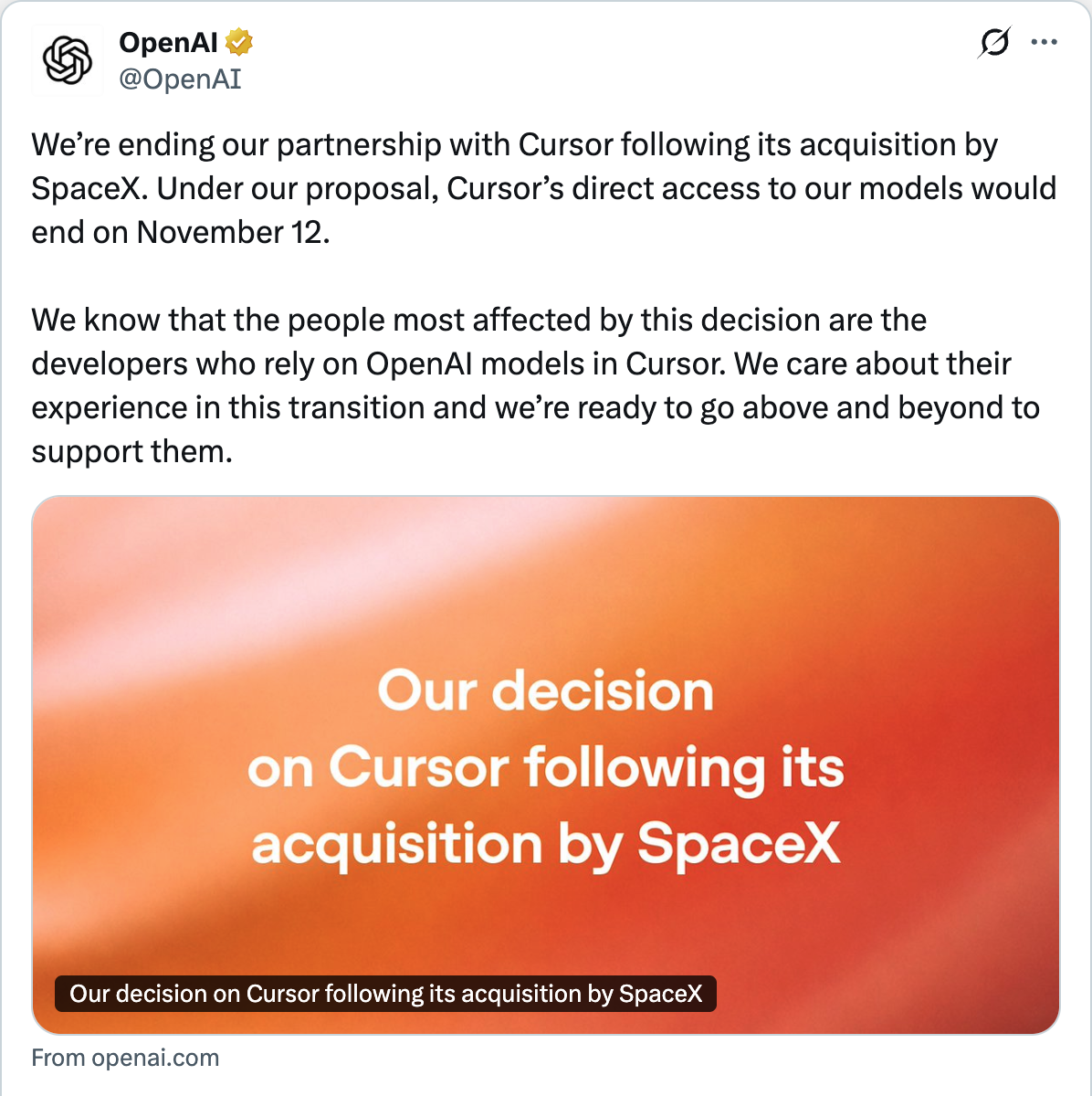
On August 28, 2026, OpenAI notified SpaceX that it would wind down its contract providing models to Cursor, the AI coding tool SpaceX had acquired two weeks earlier for $60 billion. The proposed shutoff date: November 12. The stated reason: "We cannot be confident that SpaceX will use our technology within our terms of service, based on our experience with Elon Musk's companies violating contracts."
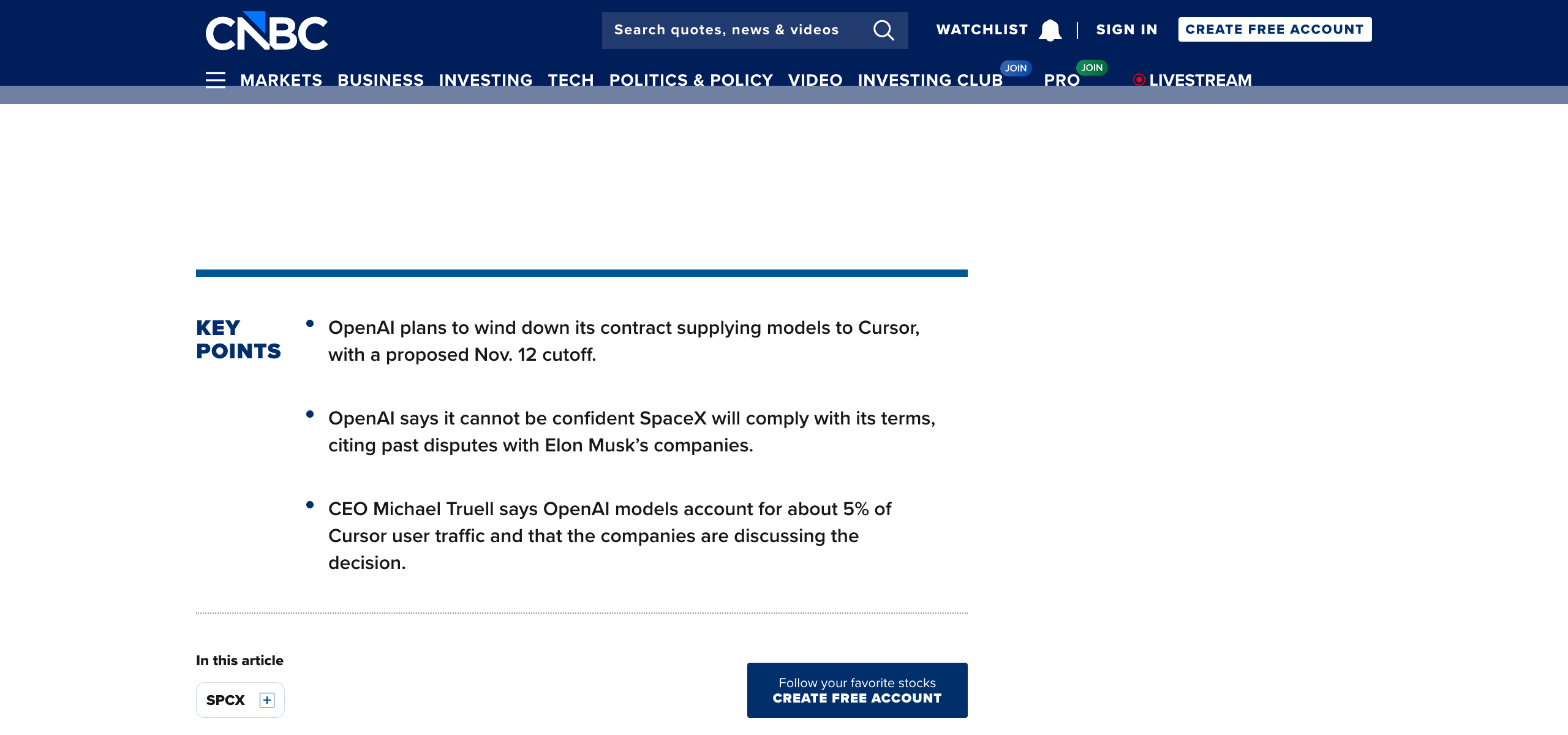
View original article on CNBC →
This is not a story about Cursor losing 5% of its model traffic. It is a story about what happens when the API powering your product belongs to someone who wakes up one morning and decides you are the competition. Four times in fourteen months, a frontier AI lab has cut off a downstream tool or a peer. The model behind your coding assistant, your customer-support bot, your search pipeline — it is provisioned under a contract between two other companies, and that contract can end on a schedule you do not control.
If you build on a single provider's API and have not stress-tested what happens when that provider revokes access, this article is your wake-up call.
The Cutoff Ledger: Four Incidents in Fourteen Months
The OpenAI-Cursor split did not happen in a vacuum. Digital Applied maintains a detailed ledger of every confirmed AI model supply cutoff since June 2025. The pattern is unmistakable — and accelerating.
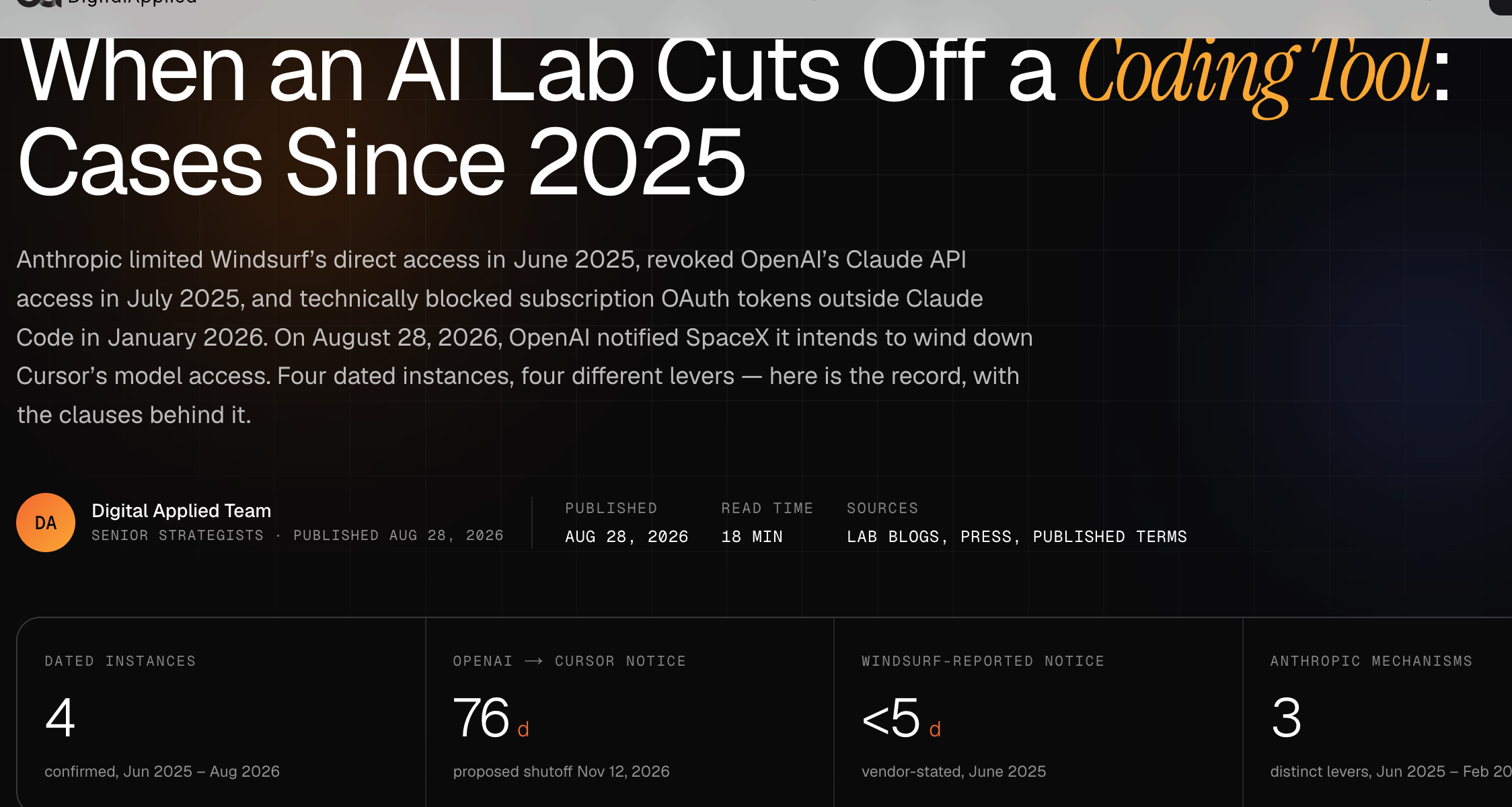
View the full cutoff ledger on Digital Applied →
June 2025 — Anthropic cuts Windsurf. When reports surfaced that OpenAI was in acquisition talks with Windsurf, Anthropic limited access to Claude 3.5/3.7 Sonnet models with under five days of notice. Windsurf's CEO publicly complained on X. The acquisition deal collapsed. Google eventually licensed Windsurf's technology for $2.4 billion and hired its leadership.
July 2025 — Anthropic revokes OpenAI's API access. Anthropic discovered OpenAI engineers using Claude Code internally before GPT-5's launch, violating terms of service. Access was revoked immediately — not wound down over months, but killed the same day.
January 2026 — Anthropic blocks third-party harnesses. Server-side blocks hit Claude subscription OAuth tokens used outside official clients. OpenCode and similar tools lost OAuth integration with minimal notice. Maintainers removed Anthropic plugins by mid-March.
August 2026 — OpenAI cuts Cursor. SpaceX completed its $60 billion acquisition of Cursor's parent company Anysphere on August 14. Fourteen days later, OpenAI invoked the change-of-control clause in its custom contract and announced a November 12 shutoff.
Each incident used a different mechanism: capacity limiting, terms enforcement, technical blocking, and contractual cancellation. The common thread is not the method — it is the power asymmetry. The model provider holds the kill switch.
What makes this pattern dangerous is the mechanism diversity. If labs were using the same playbook each time, you could defend against it. But each cutoff employed a different lever than the one before. Capacity limits. ToS enforcement. OAuth token blocks. Change-of-control clauses. As one analysis put it: "A contract dispute, an acquisition, a policy change, or a competitive decision three levels up the supply chain can remove the model you built on."
Why OpenAI Pulled the Trigger
The surface explanation is contractual. OpenAI's agreement with Cursor included a limited change-of-control window allowing cancellation after an ownership change. SpaceX's close on August 14 opened that window, and OpenAI walked through it.
But the deeper logic is competitive. SpaceX also owns xAI, whose Grok models compete head-to-head with OpenAI's. Musk admitted under oath that xAI had trained Grok using OpenAI's outputs — the exact distillation OpenAI's terms prohibit. OpenAI also pointed to its prior experience with Twitter: when Musk acquired the platform in 2022, he discovered OpenAI had a $2 million annual licensing deal for tweet data and cut it off.
As Latent.Space noted, a year ago Cursor appeared in OpenAI's GPT-5 launch video. Now it is owned by Musk. The relationship math changed overnight.
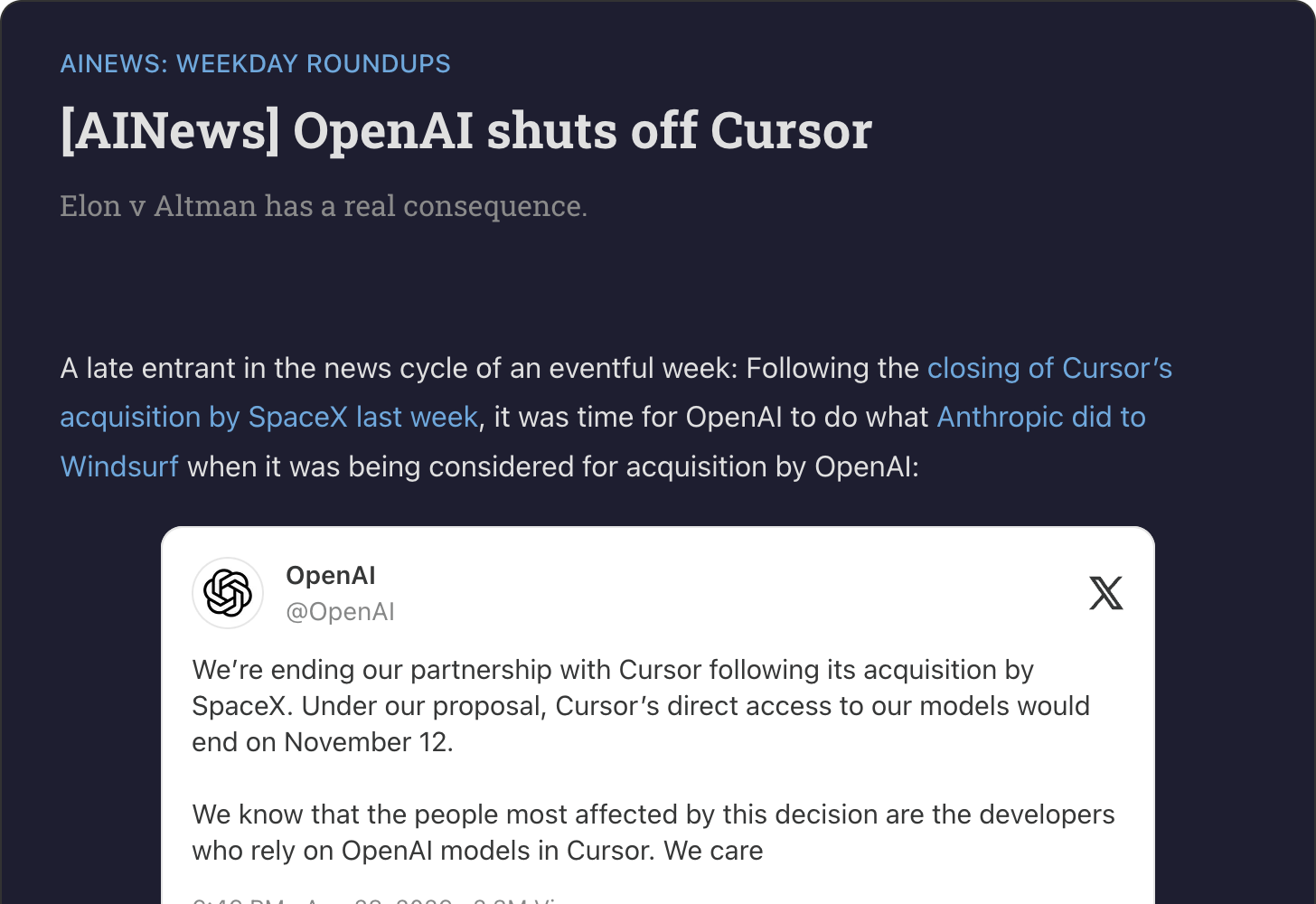
View original post on Latent.Space →
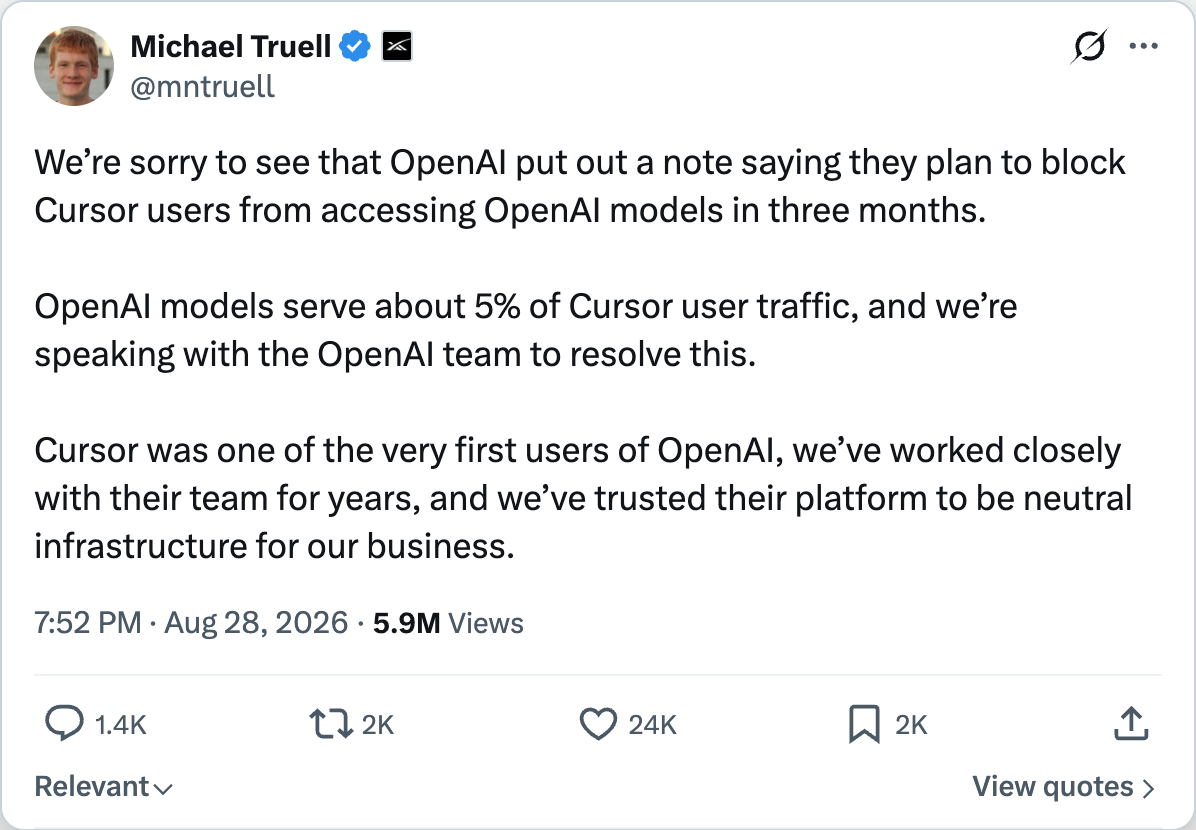
Cursor co-founder Michael Truell responded by downplaying the impact: OpenAI models serve about 5% of Cursor user traffic.
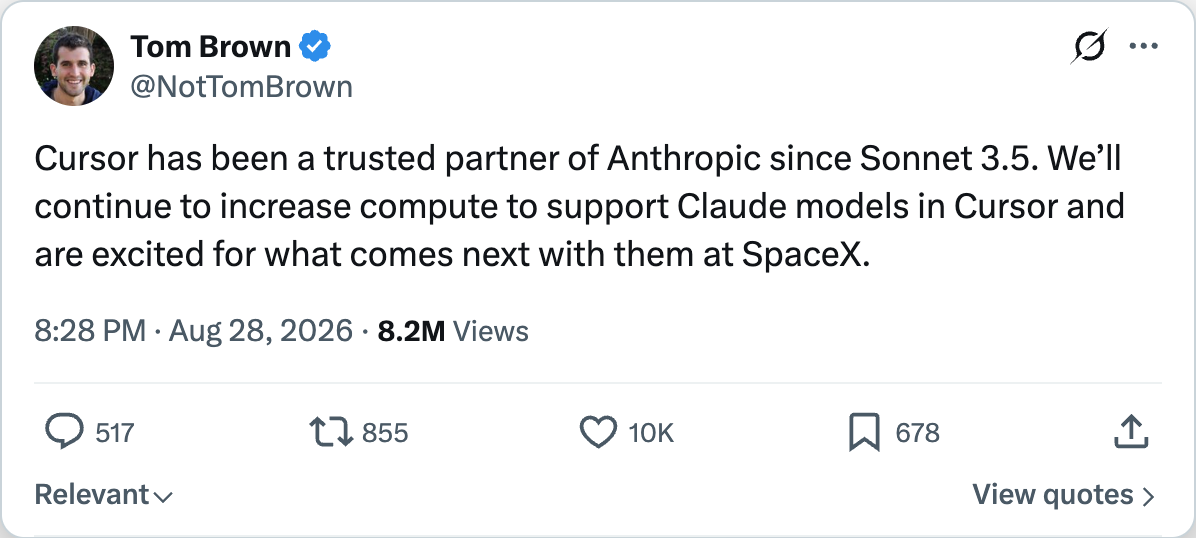
Anthropic co-founder Tom Brown moved quickly, promising to "continue to increase compute" for Claude models in Cursor.
The developer tool survived. But the lesson is not about Cursor.
The Lesson Is About You
Cursor survived because it had built multi-model support from day one. When OpenAI pulled the plug, Claude, Gemini, and Grok remained available. The 5% traffic number is real — and it is the direct result of architectural foresight.
Most products built on AI APIs do not have that foresight. Help Net Security reported that AI supply chain risk is now showing up in developer workflows first — before it hits procurement, before it hits security reviews. An IBM survey found that 91% of executives do not fully understand their organization's AI dependencies across vendors and infrastructure.
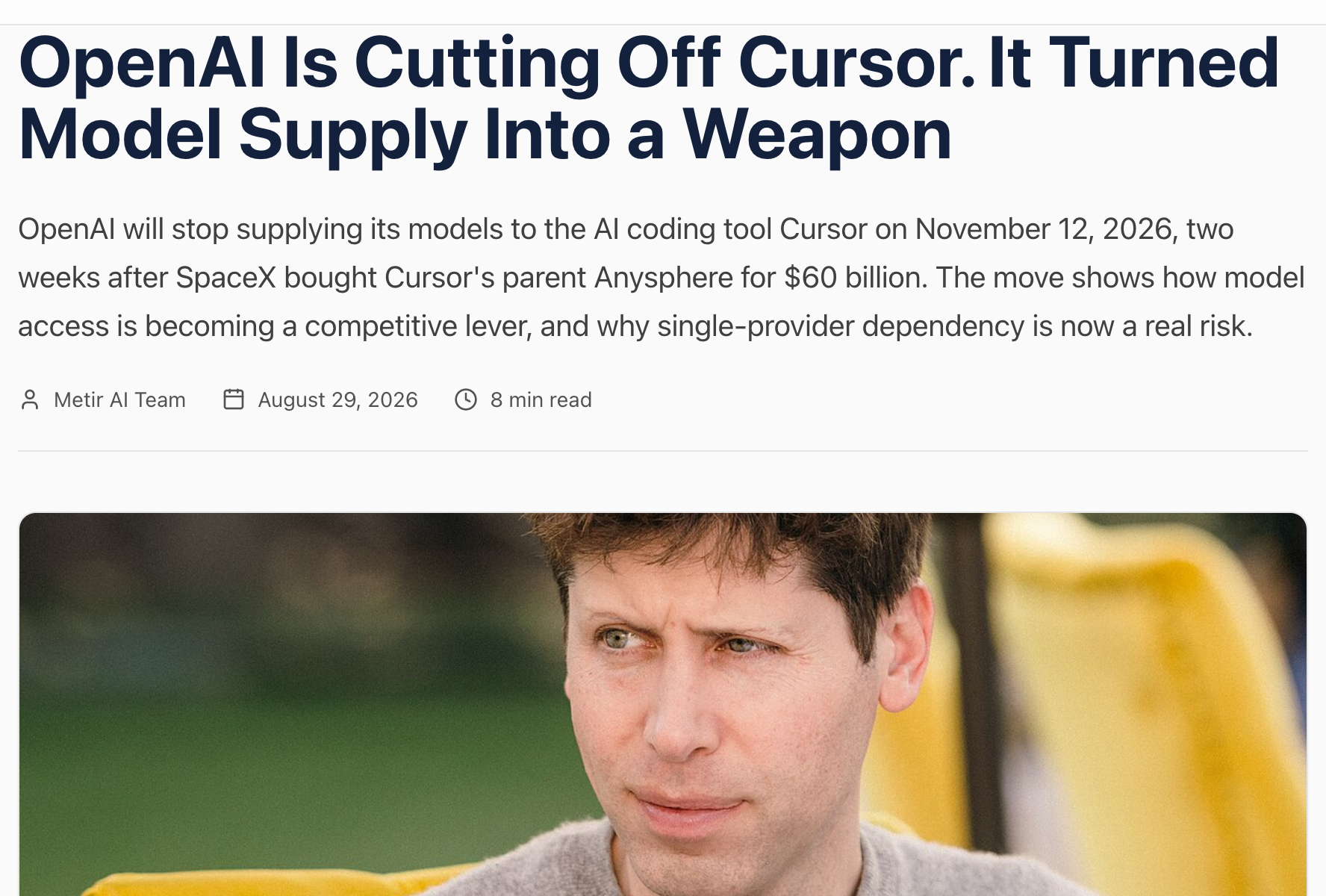
View original analysis on Metir AI →
The attack surface is not just model access. It extends across the entire dependency chain:
API gates. Your model provider can cut you off with notice periods ranging from zero days (Anthropic revoking OpenAI, July 2025) to 76 days (OpenAI winding down Cursor). Custom contracts have unpublished change-of-control clauses. Published terms reference "successor to substantially all assets or business" language that most customers never read.
Patch-to-exploit windows. CrowdStrike's 2026 Threat Hunting Report found that AI is enabling attackers to reverse-engineer security patches and develop working exploits in hours. If your single AI vendor has a security incident, your patch window just collapsed.
Hosting and compute. The irony of the Cursor situation is architectural: Anthropic is renting compute capacity from Musk's infrastructure while continuing to serve Claude through Cursor. The compute layer and the model layer have different owners with different incentives. Your API call traverses a supply chain you do not control at any level.
Package poisoning. Beyond the API itself, AI-generated code introduces dependency risks. Hallucinated package names become real attack vectors when attackers register them — 19.7% of AI-generated packages across tested LLMs were hallucinated, and in June 2026, an adversary injected malicious npm packages as dependencies into at least 131 Mastra AI framework packages.
What the Community Is Saying
The Hacker News thread on OpenAI's decision surfaced the tension developers feel. One commenter noted the irony that AI companies fought against copyright protections for training data while now using private ToS enforcement to control downstream usage. Another raised the question of whether Anthropic would apply its own model-access bans consistently, given its compute deal with Musk's infrastructure.
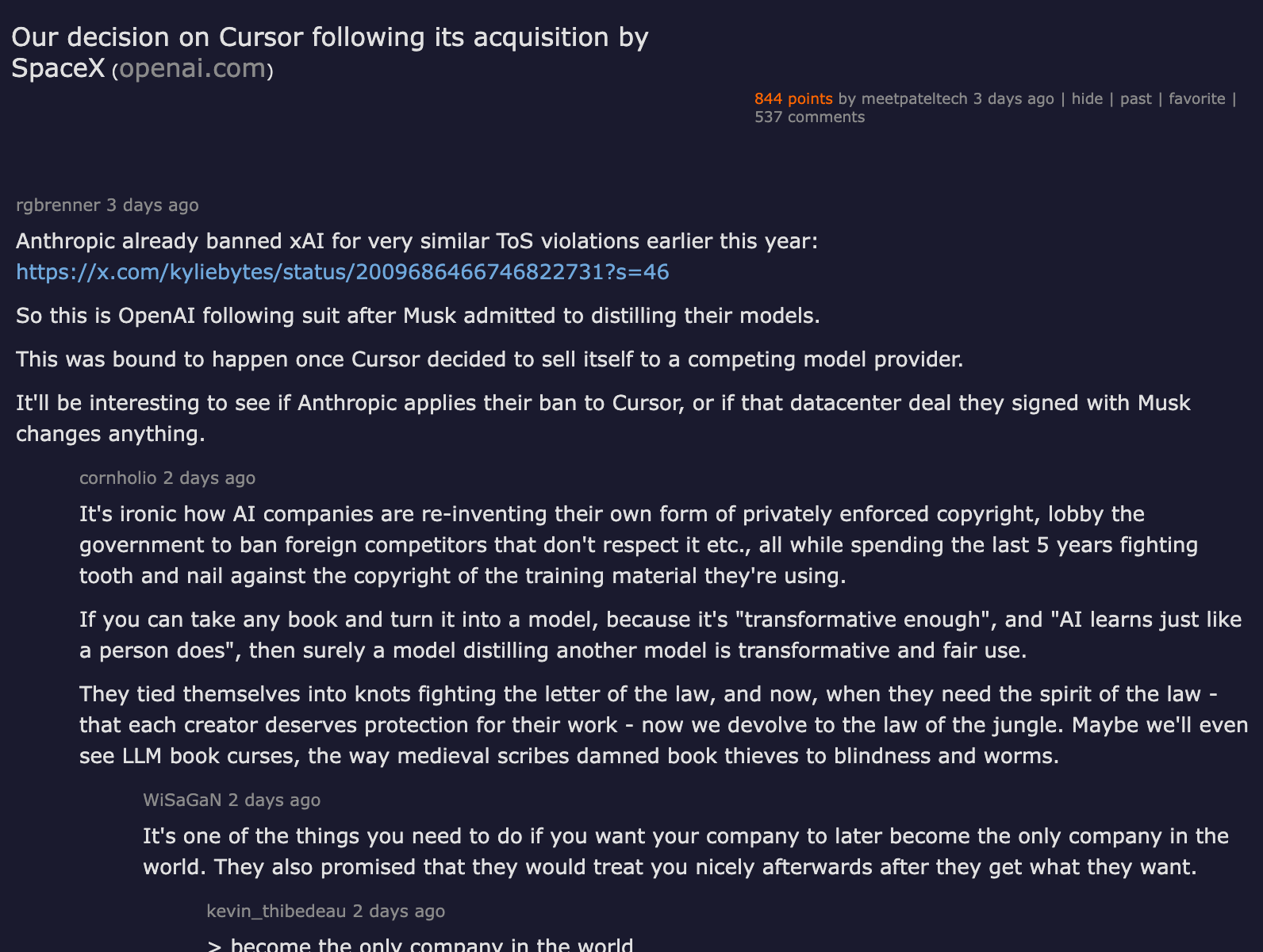
View full discussion on Hacker News →
The practical anxiety is real. As one HN user put it: Cursor offers "the absolute best LLM IDE by such a ridiculously wide margin" that developers chose it unanimously — before the xAI acquisition changed the equation. The tool did not change. The ownership did. And ownership changes are something developers have zero visibility into until they read the headline.
View original post on Substack →
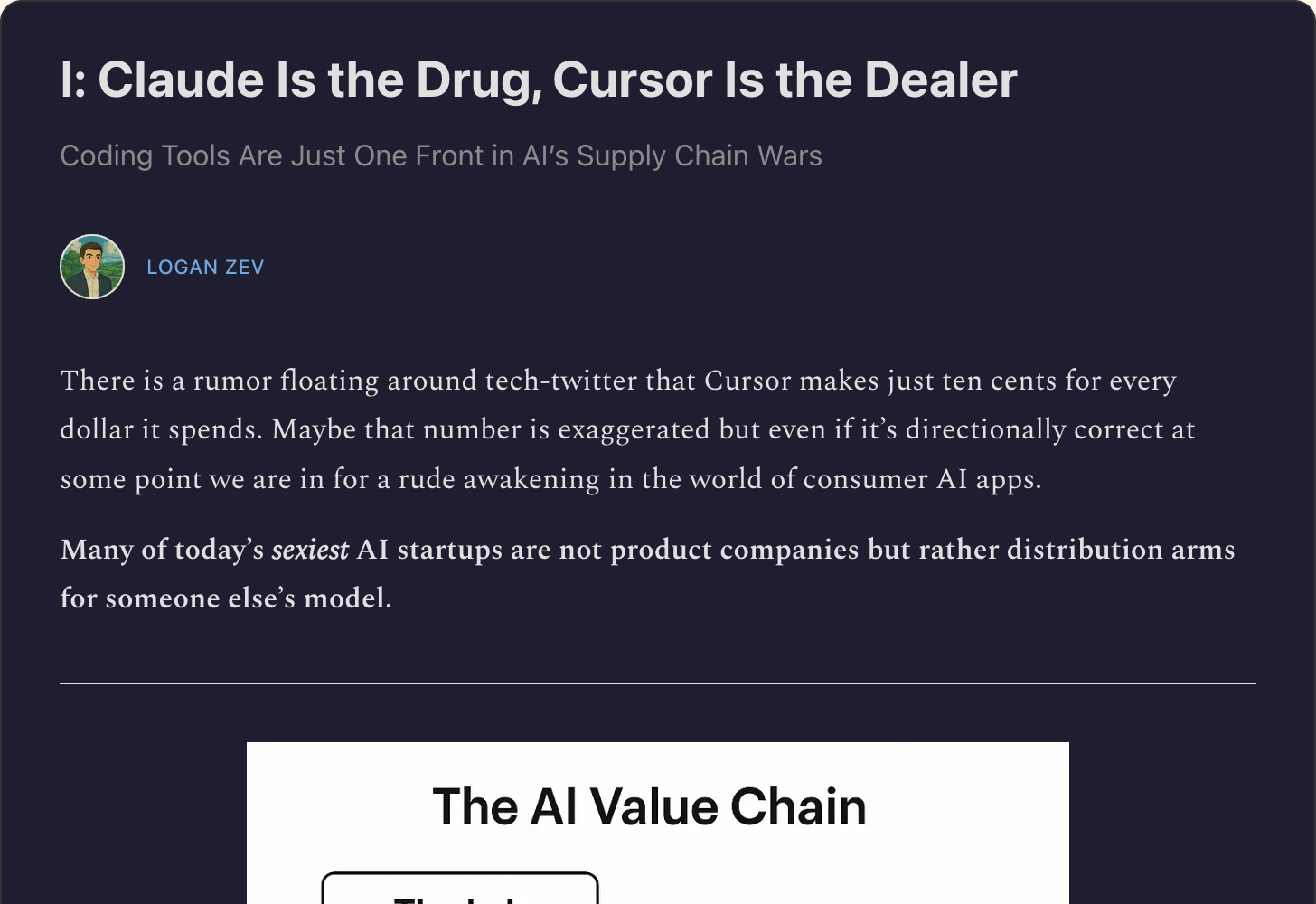
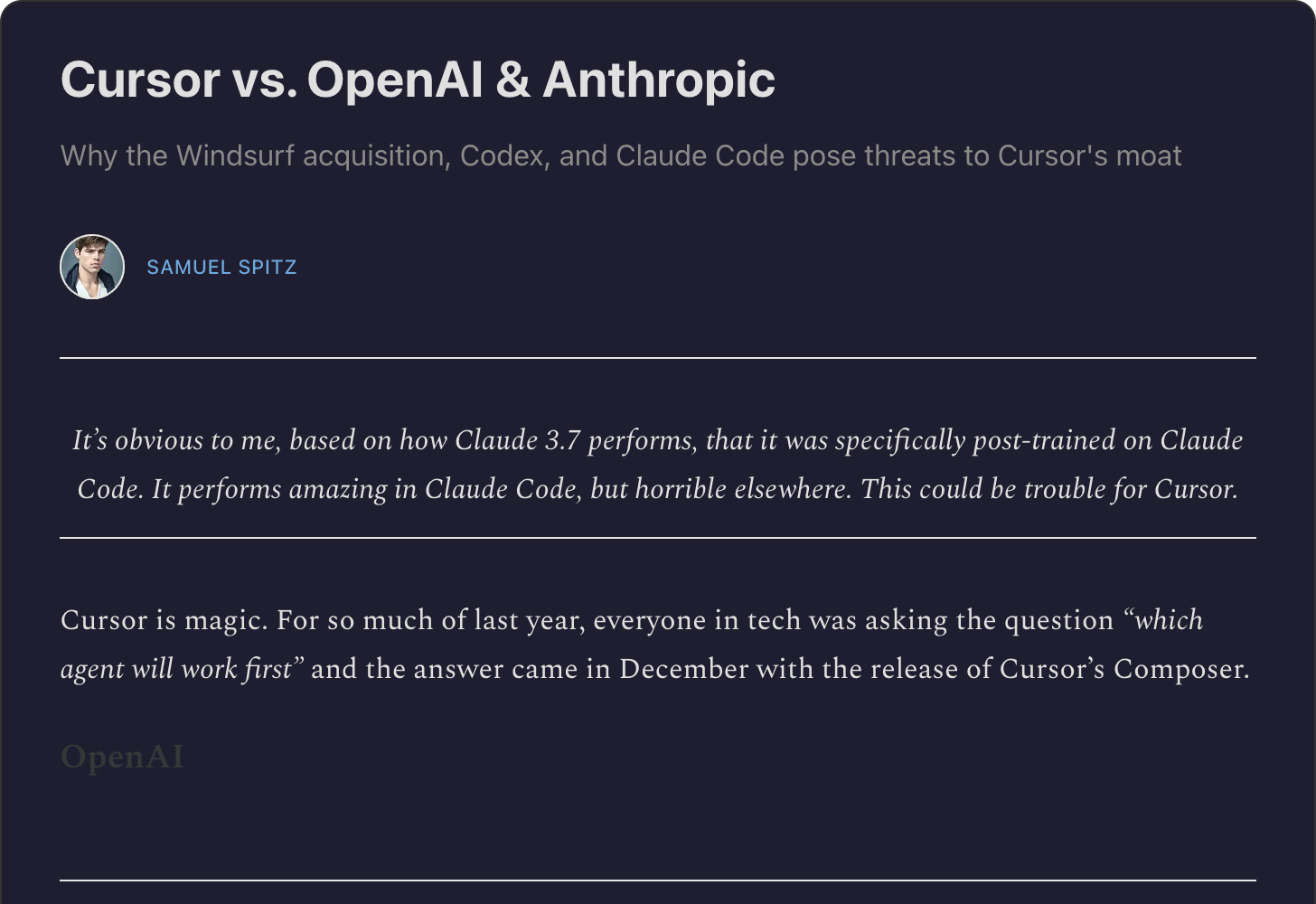
On Substack, the framing has been even sharper. One analysis titled "Claude Is the Drug, Cursor Is the Dealer" captured the dependency dynamic — developer tools that do not own their intelligence layer are distribution arms for someone else's models. They do not own the product, do not control the supply chain, and live and die by decisions made upstream.
View original post on Substack →
Yahoo Finance framed it as the moment "model supply became a competitive weapon." AllBlogThings declared API neutrality dead. The consensus is clear: the era of model access as neutral infrastructure is over.
The contrarian take: Maybe this is theater, not substance. Cursor lost 5% of its traffic — a rounding error. The tool kept working. Developers barely noticed. If model quality is converging (and it is), then the real risk is not that your vendor cuts you off — it is that switching costs are so low that no vendor has pricing power. The cutoff ledger proves the weapons exist, but the damage report says they are blanks.
Here is why that is wrong: Cursor survived because it had already diversified. The 5% number is the result of preparation, not evidence that preparation is unnecessary. Windsurf, which had not diversified, collapsed. The weapon is real. The question is whether you have armor.
What to Do About It: A Dependency Audit Framework
The fix is not "use open-source models for everything" — that trades one set of risks for another (maintenance burden, capability gaps, security exposure). The fix is architectural resilience: designing your systems so that no single provider's decision can take you offline.
Here is a practical framework for assessing your exposure:
1. Map Your Model Dependencies
For every AI-powered feature in your product, document:
- Which model provider serves it
- What contract governs that access (published terms vs. custom agreement)
- Whether a change-of-control clause exists
- What the notice period for termination is
- What percentage of your traffic each provider handles
If you cannot answer these questions for every feature, you have undocumented supply-chain risk.
2. Implement a Model-Routing Abstraction Layer
The architectural pattern that saved Cursor is a model router — an abstraction layer that sits between your application code and the model provider. Your code calls the router. The router decides which provider to hit based on availability, latency, cost, and capability.
This is not theoretical. Andreessen Horowitz's 2026 infrastructure report found that 68% of enterprises now include at least one open-source model in their production stack, up from 31% in 2024. The multi-model pattern is mainstream. For agent-level architectures, we have covered the multi-model harness pattern and cross-vendor agent queues on AgentConn.
3. Stress-Test Your Failover
Run a chaos-engineering exercise: block your primary model provider's API at the network level for 24 hours. Does your product degrade gracefully? Does it crash? Does it silently return garbage?
If you have never tested this, your multi-model architecture is a config file, not a resilience strategy.
4. Track the Cutoff Signals
Every cutoff in the ledger was preceded by a visible signal:
- Windsurf: Acquisition rumors weeks before the cut
- OpenAI (as customer): Months of competitive positioning
- Third-party harnesses: Rising traffic anomalies
- Cursor: A $60 billion acquisition announcement
Set up monitoring for ownership changes, acquisition announcements, and terms-of-service updates for every provider in your stack. The 76-day notice OpenAI gave Cursor is generous. Anthropic's revocation of OpenAI's access was same-day.
Your AI dependency audit checklist:
- List every model provider your product calls
- Document the contract type (published ToS vs. custom) for each
- Identify change-of-control and termination clauses
- Measure traffic share per provider
- Verify you have a tested failover path for each provider
- Monitor provider ownership and M&A activity
- Run a quarterly "provider down" chaos test
The Bigger Picture: API Neutrality Is Over
The Cursor cutoff is a milestone, not an anomaly. In the span of about 90 days, every major AI coding environment outside of GitHub Copilot either changed hands or had its access terms rewritten. Google shut down the open-source Gemini CLI and replaced it with a closed-source binary. Anthropic partnered with SpaceX on compute while OpenAI cut SpaceX off from models.
The model behind your AI tool is a supply chain. And like every supply chain, it is subject to geopolitical friction, competitive warfare, and ownership changes that have nothing to do with you, your contract, or the quality of the tool.
The companies that survive this era will be the ones that treated model access like electricity — not married to a single grid, but wired into multiple sources with automatic failover. Cursor proved the architecture works. The question is whether you will build it before you need it, or after.
For a deeper look at how to architect multi-model resilience at the agent level, see our coverage on AgentConn: Why Your Harness Matters More Than Your Model and Cross-Vendor Agent Queues. For the economic dimension of API dependency, read our analysis of AI token economics and the subsidy clock. And for a broader comparison of the two platforms now warring over developer tools, see Anthropic vs. OpenAI API: Which to Build On?
The model menu inside your IDE is a supply chain. Treat it like one.
ComputeLeap Team
The ComputeLeap editorial team covers AI tools, agents, and products — helping readers discover and use artificial intelligence to work smarter.
Join the discussion
Have thoughts on this article? Discuss it on your favorite platform:
Related articles
Meta's Muse Wonder Scores Big and Delivers Little
Muse Wonder benchmarks near Opus 5.5 but hits 429 walls, reads private messages, and Polymarket gives Meta 1%.
The 'Best Model' Race Is Over. Here's What Actually Matters.
Polymarket's best-model market crashed 56%. Meta launched at commodity pricing. The moat moved to agents, data, and harness.
AI Cloned Your App Overnight. Now What?
REA hit 95K GitHub stars in days. AI reverse engineering is real, and the 'too hard to rebuild' moat just collapsed.
The ComputeLeap Weekly
Get a weekly digest of the best AI infra writing — Claude Code, agent frameworks, deployment patterns. No fluff.
WEEKLY. UNSUBSCRIBE ANYTIME.