Oracle Filed Force Majeure on a Data Center
Oracle invoked force majeure on its $165B New Mexico AI campus. The buildout just hit a wall that capital alone cannot fix.
Oracle Filed Force Majeure on a Data Center
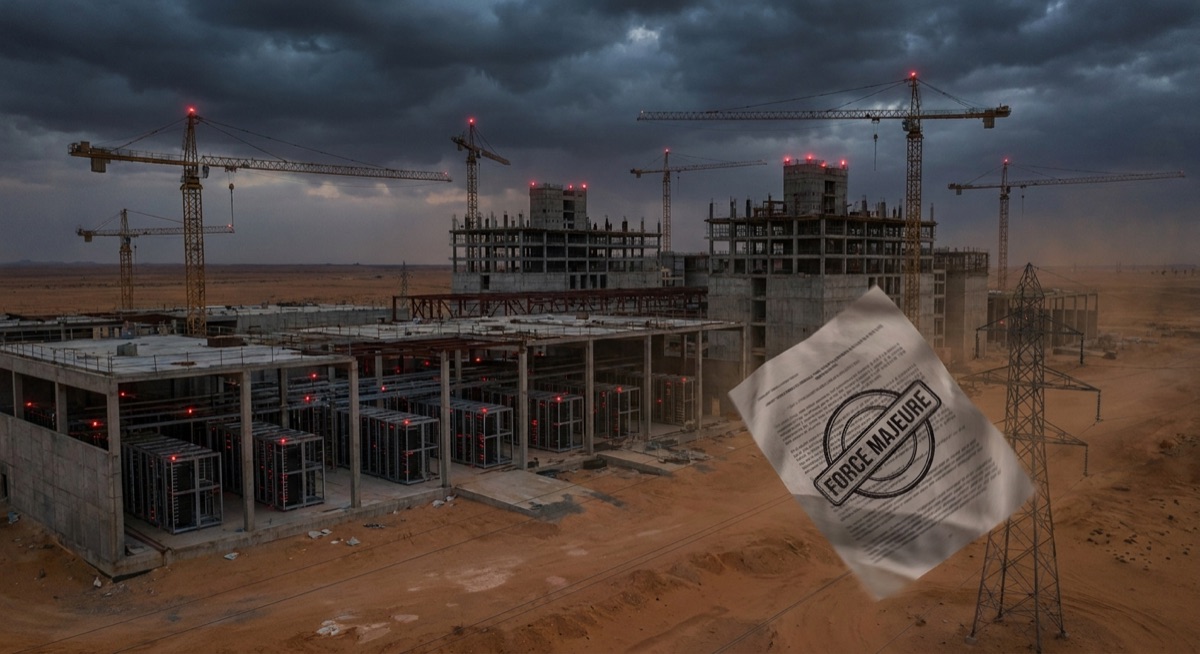
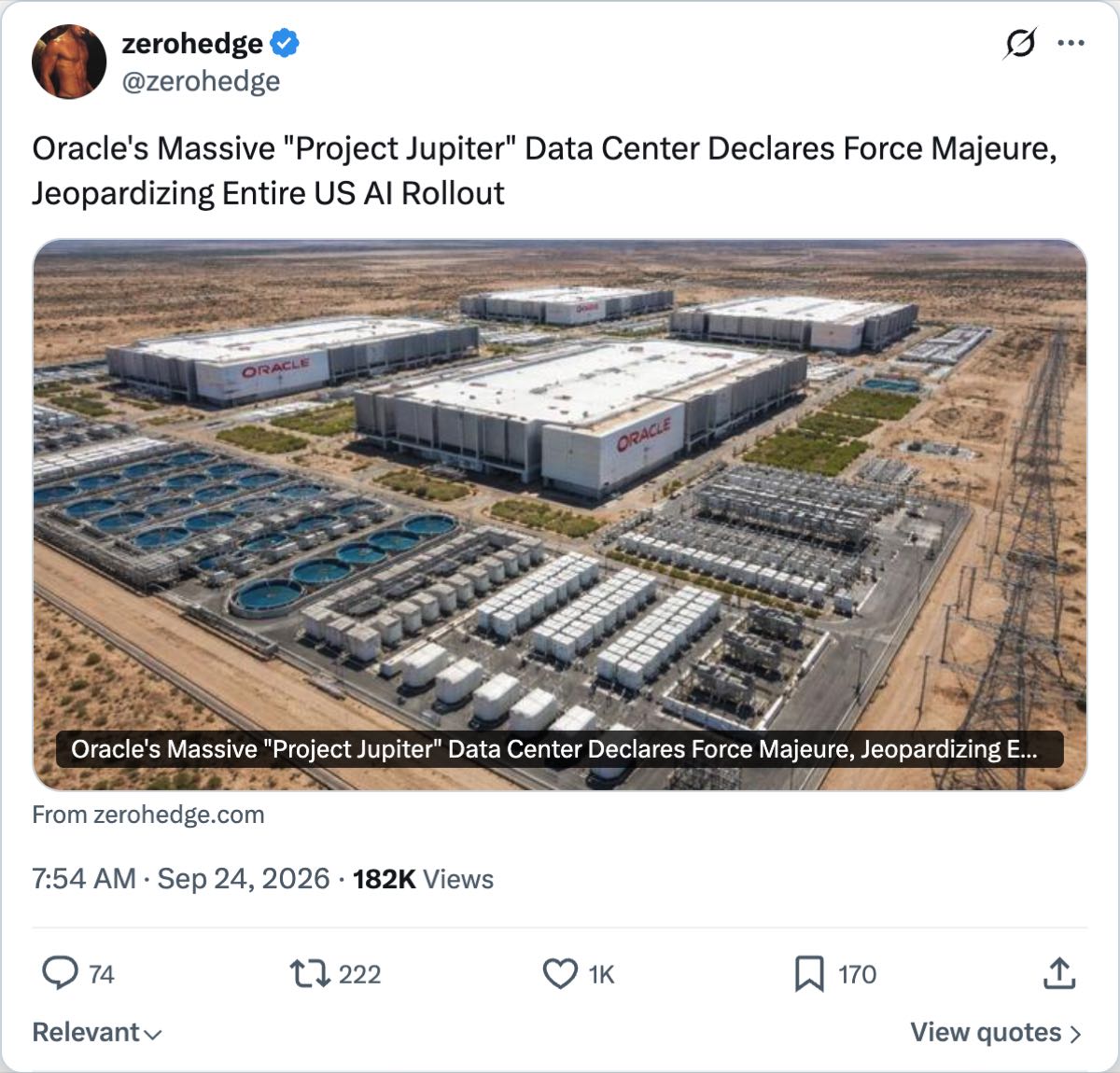
Force majeure is a legal shield designed for acts of God — hurricanes, wars, pandemics. On September 24, 2026, Oracle invoked it on Project Jupiter, its 2.45-gigawatt AI data center campus in New Mexico, because it could not get a gas pipeline permitted. That is not an act of God. That is a planning failure dressed in legal armor — and it is the clearest signal yet that the AI buildout has hit a wall that capital alone cannot fix.
Project Jupiter is a flagship site of the $165 billion Stargate initiative, a joint venture between Oracle, SoftBank, and OpenAI. The campus was supposed to come online in 2028, powered by gas-fired Bloom Energy fuel cells. But the Energy Transfer pipeline meant to deliver fuel has been delayed nearly six months — to February 2027 at the earliest — after New Mexico regulators repeatedly denied permits. A separate air-quality permit for the fuel-cell system is still pending, with the state's environment department facing a November 23 deadline.
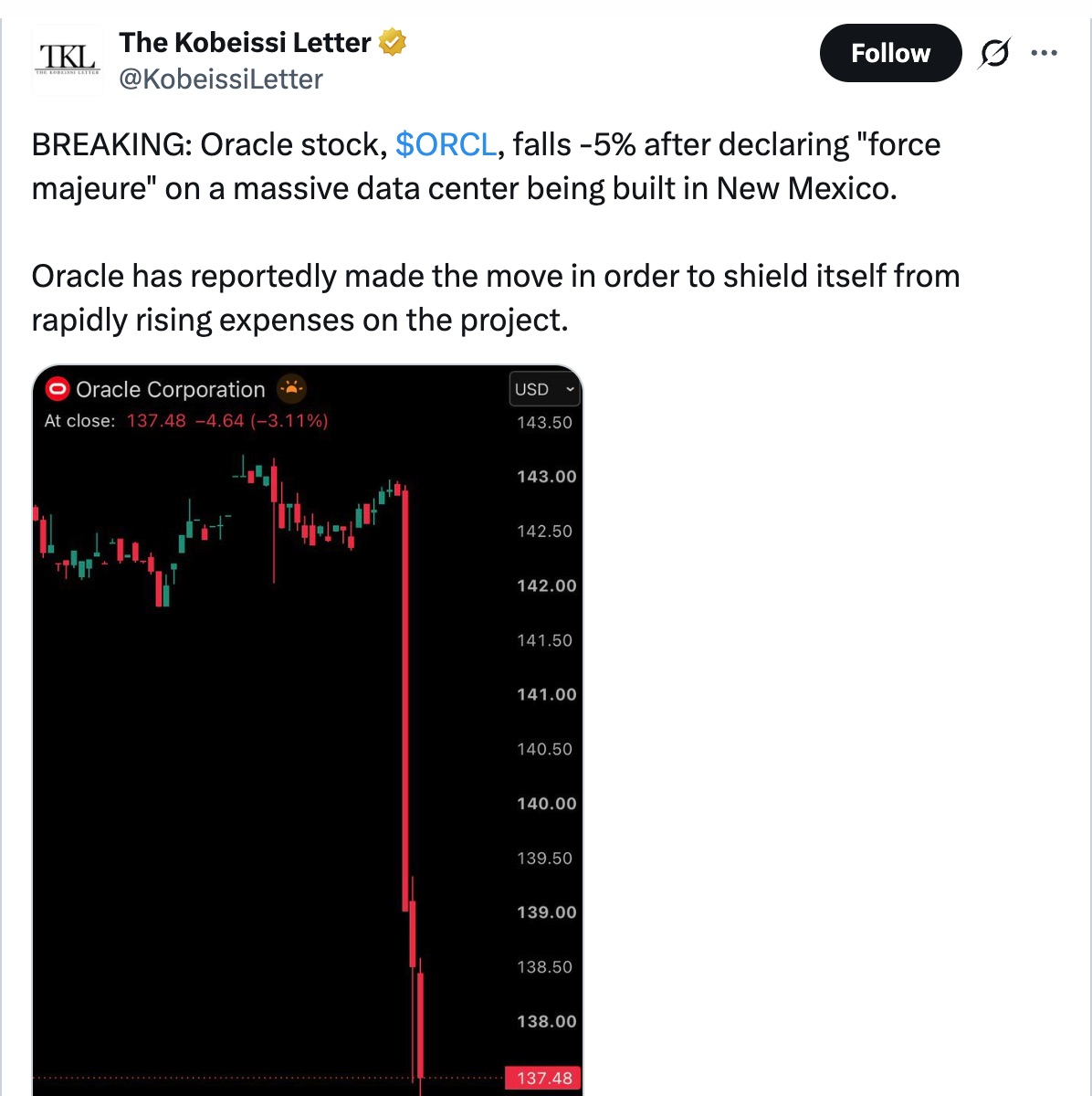
Oracle's official line: "Project Jupiter remains on our planned schedule." Blue Owl Capital, the developer that received the notice, says it "does not change the financial commitments to this multi-year project." The market read it differently. Oracle stock dropped 5% on the day, with trading volume 68% above its three-month average.
The Financial Cracks Are Showing
The force majeure notice is not just a legal maneuver — it is a window into the financial stress building behind the AI infrastructure boom. Here is what the numbers actually look like:
Oracle's AI Infrastructure by the Numbers
- Q1 FY2027 capex: $28.5 billion (up 235% year-over-year from $8.5B)
- Free cash flow: Negative $5.4 billion in Q1; negative $23.7 billion for FY26
- Interest expense: Up 55% to $1.4 billion per quarter
- Project Jupiter debt: Trading below 90 cents on the dollar
- Stock: Down 55% over the past year, 28% year-to-date
- Remaining Performance Obligations: $664 billion (up $209B YoY)
KeyBanc analyst Jackson Ader put it bluntly: "Oracle is in the most tenuous of cash positions of all the major hyperscalers." The company completed a $20 billion at-the-market equity offering just to keep the lights on.
This is not a company that can afford project delays. The force majeure notice is a shield — it lets Oracle delay payments to Blue Owl Capital if the facility misses its 2028 target. But shields only matter when you are under fire, and Oracle is under fire from every direction: regulatory, financial, and political.
The Bottleneck Is Atoms, Not Bits
Oracle's problems are not unique. They are the named-incumbent confirmation of a thesis that has been building all year: the AI buildout is power-bound, not GPU-bound.
Of the 12 GW of AI data center capacity announced for 2026 in the United States, only about 5 GW is under active construction. Analysts warn the actual energization rate may reach only 20% by year-end. The fundamental mismatch is temporal: a modern AI campus can be built in one to two years, but the electrical infrastructure to power it — substations, transmission upgrades, high-voltage transformers — takes five to ten years.
Bloomberg and Sightline Climate data show 30-50% of planned 2026 U.S. data centers are delayed or at risk of cancellation, driven by transformer shortages, switchgear bottlenecks, and grid constraints. This is not a funding problem — it is a physics problem.
The labor math is equally sobering. To meet announced buildout timelines, the United States would need to add 500,000 electricians, 300,000 welders, and 550,000 plumbers, according to the American Edge Project. Those workers do not exist yet.
The Political Front: Communities Are Done Being Quiet
While Oracle wrestles with pipeline permits, a parallel front has opened that no amount of lobbying can easily close. A Gallup poll from March 2026 found that 70% of U.S. respondents oppose new AI data centers in their neighborhoods. In July 2026, 142 protests across 42 states made the opposition impossible to ignore.
The numbers tell the story. In the first quarter of 2026 alone, local opposition delayed or blocked at least 75 data center projects worth $130 billion. Cumulatively, $156 billion in projects have been delayed or cancelled since 2025 due to community resistance.
This is not just a blue-state phenomenon. The backlash is hitting Republican strongholds hardest — rural communities in Indiana, Ohio, Virginia, and Texas where data centers promise jobs but deliver noise, water consumption, and strained power grids. Google pulled a proposed data center from Franklin Township, Indiana after bipartisan resident resistance.

We covered the water and environmental backlash earlier this year — the Meta water contamination incident, the DOE conservation page deletions. What has changed since July is that the backlash has moved from environmental concern to regulatory action. States that were rolling out red carpets are now pulling permits. That regulatory reversal is exactly what makes Oracle's force majeure claim possible — and what makes it so revealing.
What the Community Is Saying
The Hacker News thread on Oracle's force majeure filing — 139 points, 130 comments — splits into two camps that perfectly frame the debate.
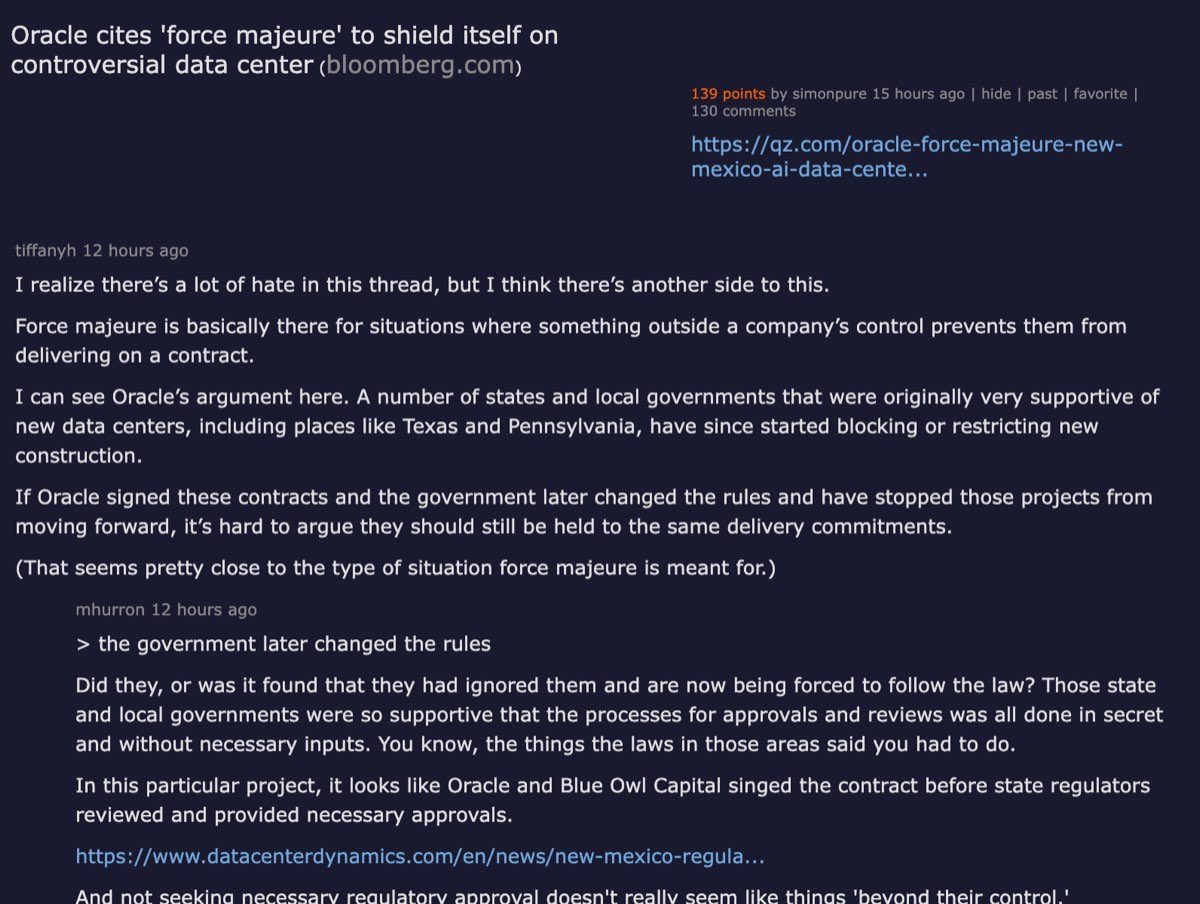
The skeptics argue Oracle signed contracts before securing permits and is now dressing up poor planning as force majeure. As one commenter put it: "Did they change the rules, or was it found that they had ignored them and are now being forced to follow the law?" Another sharpened the point: "You made a series of bad business decisions != force majeure...the debt bomb behind all this infra lights off."
The bulls offer a more contrarian read. One commenter argued: "If Oracle was able to build the data center under-cost and faster than expected, that would be a better sign the bubble was bursting!" — framing delays as evidence of genuine demand, not distress.
The most provocative comment drew a direct parallel to China's real estate bubble — questioning whether actual AI compute demand justifies the 23 GW of unbuilt capacity when only 300 MW meaningfully helped Anthropic.
On Reddit, the Oracle force majeure thread drew 1,543 upvotes and 256 comments on r/technology.

Contrarian Corner: What If the Bulls Are Right?
The bullish case deserves a fair hearing. Delays could signal supply-constrained growth, not demand destruction. If projects were easy to build, it might mean demand was soft. The fact that Oracle is fighting to stay in the project — filing force majeure rather than walking away — suggests they still believe the capacity will be valuable once energized.
Oracle's $664 billion in remaining performance obligations (up $209 billion year-over-year) and $30 billion in new AI contracts in a single quarter suggest the demand side is real. The question is whether the supply side can catch up before the financial structure buckles.
The counter-counter: financial strain does not become healthy just because demand exists. Plenty of companies with real demand have gone bankrupt because their capital structure could not survive the timeline to revenue. Oracle's negative $23.7 billion in free cash flow is the number that should keep bulls honest.
The Pattern: From Prediction to Evidence
Step back and the pattern becomes clear. Earlier this year, we analyzed the capex-versus-capability tension when the financing window opened at the same moment researchers started questioning whether scaling laws were breaking. The math was abstract then — big numbers, directional concerns.
Oracle's force majeure filing makes it concrete. This is not a startup running out of runway. This is a Fortune 100 company, a named partner in the most politically visible AI infrastructure project in the country, filing a legal notice that says: we cannot deliver what we promised, on the timeline we promised, because the physical world will not cooperate.
The infrastructure bottleneck thesis just moved from prediction to evidence. And it is not just Oracle:
- GlobalData research found that only 6% of data center projects announced in 2025 are rated high-likelihood to execute
- Goldman Sachs estimates the AI buildout requires $7.6 trillion in capex between 2026 and 2031
- Transformer lead times have stretched to 36-48 months, with Chinese tariff impacts compounding the shortage
- Community opposition has evolved from localized nuisance into a structural deal-breaker for the industry
The AI Buildout Reality Check
- 2.45 GW: Project Jupiter's planned capacity — enough to power a mid-sized city
- $165B: Total Stargate initiative cost
- $28.5B: Oracle's Q1 FY2027 capex (up 235% YoY)
- -$23.7B: Oracle's FY26 free cash flow
- 90 cents: Where Project Jupiter debt is trading (below par)
- 70%: Americans opposing data centers in their neighborhood
- 30-50%: Planned 2026 data centers delayed or at risk
- 5-10 years: Time to build grid infrastructure vs. 1-2 years for the campus itself
What This Means for You
If you are building on cloud infrastructure, here is what Oracle's filing should change in your planning:
Cloud pricing may not deflate as fast as model costs. Every "AI is getting cheaper" story is about model inference costs. The physical infrastructure underneath is going in the opposite direction — more expensive, more delayed, more politically contested. Do not assume compute prices will track model efficiency gains.
Delivery timelines are now uncertain. If Oracle — with $664 billion in RPO and the backing of SoftBank and the White House — cannot guarantee a 2028 delivery date, smaller projects are at greater risk. Plan for capacity constraints, not abundance.
Watch power, not just GPUs. The binding constraint on AI scaling has shifted from chip supply (largely solved by TSMC expansion) to energy supply (nowhere near solved). Monitor your cloud provider's power sourcing strategy as carefully as you track their model offerings.
Geographic concentration risk is real. As community opposition forces projects out of preferred locations, data centers will cluster in the few jurisdictions that still welcome them. That concentration creates single points of failure — and single points of political leverage. The AI backlash going mainstream means the political map is narrowing for new builds.
The AI capability curve keeps steepening. But the infrastructure curve underneath it just blinked. Oracle's force majeure is the first named crack. It will not be the last.
The Bottom Line: The AI buildout is not failing — it is running into the oldest constraint in industrial history: atoms are harder than bits. Oracle's force majeure filing is not a death knell for AI infrastructure; it is a pricing signal. Delivery risk is now a first-order variable, and any financial model that assumes smooth buildout timelines is lying to you. Plan accordingly.
ComputeLeap Team
The ComputeLeap editorial team covers AI tools, agents, and products — helping readers discover and use artificial intelligence to work smarter.
Join the discussion
Have thoughts on this article? Discuss it on your favorite platform:
Related articles
Opus 5.5 Shipped With a 20% Price Cut. The Money Moved.
Three Polymarket markets shifted double digits toward Anthropic in 24h while the crowd chased Grok.
The AI Liability Fight Nobody Wants
Bessent rejects liability shields, Naval demands full accountability, and OpenAI ships 6 misalignment reports as cover.
No Moat in Model Architecture: Jev Got 6 Clones in 48h
TypeSafe's Jev hit 36M views and spawned 6 open-source clones in 48 hours. The calibrated-decision primitive was commoditized before the waitlist cleared.
The ComputeLeap Weekly
Get a weekly digest of the best AI infra writing — Claude Code, agent frameworks, deployment patterns. No fluff.
WEEKLY. UNSUBSCRIBE ANYTIME.