Tencent Hy3: 295B Params, 21B Active — Can You Run It?
Tencent's Apache-2.0 MoE needs 295GB+ VRAM despite 21B active params. Here's the hardware math — and why the API economics win.
Tencent Hy3: 295B Params, 21B Active — Can You Run It?
Tencent just dropped Hy3, a 295-billion-parameter Mixture-of-Experts model with 21 billion active parameters per token, under an Apache 2.0 license. The headline numbers invite a specific fantasy: a frontier-class model that activates only 21B parameters should run on a beefy workstation, right? That fantasy is wrong — and the reason it's wrong tells you more about where open-weights AI is actually heading than any benchmark table.
Here's the thesis: Hy3's real innovation isn't the model. It's the licensing strategy. While Meta gates Llama behind revenue caps and registration requirements, Tencent shipped genuinely permissive weights for a model that trades blows with GLM-5.2 and DeepSeek-V4-Pro — models two to five times its size. The "Can You Run It?" question has a clear answer (not locally, not without serious iron), but the "Should You Use It?" question is where things get interesting.
Architecture Deep-Dive: How 295B Becomes 21B
Hy3's architecture is a dense-attention, sparse-FFN Mixture-of-Experts design. The specifics: 80 transformer layers (plus one Multi-Token Prediction layer), 64 attention heads with Grouped Query Attention, and 192 routed experts per MoE layer with one always-active shared expert. A learned router picks the top 8 experts per token — so out of 295B total parameters, only ~21B fire on any given forward pass.
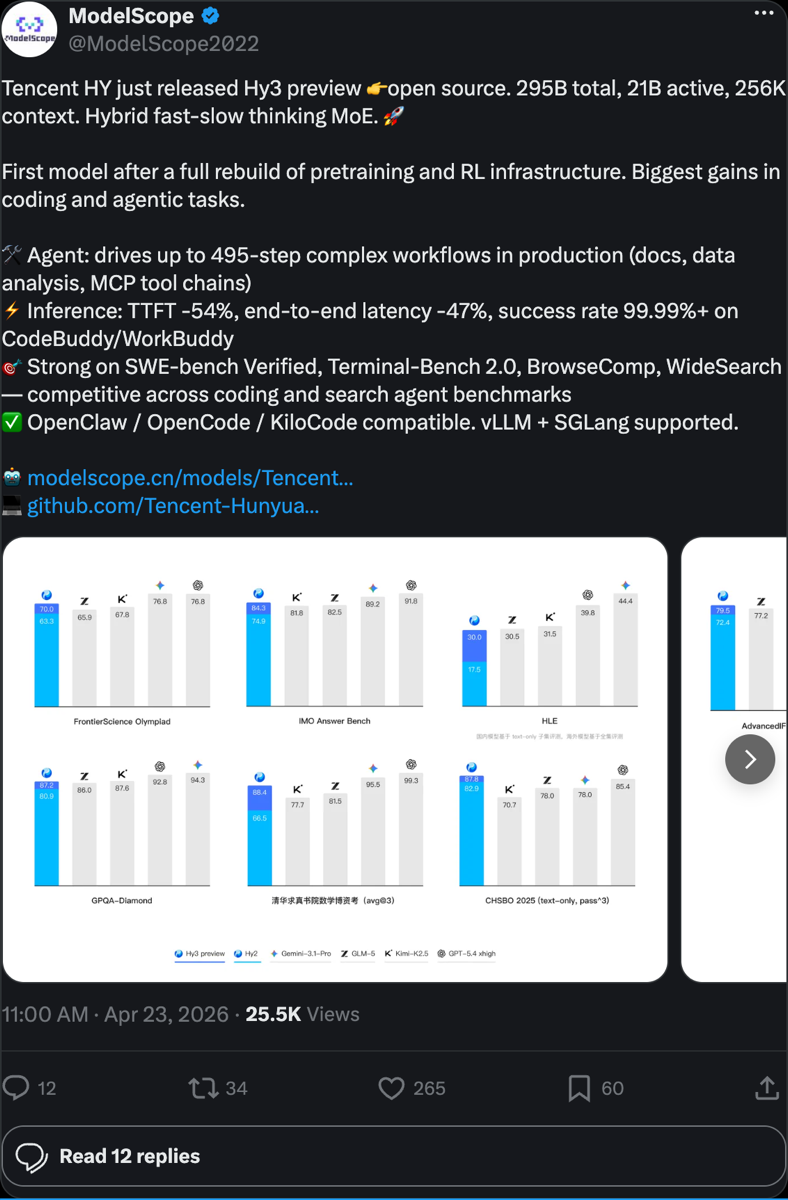
The MTP layer deserves attention. It enables speculative decoding in frameworks like vLLM and SGLang, predicting multiple tokens ahead and verifying in parallel. Tencent reports this cuts time-to-first-token by 54% and end-to-end latency by 47% in production.
The context window stretches to 256K tokens with a vocabulary of 120,832 — large enough to digest entire codebases or long documents without chunking. The model was rebuilt from scratch after the April preview, with post-training scaled up using feedback from 50+ internal Tencent products.
Benchmarks: Where Hy3 Wins (and Where It Doesn't)
Let's be specific about what the numbers show.
Where Hy3 excels:
- GPQA Diamond (graduate-level science): 90.4 — competitive with models 5× its active parameter count
- USAMO 2026 (math olympiad): 72.0
- FrontierScience-Olympiad: surpasses GPT-5.5 on scientific research tasks
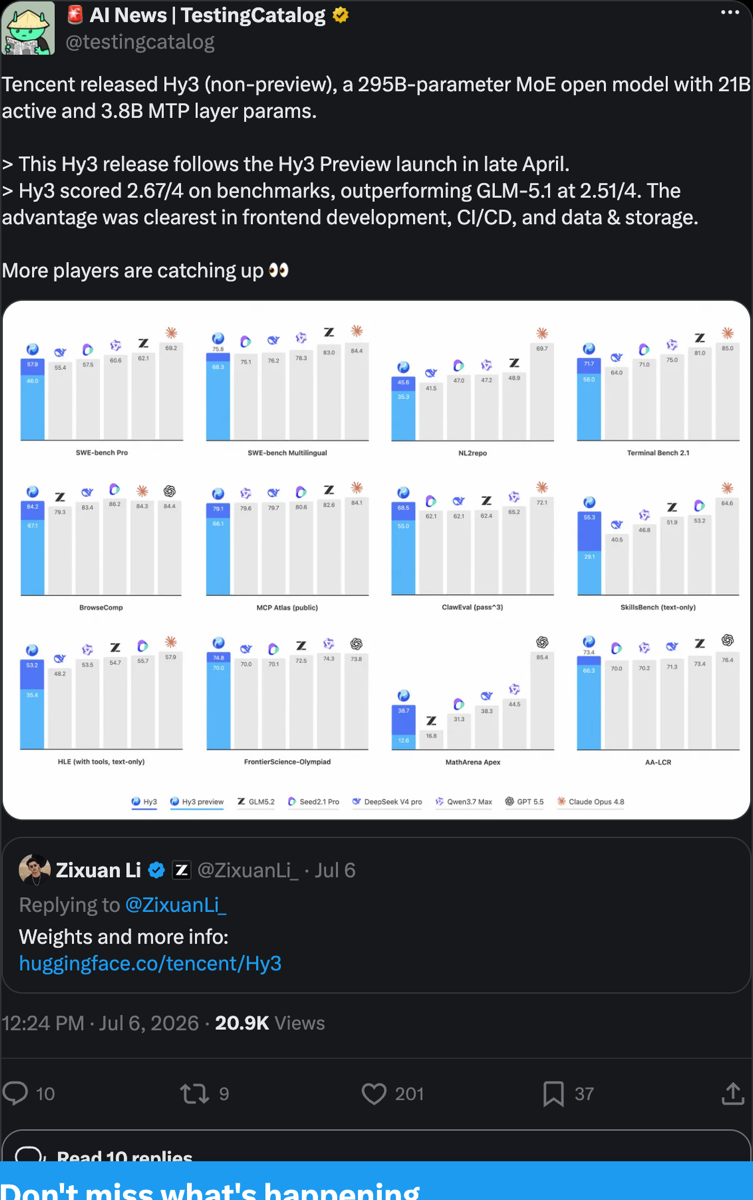
- Token efficiency: completes WorkBuddy agent tasks with 47.4% fewer tokens than GLM-5.2
- A blind expert evaluation with 270 participants rated Hy3 at 2.67/4, outperforming GLM-5.1 (2.51/4), with particular strength in frontend development
Where Hy3 falls short:
- SWE-Bench Verified (real-world bug fixing): 78.0 vs. GLM-5.2's 84.2. For repository-scale coding, GLM-5.2 still leads
- The gap isn't surprising — GLM-5.2 runs 753B total / ~40B active parameters, roughly double Hy3's compute budget per token
The cost-performance trade-off is where Hy3 shines. On Artificial Analysis, Hy3 prices at $0.12/M input tokens (median across comparable models: $0.59) and $0.43/M output tokens (median: $2.20). That's a 5× input cost advantage over the median.
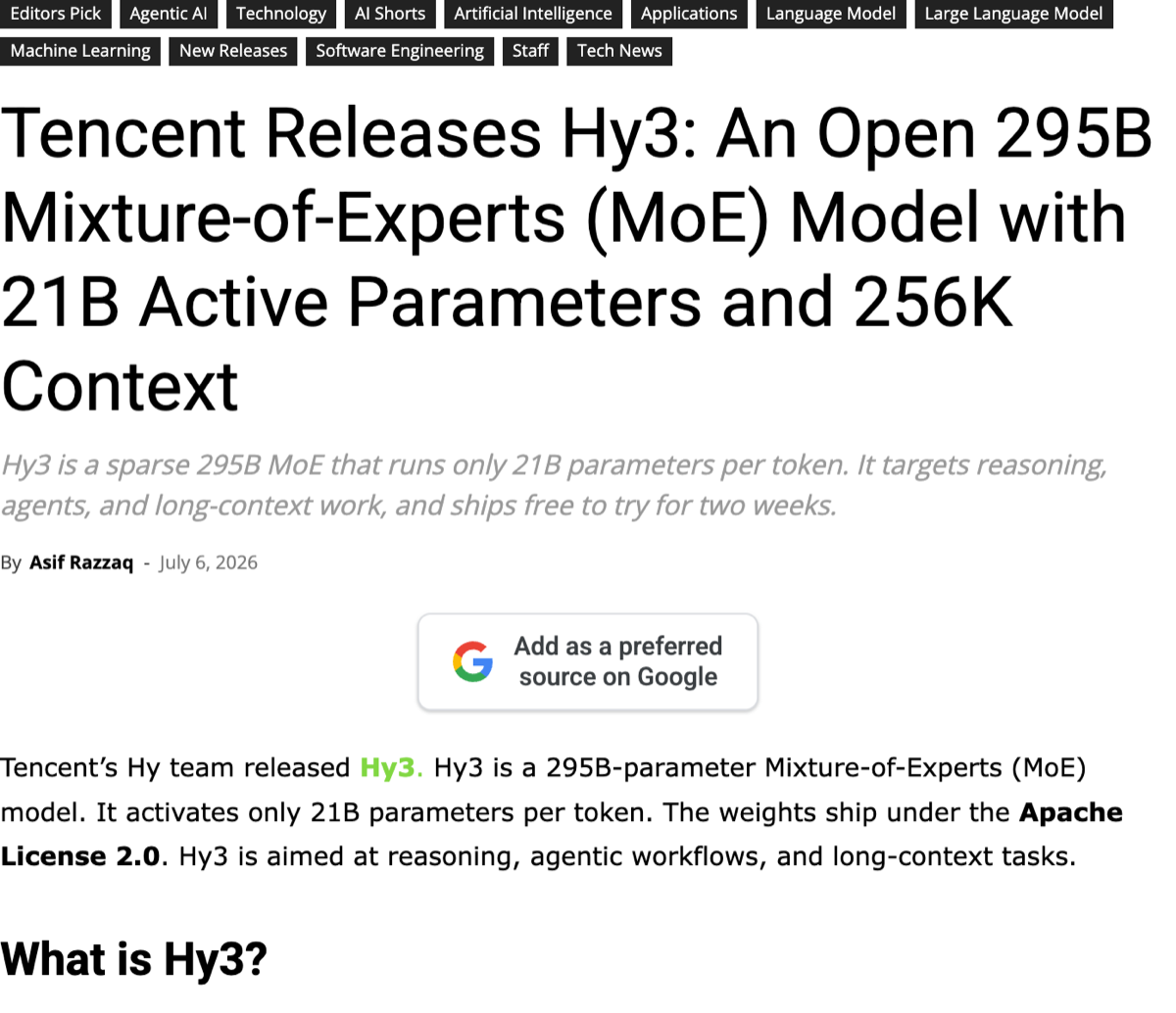
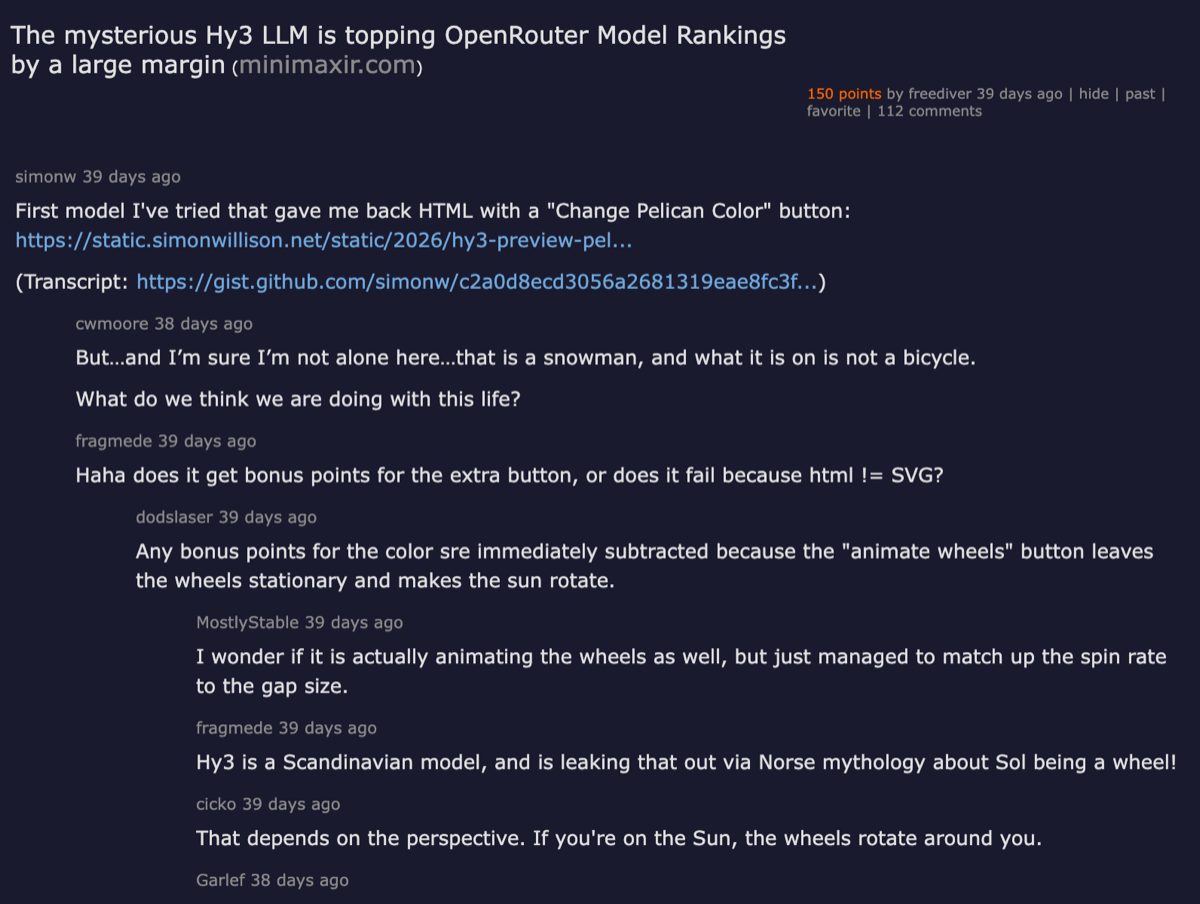
During the preview period, Hy3 reached #1 in overall token usage on OpenRouter, #1 in coding, and #1 in tool calls with 15.4% market share across all providers. The Hacker News community noticed before most of the tech press did — "the mysterious Hy3 LLM is topping OpenRouter rankings by a large margin" was the thread title that first surfaced the model in Western developer circles.
The Hardware Reality — Can You Actually Run It?
This is where the "21B active" number gets misleading. In a Mixture-of-Experts architecture, all 295B weights must stay resident in GPU memory — the router needs instant access to every expert to select the top-8. You cannot swap experts in and out of VRAM on demand without latency spikes that make the model unusable.
Here's the actual hardware math:
| Configuration | VRAM Required | Use Case | Cost (Spot) |
|---|---|---|---|
| BF16 (full precision) | ~590 GB | 256K context, max throughput | 8× H200 SXM5 — $14.56/hr |
| FP8 (quantized) | ~295 GB | 32–64K context, cost-optimized | 4× H200 SXM5 — $7.28/hr |
| KV cache (256K context) | +80–120 GB | Per concurrent sequence | Additional overhead |
For reference, a Mac Studio M4 Ultra maxes out at 512GB unified memory. Even the FP8 checkpoint (300GB on Hugging Face) would consume over half of it, leaving almost nothing for the KV cache. A single NVIDIA H100 has 80GB of HBM3 — you'd need four of them just for the weights, and even then you're tight on context. Consumer hardware is not an option.
Compare this to models where "run it locally" actually works: Gemma 4 12B fits in 8GB VRAM. DeepSeek's distilled models run on a single GPU. Even GLM-5.2's local setup is documented for multi-GPU workstations. Hy3 is firmly in cloud-or-datacenter territory.
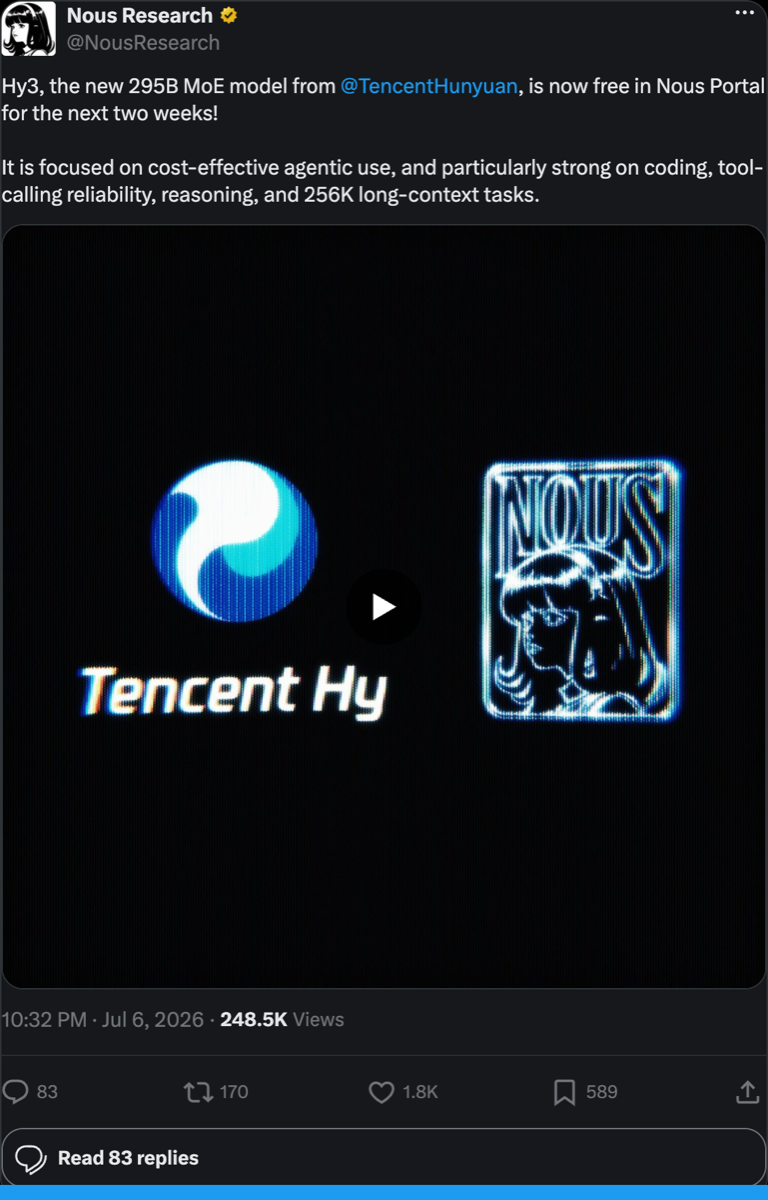
But here's the thing: the economics still work. Self-hosted Hy3 on 8× H200 spot instances runs $0.90–$1.62 per million output tokens — compare that to GPT-4o at $10/M or Claude Opus at $75/M. And via API, the free OpenRouter period runs through July 21, after which pricing stays well below the median.
Apache 2.0 vs. Llama's Fine Print
This is the part of the Hy3 release that matters most for anyone building production systems.
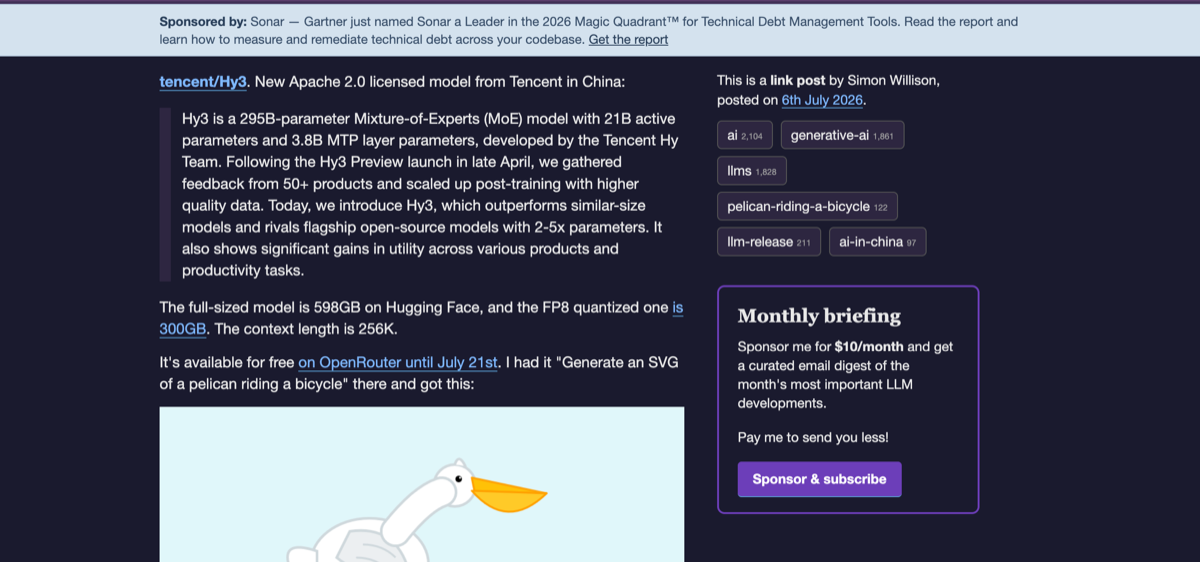
Simon Willison's read nails it: Apache 2.0 is a direct undercut of Meta's gated approach with Llama. Here's what that means in practice:
| Hy3 (Apache 2.0) | Llama (Meta License) | |
|---|---|---|
| Commercial use | Unrestricted | Revenue cap (varies by version) |
| Geographic restrictions | None | Embargo-country exclusions |
| Registration required | No | Must register with Meta |
| Derivative models | Full freedom | Must include "Built with Llama" |
| Fine-tuning & redistribution | Standard Apache terms | Subject to Meta's acceptable use policy |
For startups and enterprises alike, this matters. If you're building a product on open weights and your legal team has to review Meta's licensing terms — which change across Llama versions and include provisions about competitive use — Apache 2.0 eliminates that entire conversation. You know what you're getting. The open-source community's reaction was immediate: the license change from April's restricted preview to July's Apache 2.0 was "the real headline," not the benchmark numbers.
Contrarian Corner: China's Agent Stack Play
The dominant narrative frames Hy3 as "China catching up" in open weights. That framing misses what's actually happening. On the same day Tencent released Hy3, they also shipped CubeSandbox (agent sandboxing in Rust, 8.3K stars) and TencentDB-Agent-Memory (local agent memory, 7.1K stars). This isn't a model drop — it's a coordinated stack deployment.
Look at it from Tencent's perspective: Hy3 powers their agent features across WorkBuddy, CodeBuddy, Yuanbao, ima, Marvis, and even WeChat. Average daily token consumption grew twenty-fold since the preview. They're not releasing weights as charity — they're making the model the default choice for anyone building agent infrastructure, then shipping the infrastructure layer alongside it.
This is the pattern the GitHub trending page confirms: 12 of 15 trending repos are agent-related, and Tencent has multiple entries. The West argues about which frontier lab is #1 on the leaderboard while Chinese labs build the complete agent stack — model, sandboxing, memory, tooling — under the most permissive license available. That's not catching up. That's playing a different game.
What This Means for You
If you're evaluating open-weights models for an agent stack: Hy3 is now the strongest Apache 2.0 option for agentic workloads. It beats the previous generation on tool-calling reliability (4% accuracy variance across agent frameworks — the lowest reported) and handles up to 495-step complex agent tasks. The licensing alone puts it ahead of Llama for any team where legal review is a bottleneck.
If you want to self-host: You need datacenter GPUs. The minimum viable configuration is 4× H200 (FP8, 32–64K context). That's $7.28/hr on spot instances — plausible for a funded startup, not for a weekend project. But self-hosted per-token costs ($0.90–$1.62/M output) crush the API pricing of closed models.
If you're comparing models right now: Hy3 sits in a specific sweet spot. It won't beat GLM-5.2 on pure coding tasks (78.0 vs. 84.2 on SWE-Bench), and DeepSeek-V4-Pro at 1.6T parameters has more raw capability. But Hy3 delivers 80–90% of that performance at a fraction of the compute cost, with no licensing strings attached. For many production workloads — especially agentic ones with lots of tool calls and long contexts — that's the better trade-off.
If you just want to try it: Nous Research is offering Hy3 free on their Portal for two weeks. OpenRouter has the same deal through July 21. Run it against your own evaluation suite before the free window closes — the cost advantage matters most when you know your workload's token profile.
The bottom line: Hy3 is the strongest argument yet that the future of open-weights AI isn't about parameter counts or leaderboard positions. It's about who ships the most useful model under the terms that let you actually build with it. Right now, Tencent is winning that race.
ComputeLeap Team
The ComputeLeap editorial team covers AI tools, agents, and products — helping readers discover and use artificial intelligence to work smarter.
Join the discussion
Have thoughts on this article? Discuss it on your favorite platform:
Related articles
JetBrains Posts Its First-Ever Loss. The Terminal Won.
JetBrains lost $14M chasing AI while Cursor hit $4B ARR. The IDE era is ending, but the fight over the agentic terminal just started.
Your AI Chatbot Has a Legal Department Now
A Florida woman's Claude diary entry led to a felony charge. Courts ruled AI chats are discoverable. Here is what builders need to know.
Gemini 4 Argon Wins 12 of 18 Benchmarks. Code Isn't One.
Google's Gemini 4 Argon leads on reasoning, agentic tasks, and hallucination — but ranks 8th in Code Arena. What that split means.
The ComputeLeap Weekly
Get a weekly digest of the best AI infra writing — Claude Code, agent frameworks, deployment patterns. No fluff.
WEEKLY. UNSUBSCRIBE ANYTIME.