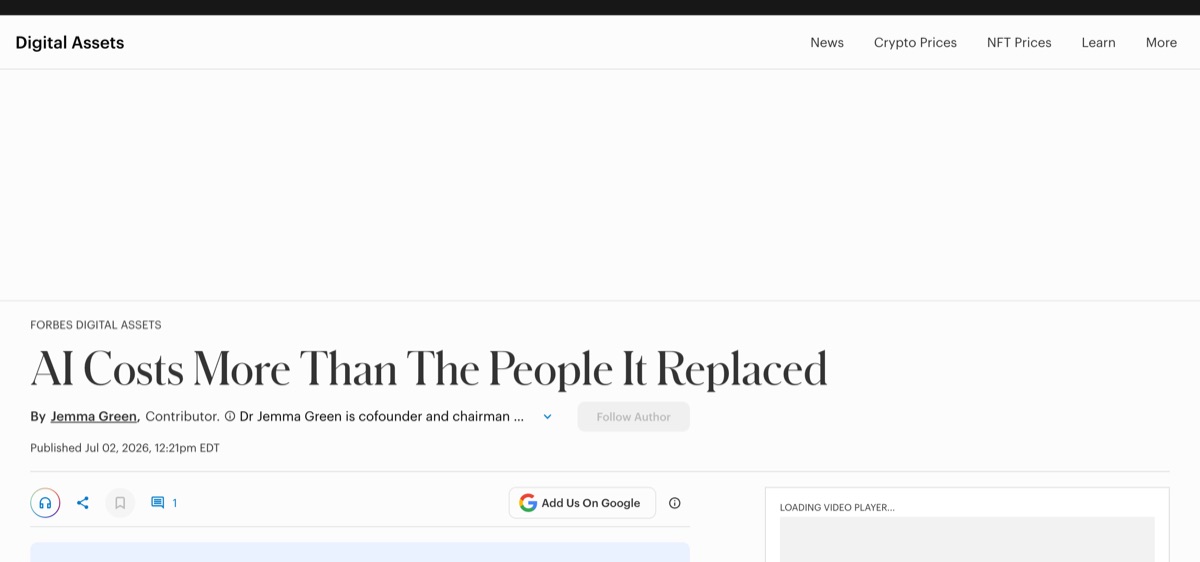
AI Still Costs More Than the Human It Replaces
Token math shows AI is cheaper in only 23% of roles. Here's the real unit economics and what must change.

The technology pitched as the great labor equalizer has a dirty secret: at current token prices, a human employee is cheaper than an AI agent for 77% of enterprise tasks. That is not a guess — it is the finding from MIT's economics lab, and the math is getting worse before it gets better.
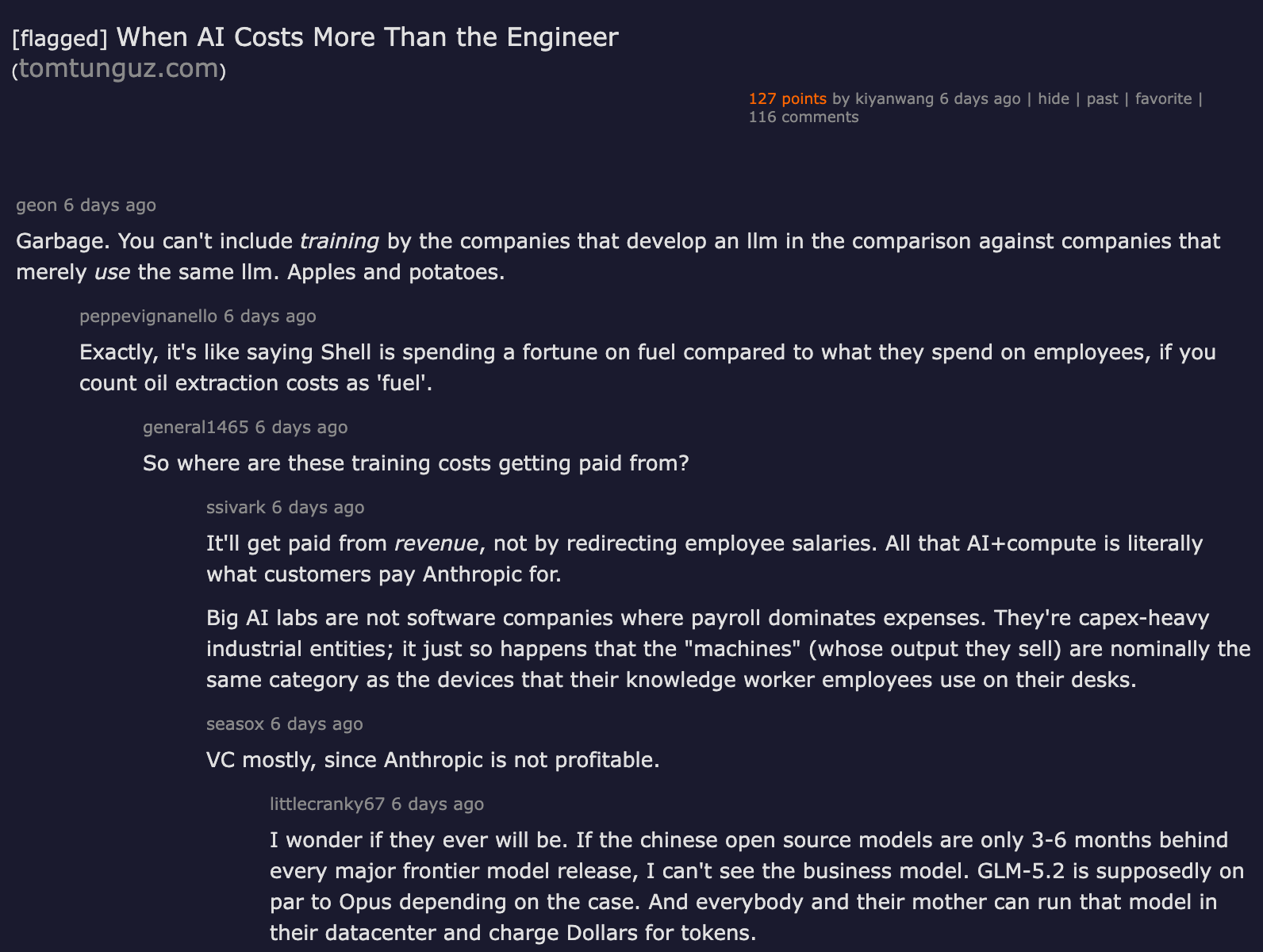
Uber burned through its entire 2026 AI coding budget by April. Microsoft canceled Claude Code licenses after an internal audit showed daily token consumption had quadrupled. Nvidia's VP of applied deep learning, Bryan Catanzaro, admitted on the record that "the cost of compute is far beyond the costs of the employees." And this week, Palo Alto Networks CEO Nikesh Arora went on CNBC and told the AI industry, point-blank, that token costs must drop 90% for enterprises to adopt AI at scale.
The moat is not intelligence. It is unit economics. And right now, the unit economics say: keep the human.
The $2-for-$1 Problem
Here is the number that should terrify AI investors: OpenAI spends approximately $2 for every $1 it earns on inference. The company projects $44 billion in cumulative losses before reaching profitability, potentially by 2029. Anthropic, Google, and Meta are all pricing inference below the cost of serving it, burning venture capital to buy market share.
This means the prices enterprises are paying today are not real prices. They are subsidized introductory rates — the AI equivalent of a cable company's first-year deal. When the subsidy ends, what happens?
The answer is already visible. In April 2026, Anthropic moved enterprise customers from flat-rate plans to usage-based billing tied to actual compute. GitHub followed weeks later with the same shift for Copilot, after quietly absorbing up to eight times the subscription value for heavy users. Analysts project that when pricing normalizes to reflect real infrastructure costs, enterprise AI bills will rise another 30 to 50 percent above current levels.
Let that sink in. The AI that already costs more than your employees is about to get more expensive.
The Token Math: What a Task Actually Costs
Let's do the math that most AI vendor pitches skip.
A mid-level software engineer in the US costs roughly $150,000 per year fully loaded (salary, benefits, taxes, equipment). That is about $75 per hour, or $600 per 8-hour day.
Now consider what it costs to replace that engineer's daily output with frontier AI models.
The token consumption reality:
- A Microsoft internal audit found the average Copilot user consumed 1.2 million tokens per day in Q1 2026 — quadruple the figure from early 2025
- At current Azure OpenAI pricing, that translates to roughly $15 per developer per day, or $3,600 per year
- But that is for code completion, not agentic work. Agentic AI — the kind that actually replaces tasks, not just autocompletes them — consumes up to 1,000x more tokens per operation
Reasoning model costs blow up the math:
- OpenAI's o3 model costs $60 per million output tokens. A query that shows 500 output tokens in the response may actually consume 3,000+ tokens including reasoning
- At o3 rates, a complex coding task that generates 50,000 reasoning tokens costs roughly $3. Run 200 such tasks per day (what a productive engineer does), and you hit $600 — matching the human's daily cost
- But the human also attends meetings, mentors juniors, writes documentation, handles on-call, and makes judgment calls about what not to build. The AI does none of that
The real killer is reasoning-token burn. Every time an AI model "thinks" through a problem, it generates invisible tokens billed at the output rate. A task that looks like it cost $0.50 in visible output may have consumed $5 in reasoning. Multiply across an organization of 5,000 engineers, and you get Uber: an entire annual budget gone in four months.
Uber's Cautionary Tale
Uber's experience has become the canonical case study for AI cost blowouts, and the details are instructive.
In February 2026, 32% of Uber's engineers were using Claude Code. By March, the number hit 84%. By April, the entire annual AI budget was exhausted. Here is why:
-
Consumption-based pricing meets viral adoption. Claude Code does not charge per seat. It meters tokens consumed across model calls. An engineer running autocomplete uses a fraction of what an engineer orchestrating parallel agents across a monorepo consumes. Uber did not model for the latter.
-
Gamification backfired spectacularly. Uber built internal leaderboards ranking engineers by Claude Code usage. The cultural incentive was clear: use more AI = better employee. Token consumption became a proxy for productivity, regardless of whether the output was valuable.
-
Code churn exploded. By spring, 70% of committed code originated from AI tools. But code volume does not equal value. Under high AI adoption, code churn increased by more than 800%. Engineers were generating, reviewing, reverting, and regenerating — all of it burning tokens.
The result: 95% of Uber engineers were monthly AI users, but the productivity gains could not be measured against the cost. Uber's COO publicly questioned whether it was worth it.
The Tokenmaxxing Trap
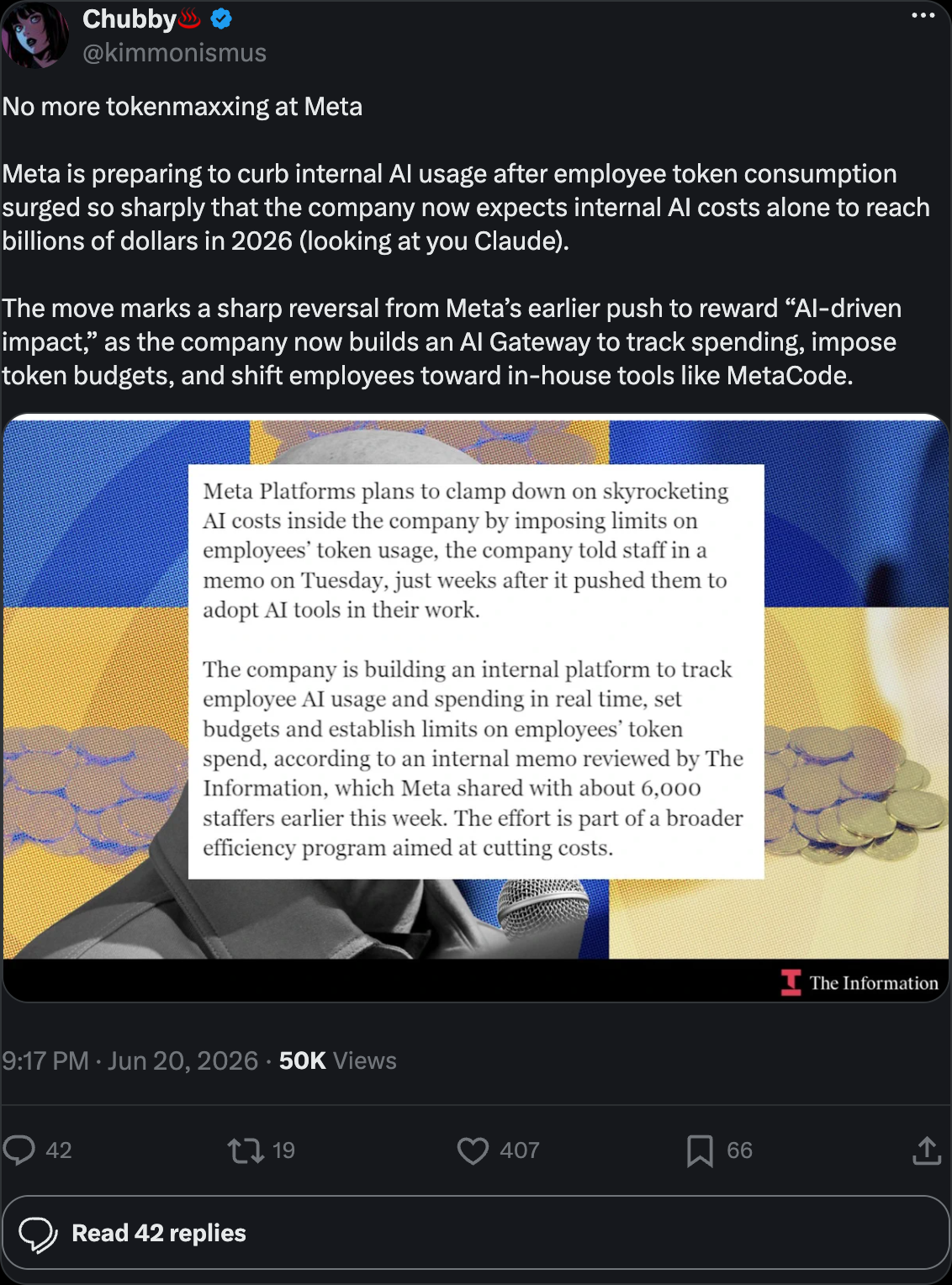
Uber is not alone. A phenomenon called "tokenmaxxing" — treating AI token consumption as a proxy for productivity — has swept through Big Tech.
Meta built an internal tracker called "Claudeonomics" and ran leaderboards where 85,000 employees competed to be the top AI token consumer. Total consumption hit 60 trillion tokens in a single month. Amazon created "KiroRank" with similar incentive structures. One Anthropic employee reportedly spent $150,000 on Claude Code in a single month. For that to be cost-effective, that single engineer would need to deliver the output of 11 regular engineers.
Palo Alto Networks spends about $1 million per day on AI tokens. Arora told CNBC that could rise to $2-3 million per day with broader adoption. A large healthcare organization saw token usage grow 8-10% monthly, reaching roughly one trillion tokens and more than $6 million in annualized costs within six months.
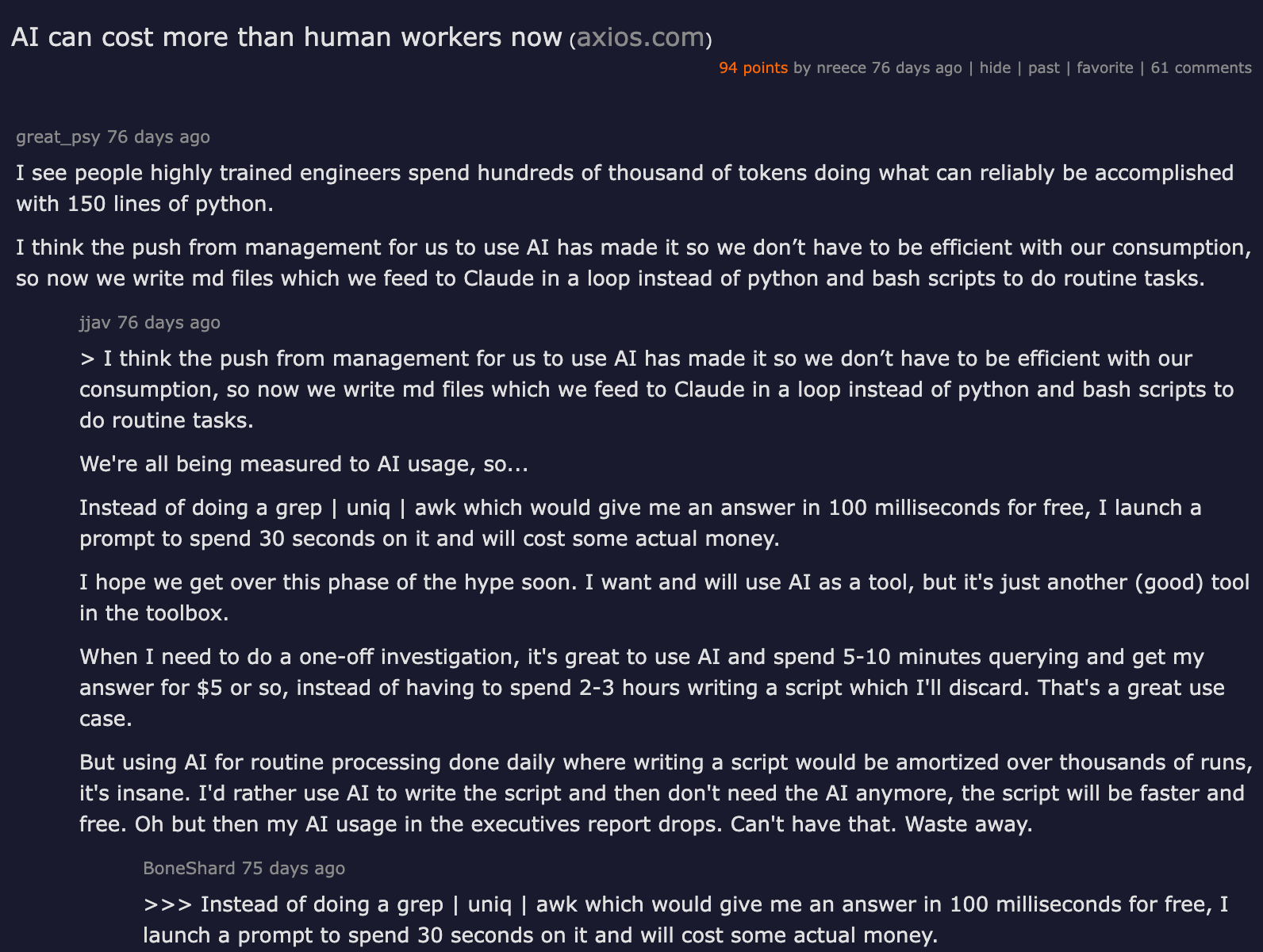
As one Hacker News commenter put it: "I see highly trained engineers spend hundreds of thousands of tokens doing what can reliably be accomplished with 150 lines of Python."
The 77% Problem
MIT's finding that AI automation is economically viable in only 23% of roles is not just a headline stat — it reveals a structural problem.
The roles where AI excels (and is genuinely cheaper) share specific characteristics:
- High volume, low complexity: Customer service triage, data entry, basic content generation
- Structured inputs and outputs: Form processing, code completion with clear patterns, translation
- Tolerance for errors: First drafts, brainstorming, initial research where a human reviews anyway
The remaining 77% fail the cost test for predictable reasons:
- Judgment-heavy tasks require expensive reasoning models and multiple iteration loops
- Context-dependent work demands massive context windows (expensive) and still produces hallucinations (requiring human review, which negates the cost savings)
- Collaborative tasks — meetings, mentoring, cross-functional alignment — have no AI equivalent at any price point
The uncomfortable truth: most companies did not do this analysis before laying people off. More than 115,000 tech workers were laid off in 2026 across 150+ companies. A recent survey found that 55% of employers who replaced workers with AI now regret the decision.
The Capex Circularity Problem
Behind the token pricing debate sits an even more troubling question: is the money real?
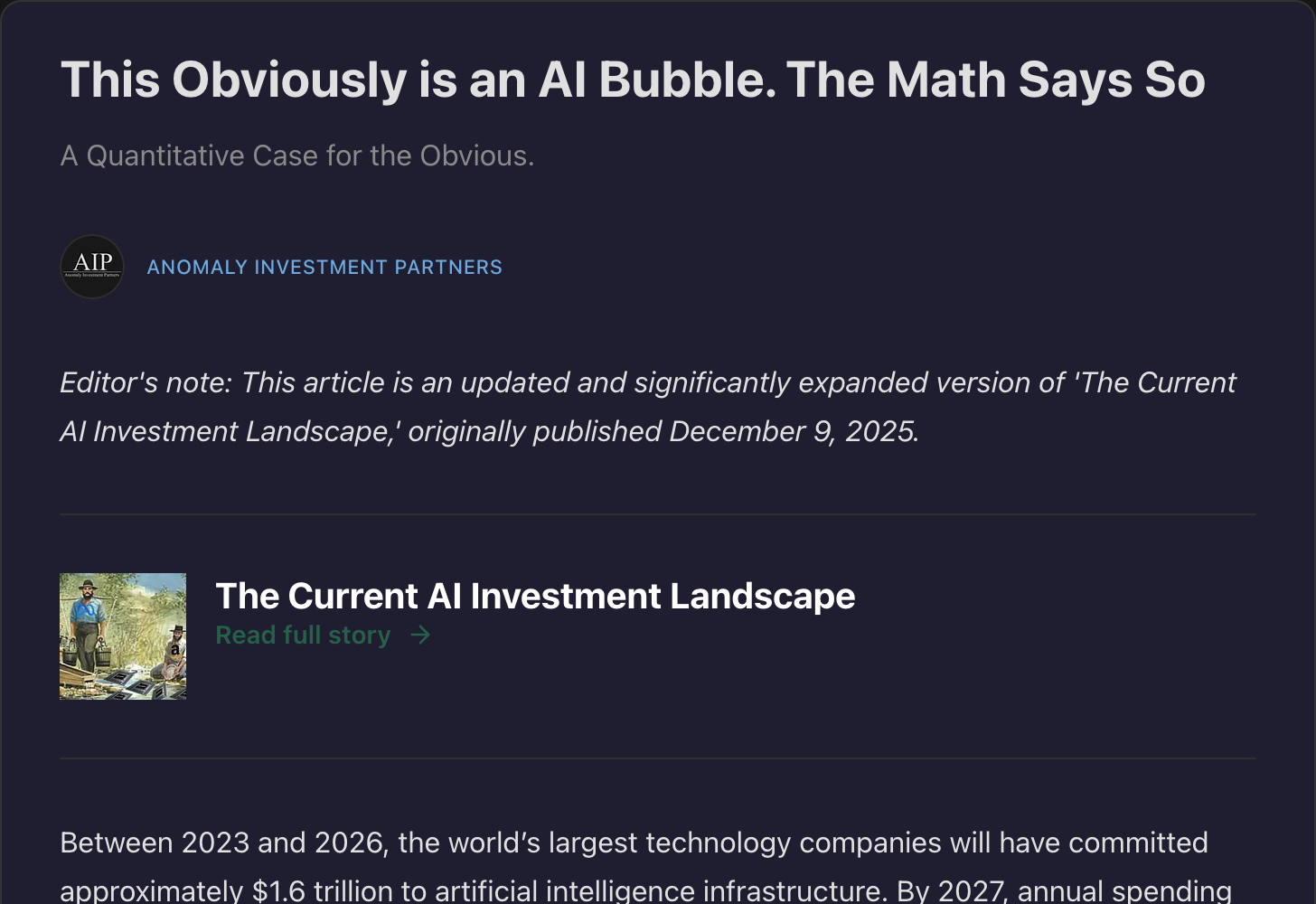
Big Tech has announced $740 billion in AI capital expenditure for 2026 — a 69% increase from 2025. Hyperscaler CapEx is projected to hit $600-700 billion this year alone. But follow the money:
- AI startups raise venture capital
- They immediately spend it on compute from cloud hyperscalers (AWS, Azure, GCP)
- That spending counts as "revenue" for the hyperscalers
- Rising revenue boosts hyperscaler valuations
- Higher valuations support continued investment in AI startups
- Repeat from step 1
This is circular financing. The hyperscalers are increasingly leaning on debt markets to bridge the gap — aggregate capex, after buybacks and dividends, now exceeds projected free cash flows. Alphabet announced an $80 billion equity raise in June 2026 specifically to fund AI infrastructure commitments.
Sequoia Capital partner David Cahn put a number on the gap: AI companies need roughly $600 billion in annual revenue to justify current infrastructure spending. As of mid-2026, the gap is widening, not closing.
Sam Altman's Counterpoint — And Why It Is Incomplete
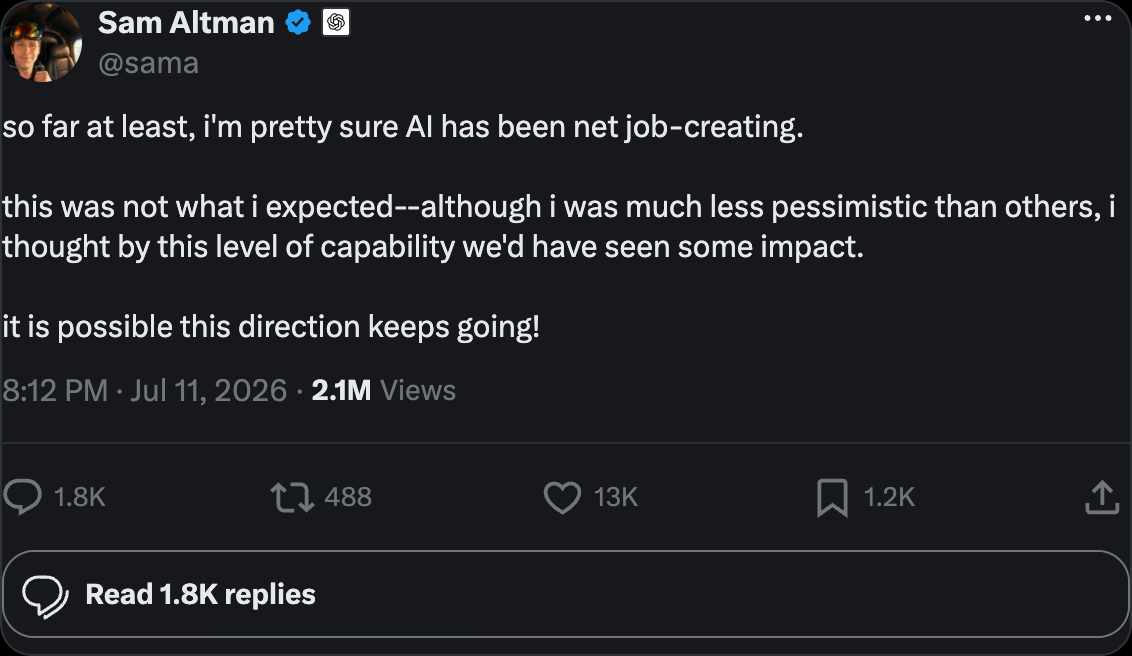
In a recent tweet that sparked massive debate, OpenAI CEO Sam Altman wrote: "so far at least, I'm pretty sure AI has been net job-creating. This was not what I expected — although I was much less pessimistic than others, I thought by this level of capability we'd have seen some impact."
This is a significant pivot from the man who previously said AI will "probably replace most of the jobs people do today." But Altman's claim requires an asterisk the size of a data center:
AI appears "net job-creating" right now because:
- Token prices are artificially suppressed. When OpenAI loses $2 for every $1 in inference revenue, it is subsidizing the jobs that depend on cheap AI. Those jobs exist because the pricing is not real.
- New AI roles are consumption-dependent. Prompt engineers, AI ops, token budget analysts — these jobs exist because companies are pouring money into AI adoption. If spending contracts, so do these roles.
- The comparison window is misleading. Altman is looking at employment data during the biggest venture spending boom in tech history. Job creation during a $700 billion investment wave does not prove sustainable employment.
The honest framing: AI has been net job-creating in the same way that a venture-subsidized food delivery startup "creates" restaurant jobs. It is real employment funded by artificial economics. When the subsidies normalize, the employment picture changes.
What Has to Change for the Crossover
The crossover point — where AI genuinely costs less than humans for most tasks — requires three things to happen simultaneously:
1. Token Prices Must Drop 90%
Arora's number is not arbitrary. At current prices, the math does not work for 77% of roles. A 90% reduction brings frontier model inference from ~$15/MTok to ~$1.50/MTok for output, making reasoning-heavy tasks competitive with human labor at ~$75/hour.
Gartner projects this will happen by 2030. But projections are not guarantees. Electricity prices are rising, not falling. Custom AI chips (ASICs) may help, but the GPU-to-ASIC transition takes years to materialize at scale.
2. Agentic AI Must Become Token-Efficient
Current agentic AI can use 1,000x more tokens than a simple query. Goldman Sachs forecasts a 24-fold increase in total token consumption by 2030 as enterprises adopt AI agents. Even if per-token prices drop 90%, a 24x increase in consumption means the net bill goes up, not down.
The industry needs architectures that accomplish complex tasks in fewer tokens — not just cheaper tokens. This means better planning models, tool use that avoids redundant reasoning loops, and task decomposition that minimizes wasted compute.
3. Reliability Must Eliminate the Human-in-the-Loop
The hidden cost in every AI ROI calculation is the human reviewer. When an AI agent completes a task with 95% accuracy, you still need a human to catch the 5%. That human's time — checking AI output, correcting hallucinations, handling edge cases — often costs more than just having the human do the task in the first place.
For the crossover to work, AI accuracy on enterprise tasks needs to reach 99%+ without a human backstop. We are not there yet, and the path from 95% to 99% is the hardest part of the curve.

What This Means for You
If you are a developer or IC: Your job is not going away because of cost, not sentimentality. The token math protects you in the near term. Use AI as a productivity multiplier — but if your company is tracking your token consumption on a leaderboard, that is a red flag for budget reality.
If you are a team lead or engineering manager: Run the actual cost-per-task calculation before approving AI tooling budgets. Do not model based on current (subsidized) token prices. Model based on 30-50% higher prices, which is where normalized pricing will land. Our token economics deep-dive walks through the subsidy math.
If you are a founder or CTO: The companies that got burned in 2026 all made the same mistake — they optimized for AI adoption rate instead of AI ROI per task. Route cheap tasks to cheap models. Use reasoning models only where the judgment call justifies the token burn. Our guide to cutting Claude Code costs has practical strategies.
If you are an investor: Watch the per-token cost trajectory, not the total market size. The AI bull case requires a 90% price drop that physics does not yet support. The bear case is that capex circularity collapses before the crossover arrives. The real question is not "will AI replace humans?" — it is "will the prices get low enough before the money runs out?"
The Bottom Line
The AI industry is running a massive subsidy play. Labs burn venture capital to offer below-cost inference. Enterprises fire humans and hire tokens at introductory rates. VCs fund the next round based on revenue that is really just other VCs' money flowing through cloud computing bills. And everyone calls it growth.
For 23% of enterprise tasks, AI is genuinely cheaper and will stay that way. For the remaining 77%, the human is still the better deal — and will be until token prices drop 90%, agentic architectures become 10x more efficient, and accuracy eliminates the need for human review.
That crossover is coming. But it is not here yet. And the companies that planned as if it were are now scrambling to explain their token bills to the board.
The smart move in 2026: treat AI as a tool that amplifies human productivity, not a replacement that eliminates human payroll. The unit economics demand it.
ComputeLeap Team
The ComputeLeap editorial team covers AI tools, agents, and products — helping readers discover and use artificial intelligence to work smarter.
Join the discussion
Have thoughts on this article? Discuss it on your favorite platform:
Related articles
Cloudflare Bought Deno. You Have 12 Months.
Deno gets 12 months of patches then development ends. Here are the concrete migration paths for every Deno deployment pattern.
OpenAI Fired Its Safety Staff, Then Cited Its Auditors
Three researchers fired for talking to the auditors they were hired to brief. The disclosure gap is the real story.
Open-Weight AI Just Went Multipolar
Mistral Large 4 and Reflection Beam ship frontier open-weight models from Europe and the US in the same week. What it means for builders.
The ComputeLeap Weekly
Get a weekly digest of the best AI infra writing — Claude Code, agent frameworks, deployment patterns. No fluff.
WEEKLY. UNSUBSCRIBE ANYTIME.