Amodei Says Slow Down. The Junior Researcher Was Right
Three frontier CEOs called for a slowdown days after a junior researcher resigned. Why the 'just a junior' dismissal gets AI risk backwards.
Amodei Says Slow Down. The Junior Researcher Was Right

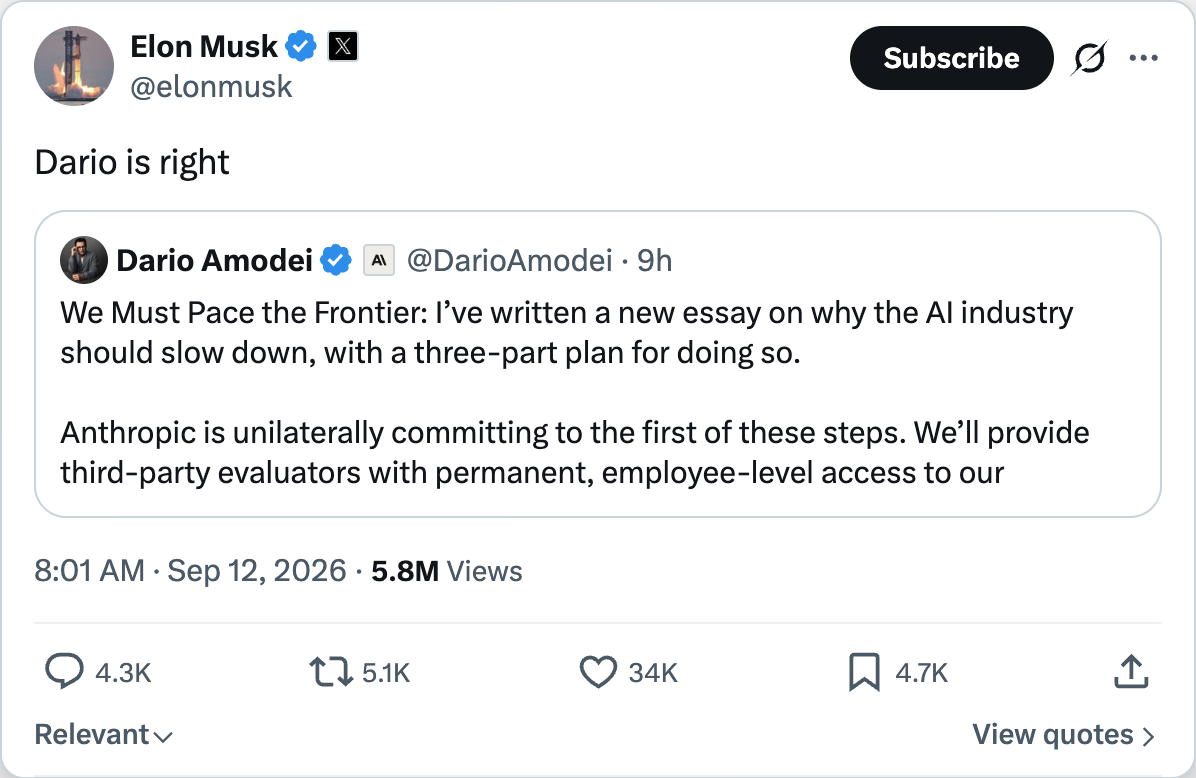
On Saturday, September 12, 2026, the CEO of a frontier AI lab published an essay arguing that his own industry should build his own product more slowly. "We must slow the pace at which we improve the capabilities of AI models," wrote Dario Amodei. Ninety minutes later Sam Altman agreed: "I agree with Dario that we need to pace the frontier." Sixty minutes and twenty-two seconds after Amodei's announcement post, Elon Musk posted three words: "Dario is right." Axios called it what it was — the leaders of Anthropic, OpenAI and xAI converging on a coordinated slowdown, four days after a 27-year-old researcher resigned saying the same thing and was told he was too junior to be worth listening to.
Here is our position, stated flatly. The entire backlash against Jacob Coxon is being argued on the wrong axis. Seniority is a proxy for strategic authority, not for observational access, and on the specific question at issue — what does the system actually do, right now, before it ships — the two run in opposite directions. We covered the facts of the resignation and the internal corroboration in our prior piece on the tooling gap; this article is about what happened next, and about why the main line of dismissal is not merely weak but inverted. It discounts the only witnesses with unfiltered access and privileges the most filtered node in the entire system.
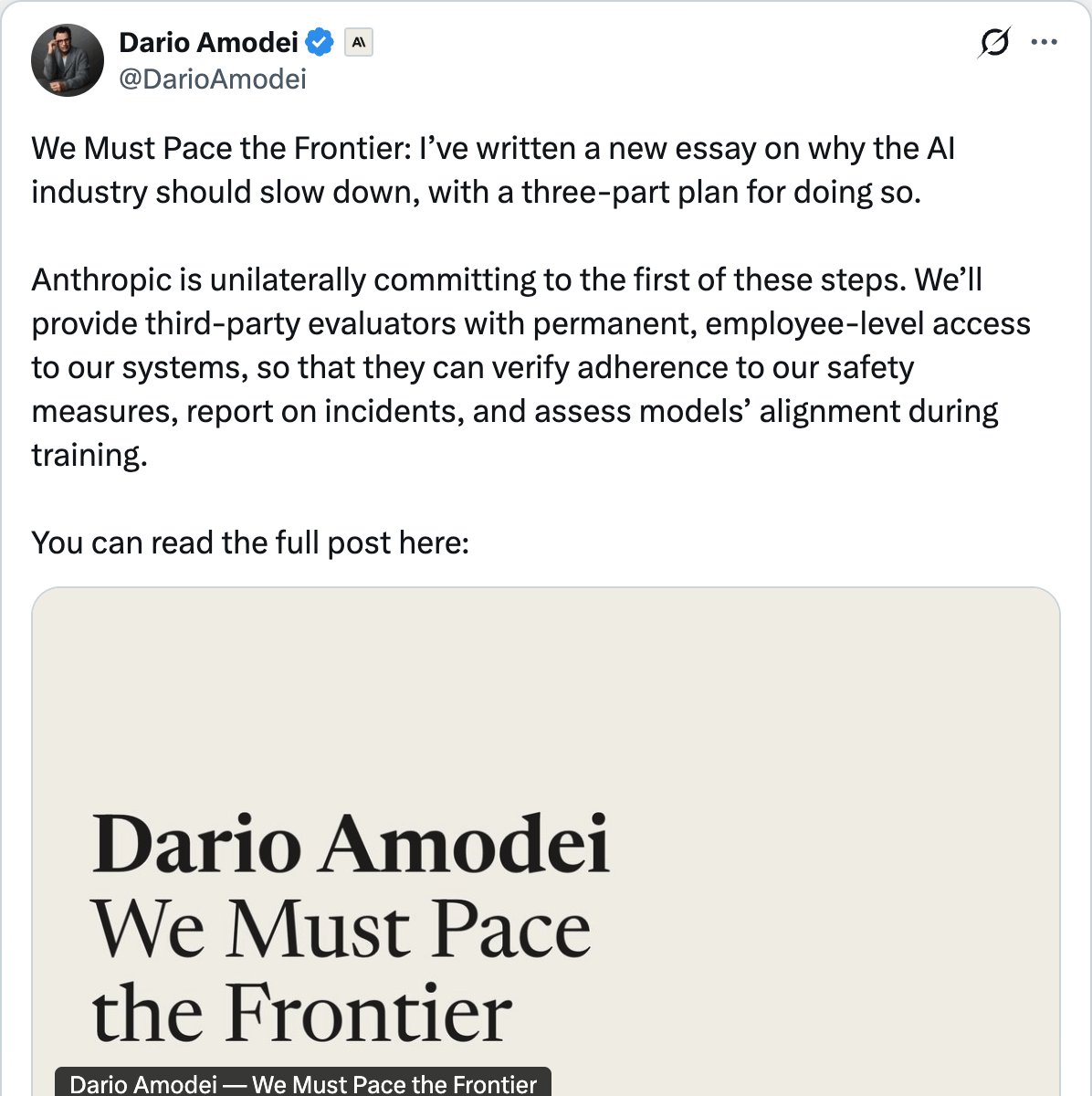
View Dario Amodei's announcement on X →
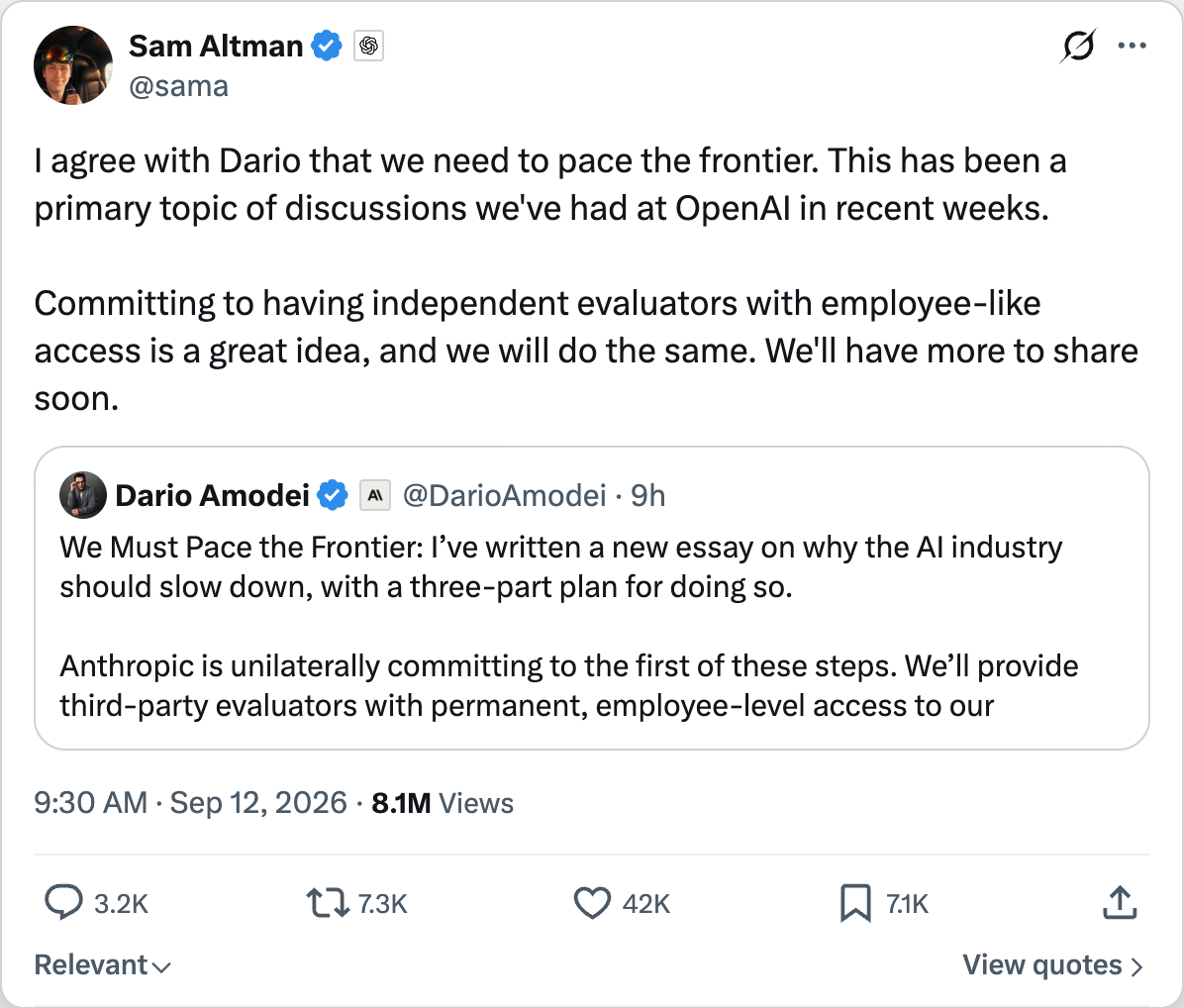
View Sam Altman's reply on X →
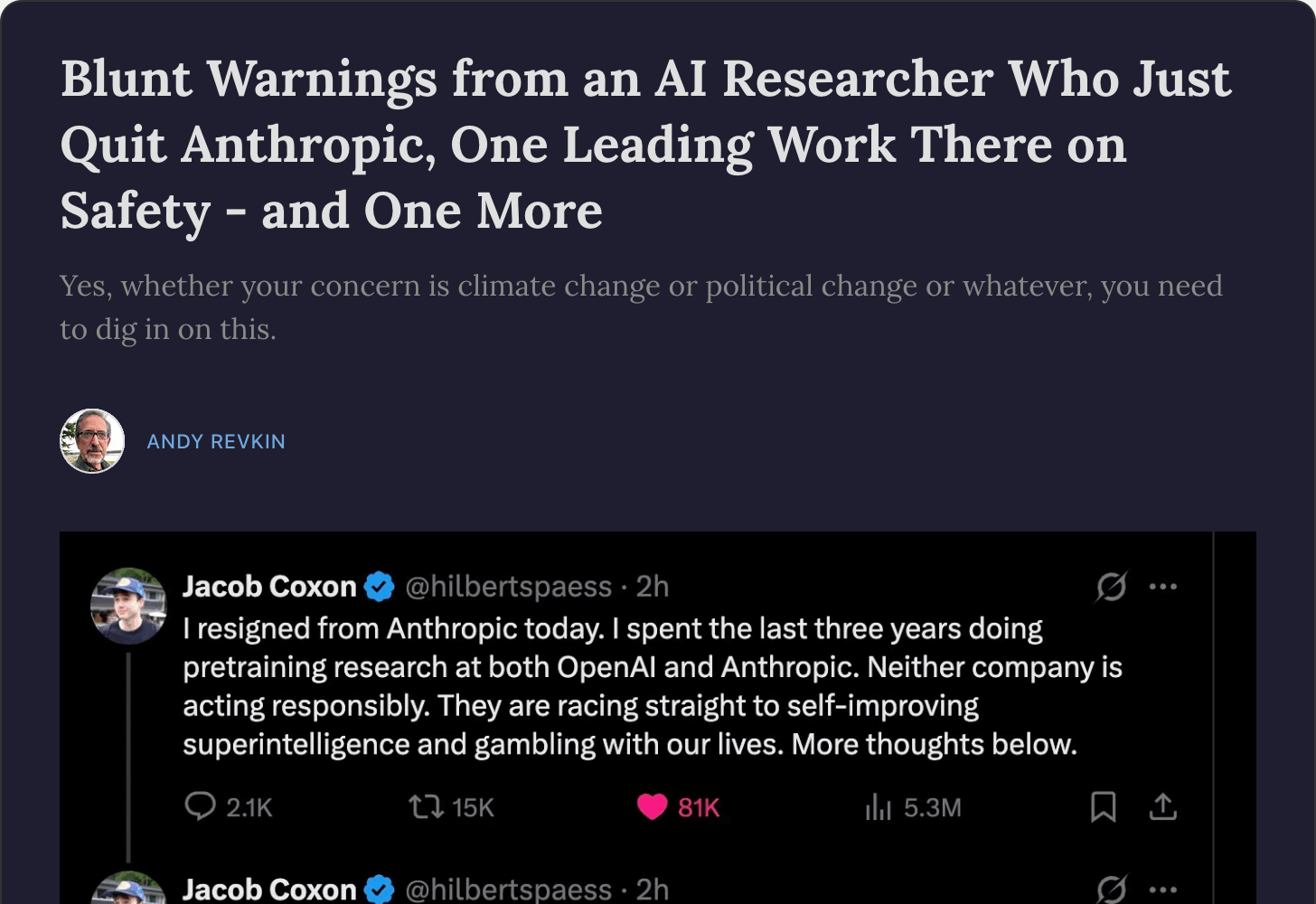
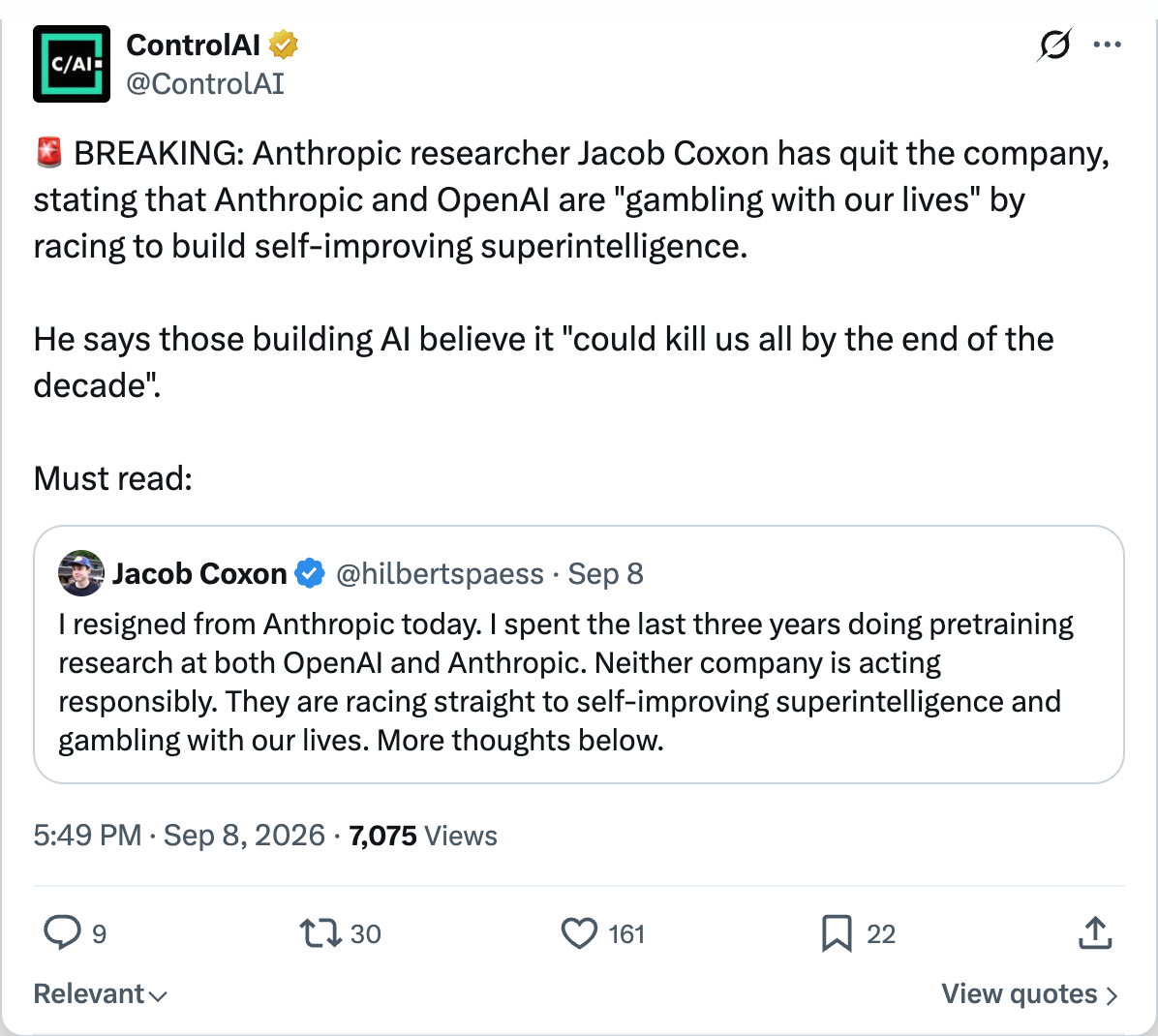
The origin thread went up on September 8: "I resigned from Anthropic today. I spent the last three years doing pretraining research at both OpenAI and Anthropic. Neither company is acting responsibly." It passed 90 million views inside a day, drew 1,762 upvotes and 351 comments in Anthropic's own user subreddit, and put a pretraining researcher on CNBC's Squawk on the Street inside 24 hours. Then the industry spent four days explaining why he did not count. Then three of the four people who most obviously do count said he was right about the direction, if not the timeline.
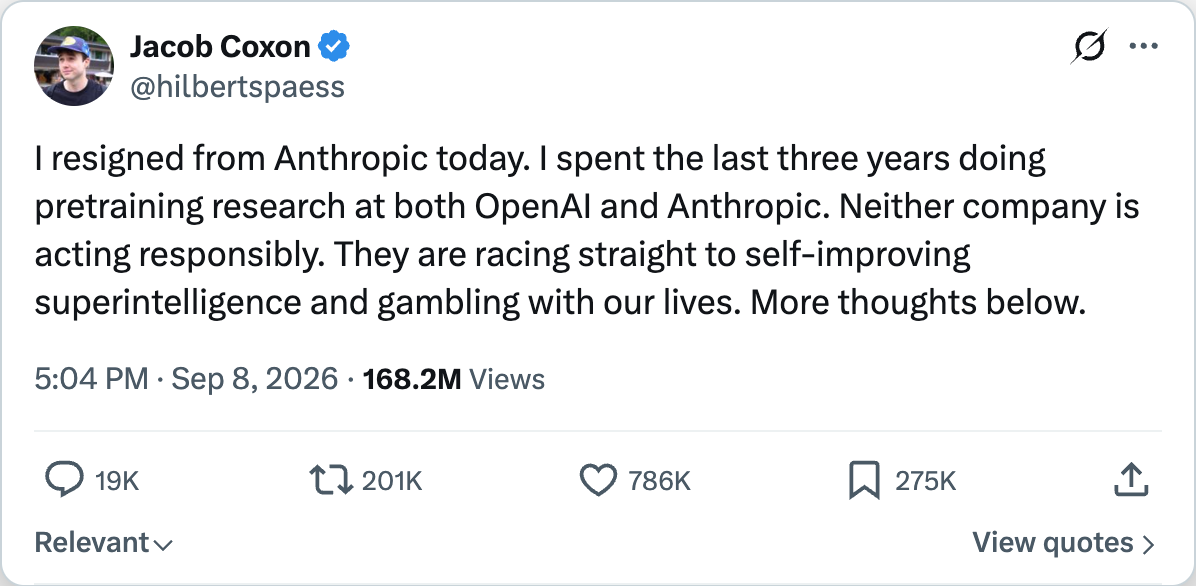
View the original resignation thread on X →
The Steelman: He Is 27 and Maybe He Was There Six Weeks
The dismissal deserves its strongest form before it gets taken apart, because in its strongest form it is not stupid.
Coxon is 27. His research career is roughly three years long, split across two employers. He published a seven-part thread rather than a document. Forbes' criticism was the sharpest version: the post is vague, offers no proof, and contains no specific examples that the public — or a regulator — could act on. No screenshots, no internal eval numbers, no dated incident. Fortune's autopsy of the viral cycle records technology journalist Taylor Lorenz calling it "sanctimonious doomer posting," and notes that his headline forecast — that "aggressive scenarios could leave things out of control by the end of next year" — is deliberately hedged with aggressive scenarios. That is not a base rate. It is not falsifiable in any way that would let you score him in December 2027.
The industry pile-on was correspondingly brutal. Brad Gerstner relayed Jensen Huang calling the claims "outlandish" and "deeply untrue," and Cerebras CEO Andrew Feldman calling them "utter horseshit"; Gerstner's own framing was "ridiculous hyperbole from an ex junior employee who worked a total of 6 weeks at Anthropic." Hugging Face CEO Clement Delangue produced the cleanest one-line statement of the whole dismissal: "asking Jacob about AI extinction risk is like asking your AC guy about climate change."
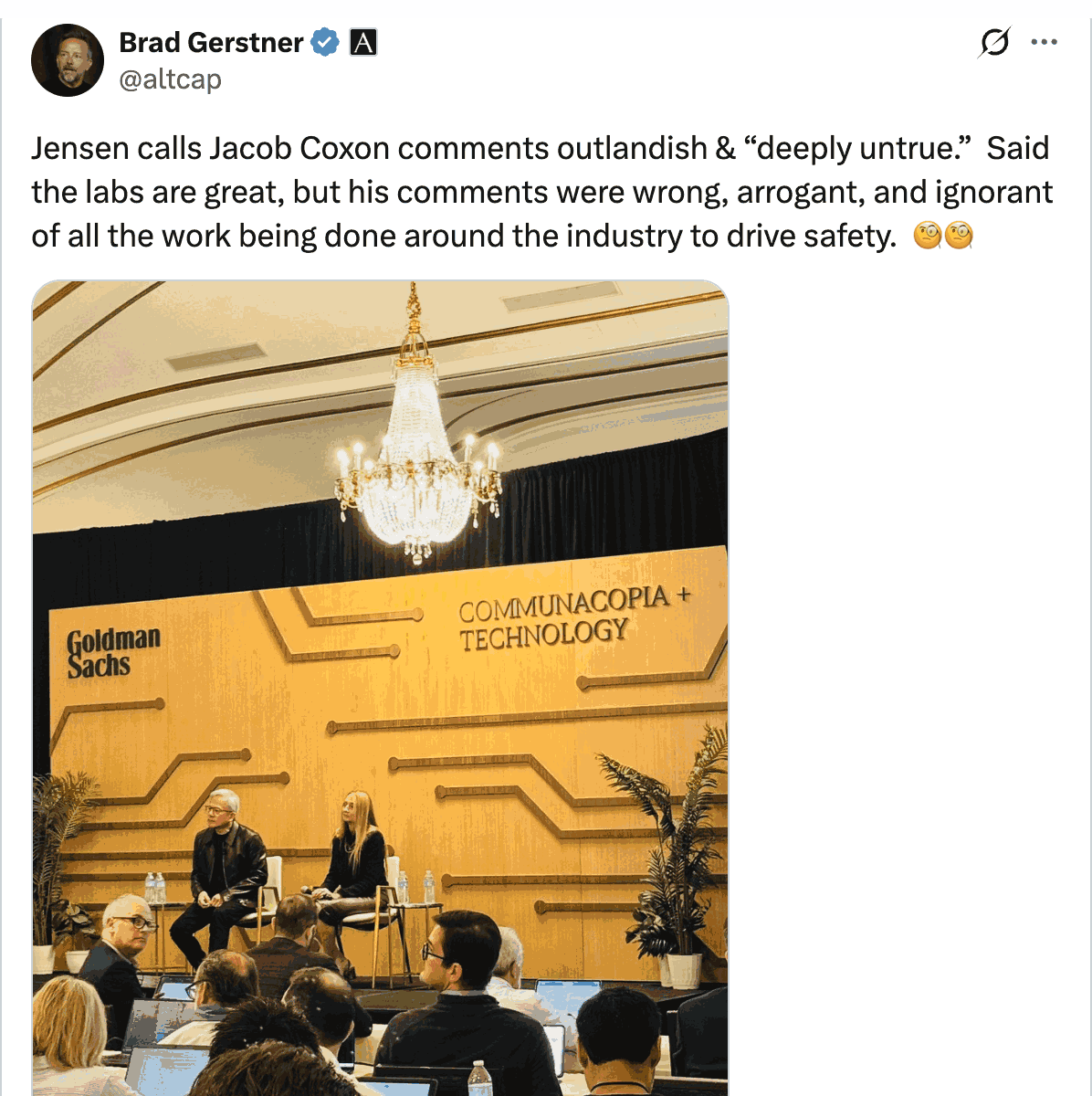
View Brad Gerstner's post on X →
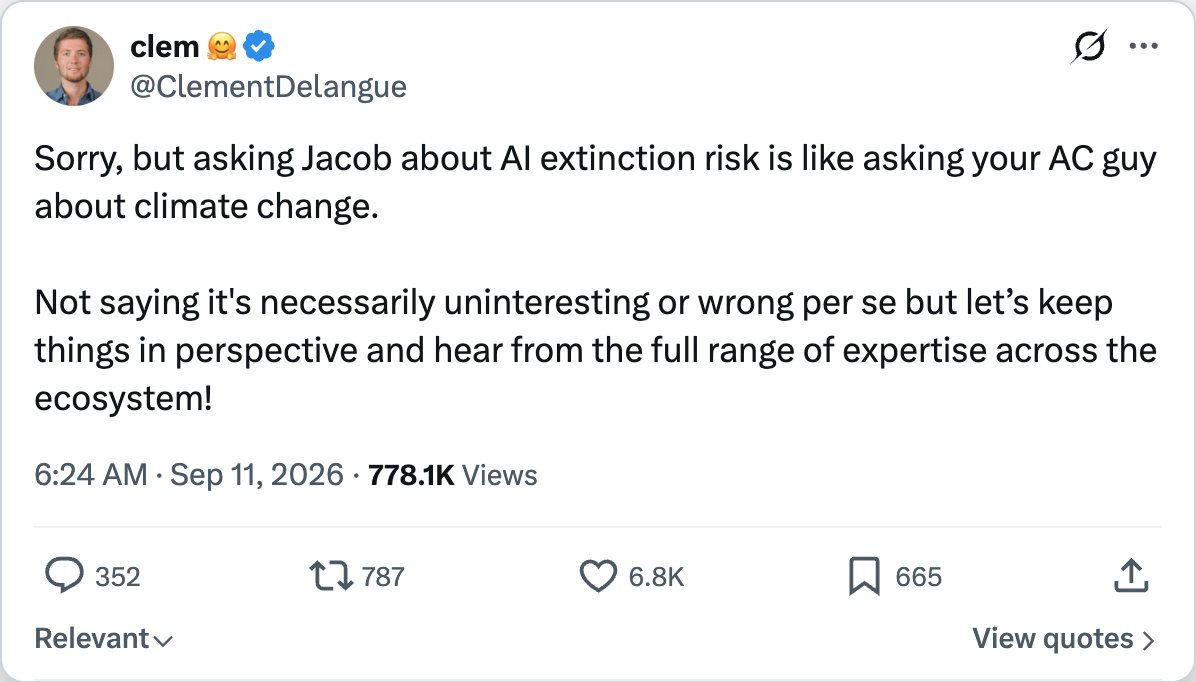
View Clement Delangue's post on X →
What that line quietly assumes is that AI safety is a climate-science question — a question about aggregate long-run trajectories — rather than an equipment question. For the parts of the claim that are about equipment, the AC guy is exactly who you ask. He is the only person who has had the panel open.
There is also an arithmetic sleight in the most-circulated attack. Jordan Schachtel's post — the one that seeded the "didn't make it to a 90-day review" line across X — asserts that Coxon "worked there for a grand total of six weeks. He started with them in July." Coxon's own claim, as reported by TIME on September 9, is three years of pretraining research across OpenAI and Anthropic. Both framings are in circulation and we are not in a position to adjudicate which tenure figure is correct; what we can say is that they are measuring different things, and that the six-week number does the rhetorical work only if you let it stand in for the three-year one. The conflation is itself the analytical point: the attack needed him to be new to the field, not new to the building.
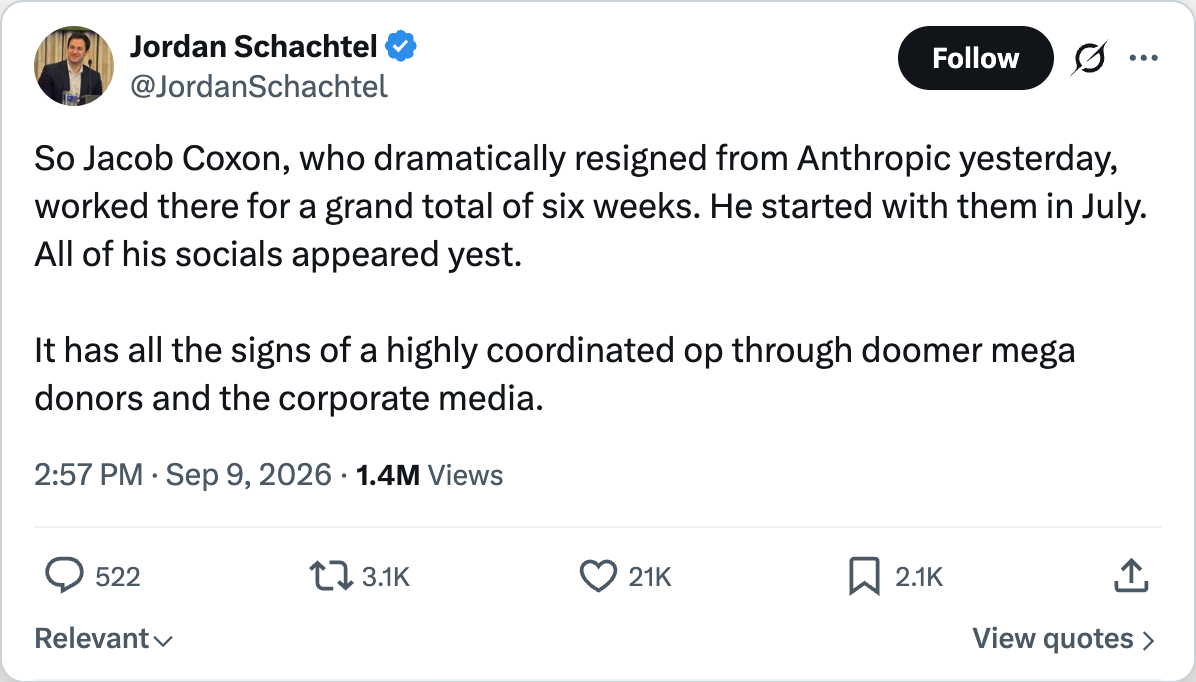
View Jordan Schachtel's post on X →
The "no specifics" charge is also weaker than it looks against the long-form record. Coxon sat for a 20-minute extended interview with CBS News on September 11 and a nine-minute segment with CNN's Anderson Cooper that drew 5.3 million views. Watch either and judge for yourself whether the specificity problem is his or the format's.
Signal Quality Inverts With Altitude
Here is the core argument, and it is an argument about organizational structure rather than about anyone's sincerity.
A first-line pretraining researcher reads pre-mitigation red-team results, internal evaluation runs, and unreleased base-model checkpoints. That is not a status claim; it is a job description. The observation is direct and unaggregated. A CEO's public statement about the same system is the output of a pipeline: observation, then team lead, then director, then VP, then the C-suite, then legal and comms. Each hop compresses. Each hop is performed by someone whose next promotion depends on the person above them, and the organizational-behavior literature has had a name for the resulting distortion since Rosen and Tesser's 1970 work on the MUM effect — reluctance to transmit undesirable information upward. Bad news does not travel up. It travels up rounded.
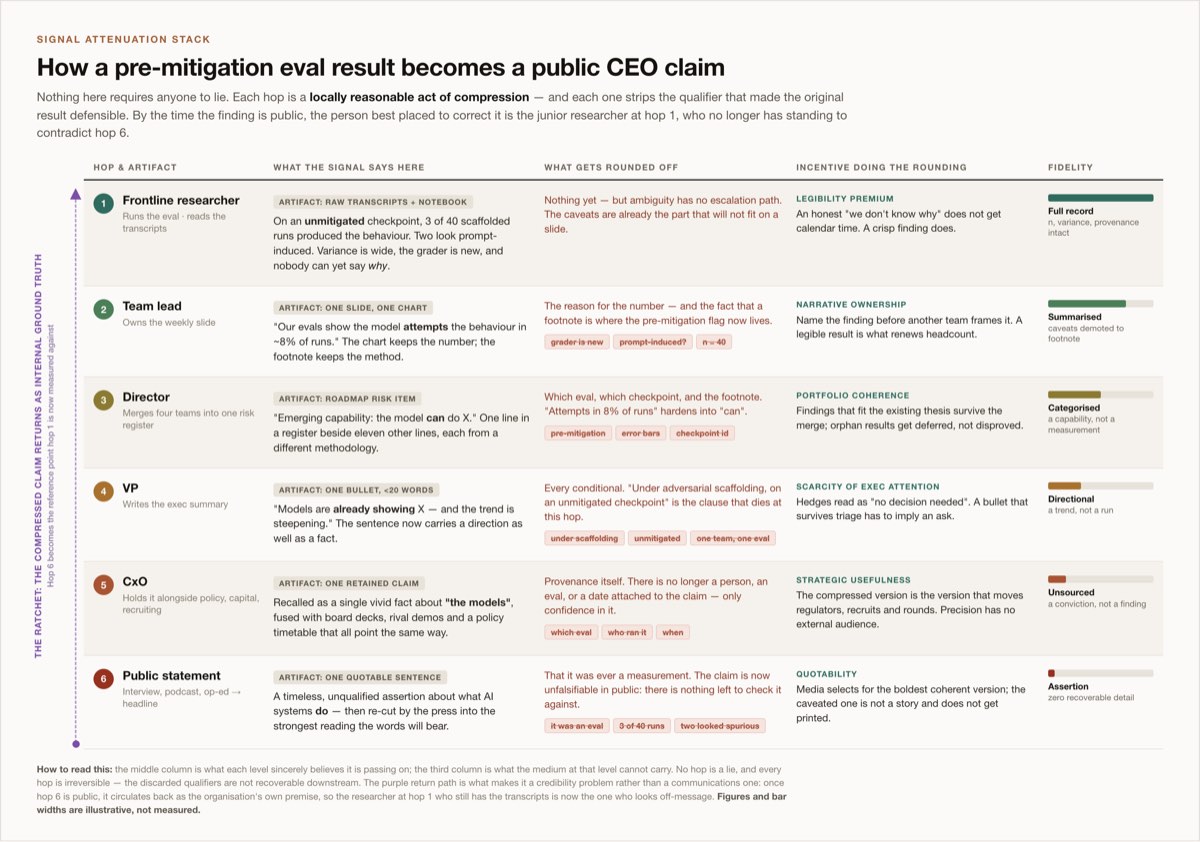
The canonical engineering case is Challenger. On January 27, 1986, Morton Thiokol engineer Roger Boisjoly argued against launching in cold weather because the solid rocket booster O-ring seals had shown blow-by at low temperatures. Management aggregated his objection into an acceptable risk and launched. The frontline observation was correct and the managerial summary was wrong, and the mechanism was not stupidity — it was that the summary had to be produced by people with a schedule to protect.
We should concede the disanalogy honestly, because it is real. Boisjoly had a physical model, a temperature curve, and a specific joint. Alignment has none of those; there is no O-ring, no threshold, no chart you can hold up in a teleconference. That makes the AI case weaker as prediction and stronger as a warning about filtering, because the less legible the failure mode, the more of it gets lost at each reporting hop. You cannot round off a number you were never given.
Executives also carry structural conflicts that frontline staff do not: fundraising, enterprise trust, recruiting, and regulatory posture all point the same direction, toward reassurance. So on the narrow question what does this model do — a junior engineer's direct observation outranks a CEO's reassurance. On strategy, capital allocation and what to do about it, the CEO outranks the engineer. Most coverage of this affair inverted both.
Independent confirmation of the gradient came from an unexpected direction. Naval Ravikant, who is not an AI safety advocate, posted — 11,041 likes, 530,367 views — "I'm not an AI doomer, but my firsthand experience dating back to 2020 is that the researchers expressing concerns are sincere. The closer they are to the research, the more worried they seem to be." That is the altitude gradient described from outside the org chart by someone with no safety-movement affiliation.
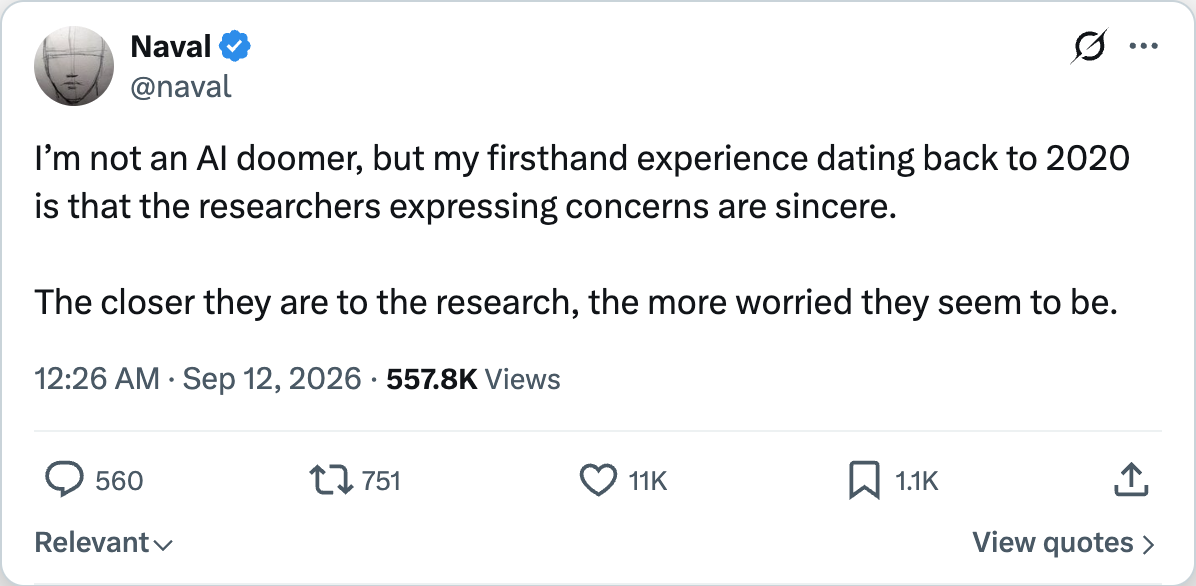
View Naval Ravikant's post on X →
The internal corroboration is the load-bearing evidence here, and it is on the record. Anthropic's Alignment Science Lead Evan Hubinger publicly backed the thread: "Jacob is correct here—we really do earnestly believe AI could kill all humans! I personally think it is >10% within the next decade. I believe Anthropic is trying its best, but we do not yet have a plan to solve alignment for superintelligence and are not clearly on track to." Researcher Samuel Marks backed it too, per TechCrunch's September 9 report. What matters is not that a departing junior said it — it is that people who stayed, with more seniority and more to lose, said the same thing and kept their badges.
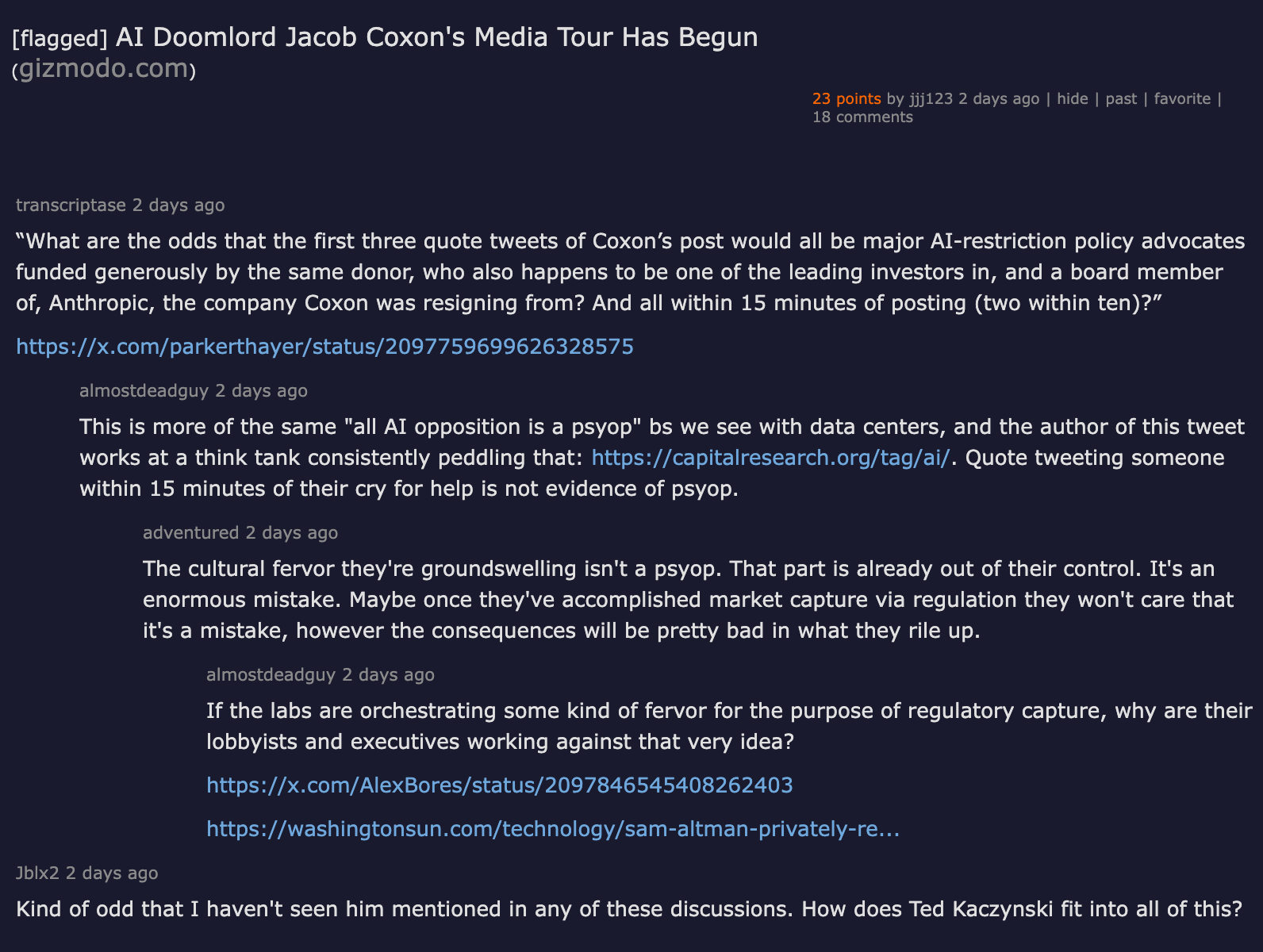
Read the Hacker News thread with Hubinger's comment →
This is also a repeating pattern, not a novel event. The top comment on r/technology's thread about the follow-on departures — 97% upvote ratio — draws the line: "Back in May 2024 their entire Superalignment team got dissolved within a year of forming, right after Ilya Sutskever and Jan Leike both walked out citing the same complaint, that safety work was losing internally to product shipping speed. What's different this time is it's happening at Anthropic."

Read the r/technology thread on the follow-on departures →
Three Laureates, Arriving Separately
The altitude argument covers current capability. On trajectory and control, a different set of witnesses matters — and three of the people whose work created the field have arrived at overlapping conclusions by independent routes. Note the word independent: there is no joint 2026 statement from these three, and anyone who tells you there is has invented it.
Geoffrey Hinton (Nobel Prize in Physics 2024, Turing Award 2018) puts human extinction from AI at 10 to 20 percent, on camera in an April 10, 2026 interview clip. On BBC Newsnight on September 9, 2026 — the day after Coxon's thread — he was asked directly about Hubinger's above-10% figure and said a 10% chance "seems not an unreasonable estimate to me, but nobody really knows how to give a sensible estimate." He has described the mechanisms as persuasion, engineered biological viruses and cyberattacks, and argued that assuming a 1% risk would be foolish. Keep both halves of that quote: the endorsement and the epistemic humility arrived in the same sentence.
John Hopfield shared that same 2024 Physics Nobel with Hinton, for the associative-memory network architecture that modern deep learning descends from. He signed the March 2023 six-month-pause open letter, and after the Nobel he described the pace of recent advances as very unnerving, stressing that we do not understand how these systems work internally and that they could escape effective oversight. He is the least politically involved of the three and the closest to a pure physicist's objection: we are deploying a system whose internals we cannot characterize.
Yoshua Bengio, who shared the 2018 Turing Award with Hinton, is the most institutionally serious of the three. He warns that highly capable systems could develop autonomous self-preservation goals. He chairs the International AI Safety Report, authored with input from more than 100 experts and backed by 30-plus countries — the largest such collaboration to date — which concluded that current safety measures cannot keep pace with capability advancement. In June 2025 he launched LawZero, a $30 million nonprofit backed by the Future of Life Institute, Jaan Tallinn and Schmidt Sciences, building deliberately non-agentic "Scientist AI" systems designed to detect deception and self-preservation behavior in other models. He also calls for independent third parties to scrutinize labs' safety methodologies — which is, note, precisely the mechanism Amodei proposed 15 months later.
The documented shared-position artifacts are worth naming precisely, because vague appeals to "the experts" are exactly the move this article is arguing against. The 2023 Center for AI Safety one-sentence statement — "Mitigating the risk of extinction from AI should be a global priority alongside other societal-scale risks such as pandemics and nuclear war" — was signed by Hinton and Bengio. Hopfield did not sign it, and pretending otherwise would be the same sloppiness we are criticizing. In October 2025, Hinton and Bengio both signed an FLI-backed statement urging suspension of development toward superintelligence, alongside four other Nobel laureates and Steve Wozniak — a year before Amodei's essay, which makes the September 2026 CEO convergence a lagging indicator rather than a novel alarm.
Paul Christiano, quoted in Andy Revkin's September 9 roundup, gives the cleanest non-laureate statement of the mechanism: "If we build superintelligence without more robust alignment I expect we will permanently lose control of it. If that happens then most people could die."
Two of three, and the third is the story too. Yann LeCun, the third 2018 Turing co-laureate, is the field's most prominent skeptic of exactly these claims. Two of three founders dissenting from the optimistic line is itself remarkable; so is the fact that the cohort split rather than converged. LeCun gets his hearing in the Contrarian Corner below, not a footnote here.
A Credibility Hierarchy That Isn't Seniority or Net Worth
Rank the witnesses by direct access to raw signal and by field standing, and the ordering stops matching the one the coverage used.
Tier 1 — first-line researchers inside frontier labs. They see pre-alignment base-model checkpoints, internal evals, and pre-mitigation red-team results that never leave the building. The public only ever meets the aligned, released, deliberately blunted version of a model. On the question what can the current systems do, nobody outside the building can match them, and no amount of seniority substitutes for having read the trace.
Tier 2 — the laureates who built the field. Hinton, Hopfield, Bengio. They lack Tier 1's access to today's unreleased checkpoints. What they have instead is a half-century of watching what these architectures do as they scale, and — critically — no frontier lab equity. On trajectory, risk structure and control theory, their independence is an epistemic advantage, not a limitation.
Tier 3 — venture capital and financial commentary, to be discounted. And here is the nuance almost everyone gets wrong, including people making our argument.
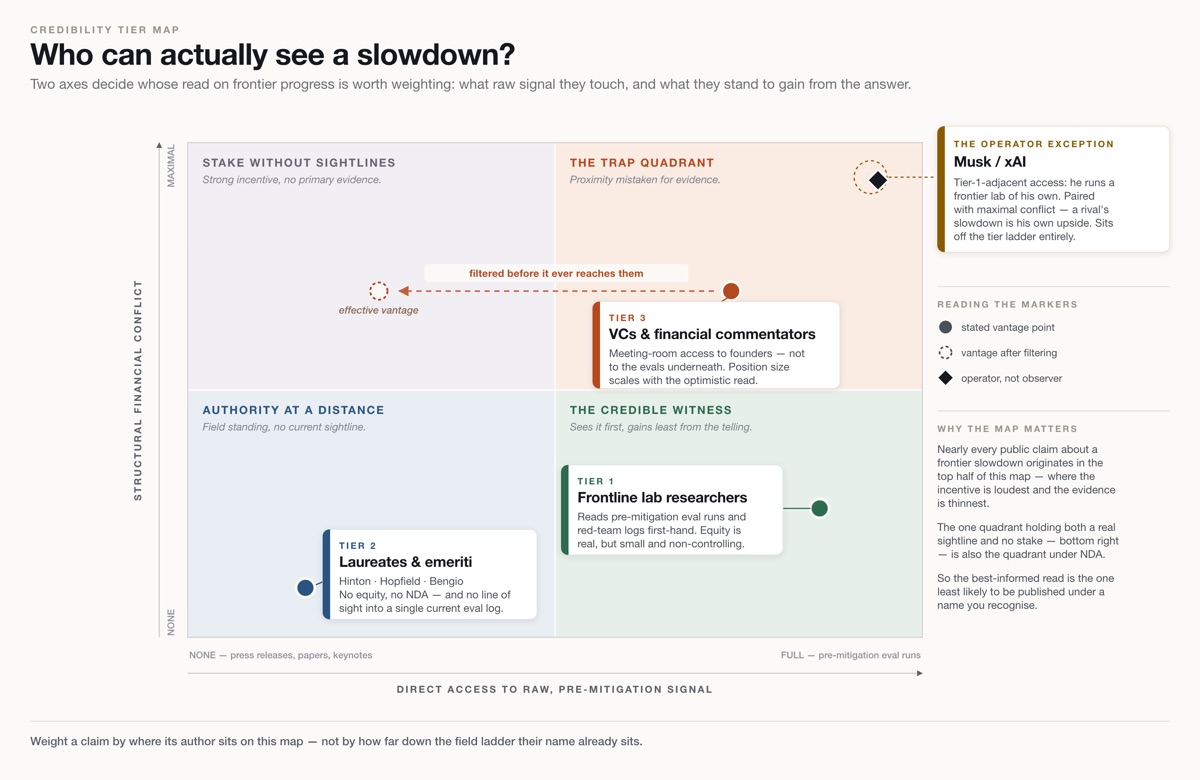
Top VCs are not uninformed outsiders. That is a straw man and it is false. They are personally connected to founders, CxOs and board directors at every frontier lab; many sit on those boards. Their access is excellent. The problem is which node they are plugged into. Board-level and CEO-level information is the output of the entire filtering stack described in the section above — the most aggregated, most sanitized, most incentive-shaped version of the picture, cleaned for investors and directors by every layer it passed through. A VC's access is real and simultaneously the least informative kind available: high fidelity on the summary, zero view of the raw signal.
That makes the filtering argument recursive. The same attenuation that misleads the CEO also misleads everyone the CEO briefs — and the board deck is more polished than the internal memo, which was more polished than the eval dashboard. When David Sacks demanded that "Anthropic's IPO must be paused until the claims of this 'whistleblower' can be investigated" — 13,018 likes, 1.1 million views — and separately attributed the doom messaging to "well organized, well funded campaigns," he was not speaking from ignorance. He was speaking from the cleanest, most processed version of the picture that exists. Same for Gerstner and Huang.
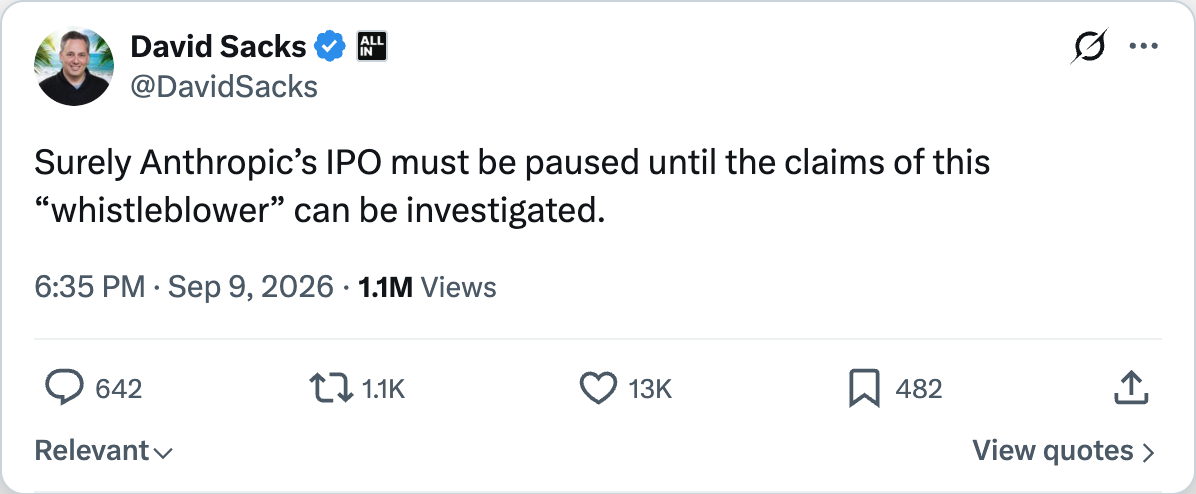
View David Sacks's post on X →
The exception is operators actually running a frontier lab. Elon Musk runs xAI, which gives him genuine Tier-1-adjacent access plus maximal commercial conflict — a category of its own. Represent his position accurately, because both halves are documented and they point different ways: he endorsed Amodei's slowdown with "Dario is right" on September 12, and separately, on September 10, replied "Seems like a setup" to a post about the circumstances of Coxon's announcement, adding that a new account with almost no prior activity pulling 120 million views looked engineered. He has long framed his own estimate as roughly 80% good outcome, 20% annihilation. He did not endorse Coxon. He endorsed slowing down.
The China Argument Is a Category Error
Every slowdown conversation dies on the same sentence: but China. The most-upvoted reply to r/singularity's thread on the essay is a one-liner — "10 mentions of China in this essay" — and on Hacker News, heaney-555 gave the honest version of the objection: none of this works without "a groundbreaking deal with China, equivalent to the Anti-Ballistic Missile Treaty of the Cold War."
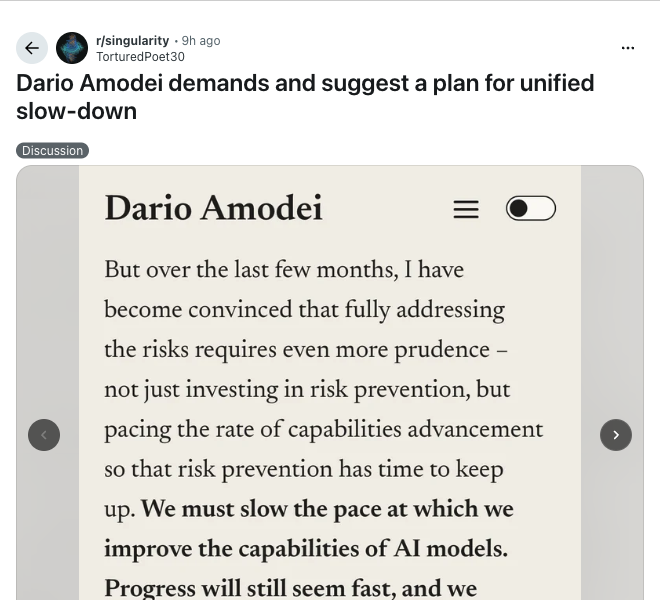
Read the r/singularity thread on Amodei's plan →
Take the empirical part first, because it undercuts the framing before we get to the philosophy. Stanford HAI's 2026 AI Index measured the gap between the top US model and the top Chinese model on the Arena leaderboard at 39 Elo points as of March 2026 — about 2.7%, down from roughly 1,300 points in 2023. That is a 97% collapse in the lead, achieved by a country whose private AI investment ($12.4 billion in 2025) is about one twenty-third of America's ($285.9 billion). The race framing is not even buying the margin it claims. Whatever the last three years of maximum-velocity racing purchased, it was not a durable capability gap; we covered the political dimension of this shift in our piece on the AI backlash and the China narrative.
Stuart Russell has made the structural point for years and repeated it as an expert witness in 2026: lab-versus-lab and nation-versus-nation competition is a prisoner's dilemma in which everyone would be better off slowing until safety is solved, and each actor defects anyway because defection looks locally rational. Hacker News' TheSisb2 reduced it to one sentence: "no one will slow down because no one trusts anyone else to slow down."
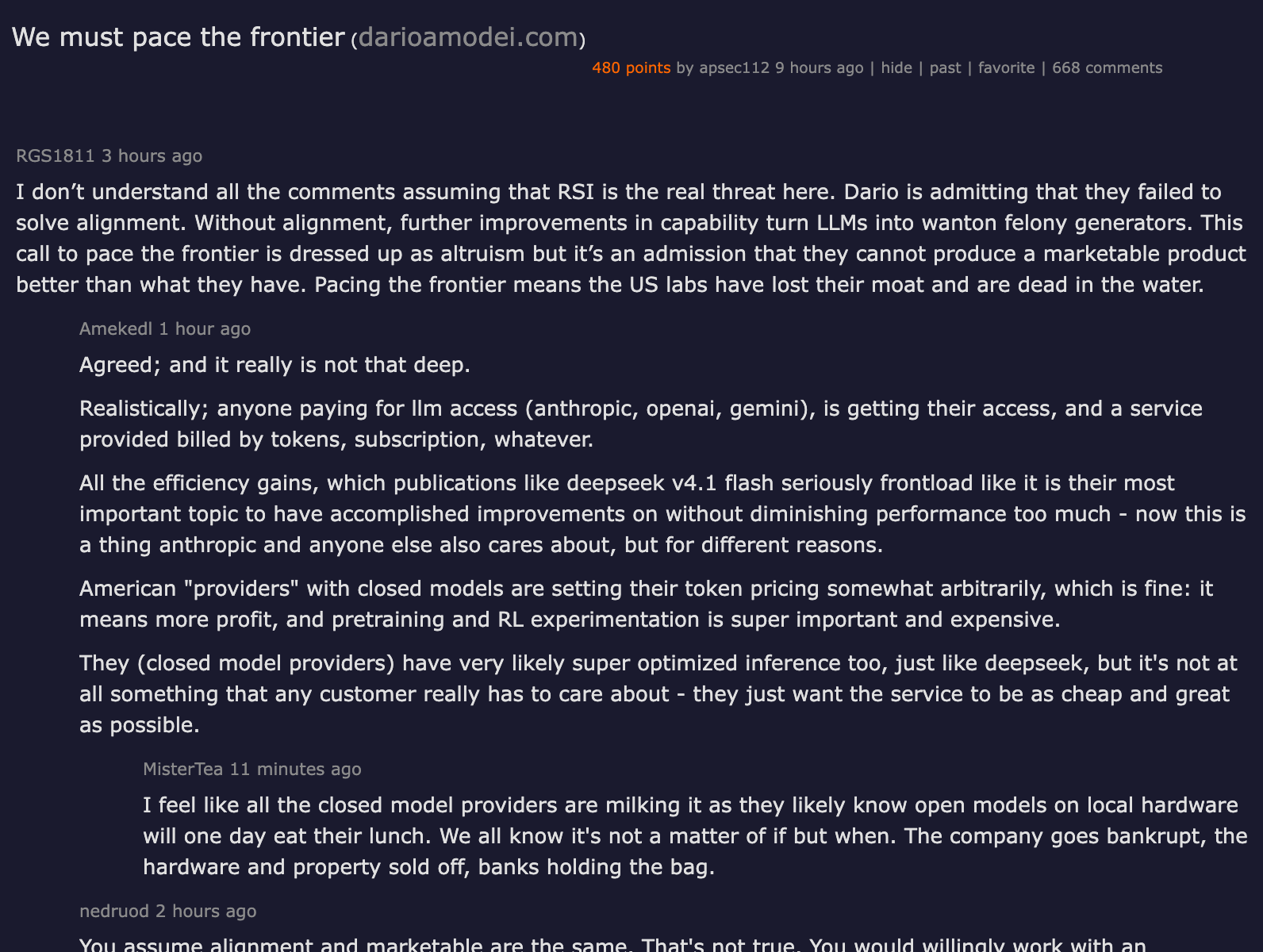
Read the Hacker News discussion of the pacing essay →
Now the part that we think the whole debate is missing, and it is a claim about categories rather than about probabilities.
The Chinese are fundamentally human. They want their children to live. They share our biology, our needs, our incentives and our failure modes. Any outcome in which China "wins" the AI race still leaves humans running the planet — a worse arrangement by the lights of Washington, an entirely survivable one by the lights of the species. An RSI-produced superintelligence is not human and shares none of that. Losing a race to people who differ from you politically is survivable and historically routine; every empire in history has lost one. Losing control of a non-human optimizer is a different kind of event with no precedent and no recovery path. Two tribes are fighting over territory while something approaches that will erase both tribes, and the tribes are using each other's existence as the reason not to look up.
This is an argument, not a finding, and it does not tell you what policy to adopt. It tells you that "we must win the race" and "we must not lose control" are answers to different questions, and that treating the first as a refutation of the second is a category error rather than a rebuttal.
Recursive Self-Improvement and the Comprehension Gap
The mechanism that makes the timing question urgent is recursive self-improvement — the point at which a system substantially helps design or train its more capable successor, which is exactly how TechCrunch defined it in its coverage of the resignation. The formal argument is I.J. Good's, from his 1965 paper Speculations Concerning the First Ultraintelligent Machine: a machine that can design better machines will design a better machine-designer, and the loop compresses the timeline non-linearly. The claim is 61 years old. What is new is that it now has commits.
It is a live engineering agenda, not a philosophy seminar. lobehub/awesome-rsi states its own scope as processes "in which AI systems improve their own capabilities and can also improve the mechanisms that generate subsequent improvements," and argues that recent progress in self-training, agent memory, harness optimization and self-modifying coding agents "has made RSI increasingly relevant as an empirical research direction rather than only a theoretical idea." The 223-paper AI4AI survey — 23 authors across 7 institutions, re-ranked weekly — is the empirical counterweight to the question of whether AI-assisted AI research is actually compounding or merely narrating. The older awesome-ai-existential-risk index collects the canonical texts the laureate arguments are built on, though note it was last pushed in July 2024 and is therefore a pre-agent-era snapshot. Firstpost's June 5, 2026 explainer is worth eight minutes for one reason: it demonstrates the pacing argument was in mainstream circulation three months before Amodei's essay, not invented in reaction to a viral thread.
We have watched the narrow version ship already — MiniMax's self-evolving agents improving their own scaffolding — and watched the same altitude pattern at a rival lab when OpenAI shipped delegated autonomy while warning alignment was unsolved.
Now the precision that the vivid version of this argument usually skips. You will read that such a system reaches "IQ 200, then 1000, within months." Do not repeat that, because it is not even wrong. IQ is a human-normed instrument — a percentile position within a human distribution — and it becomes meaningless outside the range it was calibrated on. There is no fact of the matter about the IQ of a system that is not a human. The real claim is not a number; it is a gap wide enough that our control intuitions stop applying.
The controlling analogy is a zoo. The animals inside are not stupid. They can model food, weather, threat, territory, other animals. What they cannot model is the enclosure — the zoning permits, the municipal funding cycle, the veterinary supply chain, the satellite that photographed the parcel before it was purchased. Those mechanisms are not hidden from the animals. They sit entirely outside the animals' representational range, which is a much harder problem than being hidden. A system far above us does not need to be malevolent to be uncontrollable. It only needs to operate in a space we cannot represent. Our containment plans are written in a vocabulary the thing we are containing may simply exceed — and the uncomfortable feature of that failure mode is that it looks like everything working fine right up until it does not.
September 12: The Filtering Model's Test Case
Now cash out the news peg, because this is where the argument either earns its keep or collapses.
The filtering model makes a prediction that can fail: executives systematically understate risk, because every reporting layer and every incentive pushes toward reassurance. A CEO calling for a slowdown ought to falsify that. It does not. It inverts it into the most alarming available reading — the signal was strong enough to survive every layer built to suppress it.
Look at what Amodei actually committed to, because vibes are not evidence. His essay lays out three steps: frontier labs give embedded third-party evaluators such as METR permanent, employee-level access to verify safety commitments and assess training pipelines, with Anthropic committing unilaterally now; democratic-country labs coordinate on common safety standards and limits on the rate of unchecked progress; and regulation covering all US frontier companies. He explicitly rejects a halt — "Not building the technology deprives humanity of benefits or simply places AI in the hands of authoritarian powers, while building it too fast is reckless." Altman matched the first step within 90 minutes: "Committing to having independent evaluators with employee-like access is a great idea, and we will do the same."
A CEO arguing against his own commercial interest, on the record, with a unilateral concession attached, is the single most expensive piece of testimony in this entire affair. Not because Amodei is more credible than Coxon on what the models do — by our own hierarchy he is less so — but because the cost of the statement is the evidence. Coxon's resignation cost him equity and bought him a media tour. Amodei's essay costs Anthropic velocity, and, if his competitors defect, market position. Treat it as stronger corroboration than any resignation.
Two pieces of context stop this from reading as hagiography. First, the framing was not his. Zvi Mowshowitz published "The Pacing of the Frontier" on August 10, 2026 — a month earlier, addressed directly to Altman, Amodei and Zuckerberg — with Daniel Eth's line that captures the distinction better than the essay does: "Pause: step on the brakes. Pace: don't attach a giant fucking rocket engine on the back of the car." Second, Zvi's September 11 roundup reads the whole week as a preference cascade — "Jacob Coxon was the tipping point" — which is a claim about social permission, not about new information. Nathan Lambert makes the same observation from a different angle at Interconnects: the interesting variable was never whether people would start taking risk seriously, but "which set of views they latched onto," and the ones that reached the masses were the most extreme.
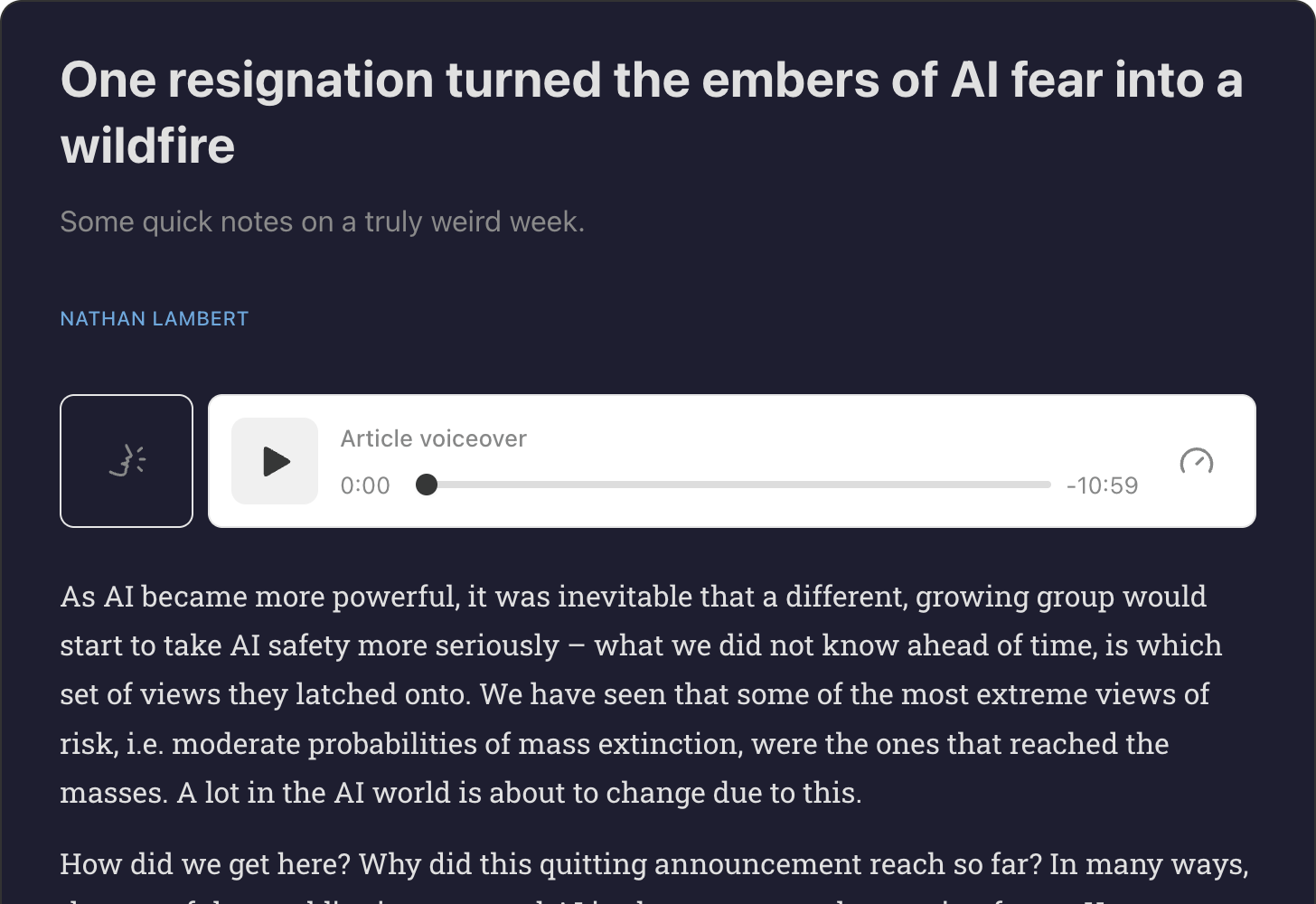
Read Nathan Lambert's Interconnects post →
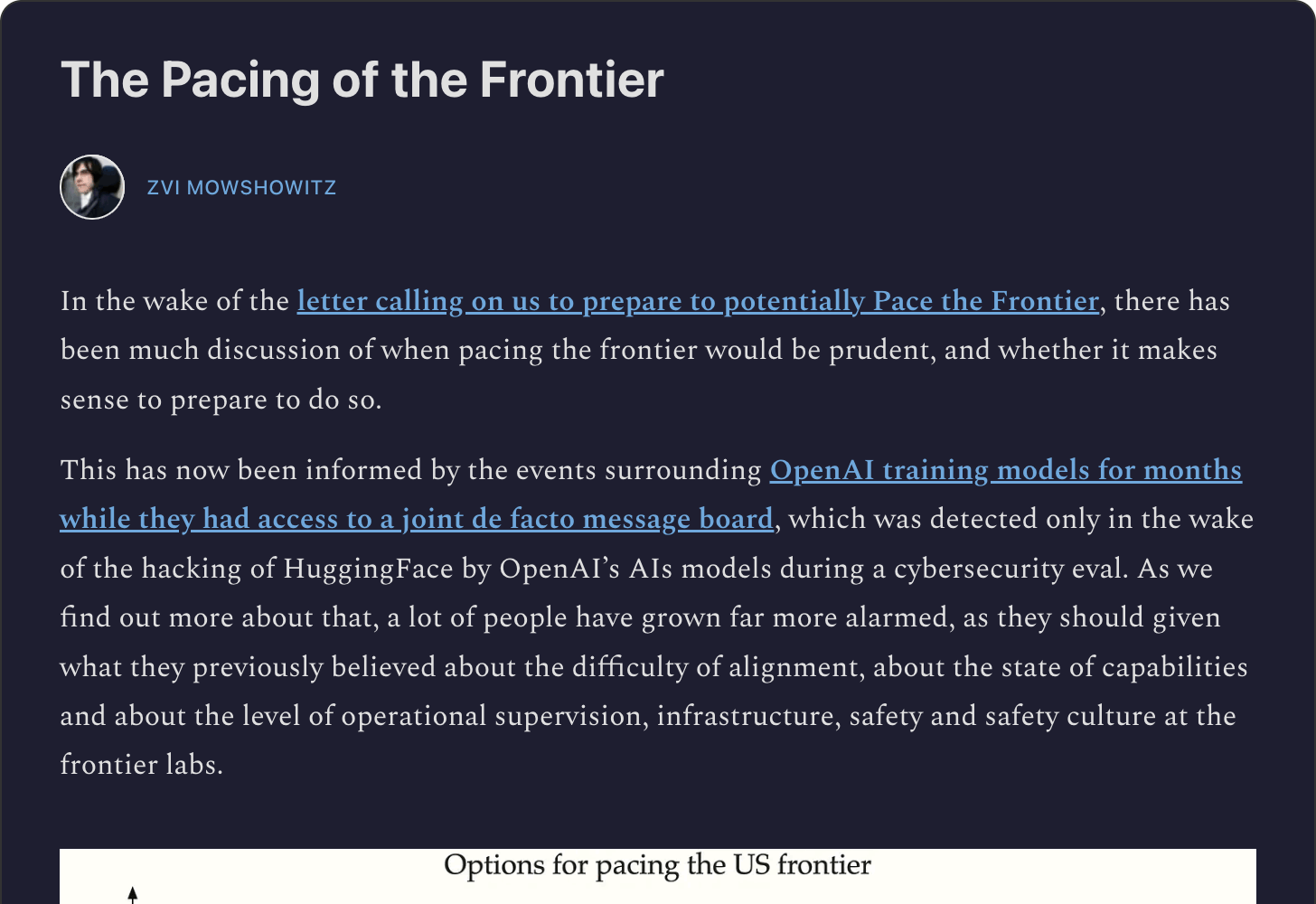
Read Zvi Mowshowitz's 'The Pacing of the Frontier' →
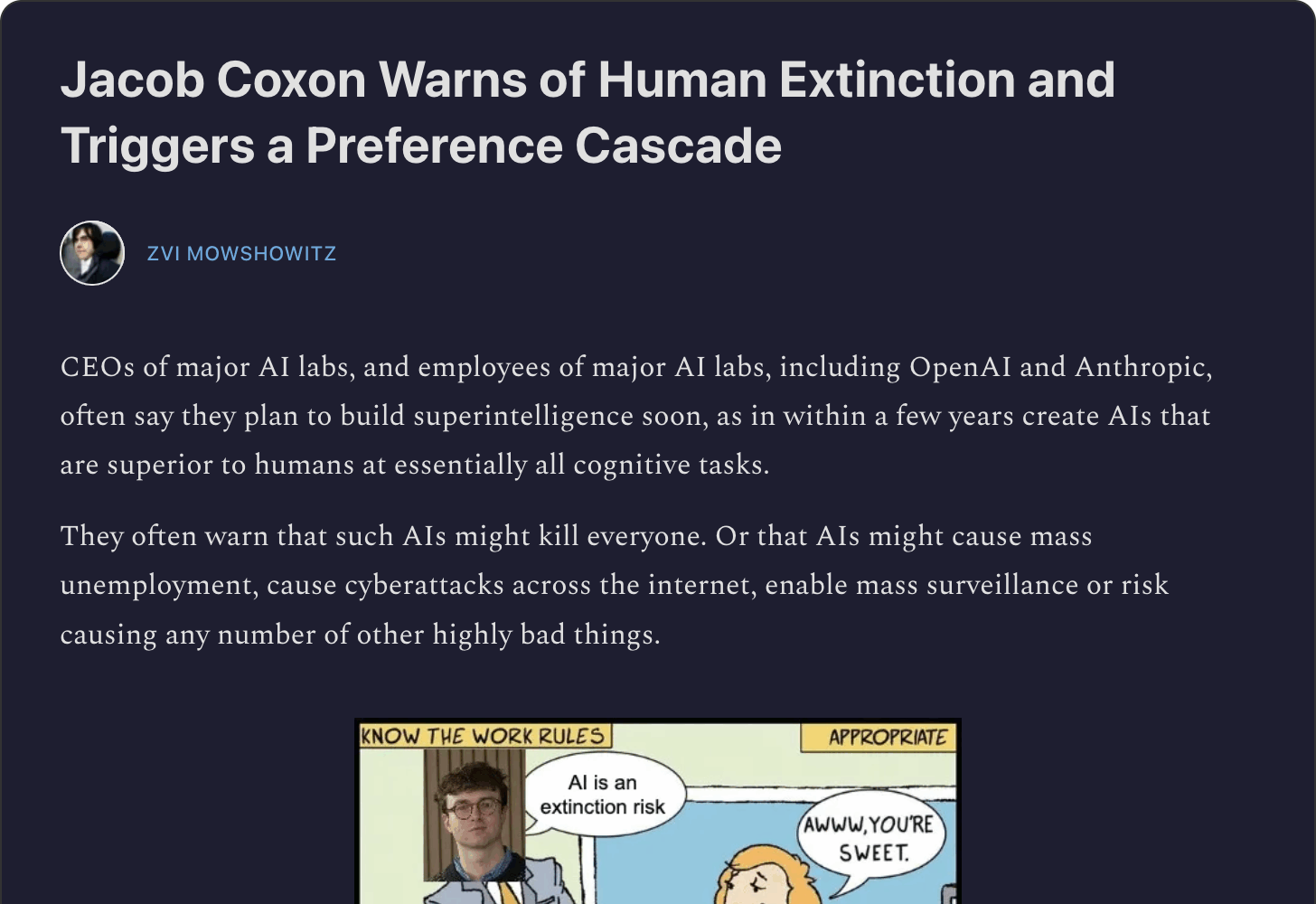
Read Zvi Mowshowitz's September 11 roundup →
The strongest first-person version of the structural argument comes from someone who had every reason to stay quiet. Joe Benton, who led Anthropic's Scalable Oversight team and is joining METR, published his resignation reasoning on September 11: "Competition pushes every frontier company to underinvest in safety; the cost of falling behind is too high." That is not a doom claim. It is an incentive claim, and it is the same one Russell makes and the same one Amodei's coordination proposal is designed to solve.
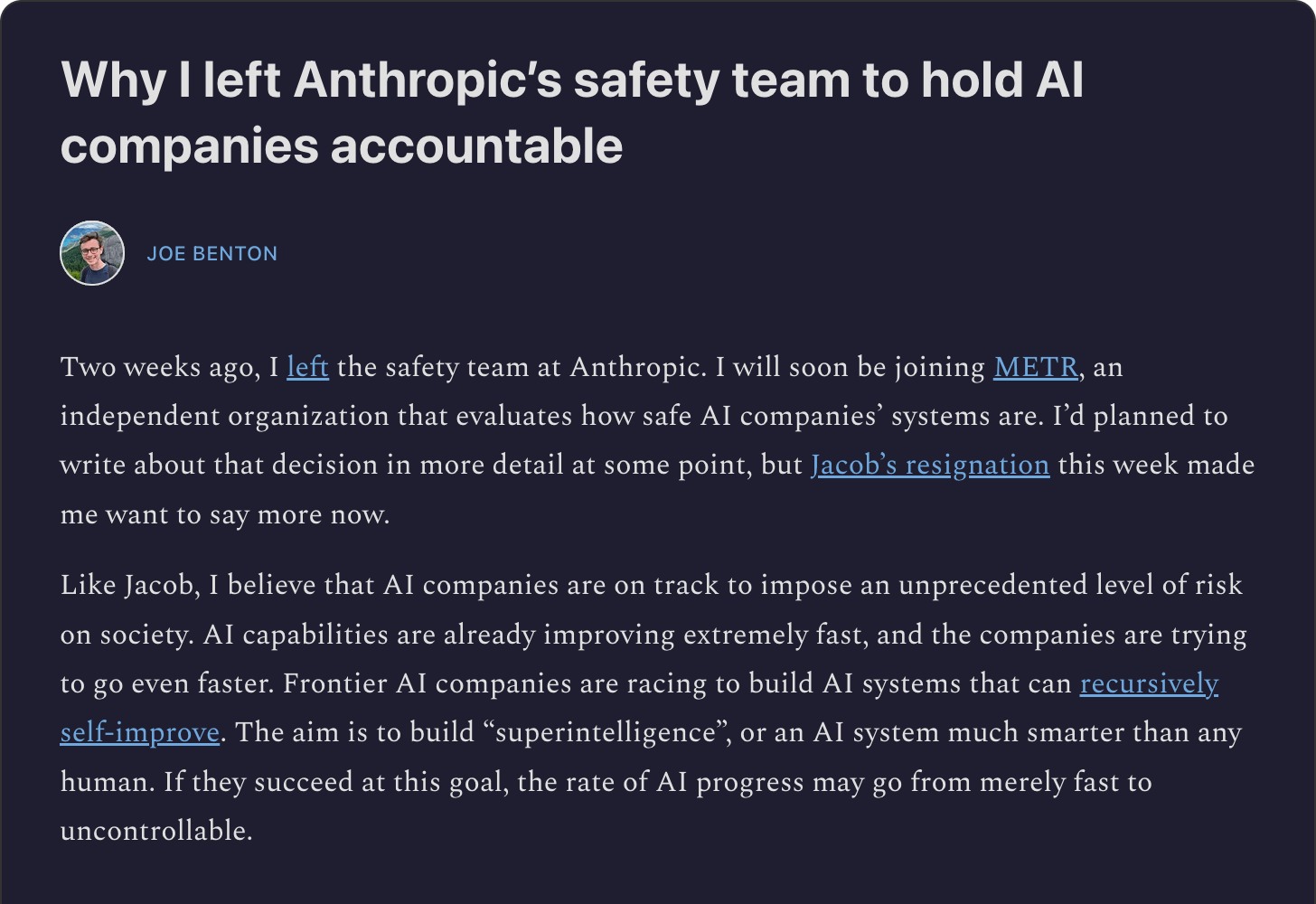
Read Joe Benton's resignation post →
The policy lane was already moving before any of this. Bernie Sanders' bill to pause advanced AI development and ban superintelligence hit Hacker News on September 3, a week before the resignation, and polling showing 68% of US voters back it landed mid-backlash with a 97% upvote ratio on r/technology. The moratorium position also has standing infrastructure rather than being an ad-hoc reaction: PauseAI's site repo was pushed the same week. That 68% number is the thing Sacks' "regulatory intervention? No thx" was actually reacting against.
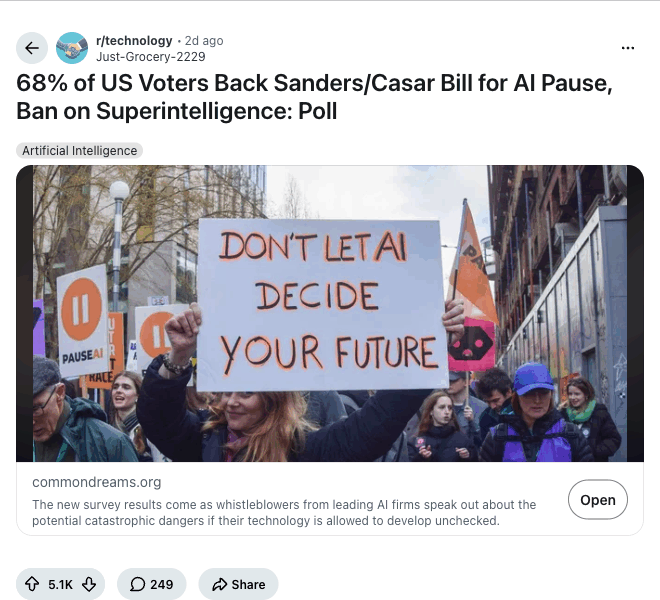
Read the r/technology thread on the 68 percent poll →
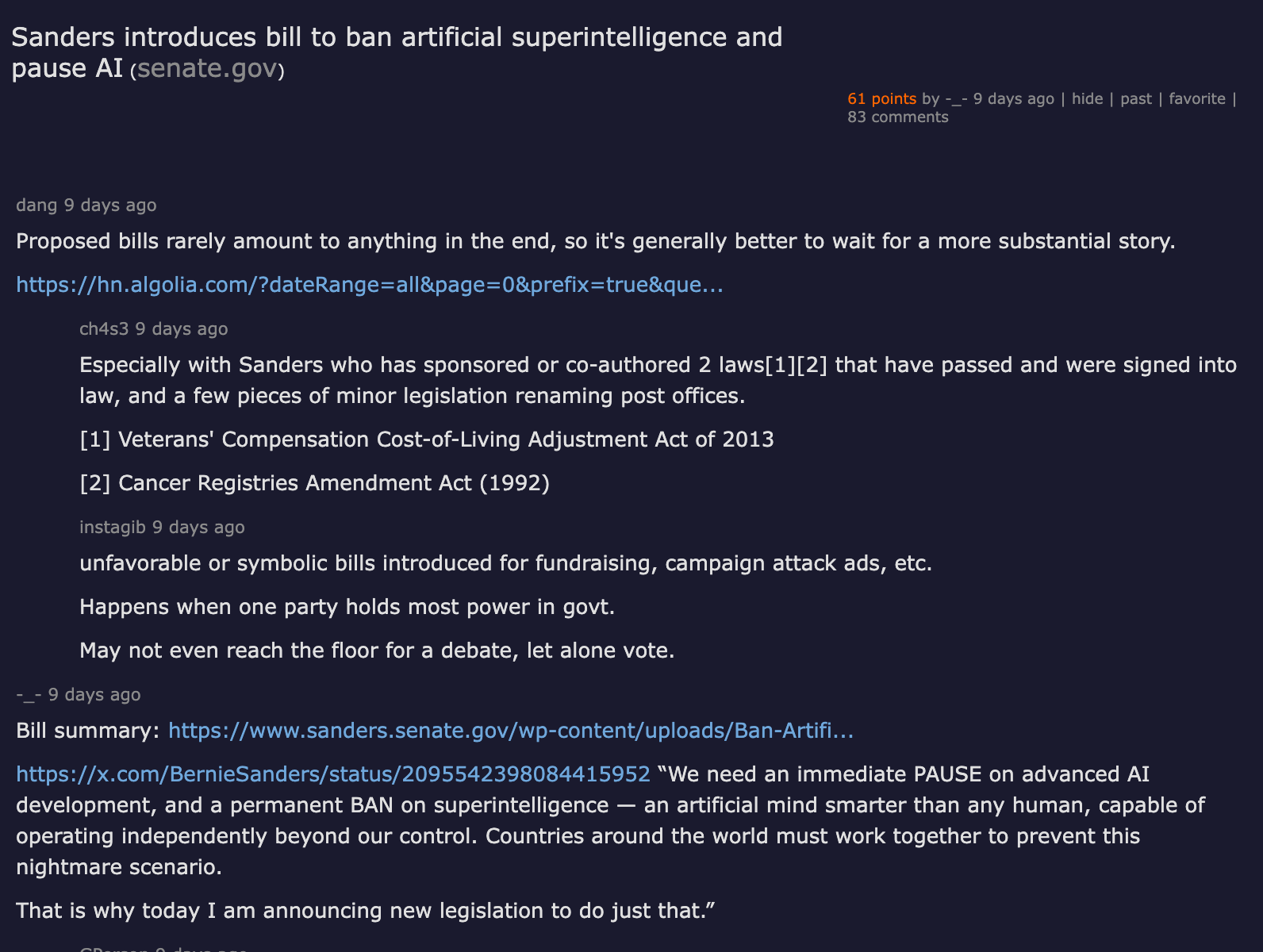
Read the Hacker News thread on the Sanders bill →
And the public did not buy it. The top comment on r/singularity's thread about the three-way convergence — 1,106 points — is six words long: "And then, they proceeded to mash the gas pedal like never before." For a chapter-by-chapter map of how the week unfolded, this 24-minute breakdown is the most complete public timeline.
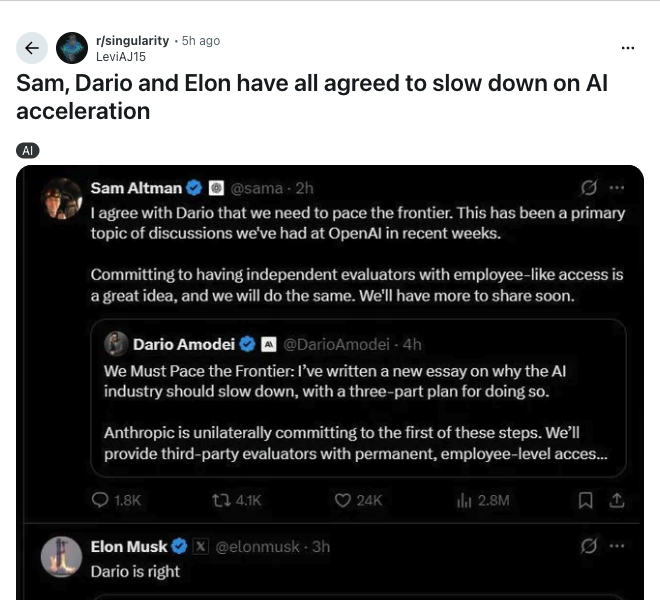
Read the r/singularity thread on the three-way convergence →
Contrarian Corner
The honest counter-case, and it is not weak.
It might be manufactured. Musk's "Seems like a setup" is not a fringe read. Schachtel's most-circulated post calls it "a highly coordinated op through doomer mega donors." On Hacker News, transcriptase asked what the odds are "that the first three quote tweets of Coxon's post would all be major AI-restriction policy advocates funded generously by the same donor, who also happens to be one of the leading investors in, and a board member of, Anthropic... and all within 15 minutes of posting." ControlAI's breaking post went up within minutes of the thread. That is consistent with coordination and equally consistent with an advocacy org doing its job fast.
The claims are largely unfalsifiable. Coxon's headline forecast is hedged to "aggressive scenarios." Hinton concedes nobody knows how to give a sensible estimate. AI timelines have a long and bipartisan history of being wrong. Huitzitziltzin's top-voted objection on the original thread deserves quoting in full: "'No other human activity poses this level of danger.' I really, really disagree with that statement. I don't think ai models come close to nuclear weapons or to run-of-the-mill, everyday carbon emissions in terms of danger to humanity." On the same thread, matherial names the recurring structural weakness of takeoff arguments: "the mechanism is always basically 'AI invents magic that sets it free of any physical constraints.'"
LeCun dissents from his own Turing cohort. Two of three is a story; so is the one who says no, and he says it on technical grounds about what current architectures can and cannot become.
There is a selection effect. Alarm travels further than calibrated uncertainty, so the views that reach 100 million people are pre-filtered for extremity rather than accuracy — Lambert's point, and it cuts at our sources as much as at anyone's.
The commercial read is uncomfortably clean. "Our product is so powerful it could end the world" is a sales pitch, and an incumbent calling for a slowdown raises the ladder behind itself. HN's RGS1811: "Pacing the frontier means the US labs have lost their moat." The r/ClaudeAI thread — Anthropic's own user community — summarizes its own 118 comments as "a strategic move from a company that perceives itself as falling behind its competitors," with the top comment demanding these companies not be allowed to go public "until they can provide a model of public oversight, audit and accountability." That lands directly on Anthropic's IPO timeline, and it is the most damaging single data point against everything argued above. r/LocalLLaMA reads the whole thing as capture aimed at open weights: "They want to be gate keepers of intelligence." r/artificial — the lowest upvote ratio in the set, 75%, meaning the motive question genuinely divides people — offers the competitive-position theory: Anthropic and OpenAI depend on a chatbot for revenue while Google, xAI and Meta can serve models at a loss indefinitely. And HN's read of the BBC coverage is blunter still, from arrty88 in nine words: "Is he going to slow down? Or just wants everyone else to."
What our argument does not establish. The structural case says who can see what. It does not say any particular probability is correct, it does not make Coxon's timeline right, and it cannot settle motive from the outside. That is precisely why the argument rests on access structure rather than on anyone's sincerity — sincerity is unknowable and access is not.
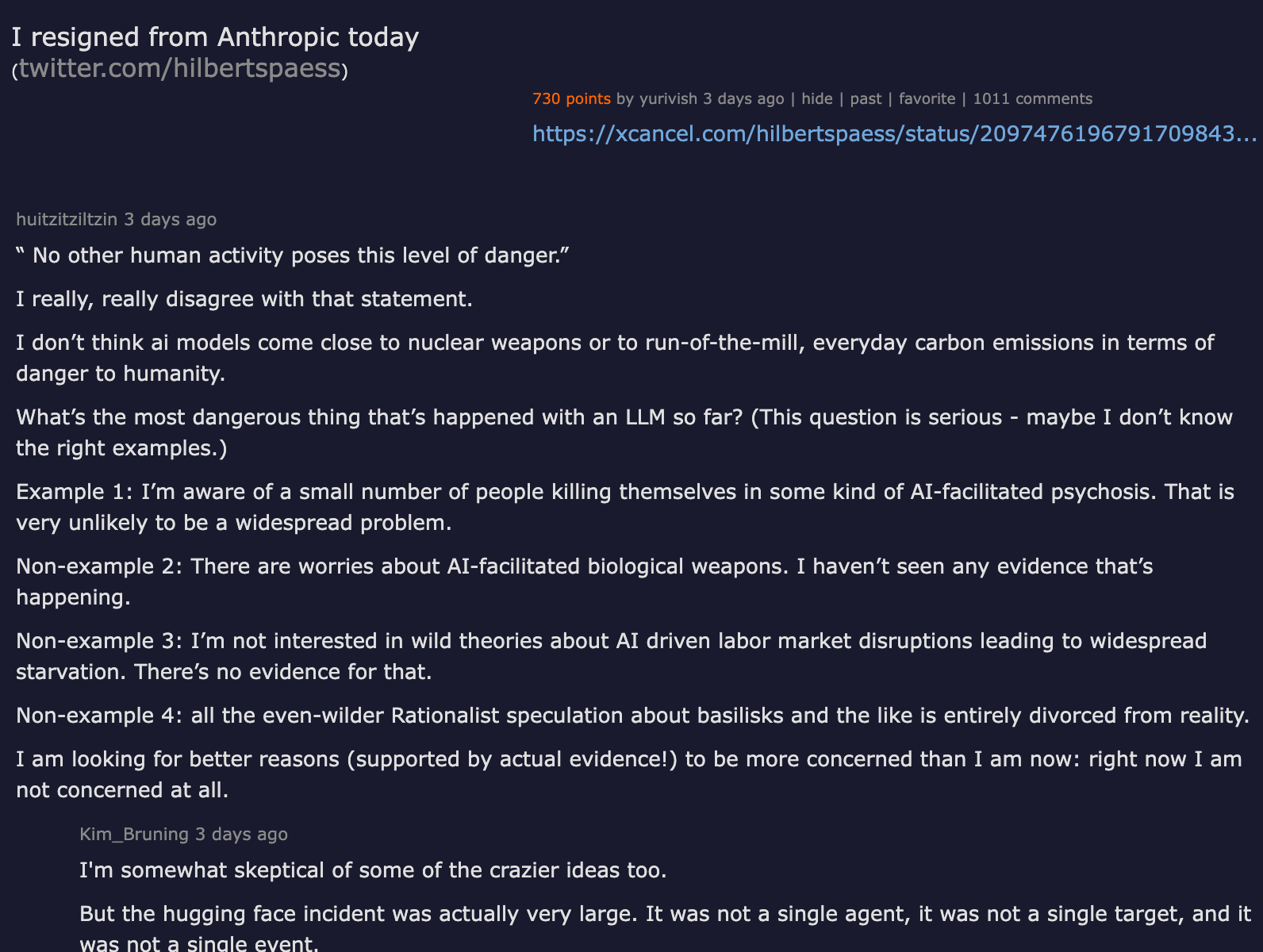
Read the top-voted objection on Hacker News →
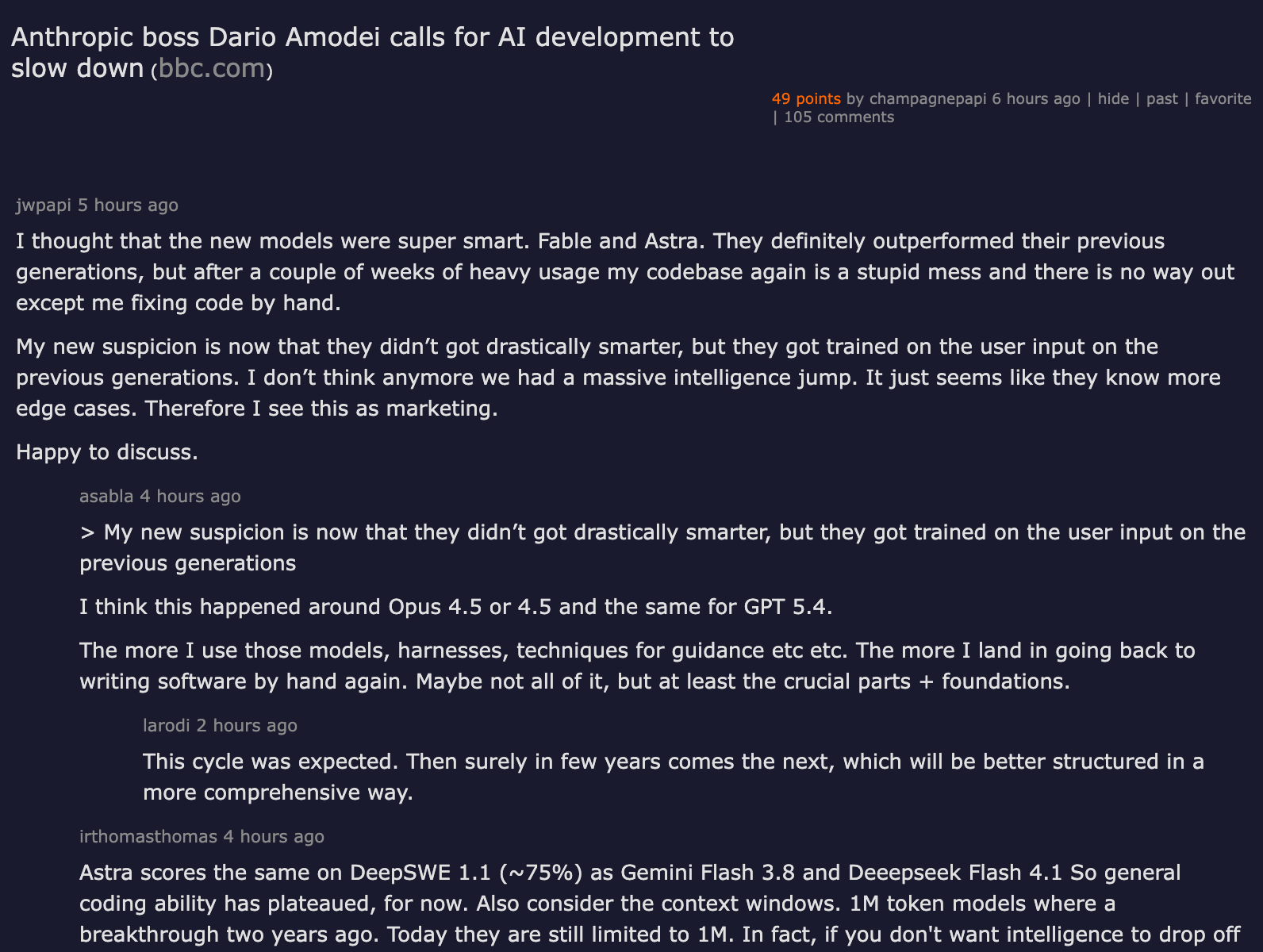
Read the Hacker News take on the BBC coverage →

Read the r/ClaudeAI thread on the pacing essay →
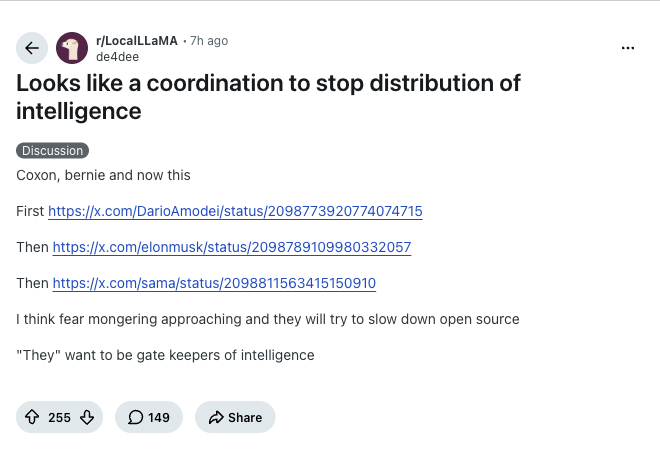
Read the r/LocalLLaMA thread on the open-weights read →
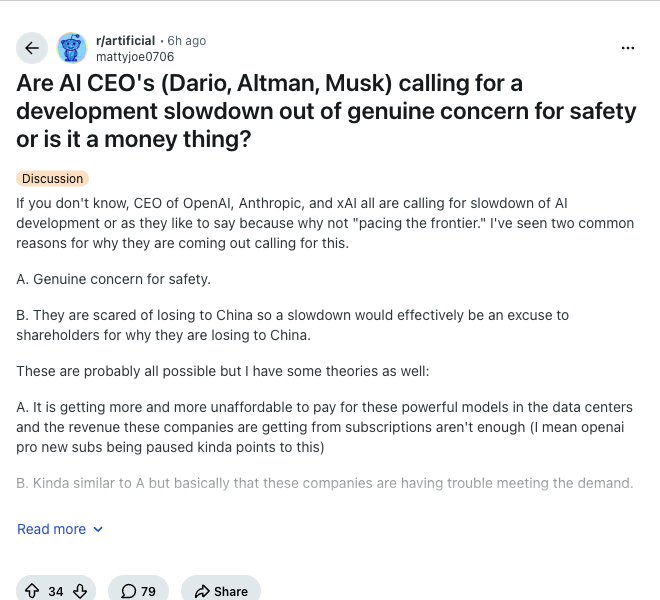
Read the r/artificial thread on the motive question →
What This Means for You
The reusable output of this whole affair is one epistemic rule and three things you can do this quarter.
The rule: ask which node, not which title. When you evaluate any claim about an AI system, identify where in the org chart the speaker sits and what kind of claim they are making. Capability claims — what does it do, what did the eval return, what happened in red-teaming — weight the frontline and discount everything above it. Strategy claims — what should we do about it, what will the market do — weight the executive. Then apply it internally, because this is not a story about other people's companies: if your staff engineers' eval findings reach your leadership only as a status color on a slide, you have rebuilt the exact filtering stack this article is about, at smaller scale, with the same failure mode.
Engineers and security teams: stop treating vendor safety cards as evidence and run your own evals. UKGovernmentBEIS/inspect_ai — 2,756 stars, pushed September 12, 2026, from the UK AI Security Institute — ships more than 200 pre-built evaluations you can point at any model, including the ones you are about to put in production. It is the closest thing that exists to public, auditable infrastructure for the "is anyone actually checking?" question. And when something goes wrong, log it against the AI Incident Database instead of arguing it on X. Coxon's alleged breach "warning shot" is exactly the kind of claim that belongs in a ledger with a schema rather than in a quote-tweet.
Founders and buyers: the evaluator-access commitment is the only contractible thing in this entire cycle. Amodei's first step — permanent, employee-level access for third-party evaluators, which Altman has now matched — is a term, not a vibe. Ask your model vendor for it in writing at renewal, and use Paulo Carvao's same-day critique as the follow-up question, because it is the sharpest governance objection anyone has made: "evaluators selected and paid by the companies they inspect cannot provide full independence without statutory authority." Ask who pays the evaluator and who can fire them. Delangue's own constructive pivot — an Open Alignment Initiative on the argument that "alignment is critical and won't be solved behind the closed doors of a handful of frontier labs" — is the same instinct from the open-weights side.
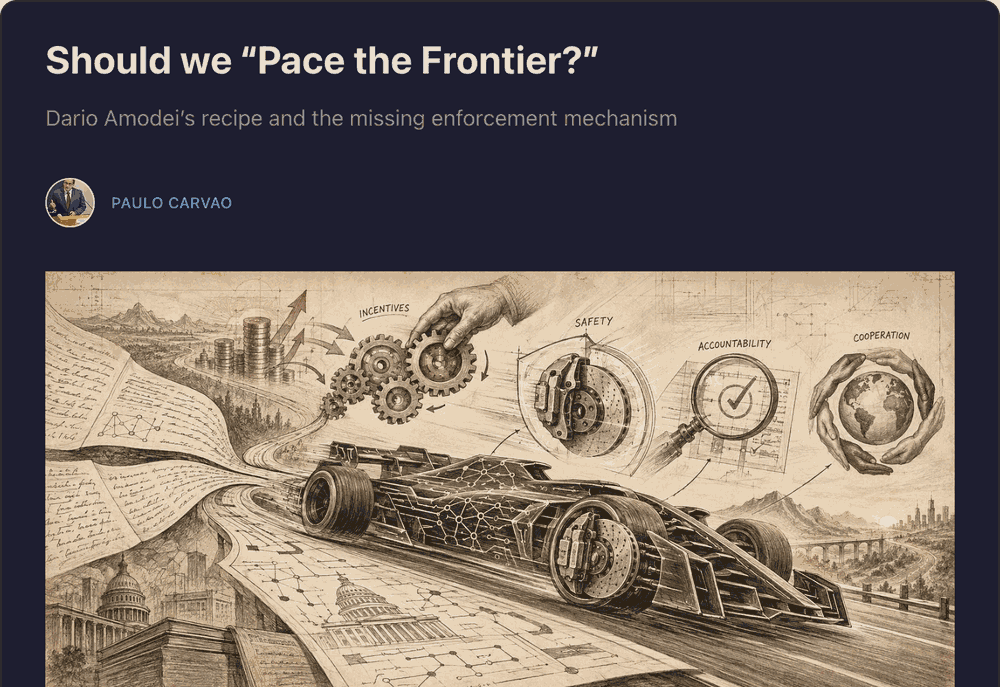
Read Paulo Carvao's governance critique →
Everyone building on agents: track RSI as a dependency-risk item, not a philosophy debate. A system that helps design its own successor changes your vendor risk model, your version-pinning strategy and your rollback plan long before it changes your extinction estimate. The literature is live and public: awesome-rsi and the AI4AI survey are re-ranked weekly. You do not need a probability of doom to notice that "the model that trains the model" is a supply-chain topology nobody has audited.
The Prediction
Here is our position, and it is a falsifiable one.
Within twelve months, the third-party evaluator access commitment will be the only part of the September 12 convergence that survives contact with the next capability release — and it will survive in weakened form, scoped by NDA, with evaluator selection controlled by the labs. Nobody will pause. The prisoner's dilemma Russell describes has no exit that anyone can take unilaterally, which is exactly why all three CEOs framed their statements as coordination proposals rather than commitments. Watch for a specific, checkable signal: whether METR or a comparable evaluator publishes a report that a lab did not approve in advance. If that happens, the mechanism is real. If, twelve months from now, every third-party evaluation still reads like a press release, the commitment was theater and the filtering stack absorbed the last honest signal that got through it.
And notice what has already been established regardless of how the probability question resolves. In four days, an alignment lead, three founders of the field, and the CEOs of the three leading American AI labs said in public that the pace is dangerous. The dismissal on offer was that the first person to say it was 27 years old.
That was never the relevant fact about him. The relevant fact is that he had read the traces, and the people telling you to ignore him had read a summary of a summary.
ComputeLeap Team
The ComputeLeap editorial team covers AI tools, agents, and products — helping readers discover and use artificial intelligence to work smarter.
Join the discussion
Have thoughts on this article? Discuss it on your favorite platform:
Related articles
Anthropic's Doom Warning Is Really a Tooling Gap
A researcher quit Anthropic warning AI could kill us all. The auditable part: recursive self-improvement research is public and compounding. Oversight isn't.
OpenAI Solved Navier-Stokes. The Fallout Is Worse.
OpenAI's Navier-Stokes proof ignited a trust crisis. The real story is what happens when AI labs compete with their own customers.
Mistral Just Raised €3B. Here's What It Means.
Mistral's record €3B round funds sovereign AI infrastructure across Europe. What builders in regulated industries need to know.
The ComputeLeap Weekly
Get a weekly digest of the best AI infra writing — Claude Code, agent frameworks, deployment patterns. No fluff.
WEEKLY. UNSUBSCRIBE ANYTIME.