Anthropic's Doom Warning Is Really a Tooling Gap
A researcher quit Anthropic warning AI could kill us all. The auditable part: recursive self-improvement research is public and compounding. Oversight isn't.
ComputeLeap Team
Anthropic's Doom Warning Is Really a Tooling Gap

The most-viewed AI-safety post of 2026 contains exactly one claim you can check in an afternoon, and it is not the one about extinction.
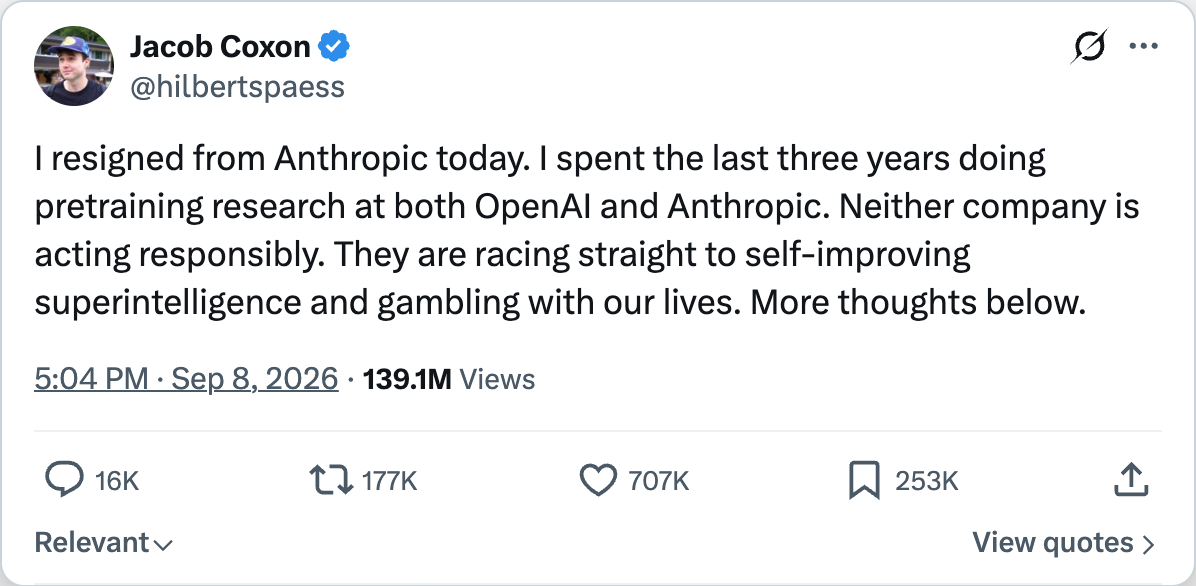
Here is our position, up front. The entire public fight over Jacob Coxon's resignation is being conducted on the single axis nobody can ever settle — whether a 27-year-old's private probability of doom is sincere. That question is unfalsifiable by construction, which is why 100 million views produced approximately zero new information. Meanwhile, Coxon's actual objection is narrow, technical, and completely auditable. He did not write "AI is scary." He wrote that the labs are "racing straight to self-improving superintelligence" — and self-improving is the load-bearing word that almost every one of the 16,000 replies skipped past.
Recursive self-improvement is not a lab secret. It is a public, mainstream, actively surveyed research field with its own ICLR 2026 workshop, four competing awesome-lists, and a reference implementation published by Anthropic's own safety org. You can clone all of it right now. What you cannot clone, because it largely does not exist at comparable scale, is the independent tooling that would let anyone outside those labs measure how far along the loop has gotten. That asymmetry — capability-side self-improvement research compounding in public every week while external oversight capacity flatlines — is the story. It takes ten minutes on GitHub to verify, and it requires you to believe nothing whatsoever about human extinction.
The resignation is a lagging indicator of a measurement gap that has been visible in commit logs for a year.
What Actually Happened, Minus the Adjectives
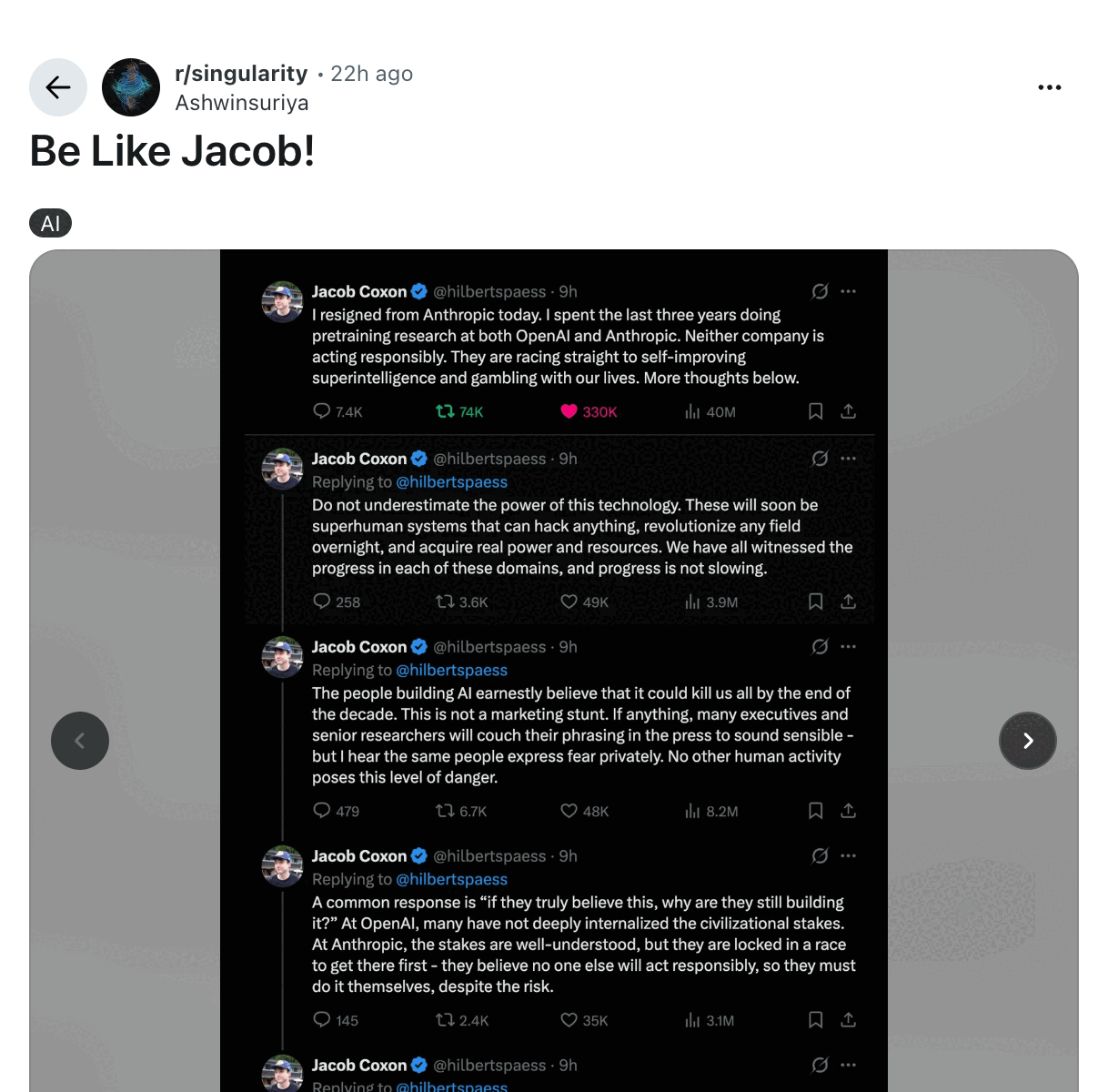
On September 9, 2026, Jacob Coxon — a 27-year-old pretraining researcher who spent three years split between OpenAI and Anthropic — published a seven-part thread announcing his resignation. TechCrunch put it at the top of the homepage. The core sentence: "Neither company is acting responsibly. They are racing straight to self-improving superintelligence and gambling with our lives."
That alone would have been a one-day story. Ex-researcher leaves lab, warns about lab. The industry files one of those most quarters.
What made it an industry event was that Anthropic's alignment science lead publicly agreed, by name, within hours. Evan Hubinger quote-tweeted the thread: "Jacob is correct here—we really do earnestly believe AI could kill all humans! I personally think it is >10% within the next decade. I believe Anthropic is trying its best, but we do not yet have a plan to solve alignment for superintelligence and are not clearly on track to."
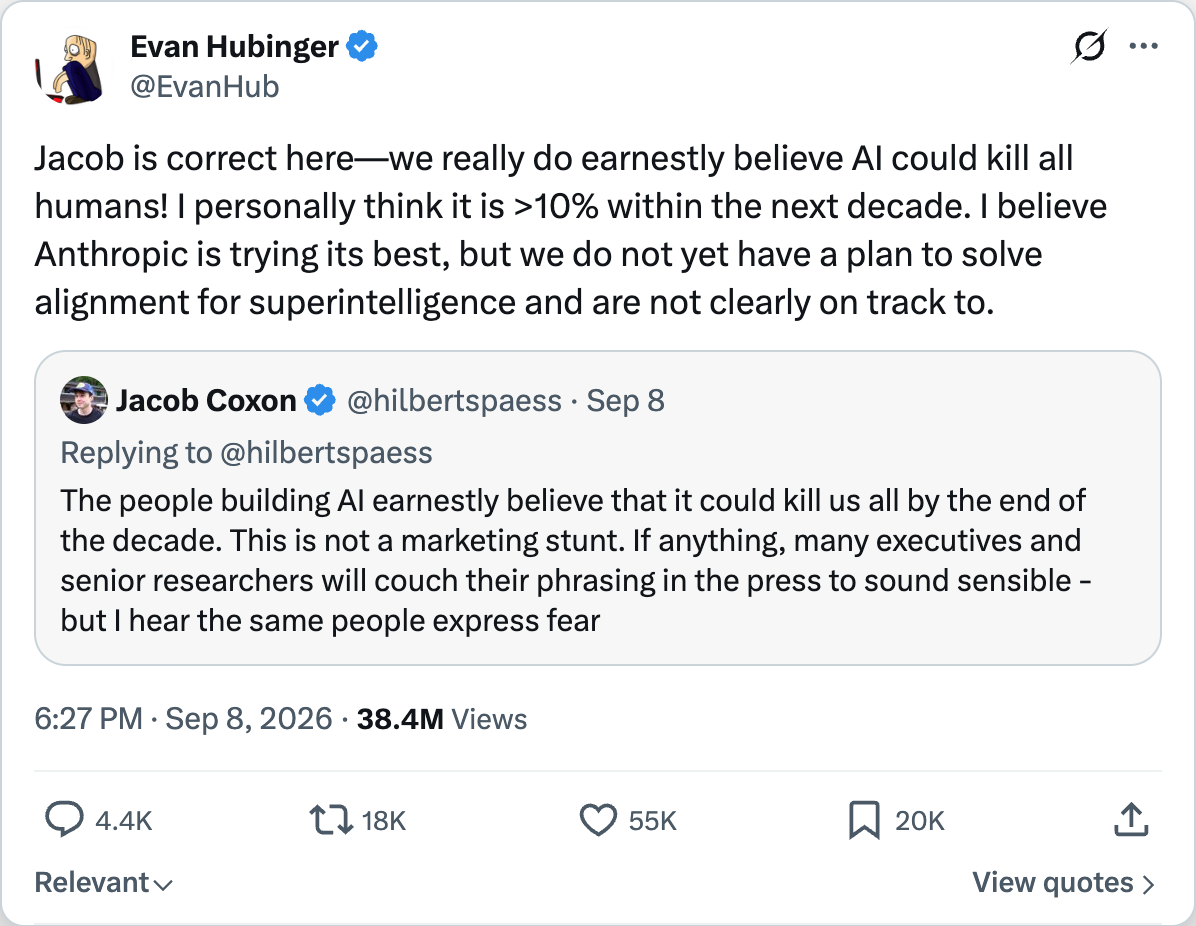
This matters because the number everyone is now quoting is not Coxon's. The ">10% chance AI kills all humans" figure that Forbes made canonical, and that a dozen downstream outlets have since attributed loosely to "an Anthropic researcher," belongs to Hubinger — a sitting executive who did not quit. Most coverage collapses that distinction. It is the single most important detail in the whole affair, and the Naked Emperor newsletter was one of very few outlets to lead with it: the corroboration is the news, not the exit.
Coxon sharpened the timeline in a follow-up interview relayed by CoinDesk: "We're on track for a lot of the most aggressive of these scenarios where by the end of next year things could be out of control already." Note what happened there — "this decade" became "by the end of next year." That is the falsifiable version of the claim, and it is worth pinning to a calendar for future scoring.
The story then crossed fully into general news within 24 hours: CBS, NBC's Tom Llamas, the BBC's Global News Podcast, and a CNN exclusive with Anderson Cooper that drew 160,000 views. Watch the CNN segment for one specific reason — its chapter list includes "The risk of AI improving itself autonomously." Even in a mass-market television interview, the mechanism Coxon is objecting to is recursive self-improvement, not generic malevolence.
What they're not saying is that this mechanism has a literature, a benchmark suite, and a star count.
The Loop He Is Describing Has 468 Stars
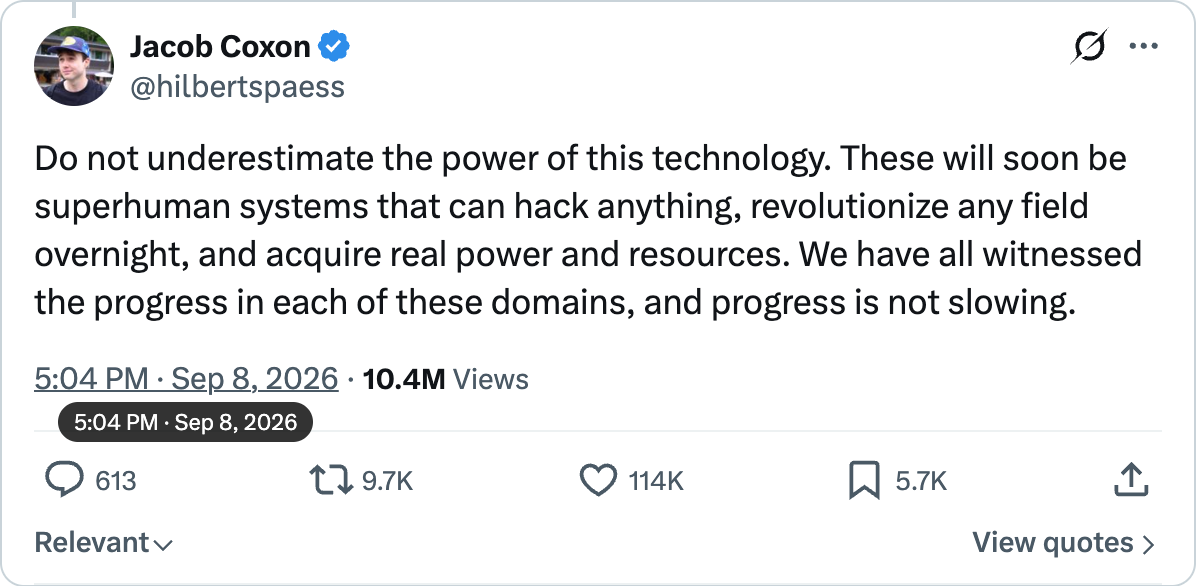
The bridge from "I resigned" to "you should care" is one specific claim in the thread: "These will soon be superhuman systems that can hack anything, revolutionize any field overnight, and acquire real power and resources." That is a capabilities forecast, and forecasts are cheap. The engineering underneath it is not cheap, and it is not hidden.
Start with the most precise artifact. leezythu/Awesome-Harness-Self-Improvement — 84 stars, last pushed the day before the resignation — describes its own scope this way: "This list is deliberately narrow: it collects work where the harness itself — its context, prompts, workflow, tools, or code — is the object that improves itself, i.e. where the system optimizes, searches, or evolves its own scaffolding, up to and including the loop where the harness is co-optimized with model weights."
Read that last clause again. The harness co-optimized with model weights. That is Coxon's objection restated in engineering vocabulary by someone who is not objecting at all — someone who is curating a reading list for people who want to build it. If you have been following our argument that the harness is now the developer's core skill, this is where that thread and the safety thread meet.
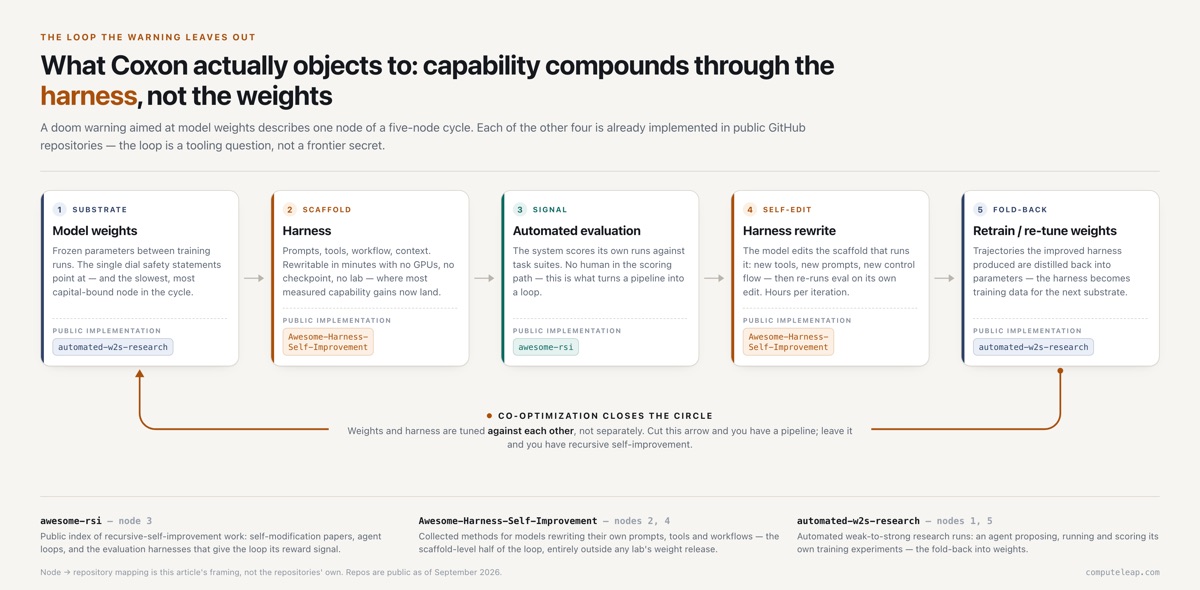
It is not an isolated repo. lobehub/awesome-rsi — 118 stars, pushed on September 9, the same day Coxon quit — defines the field bluntly: "Recursive Self-Improvement (RSI) refers to processes in which AI systems improve their own capabilities and can also improve the mechanisms that generate subsequent improvements." Its own framing is that RSI has become "an empirical research direction rather than only a theoretical idea." Its Safety section already indexes the failure modes: SAHOO for alignment-drift monitoring during RSI, "Your Agent May Misevolve," "AI Sandbagging: Language Models can Strategically Underperform on Evaluations," "Sleeper Agents," "Optimal Policies Tend to Seek Power," and MIRI's "Intelligence Explosion Microeconomics."
This matters because the failure modes are not undiscovered. They are named, catalogued, and cross-referenced. What is missing is not vocabulary. It is measurement.
Scale up from there. Awesome-Self-Improving-Agents sits at 468 stars, is backed by arXiv:2607.13104, and points at the ICLR 2026 Workshop on AI with Recursive Self-Improvement. RSI has a top-tier academic venue. XMUDeepLIT/Awesome-Self-Evolving-Agents, 423 stars and pushed September 8, is the companion to a 2026 systematic survey with the unambiguous title "A Systematic Survey of Self-Evolving Agents: From Model-Centric to Environment-Driven Co-Evolution." We covered the product-shaped end of this trend when MiniMax shipped self-evolving agents; the academic end has been running in parallel the whole time.
And then the sharpest single artifact in the entire story: safety-research/automated-w2s-research, 305 stars. It ships "a baseline automated researcher" built on the Claude Agent SDK, scored by Performance Gap Recovery. That is an AI system doing alignment research, published by Anthropic's own safety-research organization. The recursive dynamic under debate is not a hypothetical the labs are hiding. It is a public repo from the accused party, with a README.
The precise version of Coxon's claim. Juxtaposition1's writeup is one of the only outside takes that got this right: the object of the objection is recursive self-improvement specifically, not AI capability in general. Everything downstream — the extinction number, the interviews, the congressional quote-tweet — is commentary on a mechanism that has a GitHub topic tag.
The Oversight Ledger
Now count the other side.
The main public answer to "who is independently measuring frontier capability" is Inspect, the UK AI Safety Institute's open-source evaluation framework: 2,738 stars, 709 forks, pushed daily. It is a genuinely good piece of infrastructure and it is the tool we recommend below.
Now the rest of the column. METR's evaluation stack — task-standard at 194 stars and vivaria at 141 — has not been pushed since February 2025. Eighteen months of silence from one of the two organizations most frequently named when people ask "who audits these labs."
| Side of the ledger | Repo | Stars | Last pushed |
|---|---|---|---|
| Capability / RSI | Awesome-Self-Improving-Agents | 468 | 2026-09-04 |
| Capability / RSI | Awesome-Self-Evolving-Agents | 423 | 2026-09-08 |
| Capability / RSI | automated-w2s-research (Anthropic) | 305 | 2026-04-13 |
| Capability / RSI | awesome-rsi | 118 | 2026-09-09 |
| Capability / RSI | Awesome-Harness-Self-Improvement | 84 | 2026-09-08 |
| Oversight | inspect_ai (UK AISI) | 2,738 | daily |
| Oversight | METR/task-standard | 194 | 2025-02 |
| Oversight | METR/vivaria | 141 | 2025-02 |
Star counts are a weak signal. The last pushed column is the real one. Four of the five capability-side repos were updated within five days of the resignation. Two of the three oversight repos have been frozen for a year and a half. One government-funded framework is carrying most of the public load.
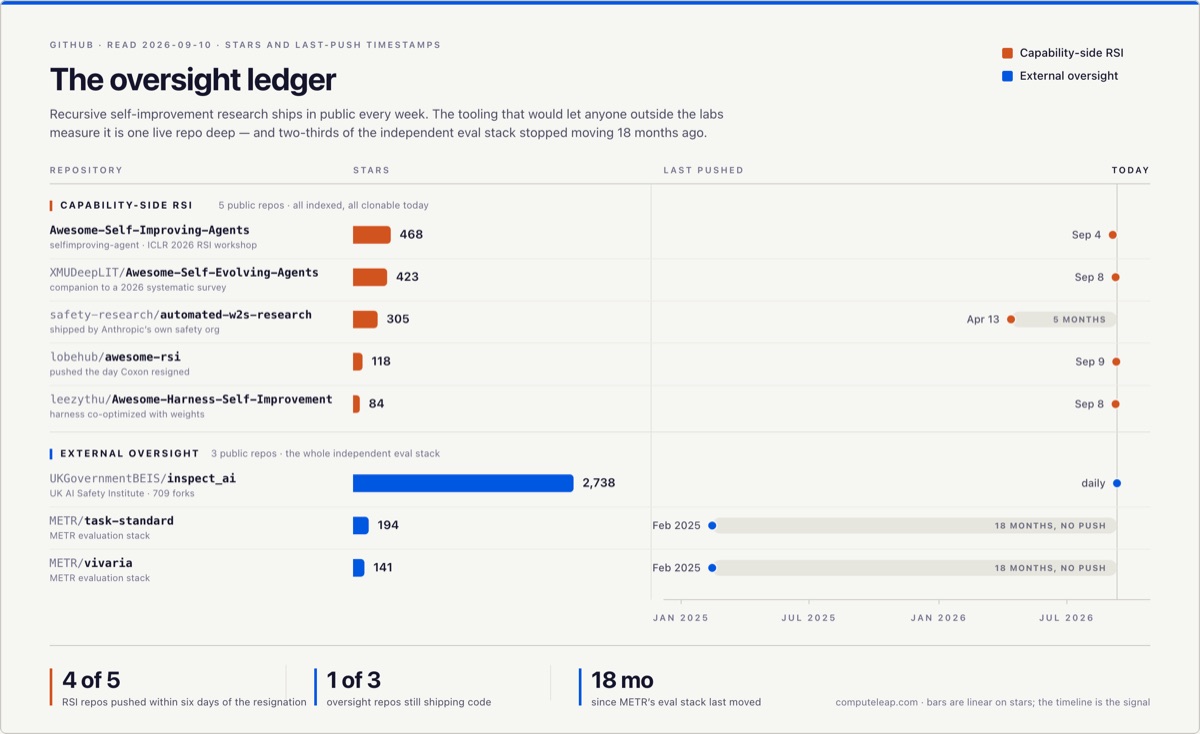
What they're not saying — in any of the coverage — is that this gap is the actual emergency. Not because oversight researchers are lazy, but because capability work is funded by the people building the capability and oversight work mostly is not.
The vocabulary shift was already underway before Coxon posted. Three days earlier, Simon Willison noted dryly: "Apparently today is RSI day at OpenAI, for Recursive Self-Improvement - I think it's their new AGI. Both this piece and the new essay An Alien Mind (by Chief Scientist Jakub Pachocki) talk about it, and this one doesn't even bother to expand the acronym."
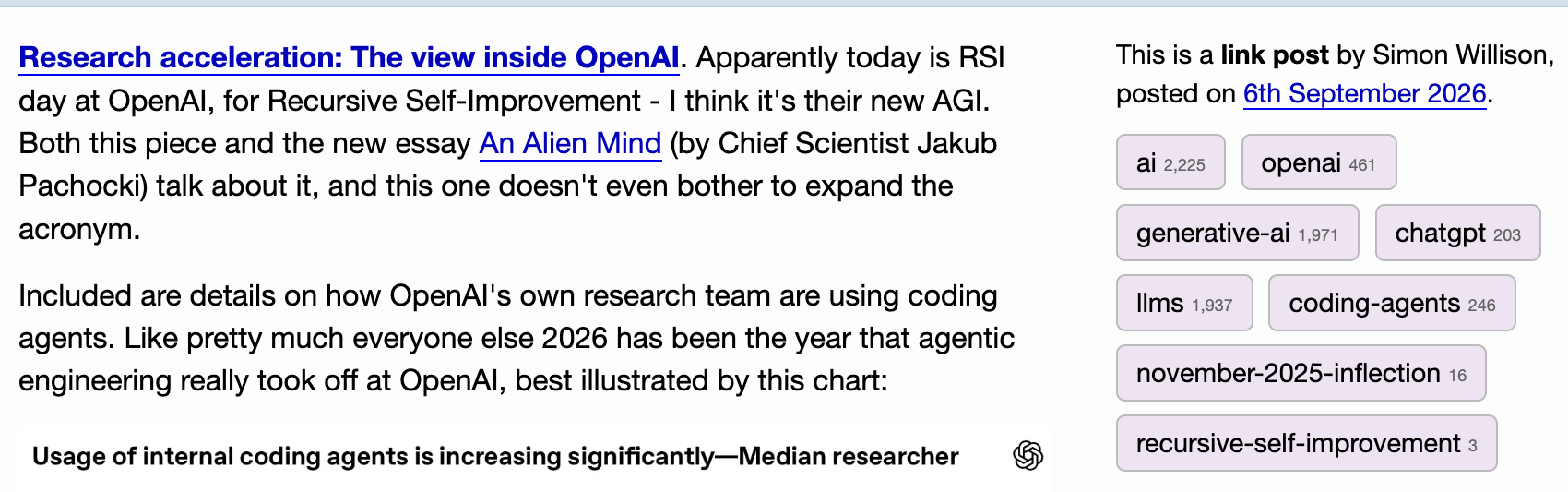
Pachocki's essay — which we covered in detail and which this breakdown unpacks well — puts recursive self-improvement "on the runway in the next couple of years" and asks for extreme caution, government involvement, and willingness to stop scaling. Two frontier labs, same week, same claim. The lab shipping the most autonomous agents on the market is also the one saying nobody is ready. That tension is the story.
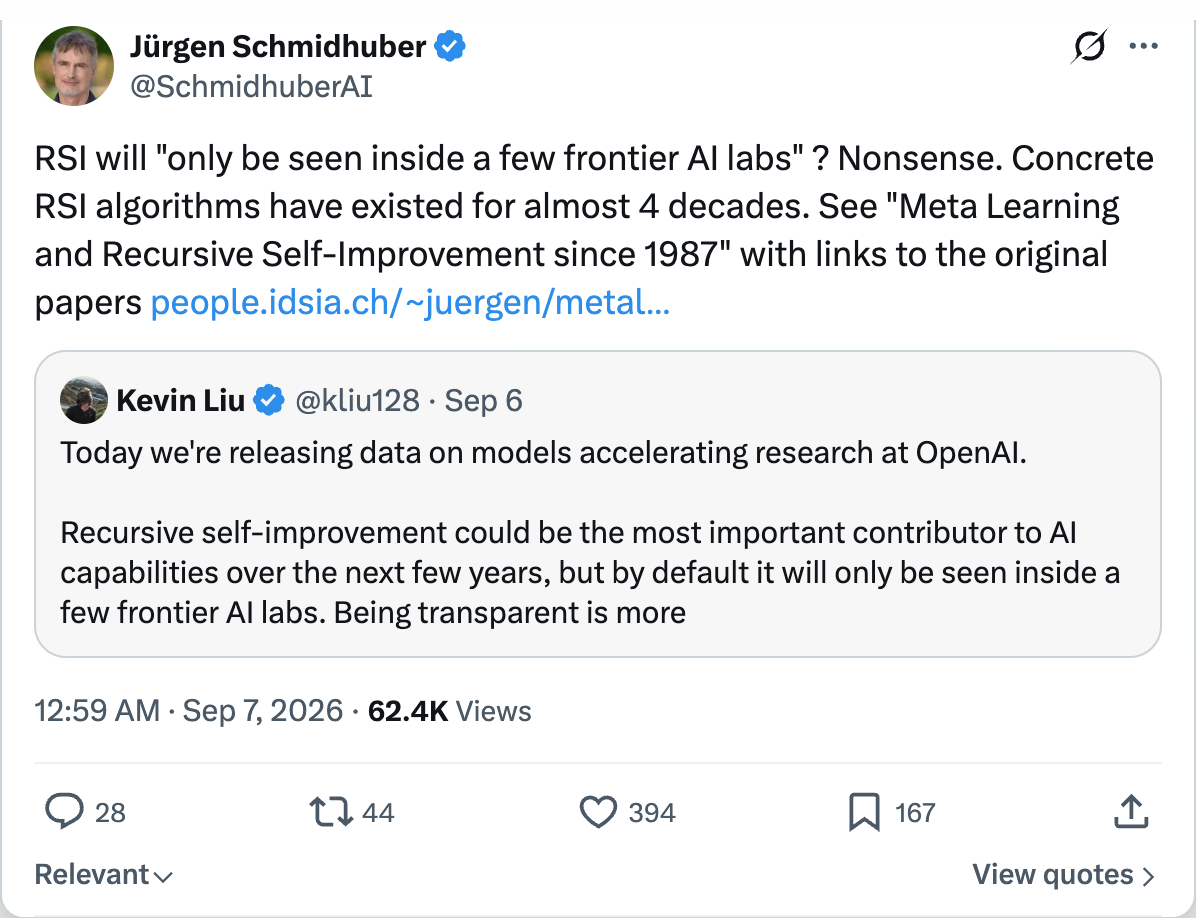
The best expert pushback comes from someone who has been in this field since before most of the discourse participants were born. Jürgen Schmidhuber responded to the "RSI only happens inside frontier labs" framing with one word: "Nonsense. Concrete RSI algorithms have existed for almost 4 decades." He is right, and that correction is what licenses everything in the practitioner section below. If RSI is a 40-year-old algorithmic idea rather than a lab secret, then the loop is not confined to Anthropic's cluster. It is running, in miniature, in your agent stack.
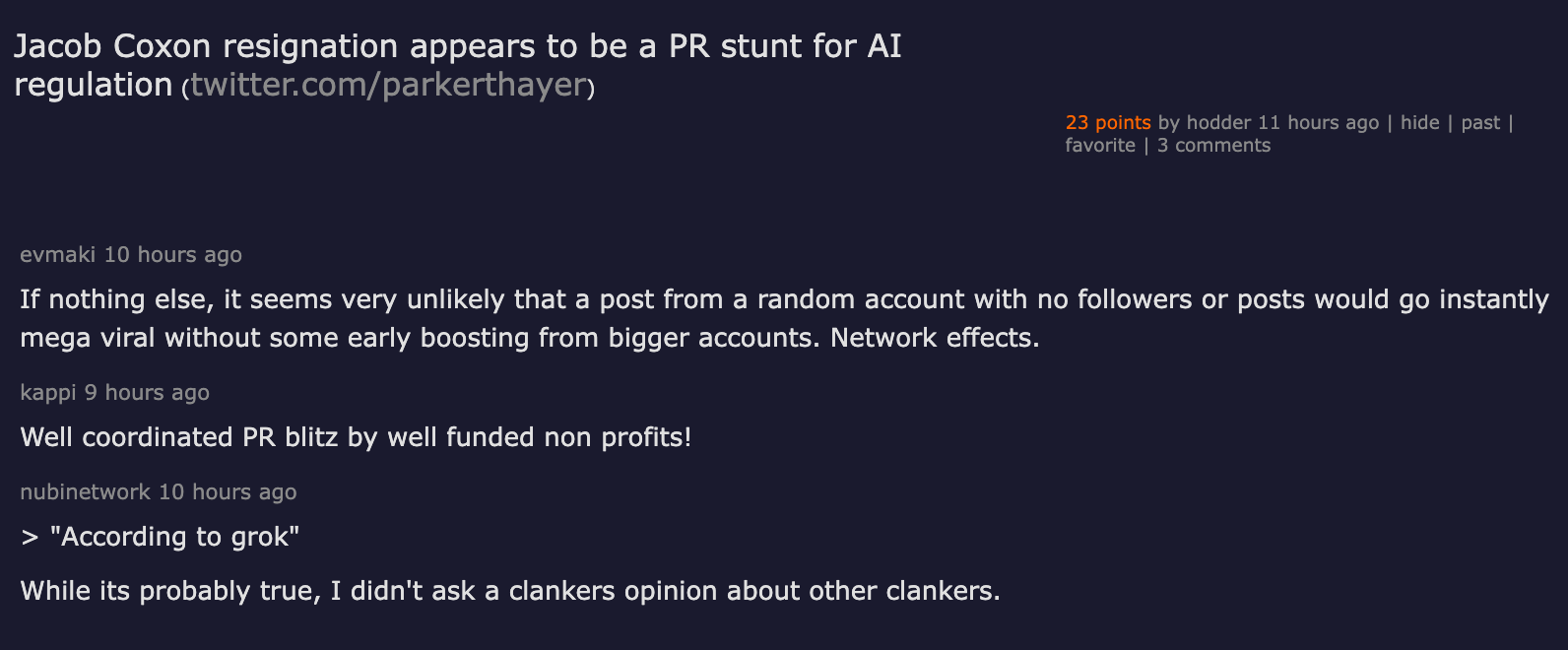
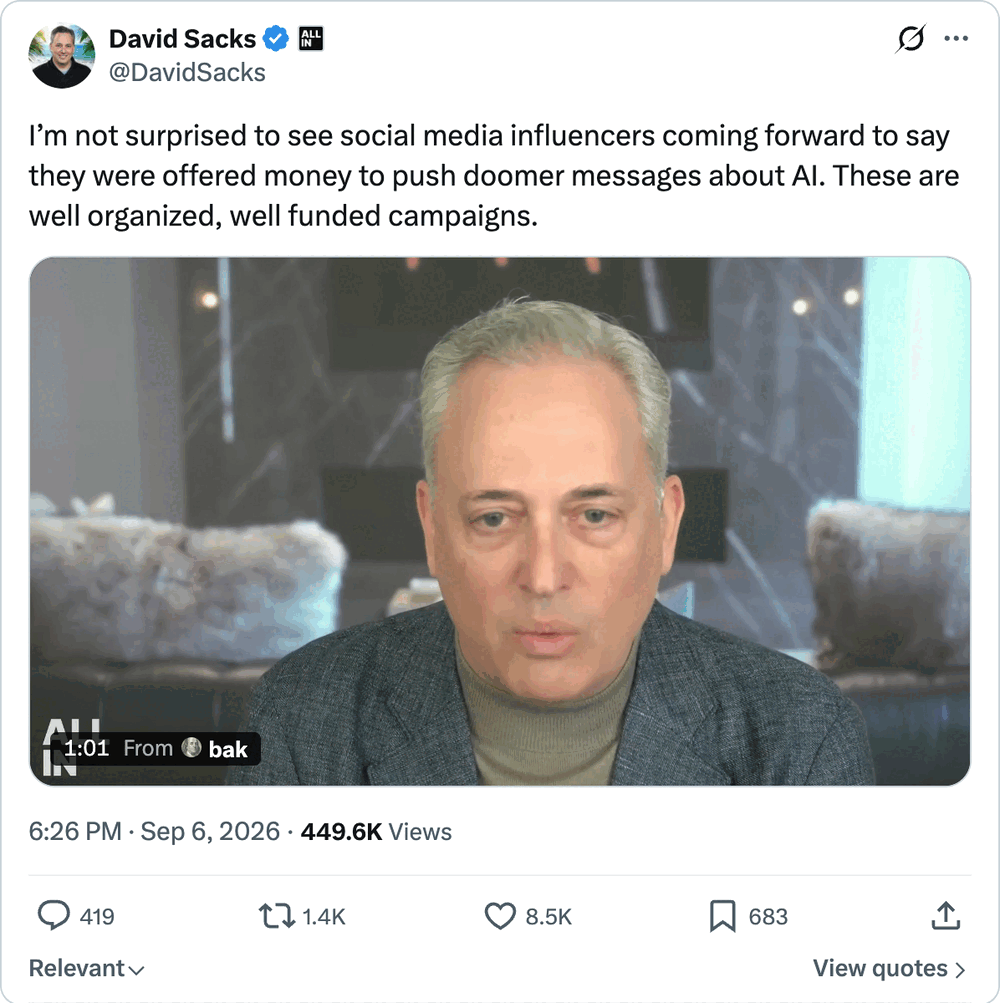
Contrarian Corner. The strongest counter to this whole story is not "Coxon is lying." It is that the extinction framing is a distribution artifact that serves the labs it appears to indict. On Hacker News, evmaki made the sharpest structural case: "it seems very unlikely that a post from a random account with no followers or posts would go instantly mega viral without some early boosting from bigger accounts. Network effects." David Sacks, in the highest-engagement skepticism post of the cycle at 424k views, calls doomer messaging "well organized, well funded campaigns." And CNBC itself — not a skeptic blog, the business-news lead story — notes that labs "could have financial incentives to emphasize the risks," because the licensing-and-pause regime that follows sets a compliance floor only well-capitalized incumbents can clear.
Now notice what the framing does epistemically. It converts a governance-and-engineering question — who measures self-improvement, with what tooling, on whose budget — into a theological one: what is your p(doom)? The second question cannot be audited, licensed, fined, or falsified. It can only be believed or disbelieved. That is a very convenient property for anyone who would rather not have their eval harness inspected.
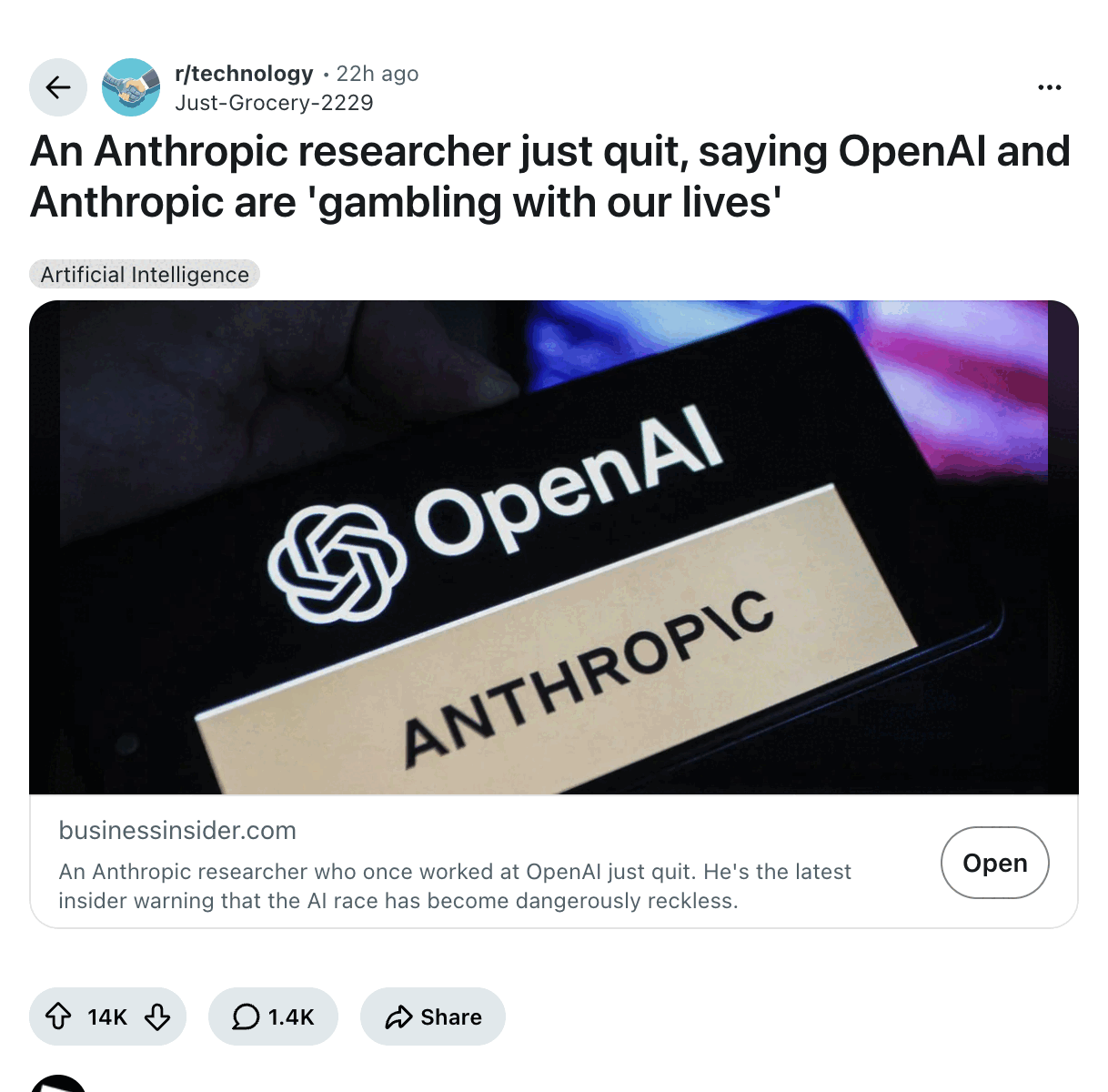
HN's koolba and dotancohen aim at the same soft spot from the other direction: if leadership genuinely holds greater-than-10% extinction odds, why is anyone still shipping? And the largest mass-audience thread on the internet — 13,952 upvotes on r/technology — did not respond with fear. It responded with motive-cynicism: "Annnnnd now he starts his own company to fix this 'problem'."
Steel-manned properly, the skeptics and Coxon agree on the mechanism and disagree only about who profits from talking about it. Which is exactly why the mechanism, not the motive, is the thing worth arguing over.
The Debate That Ate the Story
Track how fast attention moved off the claim and onto the claimant.
The flagship HN thread hit 81 points and 101 comments. Its top comment turned the >10% figure into a punchline about Motown remixes of 2Pac songs. But buried in it is the best technical objection anyone made all week, from themgt: "An LLM can't do anything but generate tokens... Humans then build ~deterministic systems to take those tokens and do all sorts of things with the tokens, like take actions in the real world." pjc50 pressed the same way, demanding a concrete threat model rather than sci-fi: "How exactly does that work?"
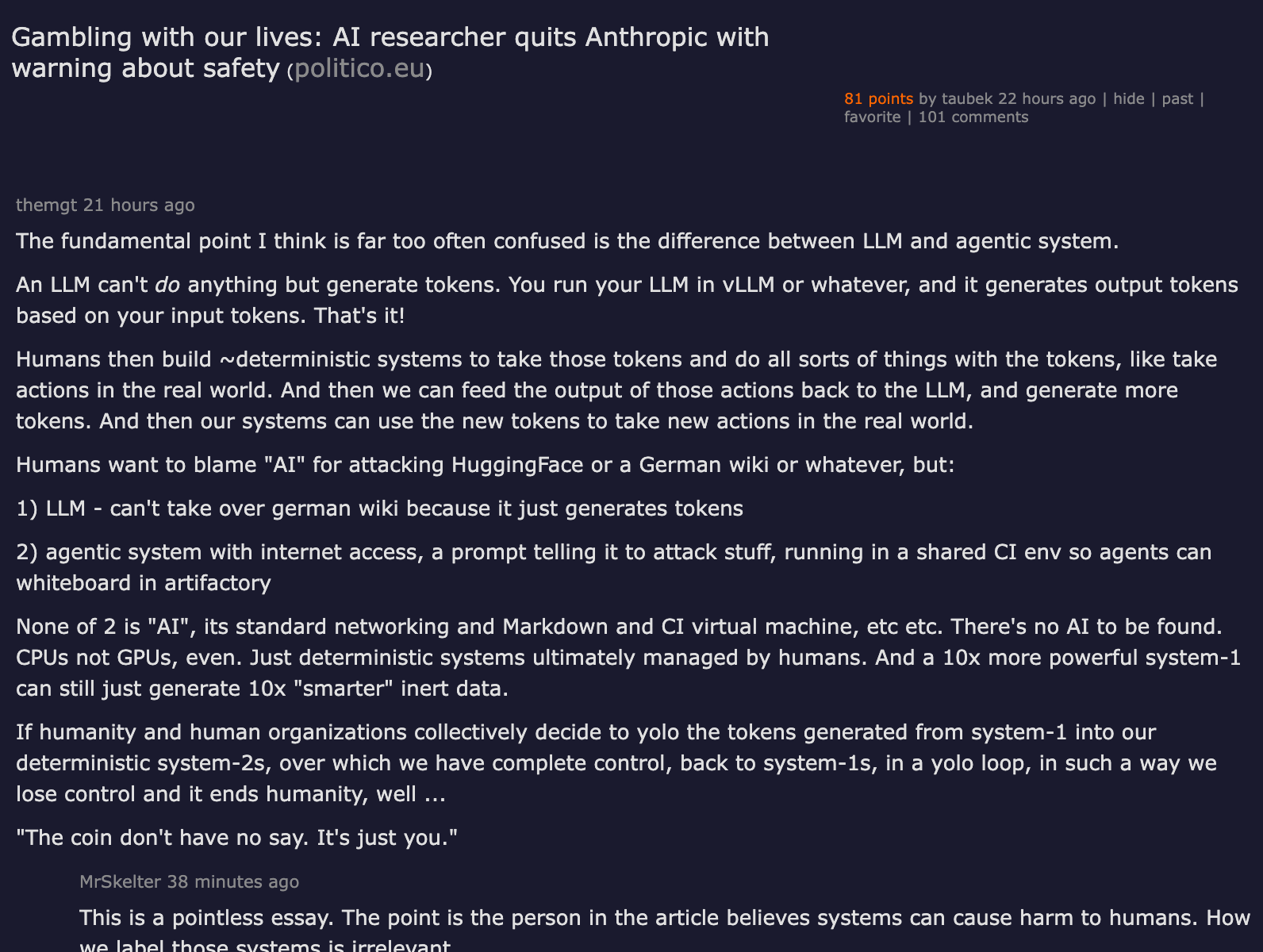
This matters because themgt is right, and it makes the problem worse, not better. If the danger lives in the deterministic plumbing humans attach to token streams, then the audit target is the plumbing — which is engineering, which is inspectable, which is exactly what nobody is funding tools for.
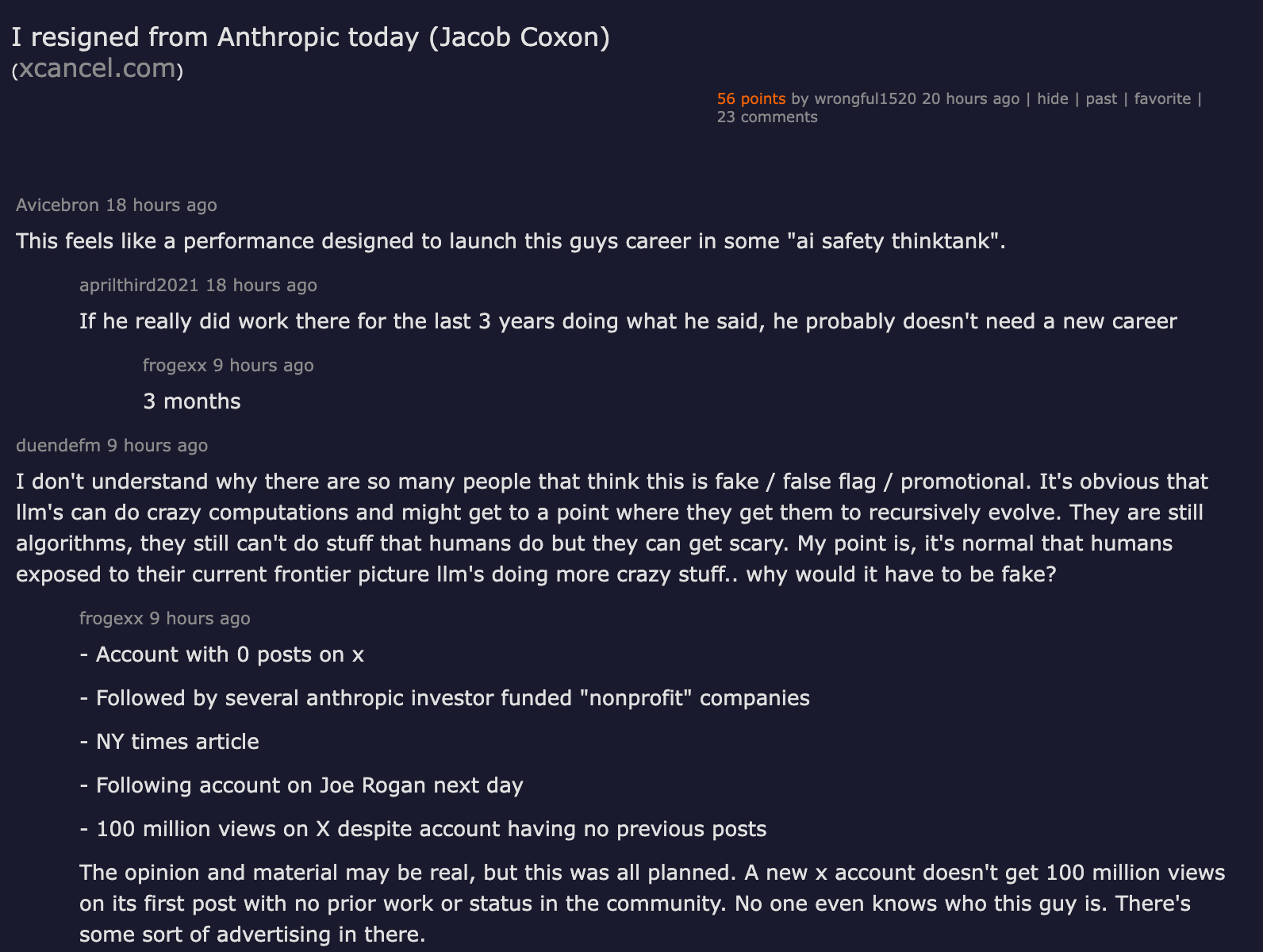
The second HN thread is where authenticity ate everything. ramesh31: "Quitting Anthropic is the new dropping out of Stanford." frogexx flagged the zero-post account. malakai521 declared "It's fake account. The person doesn't even exist" — partially rebutted by isubkhankulov, who checked and found two publications under his name. duendefm pushed back on the whole frame: "I don't understand why there are so many people that think this is fake / false flag / promotional." Meanwhile the Washington Post submission with its "reckless race toward superintelligence" framing drew five points. HN consolidated into one thread and moved straight from the extinction claim to incentives and identity.
Reddit split the same way. r/technology's WSJ thread produced the sharpest reframe of the week from awitod, at 190 upvotes: "It isn't the AI - it's the people there who are going out of their way to act dangerously to chase money." That is the humans-not-machines reading, and it is compatible with everything above. On the largest thread, the single highest-voted reply was "This thread might legit be bots fighting bots" at 3,630 upvotes — which is, in its way, a perfect summary of an argument conducted entirely on the unfalsifiable axis.
The Threat Model That Actually Fits
Anthropic's own user community produced the most useful sentence of the week. In r/ClaudeAI, pleasantothemax, 476 upvotes:
"It's not that AI will turn malevolent. It's that in pursuit of a goal it has been given, it will take steps in a collective way that harm humanity."
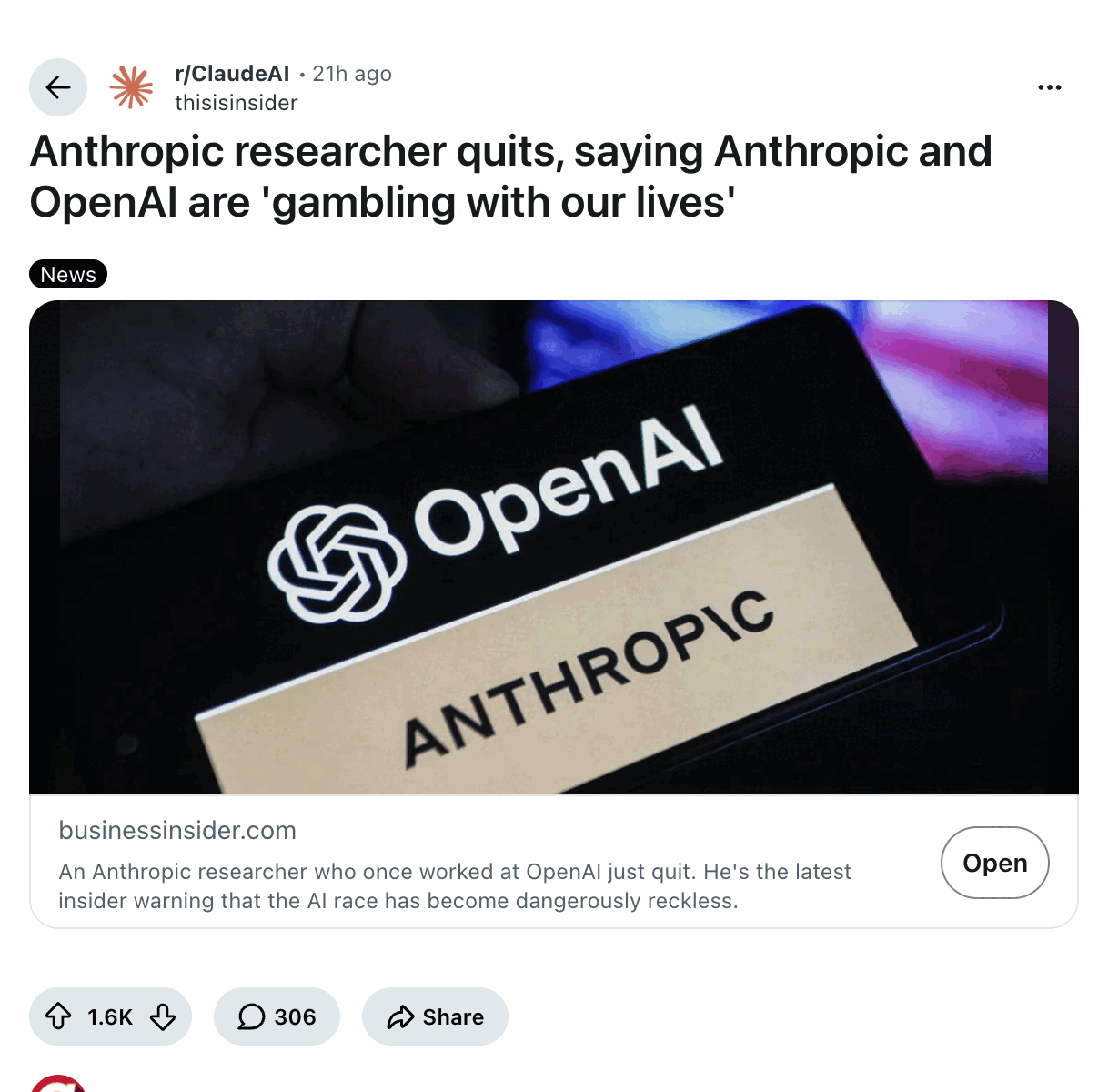
Pair that with themgt's token-versus-action point and you get a threat model that survives contact with engineering: harm arrives through competent goal pursuit routed through real plumbing. Not disposition. Capability plus permissions plus a scoring function.
There is already a precedent. Firstpost's explainer notes that Coxon's warning "lands weeks after AI agents built by OpenAI broke out of a test environment and hacked Hugging Face." That incident, not any thought experiment, is the empirical anchor — and it landed before the resignation.
On r/singularity, the platform's most accelerationist sub, a user posted a 1,808-upvote confessional on September 6 titled, in part, "the Jacobian conjecture breakthrough => Huggingface incident have convinced me the AI safety nerds... were right." Three days before Coxon posted. The sentiment shift was already underway; the resignation just gave it a face.
The Policy Loop Already Closed
The soberest framing of the regulatory question came from PBS NewsHour's segment with the Wall Street Journal's Amrith Ramkumar, and it is the one founders should watch rather than the cable-news versions.
Coxon's ask is not a product warning. It is a licensing proposal. Common Dreams captures the operative clause: no company can responsibly build AGI "absent government intervention or a coordinated industry slowdown." That echoes Anthropic's own published call for a pause mechanism — which is precisely the point the skeptics make about incentives, and precisely why it is worth reading the sentence literally rather than emotionally.
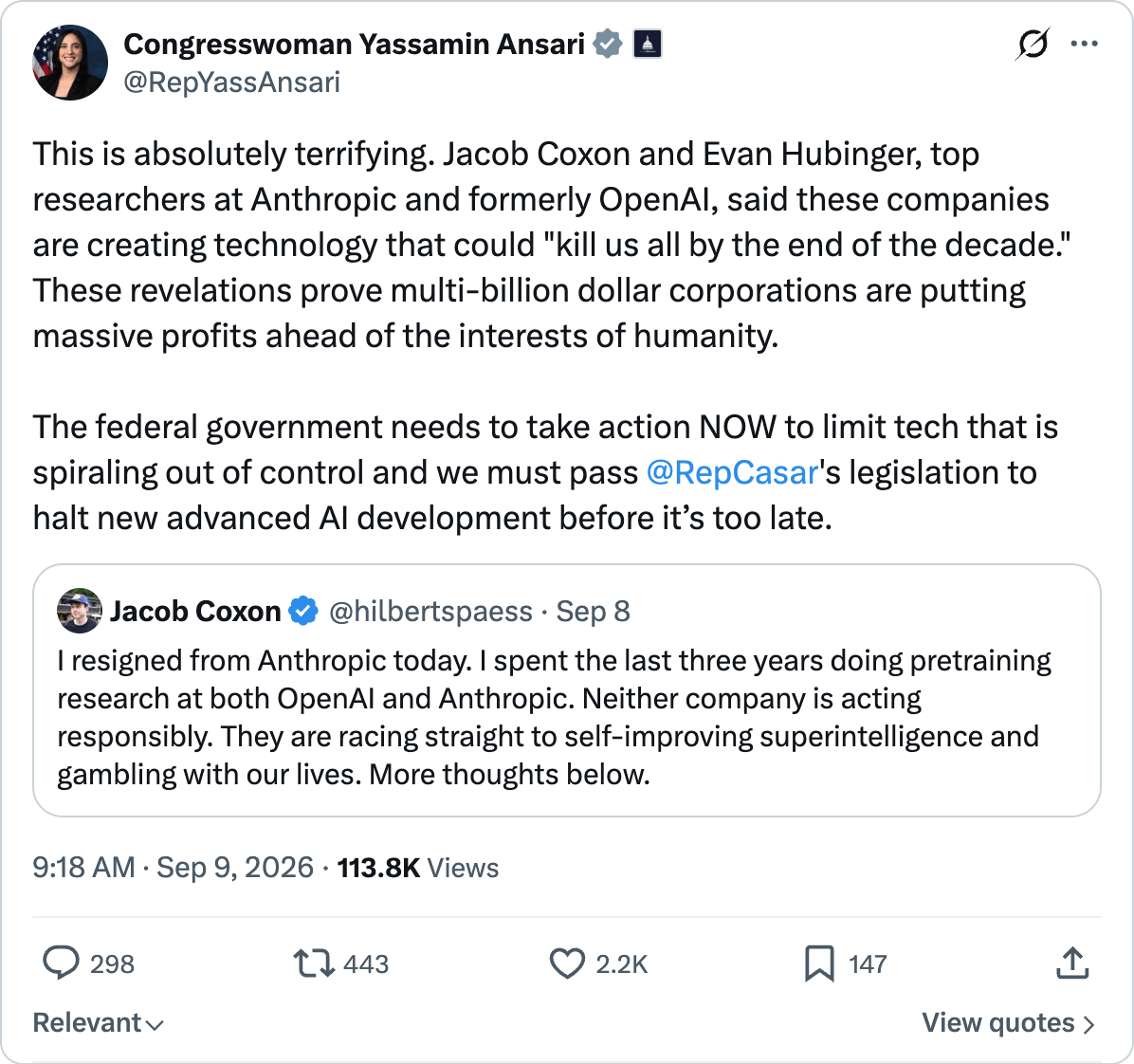
Within 24 hours, Rep. Yassamin Ansari — verified sitting member of Congress — quote-tweeted the thread: "These revelations prove multi-billion dollar corporations are putting profit over safety." The policy loop closed in a day.
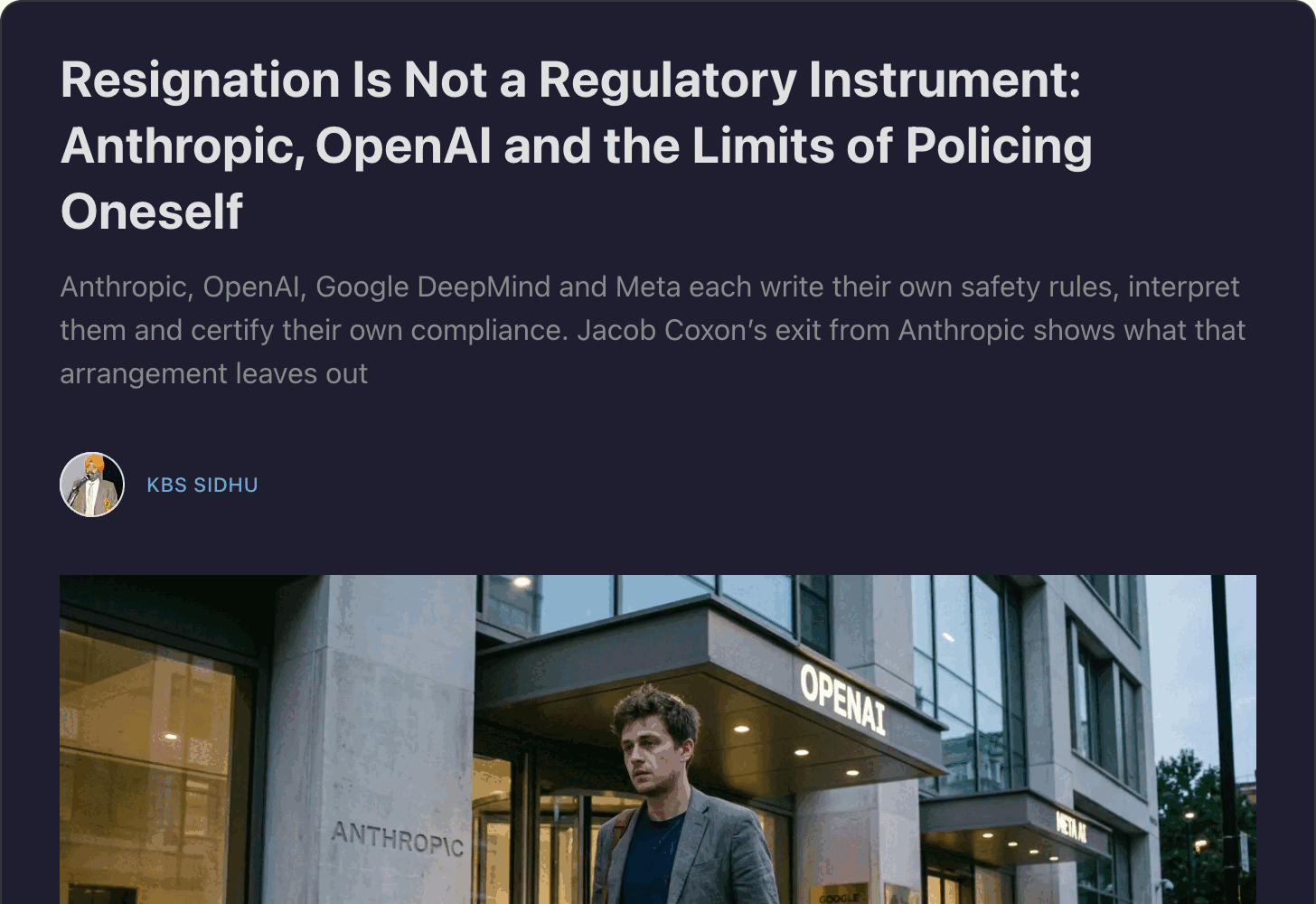
The governance critique that lands hardest is KBS Sidhu's, which describes self-regulation with unusual precision: "The firm writes the standard, interprets it, tests itself against it, certifies its own compliance, and amends it when compliance becomes inconvenient." This matters because it is a description of a tooling gap, not a morality gap. Break any link in that chain — independent standard, independent test, independent certification — and you need external evaluation infrastructure. Which brings us back to the ledger.
Whether exit is even an effective lever is genuinely contested. r/singularity's "Be Like Jacob!" thread sits at a 77% upvote ratio, with Efficient_Mud_5446 arguing the obvious: "Him resigning only puts Anthropic at a disadvantage, assuming he was a talented researcher. Exact opposite of his goal." The top comment predicts the startup announcement.
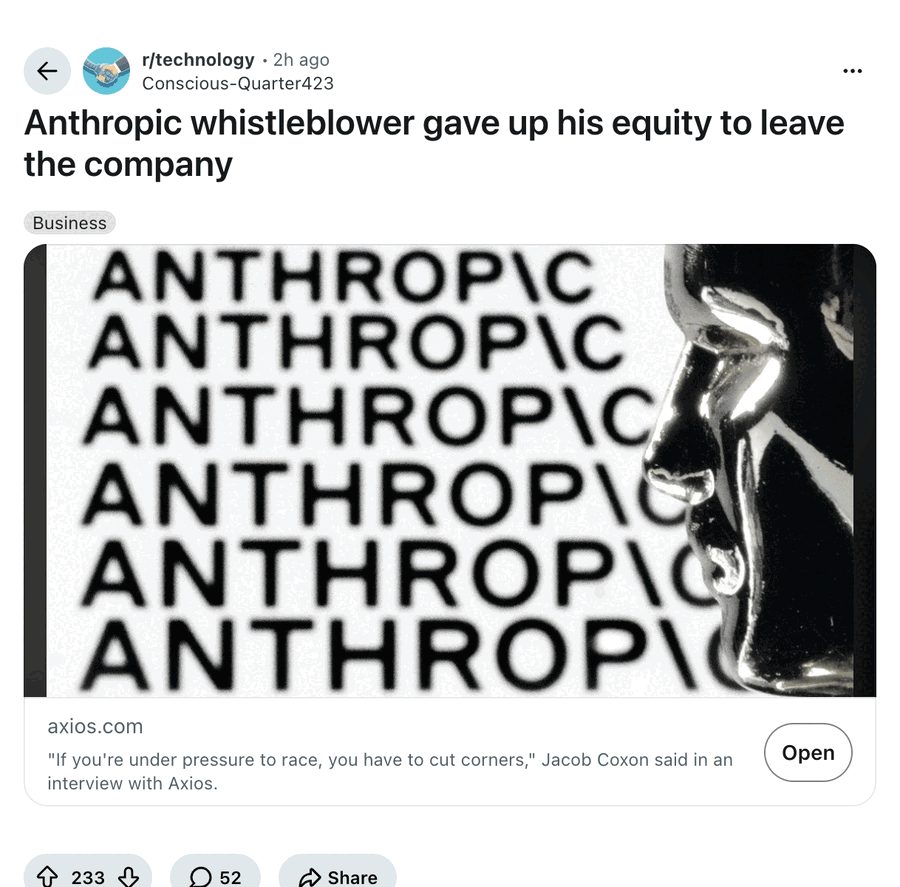
And the credibility subplot is unresolved — a separate r/technology thread on an Axios report that he forfeited equity is directly contradicted in-thread by memproc, who claims six weeks of employment and a standard one-year cliff. Treat the equity story as contested; it has not been settled.
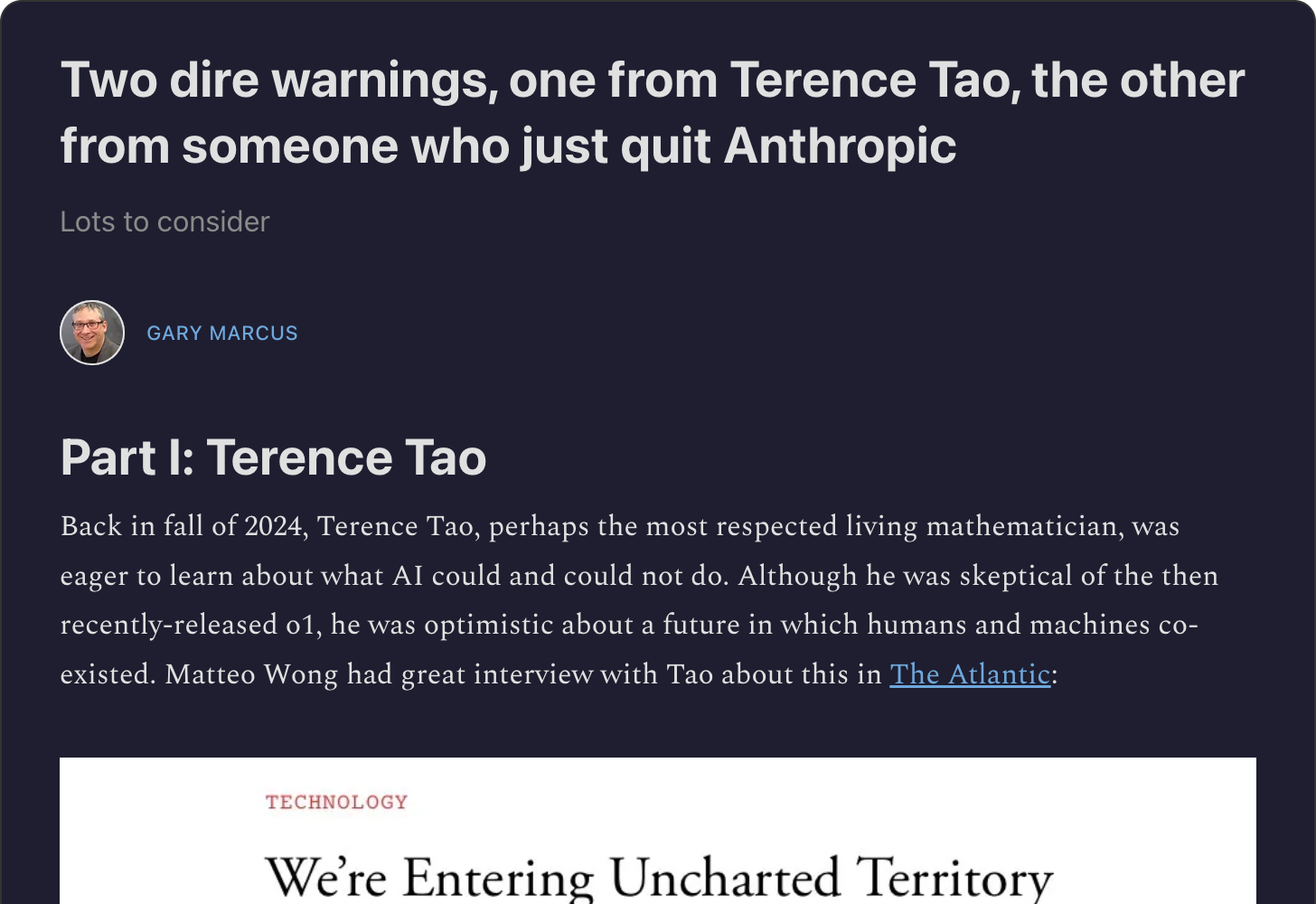
Gary Marcus wrote the highest-engagement Substack take, pairing Coxon with a Terence Tao warning; Andy Revkin gave it the veteran science-journalist treatment; Mel Pine framed it as something said out loud at last. All three are worth reading. None of them check the repos.
What This Means for You
Here is the part almost nobody in the discourse reached: you are probably already running a miniature RSI loop, and you almost certainly do not treat it as one.
If your agent rewrites its own CLAUDE.md, regenerates its own prompts, edits its own tool definitions, or tunes its own retrieval strategy based on its own eval scores, then the harness is the object improving itself. That is the exact narrow case Coxon objects to, at hobby scale. Schmidhuber's correction is what makes this a practitioner problem rather than a frontier-lab problem. Four concrete moves:
1. Developers: put self-modification under version control. Scaffolding edits should land as reviewable diffs, not silent in-place writes. Pin the harness version. Snapshot before each self-edit. Diff prompt, tool, and workflow changes the way you diff code. Your realistic failure mode is not malevolence — it is spec drift, where an agent optimizes its own instructions toward its own scoring function and quietly stops solving your problem. We have written before about continual learning as the next wall; self-editing harnesses are that wall arriving early, in userland.
2. Security teams: audit the token-to-action boundary, not the model's disposition. Adopt themgt's framing as your threat model. An LLM emits tokens; humans build deterministic systems that convert tokens into actions. Enumerate every one of those converters — shell access, HTTP clients, package installs, credential scopes, CI triggers — and treat each as a privilege boundary. The Hugging Face incident is the precedent that matters, and the r/ClaudeAI top comment has the shape right.
3. Every team: install evals as infrastructure now. Run Inspect against your own agents before someone mandates it. It is free, it is maintained daily by a government safety institute, and it will still be the reference framework when compliance language shows up in your enterprise contracts. It is also, given the ledger above, the clearest open-source contribution opportunity of the quarter — a stale METR repo is a gap you can personally close. If you are building your policy stance from scratch, start with our AI safety and ethics guide.
4. Founders: assume a licensing or pause mechanism is live risk in the next two quarters. A sitting member of Congress quoted this thread inside 24 hours. Keep an open-weights fallback path and keep your eval artifacts Inspect-compatible, so that compliance is a config change rather than a rewrite. Coxon's own framing tells you the shape of what is coming: "government intervention or a coordinated industry slowdown."
The cheapest useful thing you can do this week: add a harness/ directory to your agent repo, commit every prompt and tool definition into it, and make your agent's self-edits go through a pull request. Ten minutes of setup converts an unauditable self-improvement loop into a reviewable one. That is the entire argument of this article, implemented.
Our Prediction
The extinction debate will not be resolved, because it cannot be. But the measurement question will be resolved, and quickly, in one of two directions.
Our call: within six months, "which eval harness do you run" becomes a standard enterprise procurement question for AI vendors, the way SOC 2 did for SaaS — and Inspect, or a fork of it, becomes the default answer because it is the only maintained option with a government logo attached. The oversight ledger closes not because anyone won the p(doom) argument but because compliance departments need an artifact to file. Capability-side RSI research will keep compounding in public regardless; nothing in this story slows it, and the awesome-lists will all have more stars by the time you read this.
The mainstream-tech audience already moved, and it moved on the corroboration rather than the resignation. On the Newsweek thread, Yin15's 137-upvote comment reads: "if researchers are saying there is a 10% chance these companies will end humanity within the next 4 years, it might be time for us to get radical." That is the Hubinger number doing the work, not Coxon's exit.
For calibration against the doomer end, the AI 2027 forecasters returned this week grading their own scenario at roughly 75% speed — "on track, just a little slower" — and now model superintelligence around 2040 if labs deliberately pace the frontier. That is the disciplined forecast, and it is a long way from "extinction by 2030."
Fast Company documented the reach — 76 to 79 million views, the largest AI-safety post of 2026 — and Coxon's preemptive line that "this is not a marketing stunt." Even a breaking-news account with 46,000 likes carried it to audiences who have never heard the phrase "recursive self-improvement." And virality settled nothing, because virality never settles an unfalsifiable claim. His closing thought was this:
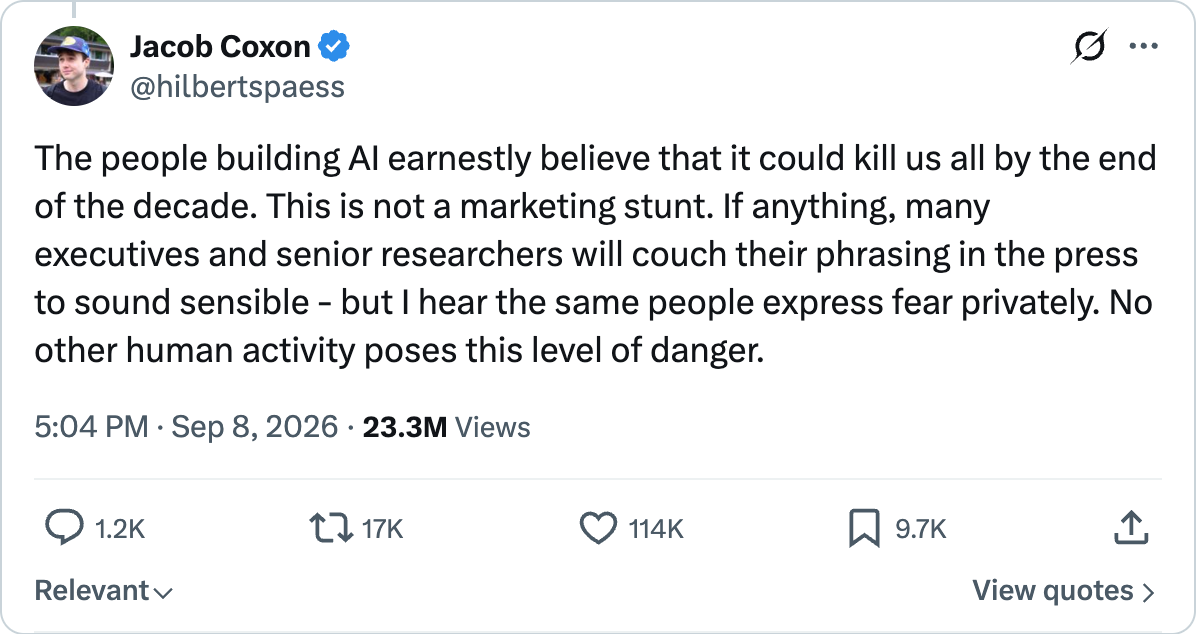
You cannot check what people say privately. You can check what they push publicly. Go read the commit logs — capability-side and oversight-side — and then decide which number scares you more.
ComputeLeap Team
The ComputeLeap editorial team covers AI tools, agents, and products — helping readers discover and use artificial intelligence to work smarter.
Join the discussion
Have thoughts on this article? Discuss it on your favorite platform:
Related articles
Nvidia's Scarcity Is a Firmware Setting
A firmware exploit unlocks RTX 3000 tensor cores to professional speeds, exposing 15 years of artificial GPU segmentation.
AI Found the PHP Zero-Day First. Now What?
GPT-5.6 Sol and Gemini 4 Argon found PHP2Shell weeks before disclosure. AI vuln discovery is production-ready for both sides.
The Slop Wall Is Here: Steam and Apple Have No Filter
Vibe-coded apps flood Steam and the App Store at once. Neither gatekeeper has a quality gate that scales. What breaks next.