Mistral Just Raised €3B. Here's What It Means.
Mistral's record €3B round funds sovereign AI infrastructure across Europe. What builders in regulated industries need to know.
ComputeLeap Team
Mistral Just Raised €3B. Here's What It Means.

Three months ago, we asked whether Mistral was falling behind. The HN thread hit 454 points. The top comment was blunt: "Mistral has fallen really far behind since 2025 Q3." The benchmark data backed it up — Mistral Large 3, a 675B-parameter mixture-of-experts model, couldn't match what Qwen 3.6 does at 27B dense or what DeepSeek V4 Pro achieves on SWE-bench.
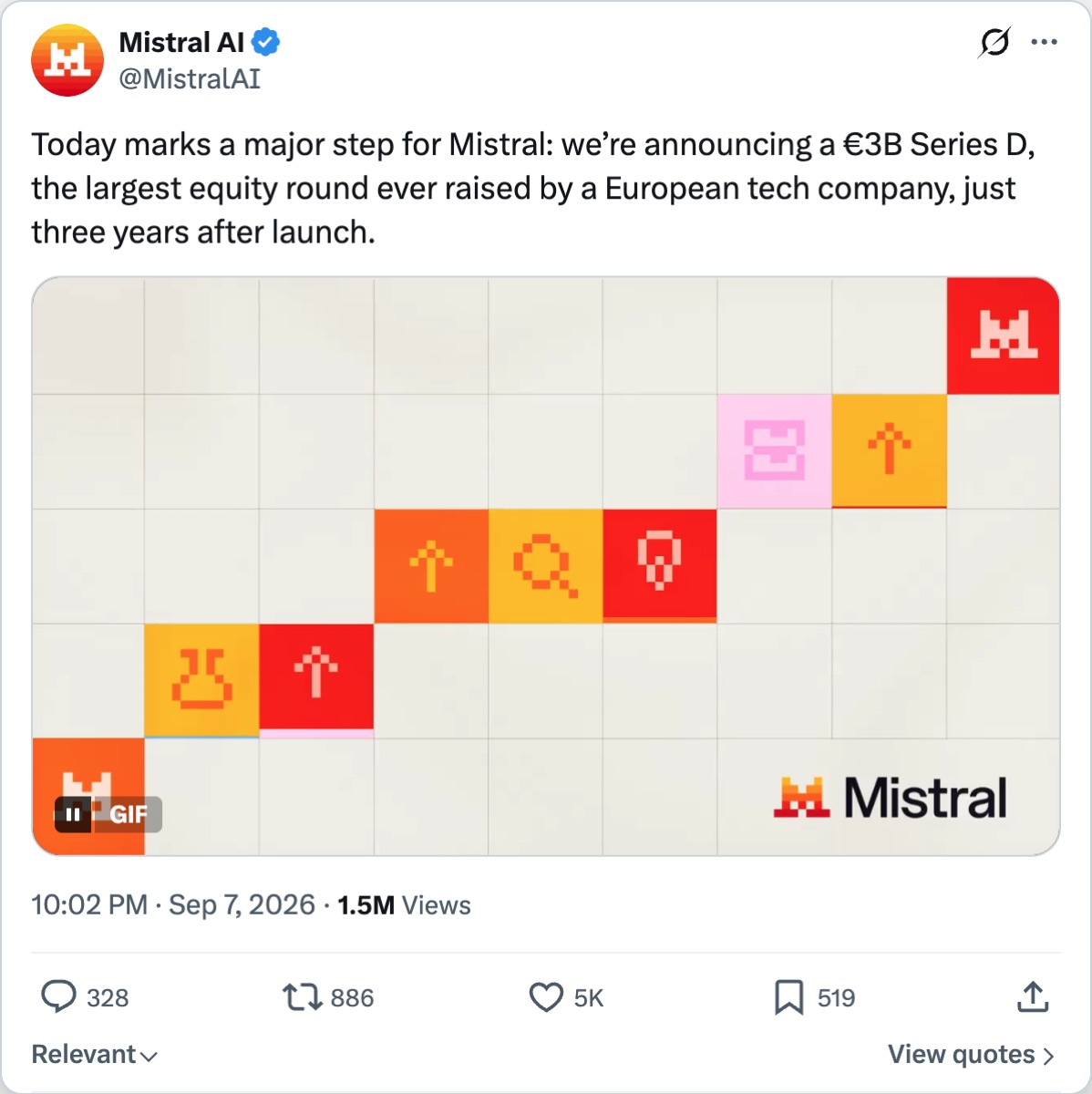
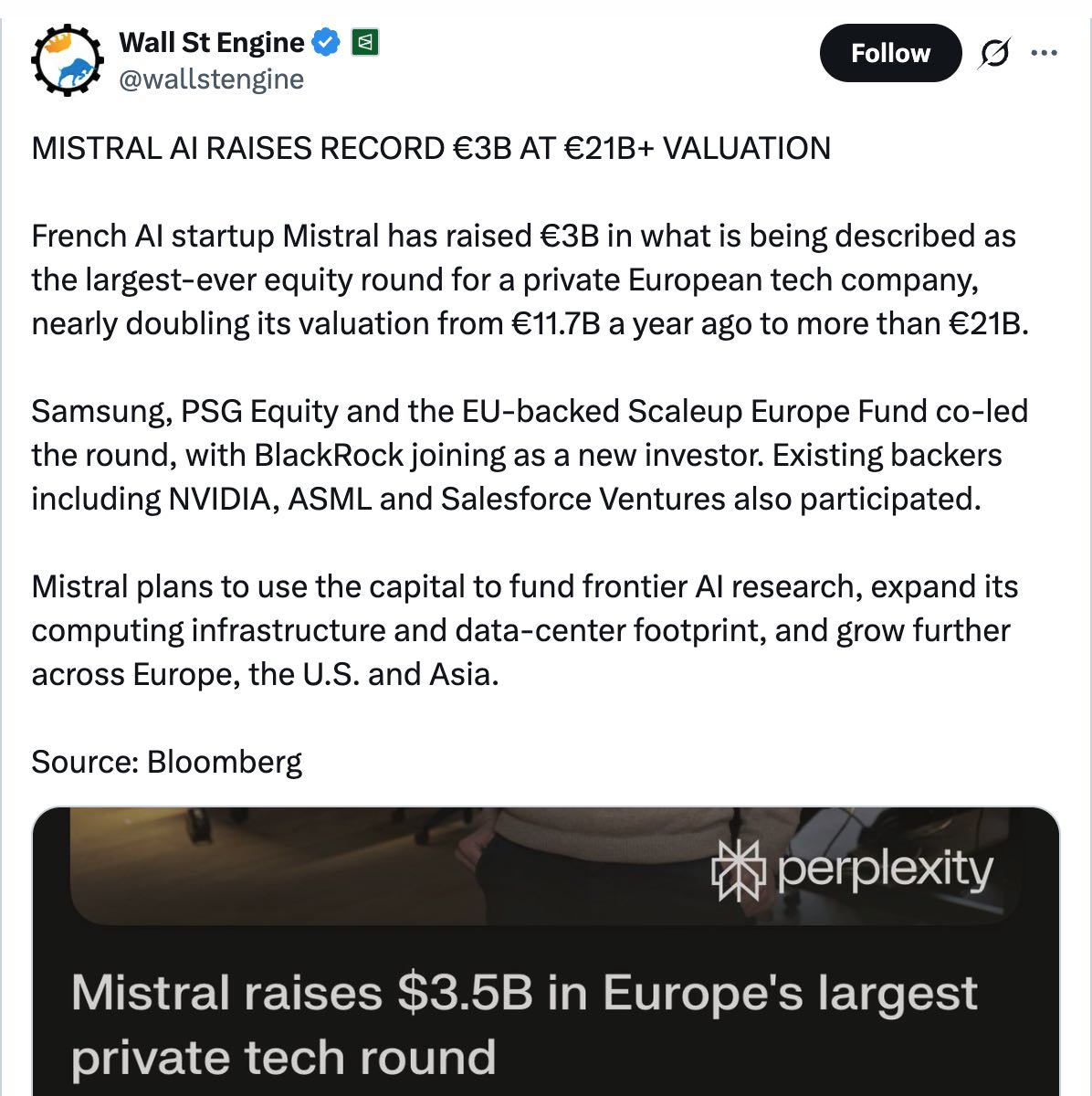
Today, Mistral answered — not with a new model, but with €3 billion in fresh capital. The largest equity round ever raised by a European tech company. Samsung Electronics led, joined by the EU-backed Scaleup Europe Fund (managed by EQT), PSG Equity, and more than two dozen backers including Advent, BlackRock, NVIDIA, Salesforce Ventures, and the Grand Duchy of Luxembourg as a sovereign investor. Post-money valuation: €21 billion — nearly double the €11.7 billion from the ASML-led Series C just one year ago.
The signal here isn't the number. It's who wrote the checks and what they're buying. Samsung isn't betting on benchmark charts. BlackRock isn't investing in a chatbot. Luxembourg isn't putting sovereign wealth into a consumer app. They're funding infrastructure — data centers, compute capacity, and an open-weight AI stack that governments and regulated industries can actually deploy on their own terms.
For builders, this changes the calculus. Open-weight AI demand isn't aspirational anymore. It's capitalized.
The Deal: What €3B Actually Buys
CEO Arthur Mensch framed the raise in operational terms: "This round means we can move faster on R&D, products, infrastructure and keep giving organisations the ability to run AI at scale, on their own terms."
CFO Johan Bergqvist went further, positioning Mistral as "a hybrid between Palantir and Anthropic" — deep enterprise integration with sovereign data guarantees, powered by frontier-adjacent models. That's a deliberate departure from the "European OpenAI" narrative that launched the company three years ago.
Mistral's CFO describes the company as "a hybrid between Palantir and Anthropic" — enterprise-embedded sovereign AI, not a consumer chatbot challenger. That's the real repositioning this round represents.
Here's where the money goes:
- Infrastructure: Mistral is building its first owned data center near Paris, with 13,800 NVIDIA GB300 GPUs. Target: 200 megawatts of European compute by end-2027, scaling to 1 gigawatt by 2030. They also introduced European Compute Units (ECUs) — a pre-purchase mechanism that converts customer cash commitments into reserved infrastructure capacity over multiple years.
- R&D: Frontier research continues across Mistral Large 3, Mistral OCR 4, Mistral Medium 3.5, and Voxtral TTS. The model portfolio is diversifying beyond LLMs into document AI, speech, and industrial simulation (via the Emmi AI acquisition).
- Commercial expansion: Operations now span 20 countries with 125+ enterprise clients, including Airbus, ASML, BMW, EDF, and HSBC. SiliconANGLE reported a projected $80 million monthly revenue by year-end — nearly $1 billion annualized.
The Investor Signal: Why Samsung, Not Sequoia
The investor mix tells a story the press release doesn't.
Samsung Electronics leading a European AI round is unusual. Samsung is simultaneously a hardware supplier (memory, chips) and now an equity investor in one of its largest potential compute customers. This mirrors NVIDIA's playbook — invest in the companies that will buy your silicon at scale.
But the geopolitical dimension matters more. French President Macron characterized the round as reflecting France and South Korea's aim to build "a third way in AI" — neither American nor Chinese. That's not startup rhetoric. That's heads-of-state industrial policy.
The Grand Duchy of Luxembourg joining as a state investor underscores this. So does the Scaleup Europe Fund, an EU initiative explicitly designed to keep high-growth tech companies European. When sovereign wealth funds and state-backed vehicles invest alongside Samsung and BlackRock, they're not chasing returns alone — they're buying optionality on technological independence.
What the Community Is Saying
The HN thread hit 812 points and 569 comments — making it one of the most-discussed AI funding stories of the year. The debate crystallized around a single tension: benchmarks versus business model.
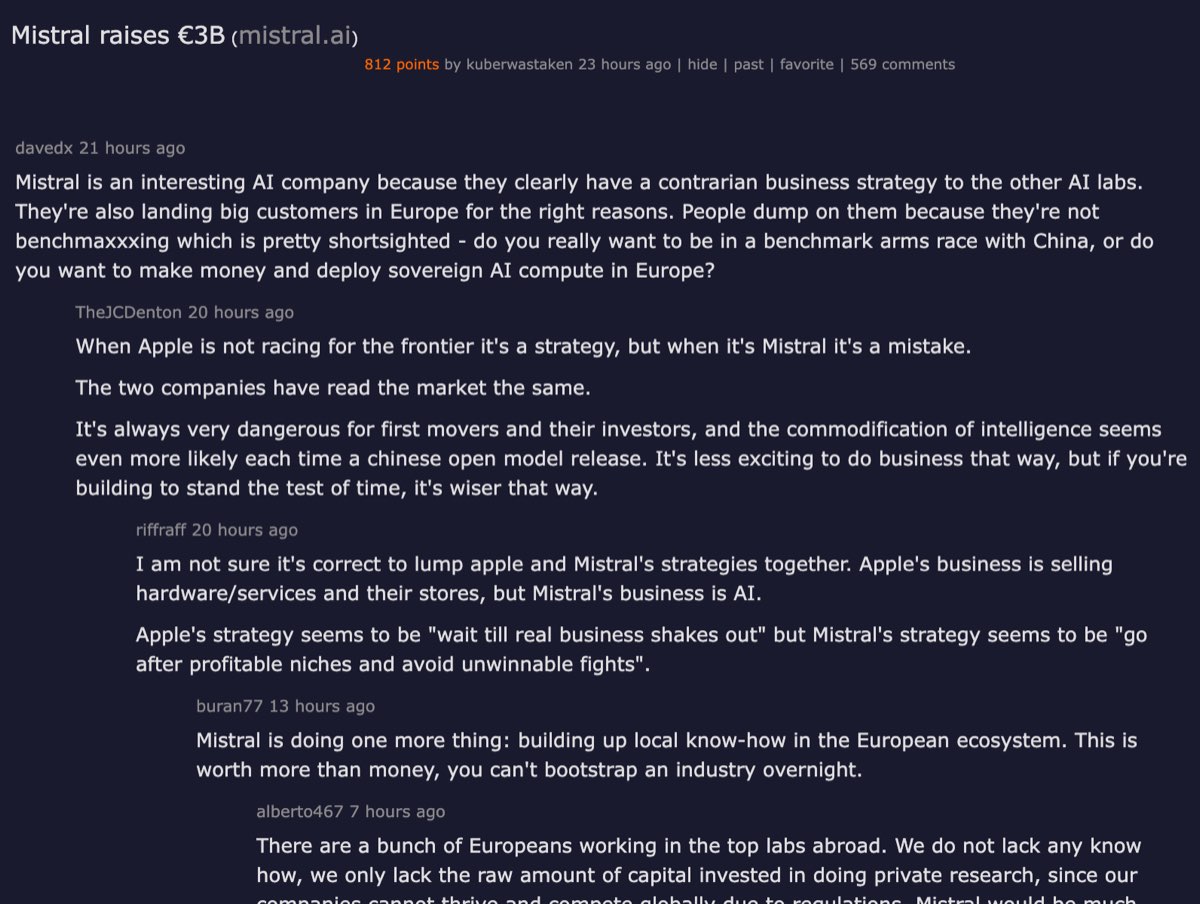
User davedx made the bull case plainly: "Do you really want to be in a benchmark arms race with China, or do you want to make money and deploy sovereign AI compute in Europe?" Multiple commenters agreed — Mistral's contrarian strategy of avoiding the frontier race while landing enterprise customers in regulated sectors is deliberate, not a symptom of failure.
The bear side was equally vocal. Several users pointed out that the model quality gap has been "only increasing" for coding tasks, with "no real progress" since Devstral 2. One commenter coined what may be the thread's best line: Mistral is "regulationmaxxing instead of benchmaxxing."
User vrganj added a philosophical layer that matters for builders: "Models are fundamentally an encoding of a way of viewing the world" — alignment decisions reflect values, making European alternatives strategically important regardless of raw capability scores.
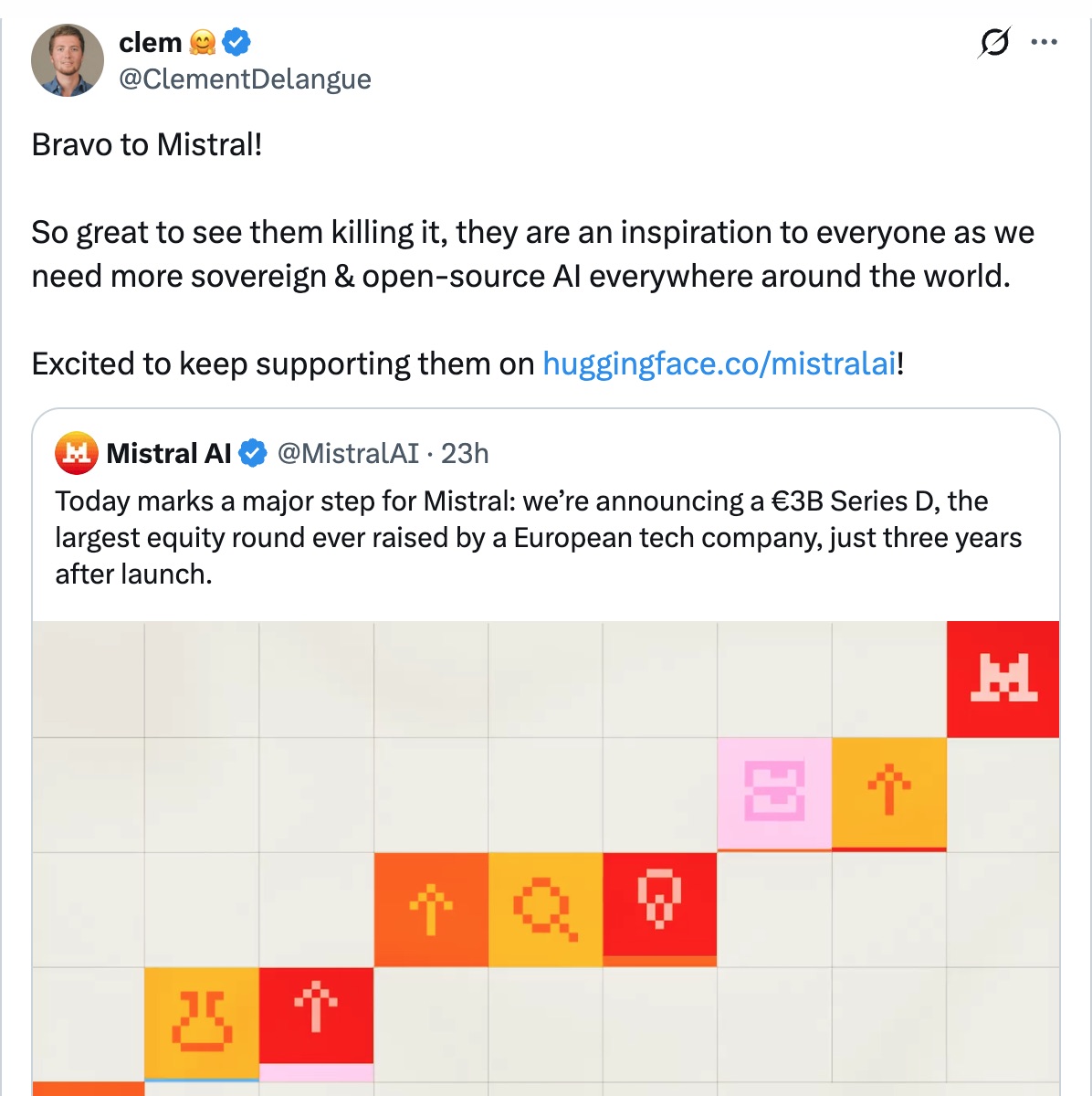
HuggingFace CEO Clement Delangue posted his support: "So great to see them killing it, they are an inspiration to everyone as we need more sovereign & open-source AI everywhere around the world."
The Sovereign AI Thesis — Now With a Price Tag
"Sovereign AI" has been a buzzword since at least 2024. What changed is that it now has a balance sheet.
Mistral's pitch to enterprises isn't "our model is smarter than GPT." It's "you can run our models in your own data center, in your own country, under your own compliance framework, and we'll build the infrastructure to make that possible." That's the Palantir playbook applied to AI — deep integration, data sovereignty, long-term contracts.
The CNAS Sovereign AI Index tracked Mistral and Mixtral appearing in 19% of all sovereign AI projects globally as of January 2026. That number has likely grown since. Mistral now hosts third-party open-weight models — including Chinese ones — on its platform, positioning itself less as a model lab and more as a sovereign AI marketplace.
The ECU model is particularly interesting for builders. Instead of pay-per-token pricing that chains you to a provider's API, ECUs let organizations pre-purchase compute capacity that they can use across any Mistral product. It's the cloud reservation model applied to AI inference — predictable costs, guaranteed capacity, European jurisdiction.
The Bear Case: Sovereignty on Borrowed Silicon
Here's the uncomfortable truth nobody at the announcement addressed.
Mistral's entire infrastructure runs on NVIDIA silicon. The CNAS Sovereign AI Index found that NVIDIA supplies hardware for 45% of all tracked sovereign AI projects globally. "Sovereignty" built on a single American chipmaker's GPUs is sovereignty with an asterisk.
The Forkast analysis named this the "sovereignty paradox" — Mistral defines sovereignty as data residency and regulatory compliance, not as technological self-determination. The 13,800 NVIDIA GB300 GPUs in their Paris data center are American chips. If Washington tightens export controls — as it already did with Fable 5 — Mistral's infrastructure roadmap is exposed.
Samsung's dual role as both lead investor and potential alternative chip supplier adds a layer of hedging. But right now, it's hedging — not independence.
And the benchmark gap remains real. Contrary Research noted that "Mistral still lags proprietary-weight models and other open-weight models in benchmark performance." The open-weight counteroffensive from Chinese labs — GLM-5.3, Qwen 3.6, DeepSeek V4 — has only intensified. For tasks where raw capability matters (agentic coding, complex reasoning), Mistral isn't the best open-weight option. It's arguably not even top-five.
The "regulationmaxxing" critique from HN has teeth. If you're a builder choosing between Mistral Large 3 and Qwen 3.6 purely on capability, Qwen wins. Mistral's value proposition requires you to weight sovereignty, compliance, and vendor independence heavily enough to accept the capability gap. For some use cases — defense, healthcare, financial services — that's rational. For a startup building a coding assistant? Not so much.
What This Means for You
The decision framework is straightforward: if your deployment requires European data residency, auditable models, or independence from US and Chinese cloud providers, Mistral just became a serious option with real infrastructure behind it. If you're optimizing purely for capability per dollar, look east.
If you're building in regulated industries (finance, defense, energy, healthcare): Mistral's infrastructure bet means European-hosted, open-weight options with enterprise SLAs will be available at scale by 2027. The ECU pre-purchase model gives you cost predictability. Evaluate now — capacity commitments go to early movers.
If you're building general-purpose AI products: The capability gap matters. For coding agents, reasoning chains, and benchmark-sensitive applications, the Chinese open-weight labs (Kimi K3, DeepSeek V4, Qwen 3.6) still lead. Mistral's models are competitive for RAG, OCR, and structured extraction — less so for frontier reasoning.
If you're watching the open-weight ecosystem broadly: This round validates the commercial model. Samsung, BlackRock, and sovereign wealth investing in open-weight AI infrastructure means the ecosystem is getting funded at a scale that sustains long-term R&D. The open-weight counteroffensive isn't just a Chinese phenomenon anymore — it's a funded European one too.
The bottom line: Three months ago, we asked if Mistral was falling behind. The answer is nuanced. On benchmarks, yes — and the gap is growing. On business model and infrastructure, Mistral just raised the largest round in European tech history to prove that sovereignty and open weights are a viable commercial thesis, not just a policy talking point. Whether that thesis survives the leaderboard treadmill depends on whether enough customers care more about control than capability.
For builders, that's not an abstract question. It's a procurement decision you'll face in the next twelve months.
ComputeLeap Team
The ComputeLeap editorial team covers AI tools, agents, and products — helping readers discover and use artificial intelligence to work smarter.
Join the discussion
Have thoughts on this article? Discuss it on your favorite platform:
Related articles
AI Found the PHP Zero-Day First. Now What?
GPT-5.6 Sol and Gemini 4 Argon found PHP2Shell weeks before disclosure. AI vuln discovery is production-ready for both sides.
The Slop Wall Is Here: Steam and Apple Have No Filter
Vibe-coded apps flood Steam and the App Store at once. Neither gatekeeper has a quality gate that scales. What breaks next.
The Per-Token Trap: Why AI Got Cheaper and Your Bill Didn't
Token prices fell 90%. Enterprise AI bills doubled. Gartner says agentic costs will 5x by 2028. Here's the Jevons math and how to fix your budget.
The ComputeLeap Weekly
Get a weekly digest of the best AI infra writing — Claude Code, agent frameworks, deployment patterns. No fluff.
WEEKLY. UNSUBSCRIBE ANYTIME.