Debian's AI Code Ban Vote Splits Open Source
Debian votes to ban AI code while Ubuntu ships it. What the 8-proposal split means for developers, maintainers, and the future of open-source governance.

Debian's AI Code Ban Vote Splits Open Source
The open-source world has stopped agreeing on how software gets made. On August 15, 2026, Debian opened a General Resolution ballot asking its 1,039 voting developers to rank eight competing proposals on whether AI-assisted contributions should be allowed in the project — ranging from an outright ban to conditional acceptance with disclosure. Voting closes August 28. Two days before the ballot opened, Ubuntu's parent company Canonical announced it was ramping up AI tooling across its engineering teams, with a bias toward local inference and open-weight models.
Same upstream kernel. Same package format lineage. Opposite conclusions about whether machines should write the code.
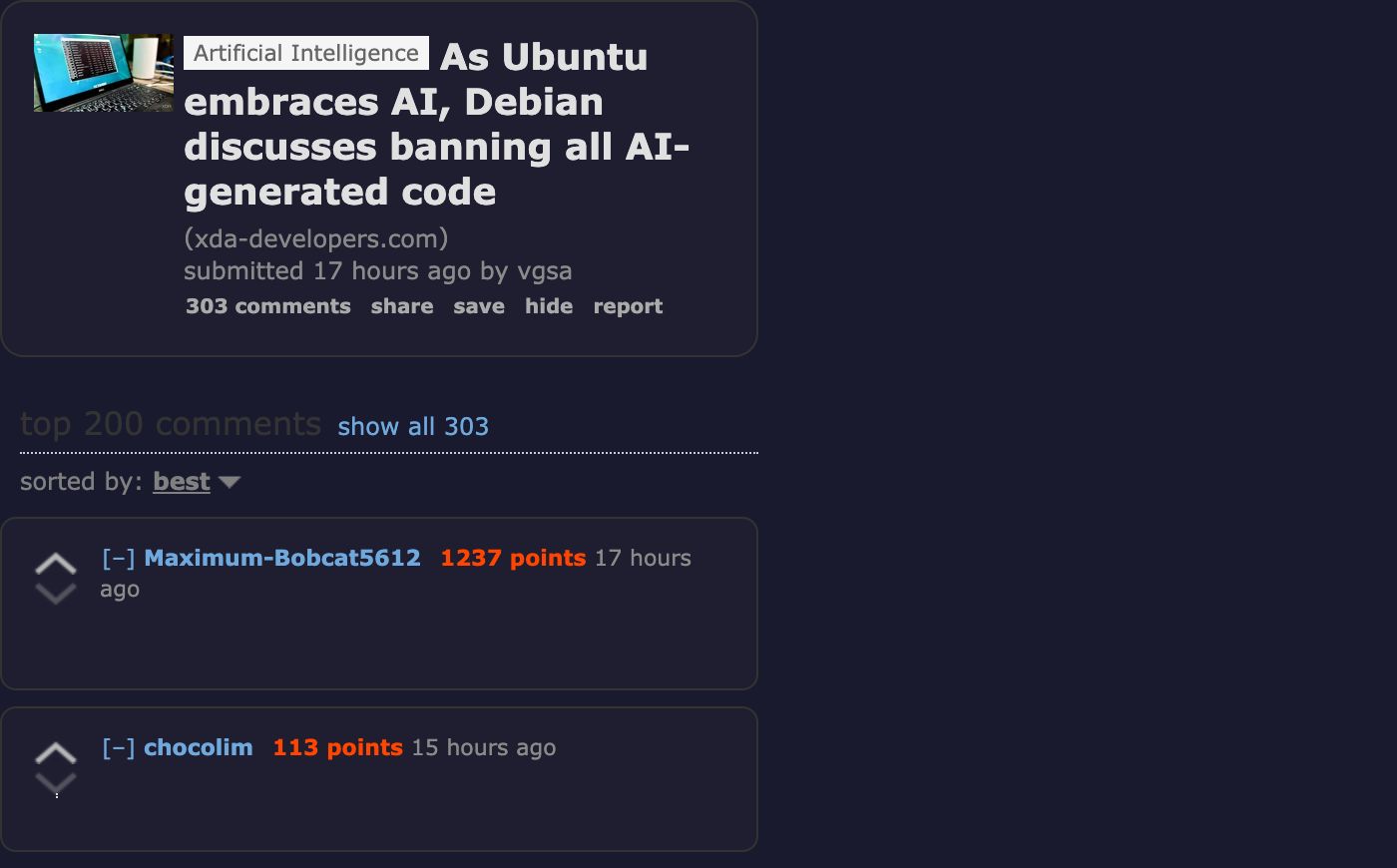
The Reddit thread pulled 1,805 upvotes and 248 comments — but the real signal is the 89% upvote ratio, unusually low for r/technology. The community is genuinely split, not performatively outraged.
This isn't a story about one project's policy vote. It's about the open-source ecosystem abandoning consensus governance on AI and fragmenting into incompatible regimes — and that fragmentation is itself a supply-chain risk that nobody is pricing in.
What Debian Is Actually Voting On
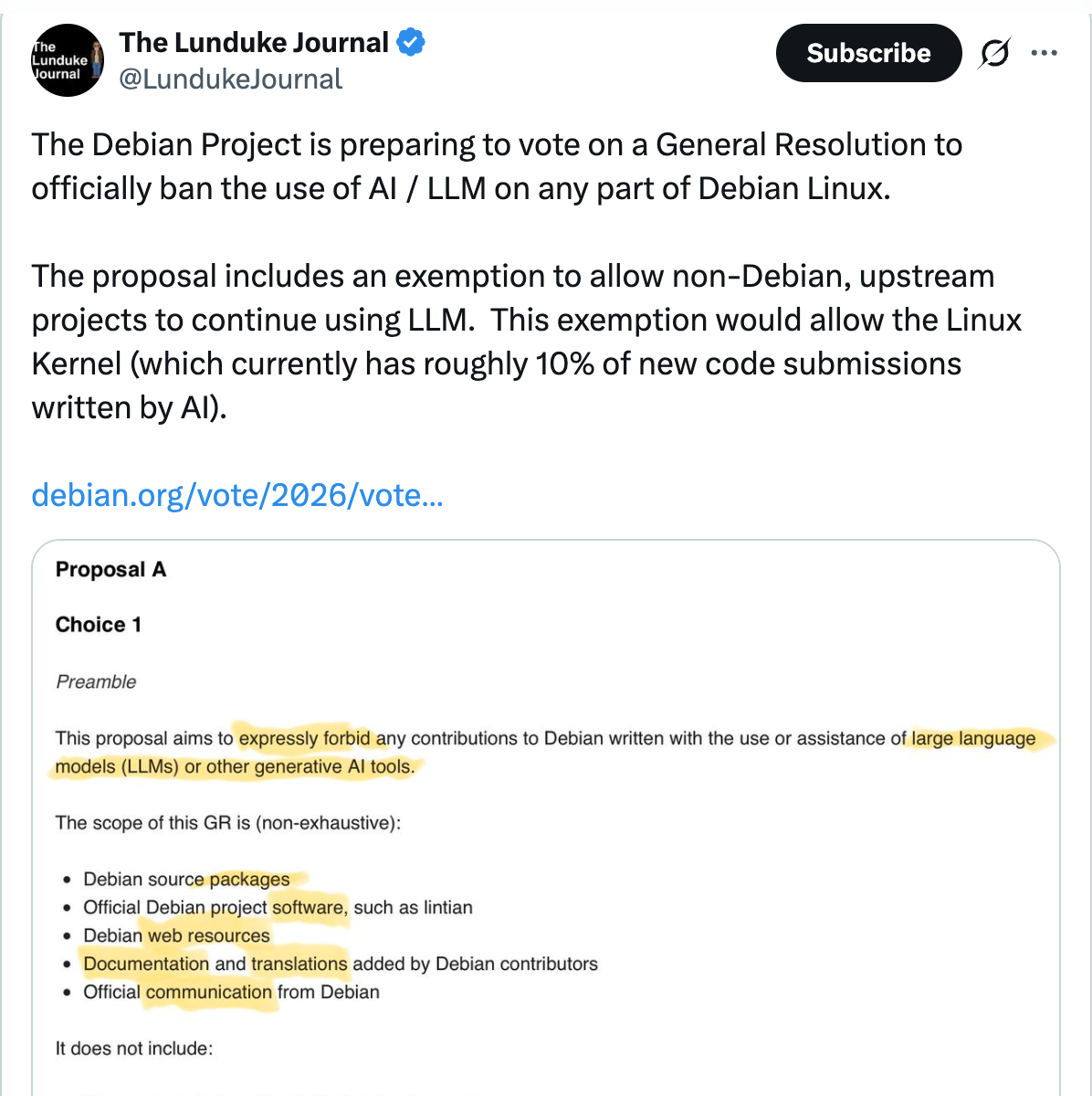
Matthias Geiger, seconded by eight developers including Ian Jackson and David Bremner, proposed Proposal A: "No LLM contributions to Debian via Social Contract." It would amend the Debian Social Contract to expressly forbid contributions written with or assisted by LLMs or other generative AI tools.
The scope covers Debian source packages, packaging work, Debian-native software, official web resources, documentation, translations, and project communications. Critically, it exempts upstream projects — if the Linux kernel ships AI-assisted patches, Debian would still package it. The ban applies only to Debian's own direct contributions.
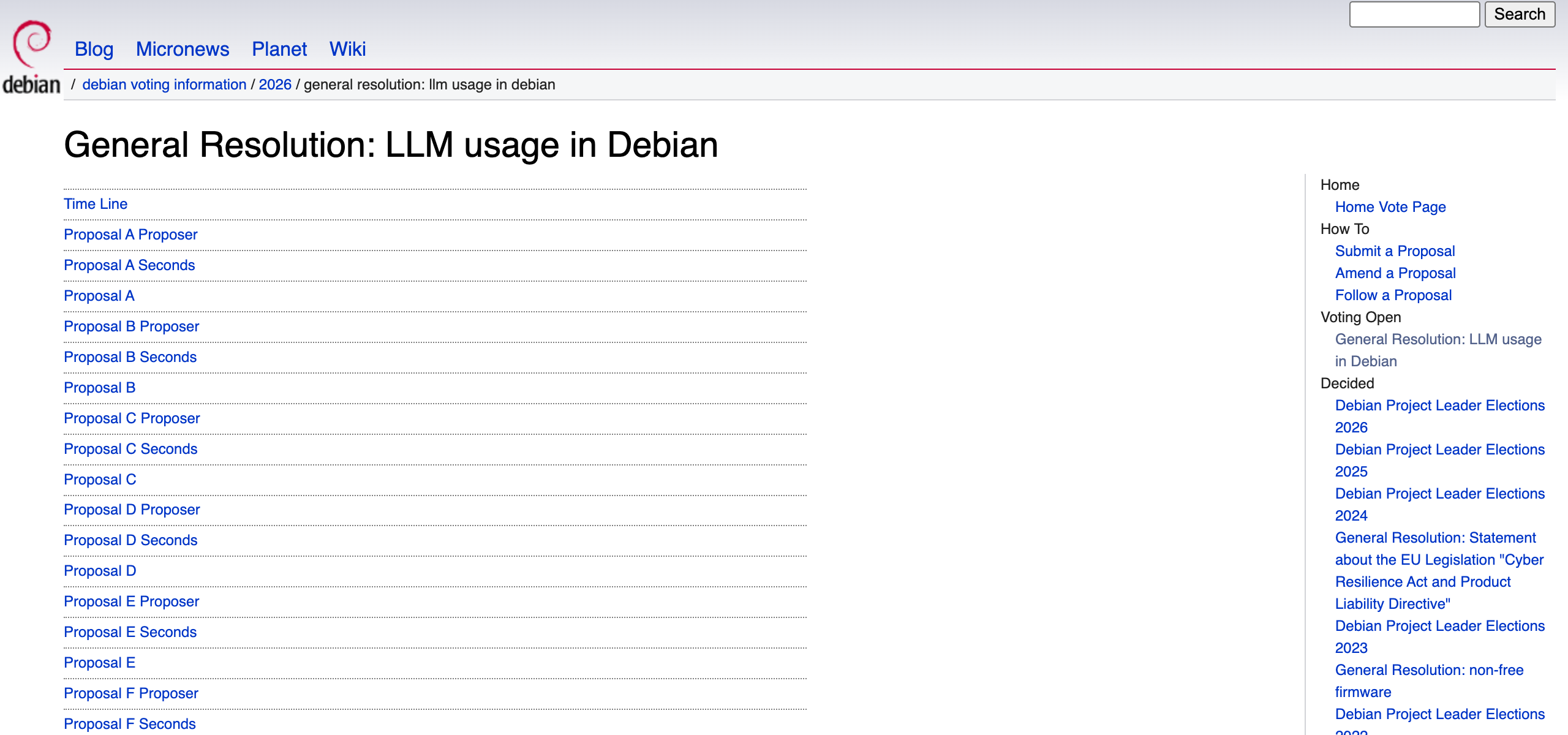
View the official vote page on Debian.org →
Proposal A cites four concerns:
- Copyright ambiguity — AI-generated code has unclear legal status, and Debian treats it the same as human code with murky copyright: reject it.
- Quality — "An LLM can never 'know' if its output is correct since it merely produces syntactically likely combinations" of training data. Adequate elsewhere, but short of Debian's standards.
- Community strain — Reviewing AI-generated submissions "places an unnecessary strain on the reviewer" and doesn't help new contributors learn Debian's development practices.
- Ethics — LLM companies scraped "the whole web for training data without any regard for license, copyright," plus the environmental cost of data centers.
But Geiger's proposal is only one of eight. Lucas Nussbaum's Proposal B, backed by nine seconders including former DPL Stefano Zacchiroli, would explicitly allow AI-assisted contributions under six conditions: tooling license compatibility, licensing verification, contributor accountability, disclosure requirements, quality responsibility, and confidentiality safeguards.
Between them sit proposals ranging from Ian Jackson's Code of Conduct approach (Proposal C) to Marc Haber's "neither endorse nor prohibit" stance (Proposal E) to Holger Levsen's climate-first framing (Proposal H, which collected 17 seconders — the most of any proposal). The full spectrum reveals a community that doesn't just disagree about AI — it disagrees about what kind of disagreement this is.
The Evidence That AI Code Works at Scale
While Debian debates, million-line codebases are being rewritten by machines in production.
Bun's Zig-to-Rust migration is the most dramatic case study. After Anthropic acquired Bun in December 2025, 64 parallel Claude instances rewrote roughly one million lines of Zig into Rust in six days — 6,778 commits at a cost of $165,000 in API tokens. The result shipped to millions of developer machines, with memory usage dropping from 6.7 GB to 609 MB after 2,000 builds, and a 2-5% performance improvement. The irony: Zig's own no-AI-contributions policy is what forced the language switch.
Paul Dix, InfluxData's CTO, used the Bun rewrite as a springboard for a broader argument in his widely cited blog post "The end of programming." Dix built two major InfluxDB features — an Iceberg integration (14 hours) and an edge replication system (28 hours) — using frontier AI models, producing thousands of lines of implementation and test code. His prediction: "more running, production software written by AIs than written by humans" within two years.
EVE Online's Python 3 migration offers a different angle. CCP Games announced in August 2026 that they're migrating 2.4 million lines of Python — some predating Python 2.7, written to Python 2.3 and 2.5 standards — to Python 3. Their approach: run the futurize script against the full codebase, then manually review approximately 20,000 places where Python 2 and 3 behavior differs. The first scan found 95.9% of files already compiled under both versions, with about 3,300 blocking lines.
The largest-scale code transformations in 2026 are all automated. Whether we call the tool "an AI agent" or "a migration script," the human role is shifting from writing code to reviewing output. That's exactly what Debian's Proposal B tries to codify — and what Proposal A tries to prevent.
The Evidence That AI Code Is Dangerous
The pro-ban camp isn't technophobic — they have data.
The CSA's research found that 45% of AI-generated code samples introduce OWASP Top 10 vulnerabilities. AI-assisted commits expose secrets at more than twice the rate of human-only commits (3.2% vs 1.5%). And package hallucination — where AI suggests dependencies that don't exist, allowing attackers to register malicious packages under those names — affects approximately 19.7% of AI-suggested dependencies in Python and JavaScript.
Bun's own rewrite proves the point in a different way. Yes, it shipped and it works. But the rewrite left 13,044 unsafe Rust blocks — versus 73 in comparable hand-written Rust. That's the safety debt from AI-speed migration, quantified. It's technical debt that someone will have to pay down, and the interest compounds.
Then there's context poisoning — the failure mode Hacker News keeps surfacing. Unlike a one-time prompt injection, memory poisoning persists across sessions, subtly altering how models reason in future tasks. OWASP now ranks it a top agentic risk for 2026. When AI agents consume their own previous output as context — and they do, increasingly — errors compound rather than correct. The Debian proposal's "quality" concern isn't abstract; it's describing a specific failure mode where AI code degrades the context that future AI code depends on.
The Fragmentation Map
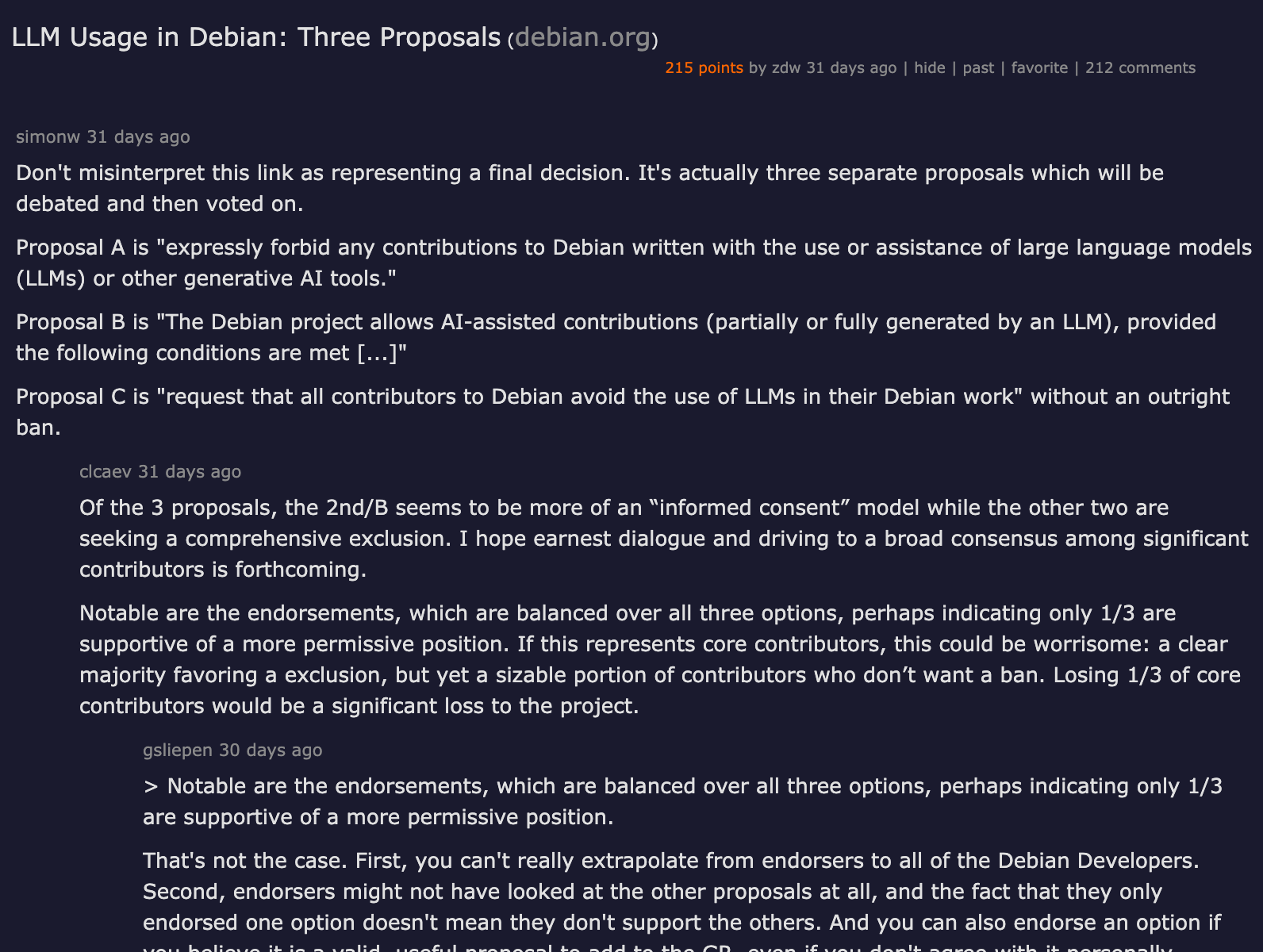
Debian's vote matters, but it's one data point in a broader fragmentation. An InfoQ analysis from August 2026 mapped the diverging policies across the Linux ecosystem:
| Project | Policy | Key Mechanism |
|---|---|---|
| Linux Kernel | Allowed with disclosure | Mandatory Assisted-by tag; human signs the DCO |
| GCC | Banned for legal contributions | Copyright contamination risk from compiler precision |
| Debian | Voting (8 proposals) | Condorcet ballot, closes Aug 28 |
| Ubuntu/Canonical | Embraced | "Ramping up AI tools in a focused and principled manner" |
| Gentoo | Banned since 2024 | "Expressly forbids" AI-created contributions |
| GNOME Extensions | Banned | Reviewers reject AI-generated submissions |
| Codeberg | Banned (71% vote) | 358-144 vote, July 2026; also bans AI training on hosted code |
| Flathub | Banned | All submission types affected |
| Kubernetes/CNCF | Allowed with disclosure | AI usage must be disclosed in PRs |
| Linux Foundation | Allowed | "AI tools can be contributed to LF projects" |
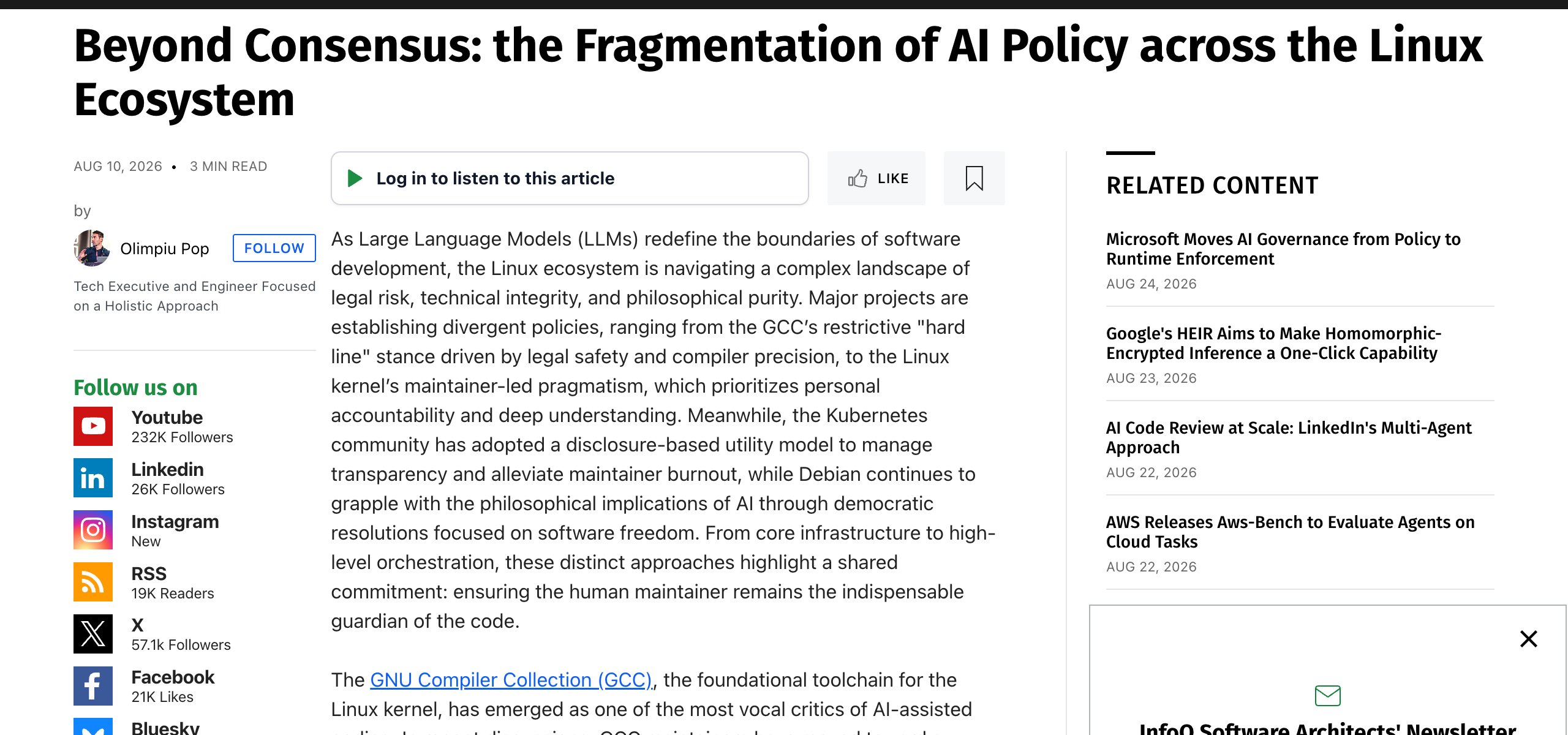
Linus Torvalds called proposals to ban AI assistance "pointless posturing" and pushed the kernel toward pragmatic acceptance. The kernel's policy requires an Assisted-by tag identifying the model, agent, and tools used, while making the human submitter solely responsible. "Banning AI is like trying to ban a specific brand of keyboard."
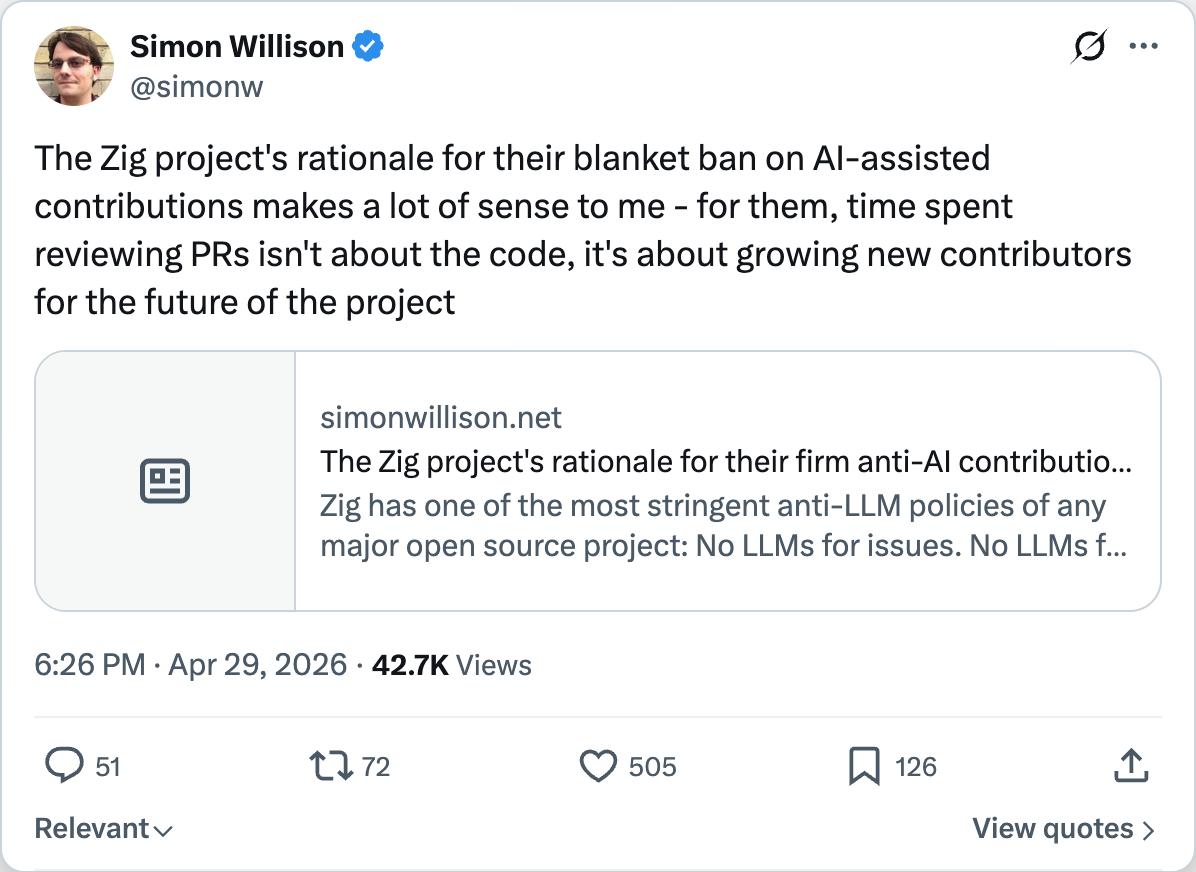
But Simon Willison offered the strongest defense of bans: Zig's rationale "makes a lot of sense to me — for them, time spent reviewing PRs isn't about the code, it's about growing new contributors for the future of the project." When the purpose of review is mentorship, AI-generated submissions are a category error, not a time savings.
Why the Fragmentation Is the Real Problem
Here's what nobody is saying clearly enough: the fragmentation itself is a supply-chain risk.
A developer contributing to both the Linux kernel (AI allowed, Assisted-by tag required) and GCC (AI banned) must maintain two entirely different workflows. A package that passes Kubernetes' disclosure requirements gets rejected by Gentoo's blanket ban. A Codeberg-hosted project banning AI code might depend on an npm package that was vibe-coded in an afternoon.
The Linux Foundation's permissive policy says "individual projects may develop their own guidance," which sounds reasonable until you realize it means there's no floor and no ceiling. Every project is a sovereign state making its own immigration law for AI-generated code, and the developers crossing those borders have no passport system.
This matters practically because AI coding tools are already the default workflow for a growing share of developers. GitHub Copilot, Claude Code, Cursor, and their competitors aren't experimental — they're driving measurable productivity gains that make them hard to abandon. When a project bans AI assistance, it's not just taking a policy position — it's filtering out a growing percentage of potential contributors who can't easily unbraid AI suggestions from their workflow.
What This Means for You
If you're a contributor: The kernel's Assisted-by tag model is likely to become the industry standard — it gives maintainers an audit trail without creating an unenforceable ban. Start tagging your AI-assisted work now, even in projects that don't require it. When the policy dust settles, you'll have a clean history.
If you're a maintainer: Debian's Proposal E ("neither endorse nor prohibit") reflects the uncomfortable truth that you can't reliably detect AI-generated code anyway. The more productive question isn't "was this written by AI?" but "does this contribution meet our quality bar, and can the submitter defend every line?" That's what the kernel policy gets right.
If you're shipping production code: The Bun rewrite proves AI can produce working software at million-line scale. But 13,044 unsafe blocks in a million-line codebase is a security liability that needs budgeting. AI code isn't free — it shifts cost from writing to reviewing, and from upfront design to downstream safety debt.
If you're watching the Debian vote: The outright ban (Proposal A) almost certainly won't pass — it needs a 3:1 supermajority to amend the Social Contract. But the vote will signal where the center of gravity lies. If Proposal B (allow with conditions) or Proposal E (pragmatic neutrality) wins, expect other projects to coalesce around disclosure requirements rather than bans. If Proposal G ("Debian is created by humans") wins, the symbolic weight could accelerate bans elsewhere.
The real lesson from this split is that the open-source world needs what it's always been worst at: coordinated governance. The Linux Foundation's "individual projects decide" approach created the fragmentation. Someone — probably the LF itself — needs to propose a minimum viable policy that projects can adopt or extend, the way SPDX standardized license identifiers. Without that, every project reinvents its own AI policy, every developer plays policy roulette, and the compliance burden falls on the people least equipped to handle it: individual contributors.
The vote closes August 28. The fragmentation doesn't.
ComputeLeap Team
The ComputeLeap editorial team covers AI tools, agents, and products — helping readers discover and use artificial intelligence to work smarter.
Join the discussion
Have thoughts on this article? Discuss it on your favorite platform:
Related articles
Cloudflare Bought Deno. You Have 12 Months.
Deno gets 12 months of patches then development ends. Here are the concrete migration paths for every Deno deployment pattern.
OpenAI Fired Its Safety Staff, Then Cited Its Auditors
Three researchers fired for talking to the auditors they were hired to brief. The disclosure gap is the real story.
Open-Weight AI Just Went Multipolar
Mistral Large 4 and Reflection Beam ship frontier open-weight models from Europe and the US in the same week. What it means for builders.
The ComputeLeap Weekly
Get a weekly digest of the best AI infra writing — Claude Code, agent frameworks, deployment patterns. No fluff.
WEEKLY. UNSUBSCRIBE ANYTIME.