DeepSeek Just Repriced the Search Stack
V4.1 Flash 1017 improved every benchmark. The Search API undercuts Perplexity 7-to-1. Polymarket hasn't noticed.
DeepSeek Just Repriced the Search Stack
DeepSeek shipped two things this week that, individually, would be worth covering. Together they signal a pricing strategy that the rest of the industry hasn't fully processed yet.
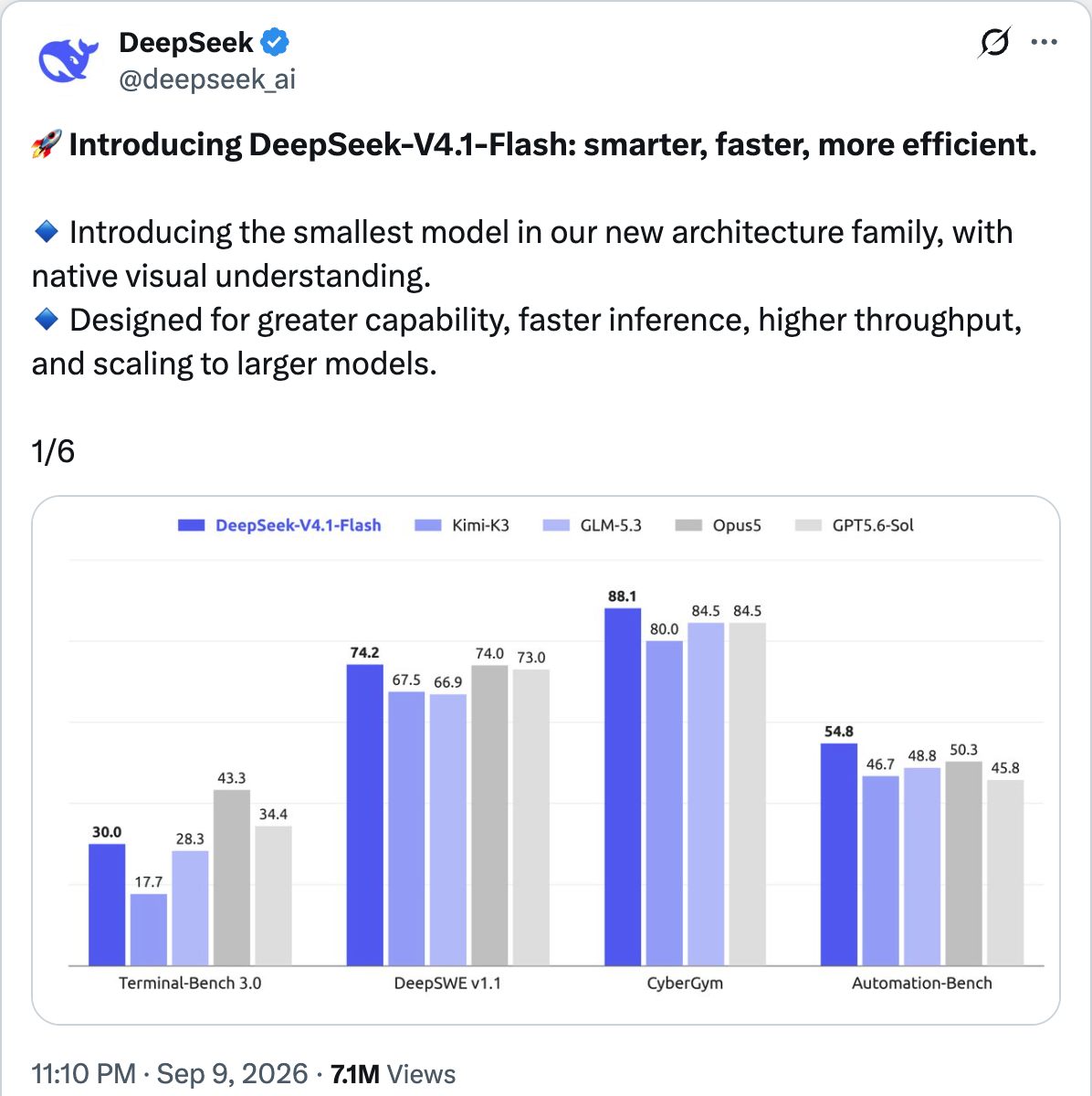
First, the V4.1 Flash 1017 update — labeled "minor" by DeepSeek's own model card — improved on all 11 of the model's published benchmarks. Terminal-Bench 4.0 jumped from 31.2% to 42.3%. DeepSWE v1.1 hit 77%, putting it in the same bracket as GPT-5.6 Sol at roughly one-sixteenth the output price. Five YouTube creators covered it independently within 24 hours. The "minor" label is doing a lot of heavy lifting.
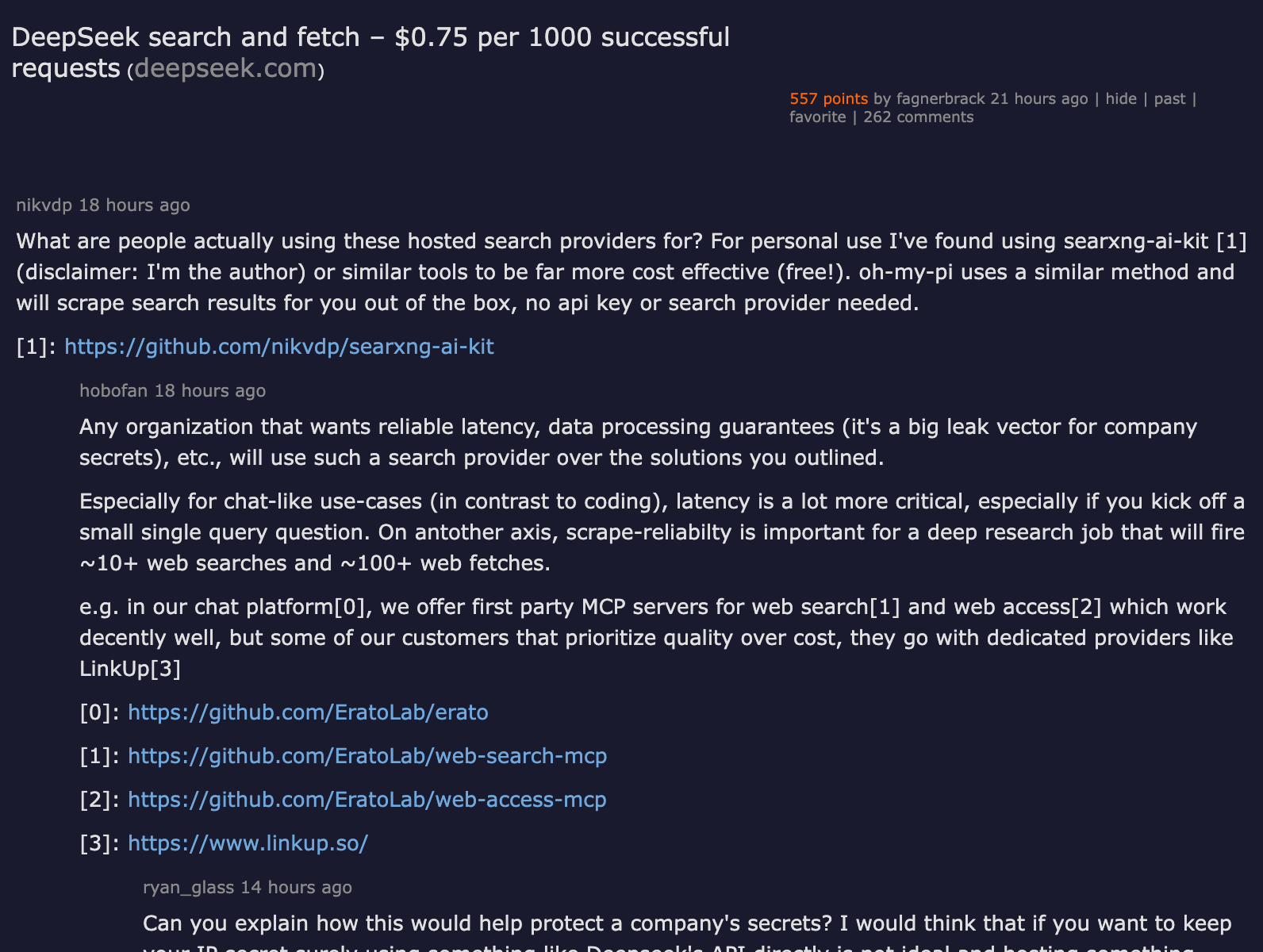
Second, DeepSeek quietly launched a Search & Fetch API at $0.75 per 1,000 successful requests — for both search and page fetching. That thread hit 439 points on Hacker News in under 12 hours.
The thesis here isn't "DeepSeek is cheap." We wrote about that a month ago. The thesis is that DeepSeek is now running a two-front price war — model inference and web search — and the prediction markets have barely noticed.
The 1017 Update: "Minor" Is a Lie
DeepSeek's model card for V4.1 Flash 1017 calls it a minor update. The benchmarks disagree.
Bijan Bowen's breakdown puts the gains in context: Terminal-Bench 4.0 went from 31.2% to 42.3% — a 35% relative improvement — in five weeks. That's not a point release; that's a generation-level jump on a single benchmark, achieved through what appears to be continued post-training optimization rather than a new base model.
The headline number everyone fixates on is DeepSWE v1.1 at 77%, which puts V4.1 Flash in GPT-5.6 Sol territory. But the more telling figure is the cost per task: approximately $0.20, versus Sol's roughly $3.20. You can run 16 DeepSeek tasks for every one GPT-5.6 Sol task — and the quality delta on software engineering benchmarks is within noise.
WorldofAI ran a full battery of tests on the 1017 build and arrived at the same conclusion: the model improved across the board, not just on cherry-picked benchmarks.
Real-World Cost: 619 Million Tokens for $4.20
The benchmark story is one thing. The cost story is another.
AI超元域 ran seven full development tasks through DeepSeek Harness using V4.1 Flash 1017 — animation, 3D scenes, a tank game, a native iOS app, and more. The total bill: 619 million tokens for approximately $4.20. Not every task succeeded perfectly — the naval-battle steering broke, some 3D scenes clipped, and a tablet navigation flow failed — but the failure mode was "good-enough agentic coding at near-zero marginal cost."
The math that matters: At $0.14/M input tokens and $0.28/M output tokens (off-peak), running an agentic coding loop that consumes 50M tokens costs about $14. The same loop on GPT-5.6 Sol costs roughly $225. On Claude Opus 5, approximately $375. The capability gap is closing faster than the price gap.
The Search API: $0.75 Changes the Economics
The V4.1 Flash update would be a story by itself. But the same week, DeepSeek launched a Search & Fetch API that reprices the entire search-augmented AI stack.
The numbers are stark:
| Provider | Search Cost (per 1K requests) | Notes |
|---|---|---|
| DeepSeek Search | $0.75 | Flat rate, up to 50 results/query |
| Perplexity Sonar | $5.00 - $12.00 | Varies by search depth |
| Perplexity Sonar Pro | $6.00 - $14.00 | Plus $3/$15 per M tokens in/out |
| Google Custom Search | $5.00 | 100 free/day; web-mode sunset Jan 2027 |
DeepSeek undercuts Perplexity's cheapest tier by 6.7x. Against Perplexity's medium-depth search — the tier most developers actually use — the gap is 10.7x. Against Google Custom Search, it's 6.7x — and Google's "search the entire web" mode is scheduled to shut down on January 1, 2027.
The Hacker News thread captured the developer reaction perfectly. The top comment put it bluntly: "These services only exist because Google refuses to provide a paid search API."
What You Actually Get
The Search API (POST /v1/tools/search) returns structured web results — title, URL, snippet, a longer model-oriented summary, site authority tier, relevance score, and publication date. It supports query operators for site filtering, date ranges, exact phrases, and language targeting. Rate limit: 5 requests per second.
The Fetch API (POST /v1/tools/fetch) takes a URL and returns the page content as Markdown. Same price, same rate limit.
Both are billed only on successful requests — failed calls, empty results, and timeouts are free. And here's the kicker: calls made through DeepSeek Harness, Claude Code, or Codex are free until November 1, 2026. That's a two-week window to test the full stack at zero cost.
Builder's action item: If you're running RAG or search-augmented agents, the cost math just changed. DeepSeek Search ($0.75/1K) + V4.1 Flash generation ($0.14/M input, $0.28/M output) gives you grounded answers at roughly $0.001 per query — search plus generation. Perplexity Sonar runs $0.005 - $0.012 per equivalent query. The free tier through November 1 is your testing window.
The Polymarket Lag: Where the Money Isn't
Here's the signal that makes this more than a pricing story.
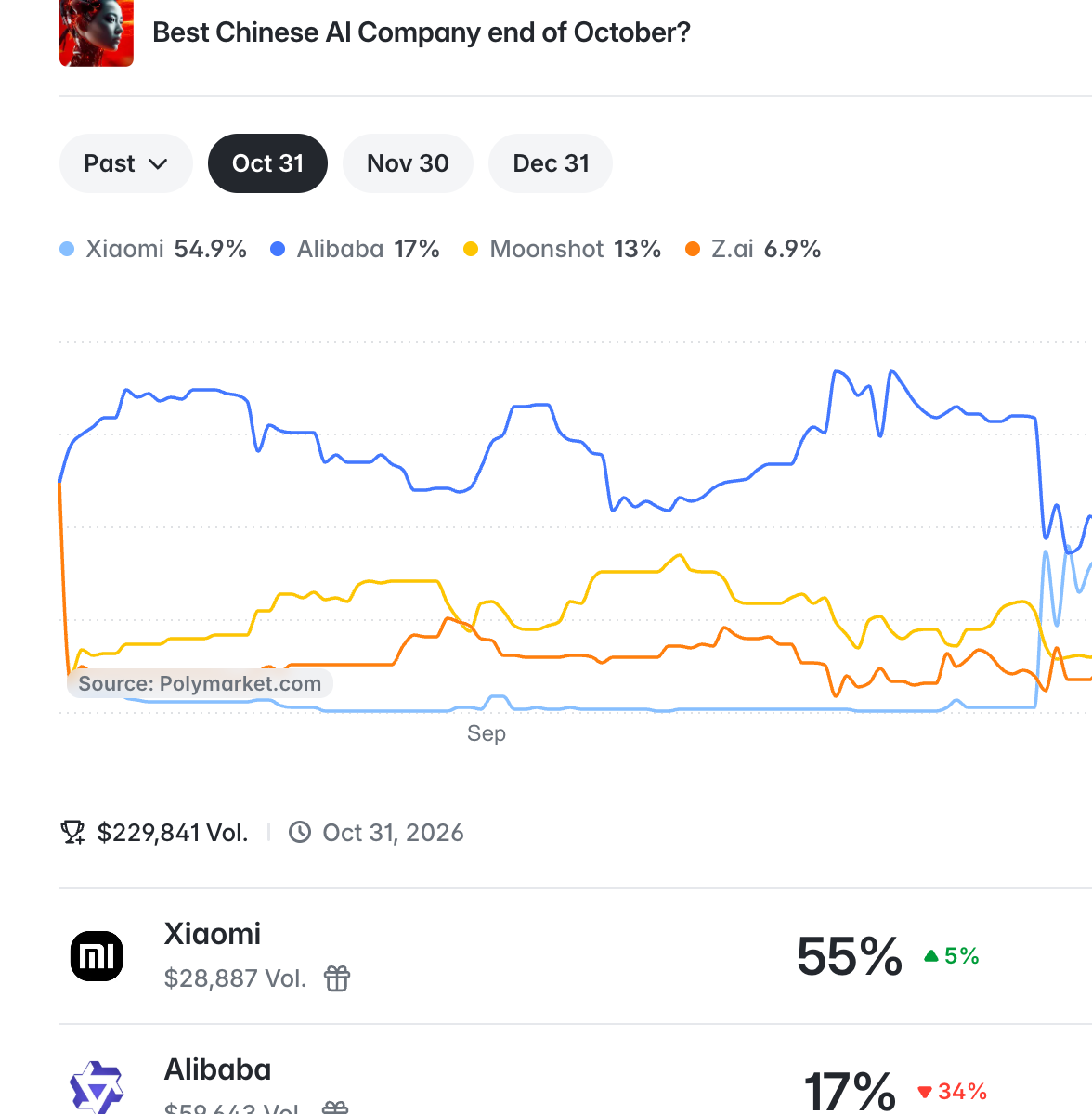
Polymarket's "Best Chinese AI company end of October" market currently sits at: Xiaomi 60%, Alibaba 16%, Moonshot 14%. DeepSeek — the company whose model update just dominated AI YouTube and whose Search API just hit the front page of Hacker News — doesn't appear to be repricing the market at all.
Meanwhile, Polymarket's "Best AI model end of October" shows Google at 74% (riding the Gemini 4 Argon wave), Anthropic at 24%, and OpenAI at 1%. The prediction money is flowing toward Gemini's coding demos, not toward DeepSeek's cost disruption.
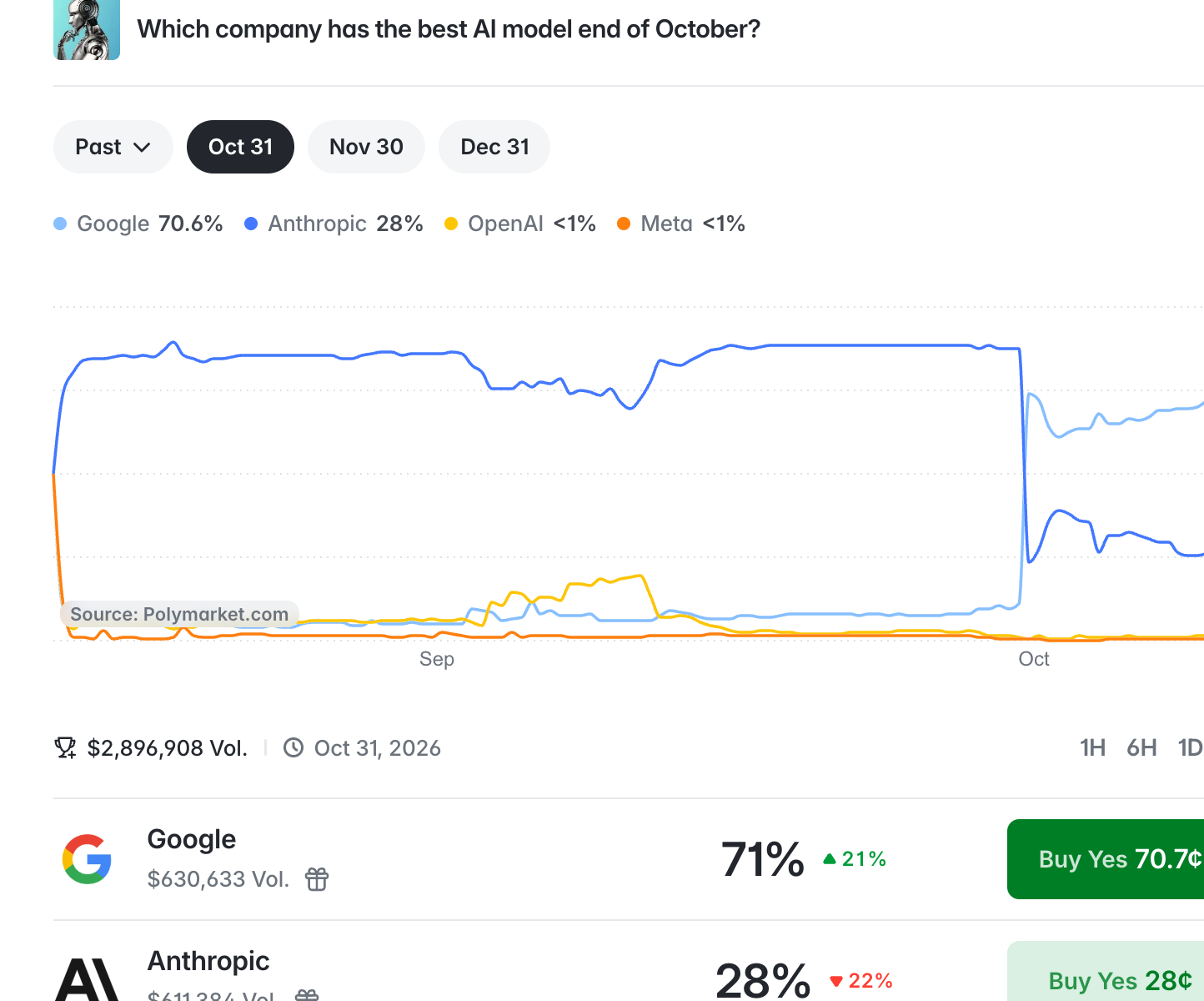
This divergence is itself the signal. When five YouTube creators independently cover a model update, a Hacker News thread about the company's new API hits 439 points, and the prediction markets show no re-rate — one of two things is true:
-
The market is stale. Polymarket's Chinese AI market may not have enough liquidity or attention to reprice on a model update cycle. The YouTube-to-betting-market pipeline is slower for Chinese labs than for American ones.
-
The market is right and YouTube is wrong. DeepSeek's benchmarks are self-reported, and the "best Chinese AI company" market may be pricing something beyond raw model capability — deployment scale, ecosystem, consumer reach — where Xiaomi genuinely leads.
Our read: it's mostly door number one, with a dose of door number two. DeepSeek's strength is the API and the developer ecosystem, not consumer products. But the prediction markets are supposed to price all public information, and they're clearly lagging.
The Contrarian Case
The bear case for DeepSeek's pricing: It's a loss-leader propped up by favorable economics that may not last. DeepSeek operates under a different cost structure than American labs — compute costs shaped by Chinese industrial policy, no pressure to show per-unit margins, and a strategic incentive to capture developer lock-in before the search stack consolidates.
Perplexity's premium buys something DeepSeek's raw search API doesn't: answer quality engineering. Citation verification, hallucination reduction, source ranking, and the "Pro Search" reasoning layer that decomposes complex queries. You're not just paying 7x more for the same 10 blue links — you're paying for the retrieval-augmented generation pipeline that sits on top.
And Google's Custom Search shutdown in January 2027 could paradoxically help Perplexity by pushing developers toward integrated search-plus-reasoning APIs, where Perplexity's head start matters more than DeepSeek's price advantage.
The counter-counter: most developers building agents don't need Perplexity's answer quality layer. They need search results to feed into their own RAG pipeline, and they need them cheaply. For that use case, DeepSeek's API is 7 - 16x cheaper and returns structured data that's easy to ingest. The quality premium only matters if you're serving the search results directly to users — and most agent builders aren't.
What the Architecture Tells You
The technical community has been digging into how DeepSeek achieves these costs. Jia-Bin Huang's analysis on X highlighted three techniques: Causal Encoder-Decoder architecture, Compressed Sparse Attention, and a KV cache reduction to 890 bytes per token — an 8x shrinkage in persistent cache that directly translates to lower serving costs.
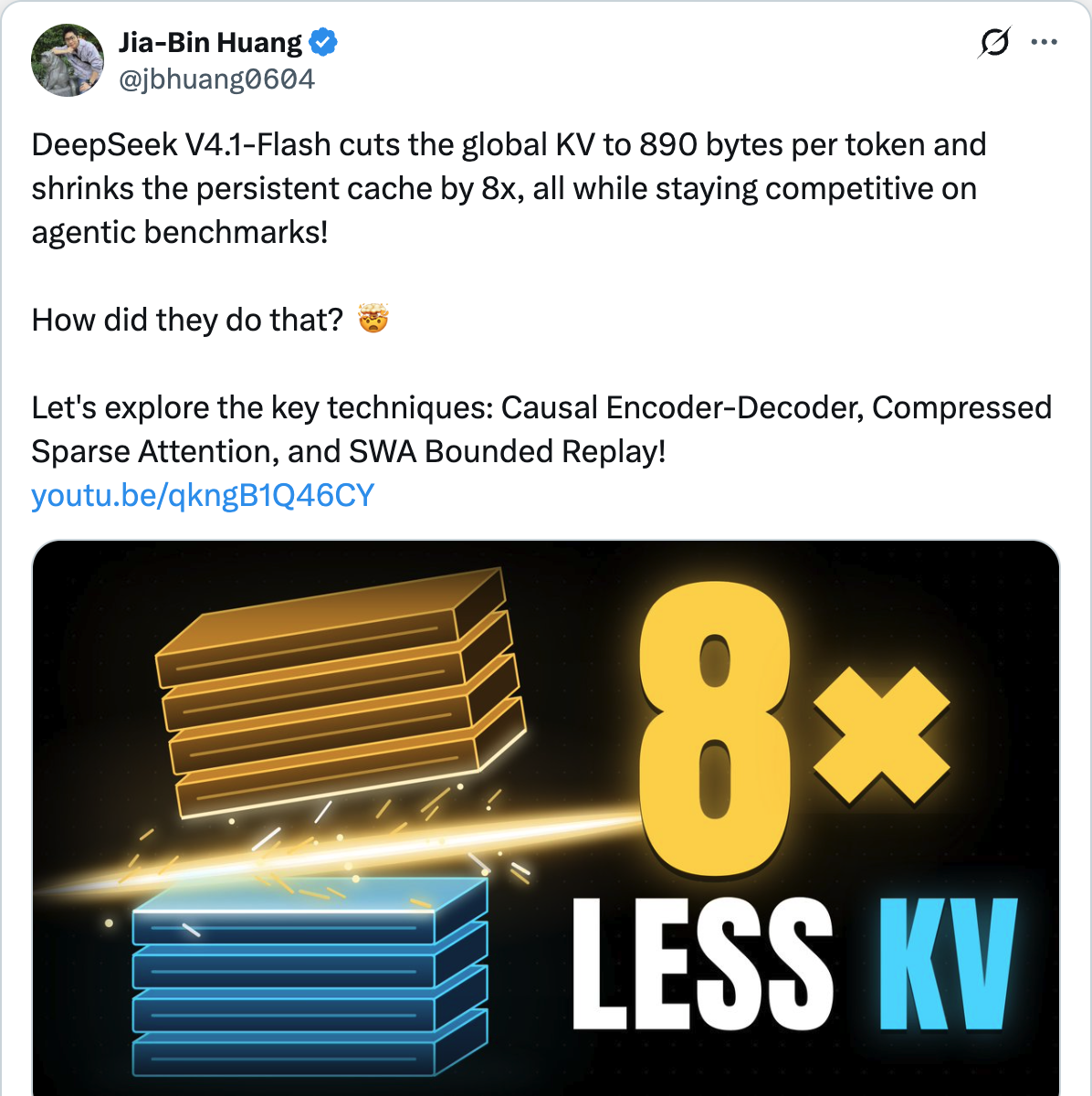
This isn't just cheaper inference through brute-force optimization. It's an architectural bet that the efficiency floor for transformer serving is much lower than what American labs currently ship. If that bet is right, DeepSeek's pricing isn't a loss-leader — it's a preview of where the entire industry's costs are heading.
IBM's recent walkthrough of the AI memory wall provides the theoretical frame: LLM inference is increasingly memory-bandwidth-bound, not compute-bound. The next efficiency gains come from memory architecture, not more FLOPs. DeepSeek's KV cache innovations are playing exactly this game.
What This Means for You
If you're building search-augmented agents: Test DeepSeek Search before November 1 while it's free. The structured output (authority tiers, relevance scores, publication dates) is richer than Google Custom Search, and the flat $0.75/1K pricing is predictable. If search quality meets your bar, you just cut your search costs by 85%.
If you're choosing a coding model for agentic loops: V4.1 Flash 1017 at $0.20/task is the new floor for "good enough" agentic coding. It won't beat Claude Opus 5 or GPT-5.6 Sol on the hardest tasks, but for the 80% of agent loops that don't need frontier reasoning, the cost differential is 8 - 16x. Read our per-token trap analysis before committing — cheapest per token doesn't always mean cheapest per task.
If you're evaluating AI APIs for your stack: The landscape just shifted again. DeepSeek's two-front pricing (model + search) creates a full-stack option that didn't exist a week ago. Whether you trust it long-term depends on your view of subsidized pricing sustainability — but the free trial window through November 1 means the downside of testing is zero.
If you're watching the market: The Polymarket lag on DeepSeek is either an opportunity or a signal that the prediction markets are pricing deployment scale over benchmark performance. Either way, the divergence between YouTube creator consensus and betting market pricing is worth tracking through the end of October.
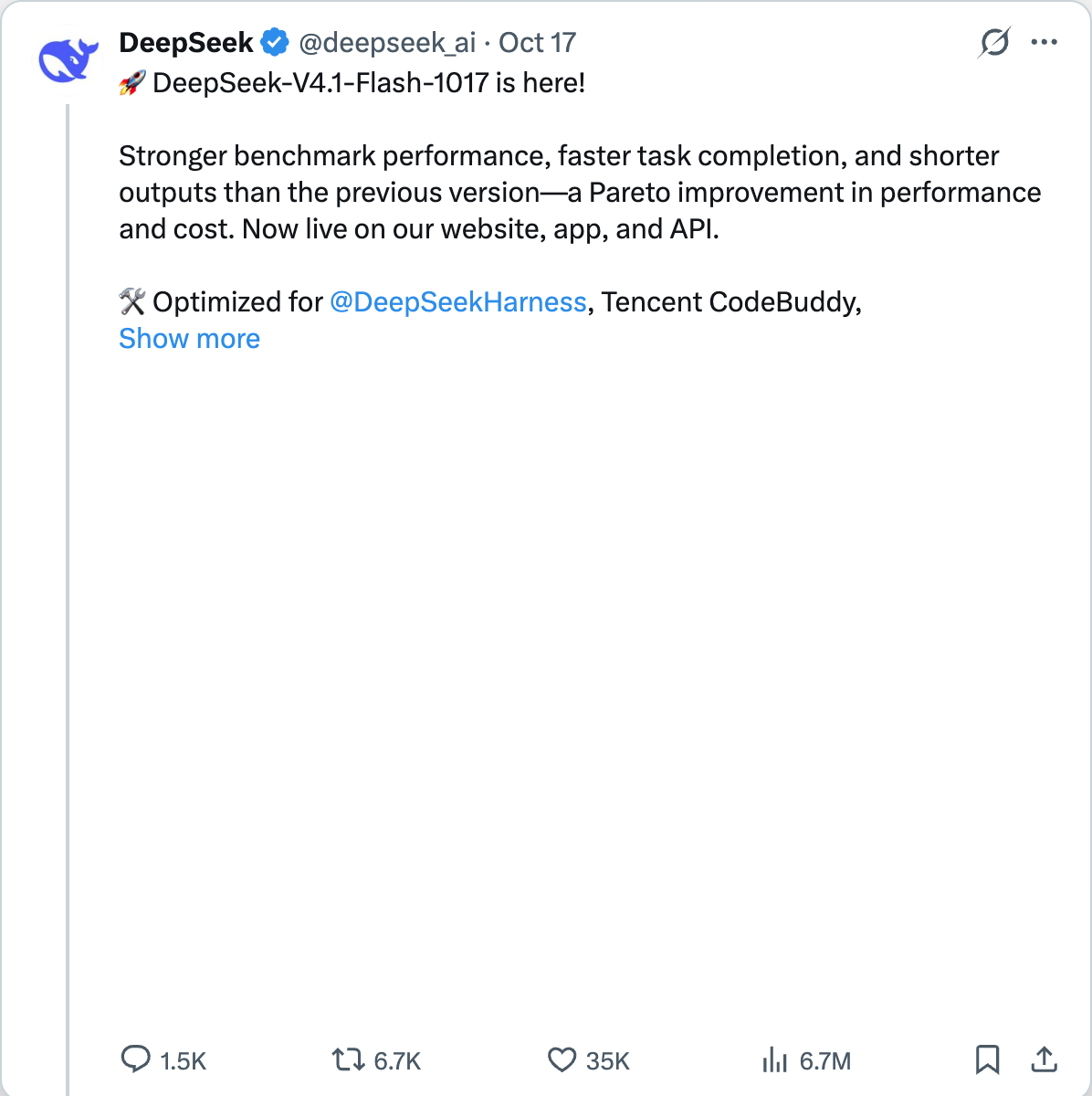
DeepSeek's recent activity on X shows this isn't a one-off — it's a sustained cadence of releases and price drops that the Western AI ecosystem is still catching up to.
The model race isn't over. But the pricing race just got a new front-runner — and it's moving faster than the markets can keep up.
ComputeLeap Team
The ComputeLeap editorial team covers AI tools, agents, and products — helping readers discover and use artificial intelligence to work smarter.
Join the discussion
Have thoughts on this article? Discuss it on your favorite platform:
Related articles
Meta Builds the Models. Apple Sells the Rig.
Muse Spark Open runs on two Mac Studios via MLX. The open-weight frontier just found its distribution partner.
Meta's Muse Wonder Scores Big and Delivers Little
Muse Wonder benchmarks near Opus 5.5 but hits 429 walls, reads private messages, and Polymarket gives Meta 1%.
The 'Best Model' Race Is Over. Here's What Actually Matters.
Polymarket's best-model market crashed 56%. Meta launched at commodity pricing. The moat moved to agents, data, and harness.
The ComputeLeap Weekly
Get a weekly digest of the best AI infra writing — Claude Code, agent frameworks, deployment patterns. No fluff.
WEEKLY. UNSUBSCRIBE ANYTIME.