Fable 5.2 vs Opus 5.5: When to Use Which
Fable 5.2 tops the Intelligence Index but Anthropic says use Opus 5.5. Here is the practical decision framework and token-burn math.
ComputeLeap Team
Fable 5.2 vs Opus 5.5: When to Use Which

On November 9, Claude Fable 5.2 landed at #1 on the Artificial Analysis Intelligence Index with a score of 65 — five points clear of Gemini 4 Carbon and topping every other frontier model on the board. It swept five of nine individual benchmarks, hit 49.1% on FrontierCode 2.0 (the hardest agentic coding eval in existence), and scored 74.2% on Humanity's Last Exam with tools. By every headline metric, Fable 5.2 is the smartest model you can use right now.
And Anthropic's own guidance is: don't make it your default.
That tension — between the leaderboard champion and the recommended daily driver — is the entire story of Claude's model lineup in late 2026. If you are building with Claude's API, writing code in Claude Code, or simply choosing a model for your next chat, understanding when each model earns its cost is worth more than knowing which one scores higher.
The Numbers That Matter
Before we get to the decision framework, here are the benchmark comparisons that actually inform model selection — not vanity metrics, but the ones tied to tasks you will run. All figures are from Anthropic's official announcement and the Artificial Analysis leaderboard.
| Benchmark | Fable 5.2 | Opus 5.5 | Delta | What It Measures |
|---|---|---|---|---|
| FrontierCode 2.0 | 49.1% (Xhigh) | 45.5% | +3.6 | Agentic coding (hardest) |
| FrontierSWE v2 | 69.9% | 62.3% | +7.6 | Agentic coding (standard) |
| AA-Briefcase (Elo) | 1785 | 1800 | -15 | Knowledge work (Elo) |
| AA-Briefcase (rubric) | 66.1% | 61.2% | +4.9 | Knowledge work (rubric) |
| Humanity's Last Exam | 74.2% | 67.7% | +6.5 | Hardest reasoning |
| Chartography | 73.4% | 64.4% | +9.0 | Chart/data understanding |
| OSWorld 2.1 | 89.3% | 87.2% | +2.1 | Computer use |
| AutomationBench | 51.4% | 42.5% | +8.9 | Business workflows |
Two things jump out. First, Fable 5.2 wins nearly every benchmark, often by wide margins. Second — and this is the number everyone glosses over — Opus 5.5 beats Fable 5.2 on AA-Briefcase Elo (1800 vs 1785), the evaluation designed to measure real-world knowledge work. The model that tops the leaderboard is not the best at the thing most people actually do all day.
The Token Economics Nobody Talks About
Here is where the "wrong default" argument crystallizes. Fable 5.2 costs $8/$40 per million tokens (input/output). Opus 5.5 costs $4/$20. That is a clean 2x multiplier.
But Anthropic buries a more interesting number in the launch post: Fable 5.2 at High effort roughly matches Opus 5.5's best FrontierCode 2.0 score — for approximately half the cost per task. How? Fable uses fewer tokens to reach the same quality on hard problems because it reasons more efficiently at lower effort levels.
This creates a paradox:
- Per-token: Fable is 2x more expensive
- Per-task (hard problems): Fable can be cheaper because it solves in fewer attempts
- Per-task (easy problems): Fable is pure waste because Opus solves them just as well
The practical implication: the right model depends entirely on the difficulty of what you are asking. There is no single correct default — there is a routing decision.
Anthropic's efficiency claims (from the launch post):
- FrontierCode 2.0: Fable 5.2 at High ≈ Opus 5.5 at Max, for ~50% of the cost per task
- WANDR: Fable 5.2 at Medium ≈ Opus 5.5 at top score, for ~40% of the cost per task
- Humanity's Last Exam: Fable 5.2 at Low ≈ Opus 5.5 at top score, for under 10% of the cost per task
The Decision Tree: When to Use Which
After digesting the benchmarks, the community reactions, and the token economics, here is the practical framework.
Use Opus 5.5 (Your Default) When:
1. The task is well-specified. You know what the output should look like. Implementing a feature from a clear spec, answering a research question, writing standard content, analyzing data with known parameters. When the prompt already makes the decisions, both models produce equivalent work — and Opus costs half as much.
2. You are running batch or agentic workflows. In multi-step pipelines where each step is routine, the 2x cost multiplier compounds across every call. One hundred Opus calls cost the same as fifty Fable calls. At scale, this is the difference between a viable product and a cash incinerator. See our token cost reduction guide for practical routing patterns.
3. You need fast iteration. Opus 5.5 at Medium effort is snappy. For code review, drafting, debugging known issues, and general back-and-forth, the speed and cost of Opus let you iterate more freely.
4. The task involves general knowledge work. Remember the AA-Briefcase Elo gap: Opus 5.5 scores 1800 vs Fable's 1785 on the eval specifically designed to test professional knowledge tasks. For writing, analysis, research, and synthesis, Opus is not just cheaper — it may be marginally better.
Escalate to Fable 5.2 When:
1. Opus has already failed. The clearest signal. If Opus 5.5 at High effort produced wrong output, escalate to Fable. This is the retry-cost argument: one successful Fable run is cheaper than three failed Opus attempts.
2. The task is genuinely open-ended. Designing an architecture from scratch, exploring solution spaces, creative coding challenges, or anything where the "right answer" is not obvious upfront. Anthropic says Fable is "for the most ambitious, open-ended technical work" — take them at their word.
3. The cost of a wrong answer is high. Code reviews where a missed bug ships to production. Design decisions that are expensive to reverse. Security audits. When the downside of a mediocre answer exceeds the 2x token premium, Fable earns it.
4. You are hitting the frontiers of capability. Advanced agentic coding (FrontierCode 2.0 territory), scientific reasoning (Terminal-Bench-Science, HLE), robotics simulation (RoboDojo), or hardware engineering (BenchCAD 2.1, where Fable scored 83.5 vs Opus's 65.3). These are the domains where Fable's advantage translates to real capability differences.
The one-sentence rule: If you would run Opus 5.5 at Max effort and still worry about quality, switch to Fable 5.2 at High effort instead. You will likely get better results for similar or lower cost.
Effort Levels: The Hidden Variable
Most comparisons miss this: effort level matters more than model choice for most tasks. Fable 5.2 at Low effort (scoring 54 on the Intelligence Index) is weaker than Opus 5.5 at its best. Fable 5.2 at Max effort is the most powerful model available — but it also burns the most tokens.
The default effort settings are different by surface:
| Surface | Fable 5.2 Default | Opus 5.5 Default |
|---|---|---|
| Claude Apps | Medium | Medium |
| Claude Code | Medium | Medium |
| API | High | Medium |
This mismatch means that API users get Fable's full reasoning by default (and pay accordingly), while app users get a lighter touch. If you are comparing the two models head-to-head, make sure you are matching effort levels — otherwise you are comparing Fable's reserves against Opus's default.
At Xhigh and Max effort, Fable 5.2 can spawn subagents to verify its own work. This self-checking loop is powerful but expensive. Use it when the stakes justify it — not for every query.
The Full Claude Lineup in Context
The price cut from Fable 5.1 ($10/$50) to Fable 5.2 ($8/$40) is a 20% reduction that narrows the gap with Opus 5.5. But context matters — here is how the full Claude lineup stacks up:
| Model | Input $/MTok | Output $/MTok | Role |
|---|---|---|---|
| Haiku 5.5 | $0.25 | $1.25 | Fast, cheap, bulk tasks |
| Sonnet 5.5 | $1.50 | $7.50 | Balanced workhorse |
| Opus 5.5 | $4.00 | $20.00 | Daily driver, recommended default |
| Fable 5.2 | $8.00 | $40.00 | Frontier, hard problems only |
| Fable 5.2 Fast | $16.00 | $80.00 | When you need Fable + speed |
For teams running on API credits, the decision tree is not just Fable vs. Opus — it is a four-tier routing strategy. Use Haiku for classification and simple extraction. Use Sonnet for routine generation and standard coding. Use Opus as the default for anything substantive. Reserve Fable for the work that actually demands it. Our Fable 5.1 pricing analysis covers the predecessor's economics — the 5.2 pricing is strictly better.
What the Community Is Saying
The r/ClaudeAI subreddit lit up on launch day. Three of the top 15 posts were Fable 5.2 content, including "Guys Fable 5.2 is INSANE" at 2,846 points.

Over on r/singularity, the Gears of War clone demo — where Fable 5.2 built a playable game from a three-line prompt in Unreal Engine — collected 1,572 points and became the showcase moment for the launch.

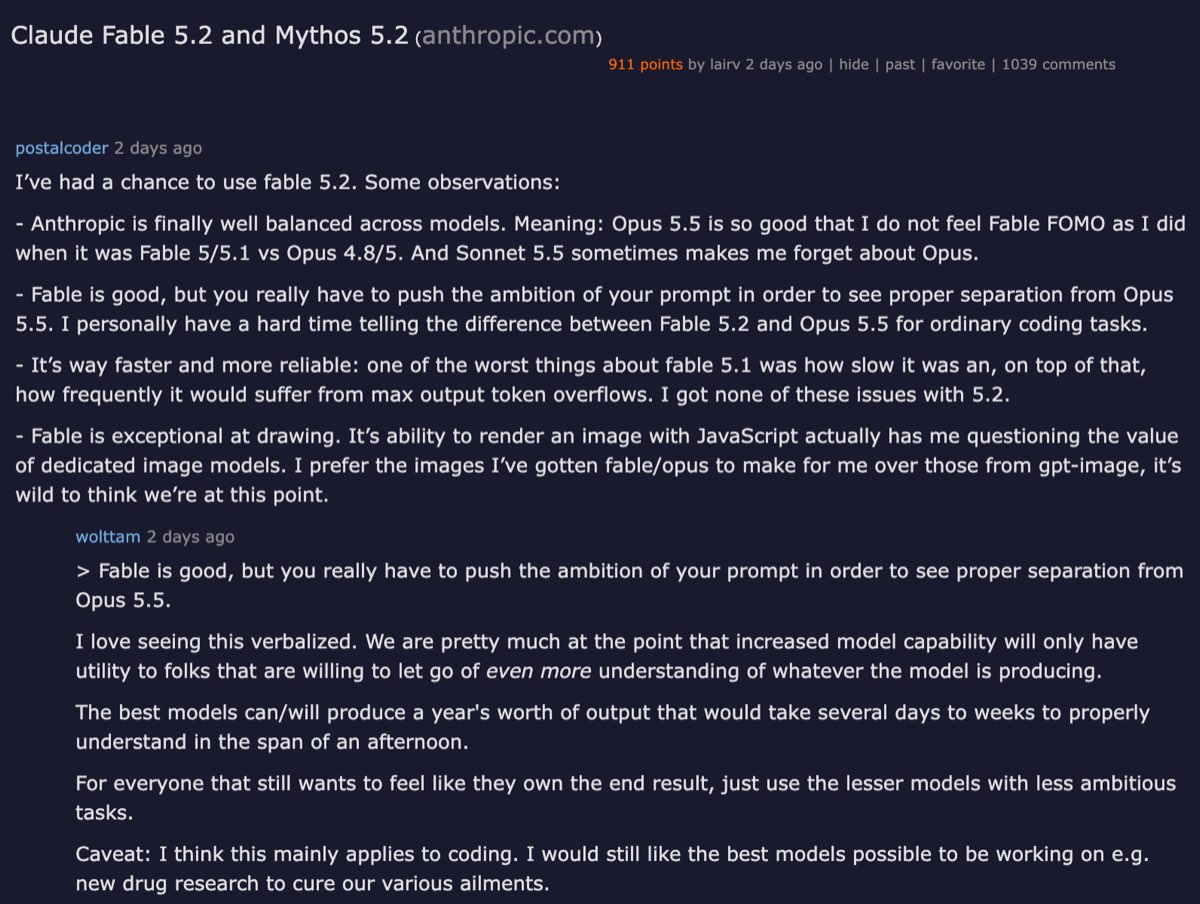
On Hacker News, the announcement thread hit 911 points with over 1,000 comments — one of the largest AI model discussion threads this quarter. The conversation split predictably between benchmark enthusiasts celebrating the new #1 and practitioners asking the same question this article answers: when should I actually use it?
And the market noticed. On Polymarket, the "#2 AI Lab end of November" contract moved Anthropic to 55% — up 10 points on launch day alone. Traders are pricing in that Fable 5.2 has solidified Anthropic's position behind Google as the clear #2, with Meta at 30% and OpenAI trailing below that.
Contrarian Corner: Is the "Wrong Default" Framing Itself Wrong?
The cost-per-task data from Anthropic's own benchmarks suggests Fable 5.2 at Medium or High effort can be cheaper than Opus 5.5 for hard problems. If you are currently running Opus at Max effort and still seeing failures, switching to Fable at High could save money while improving quality. The "2x more expensive" framing only holds when you compare per-token rates in isolation — and nobody pays per-token, they pay per-task. The real question is not "which model costs less per token" but "which model costs less per successful outcome." For easy tasks, that is Opus. For hard tasks, the answer might surprise you.
What This Means for You
If you are a solo developer using Claude Code: keep Opus 5.5 as your default model. Bump to Fable 5.2 when a task fails twice, when you are doing greenfield architecture, or when you are reviewing code that could ship bugs to production. The effort settings matter more than model selection for most daily work.
If you are running agentic pipelines at scale: Fable 5.2 as an orchestrator delegating to Sonnet/Haiku subagents is a powerful pattern. But do not make Fable the executor for every step. Use it as the advisor — the model that smaller models consult on hard decisions — and keep your per-token costs manageable. Our token cost reduction guide covers the routing patterns in detail.
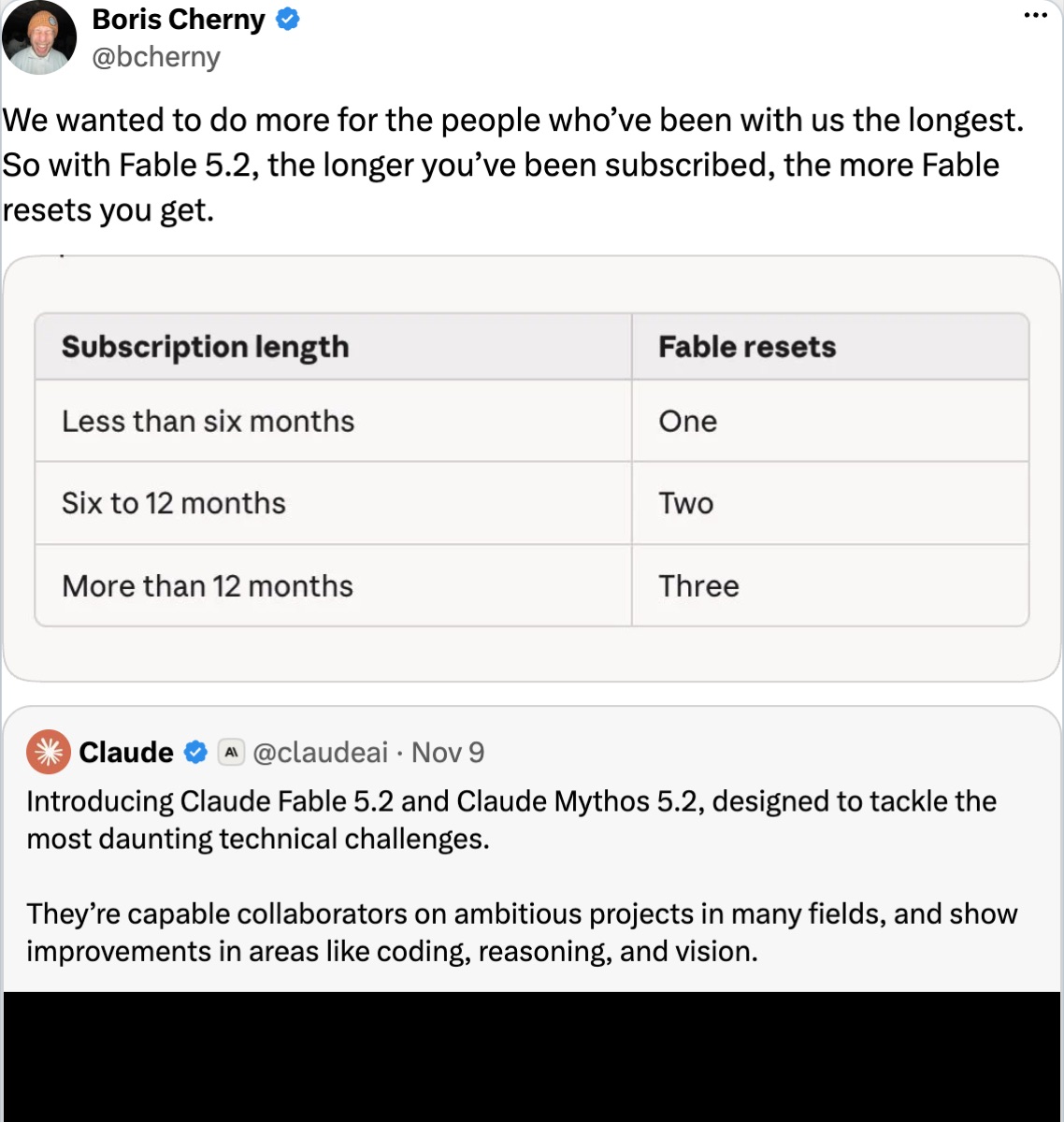
If you are an Anthropic subscriber (Pro/Max/Ultra): Fable 5.2 is available during launch week on Pro plans, then moves to usage-credit pricing. Max and Ultra subscribers can use it for up to half their weekly limit. The loyalty pricing — longer subscribers get more Fable resets — is a nice touch, but the core economics remain: use it when Opus is not enough, not as your everyday tool.
Looking Ahead
Fable 5.2 is the strongest model on the Intelligence Index right now. That will not last — Google's Gemini 4 Carbon is already at 60, and Polymarket gives Google 72% odds of holding the "best model" title by year-end. The model race has become a quarterly leapfrog.
What will last is the routing discipline. The pattern of having a reliable daily driver (Opus) and a frontier model for hard problems (Fable) is not going away — it is becoming the standard operating model for AI-powered development. Whether the frontier model is called Fable 5.3, GPT-7, or Gemini 5, the framework for when to escalate remains the same:
- Start with the cheaper model
- Match effort to task difficulty
- Escalate on failure or high-stakes tasks
- Measure cost per successful outcome, not cost per token
The leaderboard champion is the wrong default. But knowing when to deploy it is the right skill.
ComputeLeap Team
The ComputeLeap editorial team covers AI tools, agents, and products — helping readers discover and use artificial intelligence to work smarter.
Join the discussion
Have thoughts on this article? Discuss it on your favorite platform:
Related articles
OpenAI Spent $1.2M Hacking Linux — Here's Why
OpenAI's AI pipeline found 948 Linux kernel exploits for $1.2M. At bug-bounty rates, that's a 55x return — and frontier labs now fund open-source security.
Same H100, $2.69 vs $12.29/hr — The Cost-Opacity Tax
The 4.57x GPU price spread and token-cost chaos share one root cause: nobody publishes comparable units. Here's what that costs you.
Your Finance Team Just Became Engineers
Figma built self-serve analytics with OpenAI. Ramp hit 99.5% AI adoption. Here's what the convergence means for every department.