Google Told Wall Street AI Is Eating Its Ad Business
Alphabet lost $475B in a day after admitting AI Mode monetizes worse than classic search. The innovator's dilemma is now priced in.
ComputeLeap Team
Google Told Wall Street AI Is Eating Its Ad Business
On October 29, 2026, Alphabet lost approximately $475 billion in market value in a single trading session — the largest one-day wipeout in the company's history and the second-largest ever for a US-listed company, behind only Nvidia's $593 billion DeepSeek-driven slide in January 2025. Shares fell nearly 13%, their steepest session since the 2004 IPO.
The trigger wasn't a product failure, a regulatory bombshell, or an earnings collapse. Revenue was up 25% year-over-year to $127.6 billion. Google Cloud more than doubled to $30.7 billion. Gemini crossed one billion users. By any traditional measure, this was a strong quarter.
But buried in the Q3 earnings call, Google's Chief Business Officer Philipp Schindler said something the market had been dreading: AI Mode queries monetize worse than traditional search queries, and that gap is already showing up in the numbers.
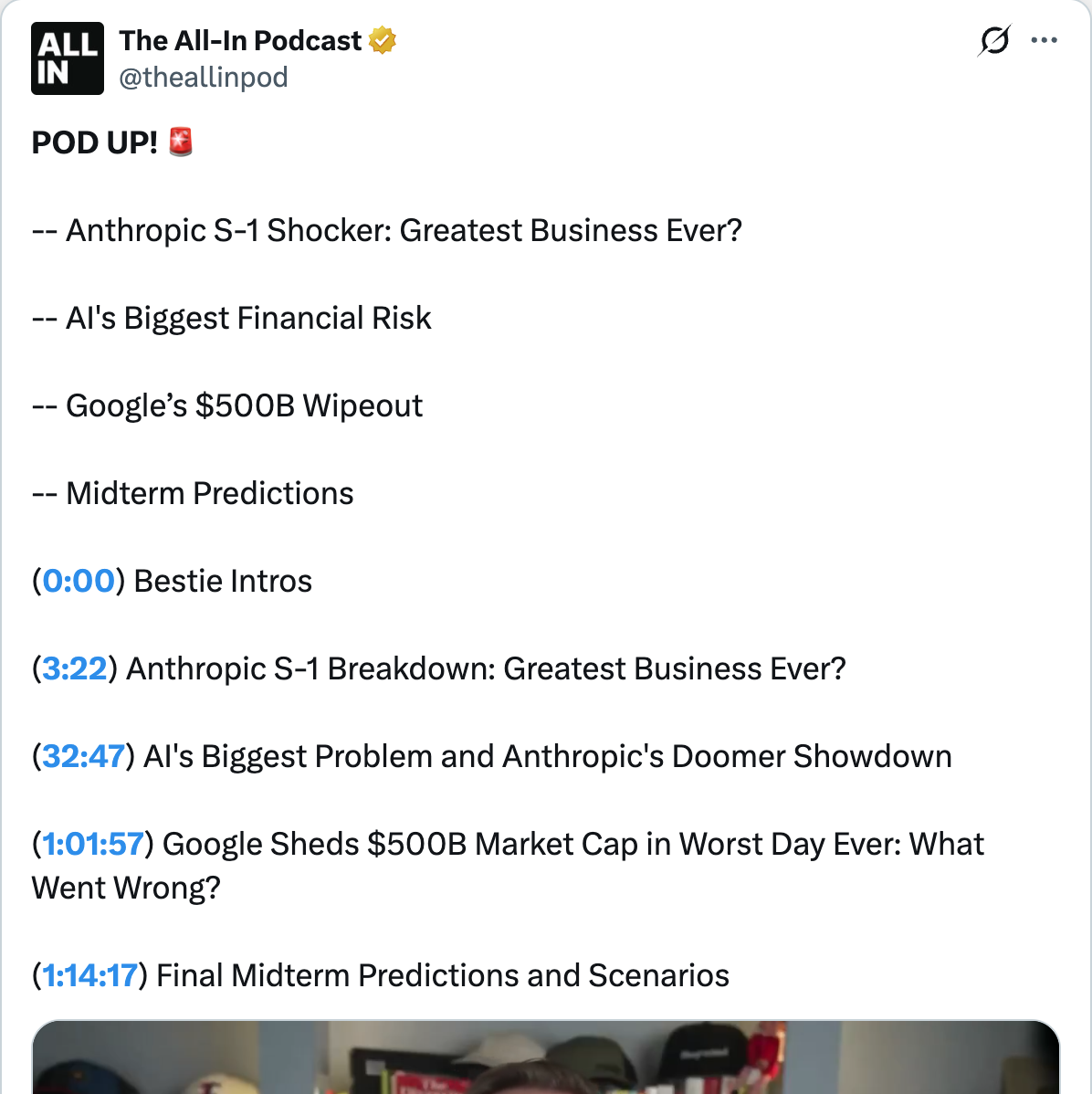
That single admission — from the executive who runs Google's ad business — turned the bear case into the base case. It's not that AI might cannibalize search ads someday. It's happening now, in the numbers, acknowledged by the company itself.
Pichai himself framed the quarter as a milestone — a "half-trillion annual revenue run rate" with AI investments "driving overall Search query growth":
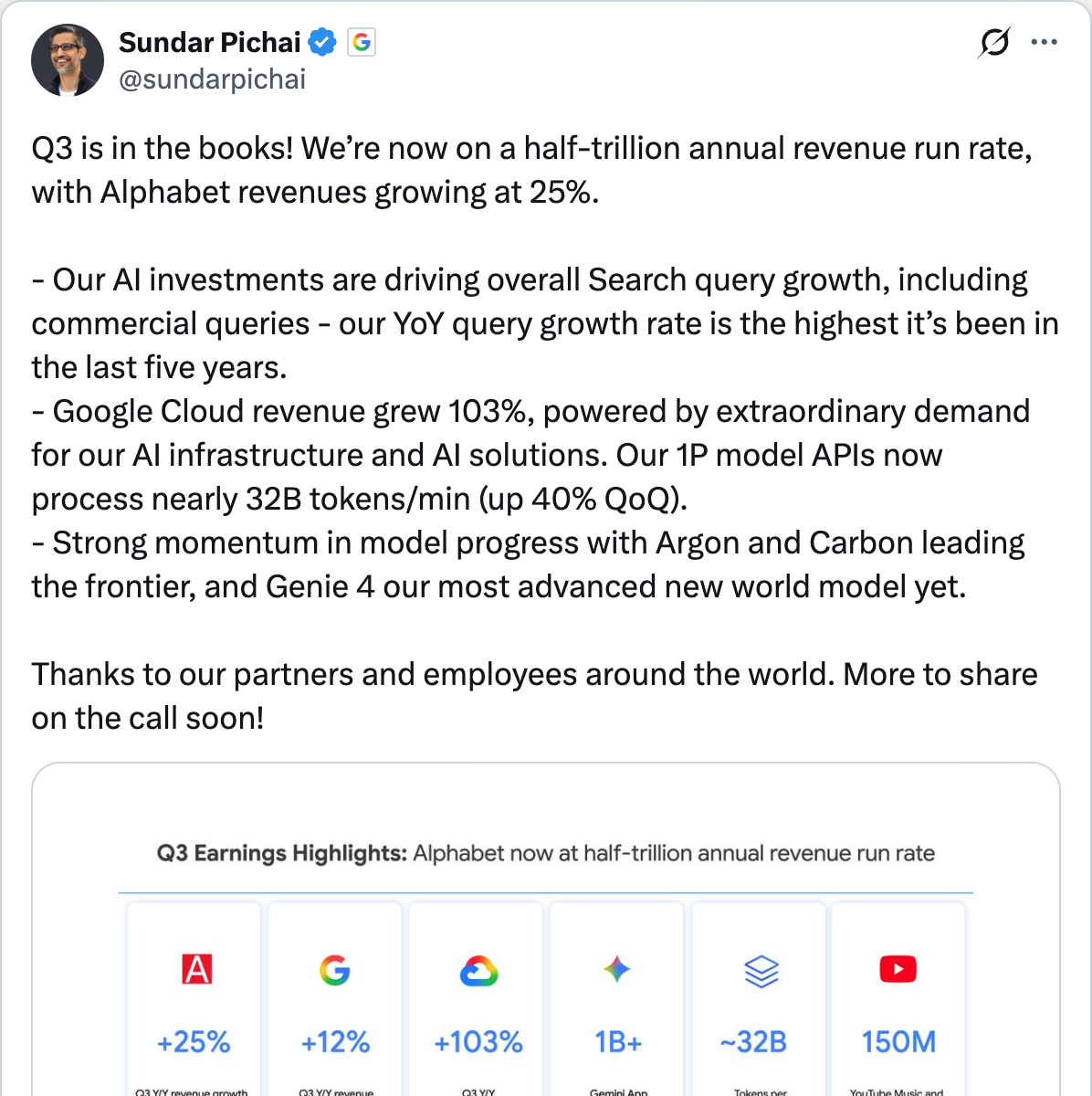
The disconnect between Pichai's victory-lap framing and the market's $475 billion verdict tells you everything about how differently executives and investors are reading the same data.
For context on the competitive pressure Google faces from AI-native companies, see our analysis of Anthropic's S-1 filing, which shows 900% net revenue retention and $16.3B in first-half revenue — the kind of growth that's pulling developers and enterprises away from Google's ecosystem.
The Numbers That Spooked Wall Street
The headline miss was modest. Revenue came in at $127.58 billion versus $128.22 billion expected — less than a 1% shortfall. But the composition of that miss told a story the market didn't want to hear:
| Metric | Actual | Expected | Delta |
|---|---|---|---|
| Revenue | $127.58B | $128.22B | -0.5% |
| Adjusted EPS | $2.67 | $3.02 | -11.6% |
| Search Revenue | $63.35B | $64.96B | -2.5% |
| Free Cash Flow | -$9.07B | +$2.70B | -- |
| Google Cloud | $30.7B | $28.7B | +7.0% |
Search revenue grew 12% to $63.35 billion — respectable in isolation, but a significant deceleration from 17% in Q2 and 19% in Q1. Wall Street had expected roughly 15% growth. The miss wasn't enormous, but the trend was unmistakable: every quarter, search growth slows while AI spending accelerates.
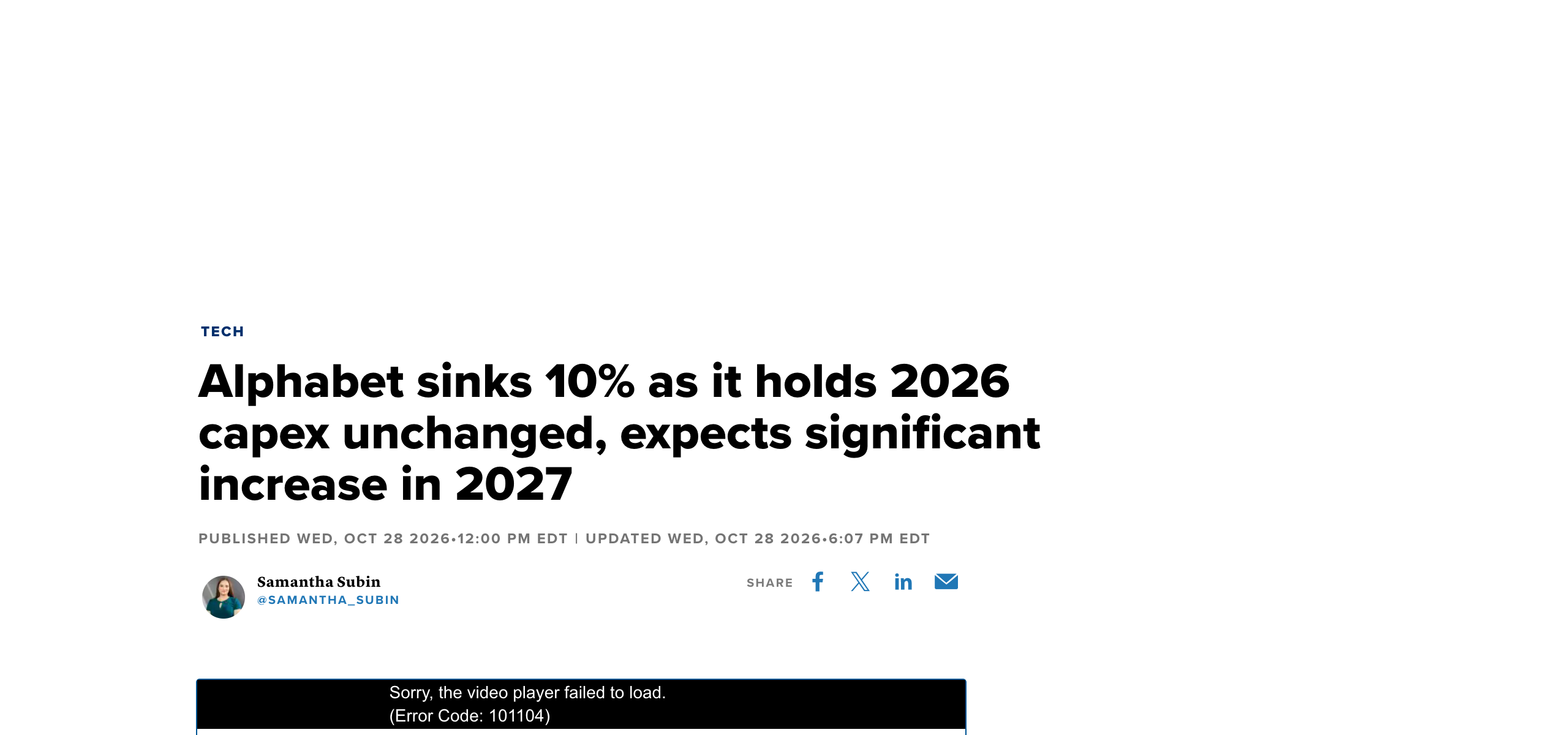
View original article on CNBC →
The free cash flow figure was the real shock. Negative $9.07 billion versus expectations of positive $2.7 billion. Capital expenditures hit $51.36 billion in a single quarter, and CFO Anat Ashkenazi signaled capex would "increase significantly in 2027" beyond the already staggering $195-205 billion planned for 2026. Long-term debt ballooned 479% year-over-year to $125.1 billion.
Then there was the $8.66 billion write-down on equity stakes in SpaceX and Anthropic — ironic given that Anthropic, one of Google's key investments, is the same company whose S-1 filing highlights the competitive threat to Google's core business.
As Jefferies analyst Brent Thill put it: "Cloud was the only segment that beat. Everything else missed."
The Schindler Confession
The most consequential moment of the earnings call wasn't a number — it was a sentence. Philipp Schindler, who oversees all of Google's advertising business, acknowledged that AI Mode's lower monetization actively dragged on search revenue growth:
"The strong growth in AI Mode queries had an impact because of the lower monetization we were seeing in AI Mode."
This deserves unpacking. Google's chief ad executive told Wall Street three things simultaneously:
- AI Mode usage is growing fast — query growth hit a five-year high, driven by AI features
- Each AI query is worth less — fewer ad slots, lower value per slot, more upper-funnel informational intent
- The mix shift is already hitting revenue — this isn't theoretical; it showed up in Q3's numbers
Schindler attempted to cushion the blow by arguing that "many of these queries are upper funnel queries, allowing us to capture new, high-value commercial intent" and that "the majority of AI Mode queries are incremental." Google's framing: these are new searches that wouldn't have happened otherwise, so even at lower monetization, they're additive.
The Bull Case Deserves Scrutiny: Google provided zero data to support its "incrementality" claim. If AI Mode queries are truly incremental — searches users wouldn't have done on traditional Google — then the monetization gap doesn't matter because it's all new revenue. But if users are simply choosing AI Mode over traditional search for queries they would have typed anyway, every converted query destroys value. Without disclosed data, investors are asked to take this on faith from the company that has every incentive to frame the numbers favorably.
Citigroup's Andrew Boone wasn't buying the optimistic framing: "While query growth reached a five-year high, monetization appears to be challenged while search faces difficult comps."
The Innovator's Dilemma, Playing Out in Real Time
This is textbook Clayton Christensen. Google faces a problem that cannot be solved with better execution:
If Google doesn't deploy AI in search, users leave for ChatGPT, Perplexity, and Claude — products that answer questions directly without making users click through ad-laden results pages. Apple's Eddy Cue already testified earlier this year that Safari search volume had declined as users shifted toward AI tools. Google's $20-billion-a-year default search deal with Apple is no longer guaranteed.
If Google does deploy AI in search, every AI answer replaces a results page that showed 8-10 blue links interspersed with 3-4 ads. Third-party data from Keywords Everywhere's AI Overviews tracker found that organic clicks dropped from 0.62 per search to 0.37 when AI Overviews were shown — a roughly 40% reduction in clicks per query. Fewer clicks means fewer ad impressions means less revenue per query.
Google chose door number two, and Q3 was the first quarter where the cost of that choice was visible in the income statement. As Pivotal Research CEO Jeffrey Wlodarczak told Yahoo Finance: "The bears will argue this is the first quarter that AI is starting to seriously hurt their search business."
The broader context makes this even more pointed. Alphabet has now lost approximately $1.4 trillion in market value since its May 2026 record — a slow-motion repricing of what the search monopoly is actually worth in an AI-first world.
What Google Is Doing About It
Google isn't standing still. The company is rapidly scaling ads into AI surfaces:
- AI Overviews ads are now eligible in 200+ markets as of September 2026
- AI Mode ads are expanding to more users and more queries in the US
- Gemini tools helped advertisers generate more than 1.5 billion campaign assets in Q3, up 7x year-over-year
- Google claims sponsored product click-through rates in AI Mode are "comparable to organic listing CTRs" (though no raw data was shared)
The strategy is clear: flood AI surfaces with ads until per-query monetization approaches traditional search levels. Schindler is betting that the format will evolve — that multi-turn ads, product carousels within AI answers, and AI-generated ad creative will eventually close the gap.
Google's response follows the same playbook it used when mobile search initially monetized worse than desktop. It took roughly 3-4 years for mobile search RPMs to reach parity with desktop. The question is whether AI's structural difference (answers vs. links) makes this a harder gap to close.
But there's a fundamental tension Google hasn't resolved. The reason people prefer AI answers is precisely because they don't have to click through ad-laden results. Stuffing ads into AI summaries risks degrading the very experience that's driving query growth. It's a tightrope between monetization recovery and user experience — and Google's competitors are watching closely for any misstep.
The Capex Trap
The monetization gap is only half the problem. The other half is cost.
Google hasn't disclosed what it costs to serve an AI Mode answer versus a traditional search result, but the direction is obvious. Traditional search is largely a retrieval problem — index lookup, ranking, rendering. AI Mode requires inference at scale: running large language models on every query, with latency requirements measured in seconds.
Q3 capex was $51.36 billion — in a single quarter. The 2026 guidance of $195-205 billion is already eye-watering, and Ashkenazi signaled 2027 will be "significantly" higher, with analysts expecting north of $300 billion. Long-term debt has exploded from $21.6 billion to $125.1 billion in twelve months.
This creates a structural squeeze: each AI query generates less revenue than a traditional query but costs more to serve. Scale makes the problem worse, not better, until either monetization catches up or inference costs drop dramatically.
And Google isn't alone. As SEO analyst Glenn Gabe noted, the negative free cash flow story is hitting every AI hyperscaler simultaneously:
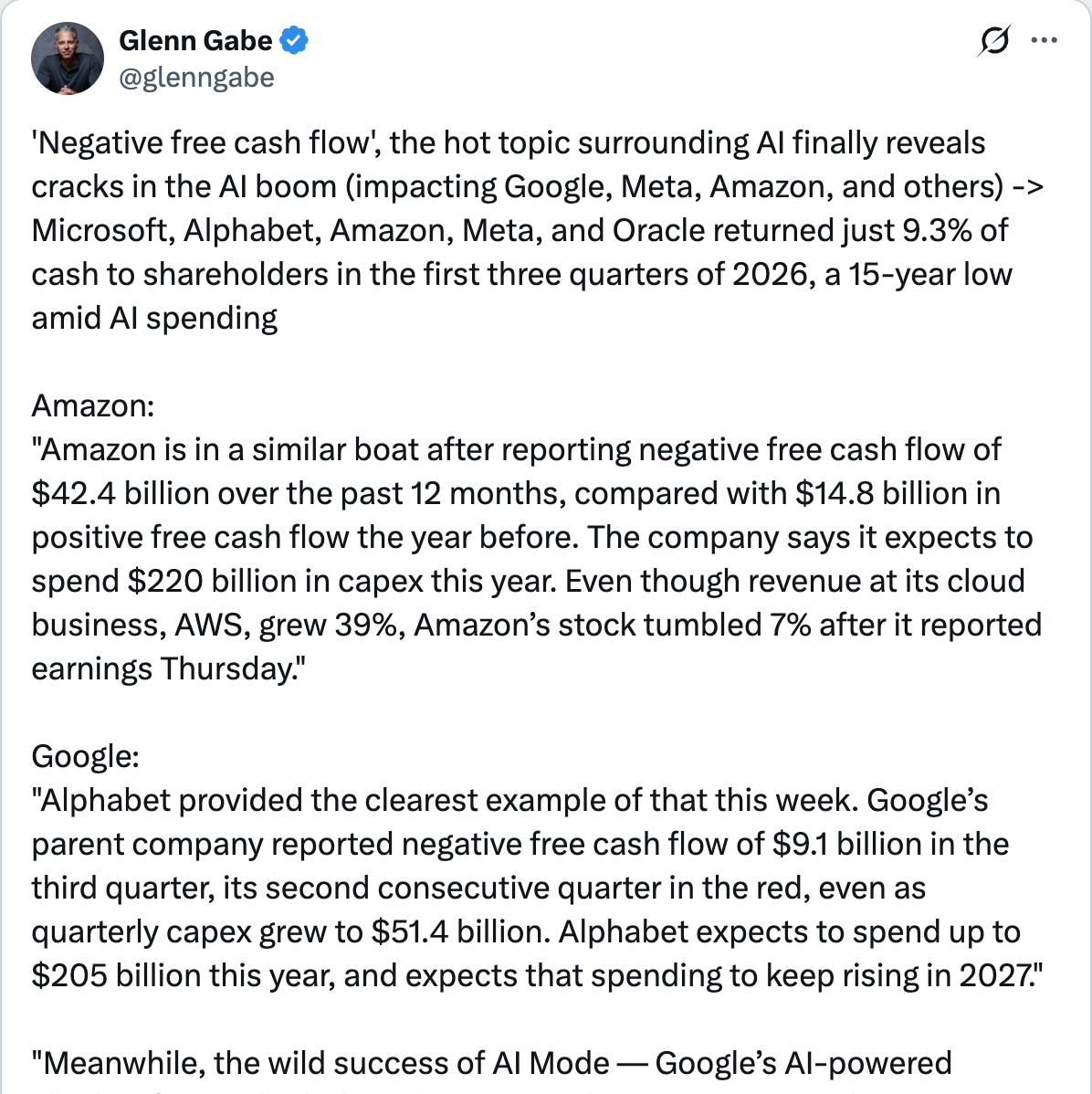
Microsoft, Alphabet, Amazon, Meta, and Oracle returned just 9.3% of cash to shareholders in the first three quarters of 2026 — a 15-year low amid AI spending.
For context on where all this capital is going physically, Google is building datacenters at a pace that's creating legal problems in Finland, where a criminal investigation has been launched over 816 acres of forest cleared without proper approvals — a tangible reminder that the AI capex story isn't just a balance sheet abstraction. For more on who's financing this infrastructure buildout, see our earlier analysis on banks underwriting the AI datacenter boom.
The $475 Billion Day in Context
View original article on Yahoo Finance →
The wipeout wasn't an isolated event. Yahoo Finance noted that US-listed stocks have shed $200 billion or more in a single session 18 times in 2026 alone — up from 13 in all of 2025 and zero before 2022.
The scale of market-cap swings reflects how concentrated AI expectations have become. When Nvidia sneezed on the DeepSeek news ($593 billion, January 2025), SpaceX stumbled ($400 billion, June 2026), and now Google confessed ($475 billion, October 2026), the losses dwarf anything from previous market cycles. These aren't corrections — they're the market repricing trillion-dollar companies by hundreds of billions on single data points.
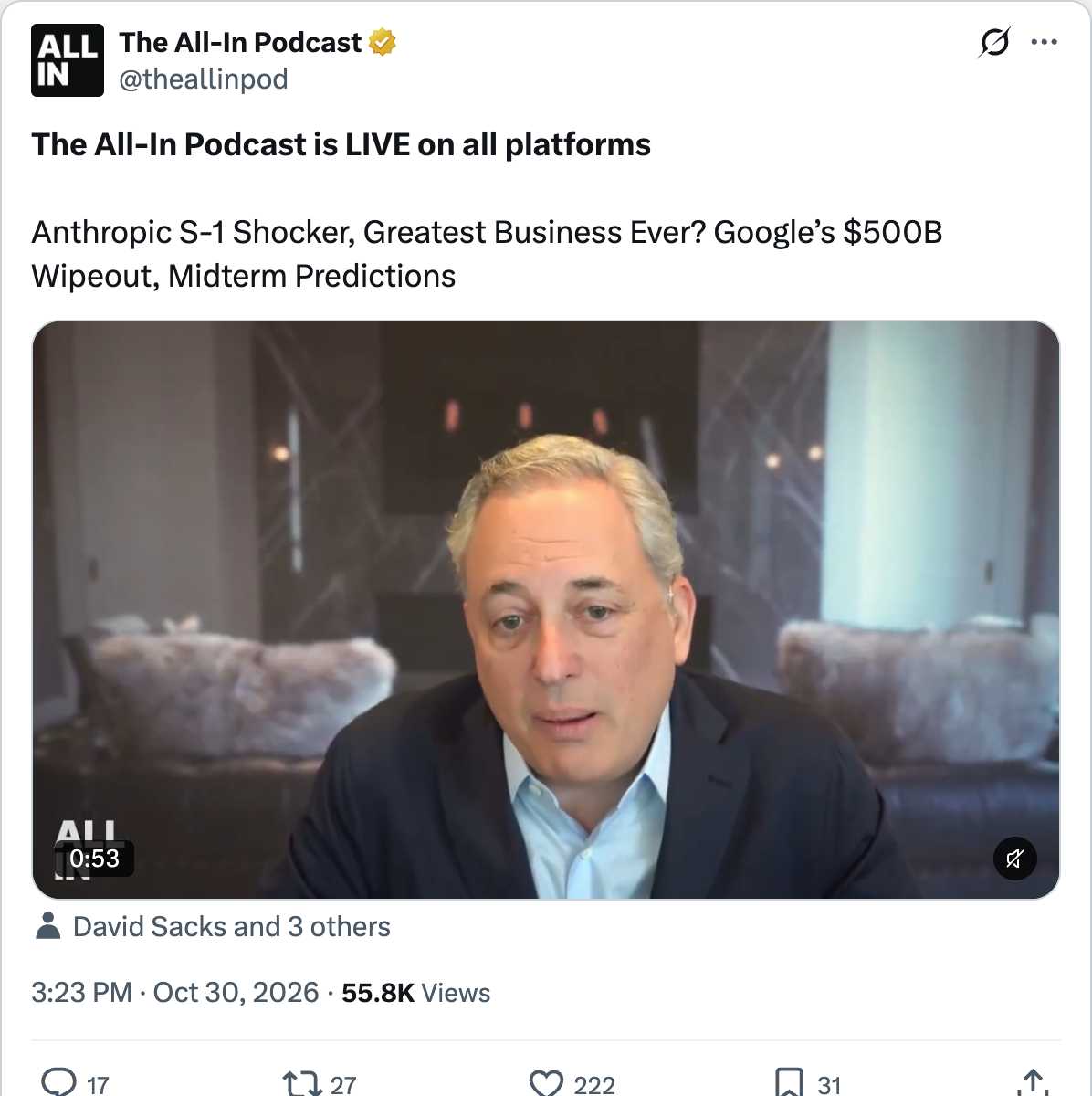
For Google specifically, the cumulative damage is severe. The stock is down $1.4 trillion from its May peak. Even CFRA analyst Angelo Zino, who called the pullback "probably a buying opportunity," couldn't disguise that the thesis has shifted: you're now buying Google on the hope that AI monetization improves, not on the certainty that the search monopoly is unbreakable.
What This Means for You
If you build products, buy ads, or invest in the AI ecosystem, three things changed this week:
For advertisers: Google will aggressively push ads into AI surfaces over the coming quarters. Expect CPCs to rise as Google tries to close the monetization gap — fewer ad-eligible impressions per query means more competition for each slot. Start testing AI Mode ad formats now, before they become mandatory.
For SEO practitioners and publishers: Optimize for AI Mode visibility, not just traditional SERP rankings. The click-through data is stark — organic clicks drop 40% when AI Overviews appear. Your content strategy needs to account for a world where Google answers the question directly and may never send the click.
For investors: The "search is forever" thesis is wounded. Google's moat hasn't been breached by a competitor — it's being eroded by Google's own product roadmap. The company is spending $200 billion a year to build something that cannibalizes its most profitable product. That can work long-term (mobile search monetization eventually matched desktop), but the transition period is expensive, and there's no guarantee AI search ads will ever match traditional search RPMs.
The uncomfortable truth: Google has no choice. Not deploying AI means losing to ChatGPT, Perplexity, and whatever Apple builds next. Deploying it means accepting lower per-query revenue, possibly for years. The bet is that volume growth from AI features will eventually outrun the per-query monetization decline. Q3 showed the first quarter where the market stopped giving Google credit for that bet.
The Bottom Line
Google didn't just miss earnings. It told the market — in the Chief Business Officer's own words — that AI search monetizes worse than traditional search, and that this gap is already material enough to show up in the income statement.
For twenty years, Google Search was the most perfect business model in technology: users typed queries, Google showed ads, money appeared. AI Mode breaks that model at the deepest level. The answer is the product now, and answers don't need blue links with ads between them.
The $475 billion repricing wasn't about one quarter's numbers. It was Wall Street recalculating what Google is worth when the bear case — AI eats the ad business from the inside — stops being a hypothetical and starts being the company's own reported reality.
The innovator's dilemma isn't theoretical anymore. It's priced in.
For more on how AI economics are reshaping the tech landscape, see our analysis of the AI payoff problem and who's financing the datacenter boom.
ComputeLeap Team
The ComputeLeap editorial team covers AI tools, agents, and products — helping readers discover and use artificial intelligence to work smarter.
Join the discussion
Have thoughts on this article? Discuss it on your favorite platform:
Related articles
Anthropic's S-1 Hides the Real Story in Plain Sight
The S-1 shows 900% NRR and $16.3B revenue. It also shows Fortune 500 firms spend under $1 per $1,000 on AI. That gap is the whole story.
Compute Is Now a Tradable Commodity
CME and ICE are listing GPU futures. Amazon says $220B isn't enough. Here's what compute-as-commodity means for builders.
The $80B Loss That Might Be Genius
Anthropic lost $80.7B on paper while DeepSeek prints 82% API margins. Why both strategies could win the AI economics war.