Apple's iPhone Duo Is Cracking on Day One
The $1,999 iPhone Duo's inner display is cracking along the hinge within hours. Here's what iFixit found, what it costs to fix, and why waiting might be wise.
ComputeLeap Team
Apple's iPhone Duo Is Cracking on Day One
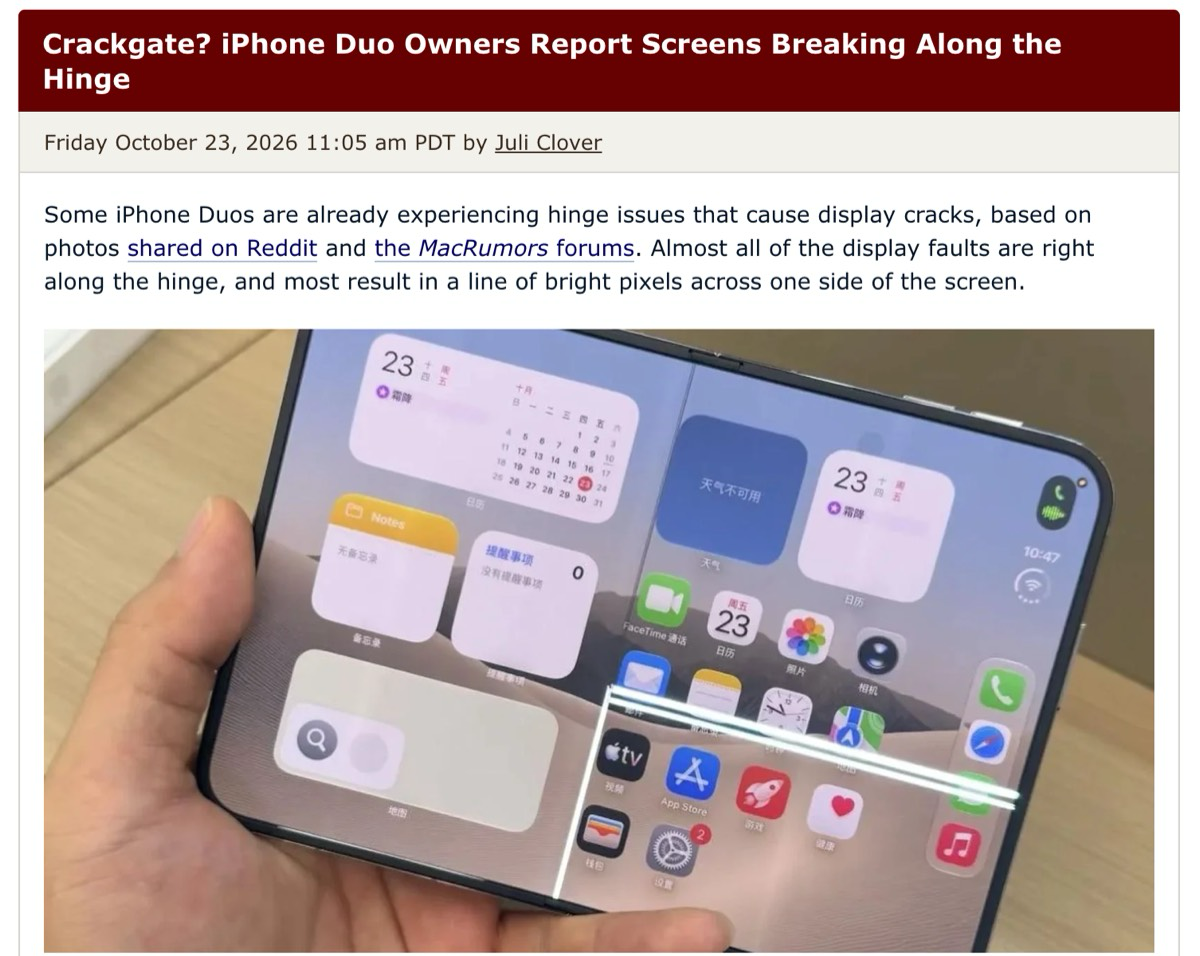
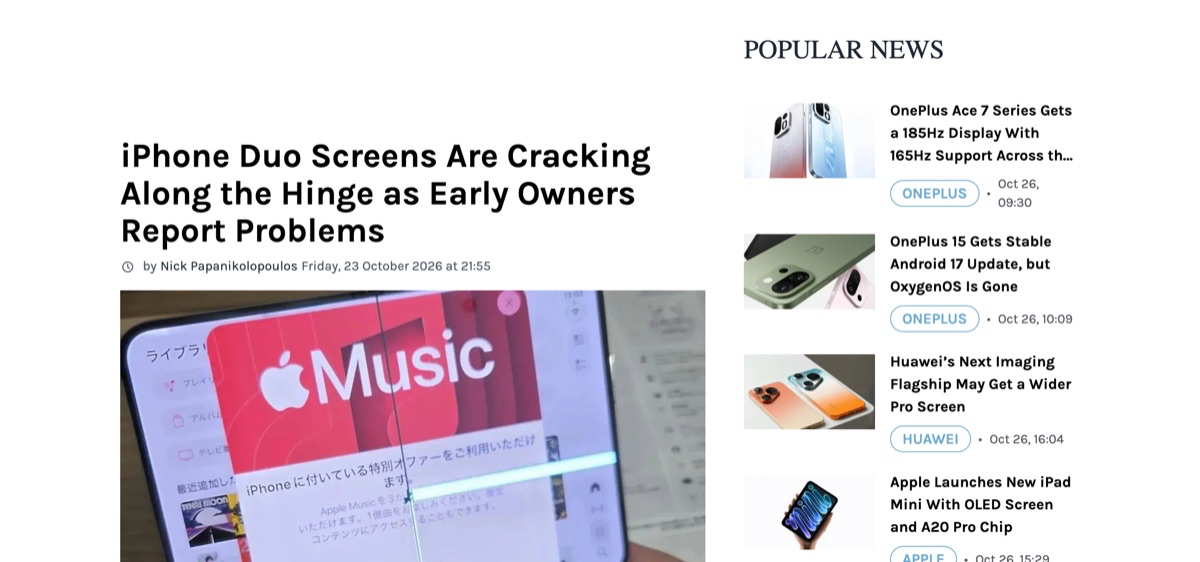
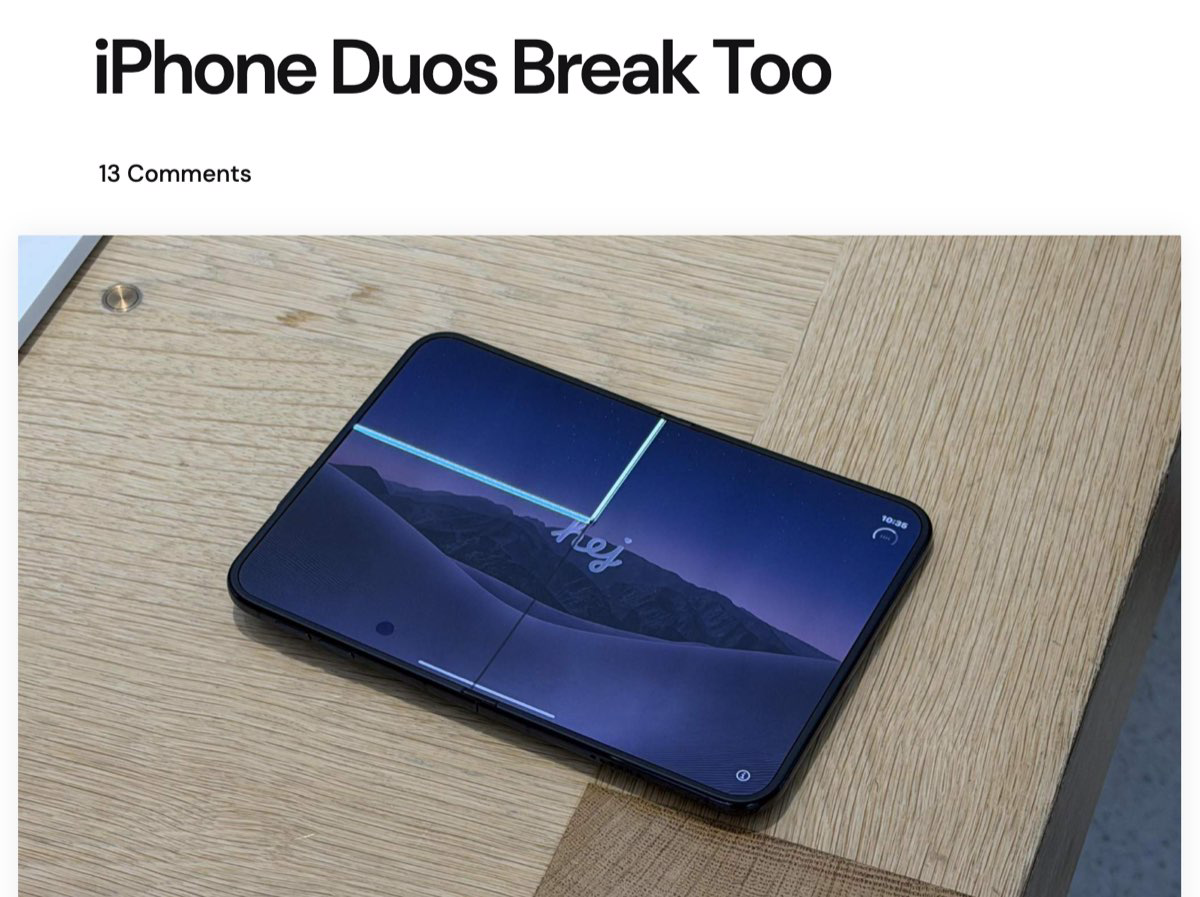
Apple spent seven years watching Samsung, Google, and Huawei iterate through foldable growing pains. The pitch was implicit: we waited to get it right. Then the $1,999 iPhone Duo launched on October 23, 2026, and within six hours, an Australian owner heard a crack while opening their phone for roughly the twentieth time. The inner display had split along the hinge — no drops, no debris, no user error they could identify. Apple replaced the device at a store the same day, but the photos were already on Reddit's r/iPhoneDuo, and more followed from China, Japan, and the United States.
This is not a story about one defective unit. It is a story about what happens when a company famous for controlling every variable meets a form factor that punishes exactly that confidence.
View original article on MacRumors →
The Damage Report
MacRumors broke the pattern on October 23: multiple iPhone Duo owners were reporting inner-display cracks concentrated along the hinge. Almost all of the display faults run along the fold line, producing a bright line of white or green pixels down one side of the screen — a telltale sign of damaged display circuitry, not a surface scratch.
The cases share a common profile:
- Australia: The most documented case — fewer than 20 openings, approximately six hours of ownership, no external damage visible. The owner wrote: "Had my iPhone Duo for about six hours and had probably opened it fewer than 20 times."
- China: Multiple reports surfaced from demo units in retail stores, though the usage history of those devices is unknown.
- United States and Japan: Additional reports emerged on Reddit, where threads accumulated over 785 comments in the first 72 hours.
Apple has not issued a public statement acknowledging a systemic defect. One affected owner received a same-day replacement at an Apple Store, delivered in a brown service box rather than retail packaging. Android Authority and Gadget Review both reported the pattern spreading across markets.
View original article on Android Authority →
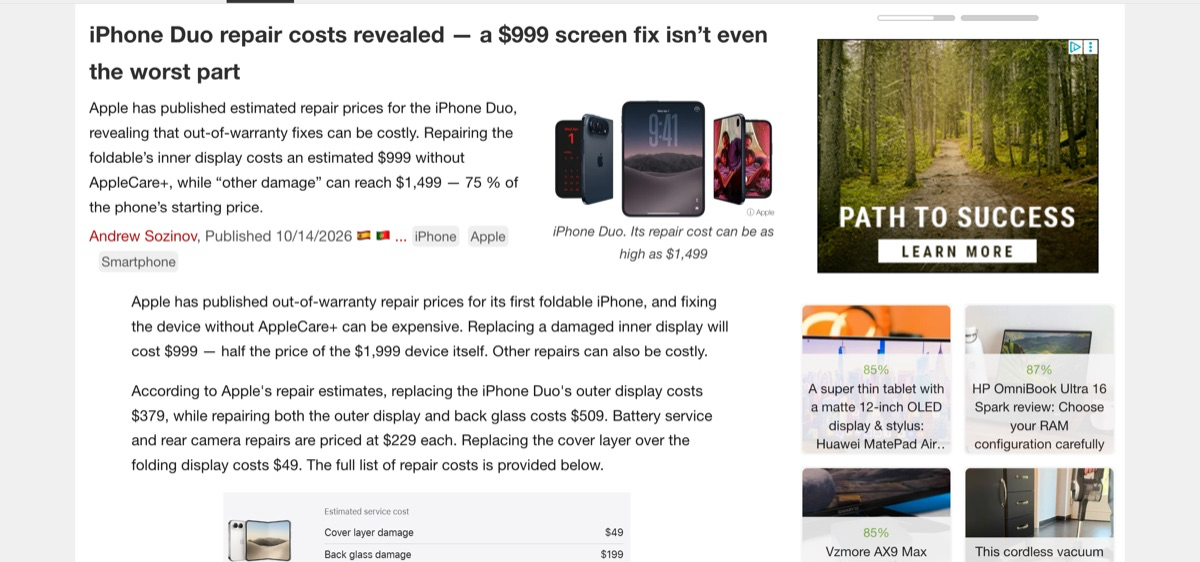
Without AppleCare+ ($199/year), an inner-screen replacement costs $999 — roughly half the price of the phone itself. Other damage can run up to $1,499. With AppleCare+, covered accidental damage drops to $99.
What iFixit Found Inside
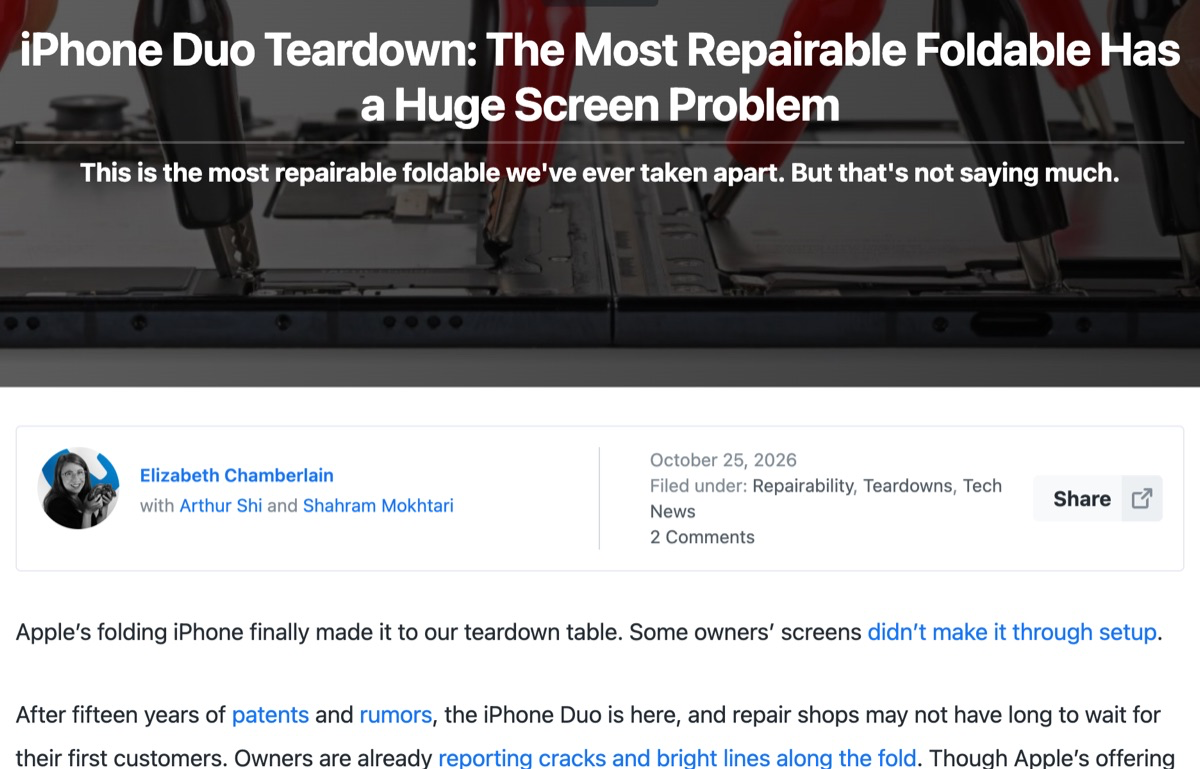
iFixit's teardown gave the Duo a provisional 5/10 repairability score — "the highest score we've given a foldable smartphone so far," they noted, before adding: "But that's not saying much."
The hinge uses linked metal joints with curved guides, synchronized by gears that keep both halves pivoting in lockstep. Springs offset some of the bending force. It is mechanically sophisticated — and mechanically complex. iFixit's simulation suggested that a center support bar failing to retract far enough could create a stress hotspot near the exact locations where cracks have been reported.
Their dust test was equally revealing. IP68 normally means dust-tight, but iFixit notes that IP ratings do not appear to cover a foldable's hinge. When they hit the Duo with glow powder — finer than beach sand but similar to office dirt — most particles stopped at adhesive barriers around the electronics. But some reached the hinge's moving parts, and the hinge began to crunch. The Duo collected less visible powder than the Galaxy Z Fold8 and the Pixel 11 Pro Fold, but cleaning the hinge requires removing the flexible display entirely.
"You'd better baby that screen, Duo owners," iFixit concluded.
View original article on iFixit →
The Durability Paradox
Here is where the story gets strange. The hinge itself appears robust in controlled testing.
Joanna Stern had a custom machine fold her review unit more than 32,000 times over four nights. The hinge held up — it became marginally stiffer, but she could not detect the difference in everyday use. The crease got deeper, but the display did not crack.
Multiple other reviewers ran similar tests. Tim Pan (Ying Shi Ju Feng) ran approximately 10,000 automated folds. Matthew Cassinelli's robot exceeded 30,000. No cracks. A Gizmodo reviewer's accidental drop down wet steps left only minor frame scuffs.
So the hinge survives thousands of machine-controlled folds but cracks under twenty human ones? That is either a quality-control outlier or evidence that real-world use introduces variables that folding machines do not capture: the angle of the open, the speed, ambient dust, the slight torque from holding it with one hand while opening with the other.
Pre-launch, Apple's VP of Hardware Engineering told 9to5Mac: "Hold us accountable" if the iPhone Duo's crease gets worse over time. Three days post-launch, the community is doing exactly that — and the crease is the least of their concerns.
Samsung learned this lesson the hard way. The original Galaxy Fold was recalled entirely in 2019 after reviewers peeled off what they thought was a screen protector — it was a structural layer. It took Samsung seven generations and the Galaxy Z Fold8's sealed hinge design to earn foldable credibility. Apple shipped generation one and expected to skip the learning curve.
The $999 Question
The repair economics make the durability question existential. Notebookcheck's cost analysis laid out the numbers:
| Repair | Without AppleCare+ | With AppleCare+ |
|---|---|---|
| Inner display | $999 | $99 |
| Outer display | $379 | $29 |
| Rear camera | $229 | $29 |
| Battery | $229 | $0 |
| Other damage | Up to $1,499 | $99 |
For a $1,999 device, the inner screen alone represents a 50% replacement cost. This effectively makes AppleCare+ mandatory — not optional. The $199/year insurance premium is no longer a "nice to have" but a prerequisite for ownership.
View original article on Notebookcheck →
The matte cover layer — Apple's nano-texture coating that hides the crease — is a $49 replacement without AppleCare+ or $19 with it. But per iFixit, the process requires specialized fixtures and precise alignment. Remove it, and you will find the crease is actually more visible on the glossy surface underneath, and that surface scratches more easily.
The Second Crisis: Apps That Do Not Fold
The hardware defects grabbed headlines, but reviewers are nearly unanimous that the software story is worse for daily use.
Marques Brownlee's review highlighted the core problem: most third-party apps were not ready at launch. Google apps including Gmail and Maps launched with black bars and scaled layouts. Brownlee estimated the app compatibility mess could take up to six months to fully resolve.
Apple built a three-tier compatibility system:
- Legacy apps (pre-iOS 27): Run in a safe area with thick black bars on both sides
- iOS 27 apps: Get automatic layout improvements but look unfinished — the "messy middle" that reviewers flagged
- iOS 27.1 apps: Full inner-display support with the "Made for iPhone Duo" badge
The problem is volume. At launch, only about 50 apps carried the badge — including Netflix, Zoom, and Slack. PhoneArena published side-by-side comparisons showing how unoptimized apps look on the $1,999 device: a small centered window floating in a sea of black. Gulf News described the experience as running "like tiny iPhone apps."
Developer action: recompile your app for iOS 27.1 using Xcode 27.1 to avoid the black-bar penalty. For most apps, this is a rebuild — not a rewrite. Apple's Device Hub lets you test on a simulated Duo before shipping.
The MacStories review roundup captured the consensus well: Joanna Stern called the app experience "sloppy, inconsistent, and sometimes unresponsive." Wired's Julian Chokkattu praised well-optimized apps but criticized the fixed 50/50 split and the lack of native cursor support. Max Weinbach noted that nearly half of his apps updated within six days of use, so the ecosystem is catching up — but on a $1,999 device, "catching up" is a hard sell on day one.
This connects to a pattern we have covered before: when the barrier to "shipping" drops below the barrier to "shipping well," users pay the price. The vibe-coded slop wall hitting Steam and the App Store is the same dynamic in a different market. Developers can technically ship a Duo-compatible app by recompiling, but "technically compatible" and "well-designed for the form factor" are very different things.
View original article on Gizchina →
The Verge's 7/10 and What It Means
The Verge gave the iPhone Duo a 7/10 — a score that generated its own debate. Nilay Patel's verdict: "It's incomplete as a product, but complete enough as an idea that you can see where things are going." The review also flagged that the Duo "doesn't seem ready to last a full day of heavy use" on battery.
The broader reviewer consensus from MacStories paints a consistent picture:
- Hinge: Nearly unanimously praised. Brian Tong called it the best he has used on a foldable.
- Display: The inner screen's nano-texture effectively hides the crease — until it cracks.
- Face ID: Gone, replaced by Touch ID on the side button. The most common complaint across reviews.
- Battery: "Just barely good enough" (PetaPixel). Struggles under heavy inner-display use.
- Apps: The consensus weak point. Every review flagged uneven third-party support.
- Camera: "Middling" — a smaller sensor than the iPhone 18 Pro, closer to the iPhone Air tier.
Contrarian Corner: Why the Panic May Be Premature
Every foldable generation one has had its "gate" moment. The Duo's may be milder than history suggests.
Here is the case for calm:
Samsung's original Galaxy Fold was fully recalled. The Galaxy Z Fold 2 had screen bubbling. The Pixel Fold had hinge gaps. Compared to those, a handful of iPhone Duo cracks with immediate store replacements is relatively contained.
The sample size is genuinely small. The r/iPhoneDuo thread has 785 comments, but comments are not confirmed cases — and self-selection bias means defect threads always overrepresent the problem. Apple sold millions of units on launch weekend. A few dozen documented cracks does not establish a defect rate.
Apple's repair infrastructure is also a genuine advantage. The same-day replacement, the $49 cover-layer swap, and the Genius Bar network mean Duo owners have options that Samsung Z Fold owners in 2019 did not have. If Apple quietly extends warranty coverage for hinge-related display failures — as they have done for other first-generation issues in the past — the financial risk drops considerably.
The contrarian position: this is Gen 1 doing what Gen 1 does, and Apple is better equipped than any competitor to absorb and fix it.
View original article on Droid Life →
What This Means for You
If you just bought one: Register for AppleCare+ immediately if you have not. The $199/year covers the $999 screen risk. Document your device's condition with photos on day one. If your screen develops a bright line along the hinge, visit an Apple Store — early reports suggest they are replacing units without pushback.
If you are considering buying: Wait. Not because the Duo is bad — the hinge engineering, the display quality, and the concept are genuinely impressive. Wait because first-generation foldable patience has been rewarded by every manufacturer. The Duo 2 will incorporate whatever Apple learns from these reports. The app ecosystem will be meaningfully better in six months.
If you are a developer: Recompile for iOS 27.1 now. Your app is displaying with black bars on a device that costs more than many laptops. Apple's Device Hub in Xcode 27.1 lets you test on a simulated Duo. Most apps need a rebuild, not a rewrite. Apple earlier launched its on-device AI capabilities with the iPhone 17 Pro — the foldable form factor extends that bet on hardware differentiation, and the DRAM cost squeeze that drove Apple's component prices higher this year explains part of the Duo's $1,999 starting price.
Apple told the market to hold them accountable. Three days in, the market is delivering its verdict: the hinge is impressive, the screen is fragile, the apps are not ready, and $1,999 does not buy you immunity from Gen 1 growing pains. The question is not whether the Duo will get better — it will. The question is whether early adopters should be paying $1,999 plus $199 annual insurance to fund that education.
For the latest on Apple's hardware and the broader tech landscape, follow ComputeLeap for analysis that goes beyond the headlines.
ComputeLeap Team
The ComputeLeap editorial team covers AI tools, agents, and products — helping readers discover and use artificial intelligence to work smarter.
Join the discussion
Have thoughts on this article? Discuss it on your favorite platform:
Related articles
AI's Payoff Problem Is Bigger Than You Think
Apollo says zero returns outside Big Tech. 200K creative jobs gone. Middle management next. The AI reckoning is here.
Nvidia's Scarcity Is a Firmware Setting
A firmware exploit unlocks RTX 3000 tensor cores to professional speeds, exposing 15 years of artificial GPU segmentation.
AI Found the PHP Zero-Day First. Now What?
GPT-5.6 Sol and Gemini 4 Argon found PHP2Shell weeks before disclosure. AI vuln discovery is production-ready for both sides.