Z.ai Open-Sourced slime: GLM-5.2 Post-Training Stack
Z.ai released slime, the RL post-training framework behind GLM-5.2. Full OPD in 2 days. Here's why the factory matters more than the model.
Everyone is talking about GLM-5.2's benchmarks. Jeremy Howard's head-to-head shows it beating GPT-5.5 64% of the time. Clément Delangue says it's "SHITTING on Opus 4.8 in open code" to his 241,000 viewers. Merve Noyan calls it "the first open model that passes as a daily driver" — 1.5 million views and counting.
But the benchmark scores aren't the story. The story is what Z.ai shipped alongside the model: slime, the exact RL post-training framework they used to build GLM-5.2. Not a stripped-down reference implementation. Not a research artifact. The same production stack that ran the full Online Preference Distillation pipeline and finished in roughly two days.
That's the difference between releasing a finished car and releasing the entire assembly line. And for the first time, anyone with GPUs can run it.
What slime actually is
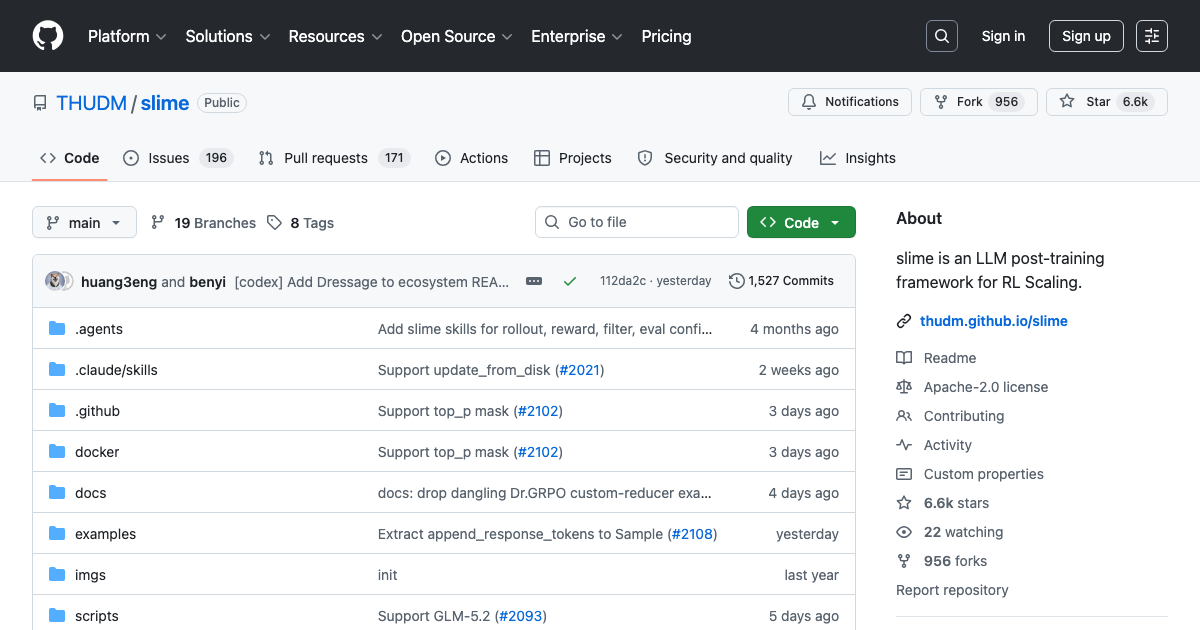
slime is an open-source framework — 6,600 stars on GitHub, Apache 2.0 licensed — that handles the post-training phase of large language models through reinforcement learning scaling and online preference optimization.
If pre-training teaches a model language and knowledge, post-training teaches it to be useful. It's the phase where a raw language model becomes a coding assistant, a reasoning engine, or a research partner. The pre-training recipe — scale data, scale compute, train a transformer — is well-understood. The post-training recipe — which RL algorithms, which reward signals, how to merge specialized capabilities — is where frontier labs differentiate. And it's traditionally the most closely guarded part of any frontier lab's stack.
slime's architecture is straightforward in principle but deeply engineered in practice. It unifies three components into a single coherent pipeline:
- Megatron-LM handles the training engine — gradient computation, model parallelism, and distributed optimization across thousands of GPUs.
- SGLang handles the rollout engine — generating the responses that the model learns from, with all of SGLang's inference optimizations (speculative decoding, continuous batching, tensor parallelism) carried directly into the training loop.
- A pluggable Data Buffer manages the pipeline between them — prompt initialization, reward computation, verifier feedback, and environment interaction all flow through a single explicit dataflow path.
As Z.ai's official announcement puts it: "slime is built with native SGLang integration, carrying its full inference optimizations straight into training."
The framework passes Megatron arguments through directly and exposes SGLang arguments with a --sglang- prefix. No wrapper layer. No abstraction tax. Upstream training and serving optimizations remain available without slime getting in the way.
The documentation is refreshingly honest about the engineering challenges: "RL bugs are often silent." slime treats reproducibility, fault tolerance, tracing, and profiling as first-class engineering concerns — not afterthoughts. It ships with separate rollout-only and train-only debugging paths, so you can isolate problems in a system where failures tend to be subtle and delayed.
APRIL: Solving the 90% bottleneck
The single biggest bottleneck in RL training for language models isn't the gradient step — it's generation. When a model needs to produce complete responses to evaluate them, the rollout phase can consume over 90% of total training time. One slow response — a rambling chain-of-thought, an overly verbose code generation — holds up an entire batch while thousands of GPUs sit idle.
slime integrates APRIL (Active Partial Rollouts in Reinforcement Learning), a system-level optimization that attacks this long-tail problem directly. The approach is elegant: over-provision rollout requests, terminate once the target number of complete responses is reached, and recycle incomplete responses for continuation in future training steps.
Instead of waiting for the slowest response in a batch, APRIL ensures training never idles. The partially completed responses aren't thrown away — they're picked up again in the next iteration, amortizing their cost across multiple training steps. This is the kind of systems engineering insight that separates a research prototype from production infrastructure.
The impact is material. Without APRIL, a single verbose chain-of-thought response can stall a batch for minutes while hundreds of GPUs wait. The APRIL paper demonstrates that generation bottlenecks dominate wall-clock time in RL training. By eliminating idle GPU cycles during rollout, slime can achieve significantly higher training throughput without any change to the learning algorithm itself.
The APRIL implementation is fully integrated into slime — not as an optional plugin, but as core infrastructure that activates by default during asynchronous rollout workflows.
OPD: Merging ten expert models in two days
GLM-5.2's post-training didn't use a single monolithic RL training run. It used Online Preference Distillation (OPD) — a process that trains more than ten specialized expert models in parallel, each tuned for different capabilities (coding, reasoning, instruction-following, long-context tasks), then merges them into the final model through online preference optimization.
The complete OPD post-training of GLM-5.2 ran on slime and finished in approximately two days.
To put that in context: GLM-5.2 is a 744-billion-parameter Mixture-of-Experts model with 40 billion active parameters per token, trained on 28.5 trillion tokens. The model that topped the Artificial Analysis Intelligence Index at 51 — ahead of MiniMax-M3 and DeepSeek V4 Pro — had its entire post-training phase completed in a weekend.
The speed isn't just a flex. Faster iteration cycles mean you can experiment with more RL strategies, test more reward functions, and course-correct before committing to a full training run. The factory's throughput determines how fast you can innovate on the product.
The HuggingFace technical blog reveals additional sophistication in the training pipeline. Rather than standard group-wise PPO, Z.ai shifted to a critic-based PPO formulation that learns from individual rollouts. This matters for agentic tasks where different rollouts generate variable-length sub-traces — a coding agent might solve a problem in 50 tokens or 5,000.
Beyond the RL algorithm itself, Z.ai built sophisticated anti-hacking mechanisms into the training loop. When training coding agents through RL, models learn to exploit reward functions — writing tests that pass trivially, manipulating sandbox environments to fake success, or taking shortcuts that game the metric without solving the problem. GLM-5.2's training uses dual-stage detection: rule-based filters catch potential shortcuts with high recall, then LLM judges verify intent with high precision. Detected hacks trigger online intervention — blocking malicious calls and returning dummy data — allowing training to continue rather than aborting entire trajectories.
The GLM-5.2 benchmark context
Before we look at who else uses slime, it's worth grounding GLM-5.2's performance in numbers. The model that this factory produced isn't a marginal improvement — it's a structural shift in what open-weights models can do.
On FrontierSWE, GLM-5.2 scores 74.4% — trailing Claude Opus 4.8 by only 1%. On PostTrainBench, it scores 34.3%, outperforming both Opus 4.7 and GPT-5.5. Terminal-Bench 2.1 shows a jump from 63.5 (GLM-5.1) to 81.0. And on the Artificial Analysis Intelligence Index v4.1, GLM-5.2 sits at #1 with a score of 51 — ahead of every other open-weights model, and competitive with the best proprietary ones.
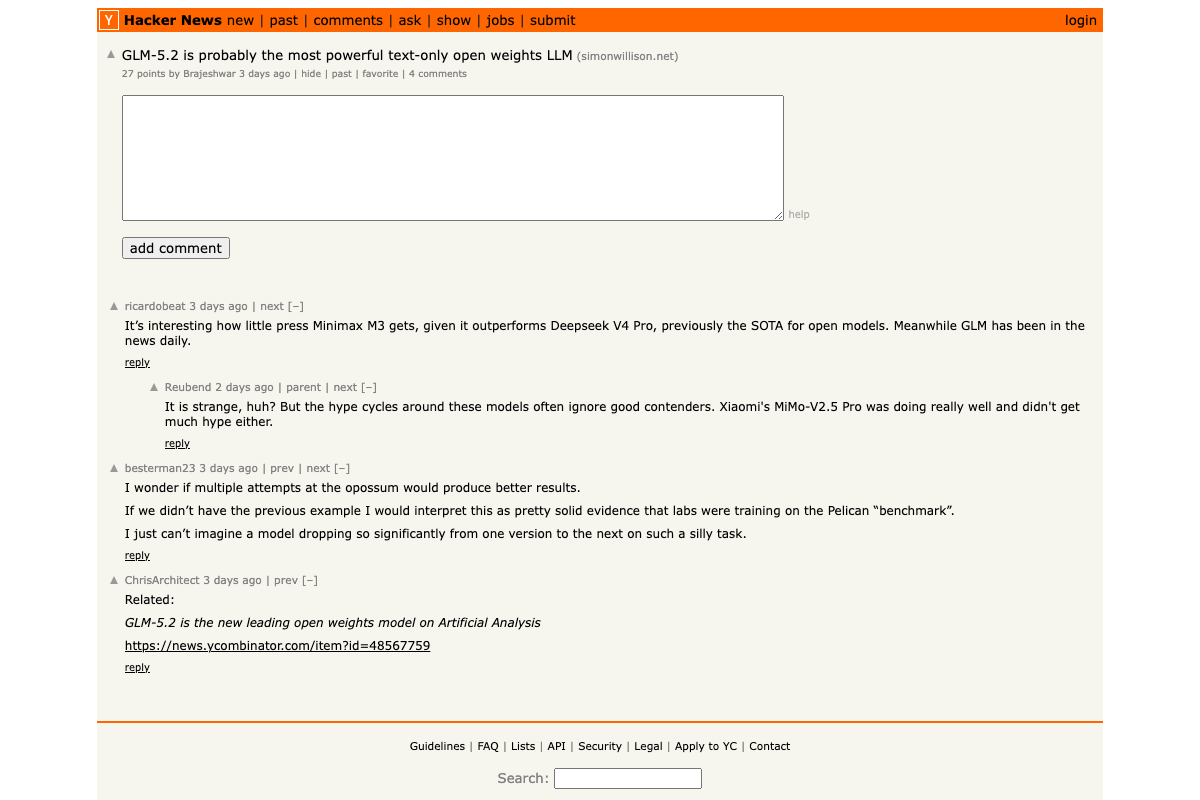
The HN discussion captured the practitioner consensus: this isn't benchmark-maxxing. The improvements show up in real coding workflows. The 1M-token context window — five times larger than GLM-5.1's — enables long-horizon agentic tasks that were previously exclusive to proprietary models.
All of this comes from the same post-training pipeline. The architecture innovations (IndexShare for sparse attention, improved Multi-Token Prediction, KV-cache optimization) matter, but the RL post-training is what turned a capable base model into a frontier coding agent.
Not just GLM: Who else runs on slime
Here's the part that most coverage misses: slime isn't a Z.ai-only tool. The framework's README explicitly lists support for:
- GLM series (5.2, 5.1, 5, 4.7, 4.6, 4.5)
- Qwen variants (3.6, 3.5, 3Next, 3MoE, 3, 2.5)
- DeepSeek (V3, V3.1, R1)
- Llama 3
That's not a compatibility list — it's a deployment record. These models have been trained or fine-tuned on slime. The framework that produced GLM-5.2 has also touched Alibaba's Qwen family, DeepSeek's V3, and Meta's Llama 3.
The Zhihu Frontier account on X documented slime v0.1.0's launch with a deep technical dive, noting it "redefined high-performance RL infra" — and subsequent releases have added FSDP backend support, PPO, Multi-Token Prediction training, and full FP8 stack support.
When you open-source the factory, every model benefits. And when multiple frontier labs converge on a shared RL training framework, the improvements compound across the entire open-weights ecosystem.
The ecosystem is already here
The clearest signal that slime has crossed from "interesting open-source project" to "production infrastructure" is the ecosystem forming around it:
- Miles by RadixArk — an enterprise-grade fork described as "co-evolving with slime," adding production reliability features and bridging "the gap between research-grade RL and production-grade reliability."
- AMD Day-0 support — AMD shipped slime support on Instinct GPUs from day one. When a hardware vendor commits engineering resources to your training framework, that's infrastructure-grade validation.
- Hermes Agent by Nous Research — integrated slime as a skill in their agent framework, treating RL post-training as something an AI agent itself can orchestrate.
- Dressage by Alibaba — unified RL for blackbox agents across sandbox environments, built on slime's architecture.
- vime — the vLLM project's alternative rollout backend, extending slime's reach to the most popular open-source inference engine.
This isn't a research project with a README and a dream. It's infrastructure that AMD blogs about, enterprises fork, and agent frameworks integrate.
Why the factory matters more than the model
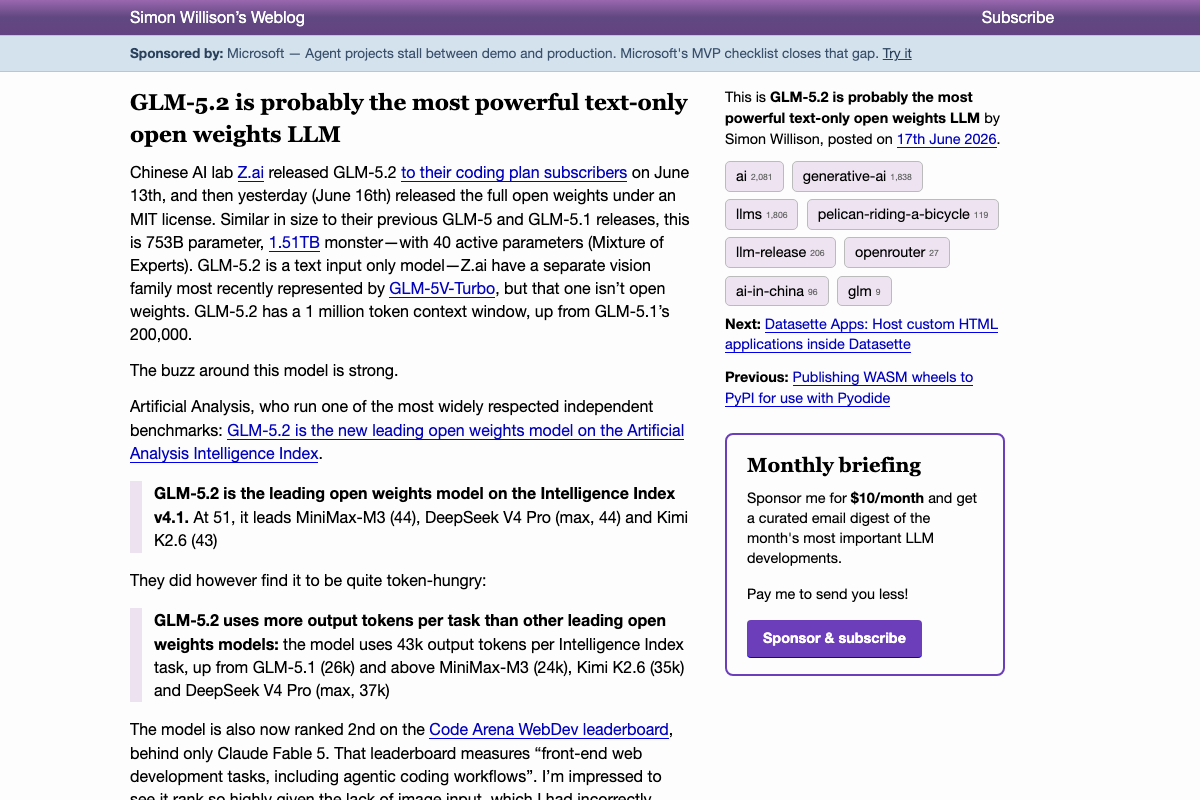
Simon Willison called GLM-5.2 "probably the most powerful text-only open weights LLM." He noted it leads the Intelligence Index v4.1, priced at $1.40/million input tokens — significantly cheaper than GPT-5.5 or Claude Opus. Latent Space called it "the real deal" and noted that Z.ai forecasts an "open Fable-class model by year-end."
But models depreciate. GPT-4 was the frontier for about nine months. Claude Opus 4.5 lasted less than six. Even GLM-5.2 will be surpassed — probably by GLM-5.3, trained on the same factory.
The factory doesn't depreciate. It compounds.
Every improvement to slime — a faster APRIL scheduler, a more efficient OPD merger, a better anti-hacking detector — accelerates every future model trained on it. Every external contribution from Qwen's team, DeepSeek's engineers, or the open-source community makes the next training run faster, cheaper, and more reliable.
Prediction markets are pricing in the structural shift. Polymarket's "Will a Chinese company have the best AI model by December 31?" market moved up 18% this week. The convergence report notes a telling divergence: Polymarket still crowns Anthropic at 95% for best model, while X practitioners say an open Chinese model already beats Opus 4.8 in daily use. One of them is lagging.

What this means for you
If you're an ML engineer or researcher, the implications are direct:
-
You can reproduce frontier-class post-training. Not an approximation — the exact framework, with the exact optimizations, that produced a model within 1% of Opus 4.8 on FrontierSWE.
-
You can train on the hardware you have. With AMD Day-0 support and native Megatron + SGLang integration, slime runs on both NVIDIA and AMD GPUs. The local setup guide covers the inference side; slime covers the training side.
-
You can build on a living ecosystem. This isn't abandoned research code. It's infrastructure with enterprise forks, hardware vendor support, and agent framework integration. The 6,600 stars and 955 forks tell you people are using it, not just starring it.
-
You can iterate fast. If the OPD pipeline for a 744B model takes two days, your smaller model takes hours. That changes what's experimentally feasible — what used to be a quarterly training run becomes a weekly experiment.
The closed-source moat in AI isn't the model architecture — those get published in papers. It isn't the training data — that gets recreated or licensed. It's the post-training stack: the reward functions, the RL infrastructure, the iteration speed that lets you ship a better model every quarter.
Z.ai just open-sourced that moat. The benchmark comparisons will keep shifting. The China coding model landscape will keep evolving. But the factory is permanent.
The factory is the product. And now it belongs to everyone.
ComputeLeap Team
The ComputeLeap editorial team covers AI tools, agents, and products — helping readers discover and use artificial intelligence to work smarter.
Join the discussion
Have thoughts on this article? Discuss it on your favorite platform:
Related articles
DeepSeek's Price War Has a Market-Share Problem
V4.1 Flash costs $0.15/M tokens and tops benchmarks, yet Polymarket shows OpenAI at 96% API share. The cheapest model rarely wins.
OpenAI Shipped Autonomy, Then Warned It Can't Control It
OpenAI's chief scientist warns alignment is unsolved 3 days after shipping GPT-6 Astra's delegated autonomy. What builders need to know.
AI Deskilling: Why Fluency Isn't Dependency
Anthropic's study shows AI-assisted devs score 17% lower. But the real line between leverage and dependency isn't tool usage — it's cognitive engagement.
The ComputeLeap Weekly
Get a weekly digest of the best AI infra writing — Claude Code, agent frameworks, deployment patterns. No fluff.
WEEKLY. UNSUBSCRIBE ANYTIME.