Brooks's Law Just Got Its First Exception in 50 Years
AI agents don't break Brooks's Law. They transform it. The HN #1 essay and 12 months of evidence reveal what actually changed.
ComputeLeap Team
Brooks's Law Just Got Its First Exception in 50 Years
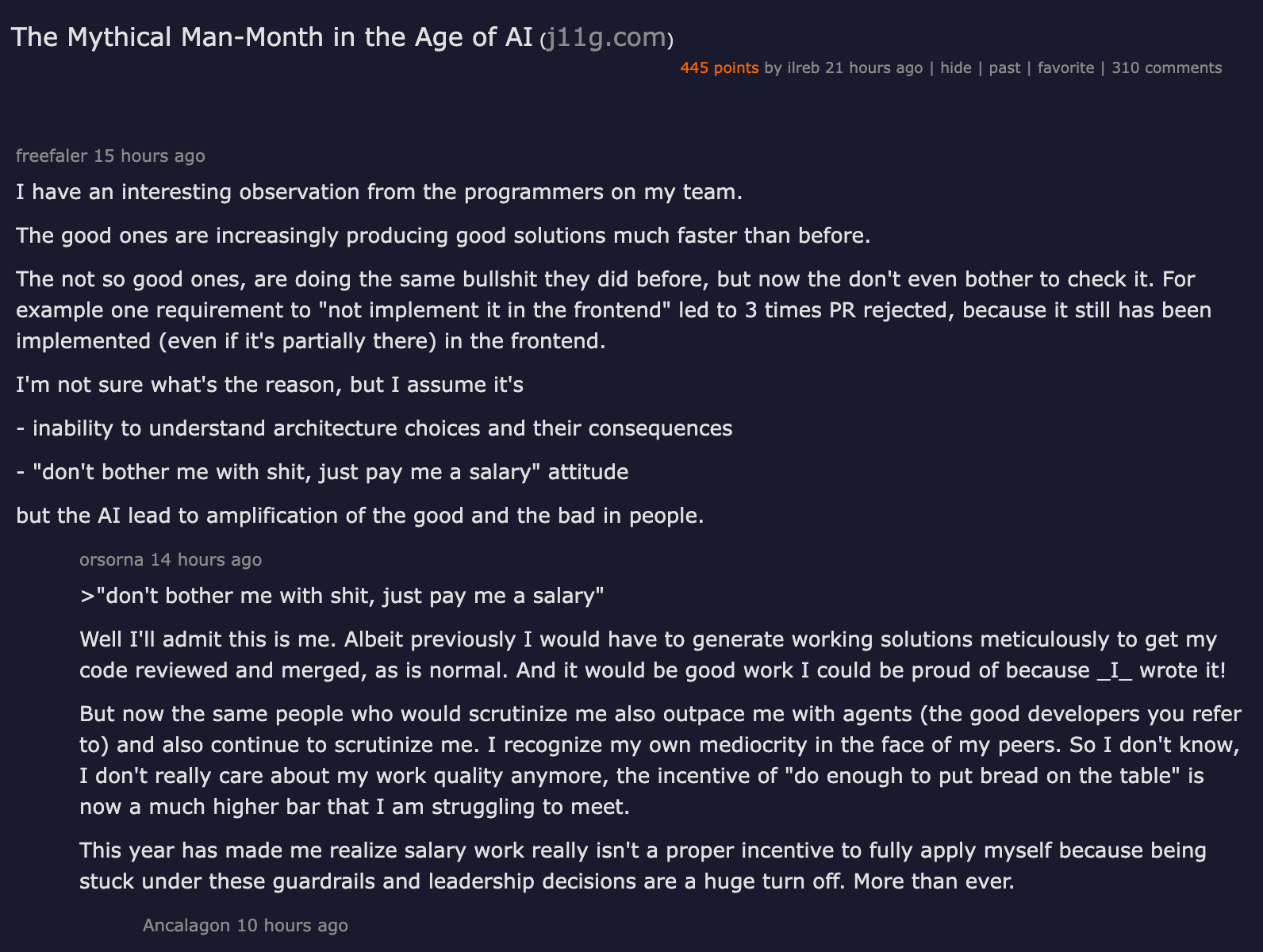
In 1975, Fred Brooks wrote the sentence that would govern software engineering for half a century: "Adding manpower to a late software project makes it later." Today, an essay applying that principle to AI coding agents hit #1 on Hacker News with 445 points and 310 comments. The debate it ignited reveals something the original law never anticipated: the first real crack in Brooks's armor isn't more people. It's agents that don't need onboarding.
But before you declare Brooks's Law dead, read the comments. The crack isn't where you think it is.
View original thread on Hacker News →
The Essay That Lit the Match
Jan van den Berg's "The Mythical Man-Month in the Age of AI" makes a deceptively simple argument: AI agents appear to remove the traditional bottlenecks of human teams — no onboarding, no stand-ups, no office politics — but the overhead has shifted instead of disappearing. Sequential tasks remain sequential. Someone still has to define what "done" means, review the output, catch hallucinations, and integrate the pieces.
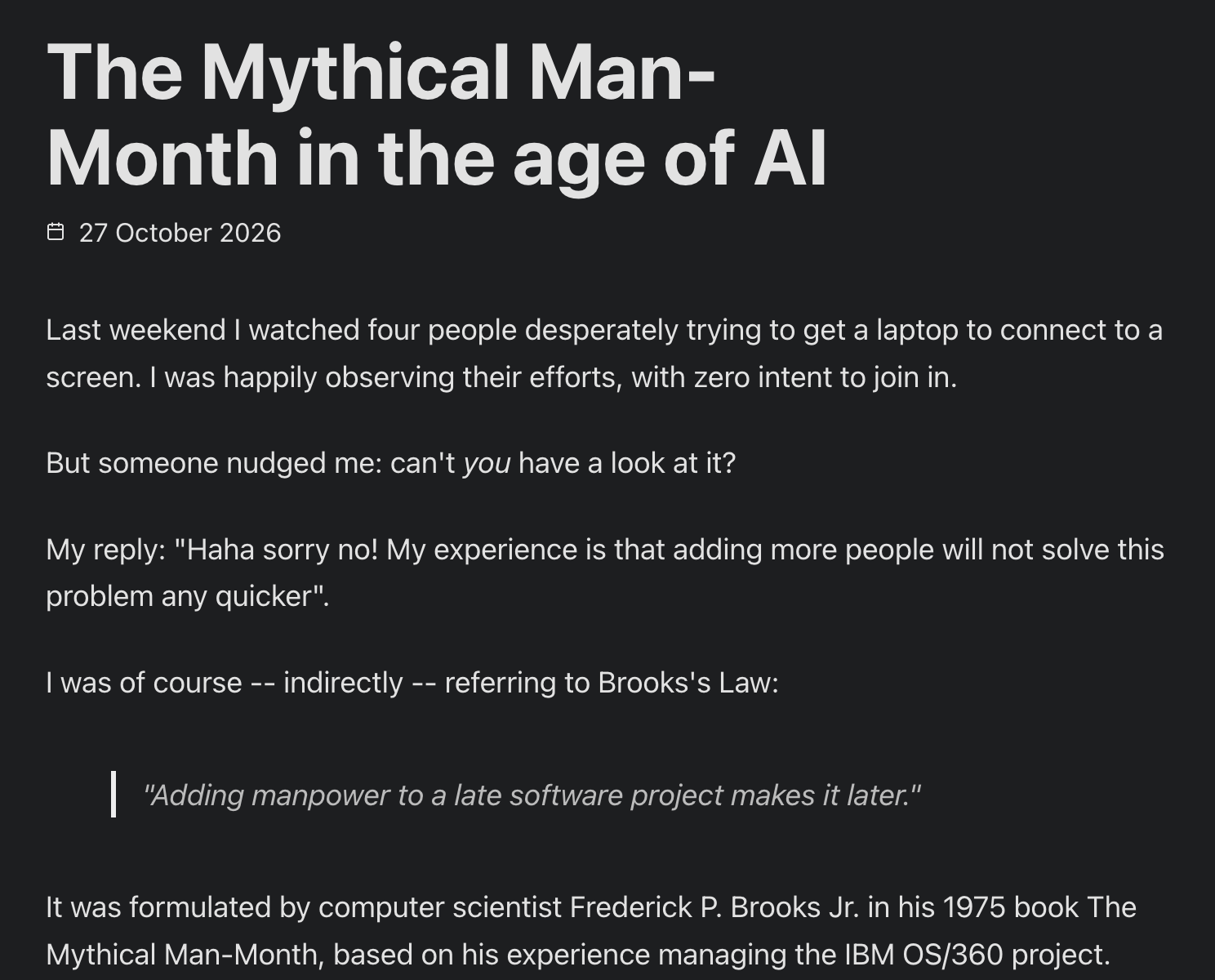
Van den Berg proposes an updated formulation for 2026: "Adding agents to a project with unclear requirements gets you the wrong answer faster."
He's half right. The law hasn't been repealed. But the 310-comment thread that followed exposed something his essay underplays: a growing number of practitioners are running 5, 10, even 20+ parallel agent sessions and shipping faster than they ever did with human teams. Not by breaking Brooks's Law — but by routing around it.
Brooks's Law (1975): "Adding manpower to a late software project makes it later." The core insight: each new person adds n(n-1)/2 communication channels, and the coordination overhead eventually outweighs the added capacity. Based on Brooks's experience managing IBM's System/360 project — one of the most expensive software projects in history.
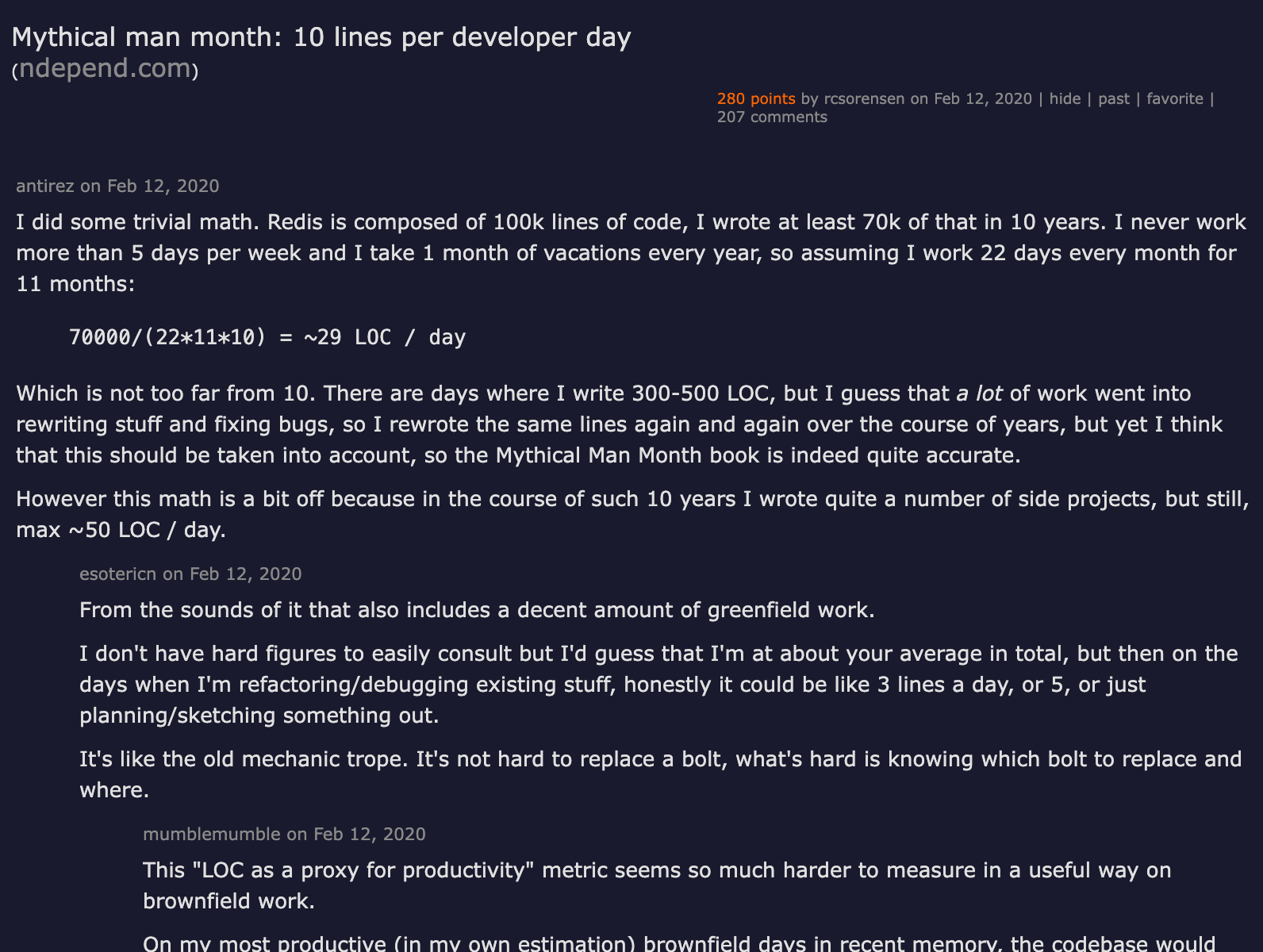
The book's influence hasn't faded — a previous HN discussion about Brooks's "10 lines per developer day" observation drew 280 points and 207 comments, with practitioners still debating whether the metric holds for modern development.
View original thread on Hacker News →
Where Brooks Gets It Wrong in 2026
Brooks's Law rests on three pillars: ramp-up time (new hires must learn the codebase), communication overhead (every person adds channels), and task indivisibility (the "nine women can't make a baby in one month" problem).
AI agents genuinely break the first two.
Ramp-up is near-zero. An agent session starts cold, ingests the codebase, and begins contributing within minutes. There's no HR paperwork, no "buddy system," no three-month learning curve. As one HN commenter put it: the biggest gains come from the fact that agents "don't need to absorb a team's shared understanding — they just need the spec."
Communication topology shifts from mesh to star. Twenty human engineers create 190 communication channels (the n(n-1)/2 formula). Twenty AI agents create a star topology: one human hub directing parallel sessions. The combinatorial explosion that Brooks warned about doesn't happen — as long as you trust the hub.
But the third pillar — task indivisibility — is where the simple "AI breaks Brooks's Law" narrative falls apart.
The Brownfield Barrier: Where the Law Fights Back
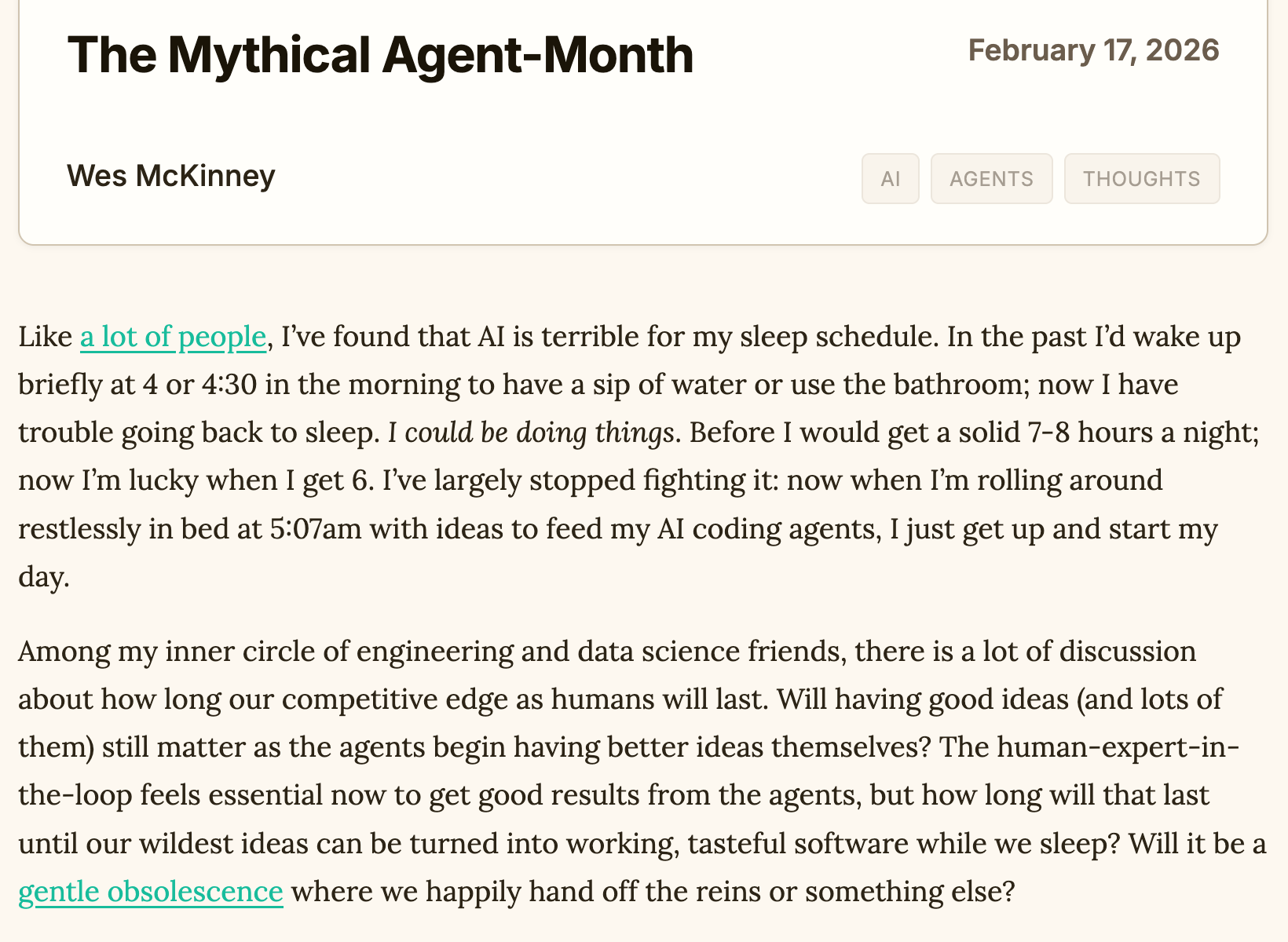
Wes McKinney, the creator of pandas and now an engineer at Posit, published the most technically rigorous counter in February 2026: "The Mythical Agent-Month." The O'Reilly-republished essay draws on his experience burning over 10 billion tokens per month across Claude, Codex, and Gemini.
Read the full essay on McKinney's blog →
His key finding: agent effectiveness degrades sharply around 100,000-200,000 lines of code. At Posit, agents struggle significantly in million-plus-line codebases like Positron, a VS Code fork. The bigger the codebase, the more "essential complexity" (Brooks's term for the irreducible difficulty of the problem itself) dominates over "accidental complexity" (the tooling friction that agents excel at removing).
McKinney identifies what he calls the "agentic tar pit" — agents generating code bloat and technical debt at machine speed. When code generation is cheap, the temptation to keep adding features grows, but maintenance, testing, and debugging costs remain stubbornly human-bound.
This maps directly to Brooks's original insight: the problem was never typing speed. It was always deciding what to type.
The Universal Scalability Law Says the Same Thing
If McKinney's essay is the qualitative case, Maxim Khailo's analysis provides the quantitative one. Khailo applied Gunther's Universal Scalability Law — a formal model for parallelism limits — to AI agent scaling and published his personal production data.
His findings: with 4 concurrent agents, he achieved an 8.5x speedup (net output from ~14K to 70K+ lines/month). But the model predicts that doubling to 8 agents would actually reduce throughput. Two forces cause the breakdown:
- Contention: Human planning, review, and testing remain serial bottlenecks that more agents can't parallelize.
- Coherency: Agents touching shared files, state, or branches create merge conflicts and rework that grows with each added session.
The parallel with Brooks is exact. Replace "people" with "agents" and the coordination overhead curve looks identical — it just kicks in at a different scale.
Contrarian Corner: The a16z Case for Repeal
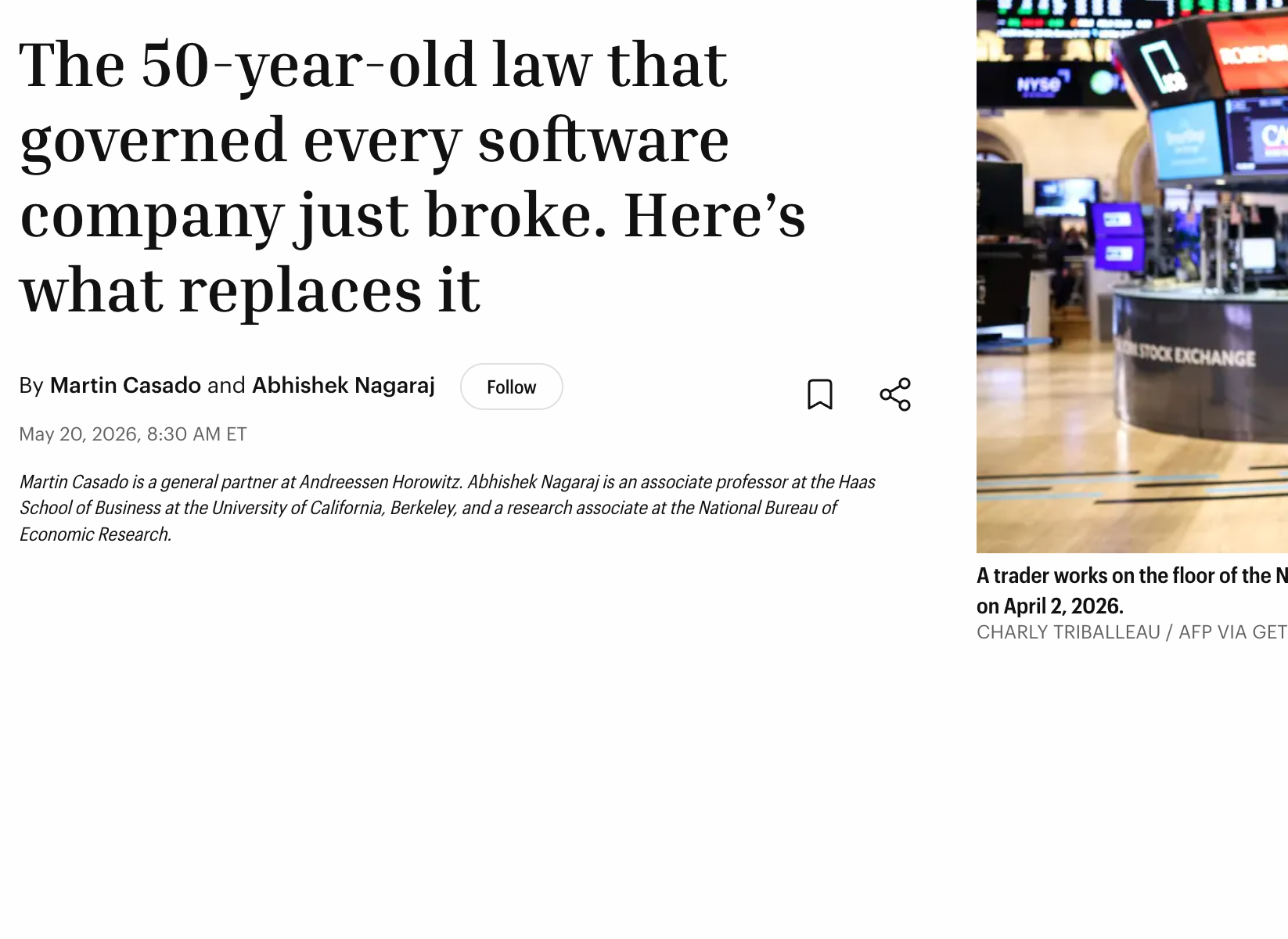
Martin Casado (a16z) and Abhishek Nagaraj (UC Berkeley) argue in Fortune that AI genuinely repeals the law — but only for a specific domain. Their claim: AI model development (as opposed to traditional software) improves with more compute and data rather than larger coordinated engineering teams. Capital converts to output more directly. They cite internal data showing AI companies have nearly 3x the revenue run rate per full-time employee as non-AI software companies.
The catch: this argument applies to training AI models, not to the software development that 99% of engineering teams do daily. For the average team shipping a SaaS product, the coordination problem hasn't been repealed. It's been relocated.
What the HN Thread Actually Reveals
The most valuable signal from the 310-comment thread isn't in the essay — it's in the practitioner reports. Three patterns emerge:
Pattern 1: Engineer-to-Director Transition. User sadilek describes going from 5 to over 20 parallel agent sessions "without burnout by changing my role from engineer to director — agents presenting demos for review." This mirrors the shift McKinney predicts: from writing code to curating specifications and reviewing output.
Pattern 2: Guardrail Engineering. calderwoodra describes kicking off "sessions to setup guardrails so I hopefully never have to make the same review comment twice." This is a new discipline — essentially programming the constraints that agents work within, rather than programming the solution.
Pattern 3: Critic Over Author. bob1029 writes "I would actually prefer to be the critic than the author." The role inversion is complete: the human's highest-value contribution is now judgment, not production.
jamesfinlayson captures the meta-insight: "Competence is additive, incompetence is multiplicative." In Brooks's original framing, adding an incompetent person created communication overhead. In the agent era, adding a poorly-specified agent session creates rework overhead. The math changed. The principle didn't.
Twelve Months of Evidence: A Score Card
The debate over Brooks's Law and AI has generated a remarkable body of evidence in 2026. Here's how the arguments stack up:
| Claim | Source | Evidence | Verdict |
|---|---|---|---|
| Agents eliminate ramp-up costs | van den Berg, Muse | Strong — near-zero onboarding is demonstrable | True |
| Communication mesh becomes star topology | Muse, Forret | Moderate — true for parallel sessions, untested at scale | Partially true |
| Agent effectiveness degrades above 100K LOC | McKinney (Posit) | Moderate — firsthand but single-org data | Plausible, needs replication |
| USL predicts diminishing returns at 4+ agents | Khailo | Moderate — self-reported data, formal model | Plausible |
| AI repeals Brooks's Law for AI model development | Casado/Nagaraj | Weak — unverifiable internal data | Unproven |
| Spec quality determines parallelizability | Wilson | Anecdotal — one case study | Directionally right |
| Review burden offsets production gains | Fabric.so, PanDev Metrics | Moderate — 100+ company dataset | Strong signal |
The pattern is clear: agents break the symptoms of Brooks's Law (ramp-up, meetings, status reports) while preserving the cause (coordination complexity scales faster than capacity).
What This Means for You
If you're leading an engineering team in 2026, Brooks's Law hasn't been repealed. But the actionable response has changed. Here's the practitioner checklist:
1. Invest in specification, not headcount. Tom Wilson's "Mythical Token Month" nails the insight: a page-and-a-half spec with every edge case defined shipped an invoice generator in three days, mostly unsupervised. Three modules with vague specs created incompatible definitions of "subscription." Precise specs make agents parallelizable. Vague specs bring the same chaos as adding people.
2. Isolate agent sessions architecturally. The Anthropic story is the cautionary tale: 30,000 daily merges overwhelmed Git itself. They had to build a custom version control system (Scion). Your team won't build Scion, but you can give each agent session its own worktree or branch. Khailo's USL analysis confirms: contention on shared state is the primary scaling limiter.
3. Build review infrastructure before scaling agents. The HN commenter joshAg notes that LLMs "are getting to be pretty great at reviewing code" for specific patterns: security flaws, N+1 queries, test convention violations. Layer automated review on agent output before human review. The Fabric.so data shows this is where coordination cost concentrates.
4. Staff for directors, not coders. The 5-person startup beating 25-person teams pattern isn't about AI replacing engineers. It's about the ratio shifting: fewer producers, more reviewers and architects. The AI-native org design debate lands here too — the survivors aren't the biggest teams, they're the best-directed ones.
The Practitioner Checklist for Agent-Era Teams:
- Write specs detailed enough that an agent can implement without clarification
- One worktree or branch per agent session — never share state across parallel runs
- Automate first-pass review (security, style, test coverage) before human review
- Track your personal "brownfield barrier" — the LOC threshold where agents start creating more work than they save
- Measure cycle time per feature, not lines of code generated
The Broader Conversation
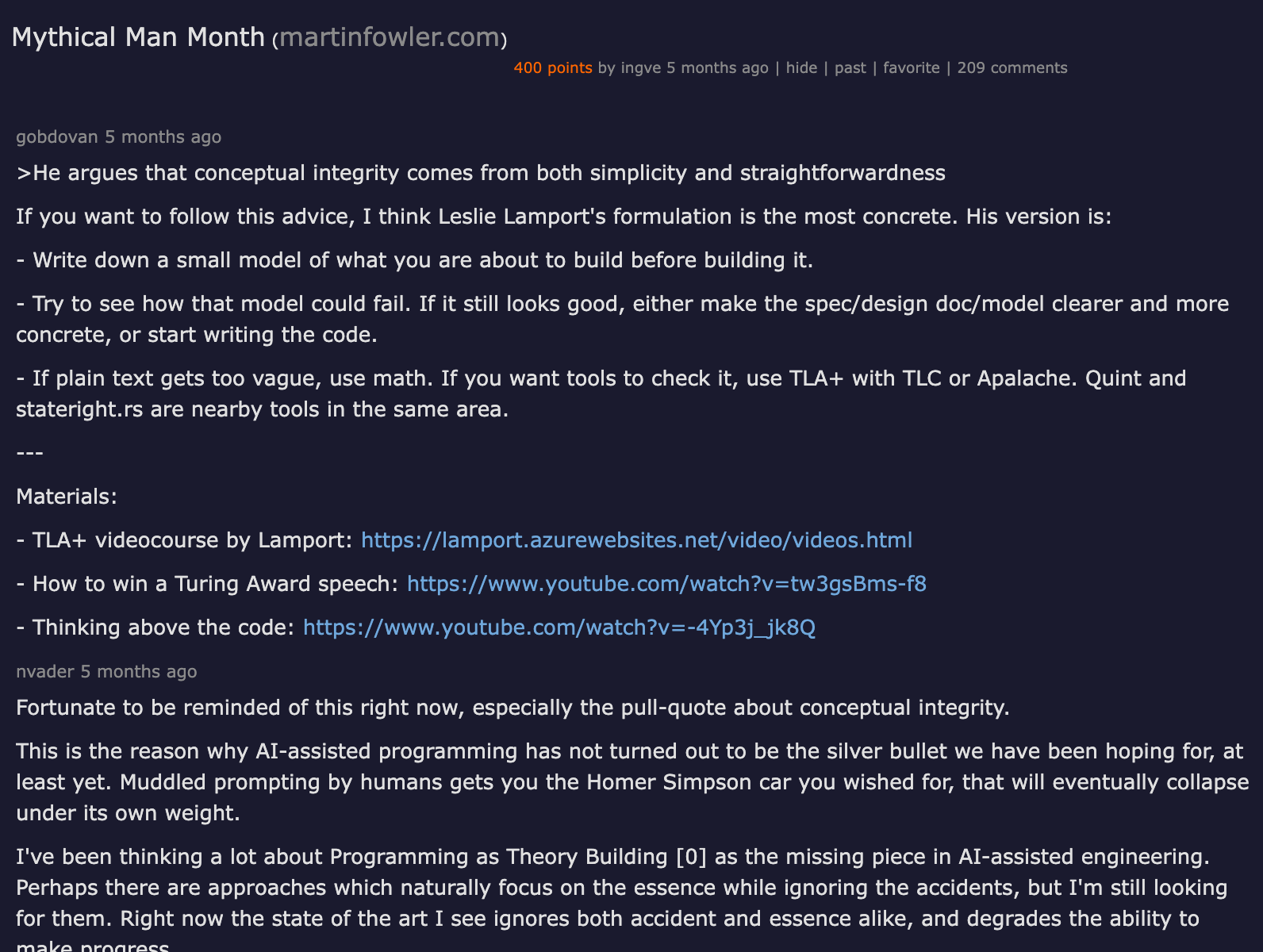
The current debate doesn't exist in a vacuum. Martin Fowler's updated assessment of the Mythical Man-Month hit HN with 400 points earlier this year, noting that while "some of it is outdated, it retains many lessons that are still relevant today." The tension between what's changed and what hasn't is the defining question for engineering leaders right now.
View original thread on Hacker News →
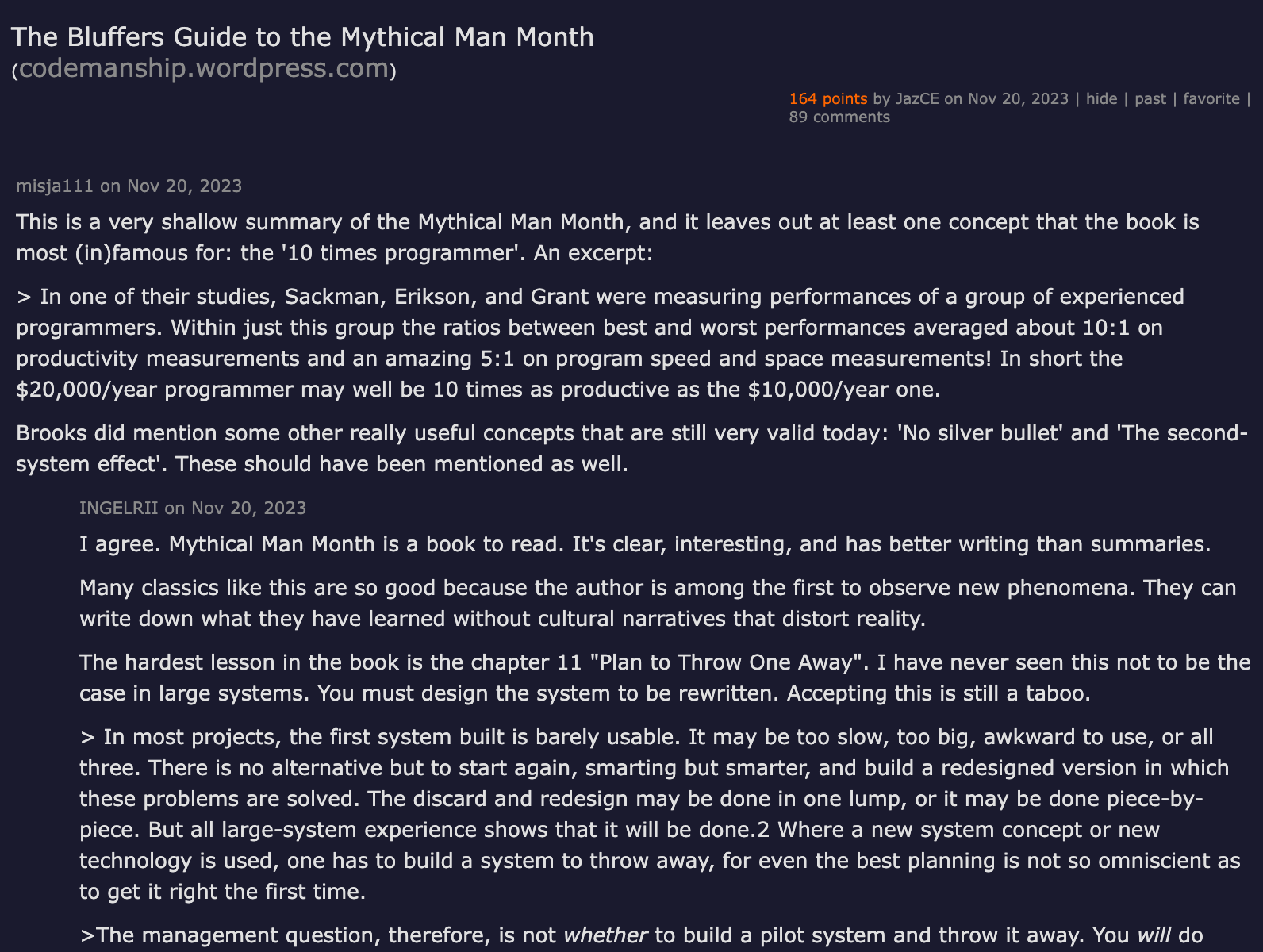
For those who want to go deeper into Brooks's original reasoning before applying it to the AI era, The Bluffer's Guide to the Mythical Man Month (164 points on HN) provides an excellent accessible summary of the core arguments.
View original thread on Hacker News →
Brooks's Law 2.0
Fred Brooks died in November 2022, four months before ChatGPT launched. He never saw what would become the first real test of his most famous principle in fifty years.
The test's verdict: Brooks was right about the thing that matters — coordination complexity is the fundamental constraint on team scaling — and wrong about the thing that seemed permanent — that the coordination must be between humans.
The updated law for 2026: Adding agents to a project makes it faster — until the human directing them becomes the bottleneck. At that point, adding more agents makes the project later, exactly as Brooks predicted. The constraint hasn't disappeared. It's concentrated.
The 52,000 tech layoffs in Q1 2026 aren't happening because AI replaced engineers. They're happening because Brooks's Law, properly understood, means you need fewer engineers — but each one needs to be better. The era of scaling teams by headcount is over. The era of scaling teams by direction has begun.
And Brooks, who spent his career arguing that there is no silver bullet, would probably say: that's exactly what I predicted.
The original essay "The Mythical Man-Month in the Age of AI" by Jan van den Berg is well worth reading in full. For the deeper technical treatment, start with Wes McKinney's "The Mythical Agent-Month" and the Hacker News discussion.
ComputeLeap Team
The ComputeLeap editorial team covers AI tools, agents, and products — helping readers discover and use artificial intelligence to work smarter.
Join the discussion
Have thoughts on this article? Discuss it on your favorite platform:
Related articles
Apple's iPhone Duo Is Cracking on Day One
The $1,999 iPhone Duo's inner display is cracking along the hinge within hours. Here's what iFixit found, what it costs to fix, and why waiting might be wise.
AI's Payoff Problem Is Bigger Than You Think
Apollo says zero returns outside Big Tech. 200K creative jobs gone. Middle management next. The AI reckoning is here.
Nvidia's Scarcity Is a Firmware Setting
A firmware exploit unlocks RTX 3000 tensor cores to professional speeds, exposing 15 years of artificial GPU segmentation.